
First competition at a glance
| Question | Quick answer |
|---|---|
| Best time to start preparing | 4–6 weeks before, or as soon as you commit |
| Most important thing to confirm | Entries, dances, levels, heat list, dress code, payment, and check-in process |
| Most forgotten items | Shoes, number/tickets, safety pins, hair/makeup touch-ups, snacks, water, phone charger |
| Biggest day-of mistake | Arriving without enough time to check in, warm up, and adjust to heat-list changes |
| Best mindset | “I am here to learn, dance, and get through one heat at a time.” |
| Who to ask when unsure | Your teacher, partner, studio organizer, registration desk, or event organizer |
Read this before you pack: rules vary. Ballroom competition rules are not one-size-fits-all. A Pro-Am student at an NDCA-sanctioned event, a USA Dance amateur couple, a collegiate newcomer, and a studio showcase competitor may all have different paperwork, dress code, eligibility, schedule, and check-in requirements.
Official rulebooks and event pages are useful, but the most practical answer is always: confirm with your organizer and studio before you buy, alter, pack, or assume. Elegant rule of thumb: when in doubt, ask before competition week.
Get the printable First Ballroom Competition Checklist
A calm, one-page checklist you can print, save, or pack in your dance bag — with the timeline, dance-bag list, attire and paperwork lists, a day-of schedule template, and after-event reflection notes.
Download the printable checklistThe first ballroom competition timeline
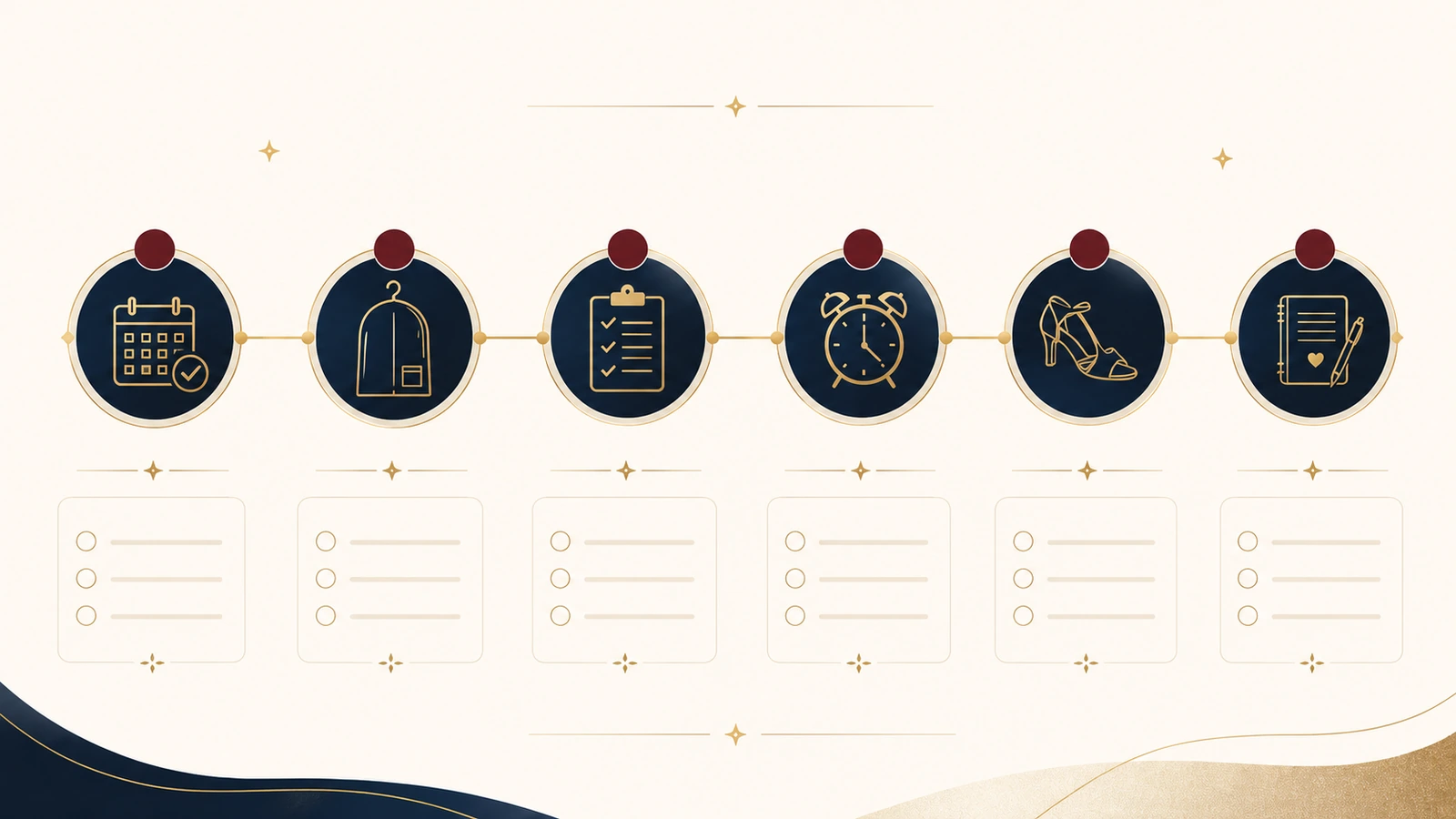
4–6 weeks before
This is the “make the plan real” stage.
- Confirm the competition name, location, dates, and session times.
- Confirm whether you are dancing Pro-Am, amateur, student/student, collegiate, newcomer, syllabus, open, showcase, or another category.
- Confirm your dances, style, level, age category, and approximate number of heats.
- Ask whether your choreography must follow syllabus restrictions.
- Confirm who submits entries: you, your partner, teacher, studio, team captain, or organizer.
- Confirm payment deadlines, package details, cancellation policy, and what is included.
- Book travel, hotel, airport transfers, parking, and time off work.
- Review dress code and costuming rules before buying or altering attire.
- Schedule any fitting, tailoring, shoe purchase, hair appointment, makeup appointment, or tan appointment if used.
- Start a simple stamina plan: rounds, walking, light conditioning, and rest.
- Practice entrances, starts, endings, bows, and transitions—not just the middle of the dance.
- Create a shared note with your teacher/partner: dances, heat count, music/timing reminders, outfit plan, and contact numbers.
New to competitive ballroom? Read the beginner guide to ballroom competitions.
2 weeks before
This is the “remove surprises” stage.
- Try on every outfit, undergarment, accessory, and pair of shoes.
- Dance in your actual shoes and practice outfit.
- Test whether straps, buttons, jewelry, hairpieces, sleeves, fringe, or skirt length interfere with movement.
- Pack each dance “look” together: outfit, undergarments, accessories, jewelry, socks/tights, and backup pieces.
- Confirm hair and makeup plan or appointments.
- Confirm whether you need tickets, session passes, wristbands, or competitor numbers.
- Confirm whether you need a membership card, ID, registration receipt, or proof of payment.
- Ask where and when to meet your teacher, partner, studio, or team.
- Review the current heat list if available.
- Make a small dance-bag kit for the ballroom floor.
- Practice a few short rounds with limited rest to simulate competition energy.
- Save or print the competition address, schedule, organizer contact, hotel confirmation, and transportation details.
Competition week
This is the “protect your energy” stage.
- Re-check the current heat list or schedule.
- Confirm entries, balances, tickets, and check-in instructions.
- Confirm photo/video rules before planning to record anything.
- Do a final outfit and shoe check.
- Repair loose rhinestones, hooks, straps, hems, buttons, heel tips, or soles.
- Charge your phone, battery pack, earbuds, and watch.
- Pack familiar snacks and water.
- Avoid drastic diet, skincare, hair, tanning, or shoe changes.
- Practice your first 30 seconds of each dance until it feels calm.
- Practice recovering from a mistake without stopping.
- Sleep as consistently as possible.
The night before
Pack now. Do not save it for the morning.
- Put your competition attire in garment bags or look-by-look packing cubes.
- Pack dance shoes separately from street shoes.
- Put paperwork, ID, tickets, and heat list in one envelope or pouch.
- Put your dance-bag essentials in a small bag you can carry near the ballroom.
- Set two alarms.
- Lay out travel clothes and warm-up clothes.
- Check the weather, route, parking, and venue entrance.
- Download playlists or music practice tracks if you rely on them.
- Text your teacher/partner/team to confirm the meeting time and place.
- Eat a familiar dinner.
- Stop “fixing” choreography late at night. Rest is part of preparation.
Morning of the competition
This is the “steady and simple” stage.
- Eat a familiar breakfast.
- Bring water.
- Wear comfortable travel or warm-up clothes.
- Arrive early enough to check in, find the ballroom, change, warm up, and check the current heat list.
- Pick up or confirm your ticket, number, wristband, or competitor packet.
- Meet your teacher, partner, studio, or team.
- Find the ballroom, changing area, restrooms, registration desk, on-deck area, and water/food options.
- Put your number on securely, if required.
- Warm up gently.
- Review your first heat and the few heats before it.
- Breathe slowly and focus on the first dance only.
At the event
This is the “stay present” stage.
- Keep checking the latest heat list.
- Stay close enough to hear announcements when your heats are approaching.
- Ask your teacher/partner before leaving the ballroom.
- Hydrate between heats.
- Eat small, familiar snacks when you have time.
- Touch up hair, makeup, deodorant, shoes, or costume details as needed.
- Keep your phone charged.
- If something goes wrong, solve the next small problem—not the whole day.
- Smile, breathe, enter the floor, dance the heat, and exit gracefully.
- Cheer for other dancers.
After the event
This is where the real learning happens.
- Save scoresheets, placements, heat list, photos, and videos.
- Write down what felt better than expected.
- Write down what surprised you.
- Write down what you would pack differently.
- Thank your teacher, partner, studio, team, family, or friends.
- Let your body recover.
- Schedule a follow-up lesson or practice session.
- Choose one technical goal and one confidence goal for next time.
Ballroom competition packing checklist
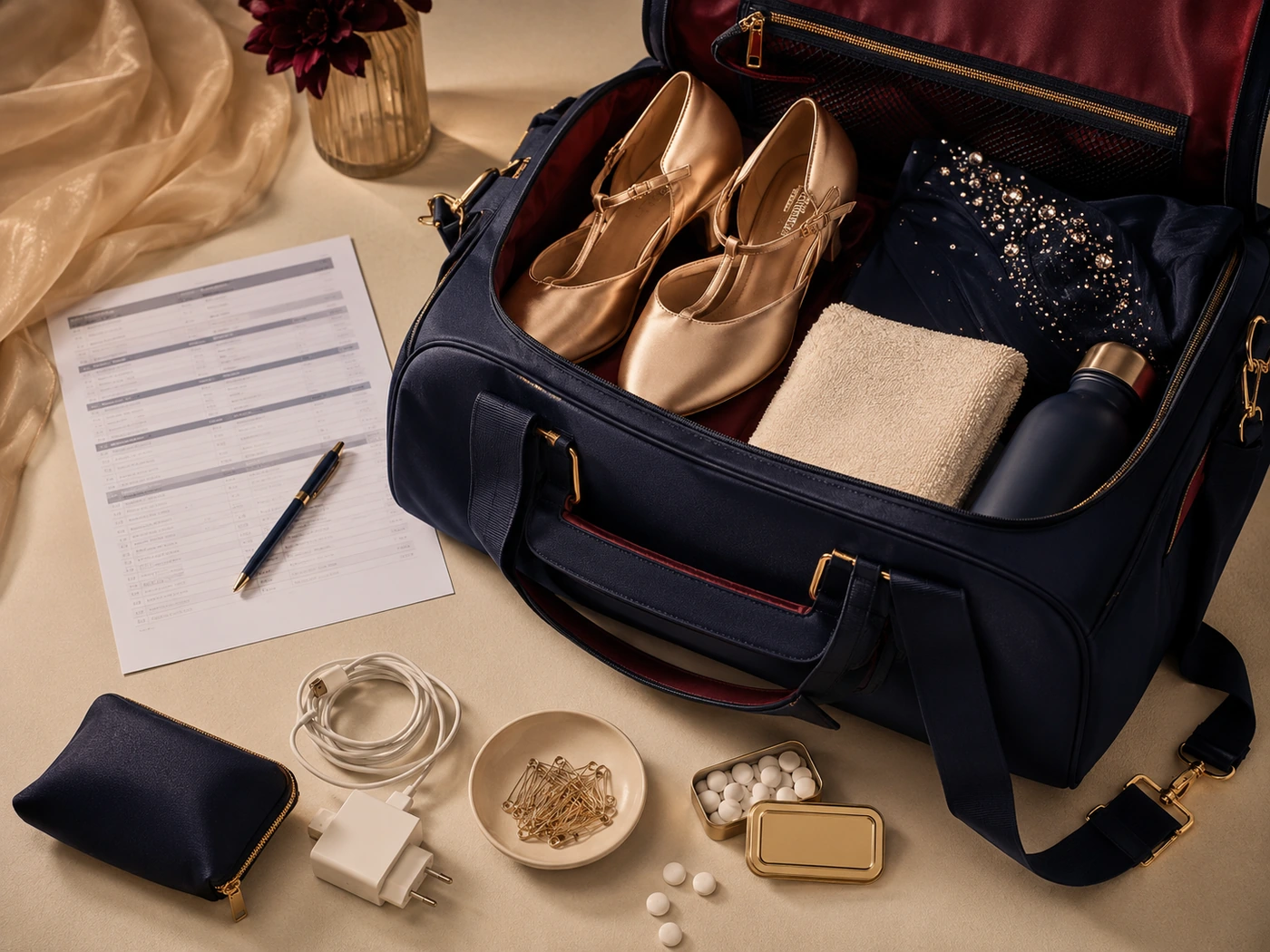
Paperwork and essentials
Pack these in one envelope, pouch, or zip folder.
- Photo ID
- Registration confirmation
- Proof of payment or receipt
- Heat list or schedule
- Session tickets or wristbands
- Competitor number, if mailed or pre-issued
- Membership card or registration ID if required
- Hotel confirmation
- Travel confirmation
- Parking information
- Studio or teacher contact information
- Organizer contact information
- Emergency contact
- Credit/debit card
- Cash, if your event or vendor setup may require it
- Pen and highlighter
- Printed checklist
Dance shoes and floor items
- Competition shoes
- Backup shoes, if available
- Practice shoes or comfortable shoes for waiting
- Shoe brush
- Heel protectors, if used
- Extra heel tips, if used
- Shoe bag
- Moleskin or blister pads
- Band-Aids
- Small towel
- Water bottle
- Mints
- Deodorant
- Phone
- Phone charger or battery pack
- Copy of heat list
- Small mirror
- Touch-up makeup or grooming items
- Safety pins
Attire and costume
Pack each look as a complete set.
- Competition outfit or costume
- Backup outfit if appropriate
- Undergarments
- Tights, socks, or fishnets if used
- Belt, tie, cufflinks, studs, or other formalwear items if used
- Jewelry
- Hairpiece or hair accessories
- Warm-up robe, jacket, or cover-up
- Comfortable off-floor clothes
- Evening or gala attire if your event includes a banquet or evening session
- Garment bag
- Lint roller
- Static spray if appropriate
- Small steamer, if allowed and safe
- Sewing kit
- Safety pins
- Fashion tape/body tape if used
- Extra rhinestones, glue, or repair items if used
Hair, makeup, and grooming
- Hairbrush or comb
- Hairspray or gel
- Bobby pins
- Hair ties
- Hair net if used
- Makeup kit
- False lashes and glue if used
- Lip color for touch-ups
- Makeup wipes
- Tissues
- Deodorant
- Toothbrush or dental floss
- Mints
- Nail file
- Nail glue or polish touch-up if used
- Tanning product touch-up if used
- Small towel
- Robe or button-up shirt to avoid pulling clothes over finished hair/makeup
Health, comfort, and recovery
- Water
- Familiar snacks
- Electrolytes if you normally use them
- Any necessary medication
- Pain reliever if safe for you and approved by your healthcare professional
- Band-Aids
- Blister pads
- Small first-aid items
- Eye drops if needed
- Tissues
- Hand sanitizer
- Layers for cold ballrooms
- Comfortable shoes for walking
- Earplugs if you are sensitive to loud music
- Small fan if allowed and useful
Tech and media
- Phone
- Charger
- Battery pack
- Earbuds
- Playlist links saved
- Downloaded music if you may not have reliable service
- Camera rules checked
- Photo/video order information
- Notes app or small notebook
The small dance bag to keep near the ballroom
Your full suitcase does not need to follow you everywhere. Your small ballroom bag should hold only what you might need between heats.
- Heat list
- Phone
- Water
- Small snack
- Mints
- Towel
- Lip color or grooming touch-up
- Deodorant
- Band-Aids or blister pads
- Safety pins
- Shoe brush
- Phone charger or battery pack
- Emergency contact card
Do not overpack the small bag. If you have to dig through 40 items to find your heat list, the bag is working against you.
Attire and grooming prep without panic
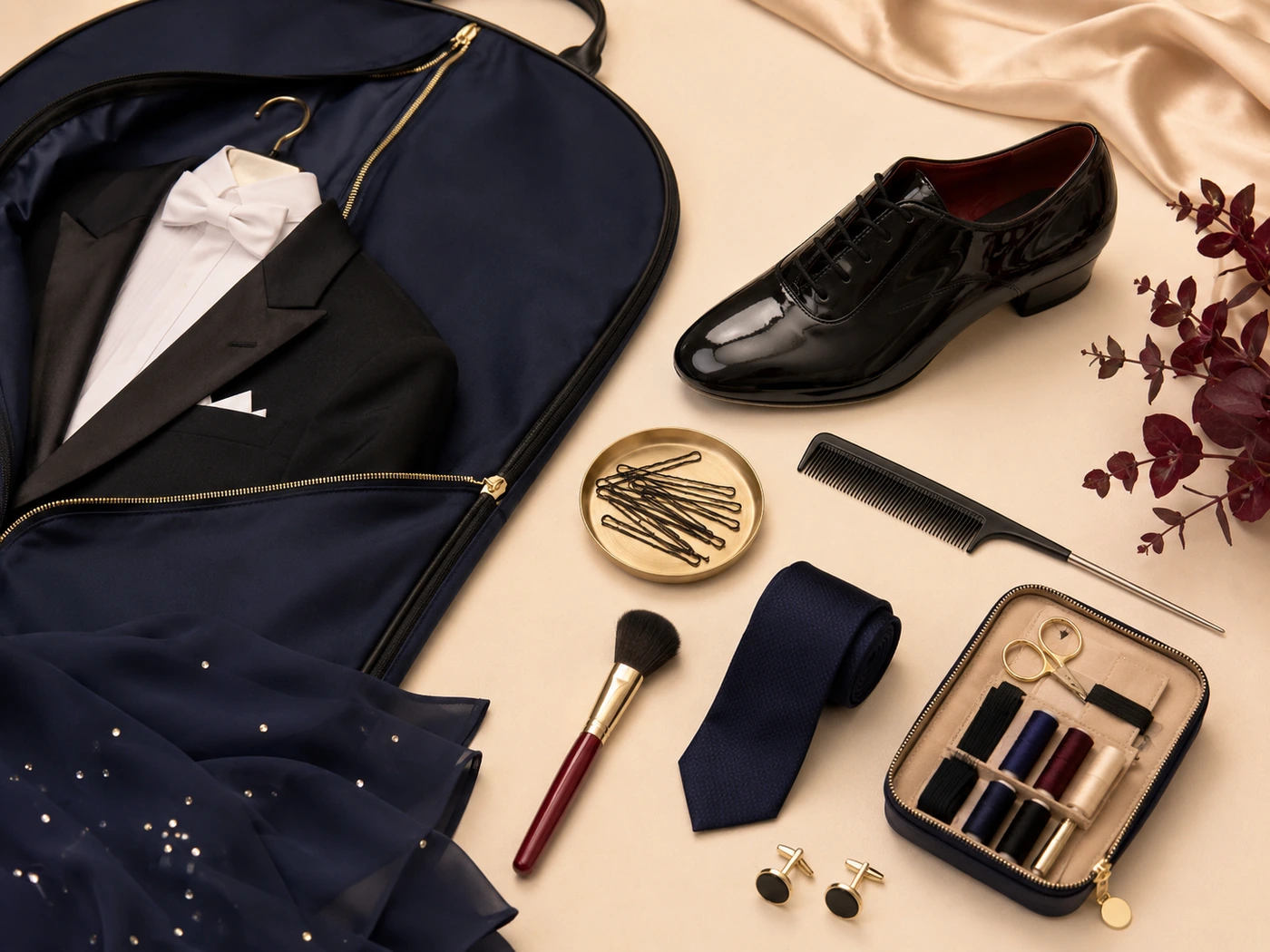
Your competition look should help you move, not distract you. Before competition week, do a full movement test:
- Walk in the outfit.
- Dance your most active steps.
- Practice your opening position.
- Practice turns.
- Sit down and stand up.
- Check whether sleeves, fringe, skirt, pants, straps, cuffs, jewelry, or hairpieces move safely.
- Confirm shoes are broken in enough to be comfortable but still supportive.
- Ask your teacher or partner to check the overall line, fit, and rule appropriateness.
Choosing your first competition shoes? See ballroom dance shoes for beginners.
Music and practice checklist
- I can find the beat for each dance I entered.
- I know my starting position.
- I know which direction I face at the start.
- I know how I enter the floor.
- I know how I finish.
- I know what to do if I make a mistake.
- I have practiced with limited rest between dances.
- I have practiced in my shoes.
- I have practiced in clothing similar to competition attire.
- I know which dances feel calm and which need extra mental focus.
- I have rehearsed smiling, breathing, and recovering.
- I know whether my event uses organizer-provided music, my own music, or special music for showcases.
Need help hearing the beat? Read How to Count Ballroom Dance Music, and steady your shape with frame and posture and lead and follow.
Practice with Ballroom Pages competition-ready playlists
Ballroom Pages’ legacy music ecosystem is one of its best assets. Use the Ballroom Pages playlists as part of your competition prep—not as background noise, but as a rehearsal tool. Use playlists to practice:
- Timing: count the first 8 bars before you move.
- Entrances: walk onto the “floor,” take position, breathe, and start.
- Rounds: play several songs in a row to build stamina.
- Transitions: practice switching from one dance mood to another.
- Nerves: use familiar music to make competition day feel less new.
- Recovery: practice making one mistake and continuing without stopping.
Playlists & platforms
Ballroom Pages Playlists
Per-dance practice playlists by style and platform — the verified hub.
BallroomPages Music on Telegram
Get Ballroom Pages playlist drops and updates.
Spotify / Apple Music / YouTube
Per-dance playlist links are organized in the hub and on each dance’s music guide.
Direct platform links via the hub Open the hub
Count the music first
Learn to hear the beat before you add movement.
What to expect at your first ballroom competition
Check-in and registration
At many competitions, you or your studio will pick up tickets, wristbands, a packet, heat list, and possibly your number. Some Pro-Am students have a teacher or studio representative who handles much of this. Some amateur or collegiate dancers handle it themselves. Before you arrive, know:
- Who is checking in?
- Who has the tickets?
- Who has the heat list?
- Who has the competitor number?
- Is any balance due?
- Does the event accept card, cash, or both?
- Where and when are you meeting your teacher, partner, or team?
Heat lists and on-deck
A heat is a scheduled competitive event or dance grouping. Your heat list tells you when your dances are expected to happen. Schedules can shift, so keep checking the most current version. When your heats are approaching, stay near your teacher, partner, team, or on-deck area. If you leave for food, photos, changing, or the restroom, tell someone.
Dancing your heat
- Go to the on-deck or staging area.
- Enter the floor calmly.
- Take your position.
- Listen for the music.
- Dance the best version you can in that moment.
- Continue if you make a mistake.
- Exit gracefully.
- Reset for the next heat.
You do not need to be perfect. You need to be present.
Judging and callbacks
Judges evaluate the dance being performed in that event. Depending on entries, there may be finals, semifinals, quarterfinals, or callbacks.
Vendors, photos, and videos
Competitions may have shoe vendors, dress vendors, photographers, videographers, and evening events. Confirm rules before recording from your seat, the aisle, or near the floor.
Sample day-of schedule
| Time | What you are doing |
|---|---|
| 6:30 AM | Wake up, hydrate, eat familiar breakfast |
| 7:00 AM | Check latest heat list and messages |
| 7:30 AM | Hair/makeup/grooming |
| 8:15 AM | Dress or pack final outfit pieces |
| 8:45 AM | Arrive at ballroom/check-in area |
| 9:00 AM | Pick up or confirm packet, tickets, number |
| 9:15 AM | Find teacher/partner/team |
| 9:30 AM | Warm up gently |
| 9:45 AM | Review first heats and stay nearby |
| 10:15 AM | Be fully ready if first heat is around 10:45 |
| Between heats | Water, breathe, check heat list, small touch-ups |
| After dancing | Save notes, photos/videos, scoresheets; recover |
Pro-Am vs amateur: what changes?
| Topic | Pro-Am student | Amateur couple |
|---|---|---|
| Partner | You dance with a professional teacher/partner | You dance with another amateur partner |
| Registration | Often coordinated by studio/teacher, but confirm | Usually handled by couple, coach, team, or captain |
| Practice focus | Teacher often guides entries, routines, and floorcraft | Partners must coordinate choreography, rules, and logistics together |
| Day-of support | Teacher/studio may help with heat list, packet, and timing | Couple is responsible for heat list and on-deck timing |
| Questions to ask | “What do you handle, and what do I handle?” | “Who has the schedule, paperwork, and plan?” |
Going the Pro-Am route? Read the Pro-Am ballroom dance guide, and decode entries with ballroom dance competition categories.
Common beginner mistakes
Packing the morning of the competition
Fix: pack the night before, then do a final morning check.
Forgetting that heat lists can change
Fix: check the latest heat list at the venue and stay ready before your scheduled heat.
Practicing steps but not entrances and endings
Fix: rehearse the first 10 seconds and final 10 seconds of every dance.
Wearing untested shoes or attire
Fix: dance in your shoes and test outfit movement before competition week.
Eating or drinking something unfamiliar
Fix: keep competition-day food simple and familiar.
Overpacking the floor bag
Fix: keep the small bag limited to immediate essentials.
Trying to fix everything at once
Fix: choose one focus for each dance: timing, posture, frame, connection, or calm recovery.
Treating the first competition like a final judgment
Fix: treat it like a live learning lab. Your goal is to finish, learn, and come back wiser.
The printable checklist
Here is the whole timeline condensed. The downloadable version is formatted for one page.
4–6 weeks before
- Confirm competition/date/location/session
- Confirm dances, level, category, and number of heats
- Confirm Pro-Am/amateur/student/team responsibilities
- Confirm entries, payment, cancellation policy
- Confirm dress code and syllabus rules
- Book hotel/travel/parking
- Schedule fittings or appointments
- Start stamina practice
- Practice starts/endings/recovery
2 weeks before
- Try on all outfits and shoes
- Test accessories and grooming
- Create look-by-look packing sets
- Confirm heat list if available
- Confirm meeting time/place
- Confirm tickets, number, ID, membership card if needed
- Build small ballroom bag
- Practice short rounds
Competition week
- Re-check heat list
- Confirm balance/payment
- Confirm photo/video rules
- Repair costume/shoe details
- Charge devices
- Prepare snacks and water
- Avoid drastic changes
- Prioritize rest
Night before
- Pack garment bag
- Pack shoe bag
- Pack paperwork pouch
- Pack dance bag
- Set alarms
- Confirm route and meeting time
- Download playlist/music if useful
- Eat familiar dinner
- Sleep
Morning of
- Eat familiar breakfast
- Arrive early
- Check in
- Pick up packet/tickets/number
- Review heat list
- Find teacher/partner/team
- Warm up
- Stay near ballroom before heats
- Breathe
After
- Save scoresheets/videos/photos
- Write quick reflection notes
- Thank your team
- Rest
- Schedule follow-up practice