
Choose your ballroom dance style
Ballroom Dance Styles
Compare the major ballroom, Latin, rhythm, smooth, standard, wedding, and social partner dances so you can choose the style that fits your music, goal, and comfort level.
One dance. One canonical guide. Clear comparisons without duplicate style pages.
Style chooser
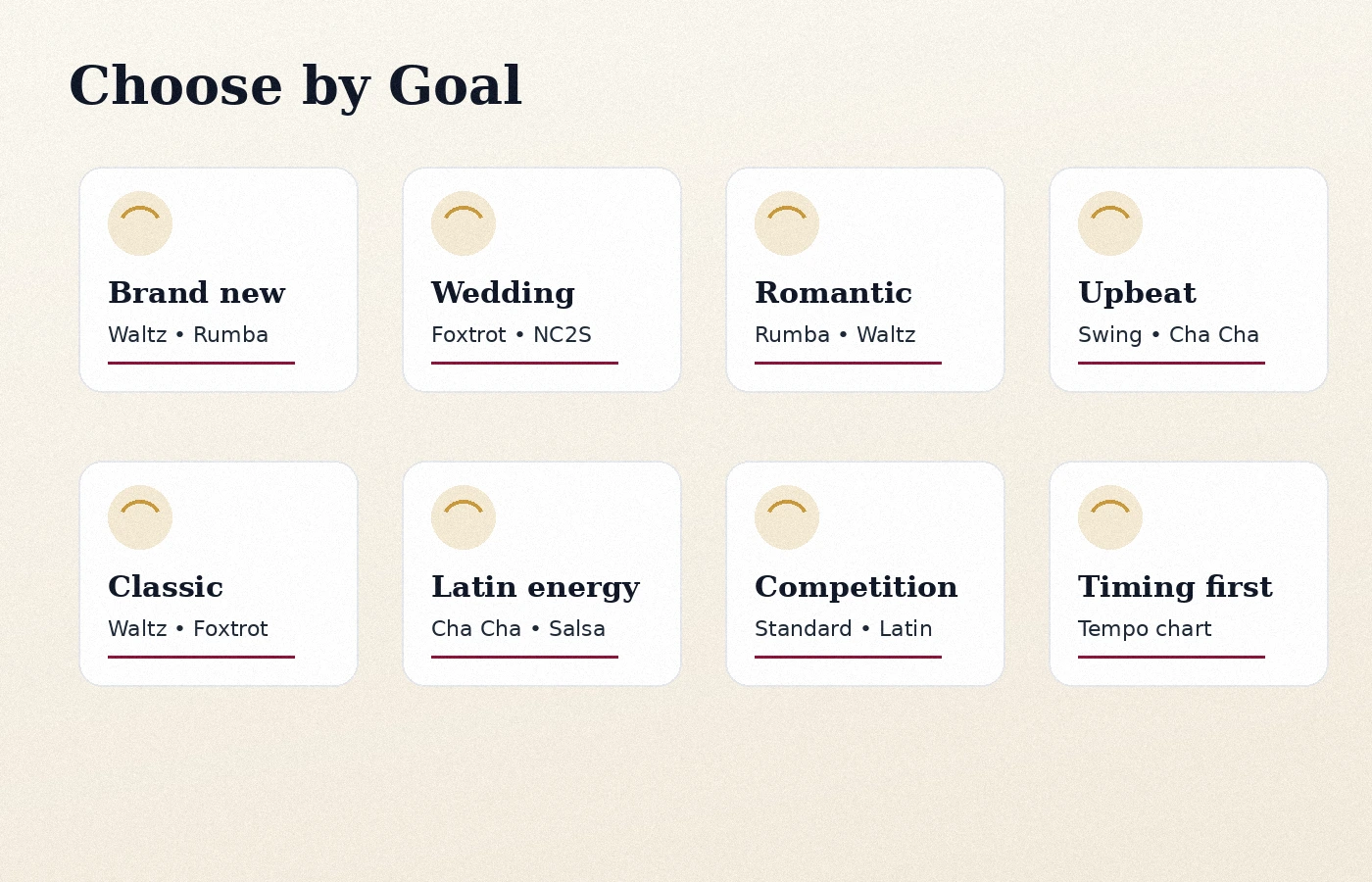
Not sure where to start? Choose by goal.

You do not need to memorize every ballroom dance style before learning. Pick the goal that sounds most like you, then follow the recommended dance links.
-
I’m brand new
Recommended: Waltz, Rumba, Foxtrot, East Coast Swing.
Clear patterns and common lesson starts.
Choose a beginner dance -
I’m planning a wedding dance
Recommended: Rumba, Waltz, Foxtrot, Nightclub Two Step, Hustle.
These work with many first-dance song types.
Find a wedding dance -
I want romantic slow dances
Recommended: Rumba, Bolero, Waltz, Nightclub Two Step.
These work well for slower love songs.
Plan a slow dance -
I want upbeat social dances
Recommended: East Coast Swing, Salsa, Bachata, Hustle, Merengue.
These are useful at parties and socials.
Try a social dance -
I want classic ballroom elegance
Recommended: Waltz, Foxtrot, Tango, Viennese Waltz.
These create the classic ballroom look.
Start with Waltz -
I want Latin/Rhythm energy
Recommended: Cha Cha, Rumba, Samba, Mambo, Salsa.
These emphasize rhythm and expression.
Start with Cha Cha -
I want to compete someday
Recommended: International Standard, International Latin, American Smooth, American Rhythm.
These are the core competitive families.
Learn the families first -
I want to learn music/timing first
Recommended: Waltz, Foxtrot, Rumba, Cha Cha, plus the tempo chart.
Timing knowledge helps every style.
Learn to count music







Definition
What counts as a ballroom dance style?
A “ballroom dance style” can mean different things depending on context. In competition, the phrase often refers to organized categories such as International Standard, International Latin, American Smooth, and American Rhythm. In a ballroom studio, it may include both those formal categories and social partner dances that people commonly learn for parties, weddings, cruises, showcases, or everyday dance confidence.
This page treats ballroom dance styles as a practical learning taxonomy: formal ballroom categories first, then related social and wedding-relevant partner dances. That keeps the page useful for beginners without pretending that every social dance is part of every official ballroom system.
Ballroom families
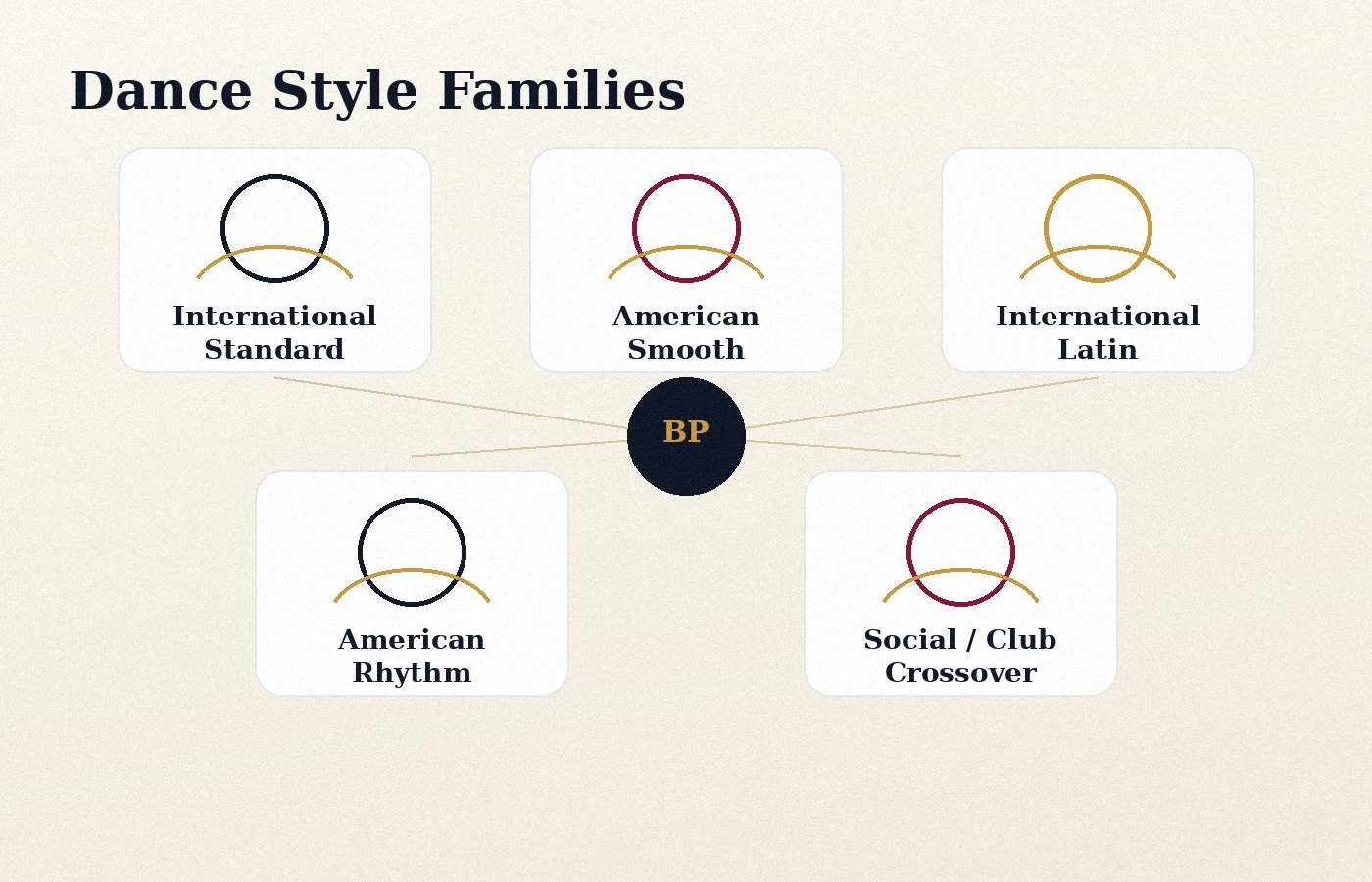
The five families you will see most often.
Four formal families plus a wider world of social and club crossover dances. Each family has its own personality, music, hold, and movement style.
-
International Standard
The classic closed-hold ballroom family. Waltz, Tango, Viennese Waltz, Slow Foxtrot, and Quickstep. These dances usually travel around the room and emphasize posture, frame, and partnership. What is International Standard?
-
American Smooth
Waltz, Tango, Foxtrot, and Viennese Waltz. Shares a classic ballroom feeling with Standard but allows more open work and separated movement — expressive and useful for showcases and weddings.
-
International Latin
Cha Cha, Samba, Rumba, Paso Doble, and Jive. Rhythm-driven and expressive, often danced more in place than traveling around the room.
-
American Rhythm
Cha Cha, Rumba, East Coast Swing, Bolero, and Mambo. Overlaps with Latin energy but has its own teaching style, music use, and social-dance feel.
-
Social & club crossover
Salsa, Bachata, Merengue, Hustle, West Coast Swing, Nightclub Two Step, Argentine Tango, Country Two Step, and Lindy Hop. Related partner dances often taught near ballroom — treat them as separate unless an event or studio system says otherwise.

Complete directory
Every ballroom and partner dance, side by side.
One canonical guide per dance. Compare family, music feel, beginner difficulty, and best use.
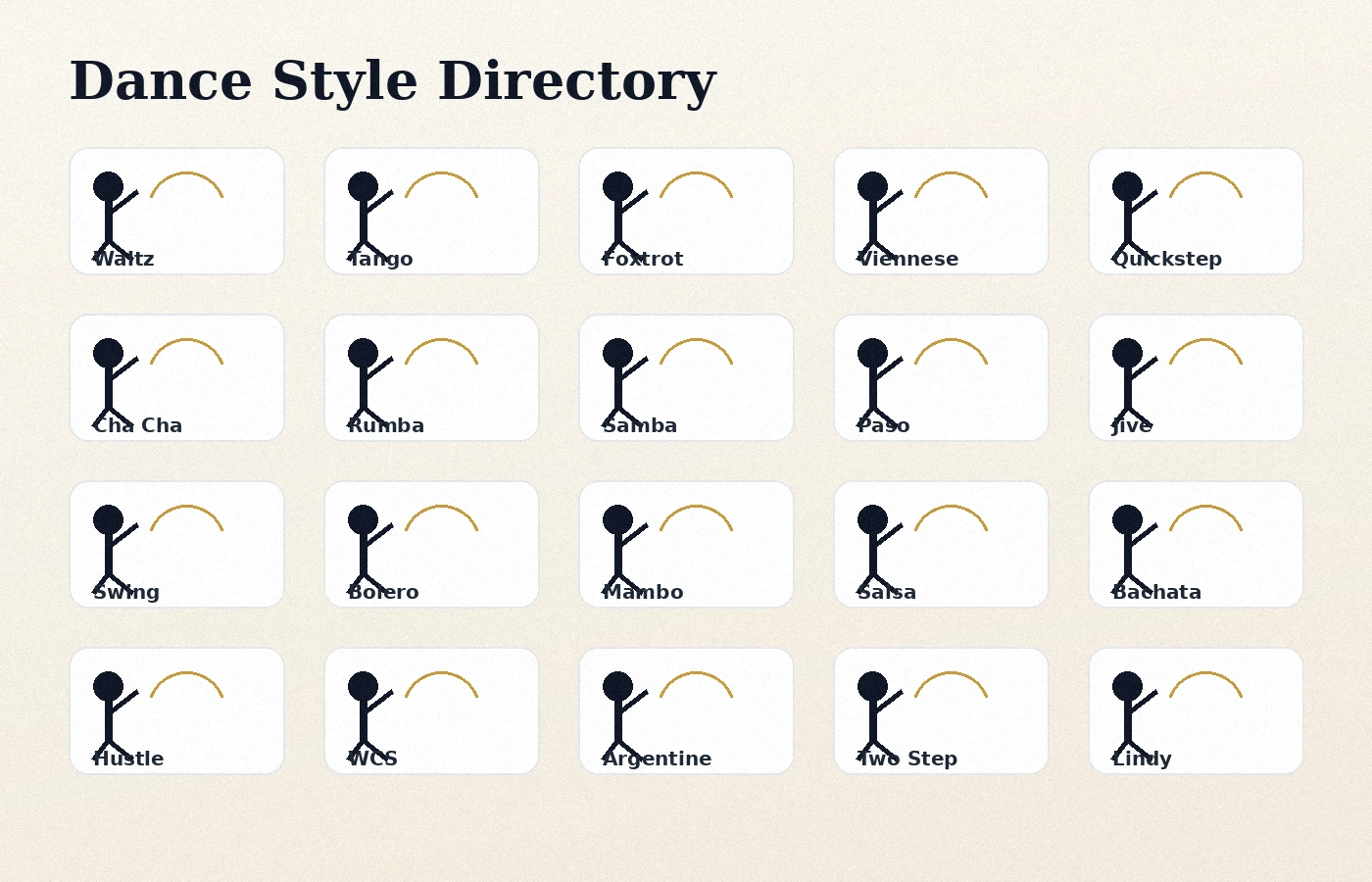
| Dance | Family | Music feel | Beginner difficulty | Best for | Guide |
|---|---|---|---|---|---|
| Waltz | Int’l Standard & American Smooth | Flowing 3/4 time, rise and fall. | Friendly | Wedding, social, beginner. | Learn Waltz → |
| Tango | Int’l Standard & American Smooth | Sharp, dramatic, staccato. | Moderate | Showcase, social, performance. | Learn Tango → |
| Foxtrot | Int’l Standard (Slow Foxtrot) & American Smooth | Smooth swing-influenced 4/4. | Friendly | Wedding, social, classic music. | Learn Foxtrot → |
| Viennese Waltz | Int’l Standard & American Smooth | Fast 3/4 with continuous rotation. | Moderate | Wedding, showcase, classic. | Learn Viennese Waltz → |
| Quickstep | Int’l Standard | Lively, light, swing-influenced. | Challenging | Competition, showcase. | Learn Quickstep → |
| Cha Cha | Int’l Latin & American Rhythm | Syncopated “cha-cha-cha” rhythm. | Friendly | Social, Latin music, beginner. | Learn Cha Cha → |
| Rumba | Int’l Latin & American Rhythm | Slow, grounded, romantic. | Friendly | Wedding, slow songs, beginner. | Learn Rumba → |
| Samba | Int’l Latin | Bouncy Brazilian rhythm. | Moderate | Competition, parties, energy. | Learn Samba → |
| Paso Doble | Int’l Latin | Dramatic march-like rhythm. | Challenging | Competition, performance. | Learn Paso Doble → |
| Jive | Int’l Latin | Upbeat, lively swing feel. | Moderate | Competition, energy. | Learn Jive → |
| East Coast Swing | American Rhythm | Upbeat 4/4 swing feel. | Friendly | Wedding, social, parties. | Learn East Coast Swing → |
| Bolero | American Rhythm | Slow, romantic, gentle. | Friendly | Wedding, slow songs. | Learn Bolero → |
| Mambo | American Rhythm | Cuban-influenced rhythm. | Moderate | Social, Latin music. | Learn Mambo → |
| Salsa | Social/club crossover | Quick Latin rhythm. | Moderate | Clubs, socials, Latin music. | Learn Salsa → |
| Bachata | Social/club crossover | Simple, musical, soulful. | Friendly | Clubs, socials, beginner Latin. | Learn Bachata → |
| Merengue | Social/club crossover | Steady marching rhythm. | Friendly | Clubs, parties, beginner Latin. | Learn Merengue → |
| Hustle | Social/club crossover | Disco-era 4/4 with syncopation. | Moderate | Parties, wedding, disco music. | Learn Hustle → |
| West Coast Swing | Social/club crossover | Smooth, slotted, contemporary. | Moderate | Socials, modern pop music. | Learn West Coast Swing → |
| Nightclub Two Step | Social/club crossover | Slow, contemporary love songs. | Friendly | Wedding, slow songs. | Learn Nightclub Two Step → |
| Argentine Tango | Social tango tradition (distinct) | Improvisational, intimate. | Challenging | Milongas, performance. | Learn Argentine Tango → |
| Country Two Step | Social/country partner dance | Country music quick-quick-slow-slow. | Friendly | Country bars, socials. | Learn Country Two Step → |
| Lindy Hop | Vintage swing/social crossover | Classic swing-era jazz. | Moderate | Swing dances, vintage music. | Learn Lindy Hop → |
International Standard
International Standard dances.
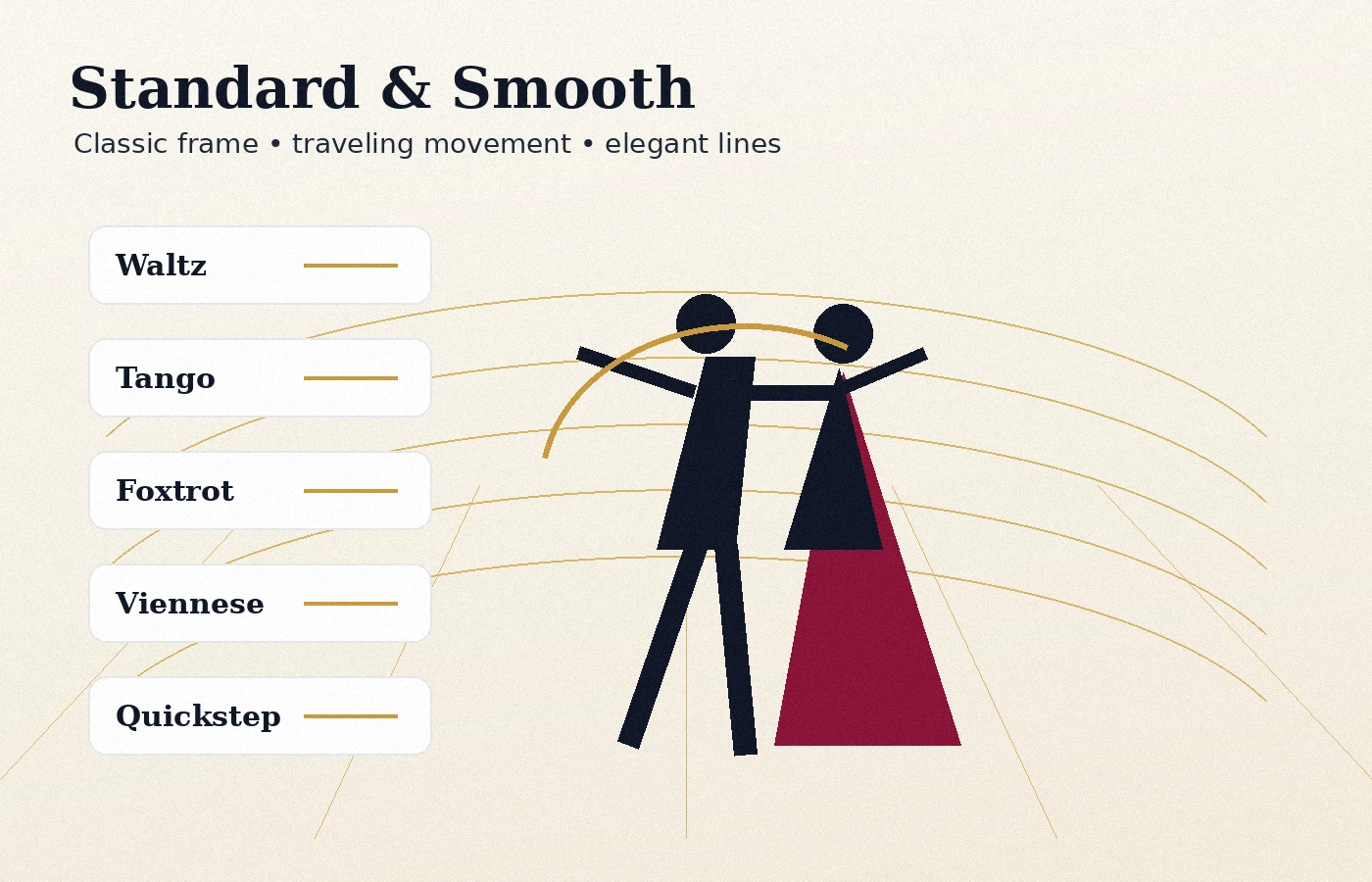
International Standard is the classic closed-hold ballroom family. These dances usually travel around the room and emphasize posture, frame, smooth movement, and partnership.
- Waltz — flowing 3/4 with rise and fall.
- Tango — sharp, structured, dramatic.
- Viennese Waltz — fast, continuous rotation.
- Slow Foxtrot — smooth, swing-influenced.
- Quickstep — lively, light, fast.
American Smooth
American Smooth dances.
American Smooth shares a classic ballroom feeling with Standard but allows more open work and separated movement, which can make it expressive and useful for showcases and weddings.
International Latin
International Latin dances.
International Latin dances are rhythm-driven, expressive, and often danced more in place than traveling around the room.
- Cha Cha — syncopated, sharp rhythm.
- Samba — bouncy Brazilian energy.
- Rumba — slow, expressive.
- Paso Doble — dramatic march-like rhythm.
- Jive — upbeat, lively swing.
American Rhythm
American Rhythm dances.
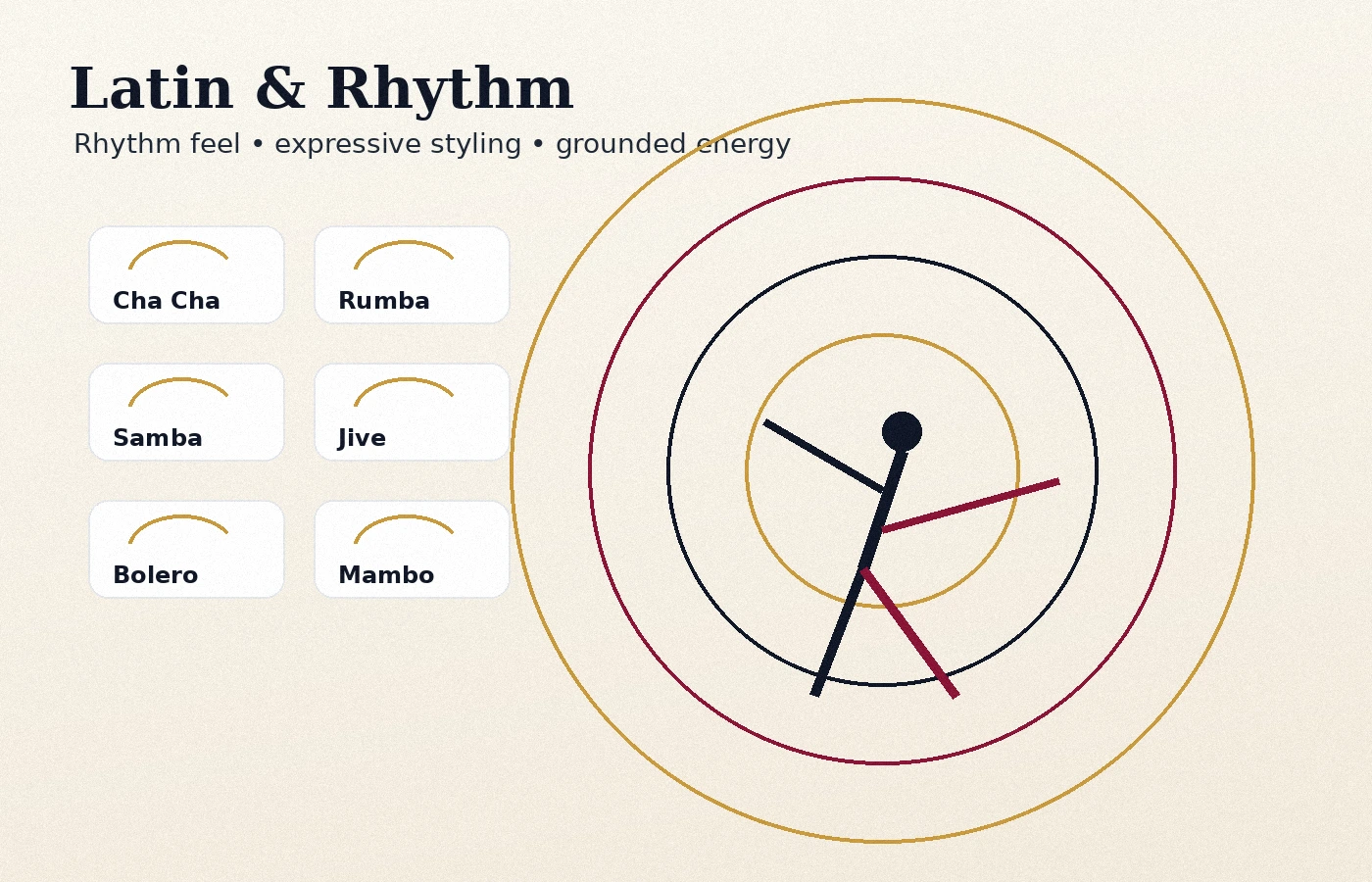
American Rhythm overlaps with Latin/Rhythm energy but has its own teaching style, music use, and social-dance feel.
Social & club crossover
Social and club crossover dances.
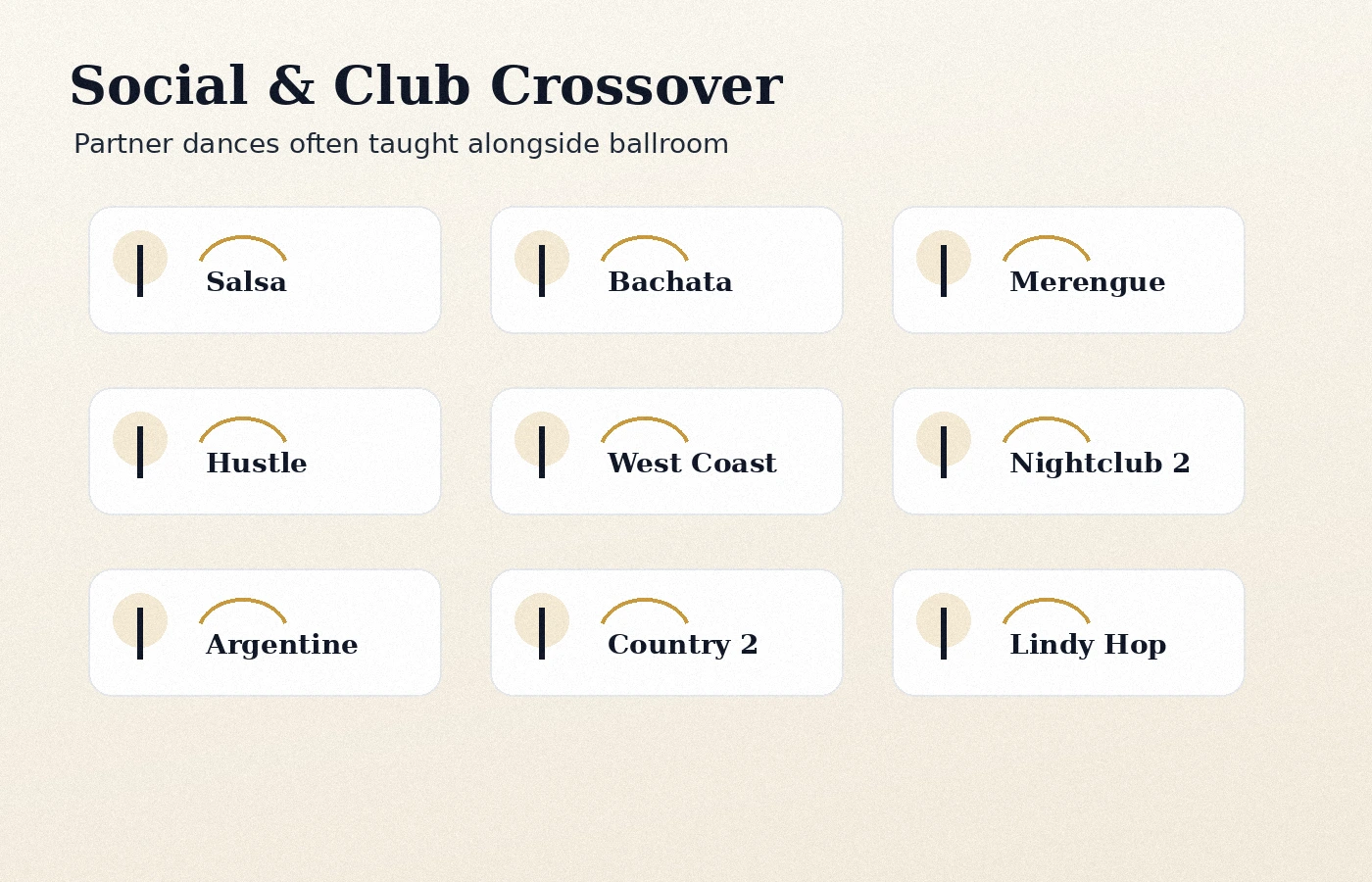
Salsa, Bachata, Merengue, Hustle, West Coast Swing, Nightclub Two Step, Argentine Tango, Country Two Step, and Lindy Hop often live near ballroom learning because people study them in studios or social dance settings. Treat them as related partner dances unless a specific organization or event defines them differently.
Best styles by goal
Quick recap by goal.
A short reference if you skipped the chooser above.
- I’m brand new
- Start with Waltz, Rumba, Foxtrot, Cha Cha, or East Coast Swing.
- I’m planning a wedding dance
- Try Rumba, Waltz, Foxtrot, Nightclub Two Step, East Coast Swing, or Hustle depending on the song.
- I want romantic slow dances
- Look at Rumba, Waltz, Foxtrot, Bolero, or Nightclub Two Step.
- I want upbeat social dances
- Try East Coast Swing, Salsa, Bachata, Hustle, Merengue, or West Coast Swing.
- I want classic ballroom elegance
- Start with Waltz, Foxtrot, Tango, or Viennese Waltz.
- I want Latin/Rhythm energy
- Try Cha Cha, Rumba, Samba, Mambo, Salsa, or Bachata.
- I want to compete someday
- Learn the four competitive families first: International Standard, International Latin, American Smooth, and American Rhythm.
- I want to learn music/timing first
- Start with the Music & Timing hub and the tempo chart.
Key comparisons
How the families and labels relate.
The terms overlap and sometimes confuse beginners. These short comparisons clarify how the labels are used and what they actually describe.
-
Ballroom vs Latin vs social dance
Ballroom can be used broadly or narrowly. In competition, Standard/Smooth and Latin/Rhythm families are separated. In everyday learning, many people use “ballroom” to mean a wider world of partner dances taught in studios.
-
American vs International ballroom
American style uses Smooth and Rhythm. International style uses Standard and Latin. American Smooth/Rhythm often feel more social/studio-oriented; International Standard/Latin are more formalized for competition. Read the full American vs International comparison.
-
Smooth vs Standard
Smooth and Standard share several dances, but Standard is more closed-hold and formal, while Smooth allows more open and separated movement. Read the full Smooth vs Standard comparison.
-
Rhythm vs Latin
Rhythm and Latin share some names, such as Cha Cha and Rumba, but the technique, styling, timing emphasis, and syllabus approach can differ. Read the full American Rhythm vs International Latin comparison.
-
Ballroom Tango vs Argentine Tango
Ballroom Tango belongs to ballroom systems and has a strong, stylized, structured character. Argentine Tango is a distinct social tango tradition with its own music, culture, embrace, and improvisational language.
-
Salsa & Bachata as social crossover dances
Salsa and Bachata are social Latin partner dances. They are often taught near ballroom, especially in social-dance studios, but they should not be treated as core International Standard/Latin or American Smooth/Rhythm dances unless a specific event or studio system says so.
Which dance first?
Which ballroom dance should you learn first?
Start with your goal, not with the longest dance list.
- If you want classic ballroom confidence, start with Waltz or Foxtrot.
- If you want romantic slow-song movement, start with Rumba or Nightclub Two Step.
- If you want social dance energy, start with East Coast Swing, Salsa, Bachata, or Hustle.
- If you want rhythm and timing, start with Cha Cha or Rumba.
- If you want future competition structure, learn the four family names first, then choose one dance from each.
Music & timing
Music and timing by dance style.
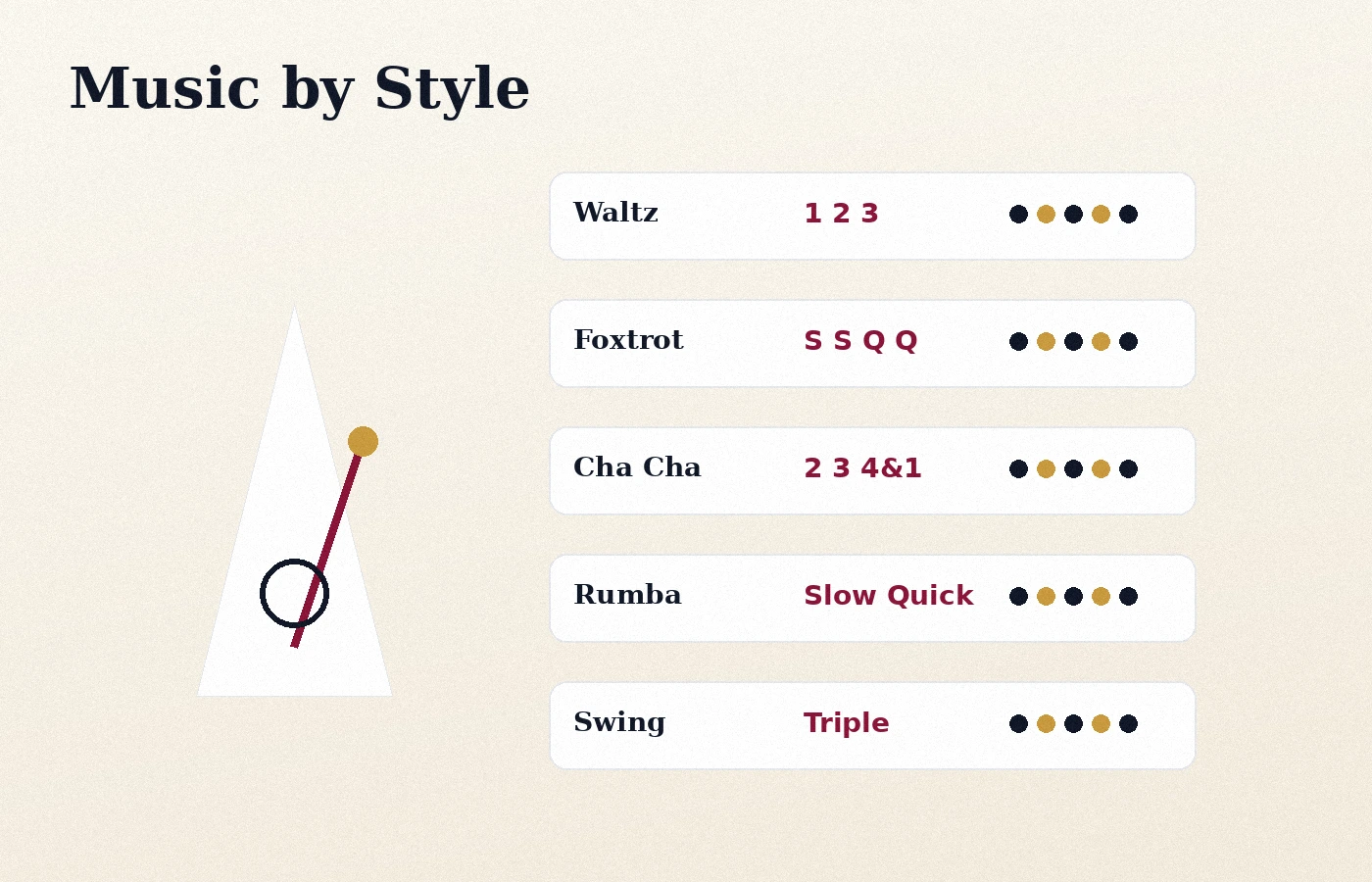
Every dance style has a musical personality. Waltz feels like 1-2-3. Foxtrot often uses slow/quick timing. Cha Cha has a syncopated rhythm. Rumba is slower and more grounded. Swing and Jive feel lively and upbeat. The Music & Timing hub explains the counting system in more detail, but this page should help you notice that the best dance often depends on the song.
Glossary terms
Dance style language you will hear.
Plain-language definitions for the terms that come up when comparing styles.
- Standard — the classic closed-hold ballroom family.
- Smooth — American style with open and separated movement.
- Latin — rhythm-driven dances, often danced in place.
- Rhythm — American style overlap with Latin energy.
- Closed position — classic partner hold facing each other.
- Frame — the organized partner shape used to communicate.
- Tempo — the speed of the music in beats per minute.
- Count — how dancers organize music into numbers or rhythm words.
Recommended next
Where to go next.
The hub is the map. These guides go deeper into the parts most beginners ask about.
FAQ
Ballroom dance styles, answered.
The most common questions about families, comparisons, and beginner choices.
What are the main ballroom dance styles?
The main organized ballroom dance families are International Standard, American Smooth, International Latin, and American Rhythm. Many studios also teach social and club crossover dances such as Salsa, Bachata, Hustle, West Coast Swing, Nightclub Two Step, Argentine Tango, Country Two Step, and Lindy Hop.
How many ballroom dances are there?
There is no single fixed number. The four formal competition families together include around ten core dances. Add American Smooth and Rhythm variants and social crossovers and the practical learning list grows to about 20 to 25 partner dances.
What is the difference between ballroom and Latin dance?
Ballroom is the umbrella term, including Standard, Smooth, Latin, and Rhythm families. Latin refers to a specific competitive family (International Latin) and to Latin-music dances more broadly. Many Latin dances are studied inside ballroom programs, but not every Latin dance is part of formal ballroom syllabi.
What is the difference between American and International ballroom?
American style uses Smooth and Rhythm. International style uses Standard and Latin. American Smooth and Rhythm often feel more social and studio-oriented; International Standard and Latin are more formalized for competition.
What are American Smooth dances?
American Smooth includes Waltz, Tango, Foxtrot, and Viennese Waltz. It shares a classic ballroom feeling with Standard but allows more open work and separated movement.
What are International Standard dances?
International Standard includes Waltz, Tango, Viennese Waltz, Slow Foxtrot, and Quickstep. These dances usually travel around the room and emphasize posture, frame, smooth movement, and partnership.
What are American Rhythm dances?
American Rhythm includes Cha Cha, Rumba, East Coast Swing, Bolero, and Mambo.
What are International Latin dances?
International Latin includes Cha Cha, Samba, Rumba, Paso Doble, and Jive.
Which ballroom dance should beginners learn first?
Waltz, Rumba, Foxtrot, Cha Cha, and East Coast Swing are common starting points. See best ballroom dances for beginners.
Which ballroom dances are best for weddings?
Rumba, Waltz, Foxtrot, East Coast Swing, Hustle, and Nightclub Two Step are popular wedding first-dance choices. The best match depends on song tempo, mood, and meter. See what dance fits your song.
Is Salsa a ballroom dance?
Salsa is a social Latin partner dance. It is often taught in ballroom studios and shares the ballroom learning audience, but it is not part of the four core competitive ballroom families unless a specific event or studio system includes it.
Is Bachata a ballroom dance?
Bachata is a social Latin partner dance. Studios that teach ballroom often offer Bachata classes because their students enjoy partner dancing, but Bachata is not part of the core Standard, Smooth, Latin, or Rhythm families.
Is Argentine Tango a ballroom dance?
Argentine Tango is a distinct social dance tradition with its own music, embrace, and improvisational language. Ballroom Tango is the version found in Standard and Smooth ballroom systems. They look and feel different and are taught differently.
What is the easiest ballroom dance to learn?
Rumba and East Coast Swing are often considered the most beginner-friendly. Waltz and Foxtrot are also approachable for many learners. The easiest dance is the one whose music and timing fit your ear naturally.
What ballroom dance is best for slow songs?
Rumba, Waltz, Foxtrot, Bolero, and Nightclub Two Step work well for slower songs. Match the dance to the meter and tempo of the song rather than picking by name alone.
What dance is best for upbeat music?
East Coast Swing, Salsa, Bachata, Hustle, Merengue, and West Coast Swing are common choices for upbeat music. Cha Cha and Jive also pair well with energetic songs.
Sources & references
Sources
This page draws on widely used dance organization syllabi and educational references. Individual style pages cite specific syllabi, tempos, and rules in more detail.
- WDSF DanceSport Disciplines — structure of competitive ballroom families.
- WDSF Standard, Latin, and 10Dance category descriptions.
- USA Dance Competitor Guide — American syllabus context.
- Dance Central American Style references for Smooth/Rhythm.
- Dance Central music resources for tempo and style fit.
- Dance Vision ballroom dance style articles and syllabus media.
- UGA Ballroom Dance Terminology — educational glossary.
- American Dancer newcomer guide for crossover and competition nuance.
- Internal Ballroom Pages guides: What Is Ballroom Dance?, Music & Timing hub, Glossary.