What is Quickstep?
Quickstep is a fast, light, traveling ballroom dance in the International Standard family. It is danced in a ballroom frame, usually in closed position, and moves progressively around the floor.
Its character is lively and elegant rather than bouncy in a casual party-dance sense. A good Quickstep looks buoyant and easy, but that ease comes from strong posture, timing, foot placement, partner connection, and careful floorcraft.
Historically, Quickstep is often traced to fast Foxtrot, Charleston, Peabody, One-Step, ragtime, and jazz-era influences. That history matters, but it should not blur the modern dance.
Quickstep is not Foxtrot, not Slow Foxtrot, not Swing, not Jive, and not Charleston. Those relationships are useful context; the canonical topic here is Quickstep.
What Quickstep feels like
Quickstep feels like controlled flight across the dance floor. The couple travels with a lifted frame, crisp timing, and quick changes of direction while still maintaining a polished ballroom look.
For the leader, Quickstep asks for clear timing, directional awareness, and calm navigation. For the follower, it asks for responsive balance, tone through the frame, and the ability to move quickly without guessing or collapsing into the partner.
For beginners, the first goal is not speed. The first goal is to hear the rhythm, maintain posture, keep the frame quiet, and make small, clean movements that can later grow into bigger traveling figures.
Quickstep timing and count
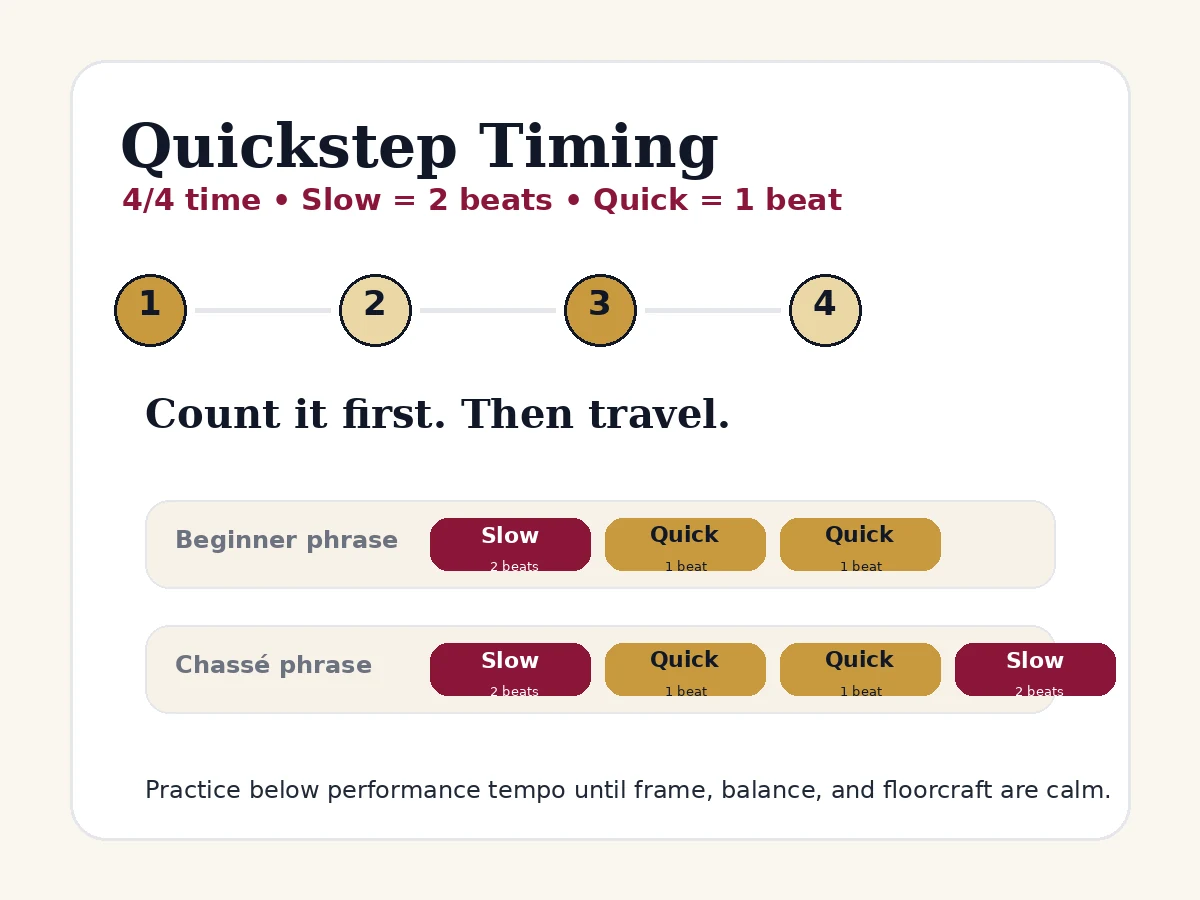
Quickstep is in 4/4 time. In common ballroom teaching language, a Slow usually takes 2 beats and a Quick usually takes 1 beat.
| Timing word | Beat value | Beginner meaning | Example use |
|---|---|---|---|
| Slow | 2 beats | A longer weight change with time to travel or settle | Walking or turning action |
| Quick | 1 beat | A faster weight change | Chassé or lock-style action |
| Slow-Quick-Quick | 2 + 1 + 1 beats | A common way to feel one full 4-beat measure | Useful for hearing the Quickstep pulse |
| Slow-Quick-Quick-Slow | 2 + 1 + 1 + 2 beats | Often used for simple chassé-style teaching patterns | Helpful for beginner progressive movement |
A useful beginner count is: Slow, quick, quick. Say it evenly with the music: “slooow, quick, quick.” The Slow takes up more time; the Quicks are lighter and shorter.
Another common teaching pattern is Slow, quick, quick, slow, especially when discussing chassé-style figures. Do not worry if some figures do not fit neatly into a single bar of music at first. Ballroom timing often flows across measures, and your teacher will help connect the count to the figure.
For more rhythm help, start with How to Count Ballroom Dance Music and the Ballroom Dance Tempo Chart.
Why tempo matters
Quickstep tempo is one reason the dance feels thrilling — and one reason beginners should practice carefully. In official competition references, Quickstep is much faster than Foxtrot.
That does not mean beginners should practice at full competition speed. Tempo affects everything: step size, balance, frame, breath, and floorcraft.
At high speed, a small mistake can carry the couple into another dancer’s path. Practice slow enough that the leader can navigate and the follower can respond without tension.
Basic Quickstep movements
Beginner Quickstep study usually introduces movement concepts before full-speed choreography. Depending on the teacher and syllabus, early concepts may include walks, chassés, quarter turns, forward locks, natural turns, and simple progressive patterns.
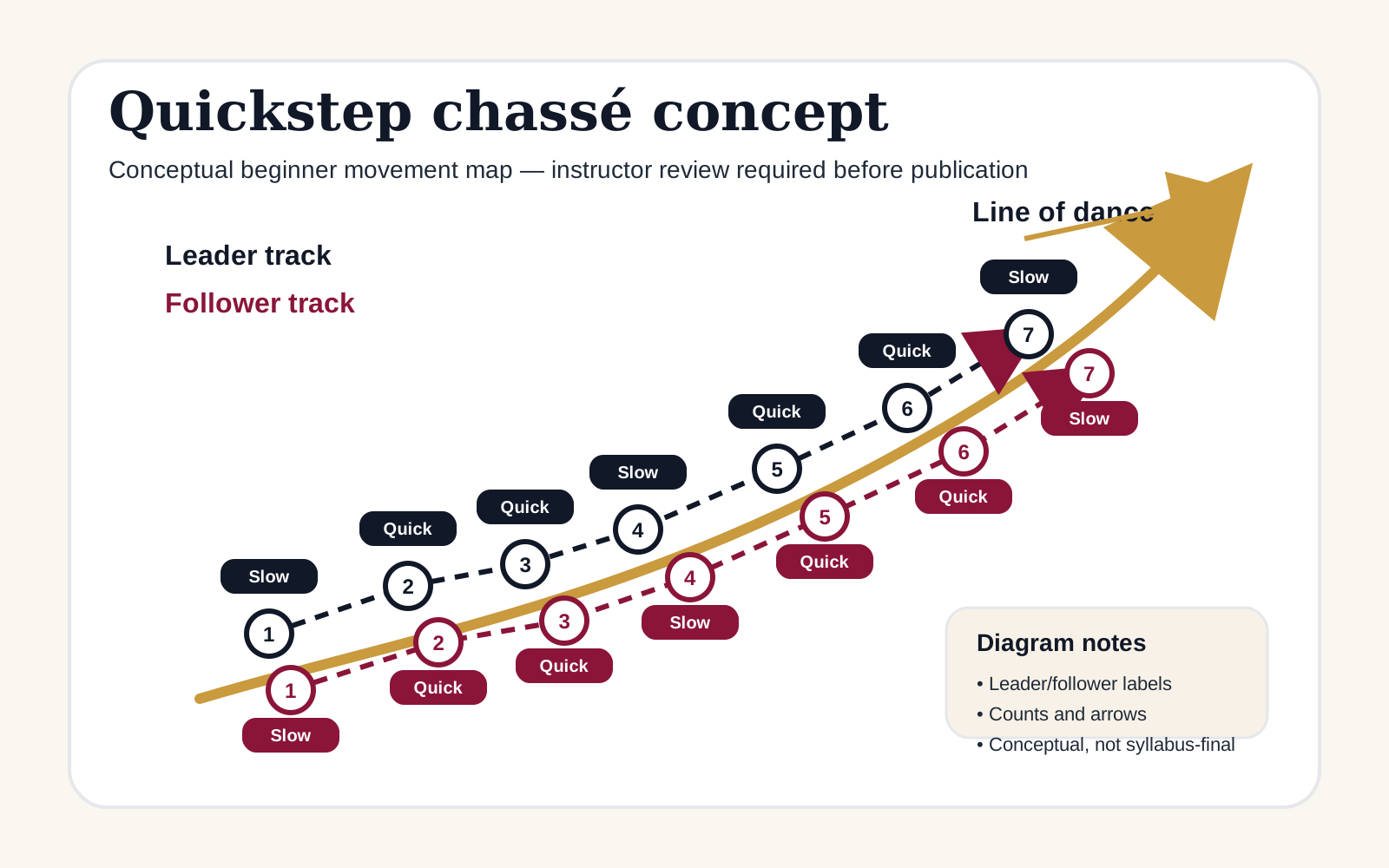
A chassé is a side-together-side action or a closing action where the feet come together as part of the movement. In Quickstep, chassé-style movement helps create the light, traveling character of the dance.
For a beginner, the takeaway is simple: Quickstep basics are not just random fast steps. They are structured traveling movements built on timing, direction, frame, and controlled footwork.
Glossary support: Closed Position, Promenade Position, Chassé, Slow, Quick, Quick.
Chassé, quarter turns, and beginner movement overview
A common beginner-friendly way to understand Quickstep is to pair a turning action with a progressive chassé. This gives the couple a way to move along the line of dance without immediately attempting advanced running figures.
- Hear the 4/4 pulse.
- Practice Slow and Quick timing without traveling far.
- Add posture and frame.
- Learn small, controlled traveling movement.
- Add chassé-style movement.
- Practice changing direction with a teacher.
- Increase tempo only when timing and floorcraft are reliable.
Do not treat this overview as a complete step tutorial. Quickstep is fast enough that even “basic” figures should be checked by an instructor, especially when two partners are traveling around a shared floor.
Quickstep music
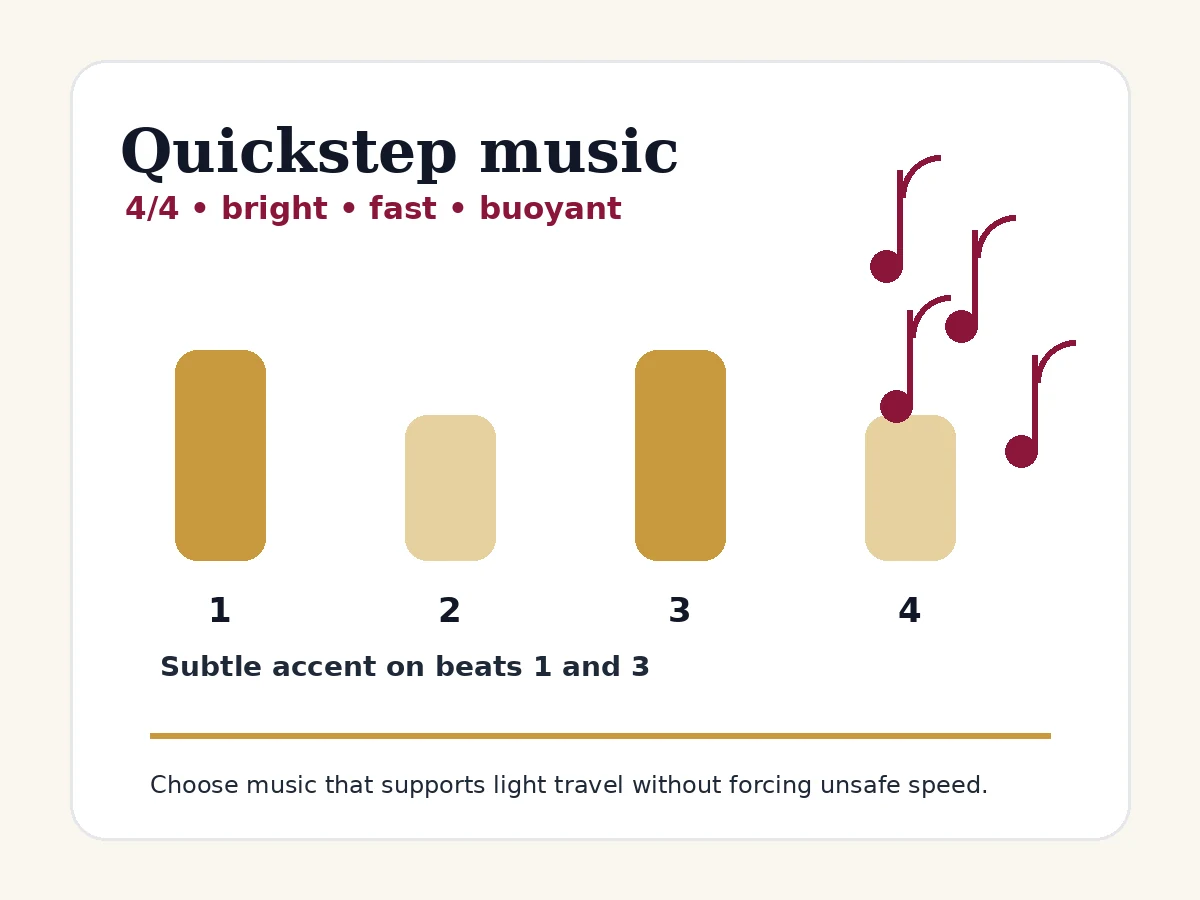
Quickstep music is usually upbeat, bright, and in 4/4. It often draws from swing, big band, jazz, ragtime-flavored arrangements, show tunes, and some contemporary songs arranged or selected at an appropriate tempo.
The music should invite light traveling movement. A song can be upbeat and still not be a good Quickstep if the tempo, phrasing, or rhythmic feel makes the dance rushed or awkward.
Use the Quickstep Music Guide for song examples when that page is available. Until then, use How to Count Ballroom Dance Music and the Ballroom Dance Tempo Chart to check whether a song is realistic for practice.
Quickstep vs Foxtrot
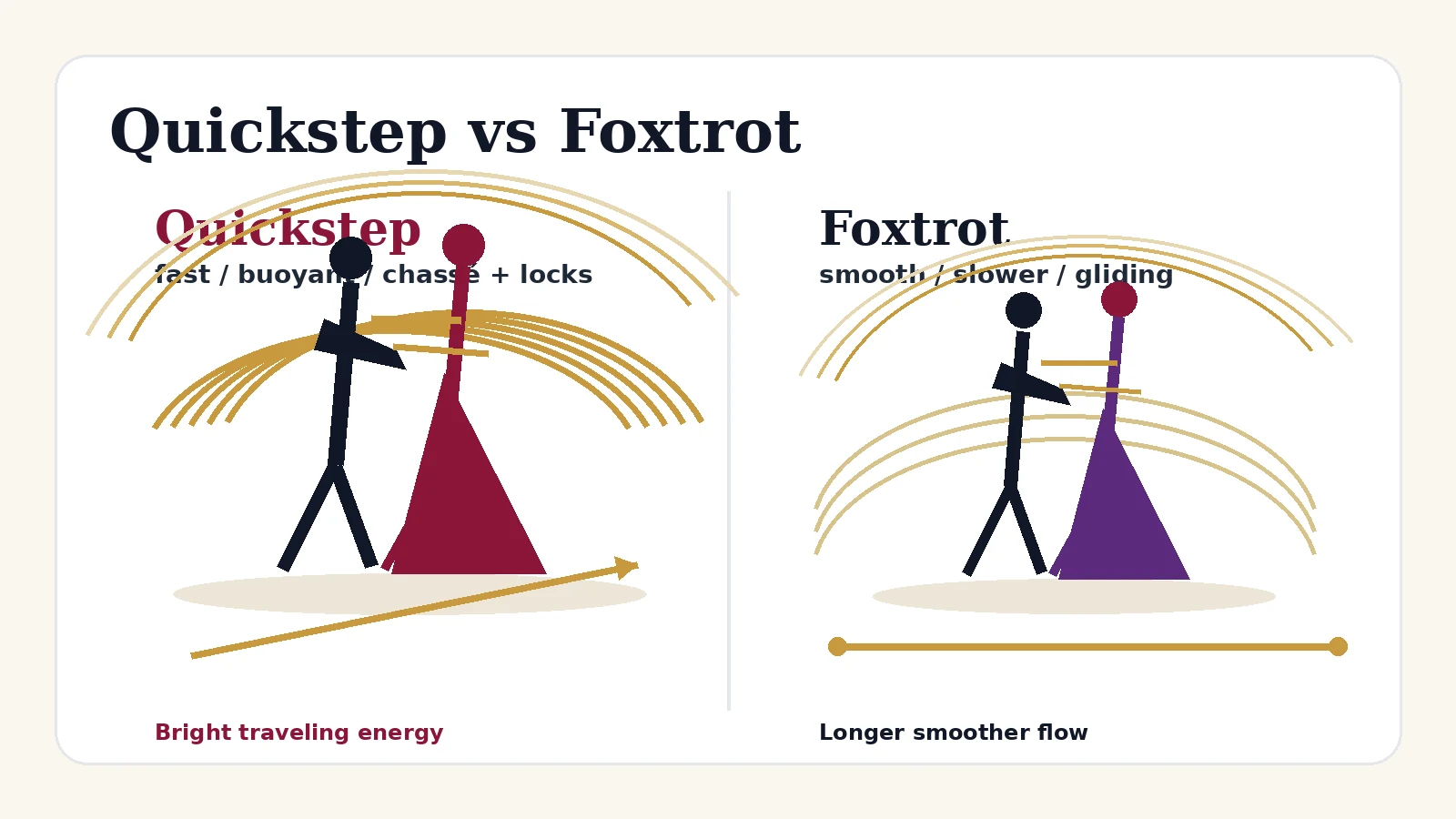
Quickstep and Foxtrot are historically related, but modern dancers should not treat them as the same dance.
| Comparison point | Quickstep | Foxtrot |
|---|---|---|
| Dance family | International Standard | International Standard and American Smooth contexts |
| Typical feel | Fast, bright, buoyant, precise | Smooth, gliding, elegant, more relaxed |
| Tempo | Fast, around 50 MPM / 200 BPM in common competition reference | Slower, with International Foxtrot commonly around 28 MPM / 112 BPM in competition reference |
| Movement texture | Chassés, locks, quick traveling actions, lightness | Longer, smoother walking actions and sustained flow |
| Beginner expectation | Exciting but demanding; needs careful tempo control | Often more approachable socially, depending on style |
| Wedding fit | Works for short upbeat numbers with space | Often better for classic, smooth, mid-tempo songs |
Quickstep is not simply “Foxtrot played faster” in practical beginner terms. The speed changes the movement vocabulary, floorcraft needs, and technical demands.
Quickstep vs Slow Foxtrot
Quickstep and Slow Foxtrot are both International Standard dances, but they have very different personalities.
| Comparison point | Quickstep | Slow Foxtrot |
|---|---|---|
| Tempo | Fast | Slow to moderate |
| Character | Bright, lively, buoyant | Smooth, sustained, controlled |
| Beginner challenge | Speed, navigation, frame under pressure | Balance, continuity, control, subtle technique |
| Musical feel | Upbeat 4/4 with quick movement | Smooth 4/4 with long phrasing |
| Common confusion | Mistaken for fast Foxtrot | Mistaken as just “regular Foxtrot” |
| Page ownership | This page owns Quickstep | Future Slow Foxtrot page should own Slow Foxtrot technique |
A future Slow Foxtrot page should go deeper into feather steps, three-step concepts, continuity, and the particular control of Slow Foxtrot. This Quickstep page should only compare the two.
Quickstep vs Swing and Jive
Quickstep may share jazz-era and Charleston-related historical context, but it is not Swing or Jive. Jive is an International Latin dance; East Coast Swing is generally treated in American Rhythm and social swing contexts.
| Comparison point | Quickstep | Swing / East Coast Swing | Jive |
|---|---|---|---|
| Dance family | International Standard | American Rhythm / social swing | International Latin |
| Hold | Ballroom frame, usually closed | Often more open or relaxed | Latin hold / action, more elastic |
| Floor path | Travels around the room | Often spot-based or compact | Often compact and highly energetic |
| Music relationship | Upbeat 4/4, often swing / jazz feel | Swing music and social swing rhythms | Fast Latin competition rhythm |
| Body action | Standard posture, frame, travel | Swing pulse and social styling | Latin action, kicks / flicks, sharp energy |
| Beginner issue | Floorcraft and speed | Rhythm and partner connection | Speed, stamina, kicks / flicks |
Quickstep for weddings
Quickstep can be a wonderful wedding first dance when the song is fast, upbeat, and playful — and when the couple has enough floor space. It works best as a short, choreographed highlight rather than a long improvised first dance.
It is not the best choice for a slow romantic ballad, a narrow dance floor, a heavy dress with limited movement, or a couple that wants the easiest possible first dance. In those cases, consider Foxtrot, Waltz, Rumba, Swing, or Nightclub Two Step depending on the song.
For wedding planning, start with the Wedding Dance Guide and What Dance Fits Your Wedding Song?.
Quickstep in social dancing
Quickstep appears socially in ballroom-focused settings, strict-tempo events, studios, and communities where International Standard is commonly danced. It is less common at casual crowded socials than dances like Foxtrot, Swing, Salsa, or Rumba.
The reason is practical: Quickstep travels quickly. It needs space, shared floor etiquette, and a leader who can navigate without forcing the follower or surprising nearby couples.
Quickstep in competition
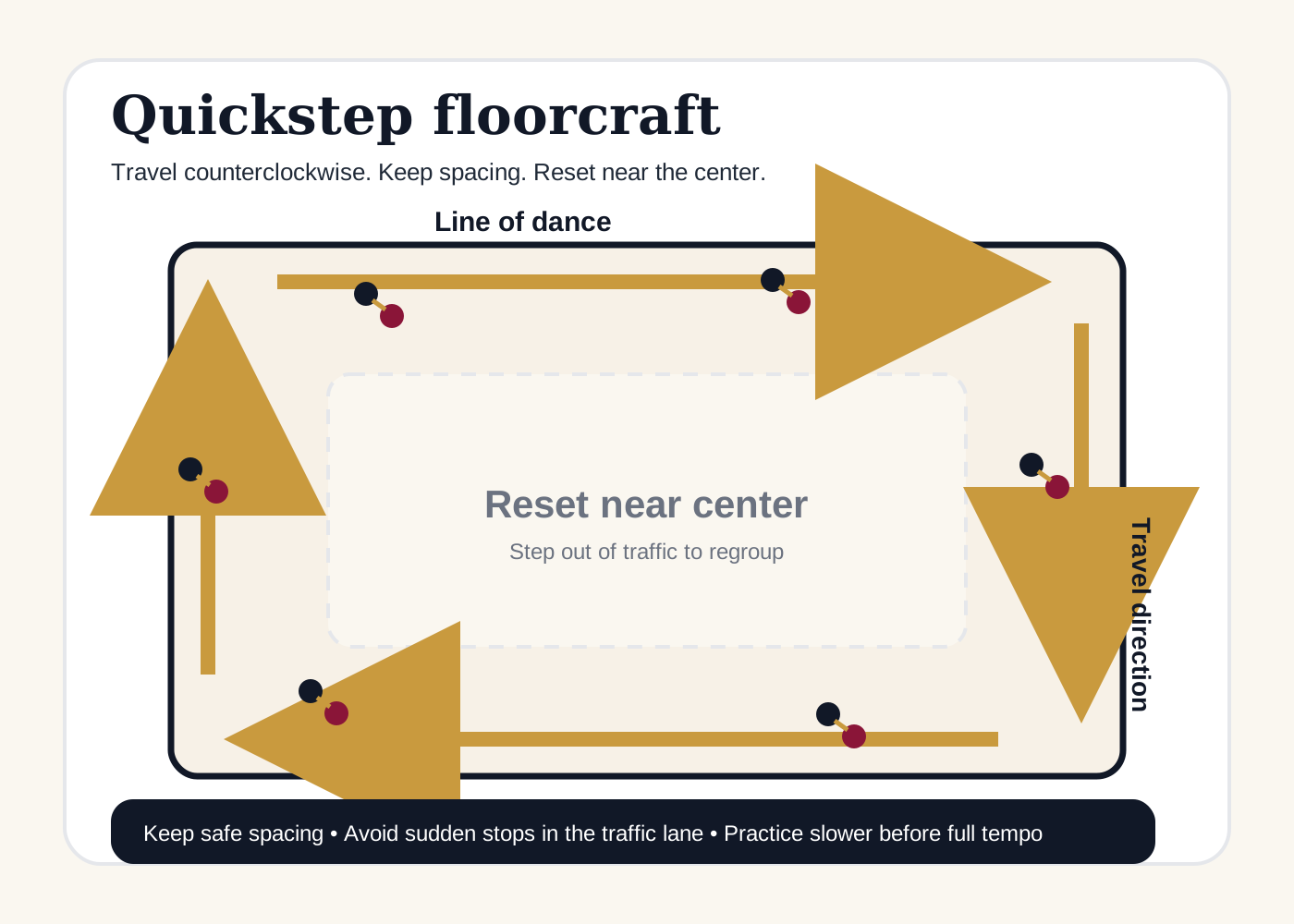
In competition, Quickstep is part of International Standard. It often brings a bright, energetic finish to Standard rounds because of its speed, lightness, and athletic character.
Competition Quickstep can include advanced figures, syncopations, runs, hops, and dramatic changes of direction. Beginners should not imitate advanced competition videos without understanding the technique underneath.
The more useful beginner question is not, “Can I do the competition version?” It is, “Can I keep timing, posture, frame, partner connection, and floorcraft steady while moving a little faster?”
Common beginner mistakes
| Mistake | Why it happens | Better approach |
|---|---|---|
| Rushing the Quicks | The music feels fast and exciting | Count Slow = 2 beats and Quick = 1 beat before traveling |
| Taking steps too large | Beginners try to “cover floor” too soon | Use smaller steps until timing and balance are stable |
| Dropping the frame | Speed creates tension or collapse | Practice Frame and Posture slowly |
| Looking down | The feet feel busy | Keep eyes lifted and use body direction, not foot watching |
| Confusing Quickstep with Swing | Both can feel upbeat | Remember: Quickstep travels in ballroom frame; Swing / Jive use different families and actions |
| Ignoring line of dance | The room feels empty during practice | Build Floorcraft habits early |
| Practicing fast figures alone | Videos make advanced steps look simple | Learn with a teacher before attempting fast traveling patterns |
| Overpowering the follower | The leader tries to steer with arms | Use posture, frame, timing, and body direction instead of force |
Safety and floorcraft tips
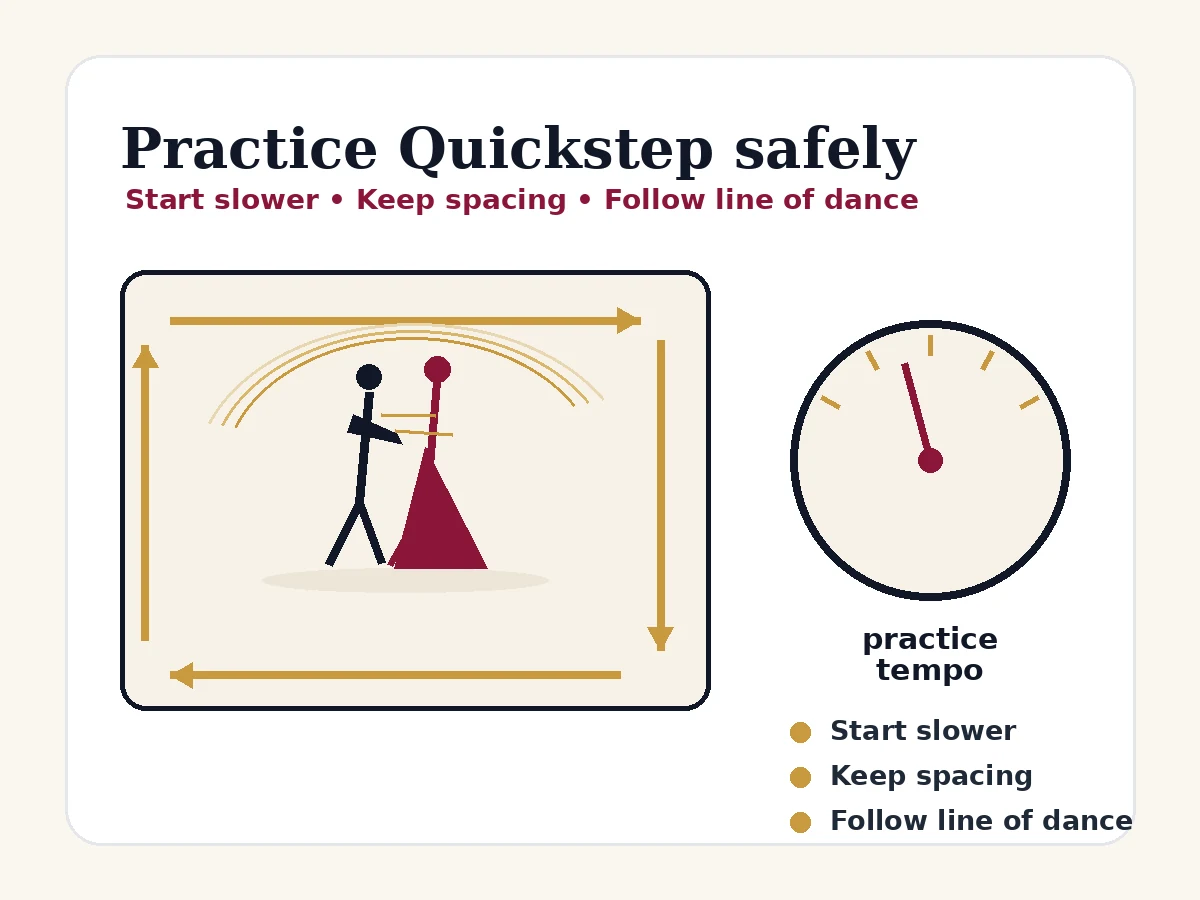
Quickstep is joyful, but it is also fast. Treat navigation as part of the dance, not an extra skill.
- Practice new figures below performance tempo.
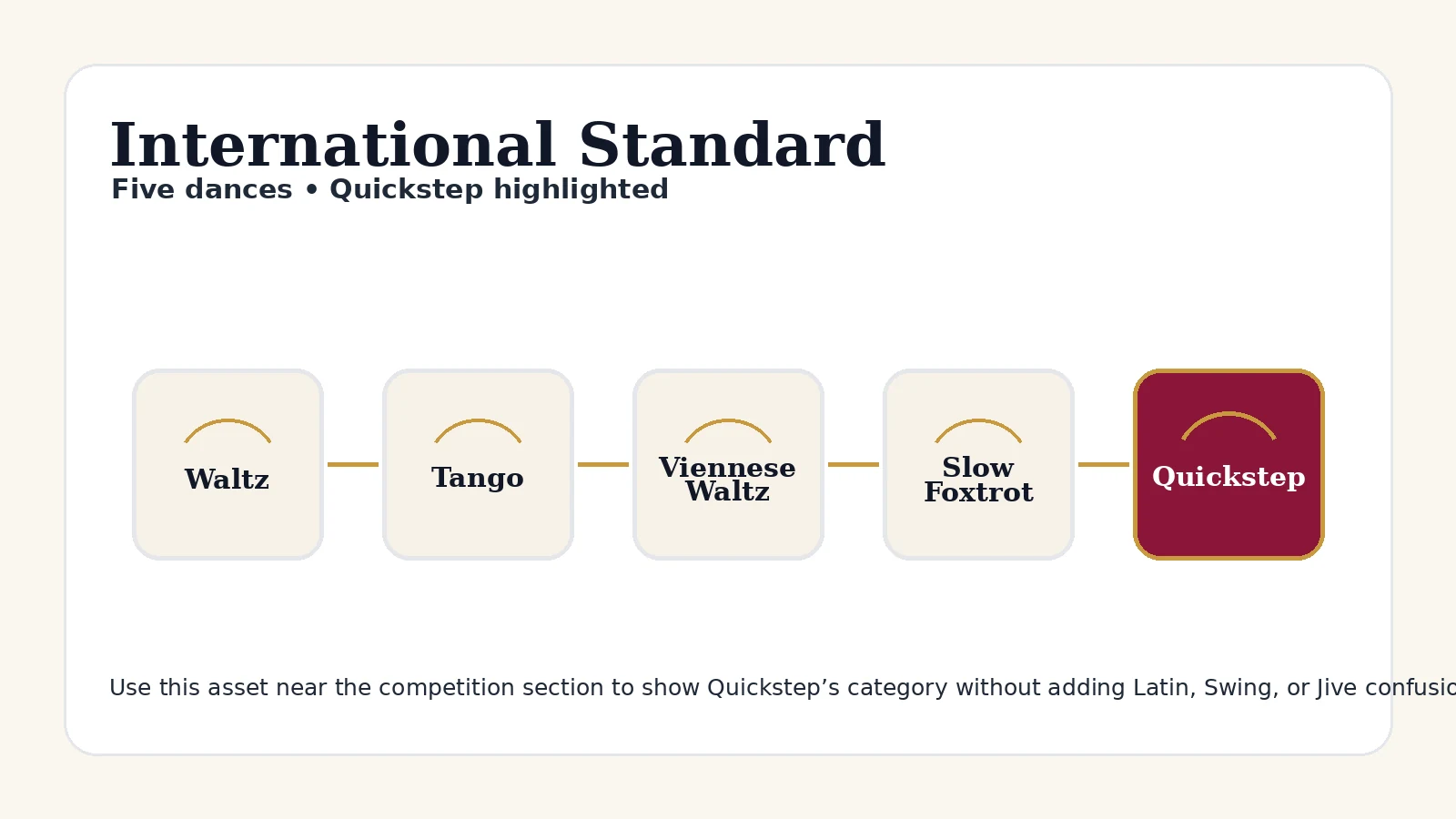
- Follow the line of dance counterclockwise around the room.
- Keep beginner patterns small on crowded floors.
- Do not stop suddenly in the main traffic lane.
- Move toward the center if you need to reset.
- Leaders should plan direction early.
- Followers should maintain tone and awareness without back-leading.
- Avoid dramatic hops, jumps, or runs until a teacher confirms they are safe.
- Wear shoes that allow secure, controlled movement.
- Never prioritize speed over balance, connection, or partner comfort.
Beginner practice plan
| Practice phase | Goal | What to practice | What to avoid |
|---|---|---|---|
| Week 1 | Hear the rhythm | Clap or step Slow-Quick-Quick in 4/4 music | Full-speed choreography |
| Week 2 | Build posture and frame | Closed position, standing balance, small weight changes | Pulling with arms |
| Week 3 | Add simple movement | Small traveling walks and chassé-style actions at slow tempo | Large steps or crowded floors |
| Week 4 | Add direction and floorcraft | Practice line of dance, corners, stopping safely | Fast runs, hops, or advanced figures |
| Ongoing | Become musical and safe | Count music, work with a teacher, refine frame | Copying competition videos without instruction |
Next step: Read Ballroom Dance for Beginners or improve your foundation with Lead and Follow.