What lead and follow really means
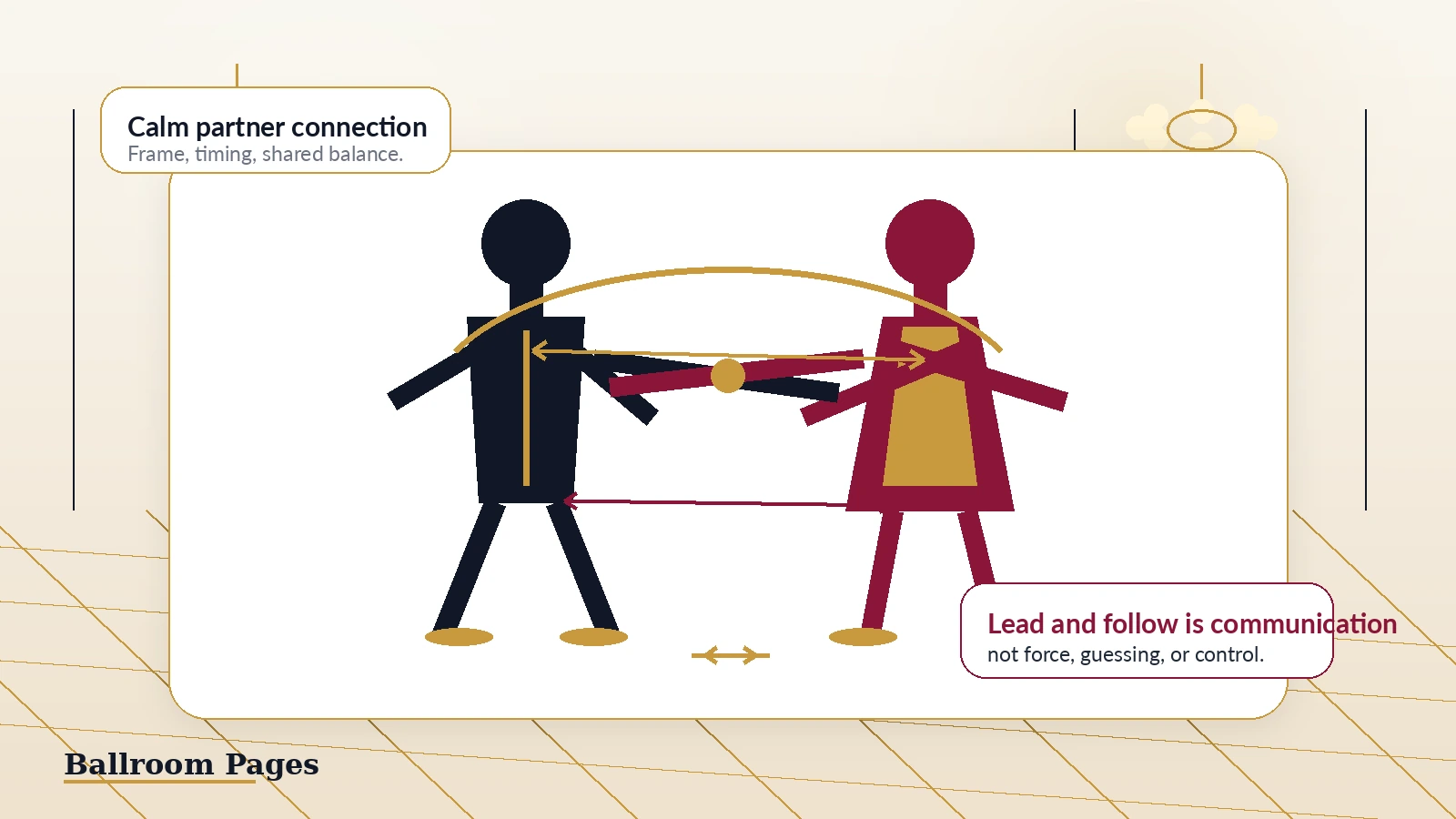
Lead and follow is the communication system of partner dancing. One dancer takes the leader role, and the other takes the follower role. Those roles help the couple coordinate movement, especially when the dance is improvised, social, or only partly choreographed.
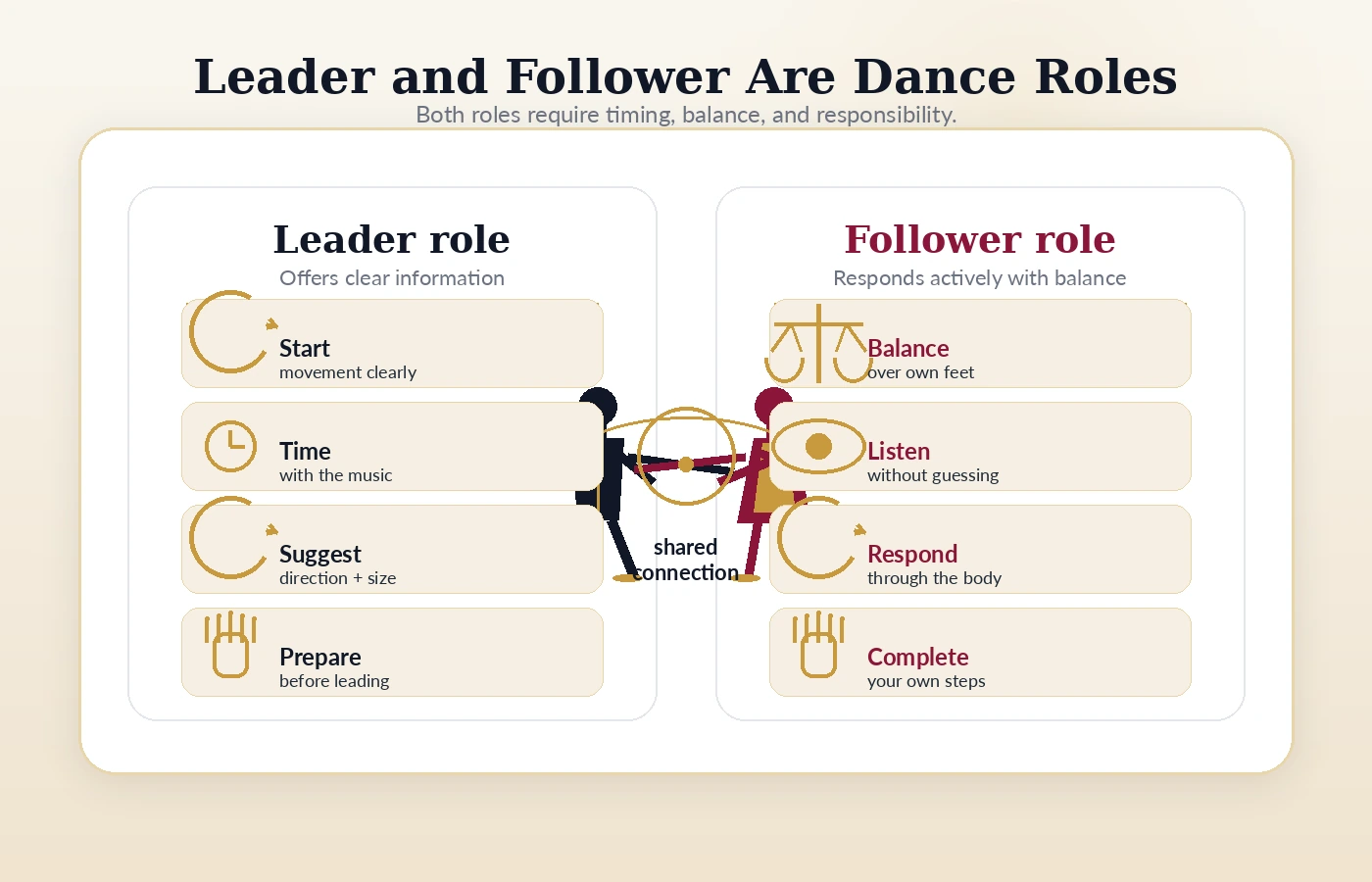
The leader’s job is to make movement understandable. That might mean starting on the right beat, preparing a turn before it happens, choosing a direction that fits the floor, or keeping the step small enough for both partners to stay balanced.
The follower’s job is to receive, interpret, and complete the movement with their own balance and timing. A good follower is not being dragged around. They are listening through the body, staying available, and choosing a clear response.
This is why “lead and follow” is better understood as partner communication than as command and obedience. The leader does not force. The follower does not guess. Both dancers keep responsibility for timing, posture, balance, and respect.
The leader offers an invitation. The follower answers with movement. The music keeps both dancers honest.
The three foundations: frame, connection, and timing
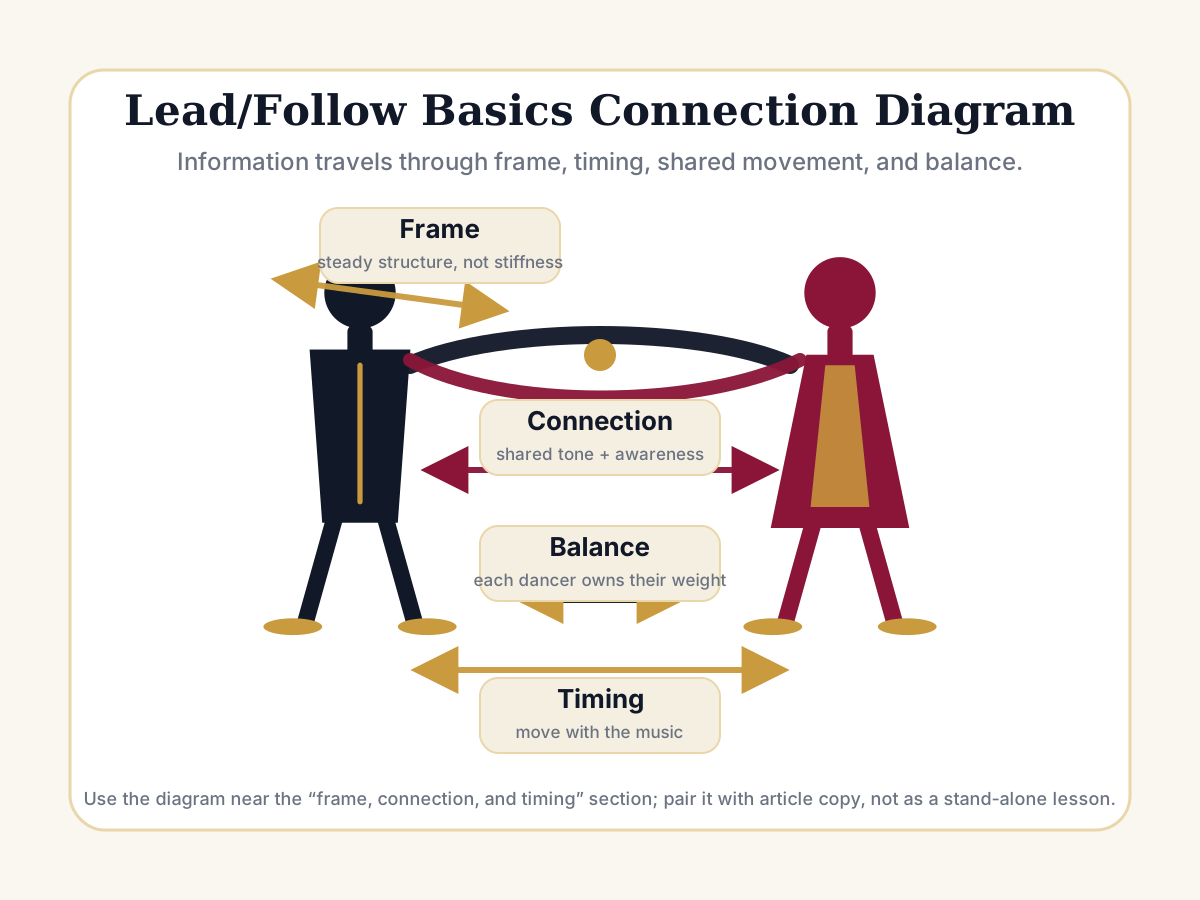
Three things carry information between partners. When all three line up, the dance feels light. When one is missing, beginners often reach for arm strength to compensate—which usually makes things harder.
Frame
Frame is the organized structure of your body that lets information travel from one partner to the other. It includes posture, arms, shoulders, back, elbows, hands, and the way you hold your own body.
A useful frame is not stiff. It is alive, steady, and responsive. If your arms are limp, your partner cannot feel clear information. If your arms are locked, your partner feels trapped. The goal is a middle tone: present enough to communicate, soft enough to adapt. Learn more in our guide to frame and posture.
Connection
Connection is the shared awareness between partners. It can happen through a closed ballroom hold, one-hand hold, two-hand hold, body alignment, visual awareness, or shared timing.
Connection is not the same as gripping. A tight hand can actually block information. Clear connection usually feels calm, elastic, and breathable.
Timing
Timing is the couple’s agreement with the music. If one partner moves before the beat and the other partner waits for the beat, the connection feels late, heavy, or confusing.
Beginners often try to fix connection by using more arm strength. Usually, the better fix is to slow down, count the music, reduce step size, and start movement with clearer timing. If counting feels tricky, start with how to count ballroom music.
What leaders do
A leader’s first job is clarity. Not force. Not speed. Not showing how many patterns they know.
A leader’s responsibilities
- Start movement clearly.
- Keep timing understandable.
- Suggest direction, size, rotation, and energy.
- Prepare before leading.
- Create enough space for the follower to move.
- Adjust to the partner, music, floor, and social setting.
- Protect the partnership from collisions and uncomfortable movement.
- Choose simplicity when the connection is not ready for complexity.
Leader habits to avoid
- Yanking with the hands.
- Steering with arms only.
- Rushing ahead of the music.
- Leading a turn before the follower is balanced.
- Taking steps too large.
- Forcing a pattern because it was planned.
- Correcting or blaming the follower mid-dance.
The best beginner leaders usually do less than they think they need to. They take smaller steps, prepare earlier, and avoid sudden hand movements. They do not blame the follower when a lead fails. They ask: “Was my timing clear? Was my frame steady? Did I give enough preparation?”
A clear lead should feel like a calm invitation that arrives early enough to answer.
What followers do
Following is active. It requires timing, balance, body awareness, patience, and choice.
A follower’s responsibilities
- Maintain their own balance.
- Keep a responsive frame.
- Wait for information without guessing.
- Respond through the body, not just the hands.
- Complete their own steps.
- Keep tone without becoming stiff.
- Match the music and the size of the movement.
- Stay aware of comfort, safety, and floorcraft.
Follower habits to avoid
- Collapsing the arms or upper body.
- Going limp in the hands.
- Locking the elbows.
- Taking over the timing.
- Back-leading every pattern.
- Looking down instead of feeling balance.
- Taking large steps that pull the couple off center.
A follower does not need to predict every move. In fact, guessing often makes lead and follow harder. If the follower moves before the information arrives, the leader cannot tell whether the lead was clear or whether the follower simply anticipated.
A good follow should feel alert, balanced, and available. The follower is not waiting helplessly; they are listening with skill.
Connection is not just hands
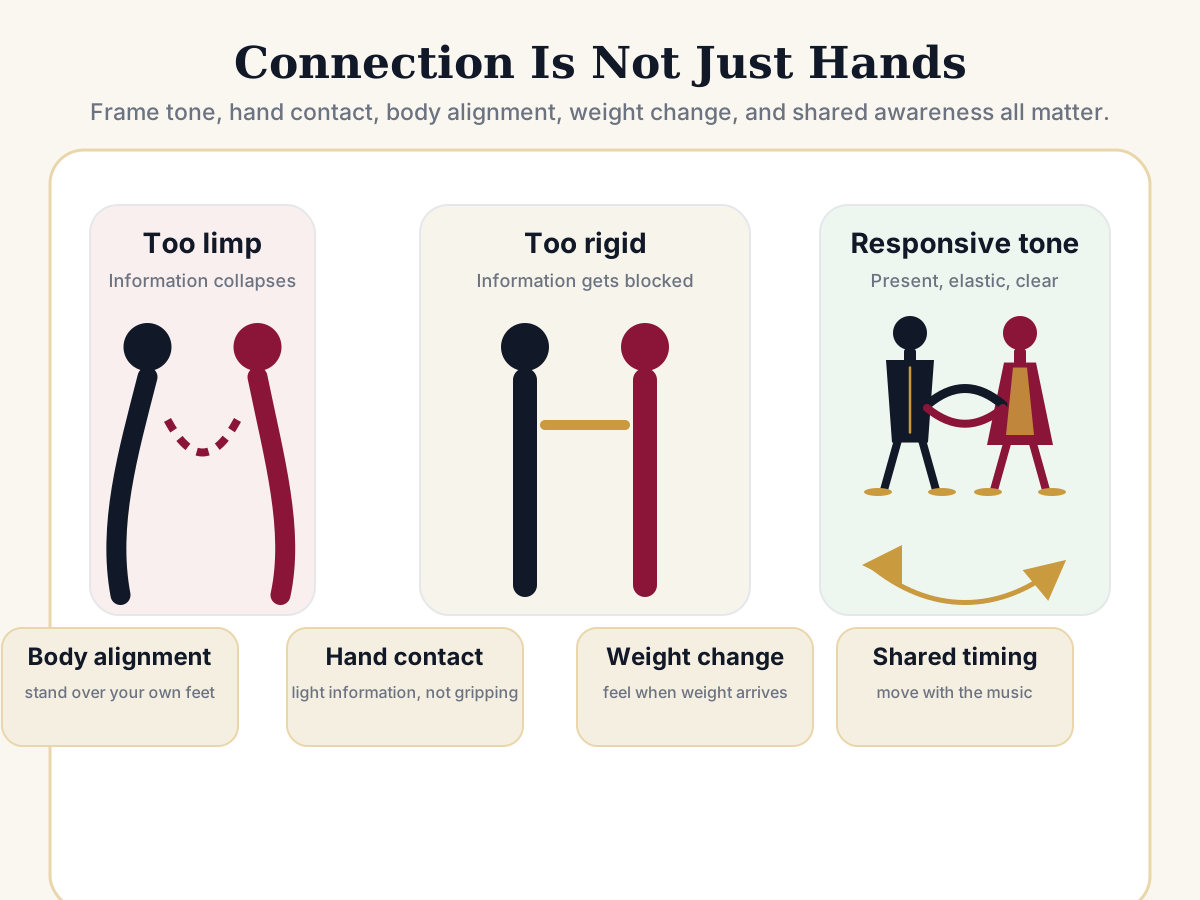
Hands are only one part of connection. They are often the most visible part, so beginners overuse them. But connection can travel through several channels at once.
Body position
The way partners stand in relation to each other affects everything. If both dancers are balanced over their own feet, the connection feels lighter. If one partner leans, twists, or collapses, the other partner has to manage extra weight.
Frame and tone
Tone means your body has enough energy to communicate. It is not tension. It is not rigidity. Think of tone as the difference between a cooked noodle and a locked board. Good frame lives between those extremes.
Weight change
Many leads begin with a weight change. If both partners can feel when weight moves from one foot to the other, the dance becomes calmer. If the weight changes are hidden, late, or rushed, the partnership feels uncertain.
Directional energy
Direction is not only “go left” or “go right.” It can include forward, back, side, rotation, compression, stretch, rise, lowering, or staying in place. The clearer the energy, the less the hands need to work.
Visual awareness
In open positions and social dances, partners may use more visual information. A follower might see the leader’s body prepare, and a leader might notice the follower’s balance before inviting the next movement.
Musical timing
Connection improves when both partners hear the same beat. Music gives the partnership a shared reference point, especially in Waltz, Rumba, Foxtrot, Swing, Cha Cha, Salsa, and Bachata.
Closed position, open position, and social holds
In closed position, partners usually have more continuous frame and body relationship. This can make timing and direction easier to feel, but it also requires posture and calm tone.
In open position, partners have more space and often more hand/arm connection. This can make turns and social patterns easier, but it requires clear timing and visual awareness.
In one-hand or two-hand social holds, the connection may feel lighter and more elastic. The goal is not to pull the partner through the step. The goal is to share enough information that both dancers can move comfortably.
Common lead-and-follow mistakes and how to fix them
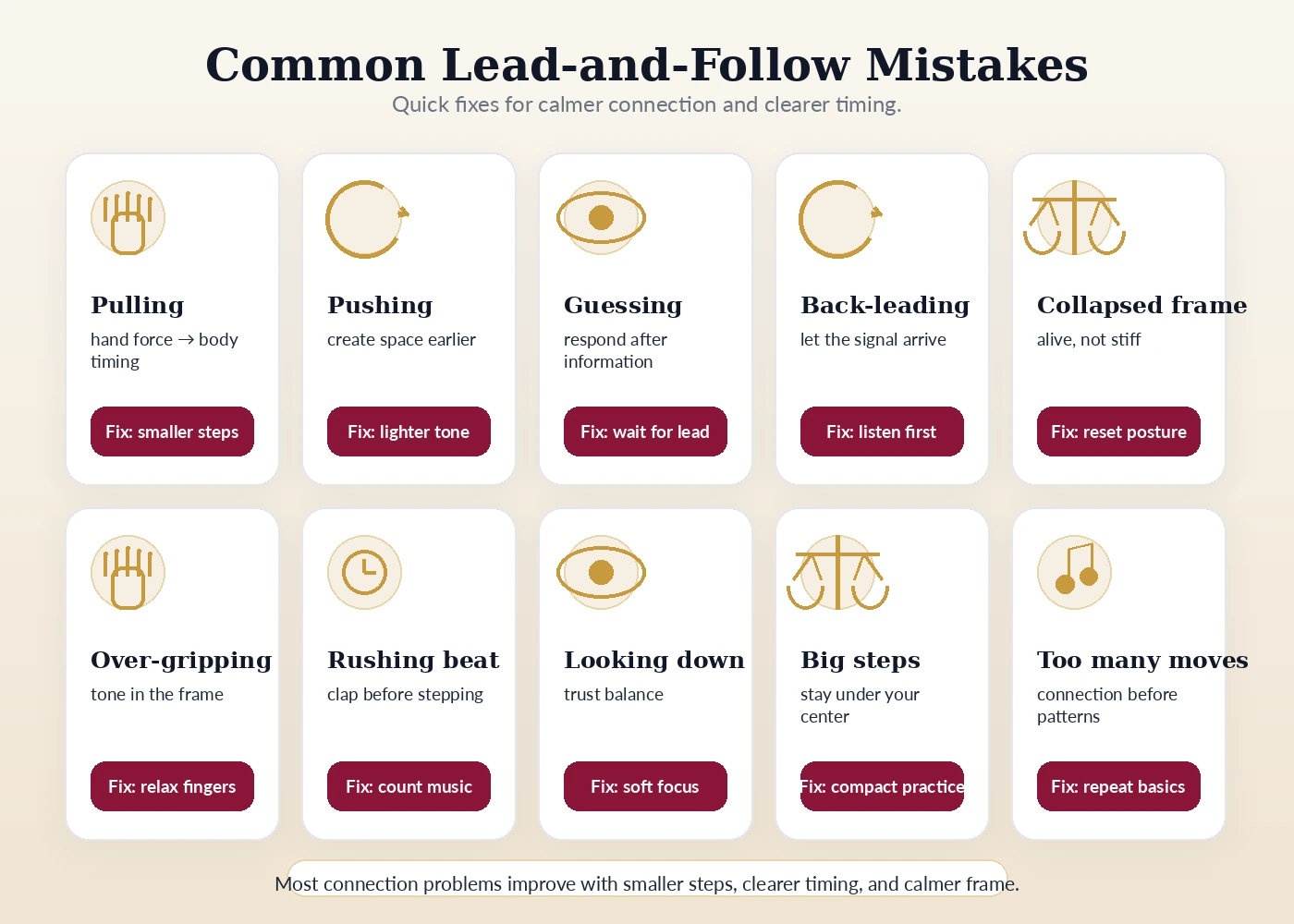
| Mistake | What it feels like | Why it happens | Quick fix | Related guide |
|---|---|---|---|---|
| Pulling | One partner feels dragged or yanked | Leader uses hands instead of body timing and preparation | Reduce step size, soften grip, initiate from body timing | Frame and Posture |
| Pushing | Partner feels shoved or crowded | Too much arm pressure or late preparation | Create space earlier and use lighter tone | Connection |
| Guessing | Follower moves before the lead is clear | Anxiety, habit, memorized pattern, or unclear timing | Wait one fraction longer from balance | Practice Routine |
| Back-leading | Follower takes over the pattern | Over-familiarity or lack of trust in the lead | Practice responding only after information arrives | Lead and Follow |
| Collapsing frame | Arms feel heavy or disconnected | Low tone, poor posture, fatigue | Reset posture and hold a light, steady frame | Frame |
| Over-gripping hands | Hands feel tense or trapped | Fear of losing partner or unclear connection | Relax fingers; keep tone in frame, not grip | Dance Etiquette |
| Moving before the beat | Couple feels rushed | Not hearing count or starting with feet first | Count aloud, clap, then step | How to Count Music |
| Looking down | Balance and connection drop | Fear of stepping wrong | Use soft forward focus; practice slow weight changes | Ballroom for Beginners |
| Steps too large | Couple feels stretched or late | Trying to travel before connection is ready | Make steps smaller than normal for practice | Foxtrot |
| Too many moves too soon | Dance feels chaotic | Pattern focus comes before connection basics | Repeat simple patterns with better timing | Solo Practice Drills |
Beginner connection drills
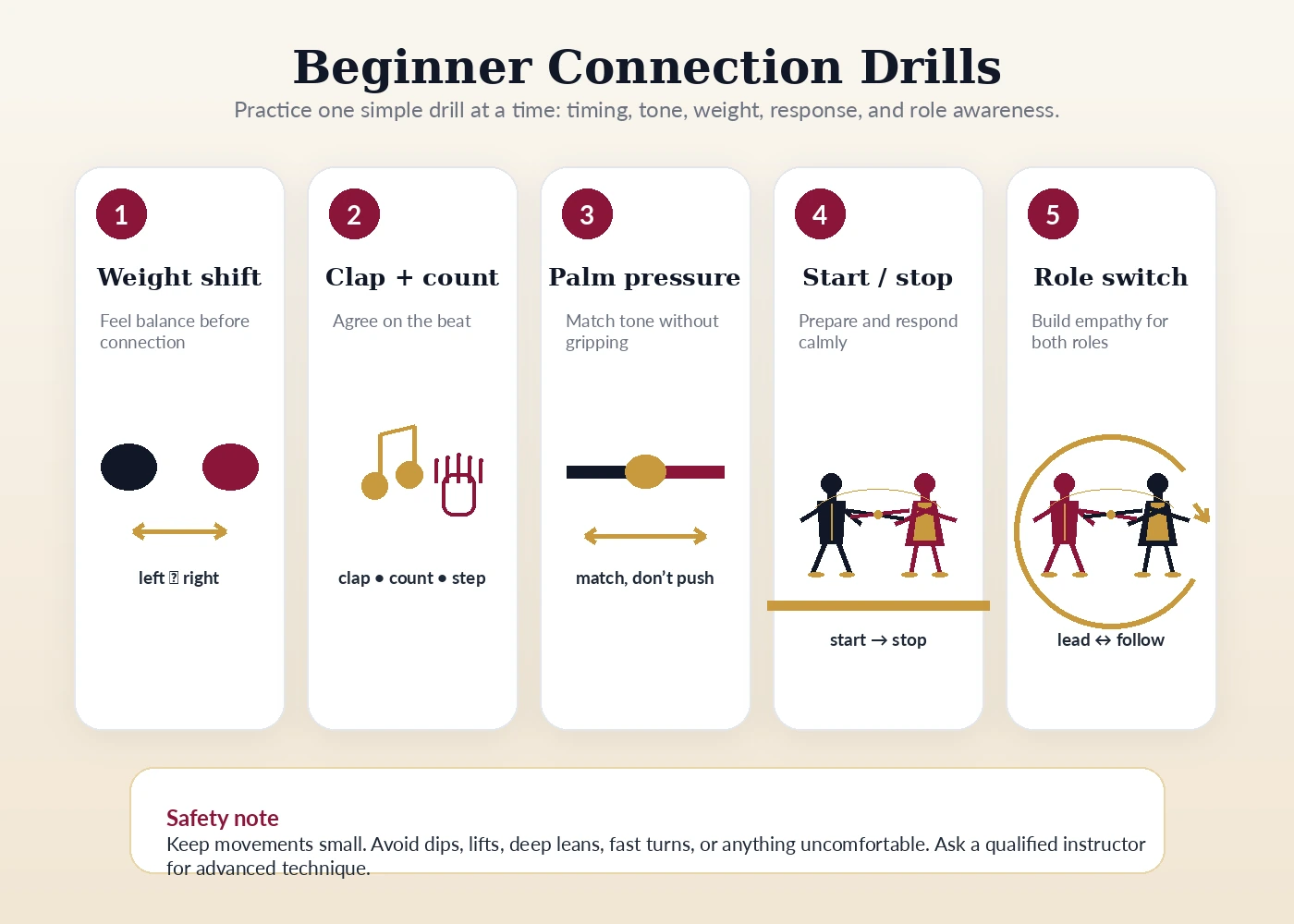
Practice safely: These drills are meant to build awareness, not replace instruction. Keep movements small. Avoid dips, lifts, deep leans, fast turns, or anything that creates discomfort. If a movement feels painful or unsafe, stop and ask a qualified instructor.
Solo timing and weight-change drill
- Goal
- Feel your own balance before connecting to a partner.
- Time
- 3–5 minutes.
- How
- Stand tall. Shift weight slowly from one foot to the other. Count 1, 2, 3, 4 or use slow music. Make sure one foot receives your weight fully before the other foot releases.
- Notice
- Can you change weight without leaning, bouncing, or looking down?
- Common mistake
- Moving the free foot before the standing foot is stable.
- Music
- Slow Waltz or slow Rumba playlist.
Clap, count, listen drill
- Goal
- Build shared musical timing.
- Time
- 5 minutes.
- How
- Play a song. Before dancing, clap the beat together. Then count aloud. Then step in place.
- Notice
- Are you hearing the same beat?
- Common mistake
- Starting steps before you both agree on the count.
- Music
- Waltz for 1-2-3 timing; Swing or Cha Cha for clearer rhythmic pulse.
Frame tone drill
- Goal
- Find a frame that is present but not stiff.
- Time
- 3 minutes.
- How
- Stand in practice position or a simple two-hand hold. Each partner gently offers tone through the arms without squeezing. Try becoming too limp, then too rigid, then find the middle.
- Notice
- Clear frame feels alive, not locked.
- Common mistake
- Holding tension in the fingers instead of tone in the body.
- Music
- None at first; add slow music after the frame feels calm.
Palm-to-palm pressure matching drill
- Goal
- Learn responsive connection without gripping.
- Time
- 3–5 minutes.
- How
- Face your partner and touch palms lightly. One partner slowly increases or decreases pressure; the other matches without pushing back aggressively. Switch roles.
- Notice
- Can you match tone without collapsing or bracing?
- Common mistake
- Turning the drill into a pushing contest.
- Music
- Slow Rumba.
Start/stop walking drill
- Goal
- Practice clear preparation and response.
- Time
- 5 minutes.
- How
- In a simple hold, the leader prepares and starts a small walking action. The follower waits until the movement is clear, then walks. Leader stops calmly; follower completes balance and stops.
- Notice
- Was the start early and clear? Was the stop gentle?
- Common mistake
- Leader yanks; follower guesses.
- Music
- Foxtrot or slow practice music.
Side-to-side weight transfer drill
- Goal
- Build shared weight changes.
- Time
- 5 minutes.
- How
- Stand facing your partner in a light two-hand hold. Shift side to side together. Keep the steps tiny. Add counting.
- Notice
- Can both partners feel when weight arrives?
- Common mistake
- Taking big side steps that pull the connection apart.
- Music
- Rumba, Bachata, or slow Cha Cha.
Leader preparation drill
- Goal
- Make leads readable before movement happens.
- Time
- 5 minutes.
- How
- Leader practices preparing direction before stepping: breathe, organize posture, show timing, then move. Follower responds only after the information is clear.
- Notice
- Preparation should feel calm and early, not sudden.
- Common mistake
- Trying to lead at the exact moment the step already needs to happen.
- Music
- Waltz or Foxtrot.
Follower waiting/responding drill
- Goal
- Reduce guessing.
- Time
- 5 minutes.
- How
- Use one simple pattern. The follower’s task is to stay balanced and wait until the lead is actually felt. The leader’s task is to stay clear without forcing.
- Notice
- Waiting is active. It requires tone and attention.
- Common mistake
- Going limp while waiting.
- Music
- Slow Rumba or Foxtrot.
No-guessing drill
- Goal
- Separate memorized choreography from real communication.
- Time
- 5–8 minutes.
- How
- Choose two possible actions, such as side step or back step. The follower does not know which one is coming. The leader must prepare clearly. The follower responds only to what is led.
- Notice
- Smaller options make the drill more useful.
- Common mistake
- Adding too many choices too soon.
- Music
- Slow Waltz or Rumba.
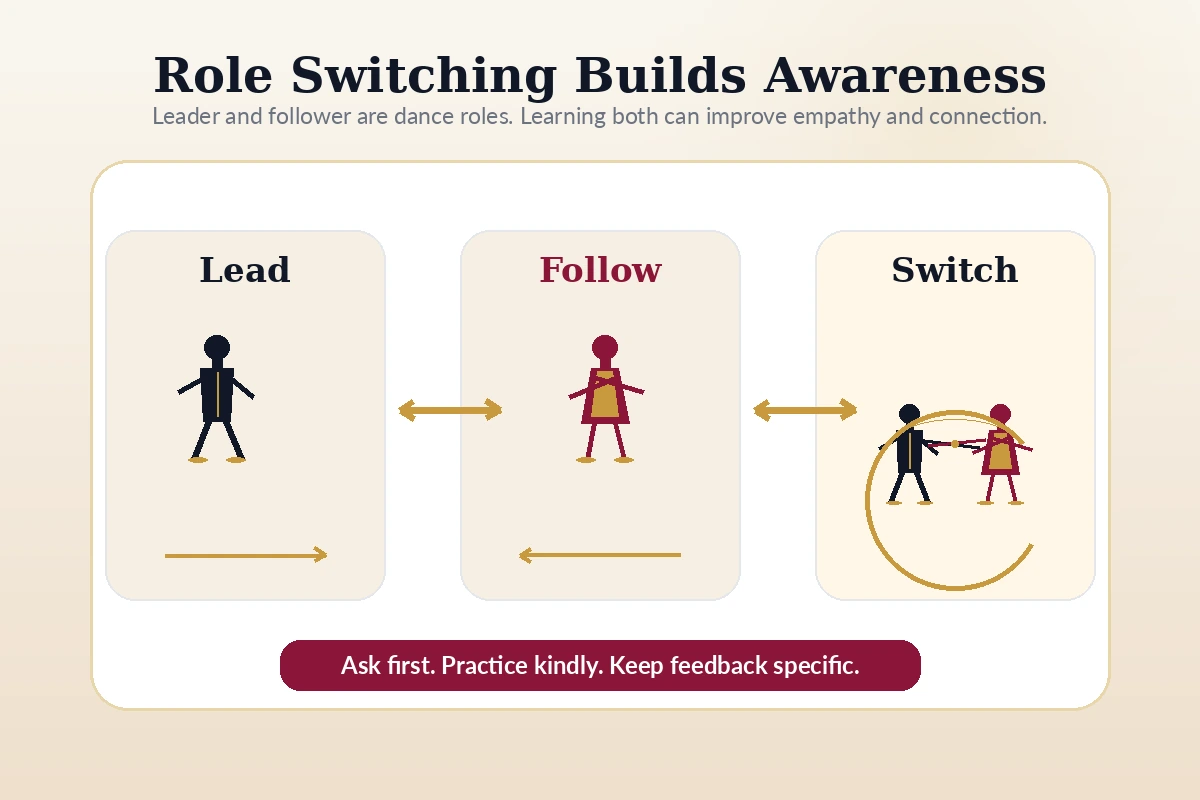
Role-switching awareness drill
- Goal
- Build empathy for both roles.
- Time
- 5–10 minutes.
- How
- Practice the same simple action, then switch roles. Discuss what felt clear and what felt confusing. Keep feedback kind and specific.
- Notice
- Leaders often learn how much followers need preparation. Followers often learn how hard it is to lead clearly without force.
- Common mistake
- Turning role switching into a critique session.
- Music
- Any slow, steady playlist.
Music playlist drill
- Goal
- Connect partner communication to rhythm.
- Time
- 10 minutes.
- How
- Pick one playlist and one drill. Practice only that drill for one song. Then write down what changed when the music changed.
- Notice
- Some songs make weight transfer easier; others reveal rushing.
- Common mistake
- Changing songs too quickly instead of practicing through one complete track.
- Music
- Waltz, Rumba, Foxtrot, Swing, Cha Cha, Salsa, or Bachata depending on your dance goal.
Style differences: Smooth/Standard vs Latin/Rhythm vs social dances
Lead and follow changes slightly by dance style. The core idea is the same, but the body relationship, frame, rhythm, and amount of open work can feel different.
Smooth and Standard
In Waltz, Foxtrot, Tango, Viennese Waltz, and Quickstep, dancers often use a more structured frame and closed-position relationship, especially in International Standard. The connection may feel continuous, with shared direction, travel, rotation, and body flight.
For beginners, Waltz and Foxtrot are useful because they reward calm timing, steady frame, and clear weight changes.
Latin and Rhythm
In Rumba, Cha Cha, Mambo, Bolero, Samba, Paso Doble, and Jive, the connection may feel more compact and rhythm-driven. Partners often use hand/arm connection, body rhythm, weight timing, and clearer changes between open and closed positions.
Rumba is especially useful for practicing slow, controlled weight transfer. Cha Cha is useful for rhythm and responsiveness.
Social dances
In East Coast Swing, Salsa, Bachata, and other social dances, lead and follow often depends on adaptable holds, rhythm, floor awareness, invitation etiquette, and comfort. The connection may be lighter, more elastic, or more visual depending on the dance.
Social dancers benefit from learning both clarity and restraint. Not every partner wants the same size step, speed, hold, or amount of styling. Explore East Coast Swing, Salsa, Bachata, and social dance etiquette.
Wedding first dance
For a wedding first dance, simple and calm connection usually matters more than many moves. A few clear weight changes, a comfortable hold, one turn, and a clean ending can feel better than complicated choreography with tense lead and follow.
Practice with music
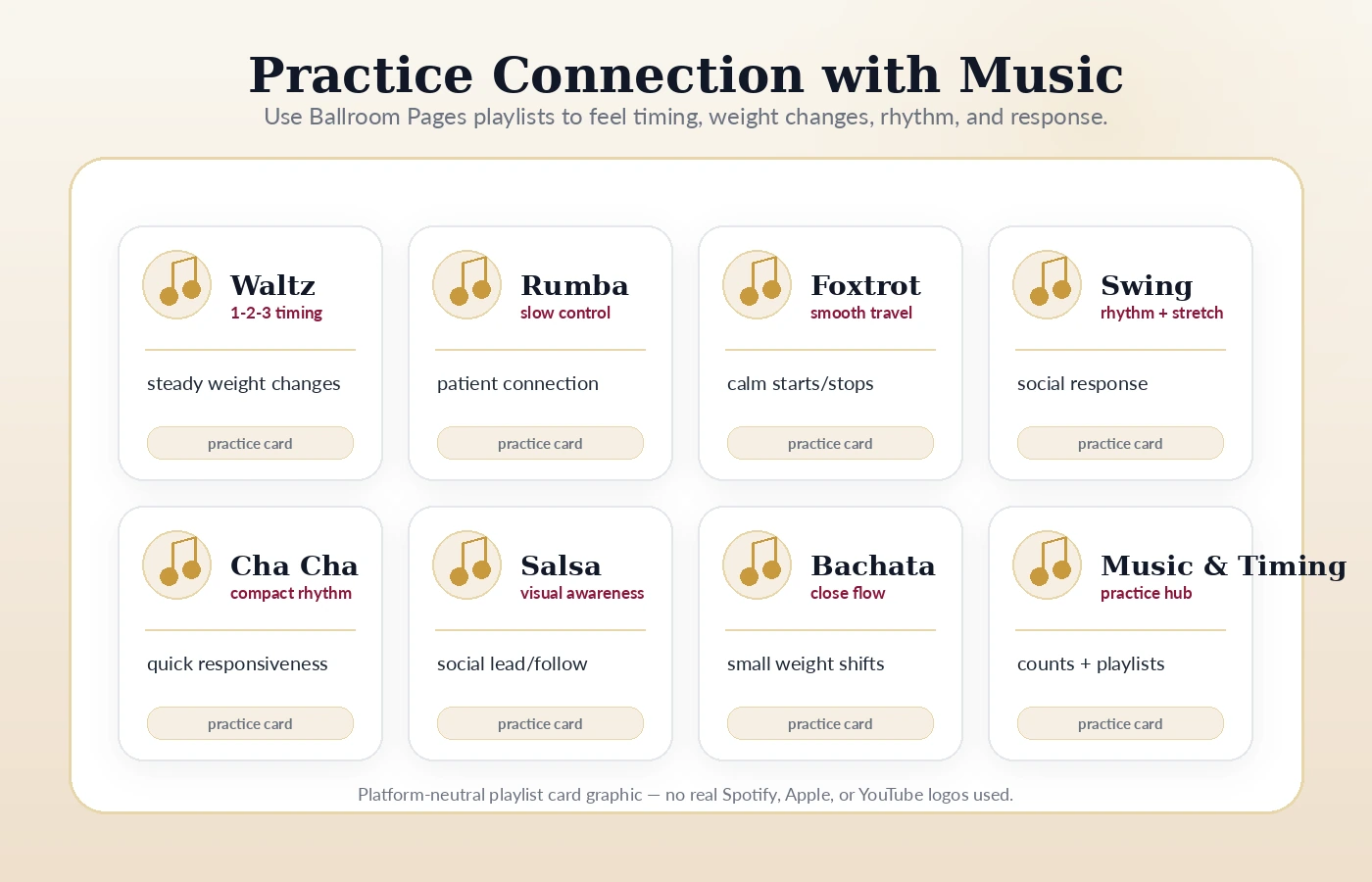
Music makes lead and follow more honest. If the couple is not sharing timing, the connection usually feels heavy or rushed. Use playlists as practice tools, not background noise.
-
Slow music for weight changes
Use slow music when you are learning to shift weight, wait, and respond. The goal is not to dance many patterns. The goal is to feel when both partners arrive on balance.
Slow Waltz (Apple) General slow playlist coming soon
-
Waltz for steady 1-2-3 timing
Waltz is useful because the count is clear: 1-2-3. Practice side-to-side weight changes, start/stop timing, and small box-step actions.
-
Rumba for slow connection and weight transfer
Rumba helps beginners feel controlled weight changes, compact movement, and patient connection.
-
Foxtrot for smooth traveling connection
Foxtrot is useful when you want to practice traveling without rushing.
-
Swing for rhythm and responsiveness
Swing is helpful for rhythm, stretch/release, and social responsiveness.
-
Cha Cha for compact rhythm
Cha Cha is useful for compact rhythm and quick response.
-
Salsa & Bachata for social connection
Salsa and Bachata can be useful for social connection, visual awareness, and adaptable holds. Verified Ballroom Pages playlists for these styles are on the way.
Salsa playlist URL needed Bachata playlist URL needed
-
All playlists & platforms
Browse every Ballroom Pages playlist across Spotify, Apple Music, and YouTube, plus the Telegram music channel.
Lead and follow etiquette
Lead and follow should make dancing feel safer, clearer, and more enjoyable. Etiquette matters as much as technique.
- Ask before correcting a partner.
- Do not yank, grip, shove, or force.
- Respect comfort levels and personal space.
- Treat social dancing as collaborative.
- Make role switching welcome when both partners want it.
- Let partners learn both roles if they choose.
- Do not assume leader means “in charge.”
- Do not assume follower means “passive.”
- Thank your partner after the dance.
- If something feels unsafe or uncomfortable, say so clearly.
A good leader does not overpower. A good follower does not have to guess. A good partnership makes both dancers feel respected. For more on shared-floor courtesy, see social dance etiquette.