
What solo ballroom practice can and cannot do
Solo practice is powerful for everything that lives in your own body—timing, balance, posture, and footwork. It is weaker for everything that lives between two people. Knowing the difference keeps your practice honest and useful.
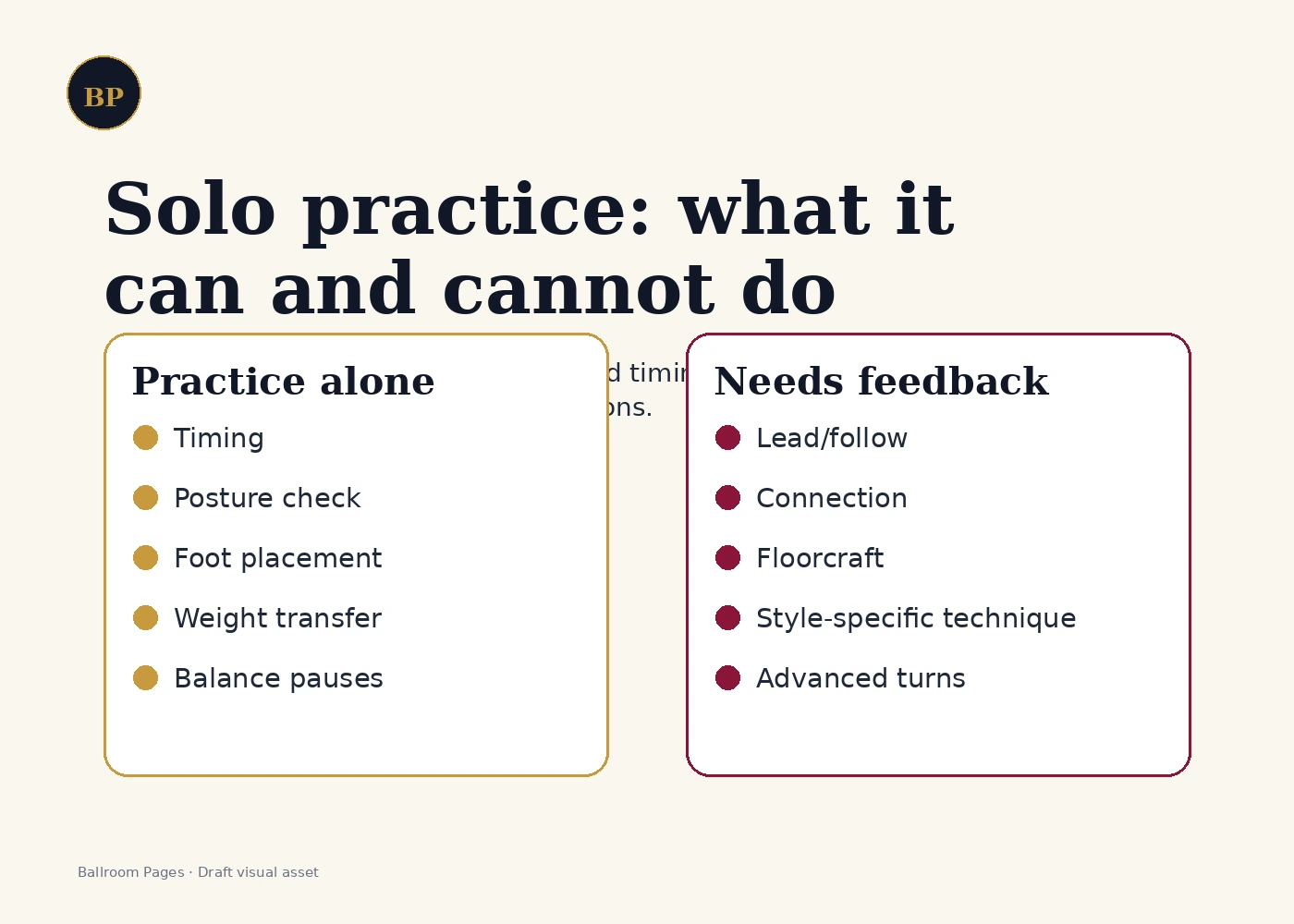
| Skill | Practice alone? | Needs partner/instructor? | Best next step |
|---|---|---|---|
| Hearing the beat | Yes | Sometimes | Use the counting guide and practice with music |
| Counting Waltz, Cha Cha, Rumba, Foxtrot | Yes | Sometimes | Link counts to simple steps |
| Weight transfer | Yes | Yes for style-specific detail | Practice step-and-freeze drills |
| Basic foot placement | Yes | Yes for accuracy | See ballroom footwork technique |
| Posture and frame shape | Yes | Yes | Use a mirror or video, then ask an instructor |
| Lead/follow response | Partly | Yes, always | Practice readiness alone, connection with a partner |
| Balance and simple turns | Yes, carefully | Yes for technique | Keep turns small and slow |
| Floorcraft | Partly | Yes in real social settings | Practice compact movement, then apply on a social floor |
| Rise and fall | Basic awareness only | Yes | See the rise and fall guide |
| Cuban motion / body action | Basic awareness only | Yes | See the Cuban motion guide |
How to set up a safe practice space
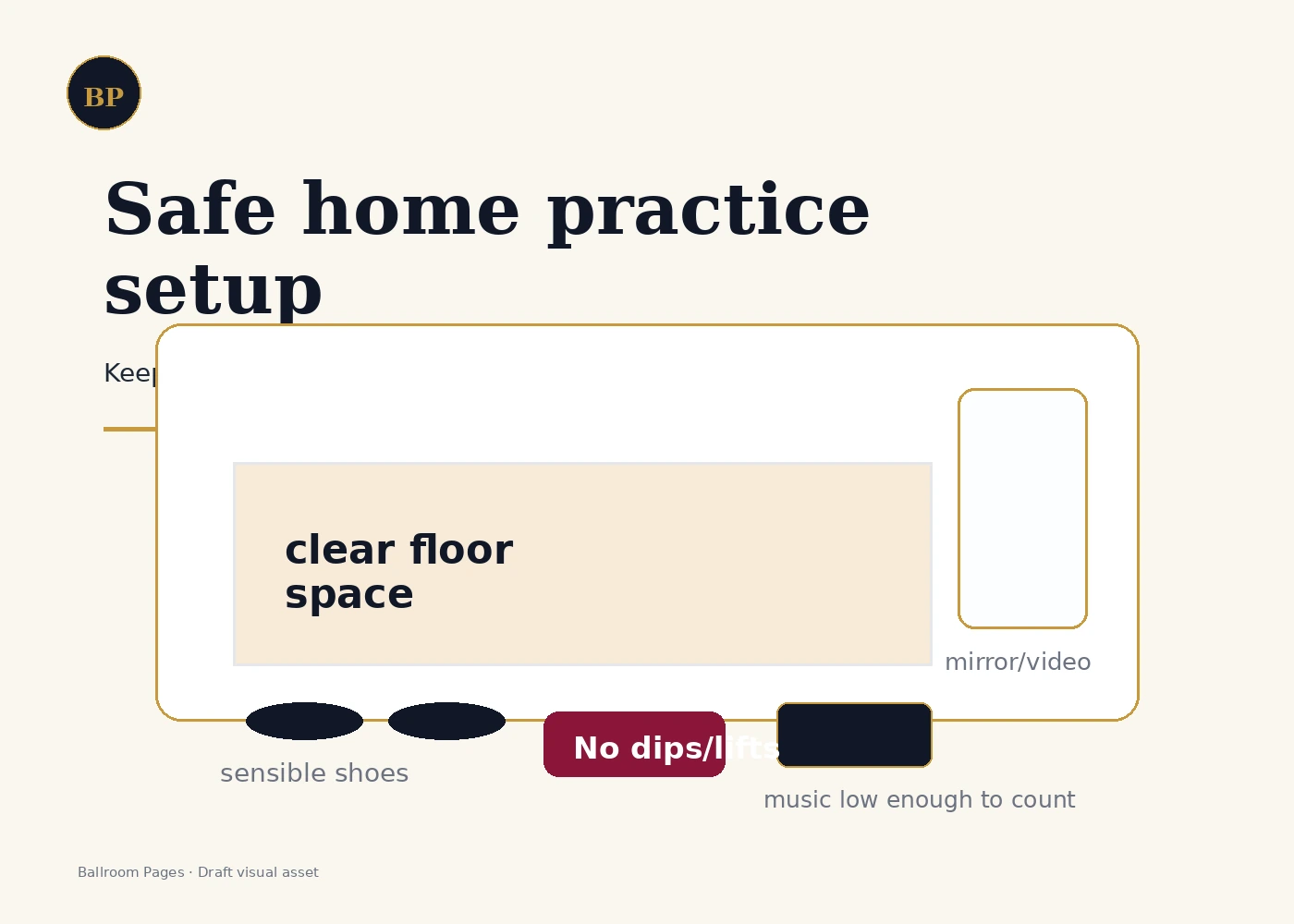
Choose a small clear area
A few square feet with nothing to trip over is plenty. Move sharp furniture and clear the floor.
Use sensible shoes and flooring
Practice on a stable, non-slip surface. See ballroom dance shoes for beginners; avoid slippery socks and sticky soles.
Use a mirror or video carefully
A mirror or short phone video helps you check posture and balance—just don’t fixate on it the whole time.
Keep music at a reasonable volume
Loud enough to feel the beat, not so loud you cannot count out loud or hear yourself.
Avoid advanced tricks alone
No spins-to-exhaustion, dips, drops, or lifts on your own. Build compact movement and apply it on a real floor — see floorcraft.
The 5-minute solo practice reset
Short on time? This ordered five-minute reset covers the essentials. Do it slowly, and stop early if anything feels off.
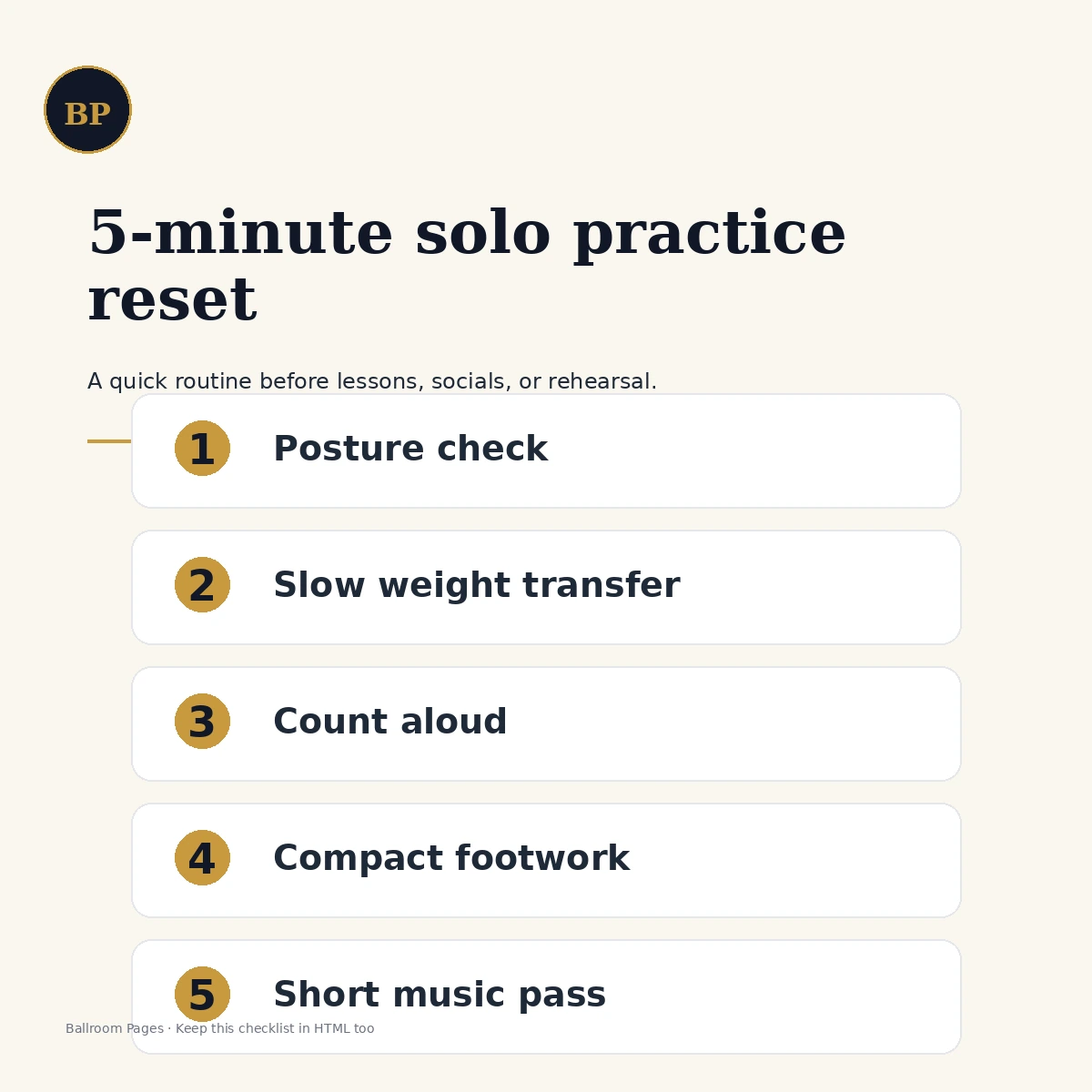
- Minute 1Posture check. Stand tall, soften tension, and find your balanced standing posture.
- Minute 2Slow weight transfer. Shift weight foot to foot, naming which foot has your weight.
- Minute 3Count aloud. Count a simple rhythm out loud until it feels steady.
- Minute 4Compact footwork. Add small, controlled steps, keeping movement clear and unhurried.
- Minute 5Add music. Play a steady track and repeat on the beat, once the steps are clear.
Take the drills with you
Download the Solo Ballroom Practice Drill Sheet and pick one timing drill, one footwork drill, one posture drill, and one music pass per session.
Download the Solo Ballroom Practice Drill SheetTiming drills
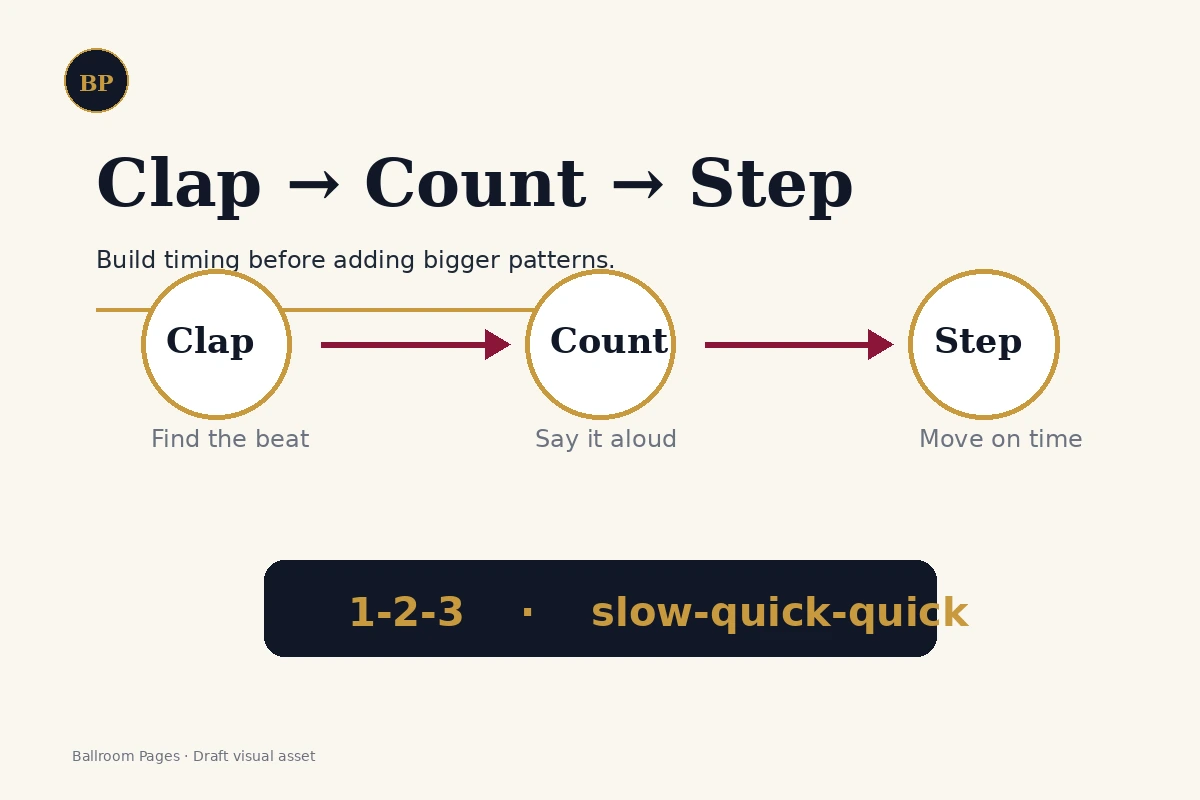
Drill 1: Clap, count, step
Clap the beat, count it out loud, then add a simple step on the beat. Layer one at a time.
Drill 2: Waltz 1-2-3
Count 1-2-3 with a stronger “1” and step small to it. See the Waltz guide.
Drill 3: Slow/quick awareness
Say “slow” (two beats) and “quick” (one beat) over a steady pulse before stepping.
Build the underlying skill with how to count ballroom dance music.
Footwork and weight-transfer drills
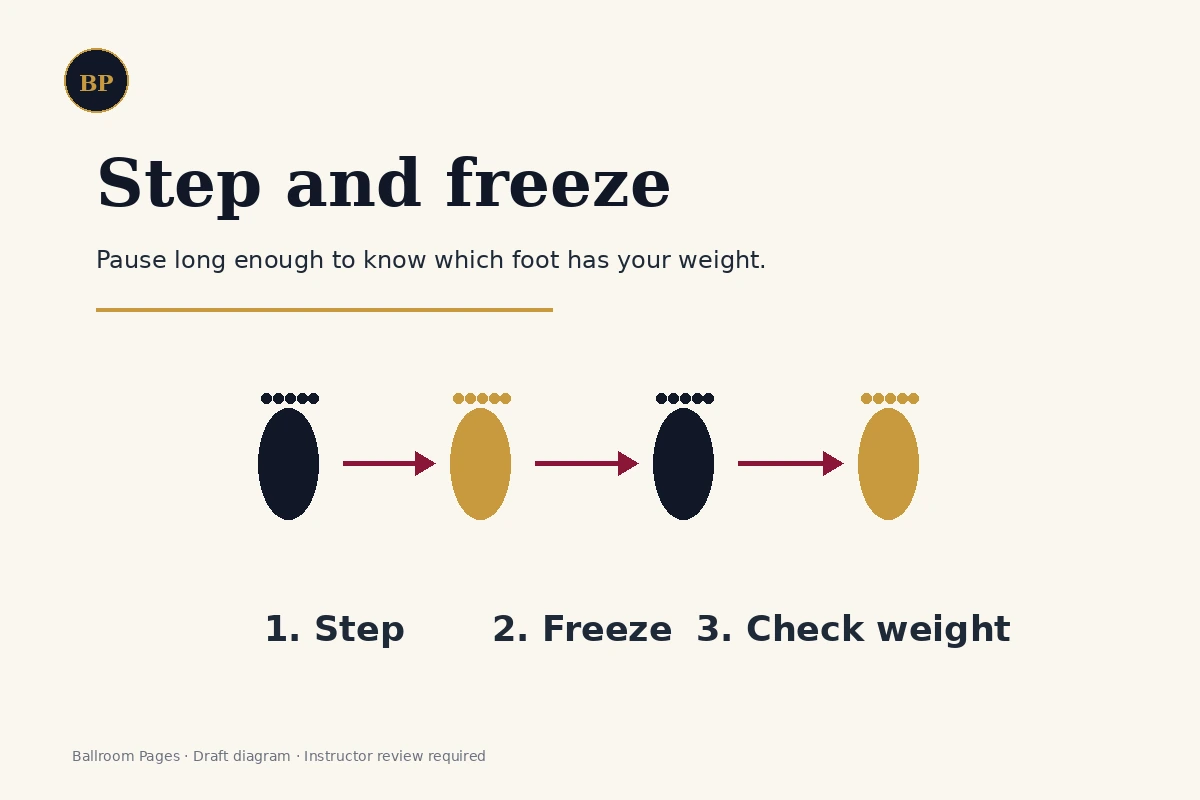
Drill 1: Step and freeze
Step, then freeze and check which foot holds your weight. Confirm balance before the next step.
Drill 2: Heel-toe awareness
Notice which part of the foot lands first, slowly, without forcing a style-specific action.
Drill 3: Ball-flat pressure
Feel the pressure roll from the ball to a flat foot on a forward step.
Drill 4: Side-step transfer
Step to the side and fully transfer weight before closing or stepping again.
Drill 5: Small box drill
Trace a compact box pattern slowly, completing each weight change.
Frame and posture drills
Drill 1: Wall alignment check
Stand near a wall to sense tall, stacked posture without arching or collapsing.
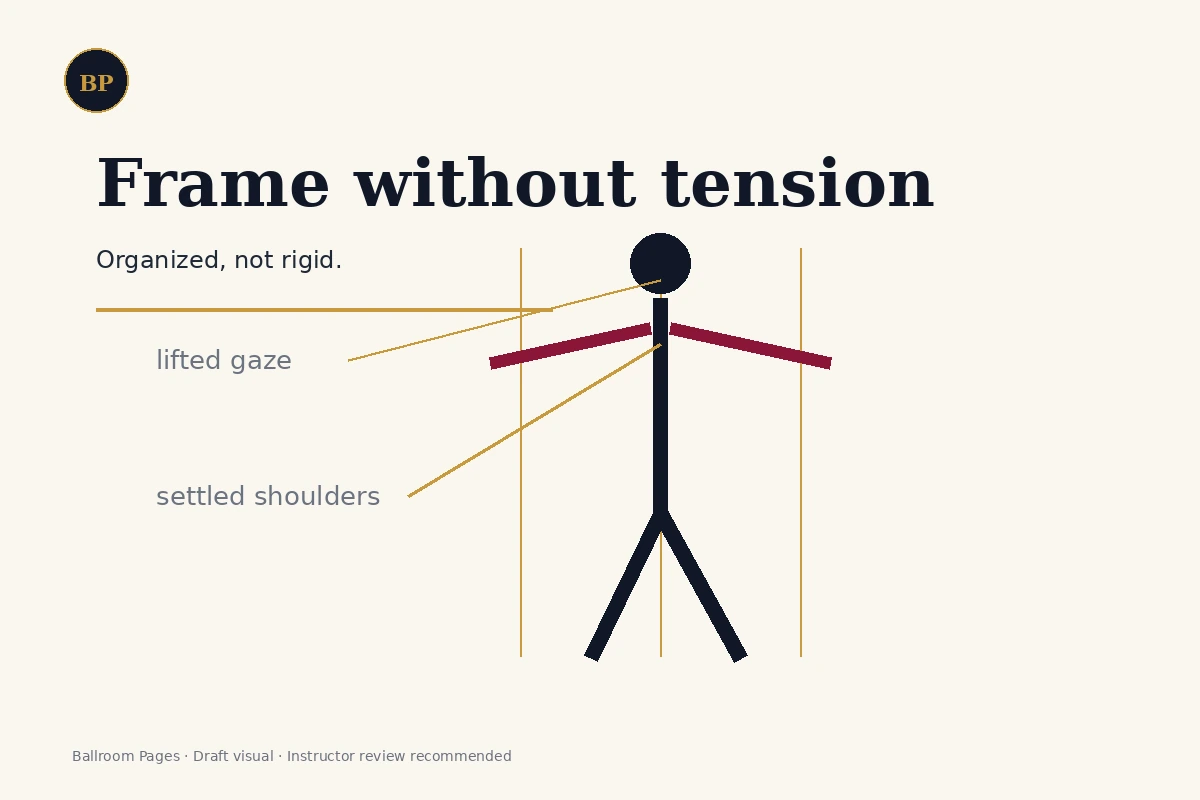
Drill 2: Frame shape without tension
Shape a relaxed, supported frame; hold it briefly without gripping or lifting the shoulders.
Drill 3: Head and gaze check
Keep your head level and gaze up and out, not down at your feet.
Drill 4: Mirror or video review
Record a few seconds, look for balance and line, then change one thing at a time.
For the full topic, read frame and posture. Solo work supports readiness, but real connection needs lead and follow with a partner.
Balance and turn drills
Drill 1: Balance pause
Step and hold a balanced position for a moment. Build steadiness before adding rotation.
Drill 2: Quarter-turn control
Turn a small quarter-turn slowly, keeping balance and posture. No momentum.
Drill 3: Spotting awareness
Pick a gentle focal point to reduce dizziness on small turns. Keep it slow.
Drill 4: Slow rotation with a stop
Rotate gradually, then stop cleanly on balance rather than spinning continuously.
Stop if dizzy, unstable, or uncomfortable. Avoid fast spins, dips, drops, or dramatic turns without instruction.
Smooth and Standard solo drills
- Waltz/Foxtrot walking awareness: walk smoothly and continuously, feeling travel through the standing leg.
- Controlled lowering awareness: sense a gentle lower before moving (basic awareness only—see the rise and fall guide).
- Travel line awareness: imagine a line of travel and keep your small steps moving along it.
- Compact box pattern: trace a small box for Waltz or Foxtrot slowly.
- Tango stillness and control: practice a grounded, level, deliberate quality (see Tango). Tango stays flat—no rise and fall.
Latin and Rhythm solo drills
- Rumba/Cha Cha weight-transfer drill: shift weight slowly and completely for Rumba and Cha Cha.
- Ball-of-foot pressure drill: feel pressure into the ball of the foot before settling weight.
- Compact triple-step awareness: mark a small triple-step rhythm without rushing.
- Side-action awareness: sense gentle lateral movement as weight settles (basic awareness only—see Cuban motion).
- Salsa and Bachata small-space drill: practice compact timing for Salsa and Bachata in a tight space.
Small-space social dance drills
Compact movement drill
Keep every step small enough to dance in a crowded space without colliding.
Direction-change drill
Practice changing direction smoothly in a tight area to build floor awareness.
Floorcraft awareness drill
Imagine other couples and adjust your path. Apply it for real with floorcraft.
Wedding entrance and ending practice
Rehearse a calm entrance, starting position, and a clean ending—useful for a first dance.
10-, 15-, and 30-minute solo practice routines
Pick a length that fits your day. Keep each block short and clear; stop a block early if the movement gets messy.
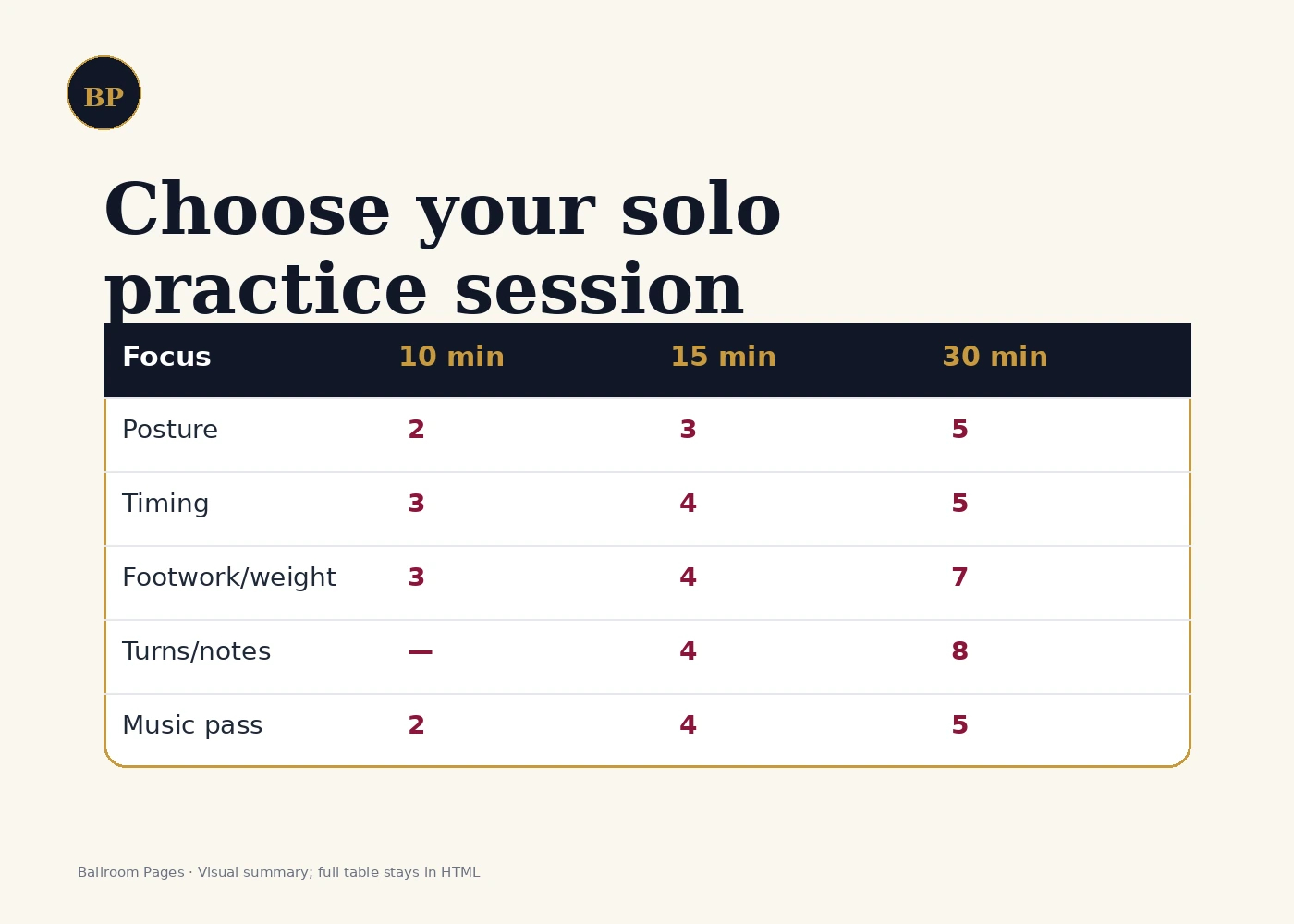
10-minute beginner session
- 2 min posture
- 3 min timing
- 3 min weight transfer
- 2 min music
15-minute technique focus
- 3 min posture/frame
- 4 min footwork
- 4 min weight transfer
- 2 min turns
- 2 min notes
15-minute music focus
- 3 min clap/count
- 4 min step on beat
- 4 min style count
- 4 min music pass
30-minute full solo practice
- 5 min reset
- 5 min timing
- 7 min footwork/weight
- 5 min posture/frame
- 5 min style drill
- 3 min notes
For weekly and monthly planning across solo and partner work, use the ballroom dance practice routine.
Common solo practice mistakes and better choices
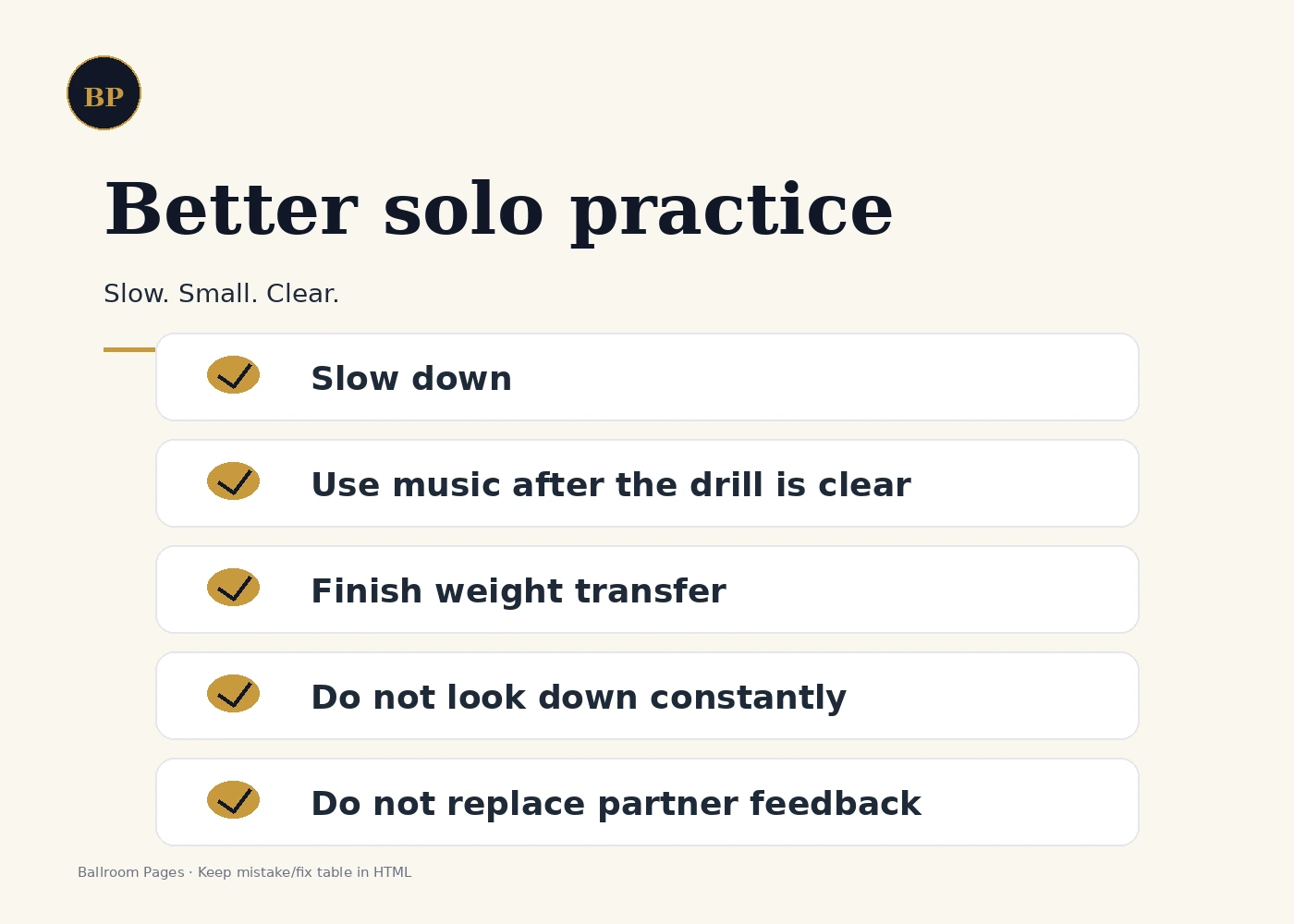
| Mistake | Why it causes problems | Better choice |
|---|---|---|
| Practicing too fast | Errors get baked in before they are noticed | Slow down until the movement is clear |
| Skipping music entirely | Timing never connects to real rhythm | Add steady music once the step is clear |
| Using only music and no technique focus | Music hides unclear movement | Drill without music first, then add it |
| Looking down constantly | Posture collapses and balance suffers | Keep your gaze up; check with a mirror briefly |
| Drilling mistakes repeatedly | You rehearse the error | Simplify, fix one thing, then repeat |
| Using too much space | Steps grow too big for social floors | Keep drills compact |
| Ignoring posture | Everything else gets harder | Reset posture at the start of every block |
| Skipping weight transfer | Steps feel unbalanced and rushed | Complete every weight change before moving on |
| Practicing advanced turns/dips alone | Risk of falls or strain | Keep turns small and slow; learn the rest with an instructor |
| Assuming solo practice replaces partner work | Connection and lead/follow never develop | Use solo work to prepare, then practice with a partner |
Practice solo drills with Ballroom Pages playlists
Music makes solo practice feel more like dancing. Use steady Ballroom Pages playlists to practice timing, weight transfer, footwork consistency, and musicality—but only after the drill is clear enough that music does not hide the problem. Browse everything in the Ballroom Pages playlists hub and the Music & Timing section.
Waltz / Foxtrot — posture, smooth walking, controlled timing
Slow Waltz (Spotify)
Slow Waltz 2 (Spotify)
Slow Foxtrot
Rumba / Cha Cha — weight transfer and Latin/Rhythm timing
Swing / Salsa / Bachata — social-dance timing and compact movement
American Rhythm Swing
Swing / Salsa / Bachata (YouTube)
Find these in the full playlist hub while the YouTube links are verified.
More resources
BallroomPages Music on Telegram
Playlist updates and listening channel. (confirm final ownership before launch)
All Ballroom Pages playlists