
What is floorcraft?
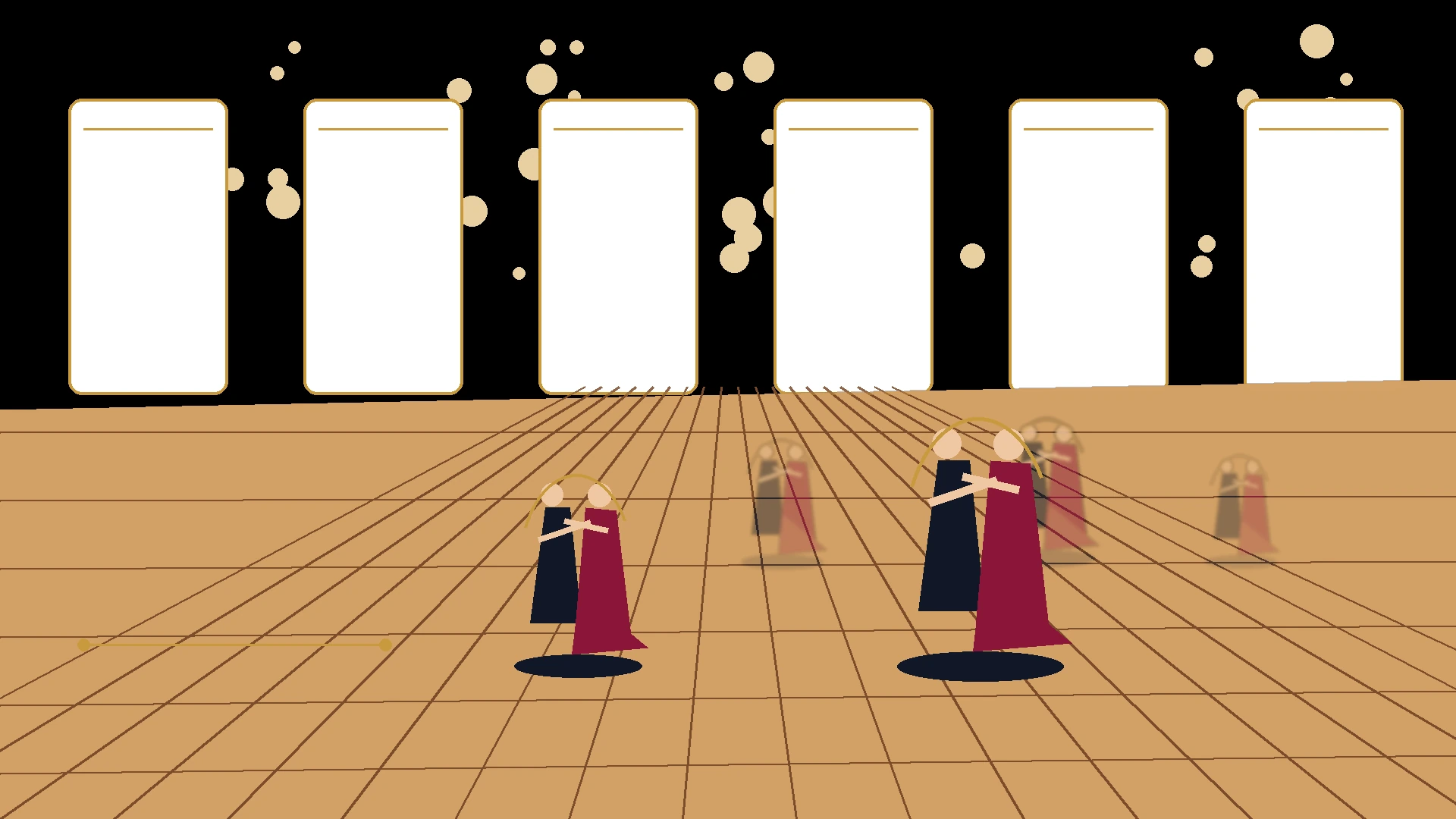
Floorcraft is the difference between “I know this step” and “I can dance this step safely around other couples.”
In a private lesson or empty studio, you might have room for full stride, wide turns, and uninterrupted patterns. At a social dance, wedding reception, or crowded class party, the floor changes every few seconds. Couples slow down, stop, rotate, pass, enter, leave, and change direction.
Good floorcraft means you can adapt without panic. You may shorten a step, choose a simpler figure, wait for a safer opening, or redirect your movement before a collision happens.
Think of floorcraft as three skills working together:
- Traffic awareness: noticing where other couples are and where they are likely to go.
- Space management: choosing steps that fit the room you actually have.
- Partner care: keeping your partner comfortable, balanced, and protected from sudden surprises.
Floorcraft is closely related to social dance etiquette, but it is more specific. Etiquette covers the whole social experience. Floorcraft focuses on how you share the physical dance floor.
The line of dance
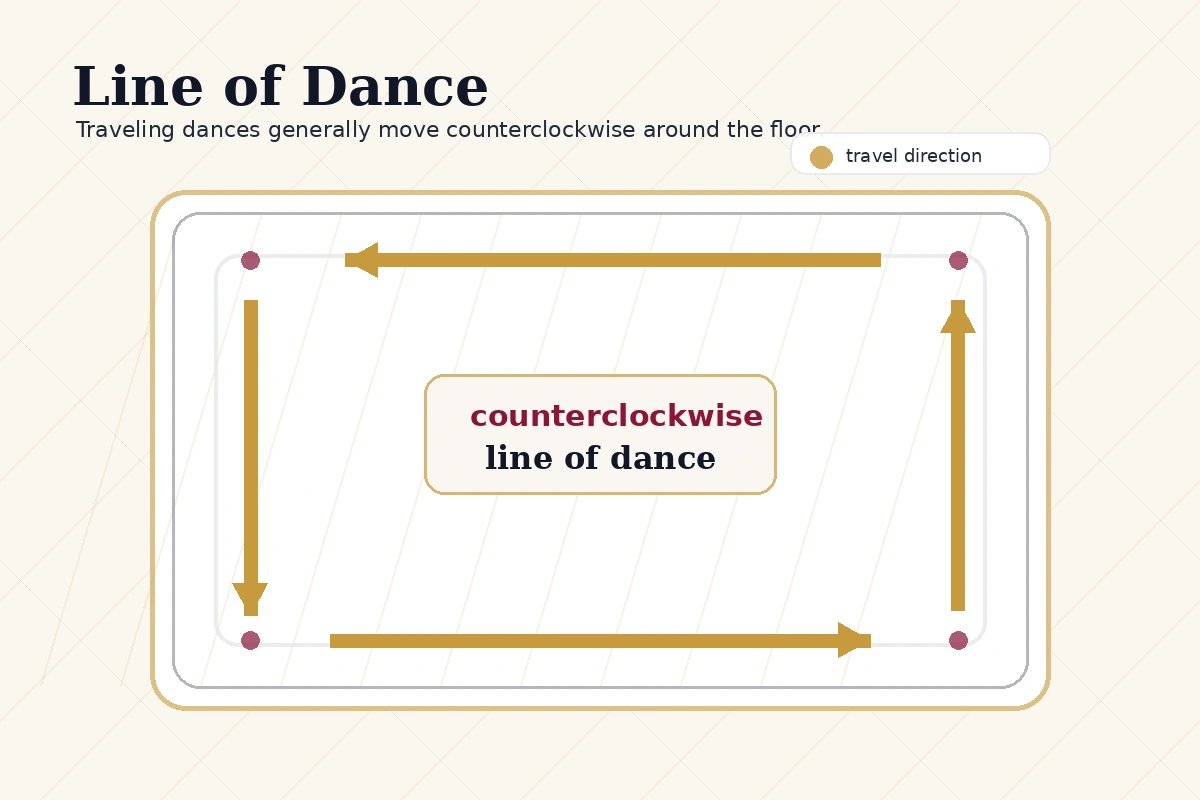
For traveling ballroom dances, dancers generally move around the room in a counterclockwise flow called the line of dance. This gives everyone a shared direction, much like traffic on a road.
You will use line of dance most clearly in dances such as Waltz, Foxtrot, Tango, Viennese Waltz, and Quickstep.
The goal is not to race around the outside of the floor. The goal is to move predictably enough that other couples can share the same space.
Beginner rule: when you are dancing a traveling dance, face the same general flow as everyone else, keep your steps smaller than you think you need, and avoid stopping suddenly in the main traffic path.
Dance floor zones
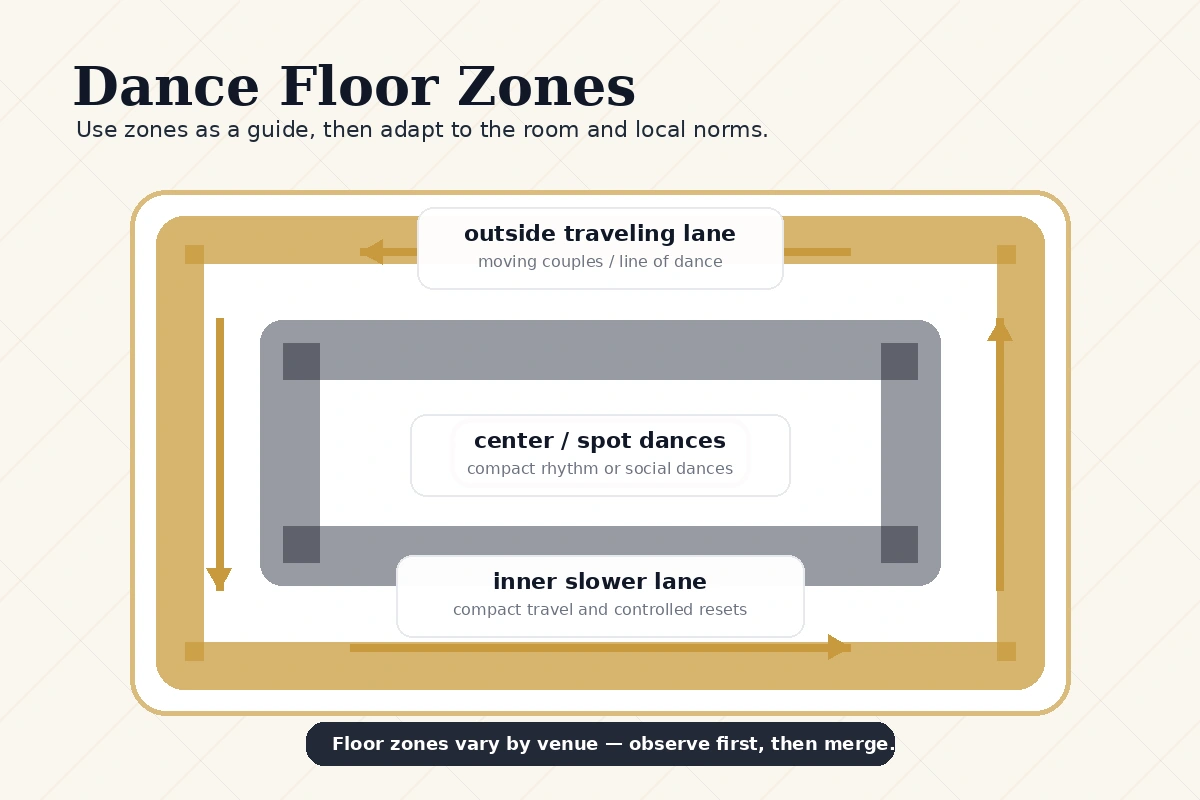
Not every part of the floor is used the same way. At many ballroom socials, the floor naturally divides into zones.
Outside lane
The outside lane is often used by couples who are traveling more continuously. This can include experienced dancers, faster-moving couples, or dances that naturally progress around the room.
Use the outside lane when you can move with the flow without blocking others. Avoid using it for teaching, stopping, or practicing a figure that requires repeated restarts.
Inner lane
The inner lane is often more comfortable for newer dancers or couples moving more slowly. You can still travel, but you have more flexibility to shorten patterns, pause briefly, or reset.
Center and spot-dance areas
The center is often better for compact or spot-based movement, especially at mixed social events. Salsa, Bachata, Rumba, Cha Cha, and East Coast Swing may stay more compact than Waltz or Foxtrot, depending on the venue and music.
This is not a universal rule. A studio party, wedding reception, Latin night, and ballroom social may all organize the floor differently. Before dancing, look at how the room is already moving.
How to enter, exit, and merge onto the dance floor
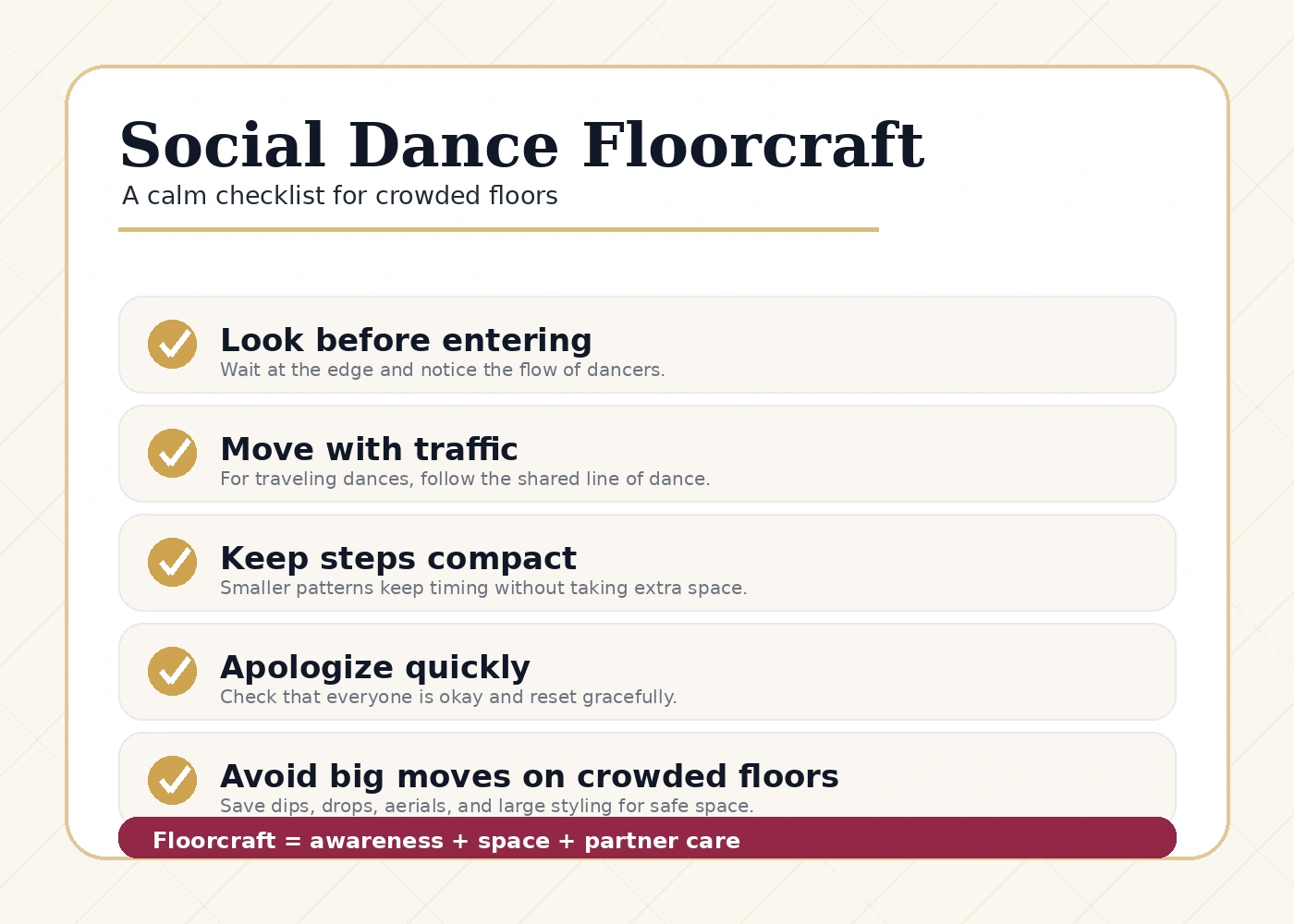
- Wait at the edge. Do not step backward into traffic or pull your partner onto the floor without looking.
- Watch one full phrase or several measures. Notice the direction, speed, and spacing of nearby couples.
- Choose a gap. Enter where you can begin with a small, simple pattern.
- Move with the flow. For traveling dances, merge into the counterclockwise line of dance.
- Start compact. Your first figure should be easy to stop, redirect, or shorten.
- Do not freeze in traffic. If you need to reset, move toward a safer inside area or edge when possible.
- Exit with awareness. Leave along the edge or during a natural break in the music, not by cutting across moving couples.
A calm entrance tells your partner and the room, “We are part of the flow.”
Leader and follower responsibilities
What leaders should do
Leaders usually have the clearest view of where the couple is going, so they often carry more responsibility for navigation. That does not mean forcing the follower through traffic. It means choosing figures that fit the space.
- Look ahead without staring over the follower’s shoulder the entire dance.
- Plan one or two steps ahead, not ten.
- Use smaller patterns when the floor is crowded.
- Protect the follower’s space, especially when the follower is moving backward or turning.
- Replace a big figure with a basic, hesitation, or compact change of direction.
- Avoid dips, drops, aerials, large lunges, and high-energy styling on crowded floors.
- Apologize quickly if contact happens.
The most elegant navigation often looks simple. A leader who can make a basic step feel musical, safe, and comfortable is doing real floorcraft. Build this with lead and follow connection and frame and posture.
What followers should do
Followers are not passive in floorcraft. Even when the leader is choosing direction, followers contribute through balance, responsiveness, frame, and communication.
- Maintain enough frame and tone to respond clearly.
- Avoid anticipating the next figure.
- Keep steps controlled instead of drifting larger than the lead.
- Stay aware of nearby bodies without taking over the dance.
- Communicate discomfort clearly and politely.
- Let the leader know if there is traffic or danger the leader cannot see.
- Recover calmly if a pattern changes suddenly.
Useful phrases: “There’s someone behind us.” · “Let’s keep it smaller.” · “Can we avoid dips on this floor?” · “I need a moment to reset.”
Good floorcraft should make both partners feel safe, not trapped.
Floorcraft by dance style
| Dance style | How floorcraft usually changes |
|---|---|
| Waltz | Travels with line of dance. Keep rotations smaller on crowded floors and avoid drifting into other couples during turns. |
| Foxtrot | Often travels smoothly around the room. Use compact walking patterns and avoid long, sweeping steps when traffic is tight. |
| Tango | Can feel sharp and directional. Use deliberate pauses carefully and avoid sudden shape changes in another couple’s path. |
| Viennese Waltz | Fast rotation makes floorcraft more demanding. Beginners should avoid crowded Viennese Waltz floors until they can control direction and speed. |
| Quickstep | Fast and traveling. Keep it simple on social floors, and do not use large running patterns unless there is plenty of space. |
| East Coast Swing | Usually more compact than traveling ballroom dances. Keep turns contained and avoid swinging arms into nearby couples. |
| Salsa | Often danced in a slot or compact space depending on the event. Maintain your lane and avoid expanding into neighboring couples. |
| Bachata | Often compact and social. Keep styling small on crowded floors and respect personal space. |
| Rumba | Generally more spot-based. Use the center or inner areas when appropriate and avoid blocking traveling dancers. |
| Cha Cha | Compact rhythm makes it useful on crowded floors, but arm styling and sharp directional changes still need awareness. |
Want the bigger picture? Compare the major ballroom dance styles.
Crowded floor strategies
A crowded floor is not a sign that you should stop dancing. It is a sign that you should dance differently.
Shrink your step size
Cut steps to half their usual length. Smaller movement keeps you balanced and keeps your partner inside your shared space.
Use basic patterns
Lean on figures you can stop or redirect instantly. Basics are not boring on a packed floor—they are the safest, most musical choice.
Rotate less
Big turns travel into other couples’ space. Reduce rotation, or break a full turn into smaller, controlled changes of direction.
Pause safely
If the path closes, pause in place with good frame rather than pushing forward. Wait for a clear gap, then continue.
Avoid showy moves
Crowded social floors are not the place for aerials, lifts, deep dips, drops, high kicks, aggressive lunges, or large arm styling. Even if you can do the move, nearby dancers did not consent to being part of it.
Apologize quickly
If contact happens, a brief “sorry” and a quick safety check is enough. Then keep dancing—no long stops in traffic.
Common floorcraft mistakes and fixes
| Mistake | Why it causes problems | Better choice |
|---|---|---|
| Entering the floor without looking | Other couples may already be moving into that space | Wait at the edge, watch the flow, and merge into a clear gap |
| Dancing against the line of dance | It surprises couples who expect counterclockwise traffic | Move with the room unless a teacher or host gives different instructions |
| Stopping in the outside lane | Traveling couples need predictable movement | Reset closer to the inside or edge when possible |
| Taking full-size steps on a crowded floor | Large steps invade other couples’ space | Cut your step size in half and use basic figures |
| Using dips or drops in traffic | Nearby dancers may be struck or forced to dodge | Save dips and tricks for open space or controlled settings |
| Looking only at your feet | You react too late to traffic | Use soft visual awareness and trust your basics |
| Anticipating the lead | The couple becomes harder to redirect | Stay responsive and wait for the lead |
| Teaching in the middle of traffic | It blocks the floor and distracts both partners | Move off the floor or save feedback for after the song |
| Apologizing too dramatically | It disrupts the dance and can embarrass others | Give a quick apology, check for safety, and move on respectfully |
Practice drills for better floorcraft
You do not need a crowded ballroom to practice floorcraft. Start with controlled drills, then bring the skill into real social dancing.
Small-space practice
Dance a basic figure inside a taped-off square or a small rug. Keep every step inside the box so compact movement becomes a habit.
Traffic awareness drill
Place a few objects (or ask friends to stand still) as “couples,” then dance around them without bumping. Practice glancing ahead and redirecting early.
Basic pattern reduction drill
Take one figure and dance a smaller version of it: shorter steps, less travel, less rotation. Learn how little movement you actually need.
Pause and restart drill
Dance a basic, pause cleanly with good frame, then restart on the next clear count. This builds calm stops for traffic.
Music-size drill
Use one song and dance it three ways: normal step size, small social-floor step size, and very compact crowded-floor step size.
Staying on time while you shrink your movement is the real skill—learn it in how to count ballroom dance music.
Practice floorcraft with danceable music
Music practice is one of the easiest ways to make floorcraft feel natural. Choose a danceable song, then practice changing your movement size without losing timing.
Start with slower or steadier music, such as Waltz, Foxtrot, or Rumba. Then add faster or more directional dances only when you can stay calm and controlled. Use Ballroom Pages playlists to practice:
- Waltz and Slow Waltz for line-of-dance awareness
- Foxtrot for smooth traveling control
- Tango for directional clarity and compact pauses
- Rumba or Cha Cha for compact rhythm practice
- Swing, Salsa, or Bachata for slot/spot awareness at social events
-
Spotify
Slow Waltz
For line-of-dance awareness and 3/4 timing.
-
Spotify
Foxtrot & Tango
Smooth traveling control and directional clarity.
-
Spotify
Quickstep
Practice keeping fast traveling dances compact.
-
Apple Music
Slow Waltz
The same line-of-dance practice on Apple Music.
-
Telegram
BallroomPages Music
Playlist updates and music discovery.
More Ballroom Pages playlists—including Rumba, Cha Cha, Swing, Salsa, and Bachata—are being organized in the Music & Timing hub. Explore Music & Timing