
Social Dancing
Social Dancing Made Comfortable
Etiquette, invitations, floorcraft, what to wear, and beginner-friendly social dance styles explained in plain English—so you can walk into a social dance with more confidence and less guesswork.
Beginner-friendly. Venue-aware. Practical, not preachy.
Start here
Start here if you’re new to social dancing
Use this simple path the first time you attend a social dance.
-
1. Arrive early enough to settle in
Give yourself time to check the room, change shoes, find water, and see how people are using the floor.
-
2. Watch one or two songs first
Notice where dancers enter, how crowded the floor is, and whether the music is ballroom, Latin, swing, salsa, bachata, or mixed.
-
3. Ask simply and kindly
A plain “Would you like to dance?” works better than a dramatic invitation.
-
4. Keep the dance simple
Choose small, clear movements. A comfortable basic step is better than a complicated pattern that does not fit the floor.
-
5. Thank your partner
A simple “Thank you” at the end keeps the night friendly, even if the dance was imperfect.
Etiquette
Etiquette essentials
Good etiquette is not about memorizing rigid rules. It is about making the dance comfortable for both people and respectful of the room.
-
Be kind before being impressive
Social dancing is not a showcase of how many patterns you know. It is a shared song with another person.
-
Respect every yes and every no
A dance invitation is an invitation, not a demand. If someone says no, answer kindly and move on.
-
Use leader/follower language
Leader and follower are dance roles, not gender rules. Any dancer can learn either role.
-
Do not teach on the social floor
Unless someone asks for help in a practice setting, avoid correcting your partner during a song.
-
Mind hygiene and fragrance
Clean clothes, fresh breath, and deodorant help. Go light on fragrance because some dancers are sensitive to strong scents.
-
Follow local customs
Some scenes dance one song together; others commonly dance two. Some are very role-fluid; some are more traditional. Let the host, instructor, DJ, or organizer set the tone.
Invitations
Asking, accepting, and declining dances
A social dance invitation should feel clear and low-pressure.
Floorcraft
Floorcraft and safety
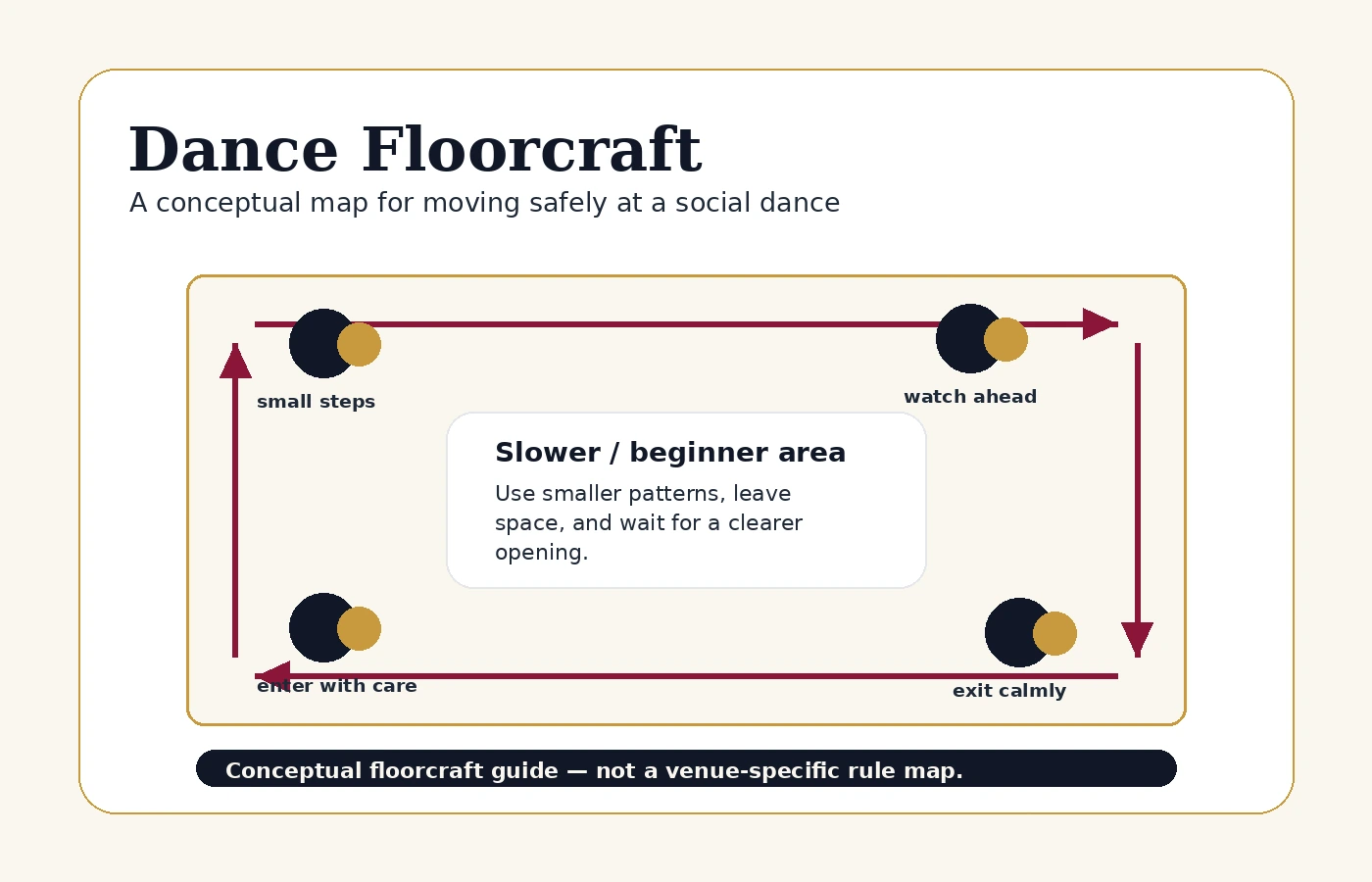
Floorcraft means moving on the dance floor in a way that protects your partner and respects the people around you.
-
Use smaller steps when the floor is crowded
Big patterns feel risky when space is tight.
-
Enter from the edge, not through the middle
Wait for a clear opening before stepping onto the floor.
-
Do not cut across traveling dancers
In ballroom dances like Waltz and Foxtrot, many floors use a counterclockwise line of dance around the room.
-
For slotted dances, protect the slot
In dances like West Coast Swing, dancers often use a slot. Stay aware of nearby slots and adjust to the room.
-
Avoid dips, lifts, aerials, and dramatic drops on crowded social floors
These moves need consent, space, training, and the right setting. A social floor is usually not the place to surprise someone.
-
If something goes wrong, pause kindly
If you bump someone, step on a foot, or lose balance, apologize, reset, and continue only if everyone is okay.
What to bring
What to wear and bring
Choose clothes you can move in, shoes that stay put, and a few small items that keep a long night comfortable.
-
Wear clothes that let you move
Choose something clean, comfortable, and secure enough for turning, stepping, and raising your arms.
-
Choose shoes that stay on your feet
Avoid shoes that slip off, stick to the floor, or slide uncontrollably. If the venue has a wood dance floor, follow its shoe rules.
-
Bring small practical items
Water, mints, deodorant, a small towel, and a spare top can make a long social much more comfortable.
-
Go easy on fragrance
Many dancers are sensitive to strong scents. Fresh and neutral is safer than heavily perfumed.
-
Check the venue tone
A studio practice party may be casual. A ballroom gala may be dressier. A salsa or bachata social may have its own style. When in doubt, neat and comfortable is a good starting point.
Social styles
Beginner-friendly social dance styles
Not every venue plays every style. These dances are common enough that they are worth recognizing.
-
Waltz
Useful at formal ballroom socials and weddings. It travels around the floor and often feels elegant and flowing.
-
Foxtrot
A practical social dance for many classic, swing, and big-band songs. It also travels, so floorcraft matters.
-
Rumba
A slower Latin/Rhythm option that can work well for beginners and wedding couples.
-
Cha Cha
Playful and rhythmic, with a clear energy that works well when the music fits.
-
East Coast Swing
A lively beginner-friendly swing dance often used at social dances and casual parties.
-
Salsa
Common in dedicated salsa socials and Latin nights. Scene customs vary, so watch the floor and follow the local style.
-
Bachata
Popular in Latin social scenes. Respect for space, consent, and comfort is especially important.
-
West Coast Swing
A slotted social dance with its own floorcraft habits and music culture.
Pick a path
Choose your social dance path
Start with the guide that matches the question you are most worried about.
-
Etiquette
Social Dance Etiquette
Learn the core manners that make the floor more welcoming.
Planned guide — coming soon -
Invitations
How to Ask Someone to Dance
Simple scripts, timing, body language, and how to handle a no.
Planned guide — coming soon -
Invitations
How to Decline a Dance Politely
Clear refusal language without guilt or overexplaining.
Planned guide — coming soon -
Floorcraft
Dance Floorcraft
How to enter, move, travel, and avoid collisions on a social floor.
Planned guide — coming soon -
What to wear
What to Wear Social Dancing
Clothes, shoes, fragrance, and what to bring.
Planned guide — coming soon -
Going solo
Social Dancing Without a Partner
How to attend alone, rotate in classes, and feel less awkward.
Planned guide — coming soon
Common mistakes
Common beginner mistakes
These are normal beginner reactions. Each one has a calm fix.
-
Mistake: Waiting until you feel perfect.
Go when you know one or two basics. Social confidence grows through small, real experiences.
-
Mistake: Apologizing through the whole dance.
A quick “sorry” is enough if something happens. Then breathe and continue.
-
Mistake: Trying every pattern you know.
Pick a few comfortable basics and repeat them musically.
-
Mistake: Teaching your partner during the song.
Save feedback for a lesson or practice setting. On the social floor, dance kindly.
-
Mistake: Taking a refusal personally.
People sit out for many reasons: rest, shoes, injury, nerves, song choice, or needing space.
-
Mistake: Ignoring the room.
Look around before entering the floor. The safest dancers are aware dancers.
Practice
Practice before a social dance
You do not need a complicated routine. Practice confidence, timing, and small movement.
-
Invitation practice — 2 minutes
Say these out loud until they feel normal: “Would you like to dance?” and “I’m still learning — can we keep this one simple?”
-
Timing walk — 3 minutes
Put on one song and walk or mark the beat. Do not add patterns yet.
-
Small-step drill — 3 minutes
Practice your basic step with smaller steps than usual. Crowded floors reward control.
-
Mistake recovery — 2 minutes
Practice stopping, smiling, resetting your weight, and starting again.
-
Floor scan — 1 minute
Before each dance, ask: Where is the edge? Where is the traffic moving? Is there enough space?
Editorial standards
Editorial review note
Related guides
Related guides
Companion hubs across Ballroom Pages for music, technique, dance styles, and shoes.
FAQ
Social dancing FAQ
The questions readers ask most often before their first social dance.
-
Do I need a partner to go social dancing?
Usually, no. Many classes, practice parties, and social dances include people who arrive alone. Customs vary, so check the event description or ask the organizer if you are unsure.
-
How do I ask someone to dance?
Use a simple question: “Would you like to dance?” You can add the dance if you know it: “Would you like to dance this waltz?” Wait for a clear yes.
-
How do I decline a dance politely?
Say something brief and kind: “Thank you, I’m taking a break this song,” or “No thank you, but enjoy the next one.” You do not need to give a detailed reason.
-
Is it rude to say no?
No. Social dancing should be voluntary. What matters is answering respectfully and accepting other people’s answers respectfully.
-
How many dances should I dance with one person?
It depends on the scene. One song is common in some places; two songs may be normal in others. If you are unsure, one dance and a thank-you is a safe start.
-
What if I do not know the dance that is playing?
You can sit it out, ask what dance it is, or say, “I’m still learning this one — can we keep it simple?” It is better to be honest than to pretend.
-
Can leaders and followers switch roles?
In many scenes, yes. Role switching is increasingly common, but local customs vary. Ask kindly: “Would you like to lead, follow, or switch?”
-
Are dips and lifts okay at social dances?
Not as surprises. Dips, lifts, drops, and aerials require consent, space, training, and the right setting. On a crowded social floor, keep movement simple and safe.
Pre-social checklist
Social dance confidence checklist
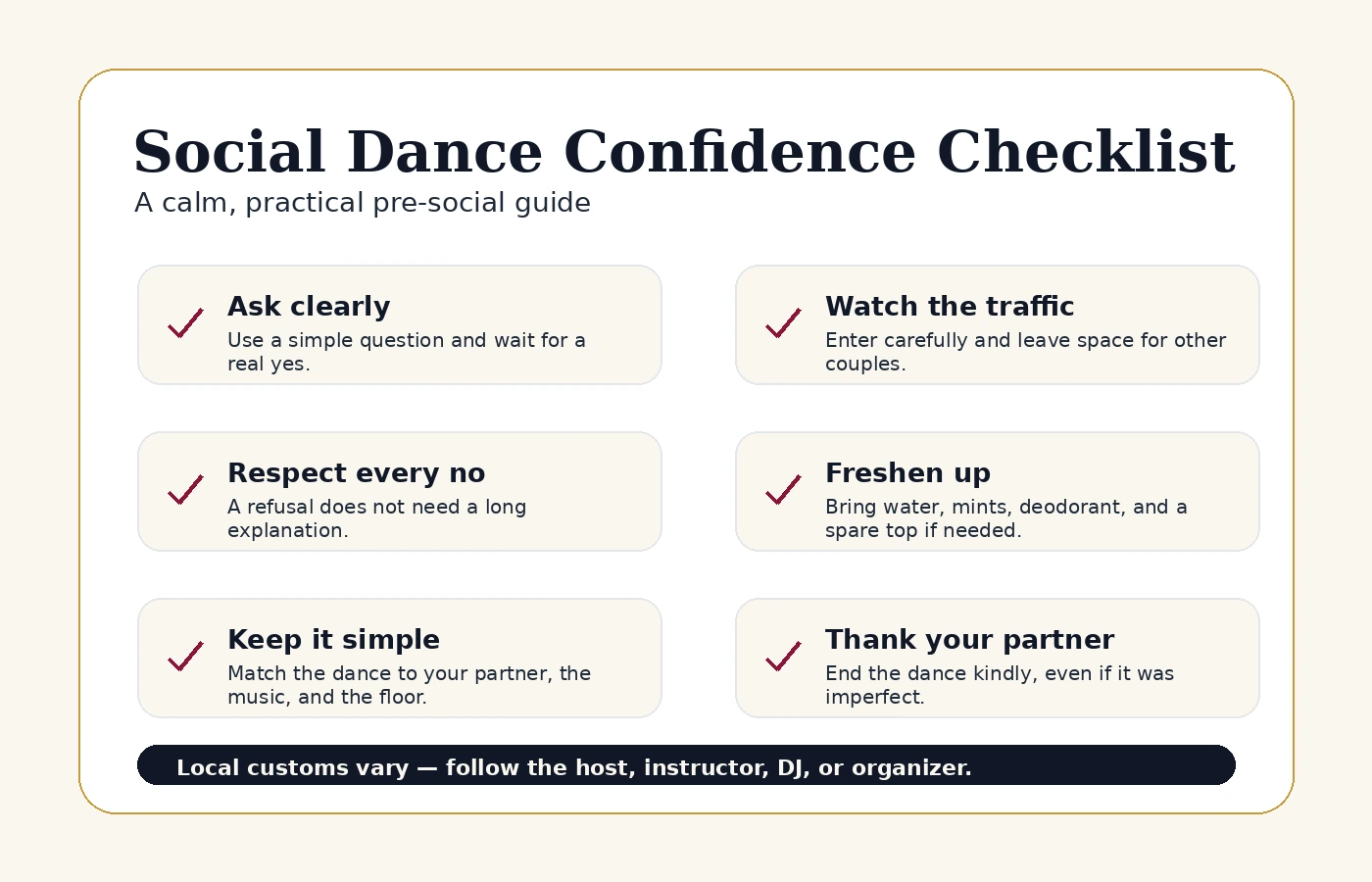
Before you step onto the floor, check these six things.