What is the Waltz?
The Waltz is a smooth, gliding ballroom dance in 3/4 time, counted 1-2-3 and known for its gentle rise and fall, sweeping turns, and tall, elegant frame. Instead of the four-beat feel of many pop songs, the Waltz travels around the floor in repeating groups of three beats: 1-2-3, 1-2-3.
Historically, Waltz developed from European folk and social dance traditions and became one of the defining ballroom dances of the 19th century. Today, most beginner dancers do not need a history lecture before they start, but it helps to know why Waltz still carries such a classic, formal, and romantic feeling.
In ballroom settings, Waltz can appear in several forms. Social Waltz is usually practical and flexible. Wedding Waltz is adapted to a couple, a song, and a floor plan. American Smooth Waltz often allows more open and expressive movement depending on level and context. International Standard Waltz is typically more formal and closed-position in competitive settings.
For a beginner, the most important goal is simple: hear the three-count, change weight clearly, keep your posture calm, and move with your partner instead of chasing the foot pattern.
Characteristics of the Waltz
The Waltz is defined by a handful of signature qualities. If a dance is smooth, travels around the floor, and rises and falls in 3/4 time, it is almost certainly a Waltz.
- 3/4 time, counted 1-2-3. Three beats to every bar, with the strongest accent on beat 1.
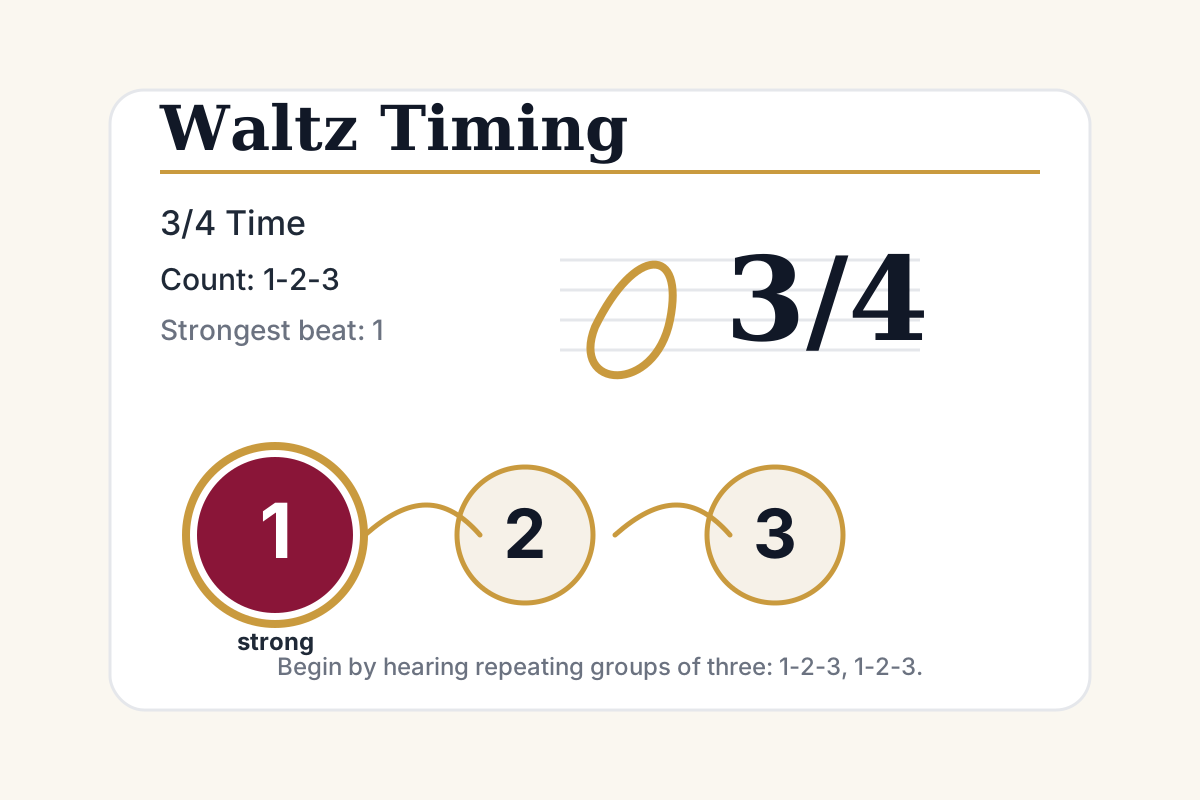
- Rise and fall. A gentle rising through the body and feet across beats 2 and 3, lowering on beat 1, which gives the Waltz its rolling, wave-like motion.
- Sway. A subtle leaning of the body through turns that softens the look and helps the couple travel.
- Continuous, traveling movement. The Waltz moves along the line of dance rather than staying in one spot.
- Sweeping turns. Long, curving figures rather than sharp, staccato changes of direction.
- A tall, calm frame. An upright posture and steady closed hold that stays elegant even as the couple moves.
Together these traits give the Waltz its classic, romantic character — graceful and flowing rather than sharp or percussive.
What the Waltz feels like
Waltz should feel smooth, spacious, and controlled. Even when dancers travel around the room, the movement should feel continuous rather than choppy.
Many teachers describe Waltz as having a gentle rise-and-fall quality. Beginners should not exaggerate that at first. If you bounce, collapse, or push up too hard, the dance quickly loses its calm feeling.
A good beginner Waltz feels like a quiet conversation between the leader and follower. The leader offers direction and timing. The follower stays balanced, responsive, and connected without guessing ahead.
Both roles matter. Waltz looks elegant when both dancers keep a lifted posture, a comfortable frame, and a shared sense of timing.
Waltz timing and count
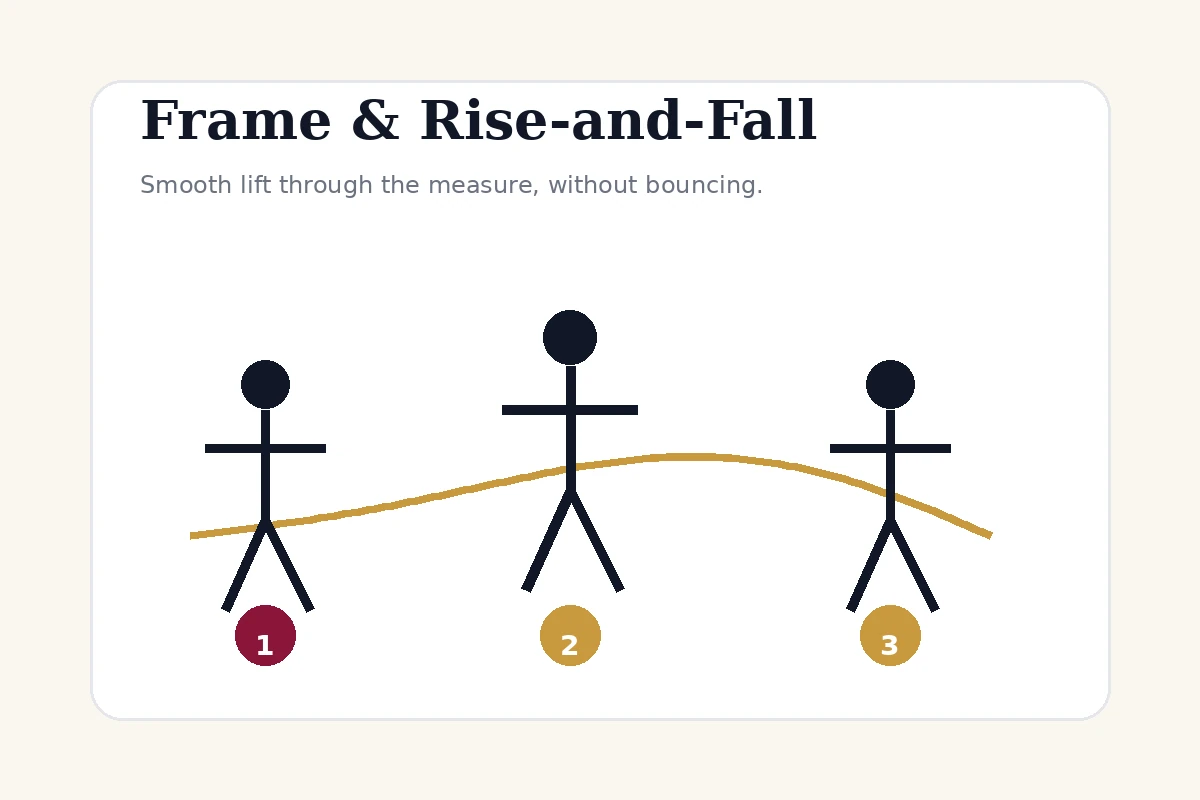
Waltz is counted in groups of three: 1-2-3. Beat 1 usually feels like the strongest anchor, while beats 2 and 3 complete the measure.
If you are used to pop music, Waltz may feel unusual at first. Many popular songs feel like 1-2-3-4, but Waltz repeats in threes: 1-2-3, 1-2-3, 1-2-3.
| Concept | Waltz explanation |
|---|---|
| Time signature | 3/4 |
| Basic count | 1-2-3 |
| Strongest beat | Usually beat 1 |
| Beginner verbal count | “One, two, three” or “step, side, close” |
| Common problem | Treating Waltz like a 4-count pop song |
| Practical fix | Listen for repeating groups of three before stepping |
| Solo drill | Clap on 1, whisper 2-3, repeat |
| Partner drill | Step only the weight changes first, then add travel |
A simple practice drill is to play a Waltz song and clap only on beat 1 while quietly counting beats 2 and 3. This helps your ear find the start of each measure.
After that, practice stepping without worrying about style. Step on each count, change weight fully, and keep the rhythm steady.
How to count ballroom dance music
Basic Waltz steps
The basic step in the Waltz is the box step — forward, side, close on one bar of 1-2-3, then back, side, close on the next. Most beginner Waltz figures are built from these simple actions. The steps are not difficult by themselves, but they must happen with clear timing and full weight changes.
A basic pattern often starts like this:
| Count | Basic action |
|---|---|
| 1 | Step forward or back |
| 2 | Step to the side |
| 3 | Close the feet |
That pattern teaches the foundation of the Waltz box step. It also teaches a bigger ballroom principle: your feet move because your body is changing weight and direction.
Do not worry about covering a lot of floor at first. Small, clean, balanced steps are better than large steps that pull the couple apart.
For partner practice, the leader and follower usually move in opposite directions. When the leader steps forward, the follower steps back. When the leader steps back, the follower steps forward.
How to dance the Waltz step by step
To dance a basic Waltz, you repeat one box step in 3/4 time. Learn it in the order below, getting the timing solid before you add smoothness or turns.
| Step | What you do |
|---|---|
| 1. Find the timing | Play a Waltz and count the repeating 1-2-3, feeling the accent on beat 1. |
| 2. Change weight in place | Step in place on 1, 2, 3, fully transferring your weight onto each foot. |
| 3. Dance the forward half-box | Step forward on 1, side on 2, close on 3. |
| 4. Dance the back half-box | Step back on 1, side on 2, close on 3 — you have completed one full box. |
| 5. Keep it small and smooth | Use small steps and a full close on 3; do not rush into the next bar. |
| 6. Add rise, fall, and travel | Once the timing is steady, add gentle rise and fall and let the box travel along the floor. |
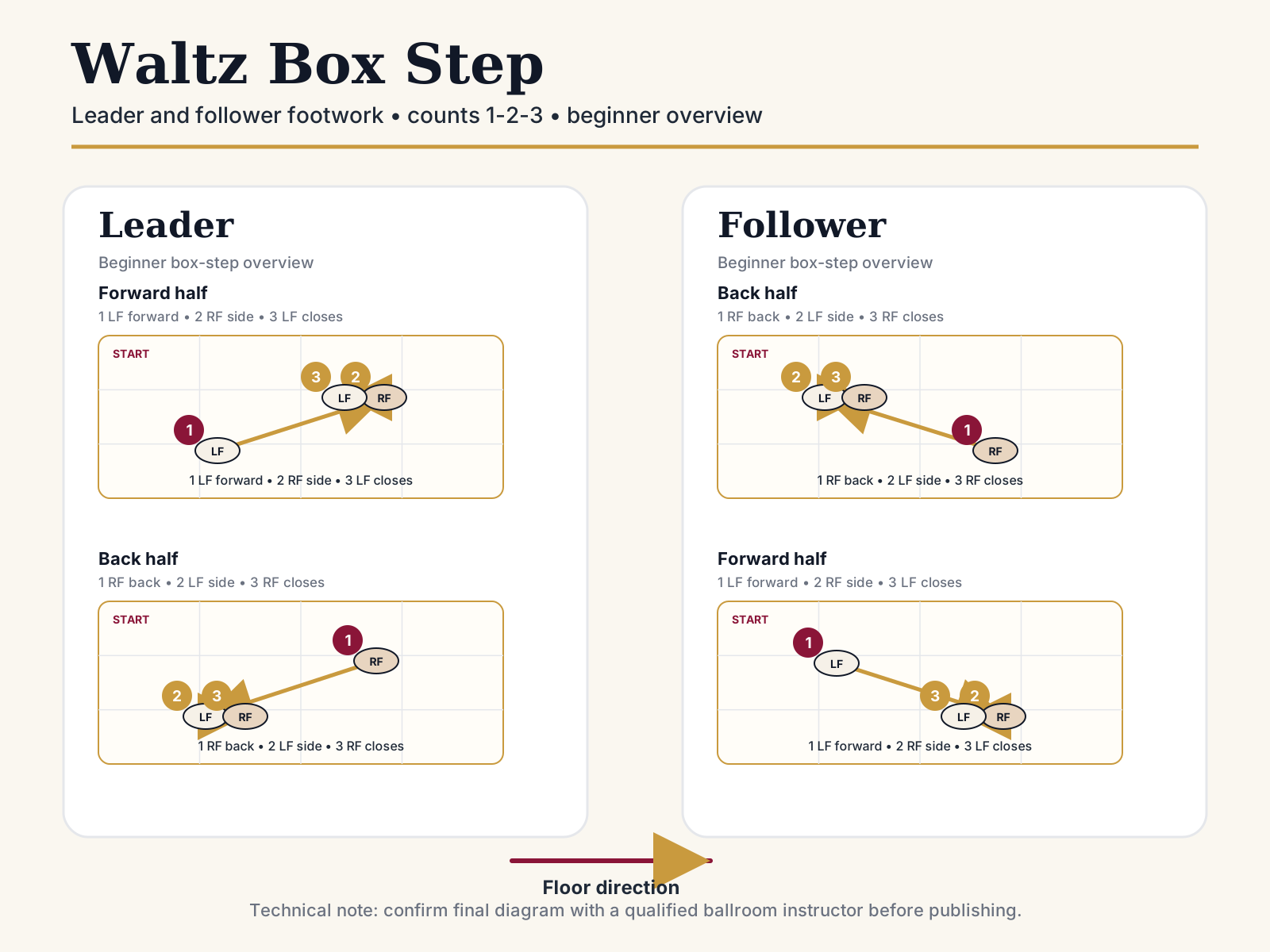
The leader dances the forward half-box first; the follower mirrors the pattern, starting with the back half-box. For the full pattern with foot-by-foot detail, see the Waltz box step guide.
Waltz box step overview
The Waltz box step is one of the most common beginner Waltz patterns. It is called a box step because the leader and follower move through a square-like pathway on the floor.
Leader’s forward half-box
| Count | Leader action |
|---|---|
| 1 | Step forward |
| 2 | Step side |
| 3 | Close feet |
Leader’s back half-box
| Count | Leader action |
|---|---|
| 1 | Step back |
| 2 | Step side |
| 3 | Close feet |
The follower usually dances the natural opposite. When the leader goes forward, the follower goes back. When the leader goes back, the follower goes forward.
The most common beginner mistake is rushing the close on count 3. Count 3 is not a throwaway step. It is a real weight change, and it sets up the next measure.
Keep the first version small. A beginner Waltz box step should feel calm and organized, not like a race around the floor.
Waltz music
Waltz music has a repeating three-beat pattern. It may be orchestral, romantic, traditional, cinematic, or adapted from modern music, but the song needs to support a 1-2-3 feel.
For beginners and wedding couples, the most important question is simple: Can you naturally count the song as 1-2-3, 1-2-3? If the song feels like 1-2-3-4, it is probably not a natural Waltz.
| Music question | Beginner answer |
|---|---|
| What meter does Waltz use? | Usually 3/4 |
| What should I listen for? | A repeating 1-2-3 feel |
| Is every slow romantic song a Waltz? | No. Many slow songs are in 4/4 |
| Can a modern song work? | Yes, if the meter and tempo fit |
| What should wedding couples check first? | The song’s count before planning choreography |
| What if the song does not fit Waltz? | Consider Rumba, Foxtrot, Nightclub Two Step, or a custom first dance |
A wedding song can be beautiful and still not be a Waltz. The emotion of the song matters, but the meter matters too.
If you are unsure, count along before you plan choreography. If the count keeps falling into groups of four, forcing a Waltz will feel awkward.
American Waltz vs International Waltz
American Waltz and International Waltz are related, but they are not identical in how they are taught, styled, or used in competition.
| Feature | American Smooth Waltz | International Standard Waltz |
|---|---|---|
| Competitive family | American Smooth | International Standard |
| General style | Smooth, expressive, and may include open work depending on level and context | More formal closed-position Standard style in competition context |
| Beginner use | Often approachable for social dancing, showcases, and wedding adaptation | Often more structured and technical in formal training |
| Music | 3/4 Waltz music | 3/4 slow Waltz music |
| Movement impression | Flowing, elegant, sometimes more open and theatrical | Flowing, controlled, continuous, and refined |
| Best beginner focus | Timing, box step, frame, simple turns | Timing, posture, closed hold, controlled movement |
| What not to assume | That “open” means anything goes | That beginners must master full competition technique before dancing socially |
For a beginner, this distinction matters mainly because teachers, studios, and competitions may use different systems. You do not need to choose a competition pathway on day one.
If you are dancing socially or preparing a wedding first dance, your teacher may borrow practical ideas from Waltz without building a strict syllabus routine. If you are training for competition, follow the rules, syllabus, and coaching for your category.
Waltz vs Viennese Waltz
Waltz and Viennese Waltz are related, but beginners should not treat them as the same dance.
| Feature | Waltz | Viennese Waltz |
|---|---|---|
| Basic feel | Slow, flowing, spacious | Faster, rotational, continuous |
| Time signature | 3/4 | 3/4 |
| Beginner difficulty | More beginner-friendly | More demanding |
| Wedding use | Often adaptable if the song fits | Beautiful but harder for most beginners |
| Social use | Useful in ballroom social contexts | Less beginner-friendly because of speed and rotation |
| Best first focus | Box step, timing, posture | Rotation, control, stamina, safety |
| Canonical URL | /dance-styles/waltz/ | /dance-styles/viennese-waltz/ |
The main confusion is that both dances use music in three. The difference is speed, rotation, movement quality, and technical demand.
Waltz is usually the better first learning choice. Viennese Waltz can be exciting and beautiful, but it requires more control, more stamina, and more care with turns.
Types of Waltz
There are three main types of Waltz. All share 3/4 time and a smooth, traveling character, but they differ in tempo, styling, and the positions they allow.
| Type | Tempo | What sets it apart |
|---|---|---|
| International Standard (Slow) Waltz | Slow | Danced entirely in a closed hold; the most formal, competition-focused form. |
| American Smooth Waltz | Slow | Allows open, released, and side-by-side positions, so partners can separate and return. |
| Viennese Waltz | Fast | Much quicker and highly rotational, built on continuous turns; has its own dedicated guide. |
Beginners almost always start with the slow Waltz (American Smooth or International Standard) before attempting the faster Viennese Waltz. In social and wedding settings, the slow Waltz is by far the most common.
Waltz for weddings
Waltz can be a beautiful wedding first dance when the song supports it. It works especially well for couples who want a classic, graceful, romantic look rather than a casual slow-dance sway.
The biggest mistake is choosing Waltz because it “looks elegant” before checking the song. Many romantic first dance songs are not in 3/4. If the song is in 4/4, another dance may fit better.
Is Waltz right for your wedding first dance?
Waltz may be right if…
- Your song clearly counts 1-2-3.
- You want a graceful, traditional ballroom feeling.
- You have enough floor space for gentle travel or turns.
- Your clothing and shoes allow comfortable movement.
- You have time to practice timing, posture, and transitions.
Check the song first
Waltz may not be the best fit if…
- Your song naturally counts 1-2-3-4.
- You want a very casual, modern, or club-style feel.
- Your venue floor is tiny or crowded.
- Your dress limits stepping or turning.
- You only want a simple sway with one or two turns.
A wedding Waltz does not need to be a competition routine. The best first dance is one the couple can perform comfortably while still feeling present with each other.
Waltz in social dancing
In social ballroom settings, Waltz gives dancers a calm, elegant option when 3/4 music is played. It is less common at casual club-style events than Salsa or Swing, but it remains important in ballroom studios, formal socials, showcases, and mixed ballroom dance events.
Social Waltz does not need to be complicated. A beginner can enjoy a simple box step, a few turns, and clean floorcraft.
Floorcraft means moving with awareness of the room. Even a simple Waltz becomes more enjoyable when dancers avoid blocking traffic, taking oversized steps, or turning without checking their space.
For social dancing, prioritize comfort over choreography. Good timing, considerate spacing, and a relaxed frame matter more than fancy patterns.
Waltz in competition
In ballroom competition, Waltz appears in both American Smooth and International Standard contexts. These systems have different expectations, figures, styling, and rule sets.
This guide is not a syllabus replacement. It is a beginner-friendly overview that explains the dance in practical language.
If you are preparing for competition, work with a qualified instructor and follow the appropriate syllabus, event rules, and category requirements. Waltz technique can become very detailed, especially around footwork, rise and fall, shaping, swing, sway, and closed-hold movement.
Common beginner Waltz mistakes
| Mistake | Why it happens | Better fix |
|---|---|---|
| Counting in 4 instead of 3 | Most popular music trains the ear to hear 4-count phrases | Count “1-2-3” out loud before stepping |
| Rushing count 3 | Beginners want to finish the box quickly | Give count 3 a real weight change |
| Looking down | Fear of stepping on a partner’s foot | Keep posture lifted and use peripheral awareness |
| Bouncing | Overtrying rise and fall | Stay smooth first; add shaping later |
| Pulling with the arms | Trying to lead with force | Lead with body direction and timing |
| Taking steps too large | Trying to travel before balance is ready | Keep steps small and controlled |
| Forgetting the partner | Focusing only on foot pattern | Practice timing, spacing, and connection together |
| Holding the frame stiffly | Mistaking tension for structure | Keep tone in the frame without locking the body |
| Turning too soon | Trying advanced movement before timing is stable | Master the basic box and weight changes first |
A beginner’s Waltz improves quickly when the dancer stops chasing “more steps” and starts refining the essentials. Timing, posture, weight transfer, and calm partner connection will make every later pattern easier.
Beginner Waltz practice plan
| Practice session | Focus | What to do |
|---|---|---|
| Session 1 | Hear the count | Listen to Waltz music and count 1-2-3 without dancing |
| Session 2 | Solo weight changes | Step in place on 1-2-3 and change weight fully |
| Session 3 | Solo box step | Practice forward-side-close and back-side-close |
| Session 4 | Partner timing | Dance the box step slowly with leader/follower roles |
| Session 5 | Posture and frame | Keep lifted posture without stiffness |
| Session 6 | Smoothness | Reduce bounce and keep each measure calm |
| Session 7 | Simple rotation | Add gentle turning only after timing is steady |
| Session 8 | Music variation | Try two different Waltz songs and compare tempo |
| Session 9 | Wedding/social test | Practice entering, dancing 30–45 seconds, and ending cleanly |
| Session 10 | Review | Record a short clip and check timing, posture, spacing, and comfort |
Practice does not need to be long. Ten focused minutes with clear timing is more useful than an hour of repeating the same mistake.