
Ballroom Technique
Ballroom Technique Made Clear
Frame, posture, timing, connection, footwork, turns, and practice fundamentals for dancers who want to move better—without turning every lesson into a wall of jargon.
Beginner-friendly. Plain-English explanations. Built to be expert-review-ready.
Start here
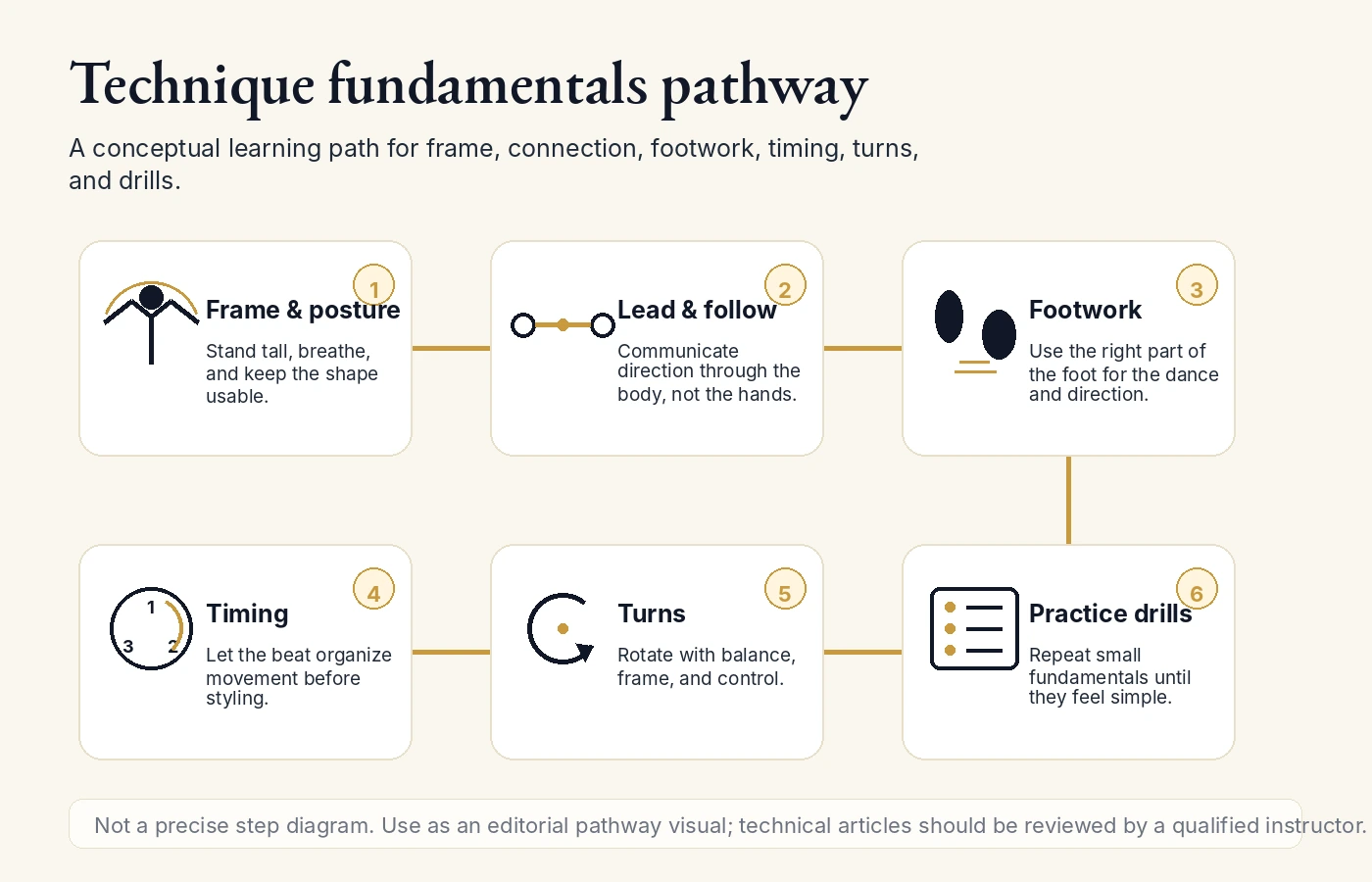
Start here: the ballroom technique path
Use this order when technique feels overwhelming. Each layer makes the next one easier.
-
1. Stand before you style
Begin with posture and balance. A clear body line makes every step easier.
-
2. Hear the beat before you add figures
Timing comes before complexity. If you can move on time, your dancing already feels cleaner.
-
3. Connect before you pull
Lead and follow should feel like shared information, not force. Learn how frame, direction, and timing work together.
-
4. Practice one small skill at a time
Technique improves through simple, repeatable drills. Choose one focus per practice session — the solo practice drills library shows you how to practice alone.
Fundamentals
Core technique fundamentals
These are the technique areas that show up again and again, whether you dance Waltz, Rumba, Cha Cha, Foxtrot, Swing, or a wedding first dance.
-
Frame & Posture
Frame & Posture
Learn how to create a comfortable, supported shape without becoming stiff.
Planned guide — coming soon -
Lead & Follow
Lead & Follow
Understand partner roles, shared timing, and connection without outdated gender assumptions.
Planned guide — coming soon -
Footwork & Weight Transfer
Footwork & Weight Transfer
See why where your weight lands matters more than memorizing foot positions alone.
Planned guide — coming soon -
Timing & Musical Control
Timing & Musical Control
Practice moving with the beat so your steps feel calmer, clearer, and more reliable.
-
Turns & Rotation
Turns & Rotation
Build cleaner turns by preparing your body, weight, and direction before you rotate.
Planned guide — coming soon -
Rhythm & Latin Body Action
Cuban Motion
How Latin/Rhythm hip action really works: weight transfer, knee action, timing, drills, and common mistakes.
-
Smooth & Standard Movement
Rise and Fall
The controlled lift and lower that makes Waltz and Foxtrot smooth—what it feels like, drills, mistakes, and why Tango is different.
Featured guides
Featured technique guides
Start with the guide that matches the problem you feel most often in lessons or practice.
-
Technique
Frame and Posture in Ballroom Dance
A beginner-friendly guide to standing tall, keeping your shape, and avoiding a rigid frame.
Planned guide — coming soon -
Technique
Lead and Follow in Ballroom Dance
How partner connection actually works: roles, timing, direction, listening, and common mistakes.
Planned guide — coming soon -
Technique
Ballroom Footwork for Beginners
A practical introduction to foot placement, weight transfer, and why different dance families use different actions.
Planned guide — coming soon -
Music & Timing
How to Count Ballroom Dance Music
Learn beat, count, rhythm, and tempo so technique has something steady to organize around.
-
Technique
Rise and Fall in Ballroom Dance
A clear guide to the lifting and lowering action used in dances like Waltz and Foxtrot.
Planned guide — coming soon -
Technique
Cuban Motion for Rumba and Cha Cha
A careful beginner overview of Latin/Rhythm hip and body action, with expert review required before publication.
Planned guide — coming soon
Common mistakes
Common technique mistakes beginners make
Most technique problems are normal. The fix is usually simpler than adding another figure.
-
Holding the arms instead of supporting the frame.
Your arms are part of the shape, but the body supports the shape. Start with posture and back tone before forcing the arms into place.
-
Looking down to find balance.
Looking down often pulls the posture forward. Use smaller steps, slower timing, and a lifted focus line.
-
Moving before the weight is clear.
Many technique problems start when the body leaves before the standing foot is ready. Practice slow weight transfers.
-
Pulling with the hands.
Connection should communicate direction and timing. Pulling usually creates tension and confusion.
-
Practicing patterns faster than you can hear the music.
If the timing is unclear, simplify the figure. Count, walk, then add the step.
Practice drills
Practice drills to start with
Use these as gentle practice ideas, not as a replacement for feedback from a qualified teacher.
-
Posture reset — 60 seconds
Stand comfortably tall, soften the knees, lengthen through the spine, and breathe. The goal is alert, not stiff.
-
Weight transfer walk — 3 minutes
Step slowly from foot to foot. Notice when your full weight arrives before taking the next step.
-
Timing walk — 5 minutes
Choose one song with a clear beat. Walk or mark steps only on the count. Do not add arms or turns yet.
-
Frame check — 3 minutes
Create your dance frame without lifting the shoulders. Release and rebuild it several times so it becomes familiar.
Editorial standards
Expert review note
Related guides
Related guides
Companion hubs and starting points across Ballroom Pages.
FAQ
Ballroom technique FAQ
The questions readers ask most often about ballroom technique, frame, timing, and practice.
-
What is ballroom dance technique?
Ballroom dance technique is the way you organize posture, frame, timing, footwork, weight transfer, partner connection, and style-specific movement. It helps your dancing feel clearer and easier to repeat.
-
What should beginners practice first?
Start with posture, timing, and weight transfer. Those three skills make almost every step easier. After that, add partner connection, turns, and style-specific technique.
-
Is ballroom frame supposed to feel stiff?
No. A good frame should feel supported and alive, not frozen. Beginners often confuse tension with strength. The goal is a shape that can communicate without locking the shoulders or arms.
-
Can I practice ballroom technique without a partner?
Yes. You can practice posture, timing, balance, weight transfer, footwork, and turn preparation alone. Partner connection still needs partner practice, but solo work makes that practice easier.
-
Are Standard/Smooth techniques different from Latin/Rhythm techniques?
Yes. Smooth and Standard dances often emphasize frame, travel, swing, and rise and fall. Latin and Rhythm dances often emphasize grounded timing, body action, and different foot and hip mechanics. The exact technique depends on the dance and style system.
-
Does this replace lessons with a teacher?
No. This hub helps you understand what to practice and what terms mean. For detailed body mechanics, partner feedback, advanced figures, dips, lifts, or competition preparation, work with a qualified instructor.