What rise and fall means in ballroom dance
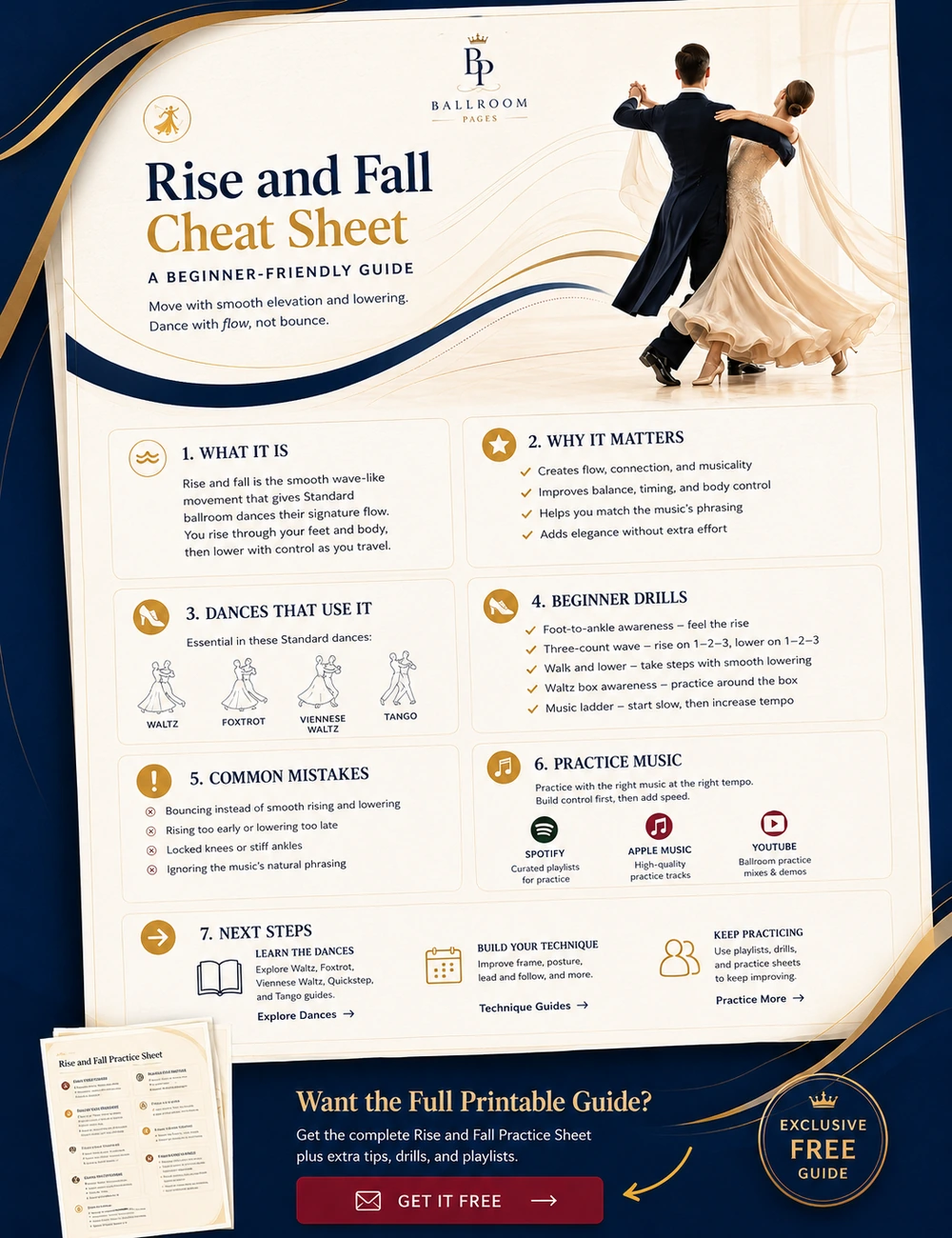
Rise and fall is the way dancers lift and lower through the body as they move. It is not just “going up on your toes.” It is a coordinated action that usually involves rolling through the foot, using the ankle, softening and straightening the knees without locking, lengthening through the body, then lowering with control into the next movement.
In plain English: rise and fall is the wave-like quality that helps Waltz, Foxtrot, Viennese Waltz, and Quickstep travel smoothly around the floor. It should not look like jumping. It should look like the body is gliding through a moving arc.
Why rise and fall matters
| It helps with | What that means for beginners |
|---|---|
| Smoothness | Movement feels less choppy. |
| Musicality | The body responds to phrasing. |
| Partner connection | Leader and follower can feel timing and direction more clearly. |
| Body flight | The couple travels through the room instead of stepping in place. |
| Balance | Lowering prepares the next step. |
| Style | Waltz, Foxtrot, Viennese Waltz, and Quickstep each gain their own character. |
What rise and fall should feel like
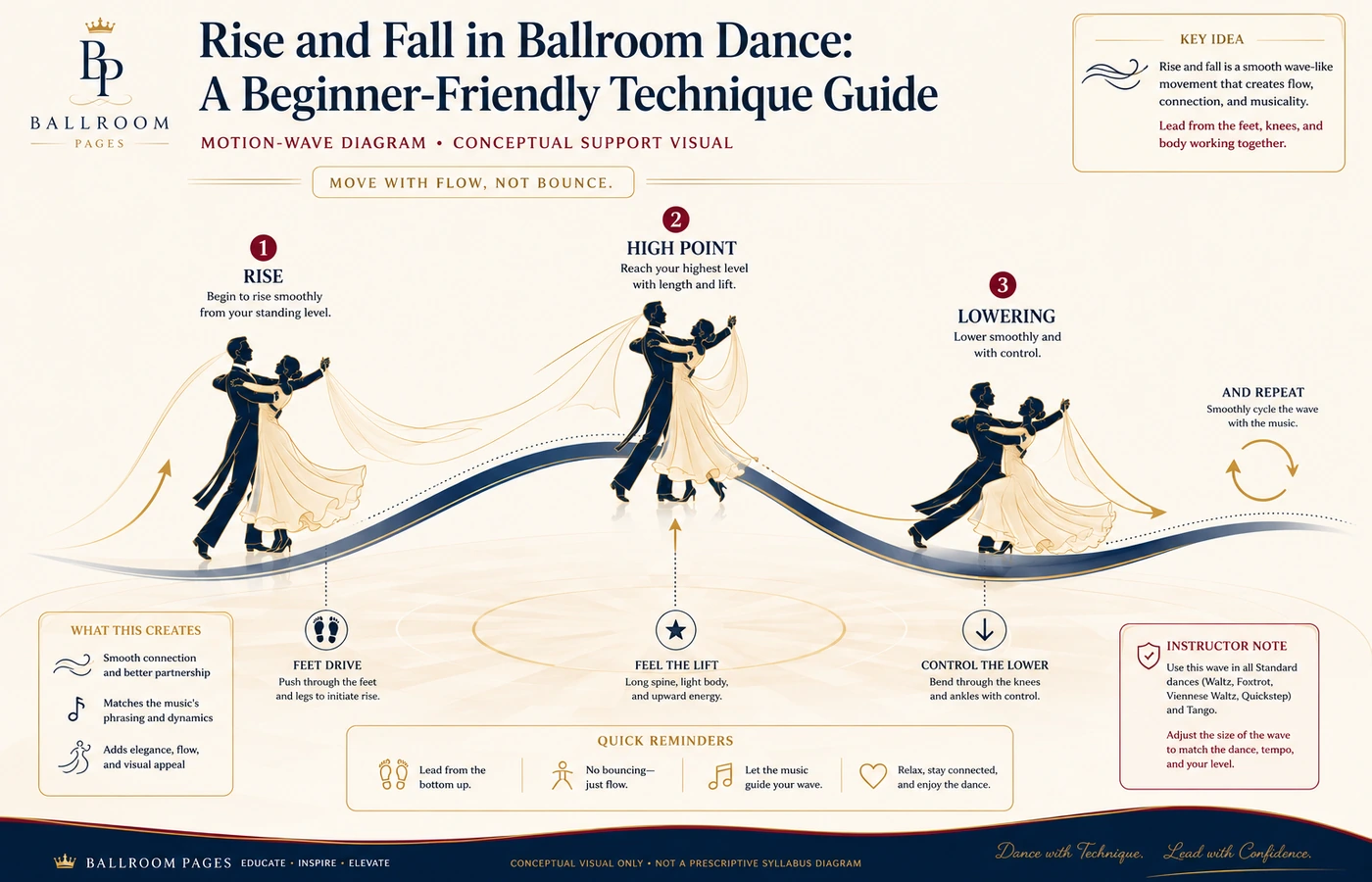
Good rise and fall should feel like a moving wave. It often feels like lowering with soft knees before moving, sending the body forward or sideways through the standing leg, gradually rising as the body travels, staying lifted without locking the knees, then lowering smoothly into the next step.
Foot rise, ankle rise, knee action, and body rise in plain English
| Term | Plain-English meaning | Beginner caution |
|---|---|---|
| Foot rise | Heel leaves the floor and body rises onto ball of foot | Do not pop up suddenly |
| Ankle rise | Ankle helps lift and control the rise | Do not force the ankle |
| Knee action | Knees soften and straighten without locking | Never lock the knees at the top |
| Body rise | Body lengthens upward through posture and leg action | Do not lift shoulders or arch back |
| Lowering | Returning from rise toward a softer grounded level | Do not collapse |
| Compression | Controlled preparation for movement | Do not sink heavily |
Rise and fall vs bouncing
| Rise and fall | Bouncing |
|---|---|
| Travels through space | Pops mostly up and down |
| Uses feet, ankles, knees, posture | Often comes from knee pumping |
| Feels gradual and musical | Feels jumpy or uneven |
| Helps partner connection | Disrupts partnership |
| Supports body flight | Stops flow |
Rise and fall vs sway
Rise and fall changes your level; sway changes your side shape. They are different tools that often work together.
| Concept | What changes | Plain-English explanation |
|---|---|---|
| Rise and fall | Level | Body lifts and lowers |
| Sway | Side shape | Body inclines or shapes to one side |
| Body flight | Travel | Body moves through space |
| Posture/frame | Organization | Body stays supported and connected |
Build the supporting structure with frame and posture and lead and follow.
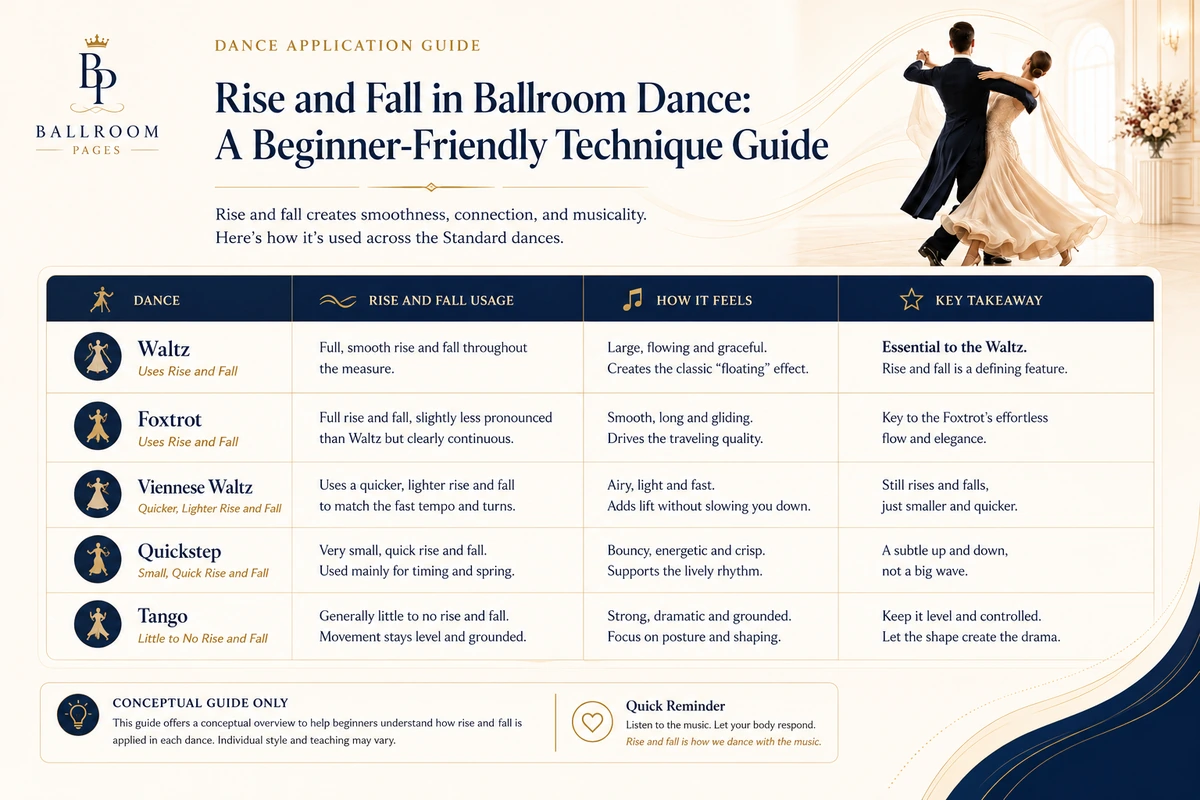
Which dances use rise and fall
| Dance | Rise and fall use | Beginner translation |
|---|---|---|
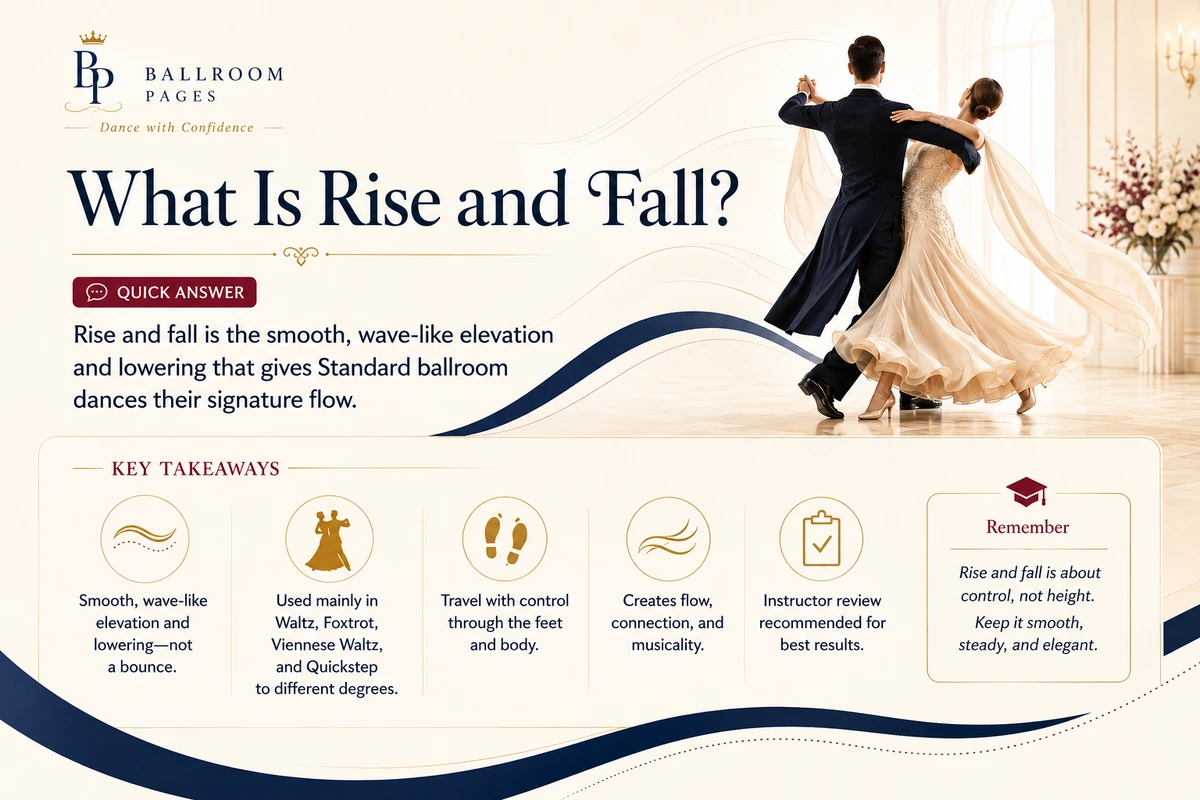
| Waltz | Strong and central | Best first dance for learning the wave-like feeling |
| Foxtrot | Present but subtler | Smooth and gliding, not as visibly up/down as Waltz |
| Viennese Waltz | Present, but faster | Less time to exaggerate; rotation matters |
| Quickstep | Present, but quick and light | Keep controlled; do not bounce |
| Tango | Generally avoided | Level, grounded, staccato quality |
| Bolero | Related lowering/rise qualities may appear, but style differs | See the Bolero guide; do not treat it as Standard/Smooth technique |
Where rise and fall is limited or avoided, including Tango
Tango is the major exception. Ballroom Tango is usually danced with a more constant body level, a compact frame, and a sharper, staccato character. Rather than rising and lowering in a wave, Tango stays grounded and deliberate.
Waltz rise and fall basics
Waltz is the clearest place to begin. A simple beginner idea:
- 1Move and begin the swing.
- 2Continue rising.
- 3Feel the top of the rise, then lower toward the next measure.
Caveat: this is simplified; exact technique depends on the figure and syllabus. Beginner warning: do not rise by lifting your shoulders. Hear the three-count shape with how to count ballroom dance music.
Foxtrot rise and fall basics
Foxtrot rise and fall is usually subtler than Waltz. The dance should feel smooth, continuous, and gliding—not like a big Waltz wave copied into 4/4 music.
- Stay smooth.
- Avoid bobbing.
- Keep traveling.
- Lower with control.
- Let the feet pass or close according to style and level.
Viennese Waltz and Quickstep notes
Viennese Waltz and Quickstep both use rise and fall, but speed changes the amount. Viennese Waltz is fast and rotational. Quickstep is light and quick. Beginners should avoid exaggerating the rise in either dance—keep it small and controlled so timing stays clean.
Beginner practice drills
1. Foot-to-ankle awareness
Slowly roll through the foot and let the ankle help you rise onto the ball of the foot, then lower. Keep it small; do not pop up.
2. The three-count wave
Without traveling, practice a gentle rise across counts 1-2-3 and lower into the next “1.” Feel the wave, not a hop.
3. Walk with a smooth lowering
Take slow walks, lowering with soft knees before each step so the lowering prepares your movement.
4. Waltz box awareness
Using a simple Waltz basic your teacher has shown you, add a small, gradual rise and a controlled lower—one change at a time.
5. Music ladder
Start with slow Waltz to hear the shape, then try Slow Foxtrot for subtler continuity, then faster Viennese Waltz for smaller control.
New to ballroom? Start with ballroom dance for beginners and the broader beginner guides.
Common rise and fall mistakes
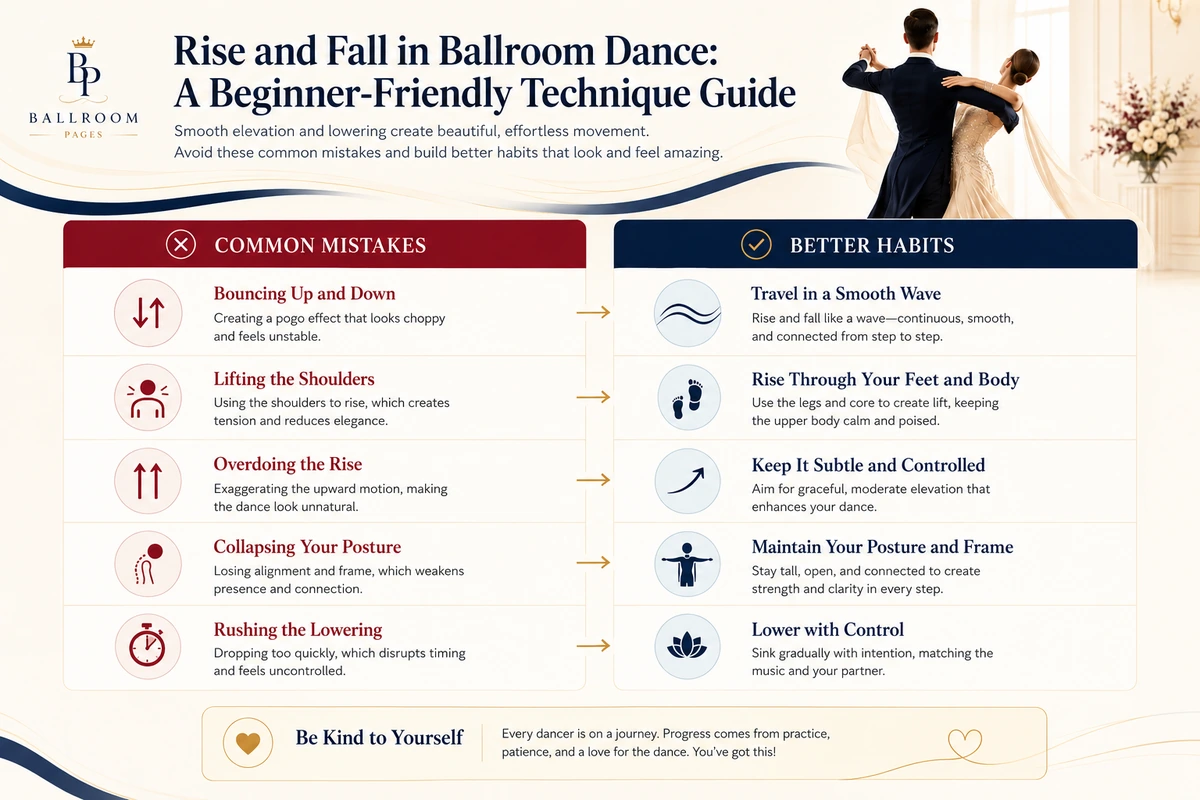
| Mistake | Why it happens | Better cue |
|---|---|---|
| Popping up on count 2 | Trying to do all the rise at once | Let rise travel gradually |
| Locking knees | Mistaking height for technique | Stay lifted but soft |
| Bending upper body | Confusing sway with rise/fall | Keep torso organized |
| Dropping at the end | Lowering without control | Lower as preparation |
| Bouncing every step | Overusing knees vertically | Move through space |
| Lifting shoulders | Creating rise from the top | Use feet, ankles, legs, length |
| Copying Waltz rise into Tango | Not understanding character | Keep Tango more level |
| Practicing too fast | Music too quick for control | Start slower |
Practice rise and fall with Waltz & Foxtrot music
Music makes rise and fall easier to feel. Start with Slow Waltz so you can hear the three-count shape, then compare Slow Foxtrot for subtler continuity and Viennese Waltz for faster, smaller control. Keep Tango nearby as a contrast: its level, grounded quality helps explain why rise and fall should not be copied into every ballroom dance.
Spotify
Slow Waltz
Slow Waltz 2
Slow Foxtrot
Slow Foxtrot 2
Viennese Waltz
Viennese Waltz 2
Apple Music
Slow Waltz
Slow Waltz 2
Foxtrot & Viennese Waltz
Find these in the full playlist hub while the direct Apple links are verified.
YouTube / YouTube Music
Waltz, Foxtrot & Viennese (YouTube)
Find these in the full playlist hub while titles and tracks are verified.
More resources
BallroomPages Music on Telegram
All Ballroom Pages playlists
More: Ballroom Music & Timing, the tempo chart, and how to count ballroom dance music.