How to read this ballroom tempo chart
This chart includes the information dancers actually need before choosing practice music:
- Dance
- The dance style, linked to its canonical Ballroom Pages dance-style guide.
- Family/category
- The context where the dance usually appears, such as International Standard, American Smooth, International Latin, American Rhythm, or Social/Wedding.
- Time signature
- How the music is grouped, such as 3/4, 4/4, or 2/4.
- Common count
- A beginner-friendly way dancers often count the rhythm.
- Beginner practice tempo
- A conservative practice note or low-end sourced range when available. This is not a universal rule.
- Reference/competition tempo
- A sourced reference value or range from official or educational ballroom references.
- BPM and MPM
- Beats per minute and measures per minute.
- Notes
- Context, warnings, and source notes.
- Playlist
- Where to practice that dance using Ballroom Pages playlist cards.
BPM vs MPM: the simple difference
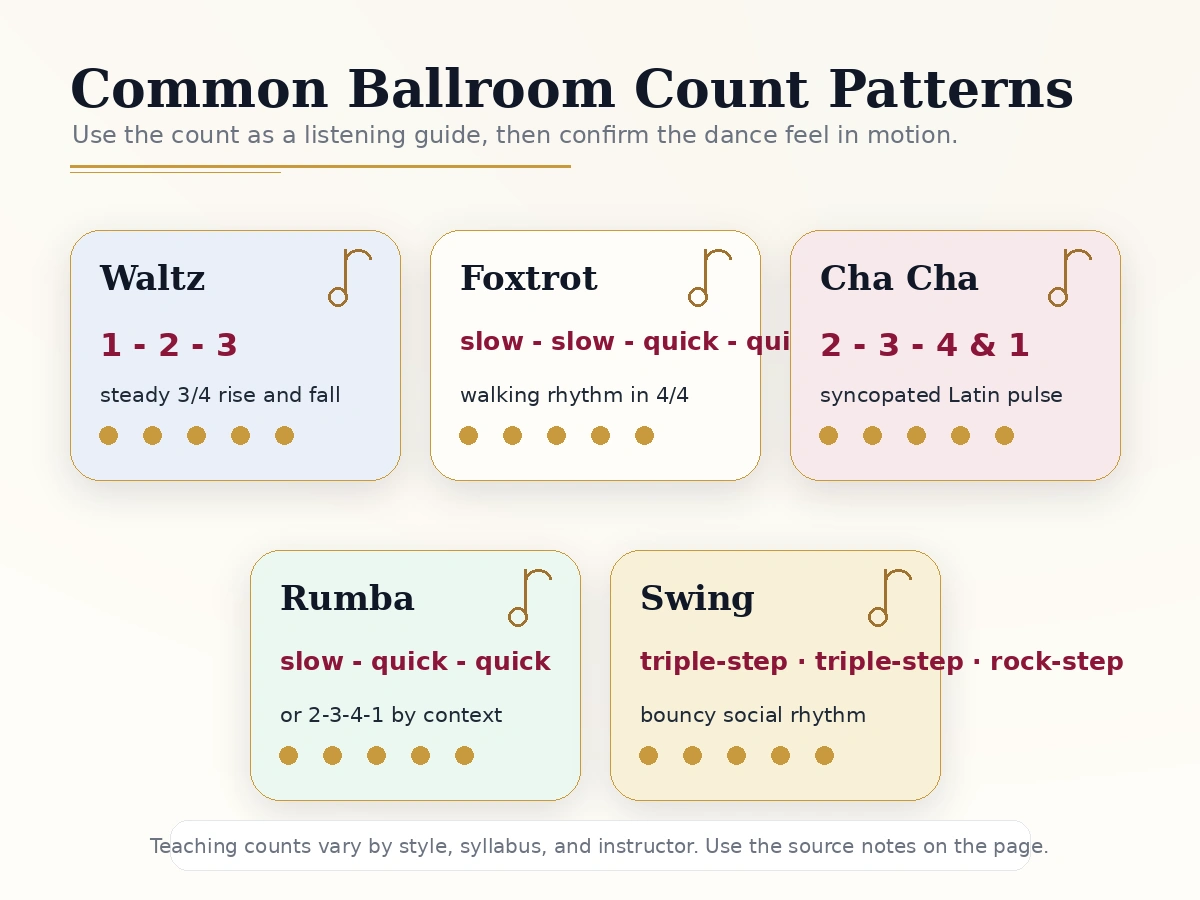
BPM tells you how many beats happen in one minute. MPM tells you how many measures happen in one minute. In ballroom, many official tempo references use MPM because dancers think in measures and phrases, not just isolated beats.
BPM = MPM × beats per measure
Examples:
- Waltz in 3/4: 30 MPM × 3 beats per measure = 90 BPM.
- Foxtrot in 4/4: 30 MPM × 4 beats per measure = 120 BPM.
- Merengue in 2/4: 32 MPM × 2 beats per measure = 64 BPM.
Some BPM apps and streaming libraries may identify a half-time or double-time pulse. That is why a Tango, Salsa, or Nightclub Two Step track can appear “wrong” in a music app even when dancers can count it clearly.
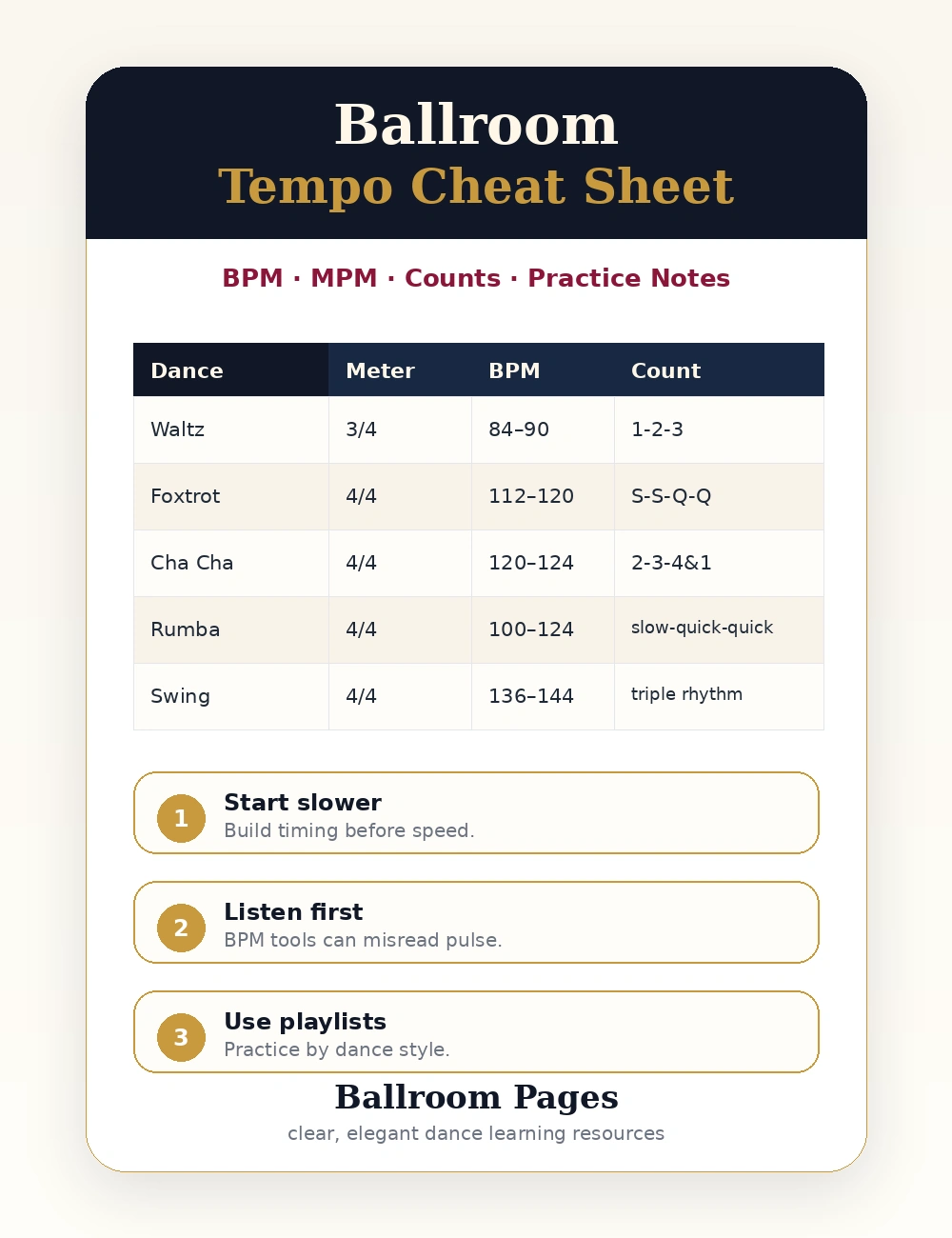
Download the Ballroom Tempo Cheat Sheet
A printable one-page reference with BPM, MPM, counts, and beginner practice notes for the most common ballroom dances.
Download the Ballroom Tempo Cheat SheetBallroom dance tempo chart
Use this chart as a practical reference, not as a rigid rulebook. Official competition values, teaching ranges, social-dance tempos, and wedding-song choices can vary. When two respected sources disagree, the notes explain the likely context.
Tip: scroll the table sideways on small screens — the dance name stays in view. BPM and MPM are reference values, not strict rules.
| Dance | Family / category | Time signature | Common count | Beginner practice tempo | Reference / competition tempo | BPM | MPM | Notes | Playlist | Learn the dance |
|---|---|---|---|---|---|---|---|---|---|---|
| Waltz | International Standard / American Smooth | 3/4 | 1-2-3 | Low end of sourced range: about 84–87 BPM | NDCA: International 29 MPM / 87 BPM; American Smooth 30 MPM / 90 BPM | 84–90 | 28–30 | Good beginner reference; use low end first. NDCA-2026DANCE-CENTRAL | Waltz playlists | Waltz |
| Viennese Waltz | Standard / Smooth | 3/4 | 1-2-3 | Not ideal for raw beginners; practice slow turn drills first | NDCA: International 58 MPM / 174 BPM; Smooth 53 MPM / 159 BPM | 159–174+ | 53–58 | Fast rotational dance; teach carefully. NDCA-2026DANCE-CENTRAL | Viennese playlists | Viennese Waltz |
| Tango | International Standard / American Smooth | 2/4 in NDCA table; often taught/listed as 4/4 in music contexts | slow-slow-quick-quick or tango phrase counts | Use clear lower-pulse Tango tracks before faster double-pulse readings | NDCA: International 32 MPM / 64 BPM; Smooth 30 MPM / 60 BPM | 60–64 NDCA pulse; 120–132 double-pulse | 30–32 | Explain pulse discrepancy clearly. NDCA-2026HOLLYWOOD-BALLROOM | Tango playlists | Tango |
| Foxtrot | American Smooth / Social | 4/4 | slow-slow-quick-quick | 112–120 BPM if learning slowly; Bronze/social may be faster | NDCA Smooth: 30 MPM / 120 BPM | 120–136 | 30–34 | American Foxtrot teaching ranges can be wider. NDCA-2026DANCE-CENTRALHOLLYWOOD-BALLROOM | Foxtrot playlists | Foxtrot |
| Slow Foxtrot | International Standard | 4/4 | slow-quick-quick / slow-slow-quick-quick | Start near 112 BPM with clear phrasing | NDCA: 28 MPM / 112 BPM | 112–120 | 28–30 | Same canonical Foxtrot page; International context. NDCA-2026DANCE-CENTRAL | Foxtrot playlists | Foxtrot |
| Quickstep | International Standard | 4/4 | quick-quick-slow / slow-quick-quick | Full-tempo Quickstep is advanced; use drills below performance speed | NDCA: 50 MPM / 200 BPM | 192–208 | 48–52 | Fast dance; not a first-week beginner tempo. NDCA-2026DANCE-CENTRAL | Quickstep playlists | Quickstep |
| Cha Cha | International Latin / American Rhythm | 4/4 | 2-3-4&1; or 1-2-cha-cha-cha | 112–120 BPM | NDCA: International 31 MPM / 124 BPM; Rhythm 30 MPM / 120 BPM | 120–124+ | 30–31 | Teaching counts vary; explain both. NDCA-2026DANCE-CENTRALHOLLYWOOD-BALLROOM | Cha Cha playlists | Cha Cha |
| Rumba (International) | International Latin | 4/4 | 2-3-4-1 | Lower clear tracks, often below American Rhythm feel | NDCA: International 25 MPM / 100 BPM | 88–108 | 22–27 | International Rumba differs from American Rhythm Rumba. NDCA-2026DANCE-CENTRAL | Rumba playlists | Rumba |
| Rumba (American) | American Rhythm / Wedding | 4/4 | slow-quick-quick | Low end around 120–124 BPM | NDCA Rhythm: 31 MPM / 124 BPM | 120–144 | 30–36 | Strong wedding relevance; avoid confusing with International Rumba. NDCA-2026DANCE-CENTRALHOLLYWOOD-BALLROOM | Rumba playlists | Rumba |
| Samba | International Latin / Social | 2/4 | 1-a-2 | 96–100 BPM | NDCA: 50 MPM / 100 BPM | 96–104 | 48–52 | Bounce feel matters more than raw number. NDCA-2026DANCE-CENTRALHOLLYWOOD-BALLROOM | Samba playlists | Samba |
| Paso Doble | International Latin / Nightclub reference | 2/4 | 1-2 with phrased accents | 110–112 BPM | NDCA: 55 MPM / 110 BPM | 110–124 | 55–60 | Competition character dance; source ranges vary. NDCA-2026DANCE-CENTRALHOLLYWOOD-BALLROOM | Paso Doble playlists | Paso Doble |
| Jive | International Latin | 4/4 | 1-2, 3&4, 5&6 | 152–168 BPM if learning; performance can be faster | NDCA: 43 MPM / 172 BPM | 152–176 | 38–44 | Fast Latin dance; compare with Swing. NDCA-2026DANCE-CENTRALHOLLYWOOD-BALLROOM | Jive playlists | Jive |
| East Coast Swing | American Rhythm / Social / Wedding | 4/4 | triple-step, triple-step, rock-step | 136–140 BPM | NDCA Rhythm Swing: 35 MPM / 140 BPM | 136–144 | 34–36 | Good social/wedding option when song swings. NDCA-2026DANCE-CENTRALHOLLYWOOD-BALLROOM | Swing playlists | East Coast Swing |
| Bolero | American Rhythm | 4/4 | slow-quick-quick | 92–96 BPM | NDCA: 23 MPM / 92 BPM | 92–104 | 23–26 | Slow, controlled rhythm dance. NDCA-2026DANCE-CENTRALHOLLYWOOD-BALLROOM | Rhythm playlists | Bolero planned |
| Mambo | American Rhythm / Social | 4/4 | 2-3-4-1 | 188 BPM if practicing full rhythm; slow drills are fine | NDCA: 47 MPM / 188 BPM | 188–204 | 47–51 | Compare carefully with Salsa. NDCA-2026DANCE-CENTRALHOLLYWOOD-BALLROOM | Rhythm playlists | Mambo |
| Salsa | Social / Nightclub / Wedding | 4/4 | 1-2-3, 5-6-7; or on-2 context | Pick steady moderate social tracks first | NDCA Nightclub: 50 MPM / 200 BPM | 150–250 (NDCA 200) | 50 NDCA | Social Salsa varies widely; do not over-standardize. NDCA-2026HOLLYWOOD-BALLROOM | Salsa playlists | Salsa |
| Bachata | Social / Wedding | 4/4 | 1-2-3-tap, 5-6-7-tap | 120 BPM reference; choose clear, steady tracks | NDCA Nightclub: 30 MPM / 120 BPM | 120 | 30 | Strong wedding/social use. NDCA-2026 | Bachata playlists | Bachata |
| Merengue | Social / Nightclub | 2/4 | 1-2 | 58–64 BPM | NDCA Nightclub: 32 MPM / 64 BPM | 58–64 | 29–32 | Beginner-friendly social rhythm. NDCA-2026DANCE-CENTRALHOLLYWOOD-BALLROOM | Social playlists | Merengue |
| West Coast Swing | Social / Nightclub | 4/4 | 1-2, 3&4, 5&6 | 102–112 BPM for easier practice | NDCA Nightclub: 28 MPM / 112 BPM | 102–128 | 28–32 | Social range varies by music style. NDCA-2026DANCE-CENTRALHOLLYWOOD-BALLROOM | Social playlists | West Coast Swing |
| Hustle | Social / Wedding | 4/4 | &1-2-3 or 1-2-3 depending teacher | 104–112 BPM for beginners | NDCA Nightclub: 30 MPM / 120 BPM | 104–121 | 28–30 | Count conventions vary by teacher. NDCA-2026DANCE-CENTRALHOLLYWOOD-BALLROOM | Social playlists | Hustle |
| Nightclub Two Step | Social / Wedding | Usually 4/4 | quick-quick-slow or slow-quick-quick | Slow wedding tracks may be below competition/nightclub references | NDCA: 18–20 MPM; table displays 76 BPM | ~72–80 by formula; 54–64 in some social refs | 18–20 NDCA | Explain source disagreement. NDCA-2026HOLLYWOOD-BALLROOM | Social playlists | Nightclub Two Step |
| Argentine Tango | Social / Argentine Tango | Varies by music/orchestra | phrase-based; not a simple ballroom count | No single ballroom tempo standard found in reviewed official sources | Do not assign one universal tempo | Varies | Varies | Use specialist Argentine Tango references; do not force ballroom Tango tempo. | Social playlists | Argentine Tango |
| Country Two Step | Social / Country | Usually 4/4 | quick-quick-slow-slow | 168–180 BPM if learning; source lists wider range | Hollywood reference range | 168–200 | Context-dependent | Useful social crossover; no NDCA ballroom tempo value used here. HOLLYWOOD-BALLROOM | Social playlists | Country Two Step |
No dances match your search. Try a different name or family.
Get the printable Ballroom Tempo Cheat Sheet
Keep the BPM, MPM, counts, and practice notes close by while you listen, tap, and practice.
Download the Tempo Cheat SheetBeginner practice tempos vs performance tempos
Beginners often practice below performance tempo, and that is not a mistake. A slower track can help you hear the beat, place your feet, maintain posture, and avoid rushing through the count.
Speed up only when timing and control are stable. Do not sacrifice frame, posture, balance, or partner connection just to match a faster track. Wedding couples should prioritize musical comfort and floor safety. Social dancers need steady, clear music more than maximum speed. New to all of this? Start with Ballroom Dance for Beginners.
Tempo by ballroom dance family
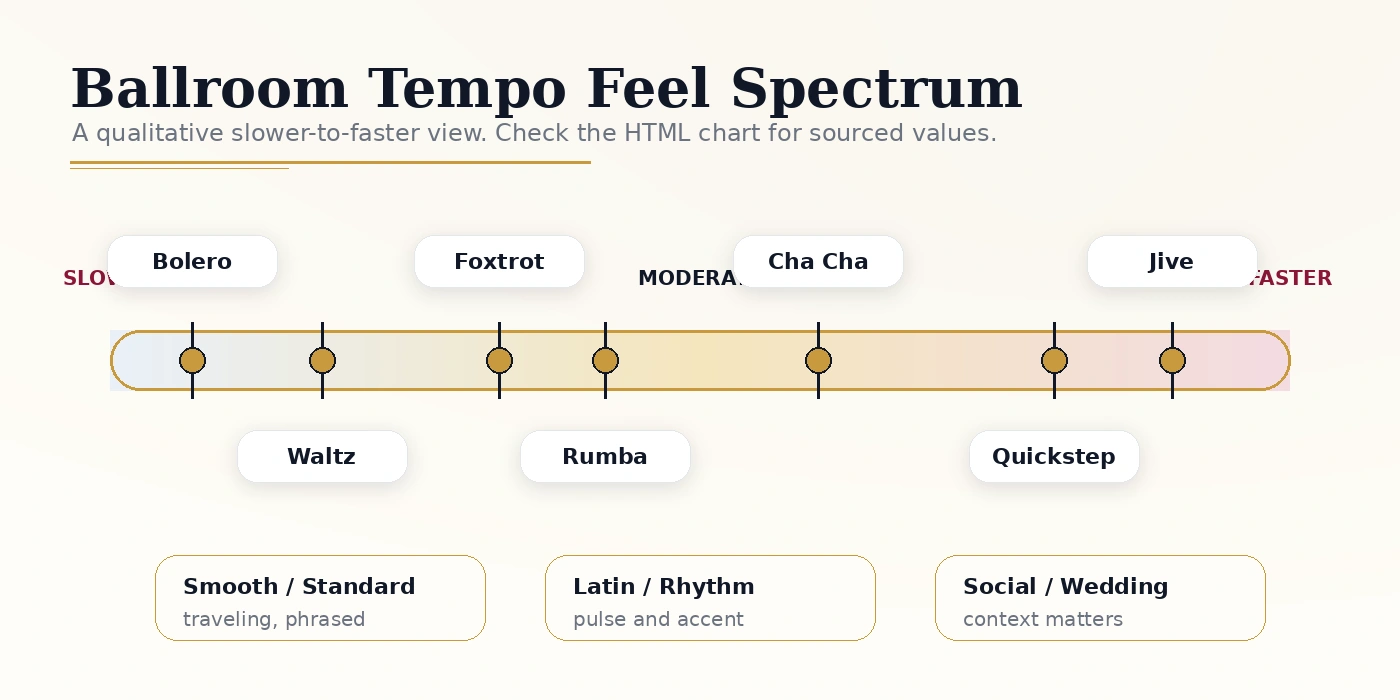
International Standard
International Standard dances usually use structured phrasing, steady travel, and clear musical timing. Waltz, Tango, Viennese Waltz, Foxtrot, and Quickstep require different listening skills, so beginners should not assume that all “ballroom” music feels the same.
American Smooth
American Smooth overlaps with Standard but has its own competition and social contexts. Waltz, Tango, Foxtrot, and Viennese Waltz may appear at slightly different reference tempos than their International counterparts.
International Latin
International Latin styles often require sharper rhythm awareness. Cha Cha, Samba, Rumba, Paso Doble, and Jive have very different pulse feels even when several are written in 4/4 or 2/4.
American Rhythm
American Rhythm includes Cha Cha, Rumba, East Coast Swing, Bolero, and Mambo. Do not assume that an International Rumba tempo is the same as an American Rhythm Rumba tempo.
Social / Wedding dances
Salsa, Bachata, Merengue, West Coast Swing, Hustle, Nightclub Two Step, Argentine Tango, and Country Two Step depend heavily on social context, music style, and instructor/DJ preference. For weddings, comfort and danceability matter more than matching a formal competition number.
How to find a song’s tempo
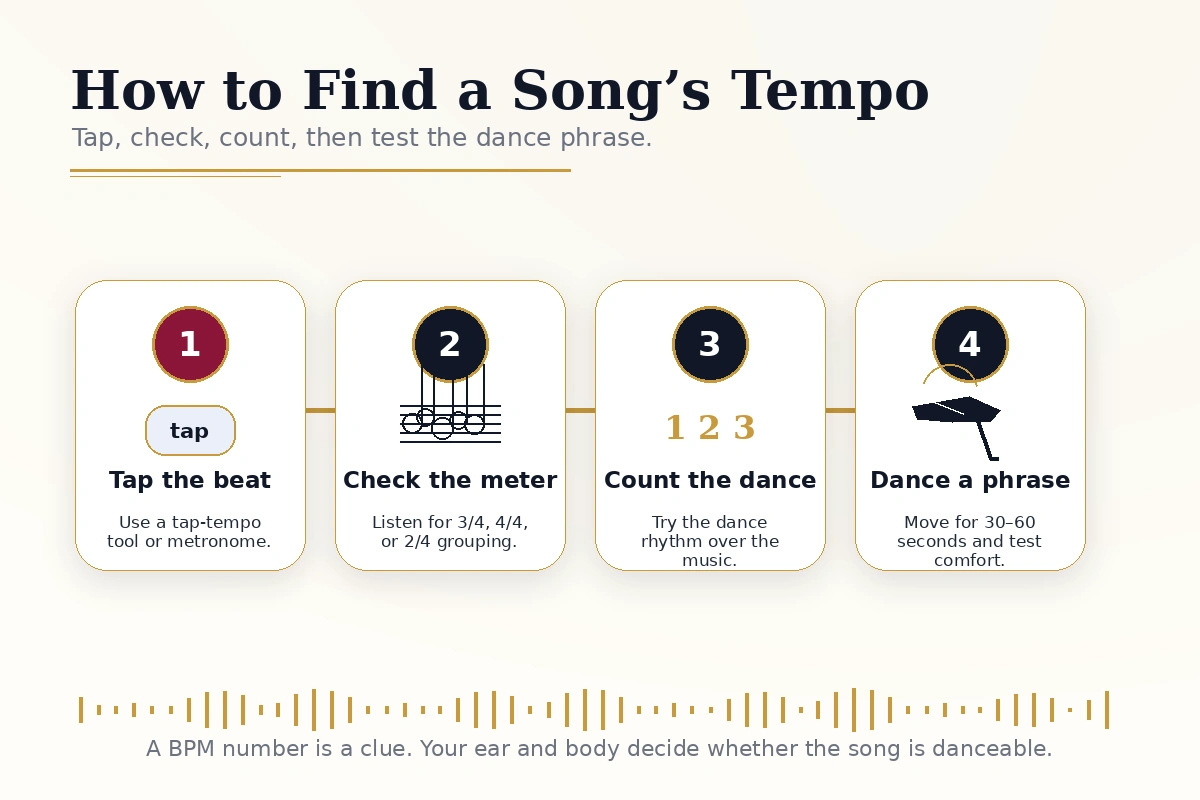
Use this four-step method:
Tap the beat
Use a tap-tempo tool or metronome app while listening to the strongest steady pulse.
Check the meter
Decide whether the song feels like 3/4, 4/4, 2/4, or another grouping.
Try the dance count
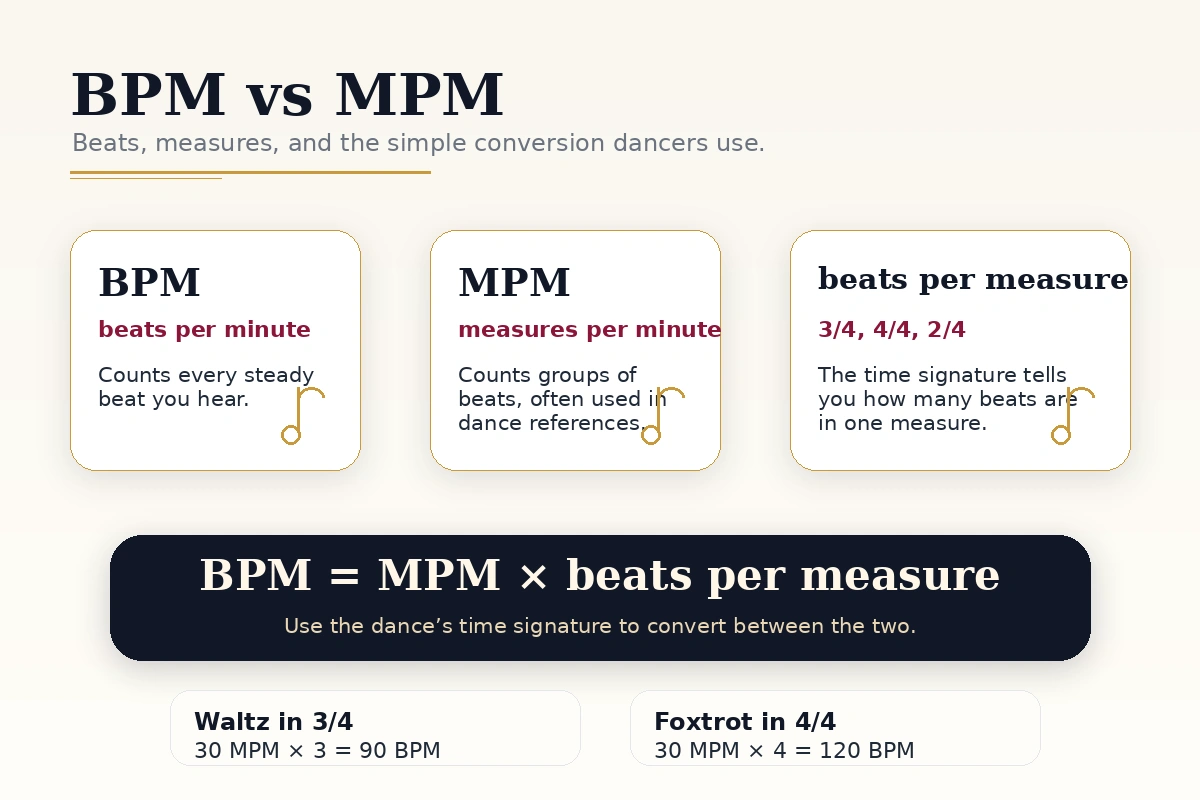
Count the dance rhythm over the song: Waltz 1-2-3, Foxtrot slow-slow-quick-quick, Cha Cha 2-3-4&1, or the relevant count.
Dance a short phrase
Try the basic step for 30–60 seconds. If your timing, balance, or connection falls apart, the song may be too fast or not clear enough.
A BPM tool can help, but your ear and your body decide whether the song is danceable. For the counting side, see How to Count Ballroom Dance Music.
Practice each tempo with Ballroom Pages playlists
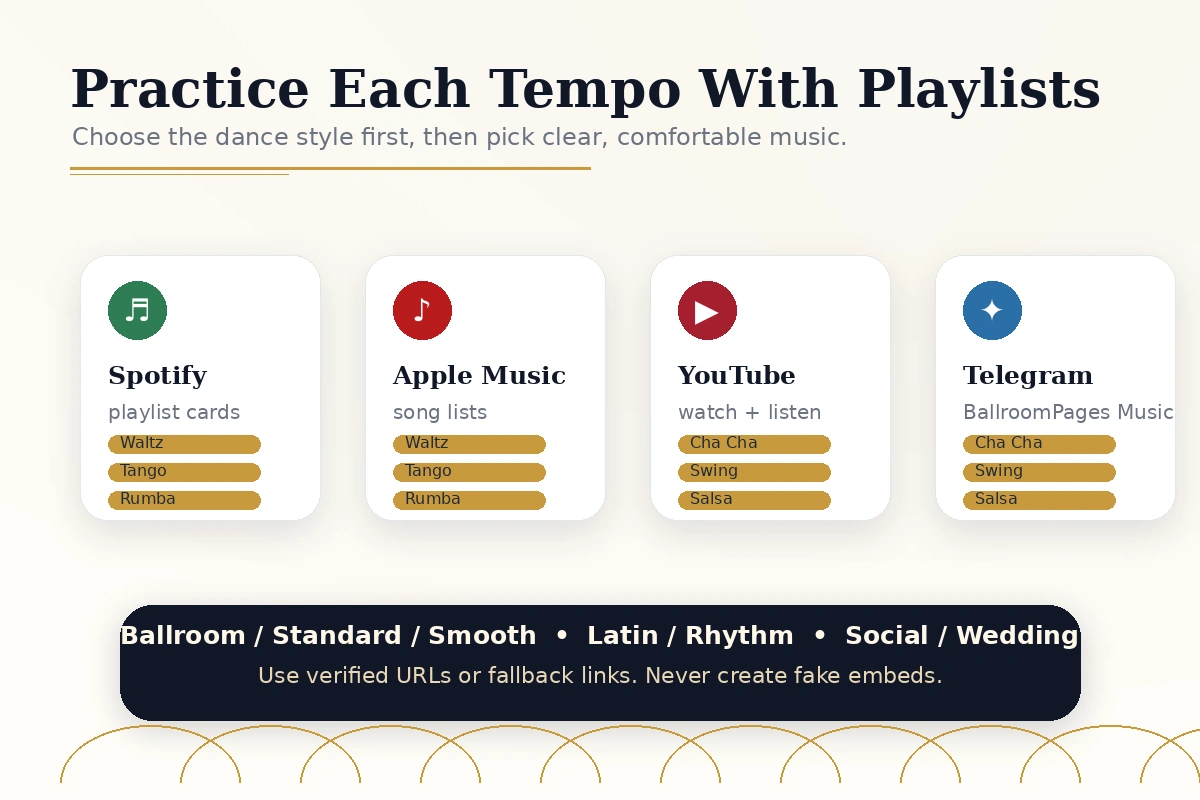
The old Ballroom Pages playlist ecosystem is worth preserving, but this page presents it as a teaching tool rather than a link dump. Use playlist cards by dance family and style, then connect each card to the tempo chart row and the dance-style guide.
Start with the dance style you are learning, then choose a track that sits near the beginner-friendly end of the range. For wedding songs, use the playlist as a reference for feel, not as a rule that your song must match perfectly.
Where to listen
Spotify
Per-dance ballroom & Latin playlists.
Direct links coming soonApple Music
Slow Waltz, Foxtrot, Rhythm sets.
Direct links coming soonYouTube / YouTube Music
Ballroom, Latin & social playlists.
Direct links coming soonTelegram
BallroomPages Music channel.
Channel link coming soonPlaylists by family
Ballroom / Standard / Smooth
Social / Wedding
Direct streaming links are being verified before publishing, so this section links to each dance-style guide for now and will gain Spotify, Apple, and YouTube buttons once URLs are confirmed. No placeholder embeds are shown.
Tempo chart for wedding songs
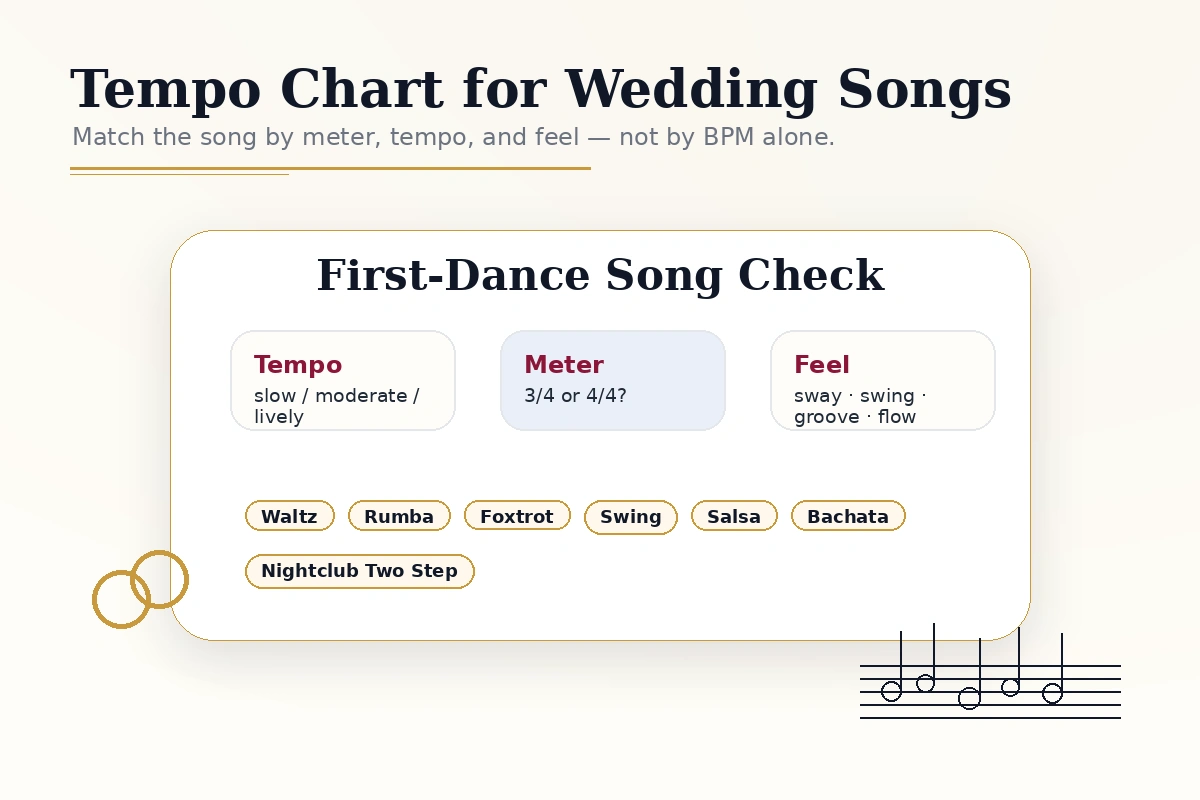
Wedding songs do not always fit classic ballroom tempo ranges. A first dance song may be meaningful, beautiful, and still awkward for strict Waltz, Foxtrot, or Rumba timing.
Use three clues:
- Meter: Does the song feel like 3/4 or 4/4?
- Tempo: Is the pulse slow, moderate, or fast?
- Feel: Does the song sway, swing, groove, pulse, or flow?
Possible matches:
- Waltz: when the song clearly feels like 1-2-3.
- Rumba or Nightclub Two Step: when the song is slow, romantic, and comfortable.
- Foxtrot or Swing: when the song has a walking or swinging feel.
- Salsa or Bachata: when the song has a Latin/social groove and both partners are comfortable with that style.
Do not force a meaningful song into a dance style that feels unsafe or unnatural. When in doubt, ask an instructor or wedding dance specialist. Keep planning with the Wedding Dance Guide and What Dance Fits Your Wedding Song?, or browse First Dance Songs by Dance Style.
Common tempo mistakes
Confusing BPM and MPM.
Counting the melody instead of the beat.
Choosing a song that is too fast because it sounds exciting.
Thinking every song needs a strict competition tempo.
Ignoring time signature.
Trusting a playlist BPM without listening.
Practicing too fast before steps are stable.
Assuming one dance has one universal tempo.