What is Paso Doble?
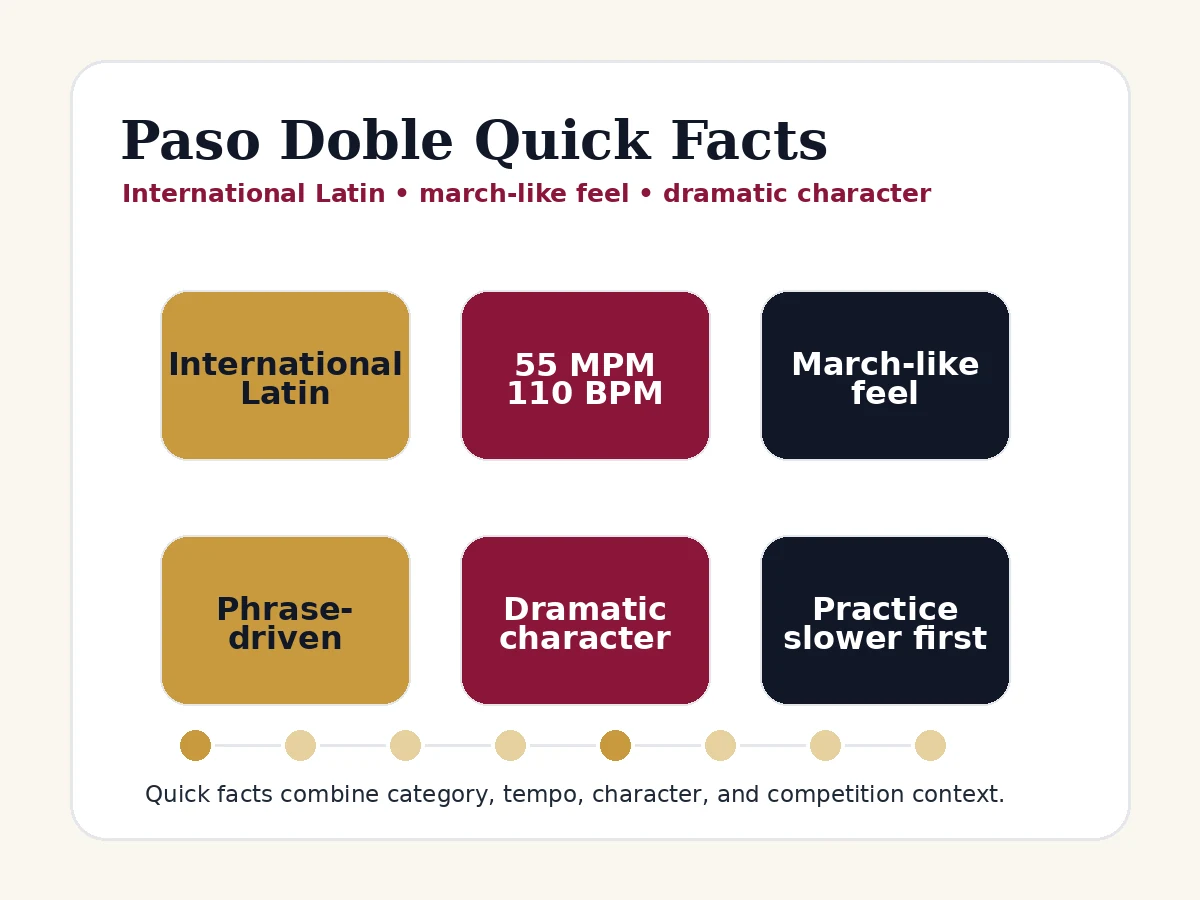
Paso Doble is a dramatic International Latin ballroom dance built around strong posture, shaped lines, march-like music, and theatrical partner movement. It is different from the more playful character of Cha Cha, the grounded romantic quality of Rumba, and the buoyant rhythm of Samba.
In ballroom, Paso Doble is usually taught as a performance and competition dance rather than a casual social dance. It has a strong musical structure, and routines are often shaped to match the phrasing and highlights of the music.
The traditional character is inspired by Spanish bullfight imagery, but a modern editorial guide should explain that as dance theatre. Ballroom Pages does not glorify real bullfighting, violence, weapons, or gore. The useful dance lesson is character, posture, timing, and shape.
Ballroom Paso Doble vs broader cultural inspiration
Paso Doble has broader music and cultural associations, but this page focuses on ballroom Paso Doble. In the ballroom context, the dance is part of the International Latin family and is performed as a stylized partner dance.
That distinction matters. A searcher may find references to Spanish marches, bullring music, theatrical character, or different social and cultural uses of pasodoble music. This page should not pretend every use of the term is the same as the competition ballroom dance.
What Paso Doble feels like
Paso Doble feels proud, structured, and dramatic. It has more of a march-like drive than a relaxed social groove.
The movement should feel lifted through the body and clear through the feet. Beginners often think Paso Doble is about acting intense, but the character works best when the timing, posture, and shapes are organized first.
For the leader, Paso Doble asks for clear direction, strong posture, and phrase awareness. For the follower, it asks for balance, responsiveness, expressive shaping, and clear timing.
Paso Doble music, timing, and phrasing
Paso Doble music is one of the biggest reasons the dance feels different from other Latin dances. It is often march-like, dramatic, and strongly phrased.
NDCA lists International Latin Paso Doble at 55 measures per minute / 110 beats per minute. Many Paso Doble figures use numerical counts such as 1–4 or 1–8, but exact timing depends on the figure and syllabus context.
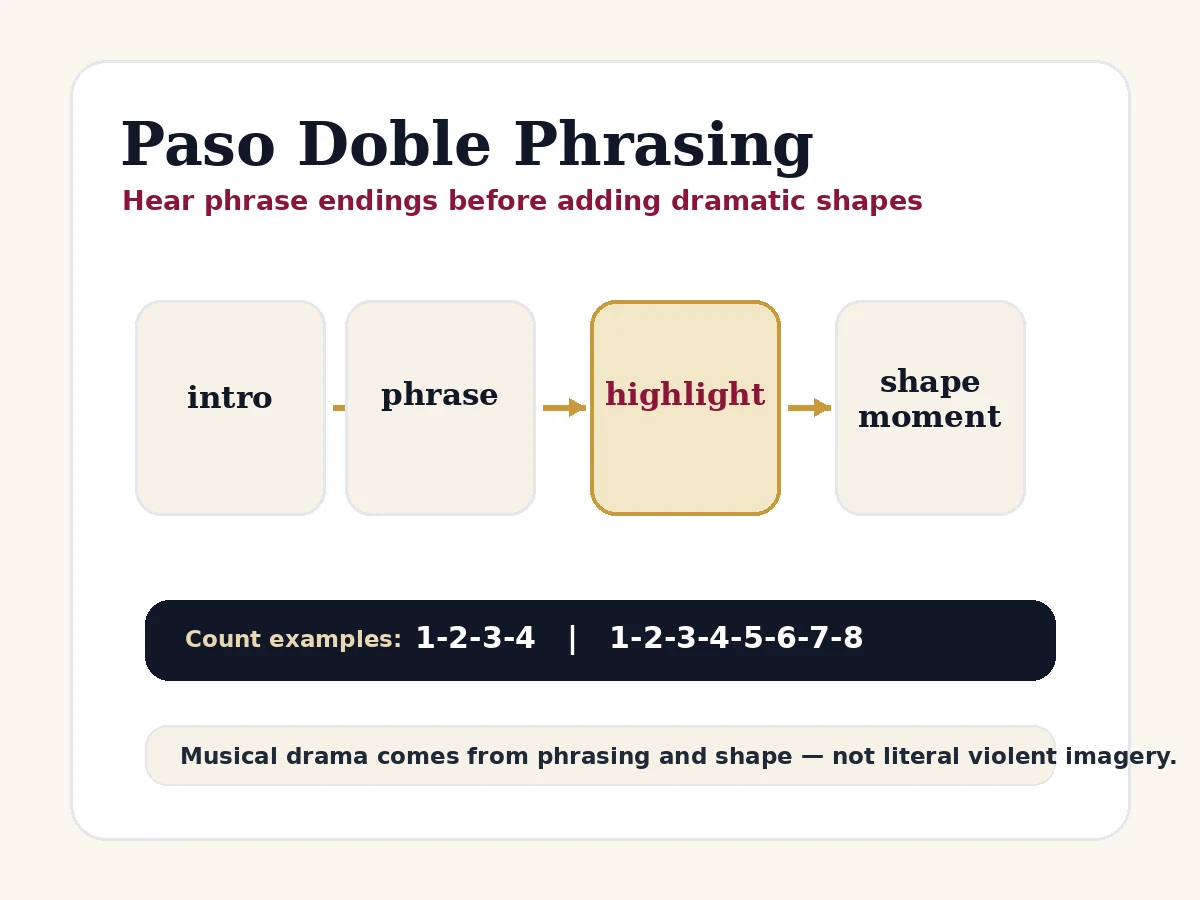
Unlike many social dances where you can simply repeat a basic indefinitely, Paso Doble often depends on musical phrasing. Dancers may build toward highlights, hold shapes at important points, and choreograph the routine around the structure of the music.
| Concept | What it means | Beginner note |
|---|---|---|
| March-like feel | The music has a strong, forward, dramatic pulse | Count clearly before adding shape |
| 1–4 or 1–8 counts | Many figures are taught with numerical counts | Confirm the figure and teacher’s timing |
| Musical highlights | Important accents or phrase endings in the music | Learn to hear them before trying to pose dramatically |
| Competition tempo | NDCA lists International Latin Paso Doble at 55 MPM / 110 BPM | Practice slower when learning |
| Phrasing | The routine often follows the structure of the music | This is why Paso Doble is often choreographed |
For broader timing help, read How to Count Ballroom Dance Music and compare speeds in the Ballroom Dance Tempo Chart.
Paso Doble character and shaping
Paso Doble character is built through posture, frame, shaping, direction, and timing. The dance often uses proud body lines and theatrical opposition between the partners.
Beginners should not start by copying extreme shapes from competition videos. First, learn how to stand, move, and change shape without losing balance.
Good Paso Doble shaping should look intentional. The body stays lifted, the arms have tone, and the movement matches the music. If the shape causes the dancer to collapse, twist sharply, or lose timing, it is too much for that moment.

Basic Paso Doble steps for beginners
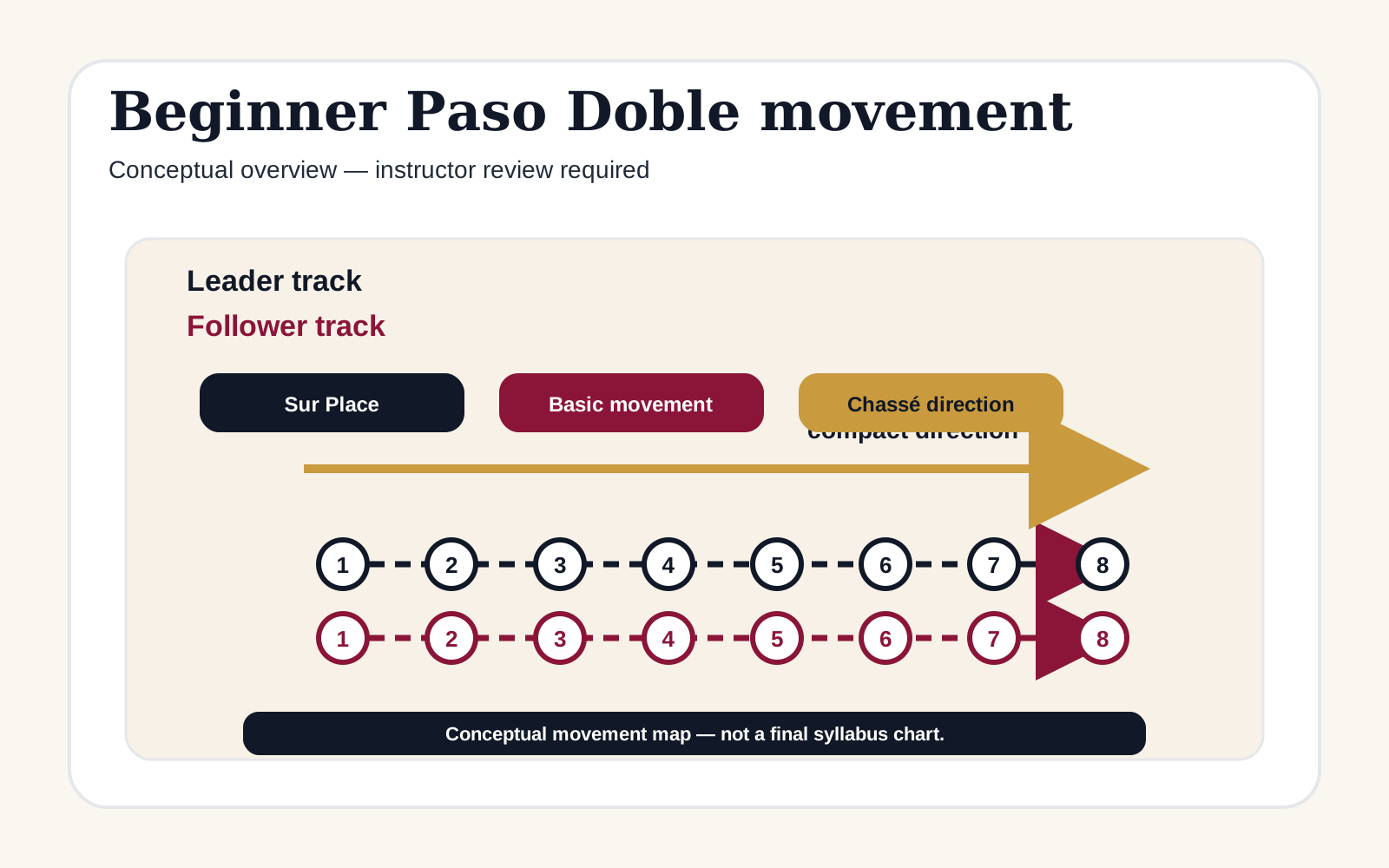
Beginner Paso Doble should start with simple movement concepts, not an advanced competition routine. NDCA and DanceCentral list beginner and bronze-level material such as Sur Place, Basic Movement, Chassés, Drag, Deplacement / Attack, Promenade Link or Close, Promenade, Ecart, Separation, Lady’s Caping Walks, Huit, Sixteen, Promenade and Counter Promenade, Grand Circle, and Open Telemark.
| Beginner concept | What it teaches | Beginner note |
|---|---|---|
| Sur Place | Rhythm and grounded marching action in place | Good place to learn posture and timing |
| Basic Movement | Core movement and direction | Keep it clean before adding drama |
| Chassés | Side-traveling action and timing | Avoid rushing or overstepping |
| Drag | Controlled shaping and movement quality | Learn slowly with balance |
| Deplacement / Attack | Direction and dramatic action | Needs instructor guidance |
| Promenade Link / Close | Position changes and partner connection | Keep roles clear and timing steady |
| Promenade | Directional movement and shape | Do not force the upper body |
| Separation | Space, timing, and relationship between partners | Keep connection through timing, not pulling |
| Caping Walk concept | Theatrical shaping idea | Explain carefully; avoid literal violent imagery |
This page should remain a style guide, not a final syllabus manual. Any exact footwork diagram should be reviewed by a qualified ballroom instructor.
Glossary support: International Latin, ballroom glossary terms.
Beginner Paso Doble basic step overview
A beginner Paso Doble practice can begin with marching rhythm, posture, Sur Place, simple chassés, and basic directional movement.
- Stand tall with lifted posture and relaxed shoulders.
- Count a steady 1–4 or 1–8 phrase.
- Practice Sur Place without forcing drama.
- Add compact chassés.
- Add a simple promenade or separation concept with a teacher.
- Add shaping only when balance and timing are clear.
Cape and shape concepts
Many ballroom explanations describe Paso Doble partner imagery through a cape concept. Treat this as theatrical dance language, not as literal violence.
A safer beginner explanation is: one dancer may create a shaped line, while the other moves around or through the space in a way that matches the music. The goal is contrast, direction, and musicality.
Do not use weapons, gore, or literal bullfighting visuals. Use abstract shape, fabric-like lines, and partner geometry.

Paso Doble in competition
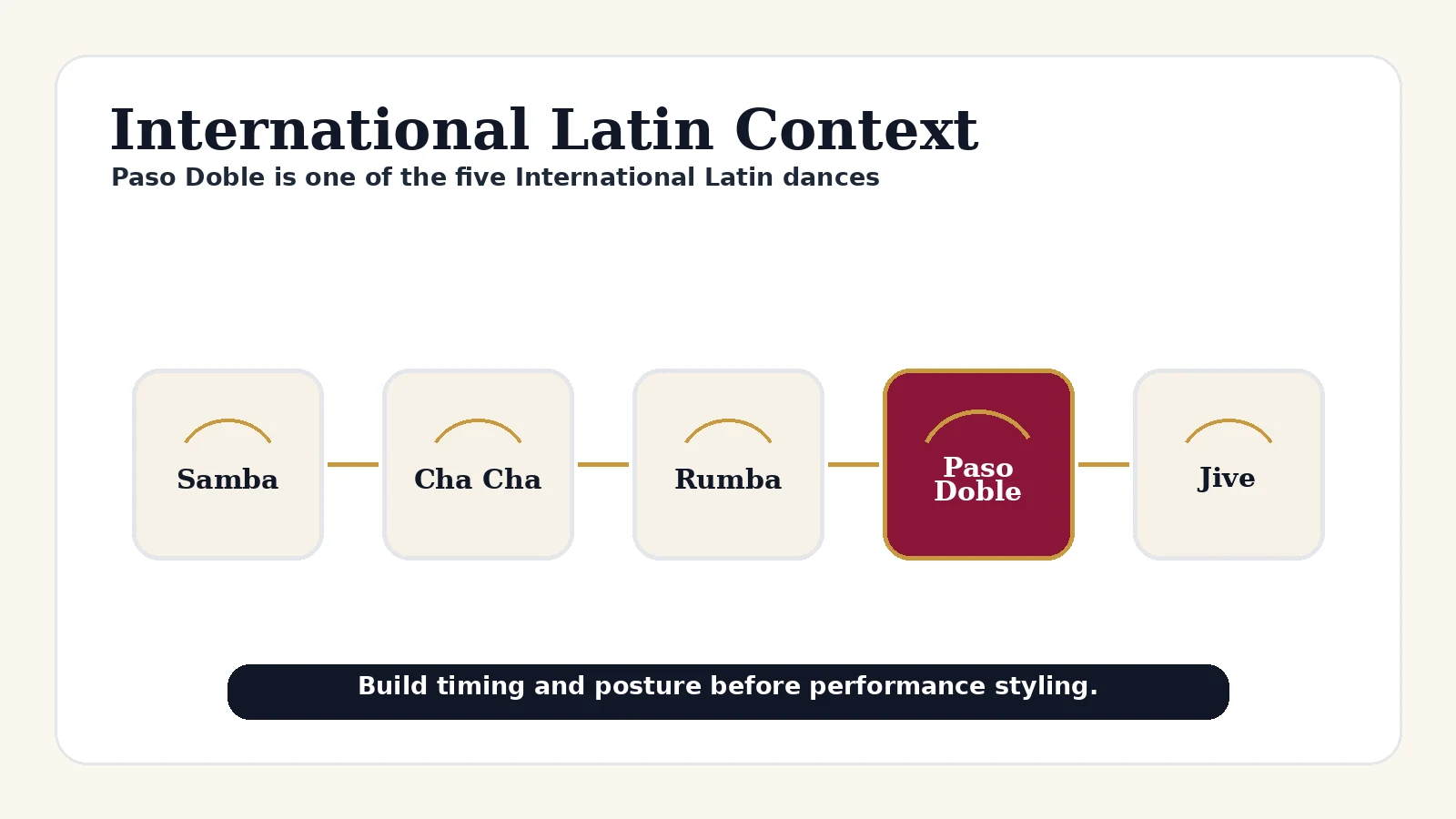
Paso Doble is one of the five International Latin dances. It is usually seen more often in competition and performance contexts than casual social dance settings.
Competitive Paso Doble rewards music awareness, posture, control, shaping, and theatrical clarity. Because the phrasing is so important, routines are often choreographed carefully to the music.
Beginners should not copy advanced competition lines before learning timing and posture. Start with simple rhythm, body position, partner spacing, and clear counts.
Paso Doble for social dancing
Paso Doble is not usually the first dance people choose at casual social events. It takes space, structure, phrase awareness, and often some choreography.
That does not mean it has no social use. In studio settings, practice parties, showcases, and themed performances, Paso Doble can be exciting and memorable. The key is knowing the setting.
If the floor is crowded, the song is not suitable, or the dancers do not know the phrasing, choose a more social-friendly option such as Rumba, Cha Cha, Salsa, or Swing.
Is Paso Doble good for weddings?
Paso Doble can work for a dramatic choreographed wedding moment, especially in a short performance section or medley. It is not usually the easiest or most natural first dance for a slow romantic song.
Choose Paso Doble only if the couple wants bold theatrical energy, has enough time to rehearse, and has a song that supports the character. For most couples, Rumba, Foxtrot, Waltz, or Nightclub Two Step will be easier first-dance choices.
Plan your first dance with the Wedding Dance Guide or use What Dance Fits Your Wedding Song?.
Common beginner mistakes
| Mistake | Why it happens | Better approach |
|---|---|---|
| Acting intense before learning timing | The dance looks dramatic in videos | Count first, shape later |
| Using aggressive movement | The character is misunderstood | Aim for proud, controlled theatricality |
| Copying real bullfighting imagery | Old descriptions can be too literal | Use abstract dance theatre language |
| Overusing arms | Dancers try to “perform” with the upper body | Build posture and direction first |
| Ignoring phrasing | The music feels like a march only | Listen for phrase endings and highlights |
| Taking steps too large | The dance feels powerful | Keep movement controlled and balanced |
| Pulling the partner | The leader tries to force shape | Use direction, timing, and body organization |
| Practicing advanced figures too soon | Competition routines look exciting | Start with Sur Place, basic movement, and chassés |
Beginner practice plan
| Practice phase | Goal | What to practice | What to avoid |
|---|---|---|---|
| Week 1 | Hear the music | Count 1–4 and 1–8 phrases; clap the pulse | Acting or posing before timing |
| Week 2 | Build posture | Practice tall carriage, grounded steps, and Sur Place | Collapsed shoulders or tense arms |
| Week 3 | Add basic movement | Practice compact basic movement and chassés | Large, rushed steps |
| Week 4 | Add shape carefully | Try simple promenade / separation ideas with a teacher | Extreme lines or forced partner action |
| Ongoing | Become musical | Learn where the music builds and where shapes belong | Copying full competition routines without guidance |
Next step: Read How to Count Ballroom Dance Music or compare Paso Doble with Samba, Cha Cha, Rumba, and Jive.