
Ballroom Glossary / Style Families
International Latin
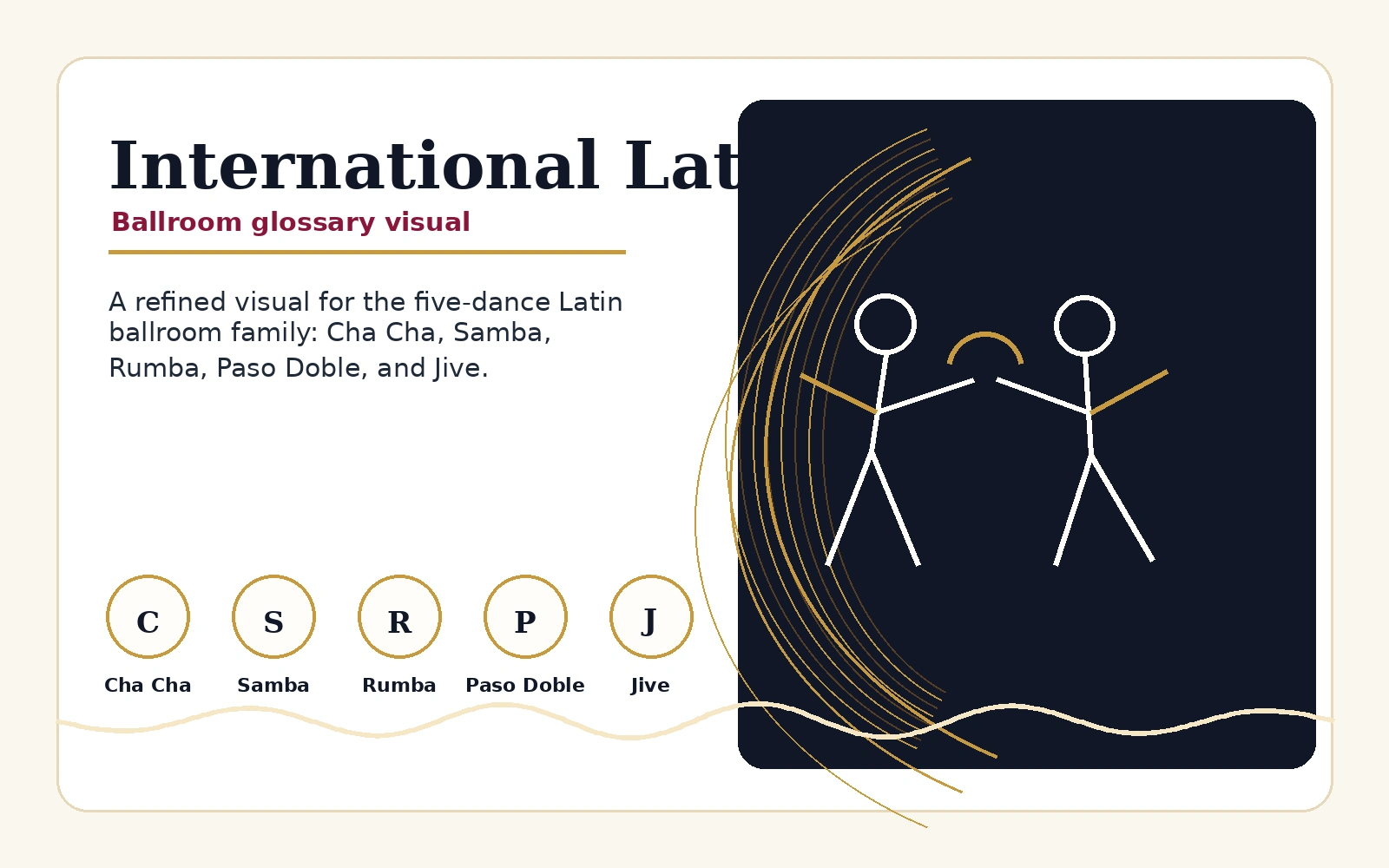
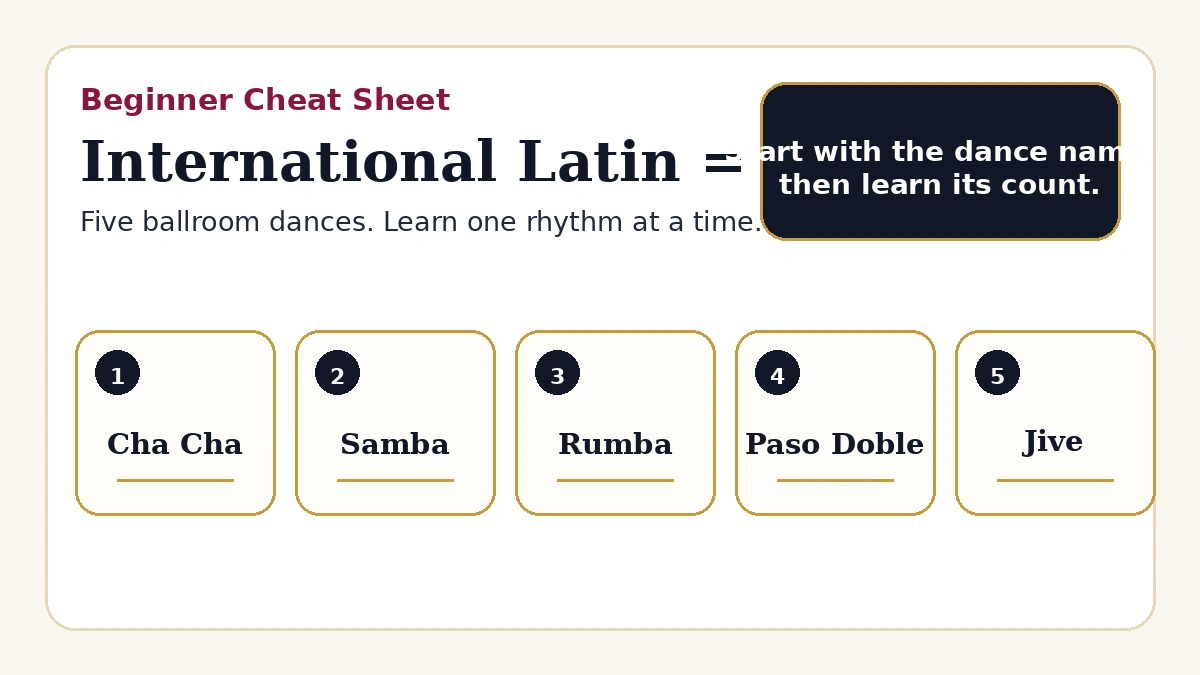
International Latin is the five-dance Latin ballroom family used in many ballroom and DanceSport competition settings: Cha Cha, Samba, Rumba, Paso Doble, and Jive.
Quick definition of International Latin
International Latin
- Term
- International Latin
- Also called
- Latin, International Style Latin, Latin American, DanceSport Latin, depending on the organization or context
- Type
- Ballroom / DanceSport style family or competitive discipline
- Includes
- Cha Cha, Samba, Rumba, Paso Doble, Jive
- Not the same as
- Generic Latin dance, social Latin dance, American Rhythm
- Beginner translation
- International Latin is the five-dance Latin ballroom family used in many competitive ballroom contexts.
International Latin is not one dance and not every Latin dance; it is a specific ballroom style family that groups five competition dances together: Cha Cha, Samba, Rumba, Paso Doble, and Jive.
What International Latin means
International Latin is a category label in ballroom dance. It groups five specific dances—Cha Cha, Samba, Rumba, Paso Doble, and Jive—so dancers, teachers, competitions, playlists, and syllabus materials can organize them clearly.
This matters because the word “Latin” can mean different things. In a ballroom competition context, “Latin” often points to the International Latin five-dance family. At a social event, “Latin night” might mean Salsa, Bachata, Merengue, Cumbia, or a broader mix of club and social dances.
Teacher note: International Latin is a category label first. The five dances share a competition family, but each dance has its own music, count, rhythm, character, and technique. Beginners should learn which dance they are studying before worrying about advanced technique terms.
The five International Latin dances
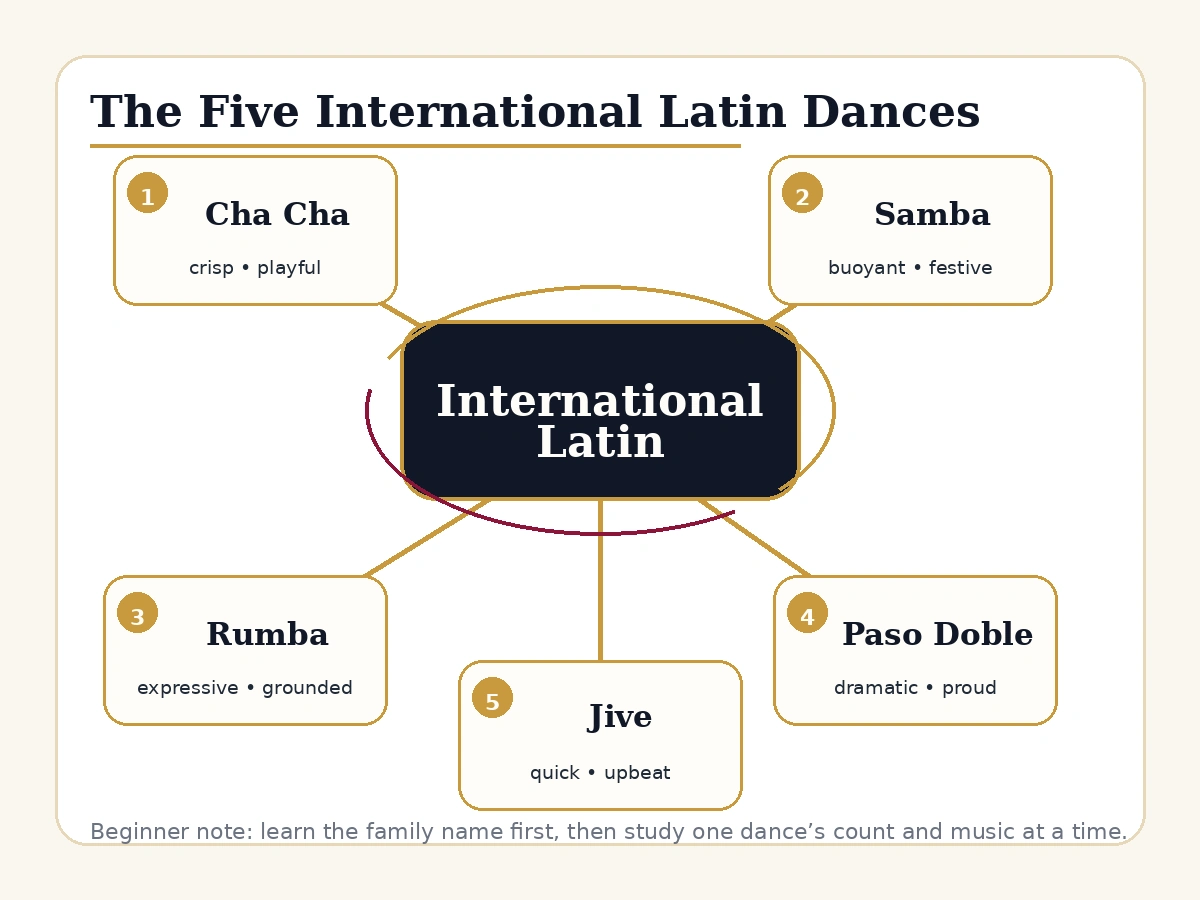
The five International Latin dances are Cha Cha, Samba, Rumba, Paso Doble, and Jive. Here is a beginner-friendly snapshot of each.
Cha Cha / Cha-Cha-Cha
Cha Cha is sharp, playful, syncopated, and usually one of the easiest International Latin names for beginners to recognize.
Bright · crisp · cheeky
Samba
Samba is energetic and rhythmically layered, with a lively feeling that makes it very different from the “Latin music in general” idea many beginners have.
Buoyant · festive · driving
Samba guide Playlist URL to verify
Rumba
Rumba is slower, expressive, and often taught as a beginner-friendly way to understand Latin timing and partner connection. Be careful: International Rumba and American Rhythm Rumba are not always taught the same way.
Controlled · expressive · grounded
Paso Doble
Paso Doble has a dramatic, march-like character and is closely associated with strong shaping and theatrical energy in competition contexts. It is usually not the first International Latin dance beginners learn.
Dramatic · proud · powerful
Paso Doble guide Paso Doble playlist URL to verify
Jive
Jive is fast, springy, and highly energetic. Beginners may recognize it as related to swing-family energy, but in International Latin it has its own competition identity.
Quick · upbeat · athletic
International Latin vs American Rhythm
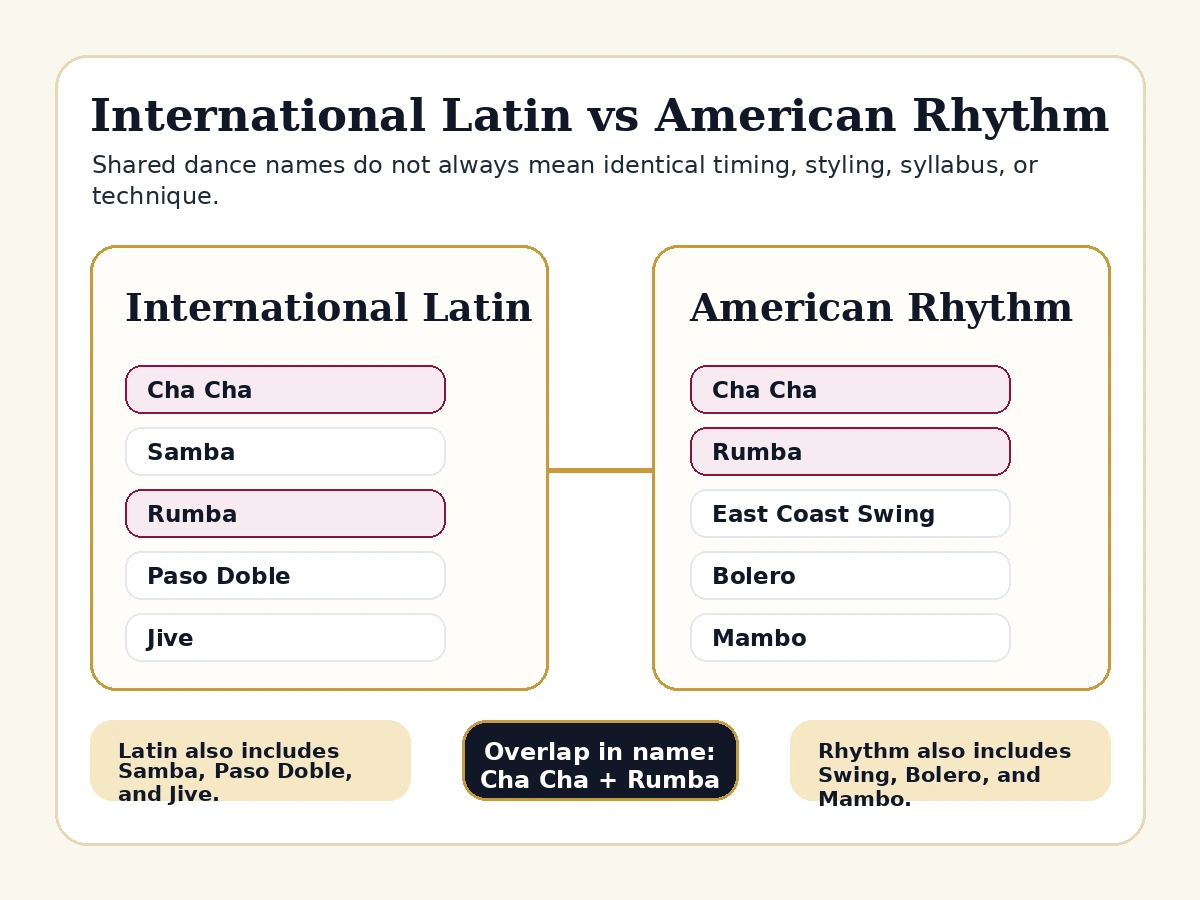
International Latin and American Rhythm are two different ballroom Latin families. They share a couple of dance names, which is exactly why beginners mix them up.
| Style family | Dances |
|---|---|
| International Latin | Cha Cha, Samba, Rumba, Paso Doble, Jive |
| American Rhythm | Cha Cha, Rumba, Swing, Bolero, Mambo |
Beginner takeaway: Shared names do not always mean identical timing, styling, syllabus, or technique. Cha Cha and Rumba appear in both families, but a student should ask which style family the class, competition, playlist, or syllabus is using.
Want the deeper side-by-side? A dedicated American Rhythm vs International Latin guide and an American Rhythm glossary entry are planned. For now, the on-page comparison above covers the beginner essentials.
International Latin vs social Latin
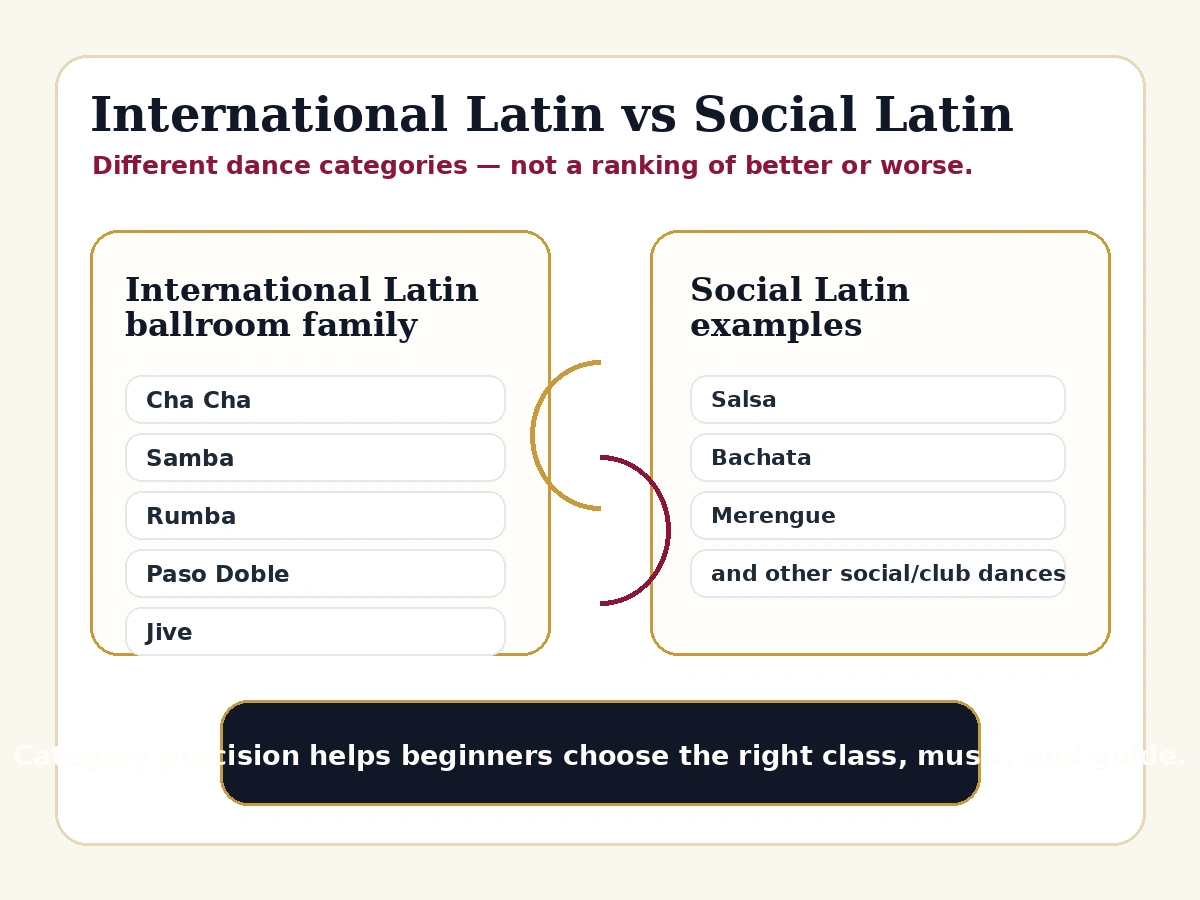
Social Latin is a broad everyday phrase. It may include Salsa, Bachata, Merengue, and other club, street, Caribbean, or social partner dances. Those dances are valuable and often deeply connected to Latin American and Caribbean music cultures, but they are not normally part of the International Latin ballroom five-dance set.
This is category precision, not a ranking. Salsa is not “less than” International Latin. Bachata is not “wrong.” They are simply different dance categories with different music, social settings, teaching traditions, and competition structures.
International Latin vs International Standard
International Latin and International Standard are different ballroom families. International Standard includes Waltz, Tango, Viennese Waltz, Slow Foxtrot, and Quickstep, and it is more strongly associated with continuous closed hold.
International Latin is a different family: Cha Cha, Samba, Rumba, Paso Doble, and Jive. The music, posture, movement character, styling, and syllabus expectations are different. Beginners do not need to memorize all technical differences right away. The first step is simply understanding that “Latin” and “Standard” are separate ballroom style families.
Related terms: see International Standard; the American Smooth and American Rhythm glossary entries are planned. The glossary hub always has the current A–Z index.
Why it matters
- Choose the right class or lesson package.
- Understand why “Latin dance” can mean different things in different settings.
- Pick the right playlist for the dance you are practicing.
- Avoid mixing American Rhythm and International Latin assumptions too early.
- Read competition categories more confidently.
- Navigate Ballroom Pages without duplicate dance-style URLs.
- Learn one dance’s count and rhythm before trying to learn the whole family.
Beginner example
If a studio says it offers International Latin, it usually means the ballroom Latin family of Cha Cha, Samba, Rumba, Paso Doble, and Jive. If a social event says “Latin night,” it may mean Salsa, Bachata, Merengue, or a broader mix of social dances. The label tells you what kind of dancing, music, and teaching context to expect.
Common confusions
- International Latin means every Latin dance.
Correction: In ballroom contexts, International Latin usually means the five-dance family.
- Salsa and Bachata are International Latin.
Correction: They are social Latin dances, not normally part of the five-dance International Latin ballroom set.
- American Rhythm and International Latin are interchangeable.
Correction: They overlap in names like Cha Cha and Rumba, but style families and syllabi can differ.
- Cha Cha and Rumba are taught exactly the same everywhere.
Correction: Ask whether the class is International Latin, American Rhythm, social, wedding-focused, or studio-specific.
- Any Latin playlist works for International Latin.
Correction: Practice music should match the dance’s rhythm, count, and tempo expectations.
- I should learn Cuban motion, bounce, and styling first.
Correction: Learn the dance family and one dance’s basic count first. See Cuban motion when you are ready.
- Competition categories are social dance rules.
Correction: Competition labels organize events and syllabi; social dance settings are broader.
Beginner practice and learning tips
- Memorize the five dances: Cha Cha, Samba, Rumba, Paso Doble, and Jive.
- Pick one dance to begin with. Many beginner classes start with Cha Cha or Rumba, but the best starting point depends on your studio, teacher, goals, and comfort with the music.
- Listen before you drill. Play the dance-specific playlist for Cha Cha, Samba, Rumba, Paso Doble, or Jive and try to hear the rhythm before learning too many steps.
- Learn one count at a time. International Latin is easier when you stop treating it as one giant category and start treating it as five separate dances.
- Compare with American Rhythm only after you understand the basic category difference.
- Use instructor guidance for technique terms such as Cuban motion, bounce action, hip action, arm styling, and shaping.
- Keep practice safe and beginner-appropriate. No dips, tricks, dramatic lines, or speed work until a teacher has given the setup and control.
Practice with music
Listen to the International Latin dance family
Ballroom Pages already has a useful music ecosystem. Use this page to connect the term International Latin to listening practice without overloading the glossary entry with heavy embeds. Verified Spotify links open in your music app; cards marked “verify before publishing” are awaiting a confirmed first-party URL.
Primary: a Latin practice playlist
Start with a clear, steady Cha Cha beat. The embed loads on demand to keep the page fast; you can also open the full library directly.
Platforms & channels
International Latin playlists
The full Ballroom Pages playlist library, organized by dance.
Spotify Latin playlists
Cha Cha, Rumba, and Jive practice playlists on Spotify.
Apple Music Latin playlists
Apple Music versions are being verified.
Apple Music URL to verify
YouTube Latin playlists
YouTube versions are being verified.
YouTube URL to verify
Ballroom Pages Music on Telegram
Get playlist updates as new sets are added.
By dance
Cha Cha playlist
Samba playlist
Playlist URL to verify
Rumba playlist
Paso Doble playlist
Playlist URL to verify
Jive playlist
More in Music & Timing, including the tempo chart and how to count ballroom dance music.
FAQ
International Latin FAQ
What is International Latin in ballroom dance?
International Latin is a ballroom/DanceSport style family. It usually refers to the five Latin ballroom dances: Cha Cha, Samba, Rumba, Paso Doble, and Jive.
Which dances are International Latin?
The standard five International Latin dances are Cha Cha, Samba, Rumba, Paso Doble, and Jive. Some organizations write Cha Cha as Cha-Cha-Cha.
Is International Latin the same as Latin dance?
No. “Latin dance” can be a broad phrase that includes social and club dances. International Latin is a specific ballroom category.
Is Salsa part of International Latin?
No, Salsa is not normally part of the International Latin five-dance ballroom set. It is better treated as a social or club Latin dance, depending on the context.
What is the difference between International Latin and American Rhythm?
International Latin commonly includes Cha Cha, Samba, Rumba, Paso Doble, and Jive. American Rhythm commonly includes Cha Cha, Rumba, Swing, Bolero, and Mambo. Shared dance names do not guarantee identical timing, technique, or syllabus.
Is Cha Cha International Latin or American Rhythm?
It can be both, depending on the style family. International Latin has Cha Cha, and American Rhythm also has Cha Cha. Ask which style your class, competition, or playlist is using.
What is the difference between International Latin and International Standard?
International Latin includes Cha Cha, Samba, Rumba, Paso Doble, and Jive. International Standard includes Waltz, Tango, Viennese Waltz, Slow Foxtrot, and Quickstep.
Which International Latin dance should beginners learn first?
Many beginners start with Cha Cha or Rumba because they are common in lessons and help students understand rhythm and weight changes. The best choice depends on your teacher, class format, and goals.
Are International Latin playlists different from regular Latin music playlists?
They should be. A regular Latin music playlist may be great for listening, but an International Latin practice playlist should be organized by dance so the rhythm, count, and tempo fit Cha Cha, Samba, Rumba, Paso Doble, or Jive.
Editorial
Sources and editorial note
Style-family names and dance lists vary slightly by organization, country, and year. This entry uses recognized DanceSport and ballroom references for the five International Latin dances and the American Rhythm and International Standard families. Because rules and labels are updated periodically, the live page should be reviewed against current governing-body documents before publication.
- WDSF — DanceSport Disciplines (Latin: Samba, Cha-Cha-Cha, Rumba, Paso Doble, Jive).
- NDCA 2026 Rule Book — International Style Latin, American Style Rhythm, and International Style Ballroom figure lists.
- WDSF — Standard dances (Waltz, Tango, Viennese Waltz, Slow Foxtrot, Quickstep).
- ISTD — Latin American page (Cha Cha Cha, Samba, Rumba, Paso Doble, Jive).
This is dance terminology, not medical advice. Ballroom Pages follows an editorial policy of education-first guidance. Questions? Contact us. Updated May 21, 2026.