What is Samba?
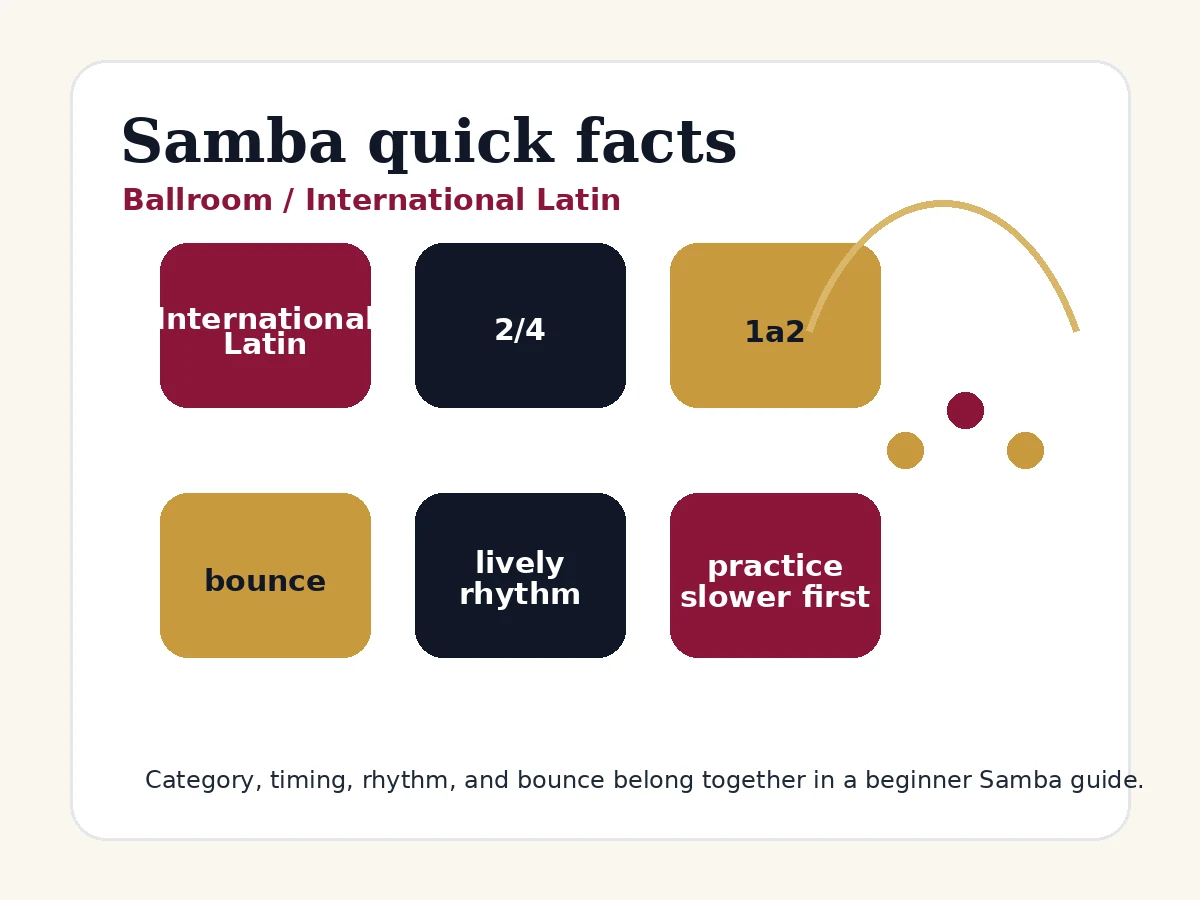
Samba is a lively, rhythmic dance with Brazilian roots and a strong ballroom identity. In the ballroom world, Samba is part of the International Latin family, along with Cha Cha, Rumba, Paso Doble, and Jive.
The word “Samba” can mean different things depending on context. It may refer to International Latin ballroom Samba, Brazilian social dance traditions, Samba de Gafieira, solo / carnival samba, or samba music. This page focuses on ballroom Samba while respecting those broader contexts.
Ballroom Samba is usually danced with a partner, uses compact traveling and stationary actions, and is known for bounce, body rhythm, and syncopated foot timing. It should feel alive and musical, not stiff or cartoonishly bouncy.
Historically, samba has Brazilian and Afro-Brazilian roots. The history section here is kept concise and source-backed rather than trying to summarize all Brazilian samba traditions in one ballroom style guide.
Ballroom Samba vs Brazilian / social Samba context
Ballroom Samba is not the same thing as every dance called Samba. This distinction matters because many beginners search “samba dance” and find a mix of ballroom, Brazilian social, carnival, and solo dance explanations.
International Latin Samba is the competition and ballroom-class version most likely to appear in a ballroom studio syllabus. It has figures such as basic movements, whisks, samba walks, voltas, bota fogos, and rhythm bounce.
Brazilian social samba and Samba de Gafieira have their own histories, music communities, embrace choices, figures, and movement vocabulary. They deserve their own dedicated pages if Ballroom Pages later expands into Brazilian partner dance content.
What Samba feels like
Samba feels energetic without being frantic. It has a springy, rolling rhythm that can make the dance look joyful and effortless when the timing is clear.
The movement should feel grounded through the feet and alive through the body. The upper body should not collapse or bounce dramatically up and down. The dance is rhythmic and playful, but still organized.
For the leader, Samba asks for clear rhythm, compact direction, and calm body organization. For the follower, it asks for balance, timing, and the ability to respond without guessing or rushing.
Samba timing, rhythm, and count
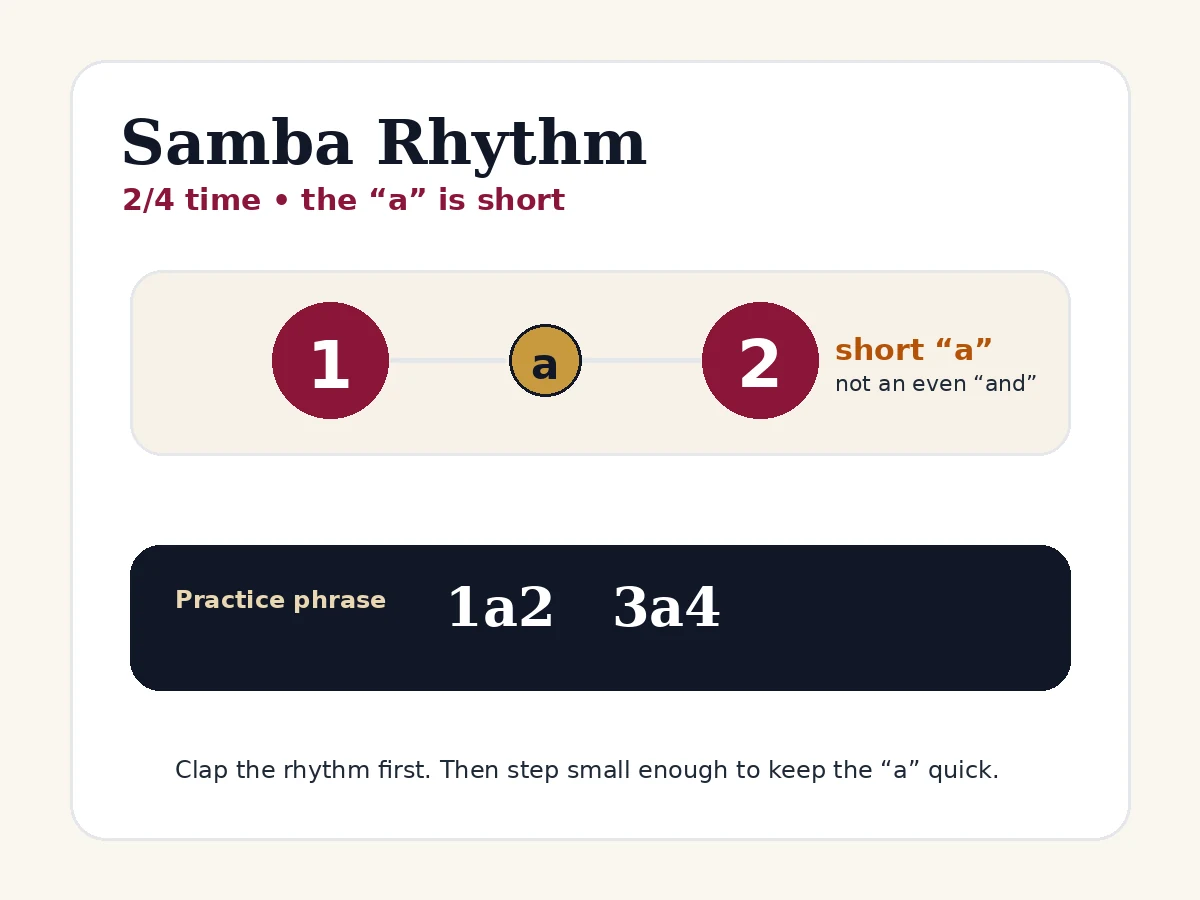
Ballroom Samba is commonly described in 2/4 time. A beginner will often hear counts such as 1a2, 1a2 3a4, or SQQ depending on the figure and teaching context.
The count “1a2” is important because the “a” is very short. It is not the same as an even “1-and-2.” Beginners often rush or flatten the rhythm because they treat each part of the count as equal.
How to hear 1a2
Try clapping “1a2” before stepping it. Say “one-a-two” out loud with a short, quick “a,” then step small enough that the rhythm stays clear.
Why “a” matters
The “a” is the syncopation that gives Samba its character. Make it too long and the rhythm flattens. Make it too quiet and the dance loses its lift. Keep it short, light, and rhythmical.
| Count phrase | What it means | Common use | Beginner caution |
|---|---|---|---|
| 1a2 | A syncopated three-part rhythm over two beats | Basic movements, whisks, samba walks, bota fogos | Do not make the “a” too large or too slow |
| 1a2 3a4 | Two 1a2 units across a longer phrase | Practice patterns and combinations | Keep the rhythm rolling, not jumpy |
| 1a2a3a4 | Repeated syncopation | Volta-style actions | Practice slowly before increasing speed |
| SQQ / SaS | Alternative timing language in some figures | Reverse turn, rocks, slow volta contexts | Confirm with the figure and teacher |
| Practice count | Say “one-a-two” clearly | Beginner rhythm practice | Count before adding styling |
For broader rhythm help, read How to Count Ballroom Dance Music and compare speeds in the Ballroom Dance Tempo Chart.
Samba bounce action explained carefully
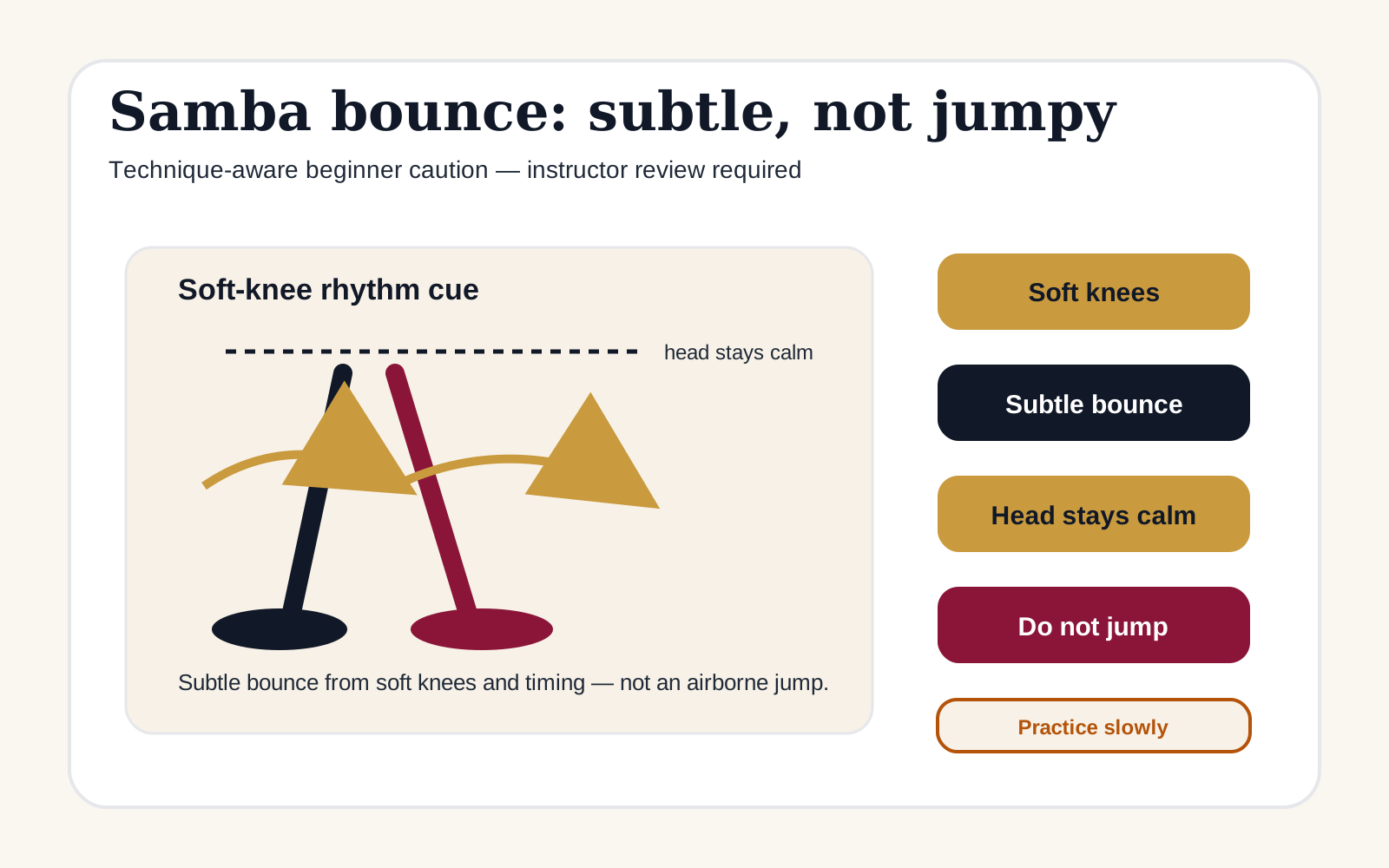
Samba bounce is one of the dance’s signature ideas, but beginners often misunderstand it. It is not jumping. It is not bobbing the head. It is not simply bending and straightening the knees as hard as possible.
A better beginner explanation is this: Samba bounce is a controlled, rhythmic body action supported by soft knees, foot pressure, timing, and body organization. It should feel buoyant, not heavy.
The head should stay relatively calm. The upper body should remain lifted and organized. The action should be subtle enough that the rhythm looks alive without making the dancer appear to hop.
What bounce is
- A rhythmic action connected to the music.
- Supported by soft knees and controlled body movement.
- Subtle, smooth, and grounded.
- Easier when steps are compact.
What bounce is not
- Jumping.
- Head-bobbing.
- A big up-and-down motion.
- Forced hip action.
- A reason to lose timing or posture.
Basic Samba steps for beginners
Beginner movement concepts
Beginner Samba usually starts with rhythm and body action before full routines. Depending on the syllabus and teacher, early concepts may include basic movements, whisks, samba walks, rhythm bounce, volta movements, and bota fogos.
| Beginner concept | What it teaches | Common count | Beginner note |
|---|---|---|---|
| Basic movements | Core Samba timing and weight changes | Often 1a2 | Keep it small and rhythmical |
| Whisks | Side action, crossing / placing action, and partner timing | Often 1a2 | Do not over-swing the body |
| Samba walks | Travel and body rhythm | Often 1a2 | Keep posture lifted |
| Rhythm bounce | Timing and bounce action | Often practiced separately | Teaching tool; do not overdo it |
| Volta movements | Traveling syncopated movement | Often 1a2a3a4 | Practice slowly |
| Bota fogos | Cross-body action and direction change | Often 1a2 | Learn before adding styling |
| Criss Cross Bota Fogos | Direction changes and partner shaping | Often 1a2 | Better after basics feel stable |
What to learn before styling
This page should not present a full step-by-step technical tutorial. A future Samba basic step page can own detailed footwork, counts, video, and HowTo markup after instructor review.
Glossary support: Closed Position, Open Position, Chassé, Cuban Motion.
Samba basic step overview
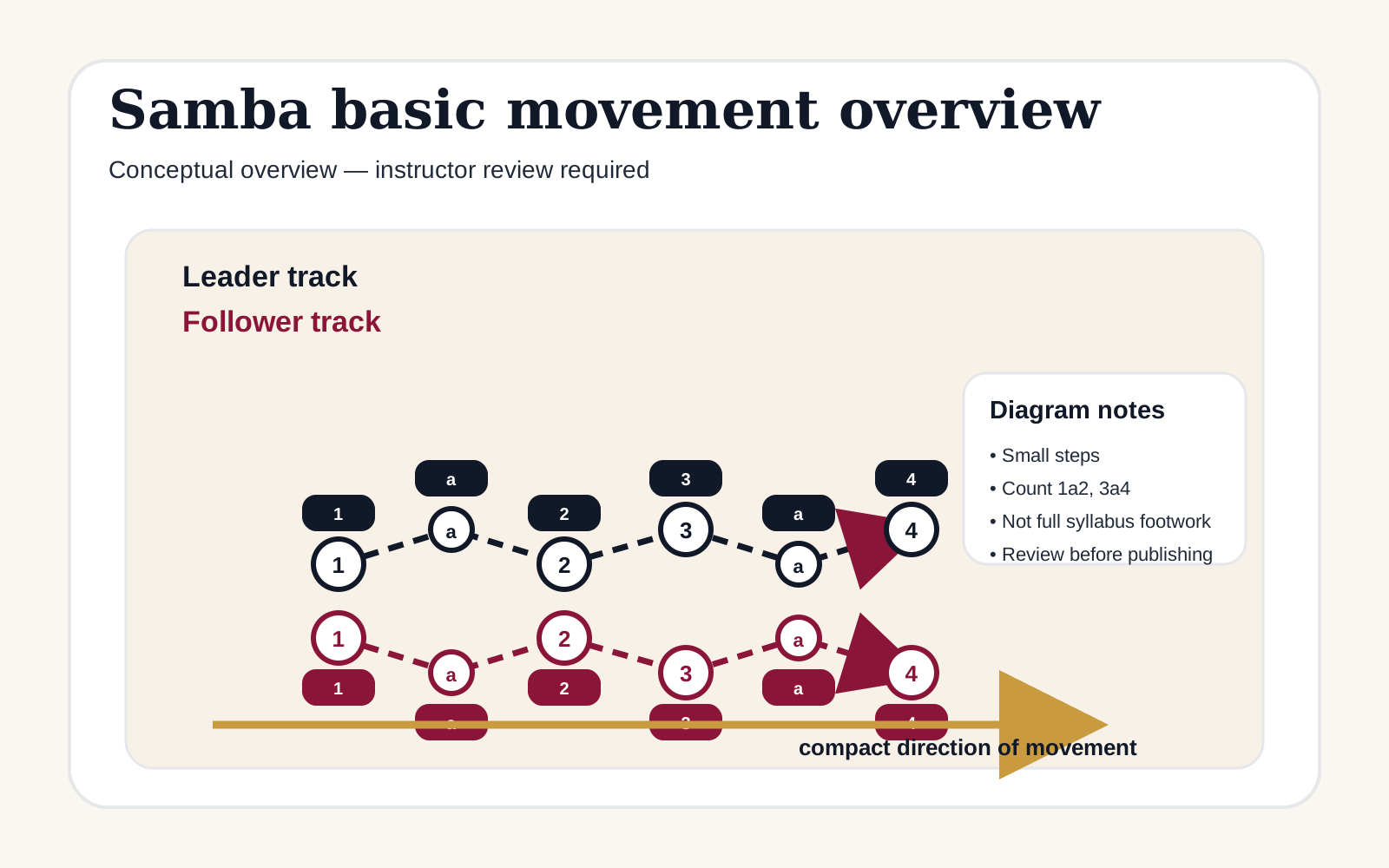
A beginner Samba basic often combines small weight changes with the 1a2 rhythm. The goal is to feel the music, keep the body organized, and avoid making the “bounce” bigger than the rhythm.
- Clap the rhythm: 1a2.
- Step the rhythm alone with very small weight changes.
- Add soft knees without jumping.
- Practice a simple basic movement or whisk slowly.
- Add partner connection only when the rhythm stays clear.
- Increase tempo after the count, balance, and body action are reliable.
Samba music and song feel
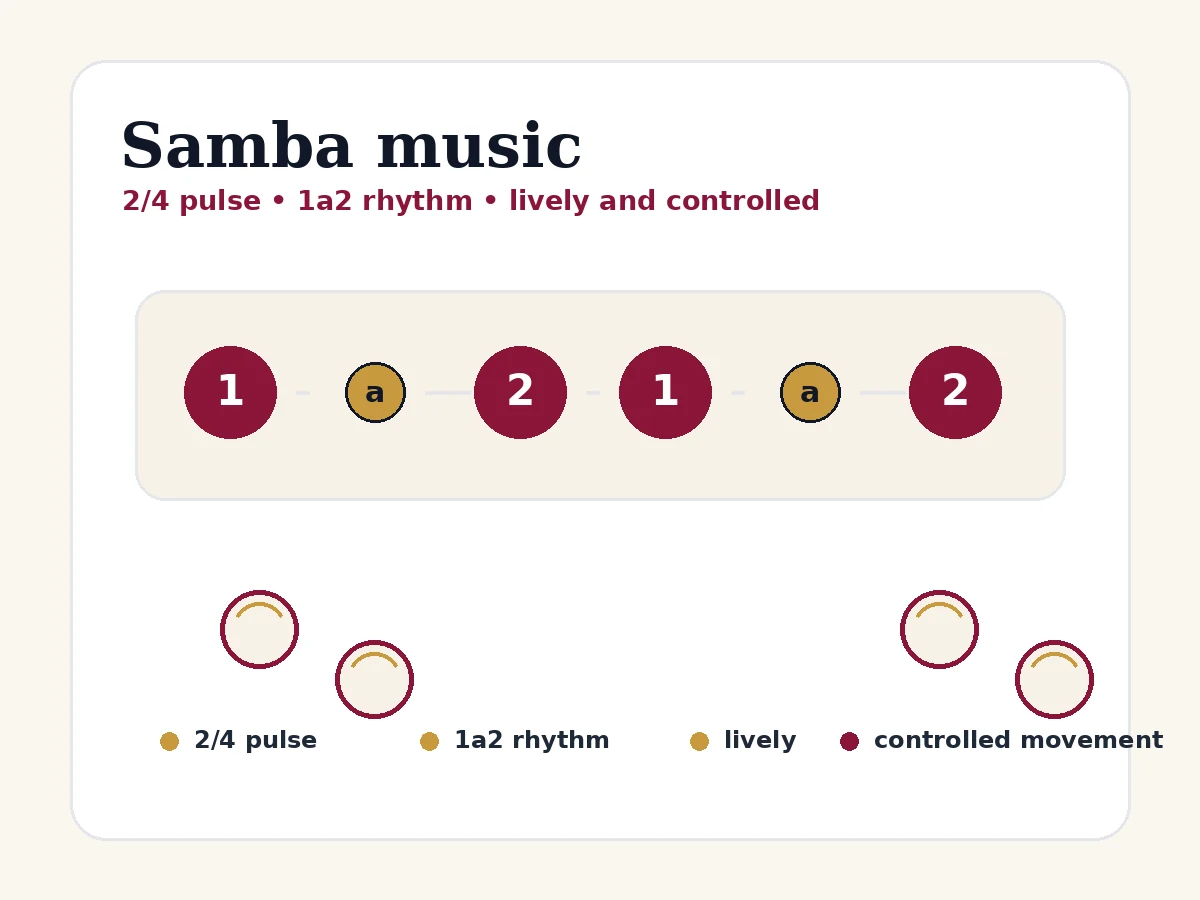
Samba music for ballroom should feel rhythmic, percussive, energetic, and clear enough to support the 1a2 rhythm. It should make the body want to move, but not force beginners into speed before they can control the count.
Competition references commonly place International Latin Samba around 50 measures per minute, or 100 beats per minute. That does not mean beginners should always practice at full competition speed. Slower practice can be useful for learning rhythm and bounce without tension.
Good practice music should make the pulse easy to hear. If the percussion is exciting but the beat feels confusing, start with a clearer practice track before moving to more complex music.
Use the Samba Music Guide when available, or start with How to Count Ballroom Dance Music.
Samba for social dancing
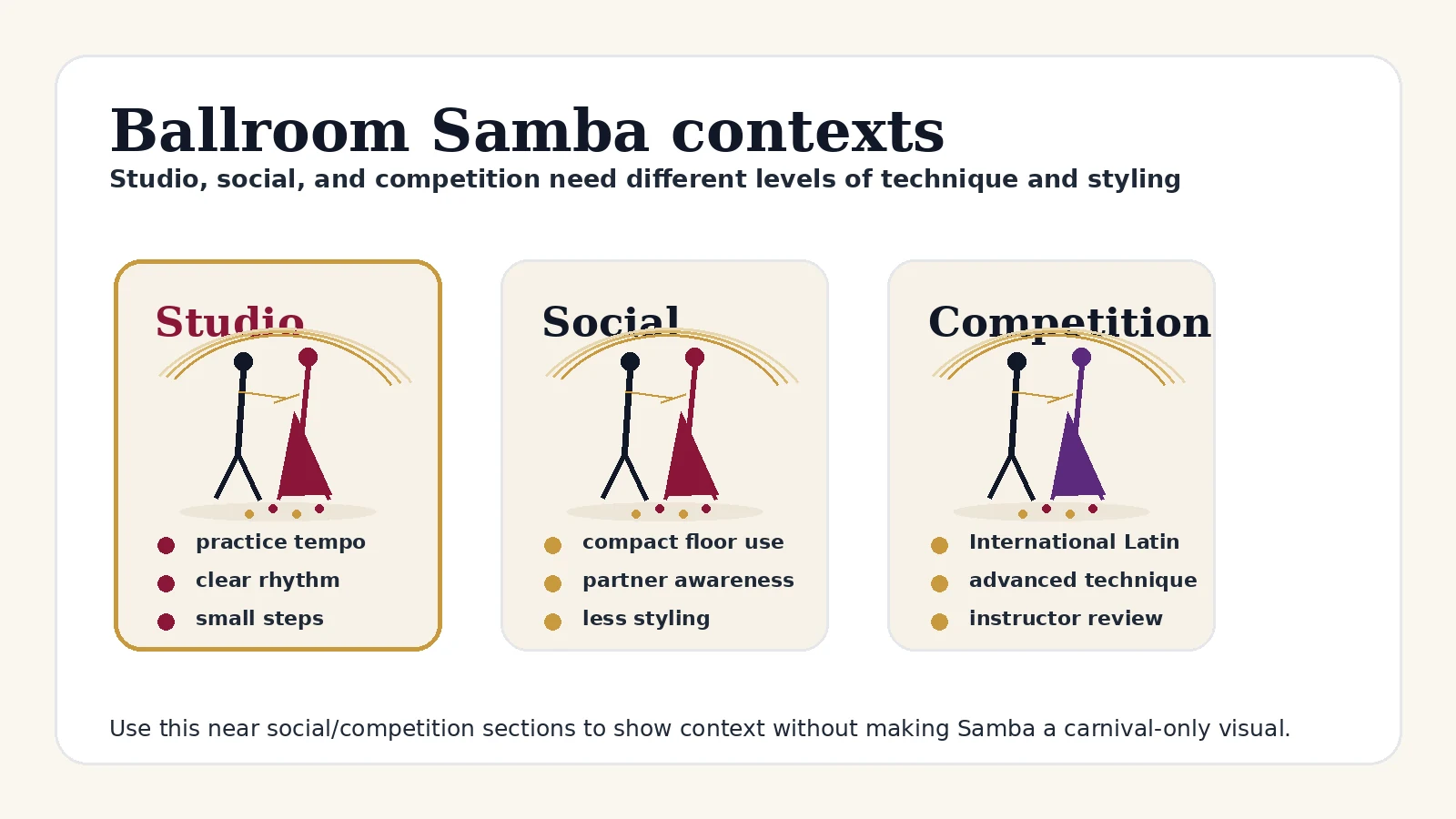
Ballroom Samba appears in ballroom studio socials, Latin rounds, mixed ballroom parties, and dance schools that teach International Latin. It may not appear at every casual social dance, especially where Salsa, Bachata, Swing, or country dances are more common.
In social settings, keep Samba compact. The dance can travel and rotate, but beginners should avoid large figures, exaggerated bounce, or competition styling on crowded floors.
It is also important to notice the context. If the event is Brazilian social dance, carnival samba, or Samba de Gafieira, the movement vocabulary may be different from International Latin ballroom Samba.
Samba in competition
In competition, Samba is one of the five International Latin dances. It often brings energy, rhythm, and visual brightness to a Latin round.
Competitive Samba can include complex timing, body rhythm, direction changes, and advanced figures. Beginners should not copy high-level competition choreography before understanding the rhythm and bounce underneath it.
A better beginner goal is simple: can you keep the 1a2 rhythm, soft knees, compact posture, and clear partner connection while moving lightly with the music?
Is Samba good for weddings?
Samba can work for a wedding first dance when the song is upbeat, rhythmic, and the couple wants a playful choreographed moment. It is especially useful as a short highlight section in a medley or reception performance.
It is not usually the best choice for slow romantic songs, tiny floors, very restrictive attire, or couples who want the easiest possible first dance. For those situations, Rumba, Foxtrot, Waltz, or Nightclub Two Step may be more practical.
Plan your first dance with the Wedding Dance Guide or use What Dance Fits Your Wedding Song?.
Common beginner mistakes
| Mistake | Why it happens | Better approach |
|---|---|---|
| Turning bounce into jumping | “Bounce” sounds like up-and-down motion | Keep the head calm and the action subtle |
| Counting 1a2 evenly | The “a” count feels unfamiliar | Clap the rhythm before stepping |
| Taking steps too large | The music feels exciting | Keep steps compact until timing is stable |
| Forcing hip action | Dancers want the Latin look immediately | Learn rhythm, feet, and soft knees first |
| Losing posture | Bounce becomes heavy | Keep chest lifted and shoulders relaxed |
| Confusing ballroom Samba with Brazilian social Samba | Search results mix styles | Learn which Samba context you are studying |
| Practicing too fast | Competition videos look exciting | Slow down until balance and rhythm are clear |
| Copying advanced figures early | Videos make choreography look simple | Build basics, then add figures with instruction |
Beginner practice plan
| Practice phase | Goal | What to practice | What to avoid |
|---|---|---|---|
| Week 1 | Hear the rhythm | Clap and speak 1a2; listen for a clear 2/4 pulse | Fast music and big styling |
| Week 2 | Build small steps | Step compact weight changes alone | Large traveling actions |
| Week 3 | Add bounce carefully | Practice soft knees and subtle bounce without head bobbing | Jumping or forced hip action |
| Week 4 | Add beginner figures | Try basic movement, whisks, or samba walks with a teacher | Advanced voltas or competition routines |
| Ongoing | Become musical | Practice with clearer tracks, then increase tempo gradually | Chasing speed before control |
Next step: Read Ballroom Dance for Beginners or improve your rhythm with How to Count Ballroom Dance Music.