Glossary · Technique

Cuban Motion

Cuban motion is the controlled Latin and Rhythm body action that shows up as natural hip movement when your weight transfers through your feet, knees, and body with the music.

It gives dances like Rumba, Cha Cha, Mambo, Bolero, and Salsa their grounded, musical look—without forcing the hips or disconnecting from timing.

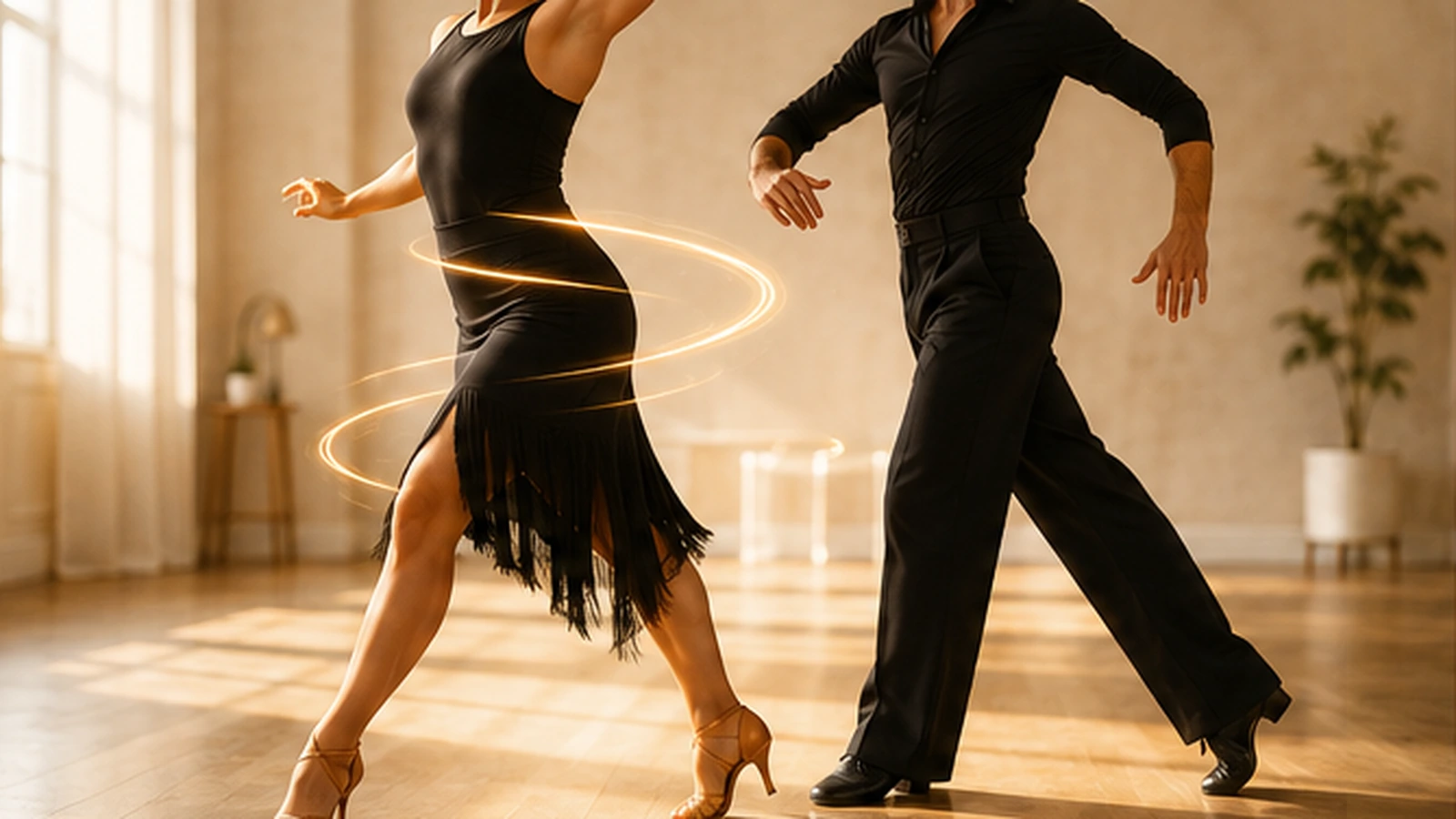
Dancer practicing controlled Latin body action for Cuban motion in a ballroom studio.

Quick definition of Cuban motion

Cuban Motion

Also called
Latin hip action, Latin body action, Cuban hip motion
Used in
Rumba, Cha Cha, Mambo, Bolero, Salsa, and related Latin/Rhythm contexts
Beginner takeaway
Move your weight clearly first; the hip action should respond to the weight transfer.
Common mistake
Trying to “shake” or twist the hips separately from the feet and timing.
Related terms
Latin motion, hip action, body action, weight transfer, timing, frame, connection

Quick definition

Cuban motion is a Latin/Rhythm dance action where the visible hip and body movement comes from how the dancer transfers weight, uses the feet, allows the knees to bend and straighten, and stays connected to the rhythm. It is not a separate decoration added on top of the step. It is part of how the step is danced.

For beginners, the simplest rule is: do not start by moving your hips. Start by moving your weight.

When the weight arrives cleanly over the standing foot, the knee action, foot pressure, and body control create the look people recognize as Cuban motion.

What Cuban motion means

Cuban motion is one of the signature body actions in Latin and American Rhythm dancing. You will hear teachers mention it in Rumba, Cha Cha, Mambo, Bolero, and sometimes Salsa or other social Latin dances.

The movement is easiest to notice at the hips, but the hips are not the whole story. Cuban motion is a connected action through the whole body. It begins with how you place the foot, how you transfer weight, how the knee softens and straightens, and how the body stays balanced over the standing leg.

That is why Cuban motion looks best when it is musical. In a slow Rumba, the action can feel smooth and stretched. In Cha Cha, it becomes smaller and sharper. In Mambo, it often feels quick, grounded, and rhythm-driven. In Bolero, it is usually softer and more sustained. In Salsa, related Latin body action may appear, but the amount and style vary by salsa tradition.

If you are new to ballroom dance, think of Cuban motion as a result, not a pose. When the step, timing, and weight transfer are organized, the movement begins to look natural. It is one part of broader ballroom technique.

How Cuban motion works

1. Weight transfer comes first

The most important part of Cuban motion is the transfer of weight from one foot to the other. If your weight stays stuck between both feet, the movement will feel stiff or fake. If you throw the hip before your weight arrives, the movement will look disconnected. The action should feel like your body is moving over the foot, not like your hip is being pushed out to the side.

Step, arrive, settle — then continue into the next step.
2. The knees create much of the visible action

In many beginner explanations, Cuban motion is taught through alternating knee action. One knee softens as weight is placed, and the other leg releases or prepares. As the standing leg organizes underneath you, the hip changes naturally. Keep the knee action controlled. It should not feel like bouncing, collapsing, or locking.

3. The feet press into the floor

Cuban motion is not only a hip idea. The feet matter. In many Latin/Rhythm steps, dancers use the ball of the foot and then lower with control, often feeling pressure through the inside edge of the ball of the foot.

Press the floor; do not throw the hip.

4. The hips respond; they do not lead alone

The hip movement is the visible effect, but it should not be forced. If you try to move only the hips, you may twist, sway, or overdo the action. Instead, let the hip respond to the weight transfer and standing leg. Good Cuban motion looks controlled because the body stays organized above it.

5. Posture and frame still matter

Cuban motion should not collapse your posture. Keep the spine tall, the rib cage organized over the pelvis, and the shoulders relaxed. If you are dancing with a partner, your frame and connection should remain clear. This is where Cuban motion connects to frame and posture and lead and follow.

6. Timing changes the quality

Cuban motion should match the dance’s rhythm. A slow Rumba gives the action more time. Cha Cha requires smaller, quicker, more compact movement. Mambo often feels sharper and more rhythmically driven. Bolero stretches the action through a smoother musical quality. The movement should never be separate from the count. If the timing is unclear, the Cuban motion will usually feel unclear too.

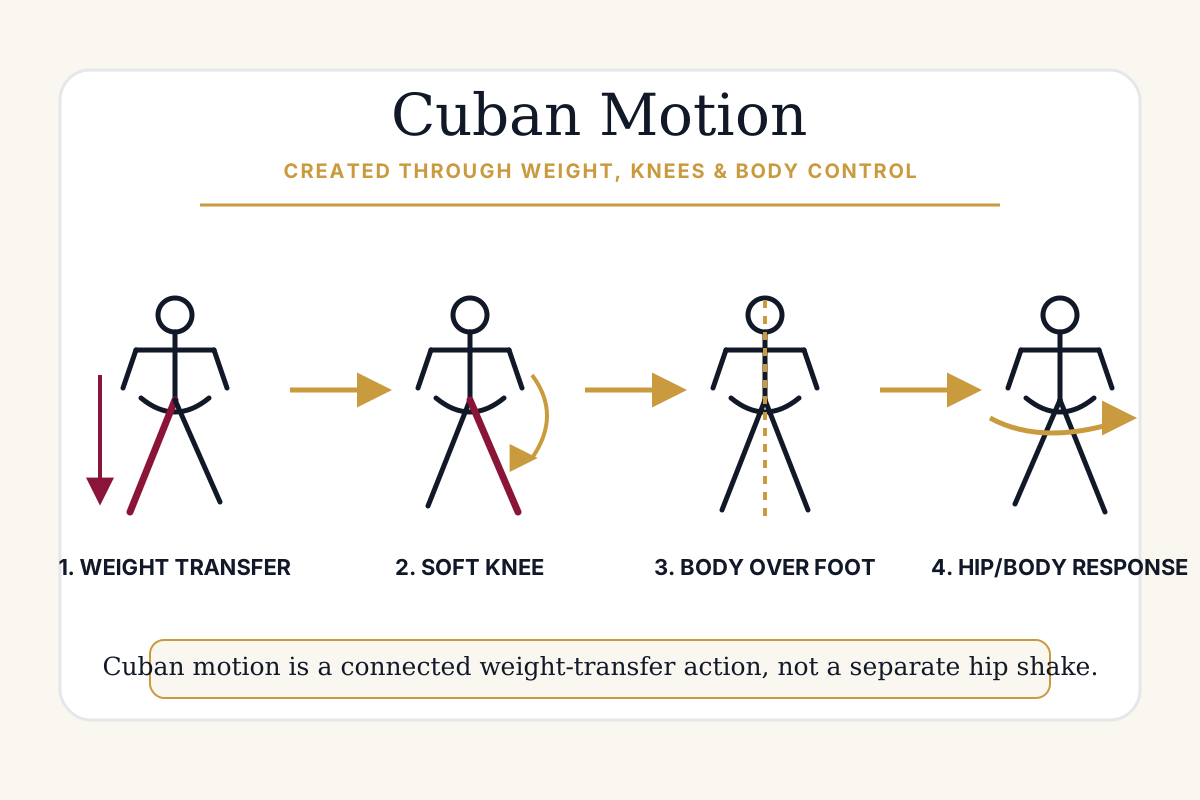
Diagram showing Cuban motion as weight transfer through the feet, knees, and body rather than isolated hip movement.
Cuban motion is a connected weight-transfer action, not a separate hip shake.

Dances that use Cuban motion

How Cuban motion appears across Latin and American Rhythm dances
DanceHow the action feelsBeginner note
RumbaSmooth, controlled, and easier to study because the music is slower.Best starting point for learning the feeling without rushing.
Cha ChaQuicker, sharper, and more compact because of the cha-cha-cha rhythm.Keep steps small so the body action has time to finish.
MamboGrounded, rhythmic, and energetic, often with clear weight changes.Listen for the break step and avoid making the hips bigger than the rhythm.
BoleroSofter and more sustained, with Rhythm body action plus a smoother, more romantic quality.Do not treat it as simply slow Rumba; the rise, stretch, and timing feel different.
SalsaRelated Latin/Cuban body action may appear, but style varies widely by salsa tradition.Keep it musical and natural; social salsa may use a looser version than ballroom technique.

What Cuban motion is NOT

Not just shaking the hips

The visible hip movement is a result of weight transfer, not a separate wiggle.

Not forced twisting

Aggressive pelvis rotation makes the upper body tense and the action unnatural.

Not separate from timing

The action should match the count, not happen randomly between steps.

Not only for followers

Leaders and followers both use grounded, musical body action.

Not something to fake with the hips alone

If the feet and weight do not arrive, no amount of hip movement will look real.

Beginner practice drills

Safety note: Keep these drills small and comfortable. If anything feels painful or sharp, stop. A qualified dance teacher can correct mechanics in person, and a medical professional should handle pain or injury concerns.

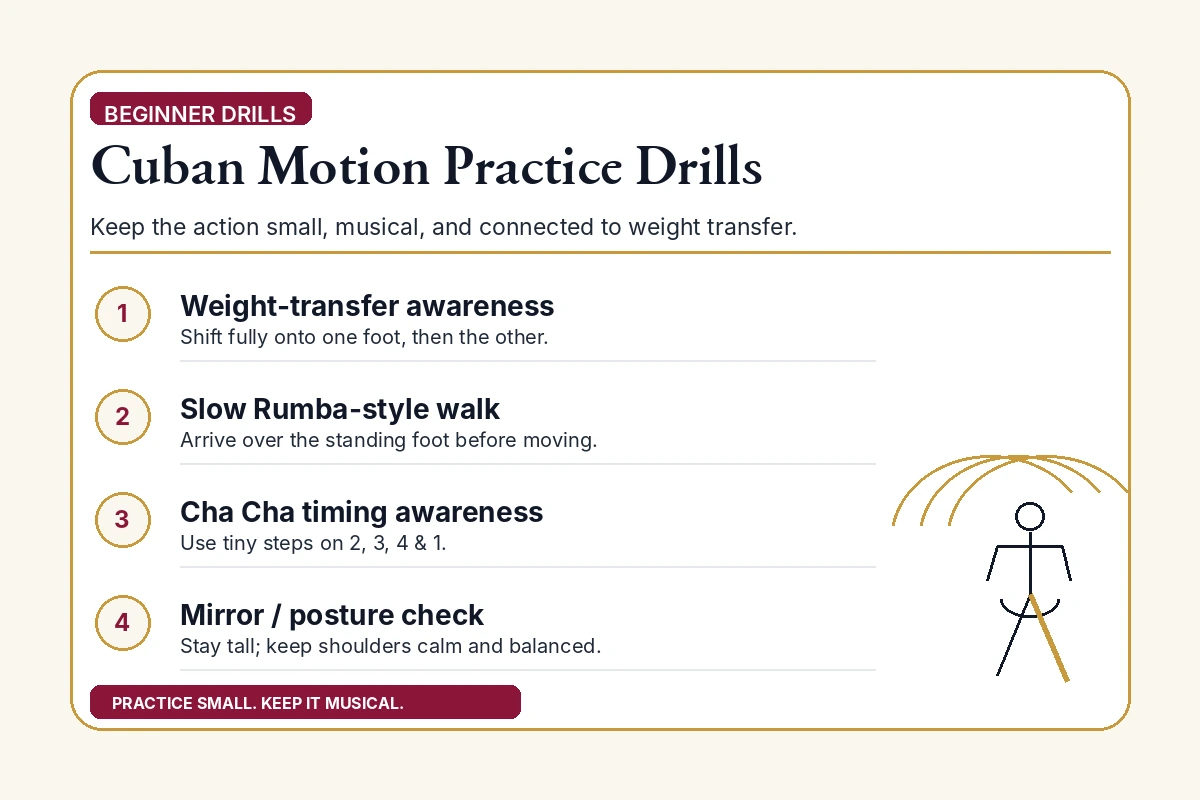
Drill 1: Weight-transfer awareness

Stand with feet under your body and hands resting lightly at your sides. Shift your weight fully onto one foot, then the other. Keep your head and spine tall. Notice when your body is truly over the standing foot.

Goal: Feel complete weight transfer before adding hip action.

Drill 2: Slow Rumba-style walk

Take a small forward step. Let the weight arrive over the standing foot before moving again. Keep the action slow and smooth. Do the same backward with tiny steps.

Goal: Learn that Cuban motion is connected to walking and arriving, not posing.

Drill 3: Cha Cha timing awareness

Count slowly: 2, 3, 4 & 1. Use very small side or in-place steps. Keep the action compact. Do not try to make the hip movement large.

Goal: Match the body action to faster rhythm without rushing.

Drill 4: Mirror and posture check

Stand in front of a mirror. Practice small weight changes while keeping the spine tall, shoulders calm, and rib cage from tilting side to side. The movement should look controlled, not collapsed.

Goal: Keep posture and body action working together.

Practice card listing beginner Cuban motion drills for weight transfer, Rumba walks, Cha Cha timing, and posture.

Practice with music

Cuban motion becomes easier to understand when you hear the rhythm. Use slow music first, then build toward quicker dances.

Start with Rumba if you want time to feel the weight transfer. Move to Cha Cha when you can keep the action compact. Try Mambo when you are ready for a stronger rhythmic feel. Use Bolero for sustained control, and Salsa for a social Latin context where the body action may feel more relaxed.

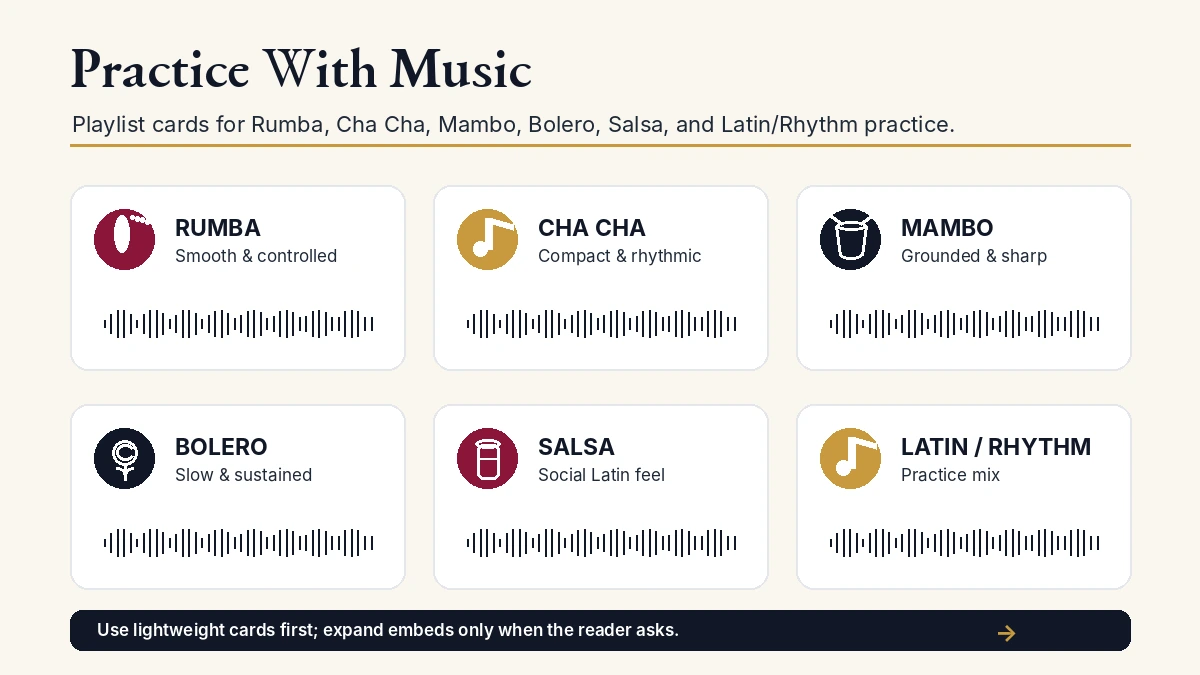
Branded playlist cards for practicing Cuban motion with Rumba, Cha Cha, Mambo, Bolero, and Salsa music.

Common mistakes and fixes

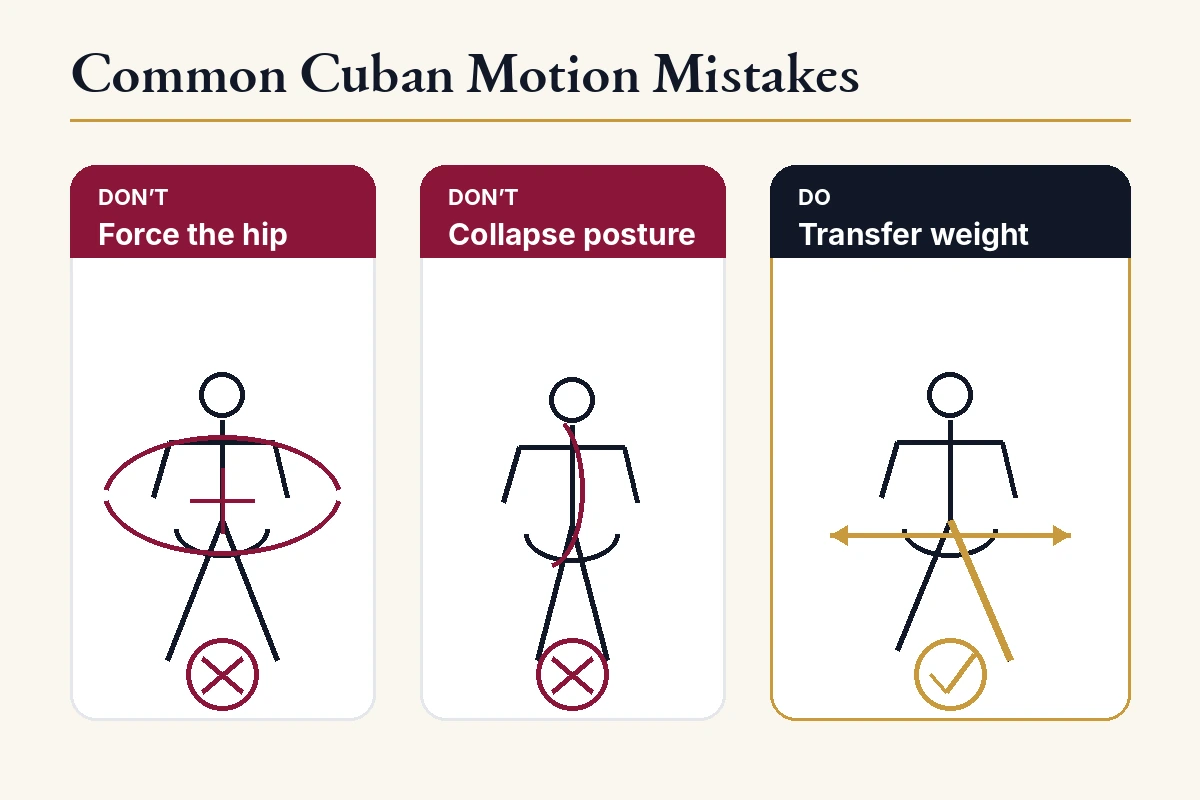
Do and don’t graphic showing common Cuban motion mistakes and beginner-friendly fixes.
Common Cuban motion mistakes, what they look like, and how to fix them
MistakeWhat it looks likeFix
Moving the hips firstThe hips wiggle, but the feet and body do not arrive clearly.Transfer weight first. Let the hip action respond.
Twisting too hardThe pelvis rotates aggressively and the upper body looks tense.Make the range smaller. Keep the spine tall and the action controlled.
Staying between both feetThe movement looks stuck or flat.Finish each weight change before moving to the next step.
Taking steps too bigThe body cannot finish the action in time, especially in Cha Cha.Use smaller steps and keep the feet under the body.
Collapsing postureThe shoulders tilt, rib cage drops, or head moves side to side.Practice in front of a mirror with tall posture and calm shoulders.
Ignoring timingThe body action happens after the beat or randomly between steps.Count out loud and practice with slower Rumba music first.
Treating it as follower stylingOnly one partner uses body action, making the partnership look uneven.Leaders and followers both need grounded, musical body action.

FAQ

Cuban motion FAQ

  • What is Cuban motion in ballroom dance?

    Cuban motion is the controlled Latin/Rhythm body action that appears as hip movement when a dancer transfers weight through the feet, knees, and body with the music. It is most visible in dances like Rumba, Cha Cha, Mambo, Bolero, and some Salsa contexts.

  • Which dances use Cuban motion?

    Cuban motion is most commonly associated with Rumba, Cha Cha, Mambo, Bolero, and related American Rhythm or Latin dances. Salsa may use related body action, but the amount and style vary depending on the salsa tradition and teacher.

  • Is Cuban motion the same as hip movement?

    Not exactly. Hip movement is the visible result, but Cuban motion is created by weight transfer, knee action, foot pressure, posture, and timing. If you only move the hips, the action usually looks forced.

  • Do leaders and followers both use Cuban motion?

    Yes. Cuban motion is not only for followers. Leaders and followers both use body action, although the amount, shape, and visibility may change depending on the figure, role, and style.

  • Can beginners learn Cuban motion?

    Yes, but beginners should start small. Focus first on clean weight transfer, timing, and posture. The movement usually feels more natural after you stop trying to force the hips and start feeling how the body arrives over the standing foot.

  • Why does Cuban motion feel awkward at first?

    It feels awkward because beginners often try to add it as a separate hip movement. It becomes easier when you connect it to simple actions: step, transfer weight, stay tall, and move with the count.

  • Is Cuban motion used in salsa?

    Salsa can include related Latin/Cuban body action, but social salsa styles vary widely. Some salsa dancers use a relaxed version, while ballroom-trained dancers may use a more structured Rhythm or Latin technique.

  • How do I practice Cuban motion without overdoing it?

    Practice slowly with small steps. Start with Rumba-style weight transfers, keep the knees soft, keep the spine tall, and avoid forcing a large hip swing. A teacher can help you find the right range for your body and dance style.

Next: Learn how Cuban motion shows up in Rumba and Cha Cha

Start with Rumba if you want a slower, clearer place to feel the action. Move to Cha Cha when you are ready to keep the same idea compact and rhythmic.

Editorial

Source and editorial note

This glossary entry is written for beginner clarity and should be reviewed periodically by experienced ballroom dancers or teachers. Technique pages should be checked by a qualified instructor before being treated as formal syllabus instruction.

Recommended sources

  • The Dance Store Online — Cuban Motion in One Short Lesson
  • Dance Vision — The Roots of Latin American Dancing
  • Dance Central — Cha Cha Technique
  • WDSF — DanceSport Disciplines
  • University of Georgia — Ballroom Dance Terminology

This is dance terminology and beginner technique guidance, not medical advice. Ballroom Pages follows an editorial policy of education-first guidance. Questions? Contact us. Updated May 22, 2026.