

What Bolero feels like
Bolero feels like a slow conversation between two dancers. The music is romantic and unhurried, but the dance is not passive. Each slow step needs time to stretch, settle, and prepare the next quick-quick action.
Compared with Rumba, Bolero usually feels more sweeping and suspended. Beginners often notice the same slow-quick-quick logic, but the body action is more lifted and continuous. The goal is not to rush through steps; it is to make the slow count feel full. You can compare Bolero with Rumba once the rhythm is steady.
Bolero music and timing
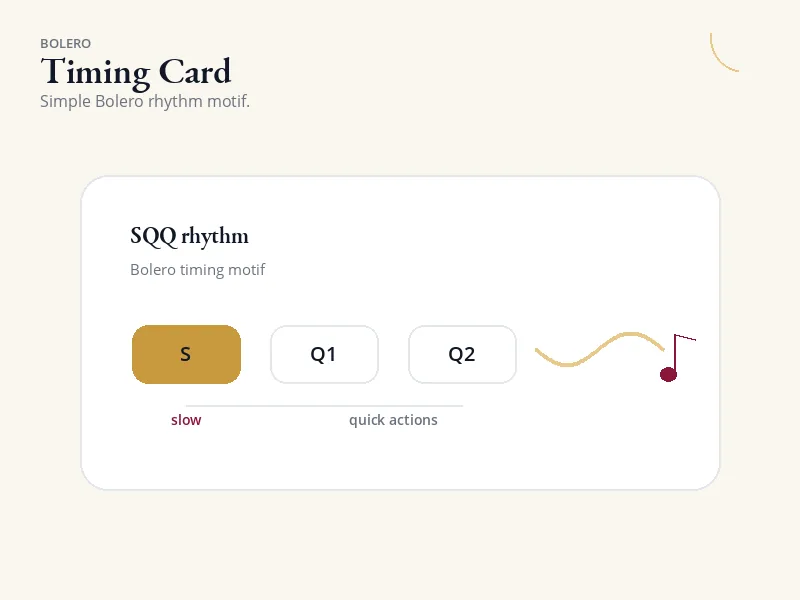
American Bolero is typically taught in 4/4 and counted slow, quick, quick. In simple terms, the slow takes two beats, and each quick takes one beat. That gives beginners a practical way to feel three weight changes across four beats of music.
For competition tempo, use current NDCA guidance separately from general practice references. The 2026 NDCA rulebook lists American Rhythm Bolero at 23 MPM / 92 BPM, while many educational references and older tempo charts still describe Bolero around 96 BPM or 24–26 MPM / 96–104 BPM. Treat this as a useful distinction—competition rule vs common practice reference—not a contradiction.
- Count
- Slow, quick, quick
- Feel
- Stretch the slow; keep the quicks balanced
- Meter
- 4/4
- Practice cue
- Say “slooow, quick, quick” while stepping side, then replacing weight through the quicks.
If the counts feel unclear, start with how to count ballroom dance music, check reference tempos on the tempo chart, and explore the Ballroom Music & Timing hub.
Bolero music & playlists
Use the Ballroom Pages Bolero playlists to hear the slow, romantic pulse before you work on steps. Start by listening for the slow-quick-quick shape, then practice marking the rhythm with small weight changes.

-
Bolero on Spotify
Two verified American Rhythm Bolero playlists for slow-count practice.
Open Bolero Spotify Playlist 1 Open Bolero Spotify Playlist 2
-
Bolero on Apple Music
Two verified Apple Music Bolero playlists. (Localized links; verify canonical locale before launch.)
Open Bolero Apple Music Playlist 1 Open Bolero Apple Music Playlist 2
-
Bolero on YouTube
YouTube and YouTube Music Bolero playlists are being verified before launch.
YouTube Music URL to verify YouTube URL to verify
-
More Ballroom Pages music
Browse the full library and follow along for new sets.
Browse all Ballroom Pages playlists Join BallroomPages Music on Telegram
A short history of Bolero
Bolero has a layered history, with Spanish and Cuban forms that are not identical to the American Rhythm ballroom version taught today. For this guide, keep the history short and practical: American Bolero is the ballroom competition and studio version most readers are looking for, and it is commonly taught as part of the American Rhythm family.
A careful page should avoid pretending that every form of Bolero is the same. The Spanish, Cuban, concert-music, social, and American ballroom uses of the word can overlap in name while differing in music, meter, movement, and context.
Basic Bolero steps for beginners
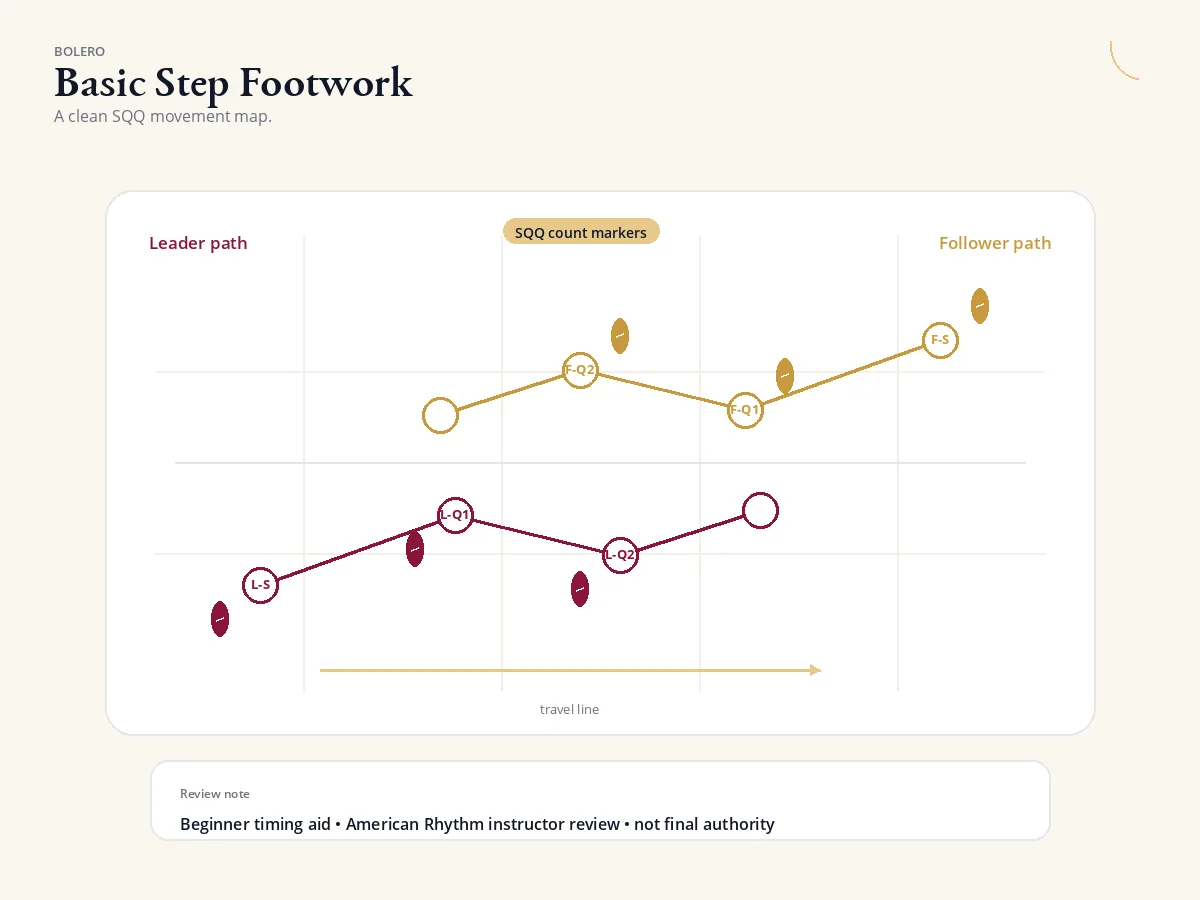
A beginner-friendly way to understand Bolero is to start with the pattern: slow, quick, quick. The slow is often a longer, more sweeping side action, followed by two quicker weight changes. Keep the first version small and balanced before trying to make it dramatic.
Leader and follower should practice the rhythm first without over-styling. One partner initiates the direction and timing through the frame; the other responds by maintaining balance, tone, and clear weight changes. Use small steps, keep the torso lifted, and avoid pulling through the arms.
Counts
- Slow = two beats.
- Quick = one beat.
- Quick = one beat.
Practice notes
- Clap or tap slow-quick-quick before stepping.
- Practice the slow side action without rushing into the quicks.
- Keep the quick-quick compact so the couple does not travel too far.
- Add partner connection only after both dancers can hold the timing alone.
- Treat the diagram as a learning aid, not a substitute for instructor review.
Technique notes: rise, fall, rhythm feel, and connection
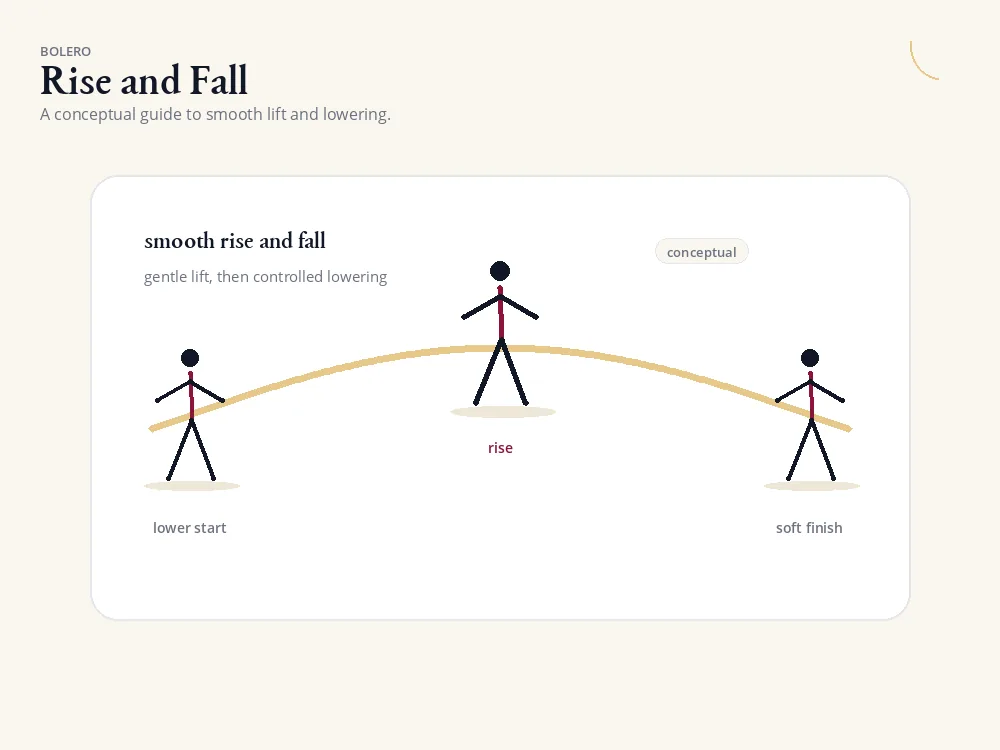
Bolero is often described as Rumba-like in timing but more lifted and sweeping in movement. The rise/fall quality should feel controlled and gradual, not bouncy. Beginners should think of a long, sustained slow count followed by two balanced quicks.
Rise and fall
Use this as a beginner concept only: the body should not collapse into the slow step or pop upward on the quicks. Keep the movement smooth and continuous. A qualified instructor should review final rise/fall language before publication.
Rhythm feel
Let the slow count breathe. The biggest beginner mistake is counting correctly but moving too abruptly.
Partner connection
Bolero needs calm tone through the frame. Avoid dragging your partner through the slow step. The leader communicates timing and direction; the follower maintains balance and responds through the body, not by guessing. To go deeper, read lead and follow in ballroom dance and ballroom frame and posture, or look up unfamiliar words in the ballroom glossary.
Common Bolero mistakes and how to fix them
| Mistake | Fix |
|---|---|
| Counting it like faster Rumba | Slow down and say “slooow, quick, quick” out loud before stepping. |
| Making the slow step empty | Use the slow count to travel, stretch, and prepare—not to pause. |
| Bouncing the rise/fall | Keep the action gradual and body-led; do not pop up and down. |
| Taking steps that are too large | Keep the quick-quick compact until balance is reliable. |
| Pulling with the arms | Maintain tone through the frame and lead/follow with the body. |
| Ignoring the music | Listen for the romantic pulse before adding figures. |
| Over-styling too early | Learn timing, balance, and connection before dramatic shapes. |
Beginner tips for learning Bolero
What to learn first
Start with the rhythm. Count slow-quick-quick, then practice small weight changes. Add partner connection before adding large shapes.
What to ignore at first
Ignore dramatic dips, big lines, advanced arm styling, and competition-level body shaping until your timing and balance are steady.
Practice drills
- Listening drill: play a Bolero playlist and speak “slow, quick, quick” through each phrase.
- Weight-change drill: step tiny slow-quick-quick patterns without a partner.
- Slow-count drill: make the slow last the full two beats without freezing.
- Connection drill: practice the same rhythm in closed or open practice hold with very small steps.
- Compare drill: alternate a Rumba song and a Bolero song to feel the difference in speed and movement quality.
Bolero video and demo notes
Use owned or controlled Ballroom Pages videos when available. Until then, this section provides context rather than embedded structured video data.
A short count-along demo is planned for this page. For now, use the music and playlists section above to practice hearing the slow-quick-quick rhythm.
Bolero song examples and playlist references
Because exact song tempo and licensing should be verified, this guide prioritizes verified Ballroom Pages playlist links instead of inventing a song list. Once the editorial team verifies specific songs, we will add 5–10 examples with tempo notes and a “why it works for Bolero” explanation.
- Start with the Ballroom Pages Bolero playlists.
- Use the tempo chart for guidance.
- Add song examples only after editorial verification.
Is Bolero good for a wedding first dance?
Bolero can be beautiful for a romantic first dance when the song is slow, expressive, and comfortable for the couple. It gives dancers time to breathe and shape the music, but it is usually more demanding than a simple slow dance or beginner Rumba.
For wedding couples, Bolero works best when there is enough lesson time to build balance, connection, and clean timing. If the couple needs something simpler, Rumba, Foxtrot, or Nightclub Two Step may be easier choices depending on the song.
Where Bolero fits socially
Bolero is less common than Rumba, Salsa, or East Coast Swing in many casual social settings, but it appears in ballroom studios, practice parties, showcases, and American Rhythm contexts. Social dancers should learn it as a slow, expressive partner dance rather than a fast floor-filler. If you want a more upbeat Rhythm dance, try East Coast Swing.
Bolero in American Rhythm competition
In American Rhythm competition, Bolero is usually grouped with Cha Cha, Rumba, East Coast Swing, and Mambo. It is the slowest-feeling of the core Rhythm dances and asks dancers to show control, musicality, connection, and sustained movement.
Mention of tempo should follow current NDCA guidance (see the sources below), but do not assume that all competitions use the same tempo. Sanctioning bodies and event rules should be checked, because music directors are allowed to vary traditional tempi by rule.
Related Rhythm dances to learn next

You can also explore the full ballroom dance styles guide or start with beginner ballroom guides.
