What is Cha Cha?
Cha Cha is a ballroom Latin / Rhythm dance known for its crisp timing, compact steps, playful character, and distinctive triple rhythm. It is usually danced to music in 4/4 and often feels bright, cheeky, grounded, and rhythmically precise.
In the ballroom world, Cha Cha appears in both International Latin and American Rhythm. That means two dancers can both say they are learning “Cha Cha” while studying different syllabus systems, technique expectations, and styling traditions.
For beginners, the essential idea is simple: Cha Cha combines rock-step or break-step actions with a quick triple step often called a chassé. The details become more refined as dancers learn posture, connection, Cuban motion, leg action, turns, and musical styling.
Why it is sometimes called Cha-Cha-Cha
The dance is commonly written as Cha Cha, Cha-Cha, or Cha-Cha-Cha. Ballroom Pages uses Cha Cha as the editorial name, while mentioning Cha-Cha-Cha naturally for search and accuracy.
Historically, the longer name is tied to the sound and rhythm of the triple action. The dance has Cuban roots and is widely associated with Enrique Jorrín, Orquesta America, and the Cuban cha-cha-chá music tradition.
For this site, the naming rule is practical: do not create separate pages for “Cha Cha” and “Cha-Cha-Cha.” They resolve to one canonical Cha Cha guide.
What Cha Cha feels like
Cha Cha feels sharp without being stiff. The dance has a lively, teasing personality, but it should still be controlled, grounded, and musical.
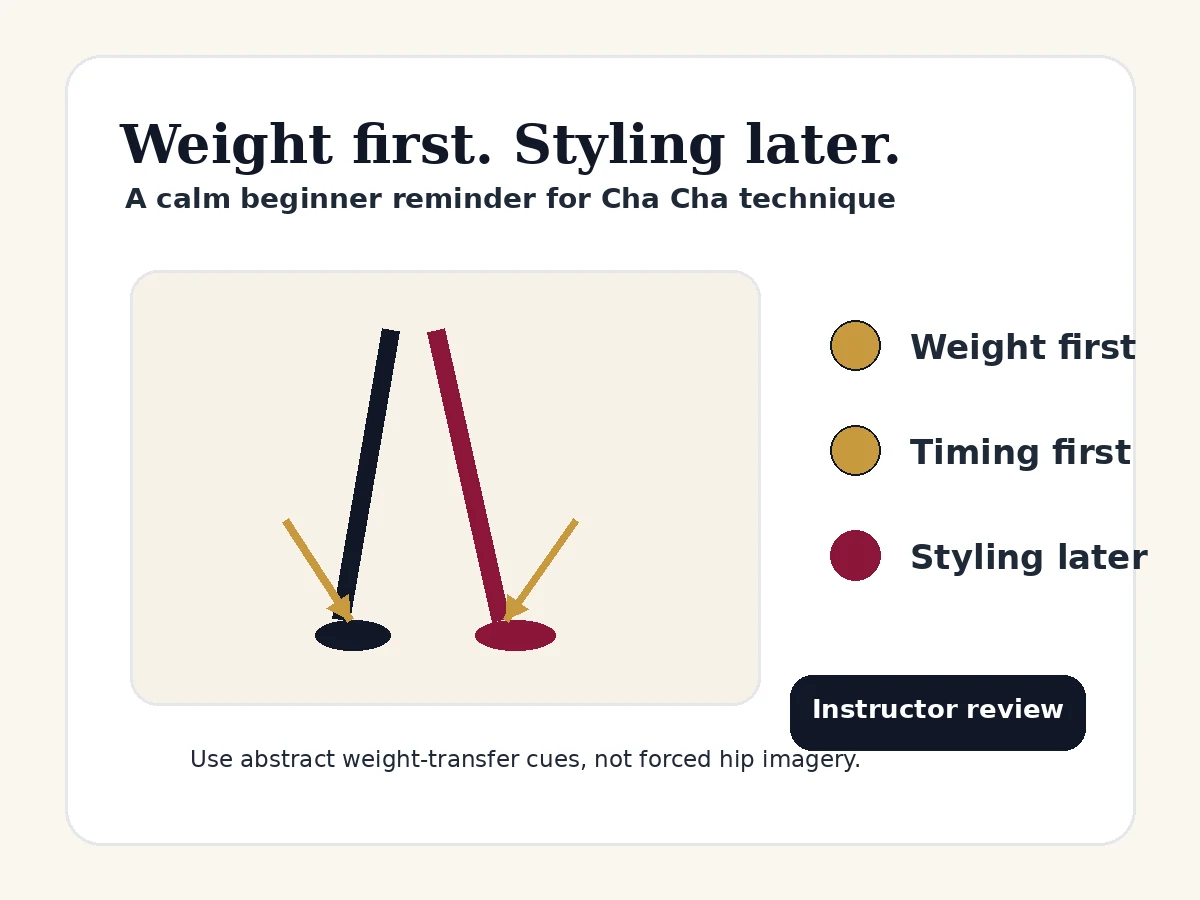
Beginners often want to add hip action immediately. A better first goal is to make each weight change clear. When the feet, count, and weight transfer are honest, the body action has a foundation.
For the leader, Cha Cha asks for clear rhythm, compact movement, and precise direction. For the follower, it asks for responsive balance, clean foot placement, and the ability to keep the rhythm without guessing.
Cha Cha timing and count
Cha Cha count is the section beginners ask about most, because different teachers use different phrases for different purposes.
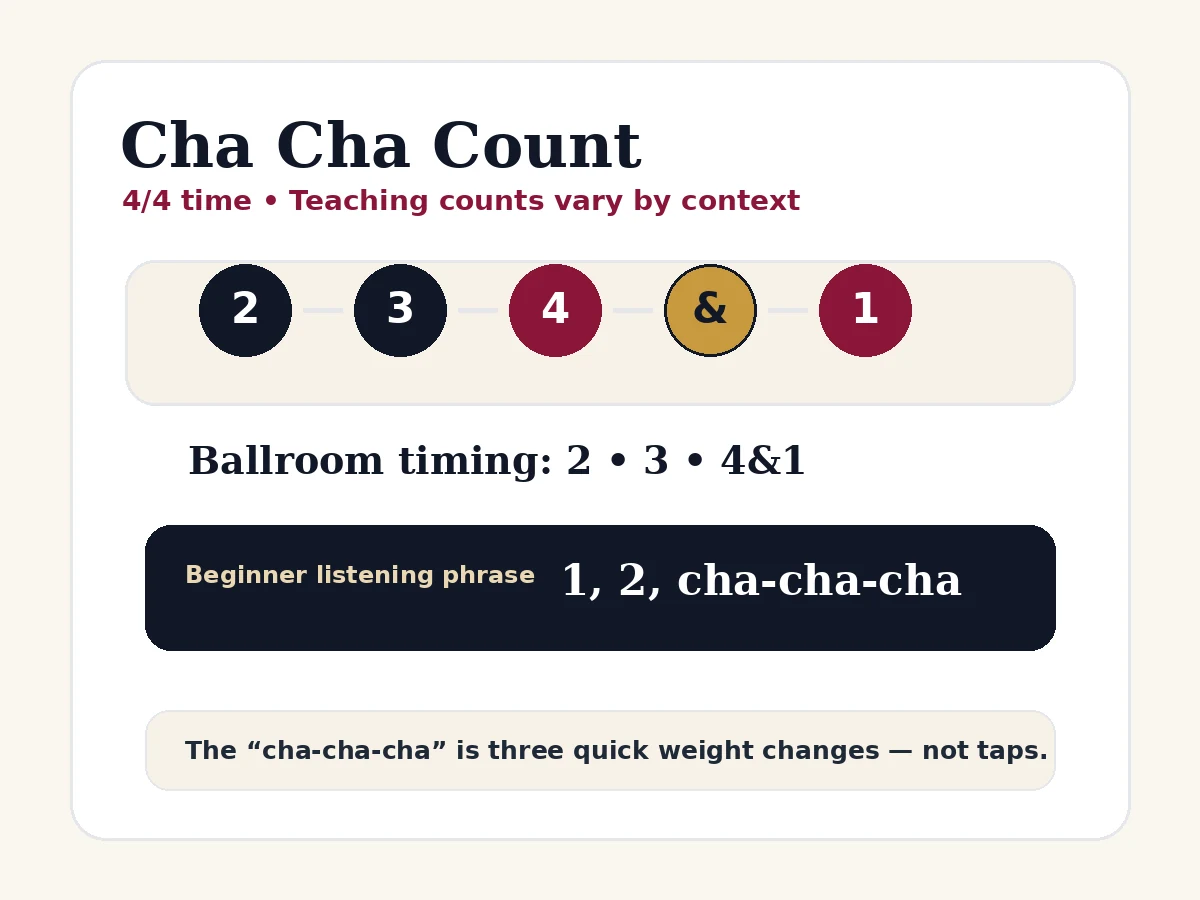
A beginner-friendly phrase is “1, 2, cha-cha-cha.” This can help new dancers hear that the rhythm includes two single beats and then a quick triple action. It is useful as a rhythm phrase, especially before students are ready for full ballroom timing language.
In ballroom teaching, especially International Latin and many American Rhythm contexts, the timing is often taught as “2, 3, 4&1.” The simplest way to practice is to say: “2, 3, cha-cha-cha.” Then connect it to the more precise count: “2, 3, 4-and-1.”
| Count phrase | What it is good for | Plain-English meaning | Caution |
|---|---|---|---|
| 1, 2, cha-cha-cha | First beginner rhythm phrase | Hear two single steps plus a triple action | Do not treat it as the only ballroom count |
| 2, 3, 4&1 | Common ballroom timing | Break or rock on 2–3, then chassé on 4&1 | Best learned slowly with a teacher |
| 4&1 | The “cha-cha-cha” part | Three quick weight changes across beat 4, the “&,” and beat 1 | Must be real weight changes, not foot taps |
| 1, 2, 3, 4&1 / 5, 6, 7, 8&1 | Full-basic mapping used in some teaching | Helps beginners see a two-measure basic | Confirm with your teacher’s system |
For broader timing help, read How to Count Ballroom Dance Music and compare tempos in the Ballroom Dance Tempo Chart.
Understanding “cha-cha-cha” rhythm
The “cha-cha-cha” is not just a sound. It usually refers to the quick triple weight change that gives the dance its identity.
In many beginner explanations, this triple action is connected to a chassé: step, close or collect, step. In actual Cha Cha technique, the exact action depends on style, figure, direction, and syllabus context.
A good beginner chassé should feel small, clean, and rhythmical. Do not make it large or bouncy. Cha Cha works best when the feet stay close to the floor and the body stays organized.

Basic Cha Cha steps
Beginners usually start with a small group of repeatable patterns rather than a long routine. Depending on the teaching system, early ideas may include basic movement, progressive basic, open break, underarm turn, crossover breaks, New Yorker-style actions, hand-to-hand actions, spot turns, and chassés.
| Beginner concept | What it teaches | Common count | Beginner note |
|---|---|---|---|
| Basic movement | Weight changes and Cha Cha rhythm | Often 2-3-4&1 | Start small and slow |
| Progressive basic | Moving the rhythm forward / back | Often 2-3-4&1 | Keep steps compact |
| Open break | Partner connection and away / together action | Varies by system | Do not pull with arms |
| Underarm turn | Basic turn mechanics | Figure-specific | Keep timing more important than style |
| Crossover break / New Yorker-style action | Direction change and open-body shape | Often 2-3-4&1 | Learn safely before adding sharp styling |
| Chassé | Triple action / “cha-cha-cha” | 4&1 | Make each step a weight change |
This page is a style guide, not a full technical tutorial. Detailed footwork diagrams and step-by-step instruction should be reviewed by a qualified ballroom instructor.
Glossary support: Closed Position, Open Position, Chassé, Cuban Motion, New Yorker.
Cha Cha basic step overview
A beginner Cha Cha basic often combines a break or rock action with a chassé. In plain English, one part changes weight forward or back, and the other part uses the “cha-cha-cha” triple rhythm to move side, in place, or progressively depending on the version.
For a leader / follower pair, the goal is not to memorize a giant routine. The goal is to stay on opposite feet, keep the rhythm, avoid pulling, and make the weight changes readable.
- Clap or speak the rhythm: “2, 3, 4&1.”
- Step the rhythm alone with small weight changes.
- Add a compact chassé.
- Practice with a partner in closed position or open position, depending on the pattern.
- Add an open break or underarm turn only after the basic rhythm feels stable.

Cha Cha music
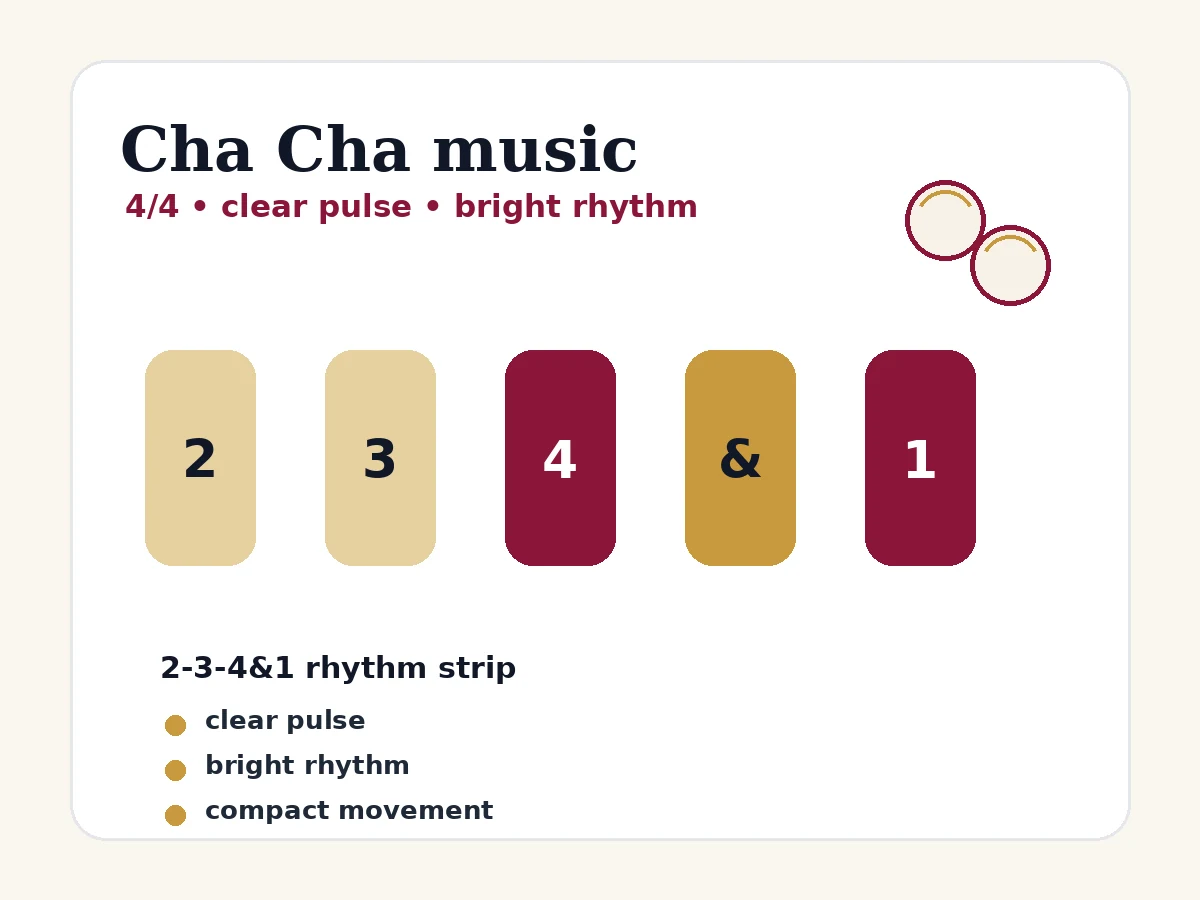
Cha Cha music usually has a steady 4/4 pulse and a bright, rhythmic feel. Traditional Cha-Cha-Cha has Cuban roots, but ballroom Cha Cha is also danced to Latin pop, Latin rock, funk-influenced songs, and some contemporary music selected at a suitable tempo.
Good Cha Cha music makes the triple rhythm easy to hear. A song may be upbeat and still not be a good beginner Cha Cha if the beat is unclear, too fast, or too heavily syncopated.
Use the Cha Cha Music Guide for song examples when that page is available. Until then, use How to Count Ballroom Dance Music and the Ballroom Dance Tempo Chart.
American Cha Cha vs International Cha Cha
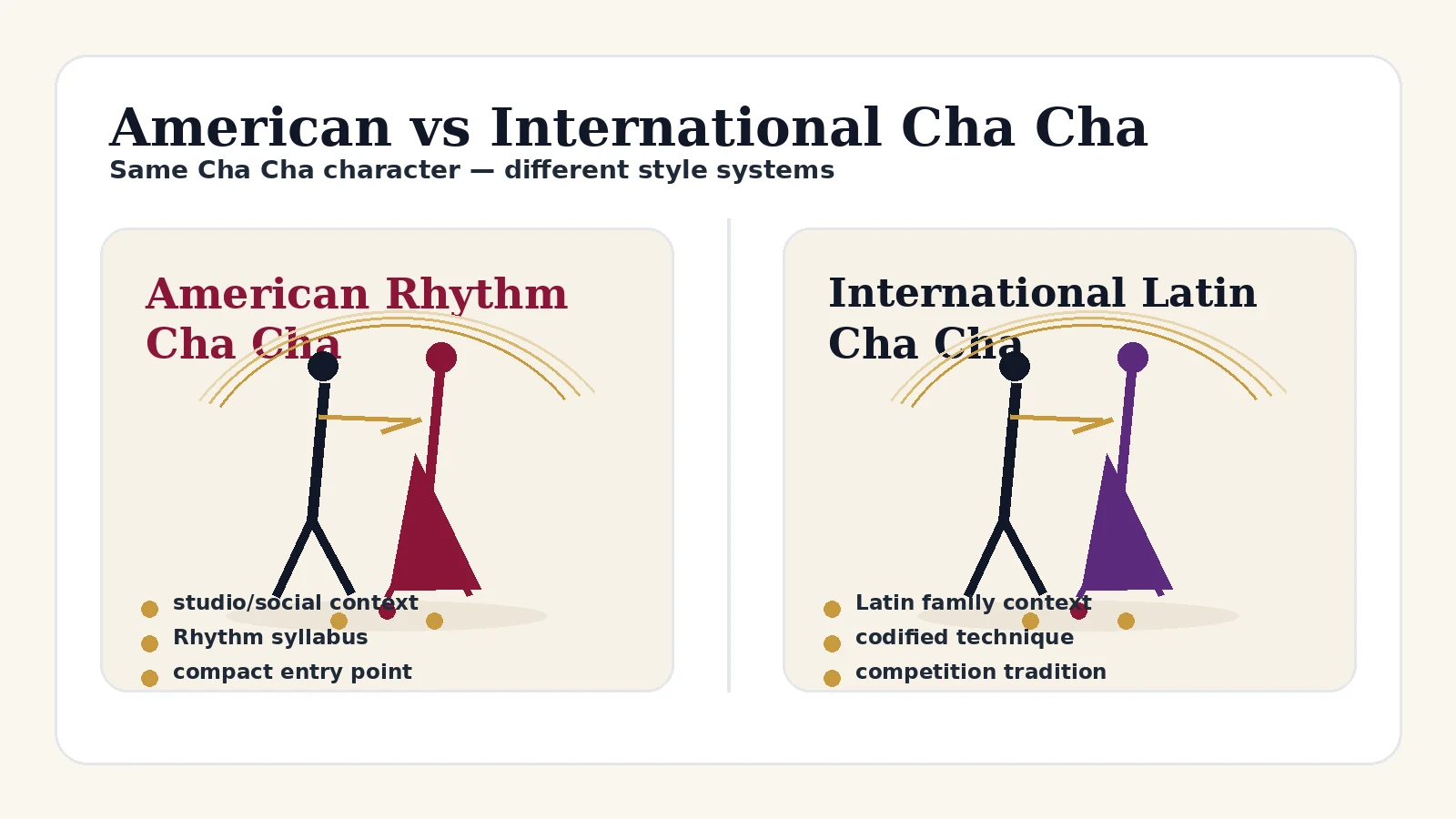
American Rhythm Cha Cha and International Latin Cha Cha are related, but they should not be blurred into one oversimplified explanation.
| Comparison point | American Rhythm Cha Cha | International Latin Cha Cha |
|---|---|---|
| Competition family | American Rhythm | International Latin |
| Related dances | Rumba, Swing, Bolero, Mambo, sometimes other Rhythm / social dances | Samba, Rumba, Paso Doble, Jive |
| Count language | Often uses 2-3-4&1, and some beginner teaching maps the full basic over two measures | Commonly taught as figures starting on 2 with 2-3-4&1 |
| Syllabus context | American-style figures, holds, and social / studio teaching traditions | International Latin technique and syllabus traditions |
| Movement emphasis | Rhythm styling and studio / social adaptability | More codified International Latin technique expectations |
| Beginner takeaway | Friendly studio / social entry point, but still needs clear timing | More technical vocabulary appears sooner in many programs |
| Page treatment | Covered here as a Cha Cha system | Covered here as a Cha Cha system, not as a separate canonical page |
American Rhythm vs International Latin
Cha Cha vs Rumba
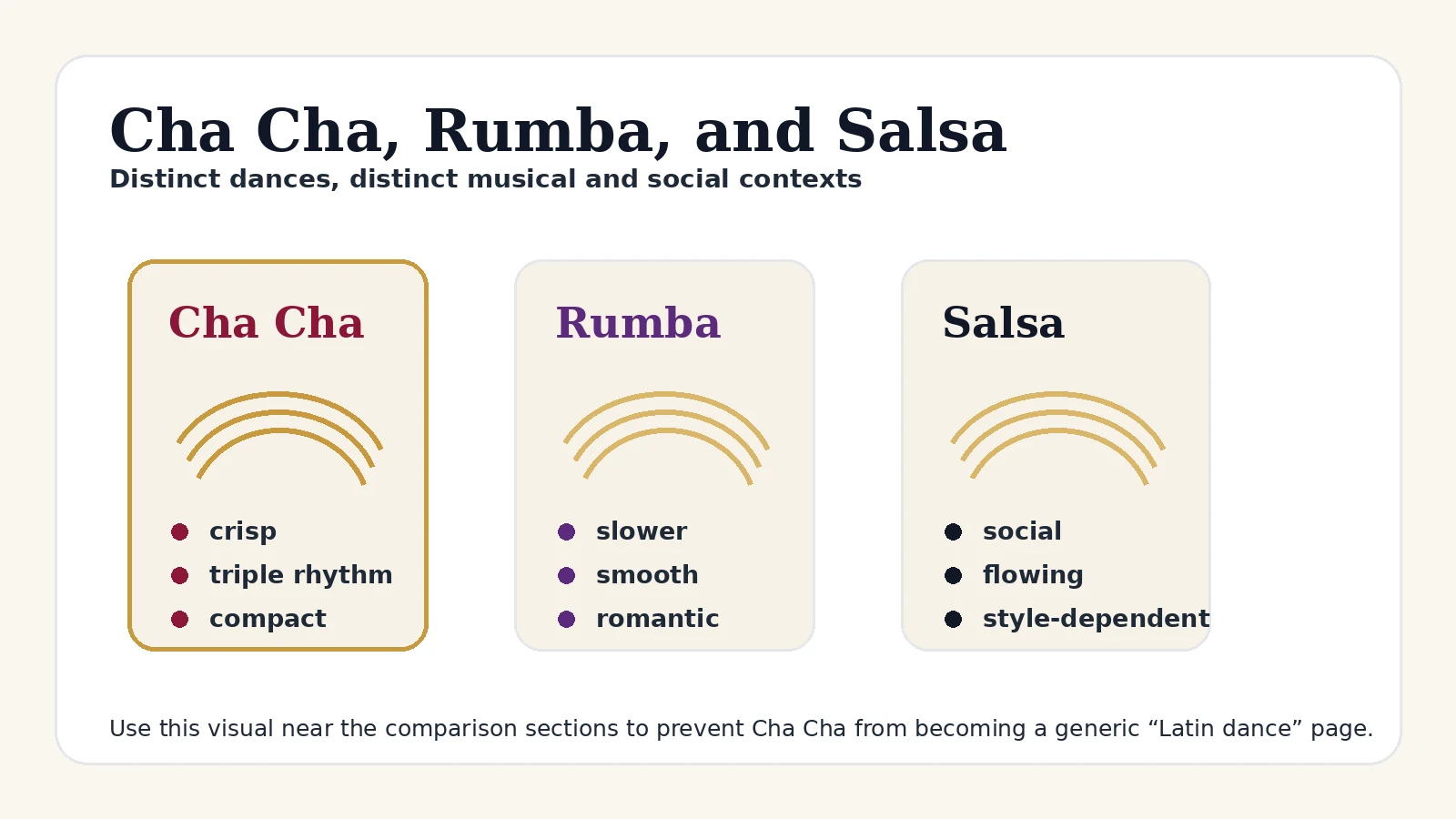
Cha Cha and Rumba are often taught near each other because both appear in American Rhythm and International Latin contexts. They share Latin / Rhythm technique ideas, including grounded movement and hip / body action, but they do not feel the same.
Cha Cha is quicker, sharper, and more rhythmically playful. Rumba is generally slower, smoother, and more romantic or sustained.
| Comparison point | Cha Cha | Rumba |
|---|---|---|
| Typical feel | Crisp, playful, energetic | Smooth, romantic, sustained |
| Speed | Faster | Slower |
| Count feel | Includes triple 4&1 rhythm | More stretched and lyrical |
| Beginner challenge | Hearing the quick triple rhythm | Controlling slow weight transfers |
| Wedding fit | Upbeat, playful songs | Slow romantic songs |
| Main caution | Do not rush or fake the chassé | Do not collapse through slow counts |
Cha Cha vs Salsa and Mambo
Cha Cha, Salsa, and Mambo can all feel Latin and rhythmic, but they are not interchangeable.
Salsa is a broader social dance world with multiple styles and social contexts. Mambo appears in American Rhythm and social contexts and has its own timing, tempo, and character.
| Comparison point | Cha Cha | Salsa | Mambo |
|---|---|---|---|
| Primary Ballroom Pages context | Ballroom Latin / Rhythm | Social Latin / club crossover | American Rhythm / social Latin crossover |
| Typical feel | Compact, crisp, playful | Flowing, social, rotational, club / studio dependent | Sharp, rhythmic, often faster-feeling |
| Count issue | 2-3-4&1 and triple rhythm | On-1 / on-2 and style-dependent systems | Often associated with on-2 timing in many contexts |
| Music | Cha Cha rhythm, Latin / pop / funk options | Salsa music and related Latin music styles | Mambo / Latin jazz contexts |
| Beginner caution | Do not turn the chassé into a Salsa basic | Do not assume all Latin music is Salsa | Do not treat Mambo as Cha Cha without the triple rhythm |
Cha Cha for weddings
Cha Cha can be a memorable wedding first dance when the song is upbeat, playful, and rhythmically clear. It works especially well for couples who want energy, personality, and a dance that does not require huge traveling patterns.
It is not the best choice for a slow romantic ballad, a tiny crowded floor, or a couple that wants the simplest possible first dance. For slower songs, Rumba or Nightclub Two Step may fit better. For smooth mid-tempo standards, Foxtrot may be a stronger choice.
For wedding planning, start with the Wedding Dance Guide and What Dance Fits Your Wedding Song?.
Cha Cha in social dancing
Cha Cha is common in ballroom studio socials, dance schools, mixed ballroom parties, and some social settings where dancers know American Rhythm or International Latin basics. It is compact enough for many floors, but it still needs partner awareness and clear timing.
Social Cha Cha may be more relaxed than competition Cha Cha. That does not mean the timing disappears. A social dancer who can keep the count, stay small, and lead or follow clearly will be easier to dance with than someone who adds big styling before the rhythm is stable.
Use Lead and Follow and Frame and Posture as supporting guides.
Cha Cha in competition
In competition, Cha Cha can appear in International Latin and American Rhythm. These systems share a dance name and broad character, but they do not always use the same figures, styling priorities, or technical expectations.
Beginners should not copy advanced competitive choreography without instruction. Start with clean count, small steps, a controlled chassé, and partner connection.
Common beginner mistakes
| Mistake | Why it happens | Better approach |
|---|---|---|
| Rushing the “cha-cha-cha” | The triple action feels exciting | Count 4&1 slowly and make three real weight changes |
| Treating the triple as taps | Feet move but weight does not transfer | Practice full weight changes without music first |
| Starting with hip styling | Dancers want the Latin look immediately | Learn weight, knees, feet, and timing before styling |
| Taking steps too large | Beginners try to look dramatic | Keep Cha Cha compact and grounded |
| Confusing Cha Cha with Salsa | Both can use Latin music | Listen for the triple rhythm and learn the style context |
| Pulling during open breaks | Leader uses arms instead of body timing | Use tone, timing, and clear direction, not force |
| Losing the 1 | The accent feels hidden at first | Clap the music and say 2, 3, 4&1 out loud |
| Over-styling New Yorker-type shapes | Shapes look fun in videos | Learn safe direction and timing before sharp lines |
Beginner practice plan
| Practice phase | Goal | What to practice | What to avoid |
|---|---|---|---|
| Week 1 | Hear the rhythm | Clap and speak 2, 3, 4&1; also use “1, 2, cha-cha-cha” as a listening phrase | Fast music and styling |
| Week 2 | Build weight changes | Step small weight changes in place and side-to-side | Tapping without weight |
| Week 3 | Add the chassé | Practice compact 4&1 triple action | Big bouncy chassés |
| Week 4 | Add partner basics | Practice basic movement, open break, or underarm turn with clear lead / follow | Pulling, guessing, or over-turning |
| Ongoing | Become musical | Try slower practice tracks, then increase speed | Competition-speed routines without instruction |
Next step: Read Ballroom Dance for Beginners or improve your foundation with How to Count Ballroom Dance Music.
Watch the beginner Cha Cha count and basic step
Video coming soon
A short Ballroom Pages demo will show the count, weight changes, basic movement, and chassé rhythm at practice tempo before music speed.
When published, the video will include captions, a transcript, visible controls, and a text summary of the steps for full accessibility.