
What is American Rhythm?
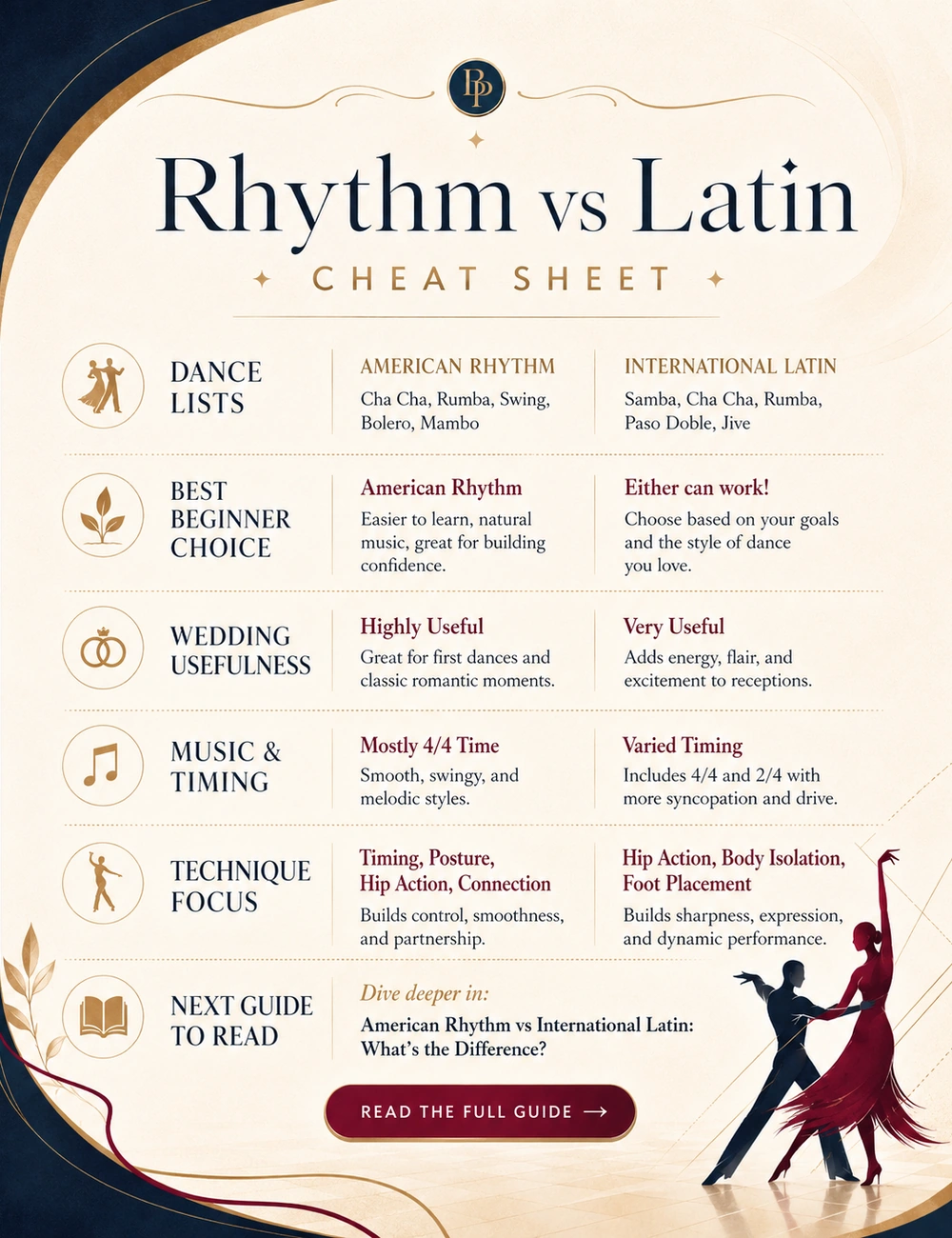
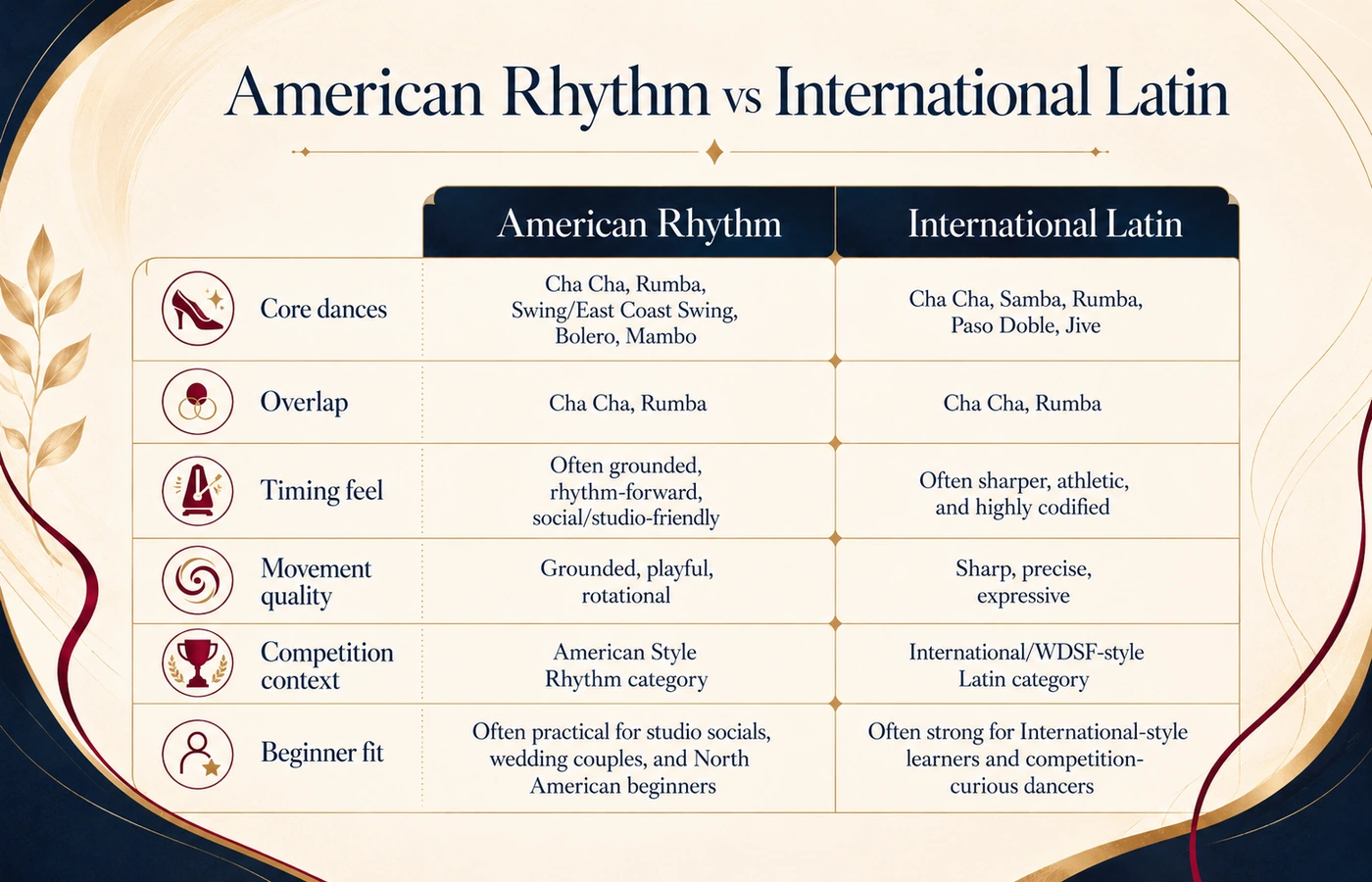
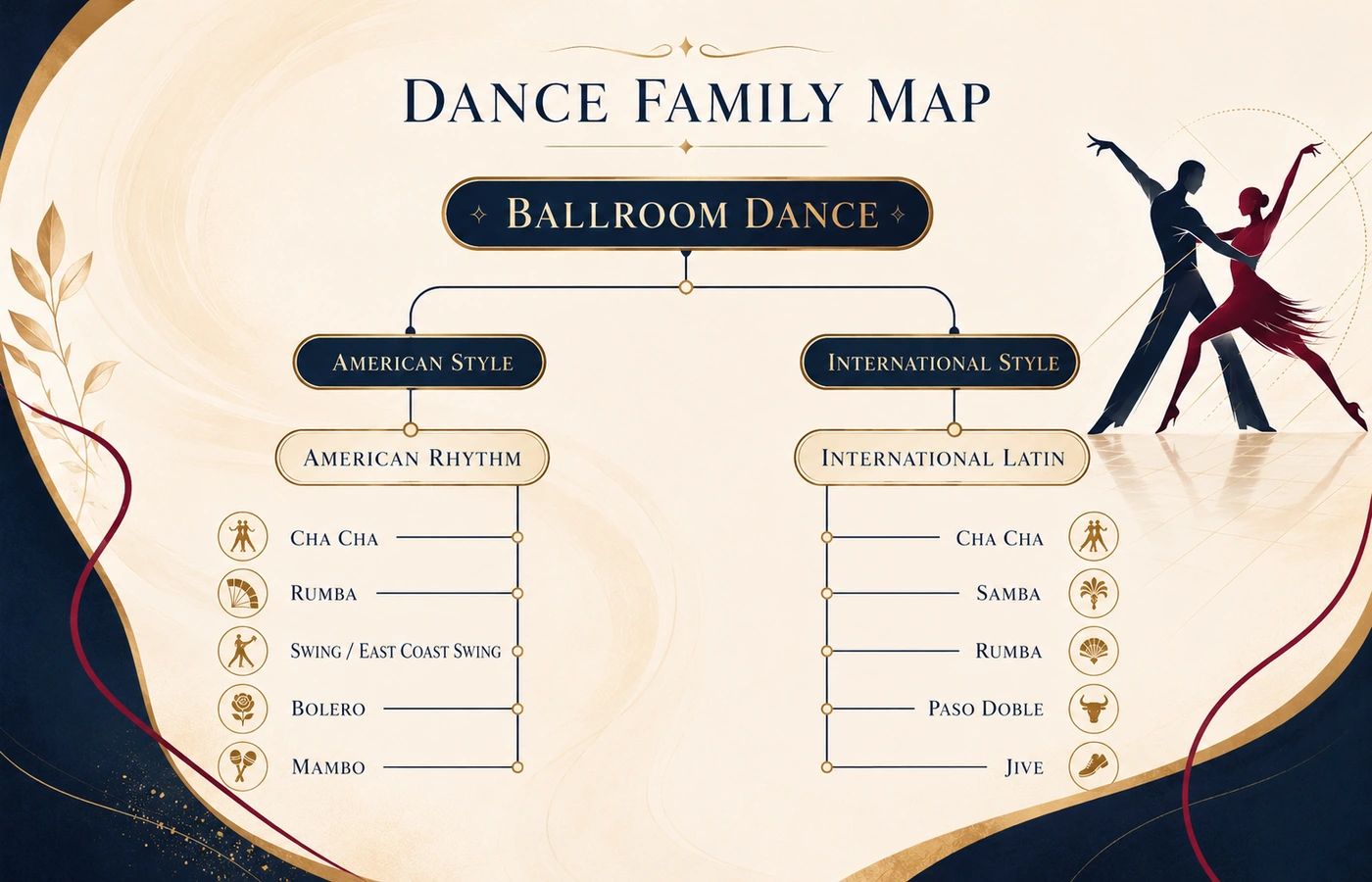
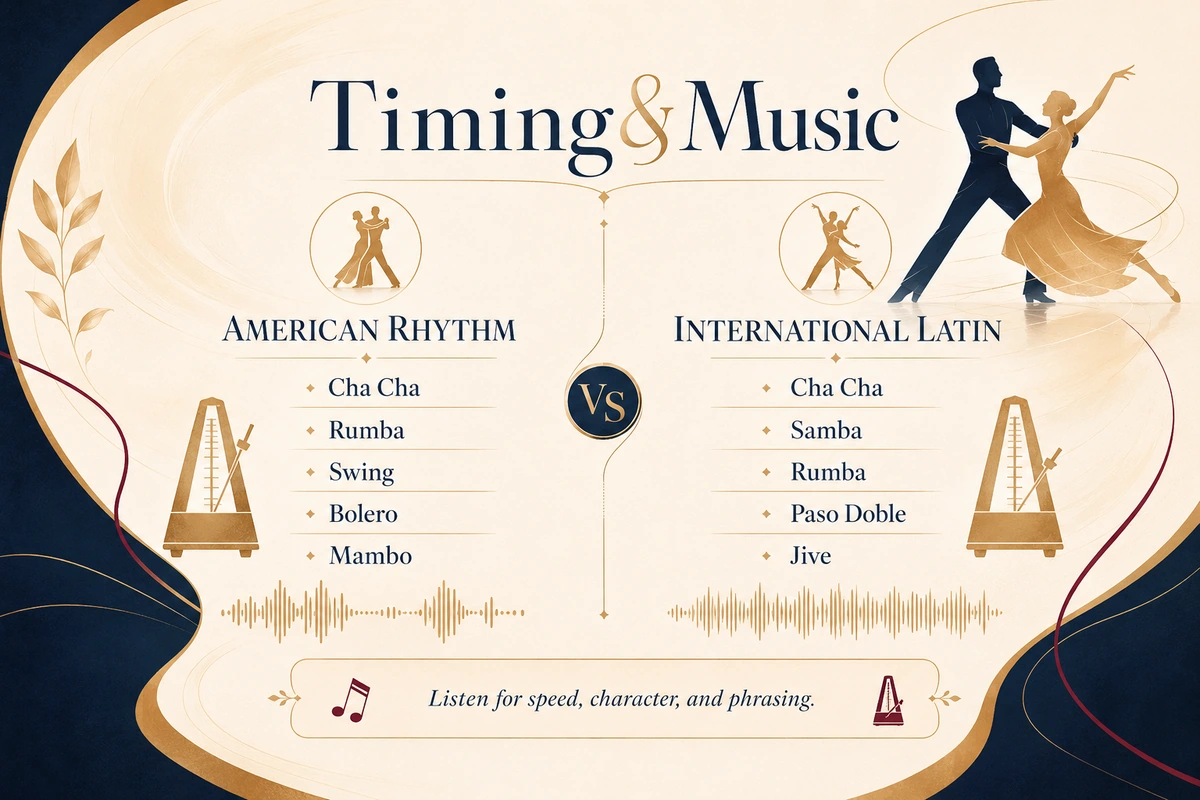
American Rhythm is the American-style Rhythm family of ballroom dance. In the most common competition grouping, it includes Cha Cha, Rumba, Swing or East Coast Swing, Bolero, and Mambo.
American Rhythm often feels grounded, rotational, playful, expressive, and connected to social dance traditions. Many beginners encounter it in North American studio programs because Rhythm dances work well for lessons, studio socials, showcases, wedding preparation, and American-style competitions.
What is International Latin?
International Latin is the International-style Latin family used in many global competitive contexts. It includes Cha Cha, Samba, Rumba, Paso Doble, and Jive.
International Latin is often more codified and competition-oriented in how students encounter it. It has precise technique expectations, distinctive leg and hip action, strong body rhythm, and a more globally standardized syllabus tradition.
Side-by-side comparison
| Topic | American Rhythm | International Latin |
|---|---|---|
| Style system | American Style | International Style / WDSF-style Latin |
| Core dances | Cha Cha, Rumba, Swing/East Coast Swing, Bolero, Mambo | Cha Cha, Samba, Rumba, Paso Doble, Jive |
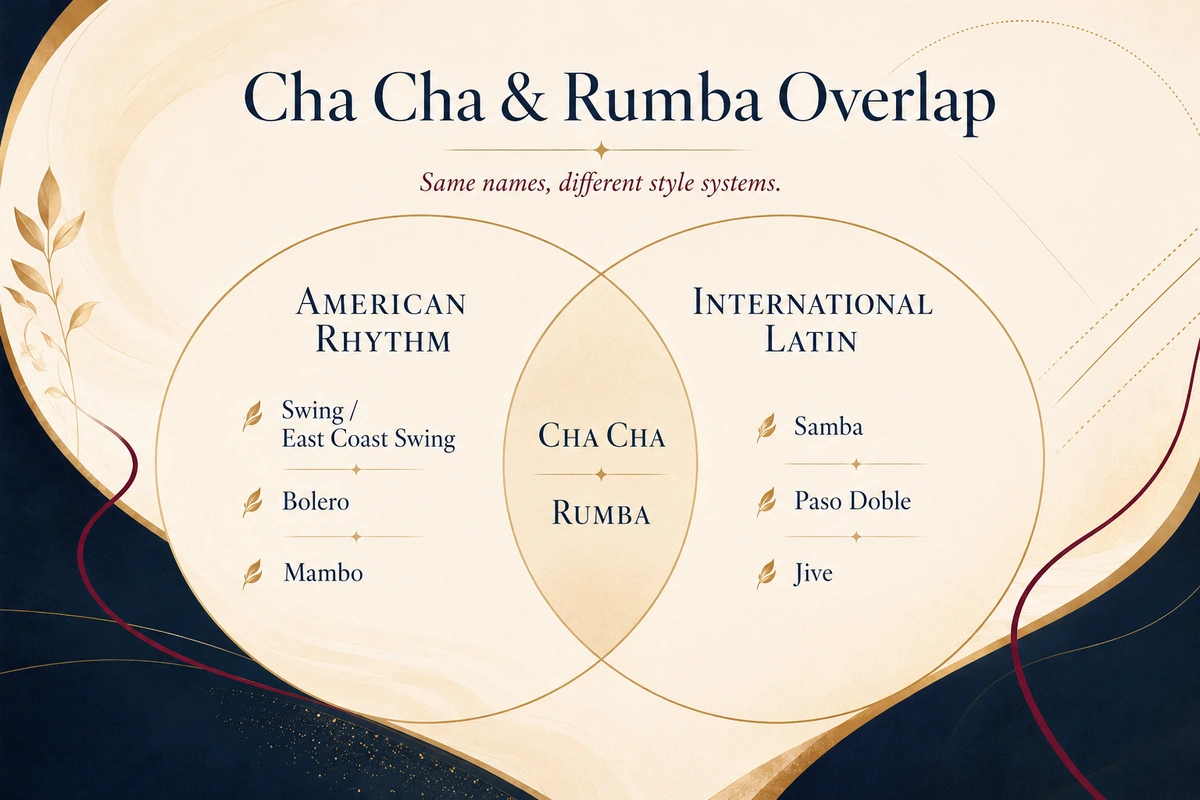
| Overlapping names | Cha Cha, Rumba | Cha Cha, Rumba |
| Related but different | Swing relates loosely to Jive, but they are not the same competitive dance | Jive relates historically to swing-family dances, but it has its own International Latin technique and tempo |
| Common feel | Grounded, playful, rotational, social/studio-friendly | Sharp, athletic, codified, globally competitive |
| Rumba feel | Often faster, earthier, more rhythmically active | Slower, more sustained, more controlled |
| Cha Cha action | Often described as softer/bent-knee in American Rhythm technique | Often described as straighter-leg in International Latin technique |
| Best for | North American studio programs, social dancers, wedding couples, American-style competitors | International-style competitors, students who want global Latin syllabus training |
| Important caveat | American syllabi vary by studio and organization | WDSF/ISTD materials and levels can vary in accepted syllabus systems |
Dance list comparison
| Dance | American Rhythm | International Latin | Beginner translation |
|---|---|---|---|
| Cha Cha | Yes | Yes | Same name, different technique tradition |
| Rumba | Yes | Yes | Same name, notably different timing and feel |
| Swing / East Coast Swing | Yes | No | Rhythm’s swing-family dance |
| Bolero | Yes | No | Slower, romantic Rhythm dance with rise/fall influence |
| Mambo | Yes | No | Fast Rhythm dance with Latin/social roots |
| Samba | Sometimes offered as an additional American Style dance, but not core Rhythm five-dance | Yes | Core International Latin dance |
| Paso Doble | Not core Rhythm five-dance | Yes | Core International Latin dance |
| Jive | No | Yes | International Latin’s fast swing-family dance |
Why do Cha Cha and Rumba appear in both systems?
Because ballroom dance developed through different teaching and competition systems. The American-style and International-style systems kept some of the same dance names while developing different technique expectations, patterns, styling, and competitive traditions.
American Cha Cha vs International Cha Cha
American Rhythm Cha Cha and International Latin Cha Cha both use lively Latin music and a cha-cha rhythm, but the body action and leg action can differ. American Rhythm Cha Cha is often taught with softer, more bent-knee action, while International Latin Cha Cha is often taught with straighter-leg action and sharper competitive styling.
American Rumba vs International Rumba
Rumba is usually the bigger surprise. In American Rhythm, Rumba is commonly faster and more rhythmically active. In International Latin, Rumba is generally slower and more sustained. This changes the entire feeling of the dance.
Timing and music differences
The BPM figures below are competition tempo references from the NDCA 2026 approved tempi; social and practice tempos can vary. Use them to hear relative speed, not as fixed rules.
| Dance | System | Competition tempo reference | What beginners notice |
|---|---|---|---|
| Cha Cha | International Latin | 124 BPM | Bright, sharp, precise |
| Cha Cha | American Rhythm | 120 BPM | Similar speed, different action/styling |
| Rumba | International Latin | 100 BPM | Slower, sustained, dramatic |
| Rumba | American Rhythm | 124 BPM | Faster, more rhythmically active |
| Swing | American Rhythm | 140 BPM | Bouncy, social, playful |
| Jive | International Latin | 172 BPM | Faster, athletic, competition energy |
| Bolero | American Rhythm | 92 BPM | Slow, romantic, sweeping |
| Mambo | American Rhythm | 188 BPM | Fast, lively, punchy |
| Samba | International Latin | 100 BPM | Bounce action and syncopated rhythm |
| Paso Doble | International Latin | 110 BPM | March-like, dramatic, phrased |
New to counting? Read how to count ballroom dance music and check the ballroom tempo chart.
Technique and styling differences
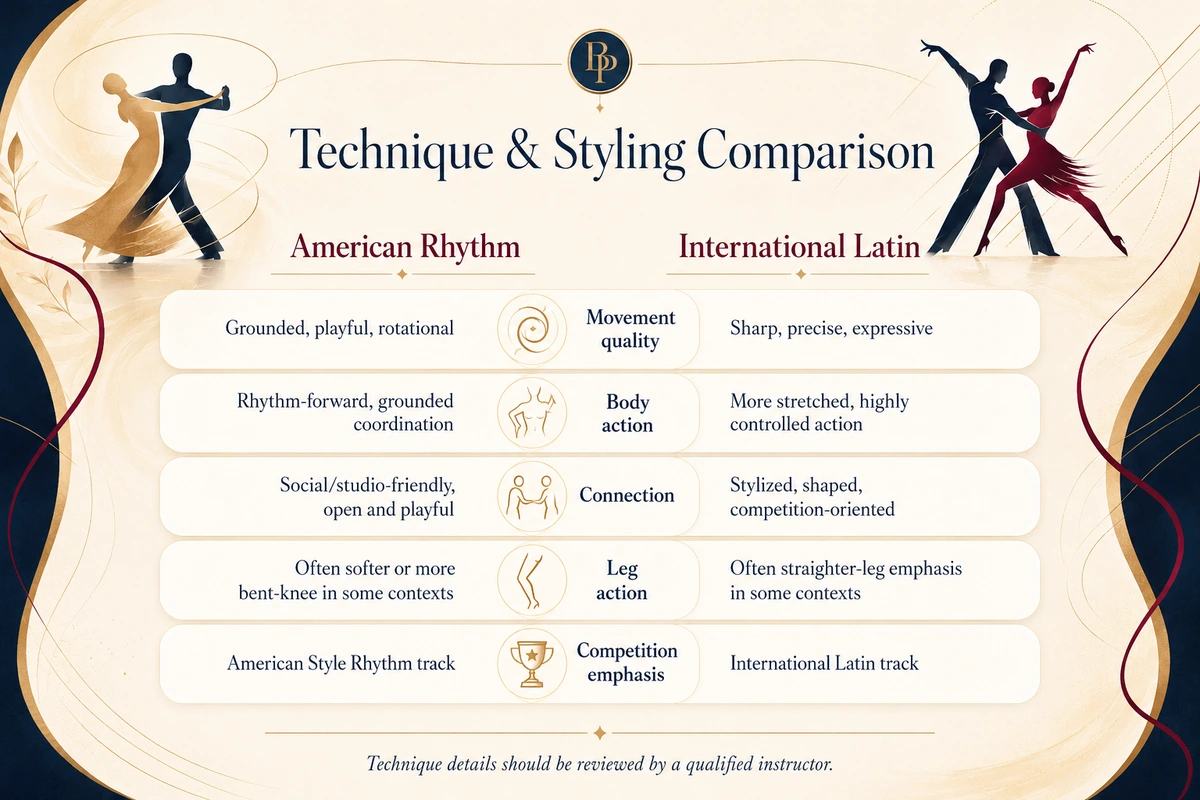
| Technique area | American Rhythm | International Latin |
|---|---|---|
| Body action | Grounded, rotational, ribcage/hip coordination | Sharper, more stretched, highly controlled |
| Leg action | Softer or more bent-knee in dances like Cha Cha | Straighter-leg actions in Cha Cha and strong foot/leg articulation |
| Connection | Open work, turns, playful partner interactions | Stylized presentation, shaped lines, competitive clarity |
| Movement quality | Earthy, playful, rotational | Athletic, precise, sharp |
| Choreography | Often less traveling and more rotational in open Rhythm work | Stronger lines, sharper body rhythms, competitive projection |
| Best question to ask | “Are we learning American Rhythm technique or social dance basics?” | “Are we learning International Latin syllabus technique or a social Latin adaptation?” |
Build the shared foundations either way with lead and follow, frame and posture, and Cuban motion.
Practice the difference with music
Music makes the Rhythm vs Latin difference easier to feel. Start with Cha Cha and Rumba because both appear in both systems, then compare Swing vs Jive, Bolero vs International Rumba, and Mambo vs Samba to hear how each family creates a different kind of energy.
-
American Rhythm playlists
Cha Cha, Rumba, Swing, Bolero, and Mambo—the grounded, social Rhythm energy.
Browse playlists Spotify / Apple / YouTube to verify
-
International Latin playlists
Cha Cha, Samba, Rumba, Paso Doble, and Jive—the sharp, athletic Latin energy.
Browse playlists Spotify / Apple / YouTube to verify
-
Compare the shared dances
Play Cha Cha and Rumba in each system back to back, then Swing vs Jive and Mambo vs Samba.
-
Ballroom Pages Music on Telegram
Follow along for new family playlists and timing tips.
Which should a beginner learn first?
Choose American Rhythm first if…
you are learning at a North American studio, want useful social dances, are preparing for a wedding, or are curious about American-style competitions.
Choose International Latin first if…
you are competition-curious, want the International/WDSF-style Latin track, or are training with a teacher who specializes in International Latin.
Choose based on your teacher if…
you are brand new and do not yet know your goal. The clearest path is usually the system your teacher teaches best. Start there with ballroom dance for beginners.
Social and wedding relevance
American Rhythm often has practical usefulness for wedding couples and social dancers because many studios use American Rumba, Cha Cha, Swing, Bolero, and Mambo in lesson programs and social events. International Latin can still work for wedding or showcase choreography when the couple wants a more dramatic, stylized, or competition-inspired look.
Planning a first dance? See the wedding dance guide, try the what dance fits your song matcher, or explore social dancing.
Competition context
Both systems are legitimate competition pathways. International Latin includes Cha Cha, Samba, Rumba, Paso Doble, and Jive. American Rhythm includes Cha Cha, Rumba, Swing, Bolero, and Mambo. The best question is not “Which is better?” but “Which competition system is my teacher preparing me for?”
Common misunderstandings
- Rhythm is just easier Latin.
Not accurate. They are different style systems, each with beginner-friendly and advanced levels.
- International Latin is only for competitors.
Not always. Beginners can study International Latin too; it is just more common in competition-oriented programs.
- American Rumba and International Rumba are basically the same.
No. American Rumba is usually faster and more rhythmically active; International Rumba is slower and more sustained.
- Swing and Jive are the same.
Related, but not the same competitive dance. They share swing-family roots but differ in technique and tempo.
- One system is more legitimate.
No. Both are recognized, established systems with their own competition pathways.
Decision guide by goal
| Goal | Recommended path |
|---|---|
| Brand new practical learner | Start with American Rhythm or Ballroom Dance for Beginners |
| International/WDSF competition | Start with International Latin |
| Wedding couple | Start with Wedding Dance and the song-matching guide |
| Studio social dancer | Start with American Rhythm |
| Loves high-energy Latin videos | Explore International Latin |
| Confused by timing | Read How to Count Ballroom Dance Music and the Tempo Chart |
| Wants the big picture | Read Dance Styles and American vs International Ballroom |
Video and demo notes
An owned Ballroom Pages demo is planned to make the difference obvious. It will show:
- American Rhythm Cha Cha basic feel
- International Latin Cha Cha basic feel
- American Rhythm Rumba timing
- International Latin Rumba timing
- Swing vs Jive energy comparison
 Demo video coming soon