
The four families at a glance
American Smooth
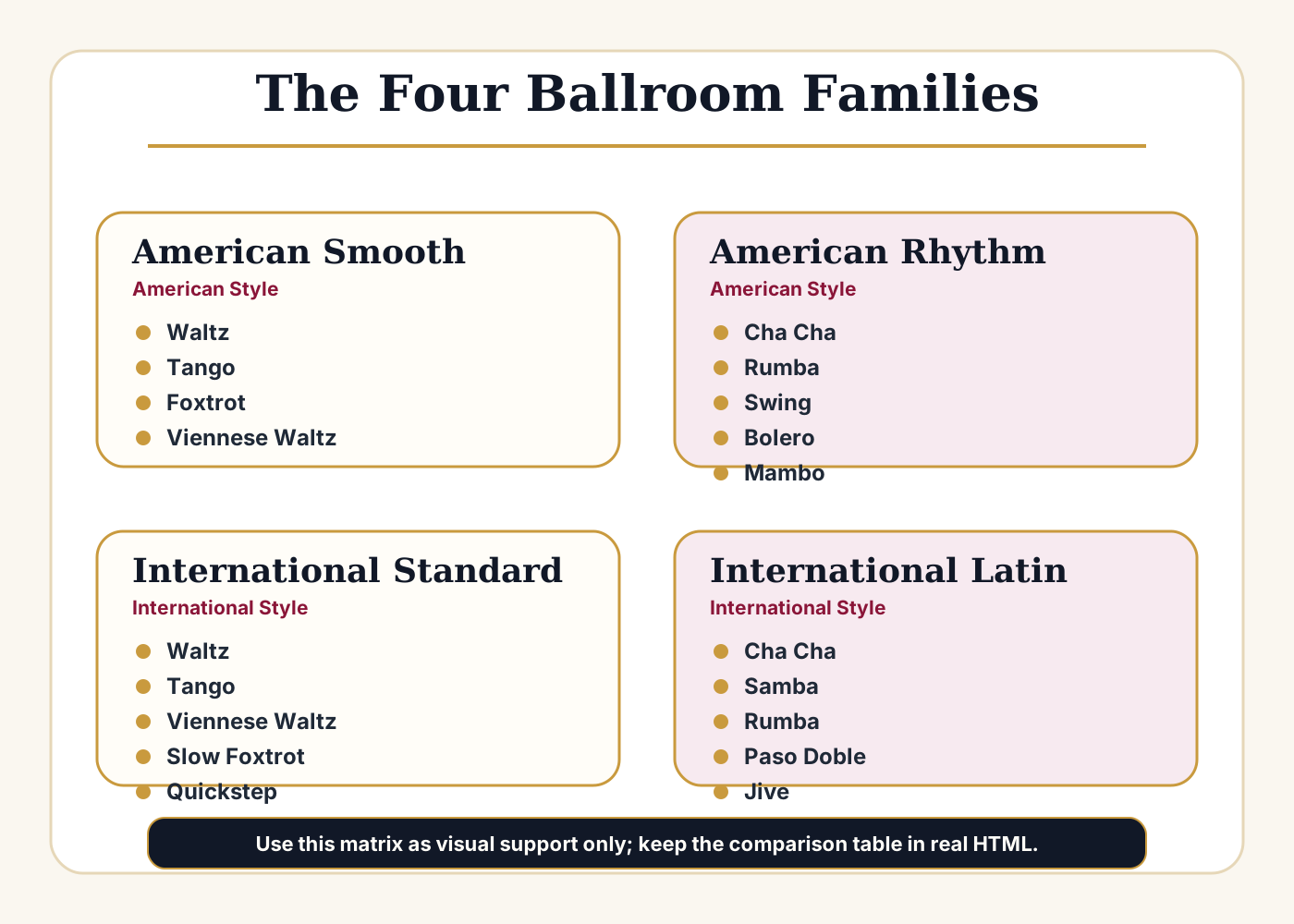
American Smooth is the American-style ballroom family built around Waltz, Tango, Foxtrot, and Viennese Waltz. It is closely related to the classic ballroom feel, but it allows more open work, side-by-side shapes, and choreography outside continuous closed hold than International Standard.
American Rhythm
American Rhythm is the American-style family that commonly includes Cha Cha, Rumba, Swing, Bolero, and Mambo. It often appears in U.S. studio and competition contexts and overlaps by name with International Latin in Cha Cha and Rumba.
International Standard
International Standard is the international-style ballroom family of Waltz, Tango, Viennese Waltz, Slow Foxtrot, and Quickstep. It is strongly associated with continuous closed hold and structured competitive technique.
Waltz Tango Foxtrot Viennese Waltz Quickstep Smooth vs Standard
International Latin
International Latin is the international-style Latin family of Cha Cha, Samba, Rumba, Paso Doble, and Jive. It is not the same as every social Latin dance.
Main comparison table
| System & family | Dances | General style feel | Hold / frame notes | Beginner fit | Wedding / social relevance | Competition context | Music / timing notes |
|---|---|---|---|---|---|---|---|
| American — Smooth | Waltz, Tango, Foxtrot, Viennese Waltz | Elegant, open, expressive | Closed hold plus open/separated work depending on level/context | Strong for beginners who want social or wedding usefulness | Very relevant for first dances and studio social dancing | Used in U.S. competitions and studio syllabi | Waltz 3/4; Foxtrot/Tango/VW vary by dance |
| American — Rhythm | Cha Cha, Rumba, Swing, Bolero, Mambo | Rhythm-forward, social, expressive | More varied hold and open work than strict closed-hold ballroom | Strong for beginners who want social dance options | Rumba, Swing, Cha Cha often appear in social/wedding settings | Used in U.S. competitions and studio syllabi | Dance-specific counts; do not assume a Latin playlist is a practice playlist |
| International — Standard | Waltz, Tango, Viennese Waltz, Slow Foxtrot, Quickstep | Formal, continuous, precise | Strong closed-hold emphasis | Good for structured learners; not only advanced | Less wedding-general, but Waltz/Foxtrot/Tango can inform first-dance training | Global DanceSport / competition context | Strong meter/tempo discipline; learn by dance |
| International — Latin | Cha Cha, Samba, Rumba, Paso Doble, Jive | Expressive, energetic, dance-specific | Open / Latin positions vary by dance and syllabus | Good for motivated beginners; start with one dance | Useful for dance training and performance; less generic social-Latin than the name suggests | Global DanceSport / competition context | Each dance has distinct rhythm/count; use dance-specific playlists |
What “American Style” means
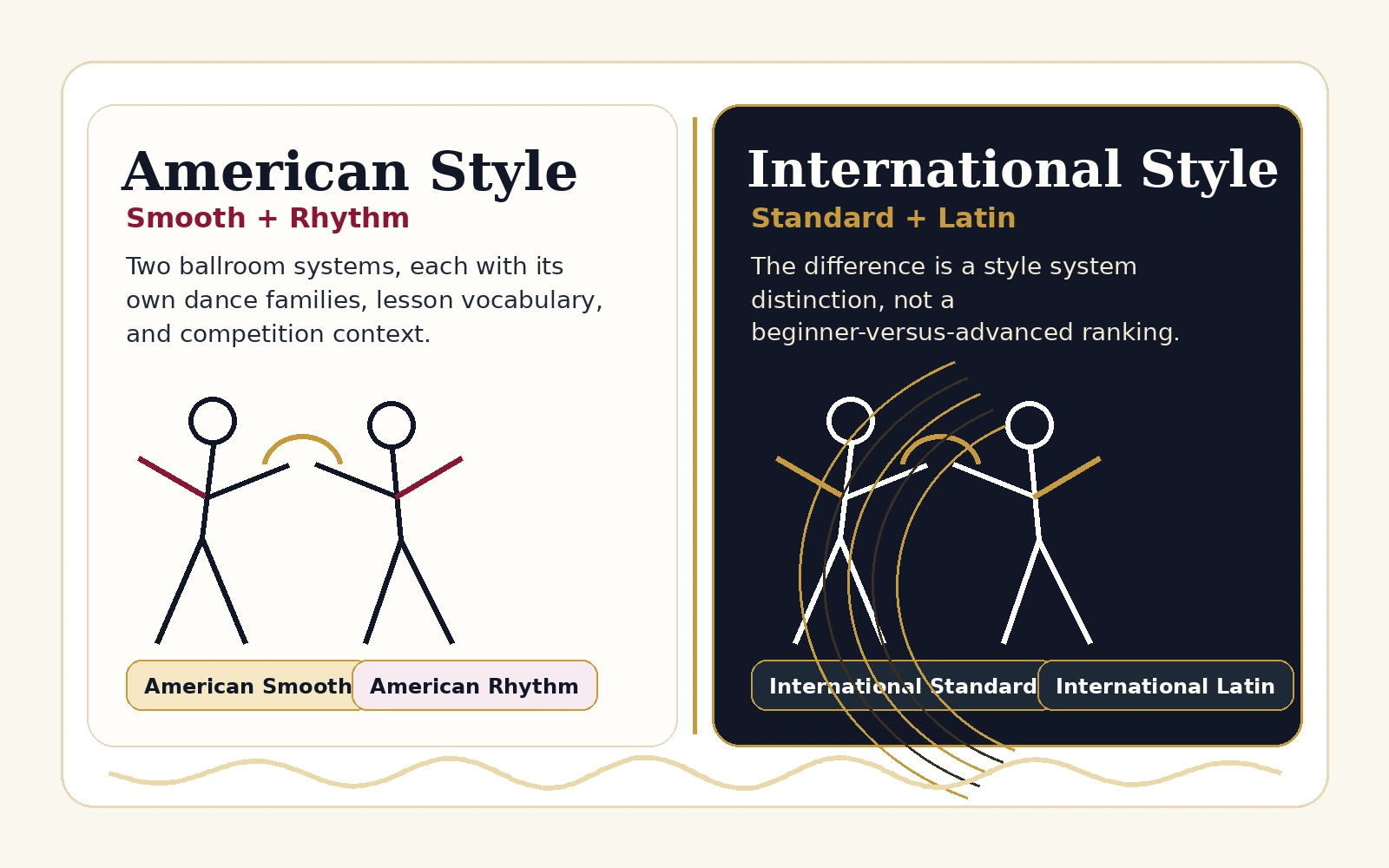
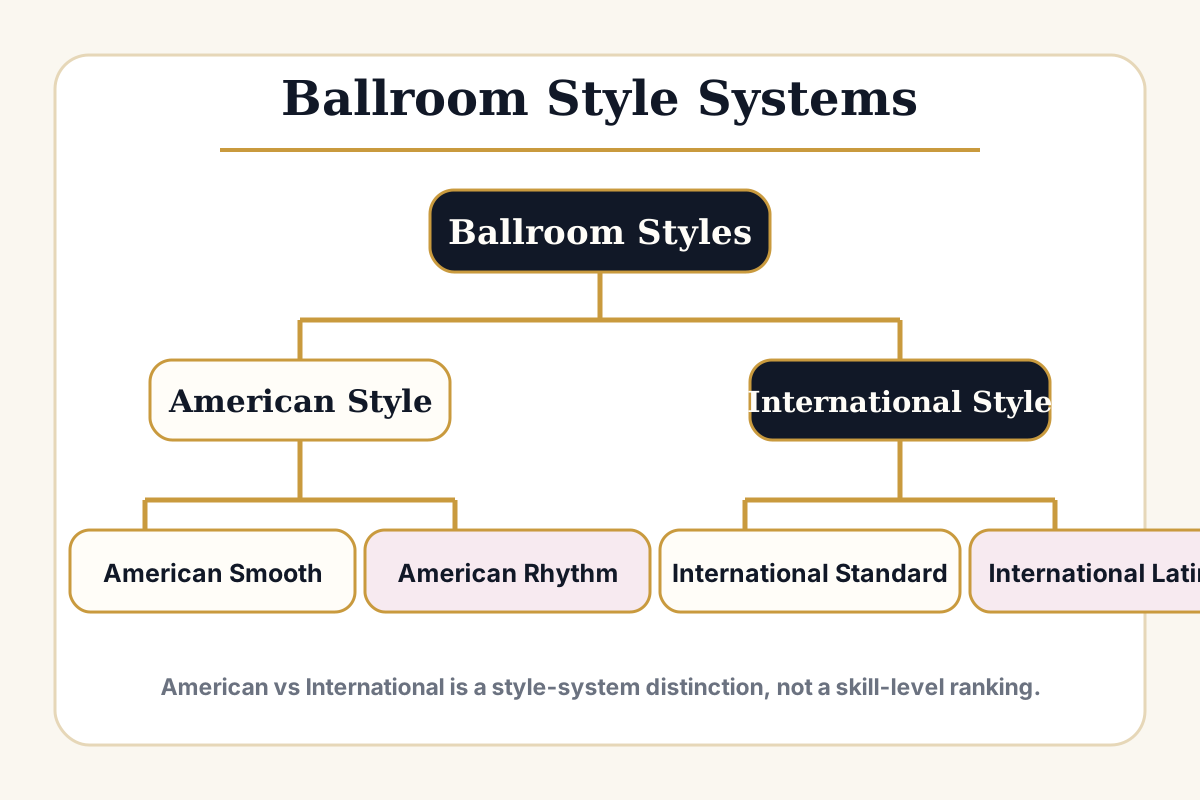
American Style ballroom is the system usually divided into American Smooth and American Rhythm. In U.S. studio contexts, beginners may encounter American Style because it often supports social dancing, wedding choreography, and flexible lesson goals while still having formal competitive syllabi.
The beginner-friendly way to understand American Style is:
- Smooth = the more classic ballroom side: Waltz, Tango, Foxtrot, Viennese Waltz.
- Rhythm = the more rhythm/Latin/swing side: Cha Cha, Rumba, Swing, Bolero, Mambo.
- The system can feel practical for social and wedding learners because it can include open work and social-facing choreography.
- This depends heavily on the studio, teacher, region, and curriculum.
What “International Style” means
International Style ballroom is the system usually divided into International Standard and International Latin. It is common in DanceSport and structured syllabus contexts, but beginners can learn it too. International does not mean “advanced only”; it means a different style system.
The beginner-friendly way to understand International Style is:
- Standard = Waltz, Tango, Viennese Waltz, Slow Foxtrot, Quickstep.
- Latin = Cha Cha, Samba, Rumba, Paso Doble, Jive.
- Standard is strongly associated with closed hold and continuous partner position.
- Latin has five distinct dances with different rhythm, music, and movement character.
Smooth vs Standard
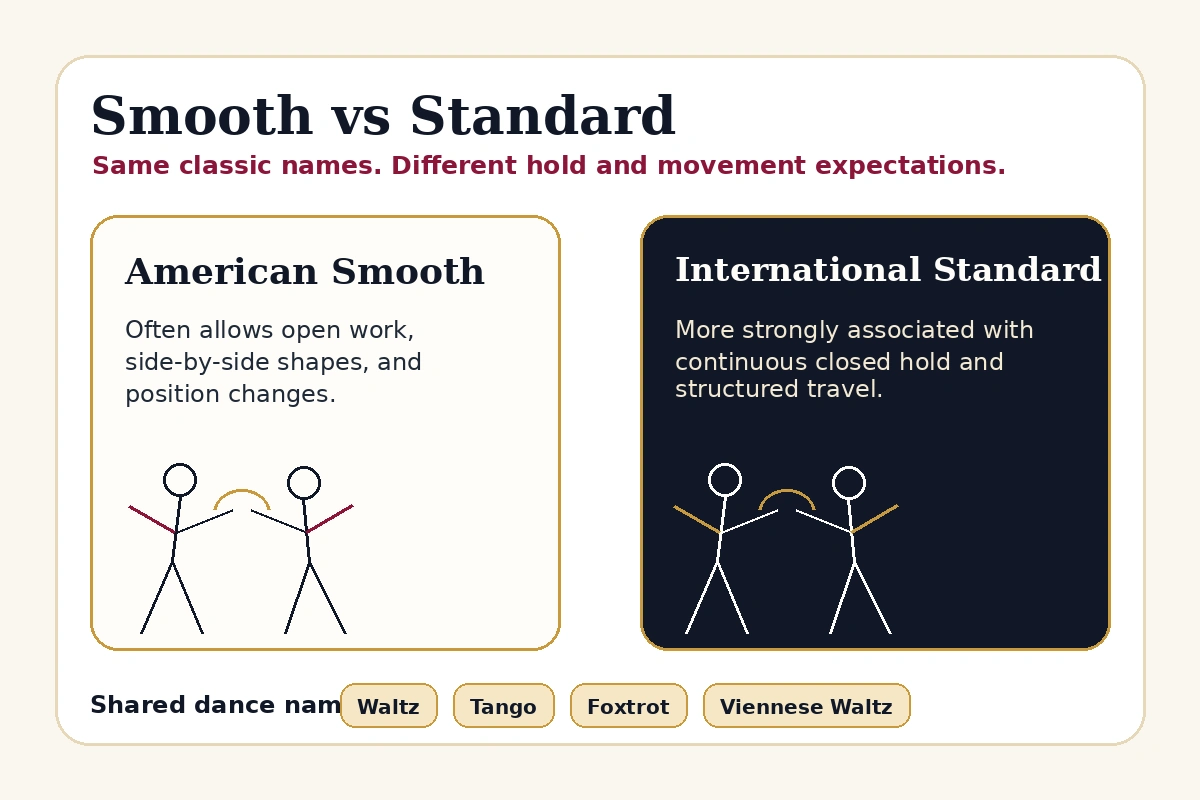
Smooth and Standard overlap by dance name: Waltz, Tango, Foxtrot, and Viennese Waltz. The simplest distinction is that American Smooth permits more open work and position changes, while International Standard is more closed-hold focused. This matters because a wedding couple may enjoy the expressive possibilities of Smooth, while a competitor training Standard needs to know the closed-hold expectations of the syllabus or organization.
Rhythm vs Latin
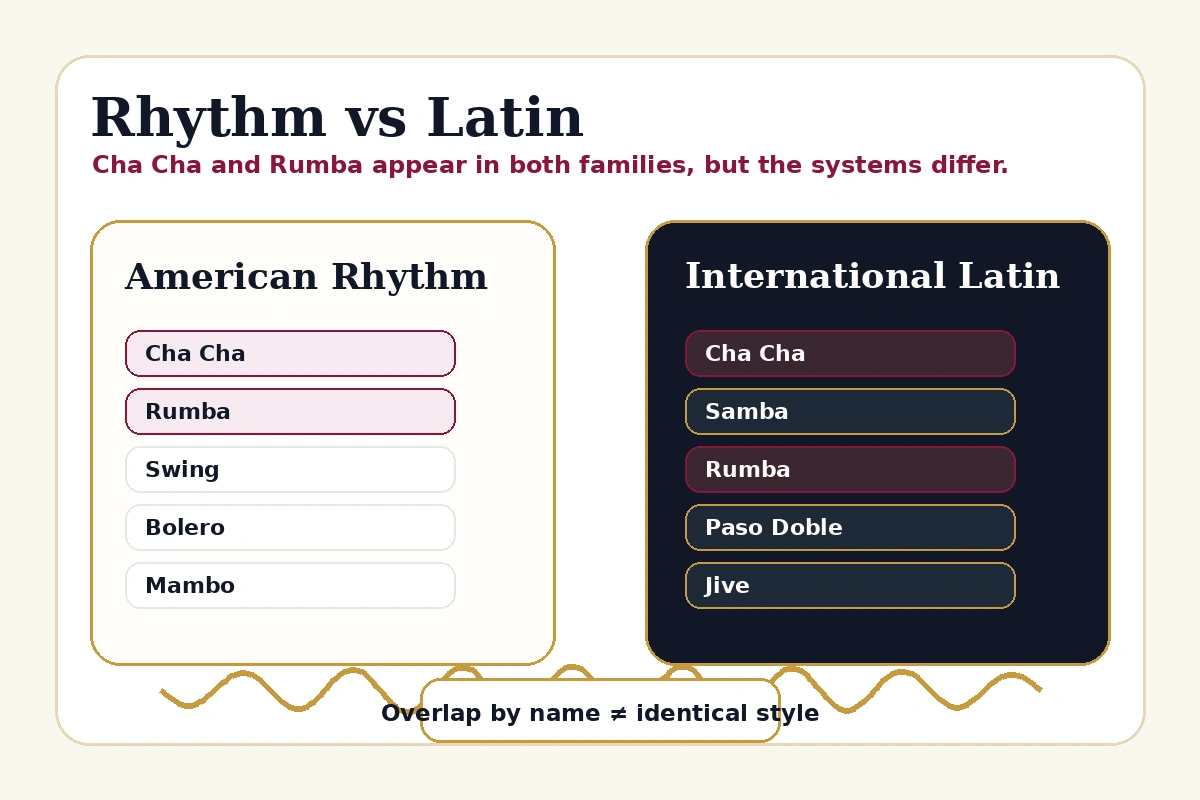
Rhythm and Latin overlap in Cha Cha and Rumba, but the families are not interchangeable. American Rhythm commonly includes Cha Cha, Rumba, Swing, Bolero, and Mambo. International Latin commonly includes Cha Cha, Samba, Rumba, Paso Doble, and Jive. The shared names are why beginners often ask whether Cha Cha or Rumba is American or International. The better answer is: both can exist in both systems, but the syllabus and style expectations can differ.
Go deeper in the American Rhythm vs International Latin comparison, or compare the Cha Cha and Rumba guides, which appear in both families.
Dance-by-dance crosswalk
| Dance | Family / families | System distinction? | Guide |
|---|---|---|---|
| Waltz | American Smooth, International Standard | Yes | Waltz |
| Tango | American Smooth, International Standard | Yes | Tango |
| Foxtrot / Slow Foxtrot | American Smooth, International Standard | Yes | Foxtrot |
| Viennese Waltz | American Smooth, International Standard | Yes | Viennese Waltz |
| Cha Cha | American Rhythm, International Latin | Yes | Cha Cha |
| Rumba | American Rhythm, International Latin | Yes | Rumba |
| East Coast Swing / Swing | American Rhythm | Usually American Rhythm in this context | East Coast Swing |
| Bolero | American Rhythm | — | Bolero |
| Mambo | American Rhythm | — | Mambo |
| Quickstep | International Standard | — | Quickstep |
| Samba | International Latin | — | Samba |
| Paso Doble | International Latin | — | Paso Doble |
| Jive | International Latin | — | Jive |
One canonical Foxtrot page covers both Foxtrot and Slow Foxtrot context. Each linked dance has its own canonical guide; browse them all from the dance styles hub.
Which system should you learn?
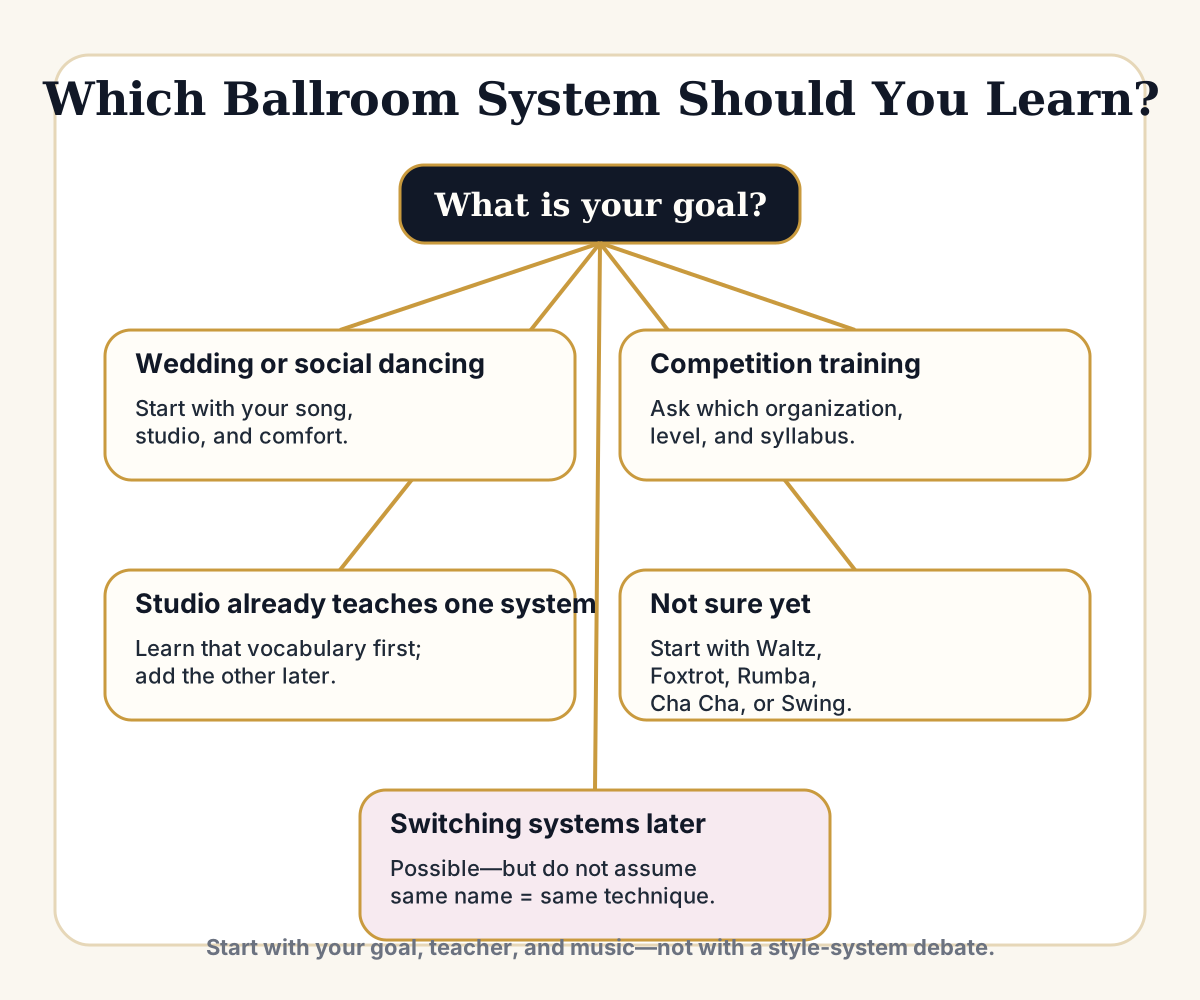
- If you want wedding or social dancing: start with the dances that fit your songs, social setting, and studio. In the U.S., this may often mean American Smooth/Rhythm basics such as Waltz, Foxtrot, Rumba, or Swing, but your teacher may use a blended approach.
- If you want competitive ballroom: ask which organization, level, and syllabus your studio trains under before choosing. Competition labels matter.
- If your studio teaches American Style: learn the American vocabulary first. You can still explore International later.
- If your studio teaches International Style: learn the International vocabulary first. You can still add social/wedding adaptations later.
- If you are not sure yet: start with a beginner-friendly dance such as Waltz, Foxtrot, Rumba, Cha Cha, or East Coast Swing, then learn which family your version belongs to.
- If you want to switch systems later: switching is possible, but do not assume the same dance name means the same technique, count, or syllabus.
Music & playlists by ballroom family
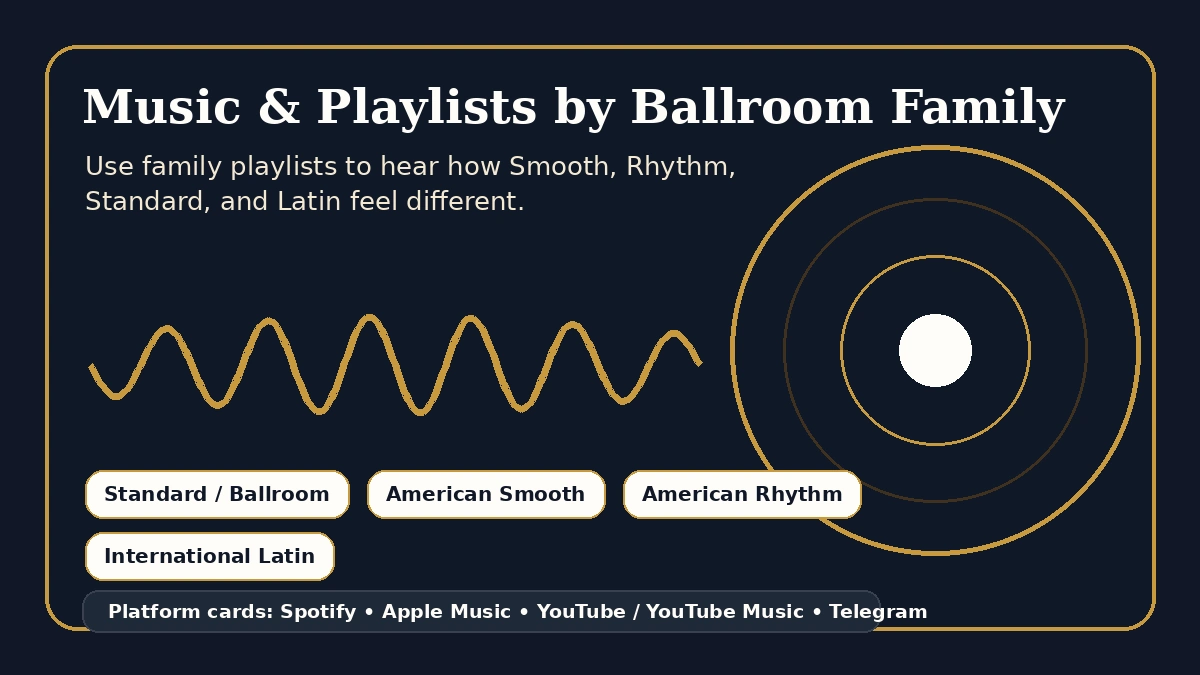
Music makes the four-family difference easier to understand. Standard and Smooth playlists often help you hear the traveling ballroom side. Rhythm and Latin playlists help you hear dance-specific grooves, counts, and energy. Use playlists for listening practice first, then pair them with a lesson or dance-specific guide.
-
International Standard / Ballroom
The traveling, closed-hold ballroom sound: Waltz, Tango, Viennese Waltz, Slow Foxtrot, Quickstep.
Browse playlists Spotify / Apple / YouTube to verify
-
American Smooth
The classic ballroom side with more open work: Waltz, Tango, Foxtrot, Viennese Waltz.
Browse playlists Spotify / Apple / YouTube to verify
-
American Rhythm
Rhythm-forward grooves: Cha Cha, Rumba, Swing, Bolero, Mambo. (Legacy pages may spell “Balero”—the dance is Bolero.)
Browse playlists Spotify / Apple / YouTube to verify
-
International Latin
Dance-specific Latin energy: Cha Cha, Samba, Rumba, Paso Doble, Jive. (Display Paso Doble, not “Paso.”)
Browse playlists Spotify / Apple / YouTube to verify
-
Music & timing references
Learn to count, then check tempos by dance.
-
Ballroom Pages Music on Telegram
Follow along for new family playlists.
Tip: a Latin music playlist is great for listening, but a practice playlist should match the specific dance’s rhythm, meter, and tempo—use the tempo chart to confirm.
Common beginner confusions
- American and International mean beginner and advanced.
Fix: They are style systems, not skill levels.
- Smooth and Standard are the same because the dance names overlap.
Fix: They share several dance names, but Smooth and Standard differ in hold/open-work expectations and syllabus context.
- Rhythm and Latin are interchangeable terms.
Fix: Rhythm is the American family; Latin is the International family.
- Cha Cha and Rumba are taught exactly the same everywhere.
Fix: The name can appear in both systems, but technique and syllabus expectations can differ.
- Social dance, wedding dance, and competition training use the same assumptions.
Fix: Social, wedding, and competition contexts often prioritize different goals.
- Salsa and Bachata are International Latin.
Fix: They are valuable social/club dances, but they are not part of the core International Latin five-dance set.
- All ballroom playlists work for every ballroom dance.
Fix: Practice music should match the specific dance’s rhythm, meter, and tempo.
- I should pick the ‘best’ system first.
Fix: Pick the system your teacher teaches, your goals require, or your music/social context supports.
Wedding relevance
Wedding couples may encounter Waltz, Foxtrot, Rumba, Swing, and Nightclub Two Step in first-dance contexts because these dances can fit common song feels. This page does not claim one family is always best for weddings. Instead, match the song’s meter, tempo, mood, clothing, floor size, and comfort level.
Explore the wedding dance guide, use the what dance fits your wedding song matcher, or browse first dance songs by dance style.
Social dance relevance
Social dancing is often less syllabus-driven than competition. A social dancer may learn American-style basics, club/social dances, wedding adaptations, or studio-specific patterns. Ask what style or system a class is teaching, and prioritize floorcraft, etiquette, comfort, and musicality.
Learn more in social dancing and the dance etiquette guide.
Competition relevance
Competitors need to know the difference because event categories, syllabus material, judging expectations, music tempo, and technique can be tied to a specific organization and level. Ask your teacher which organization, level, and syllabus you are training under.
Explore ballroom competitions for the bigger picture.
Related guides
Go deeper with the American Rhythm vs International Latin comparison.