






Beat, count, rhythm, tempo, and meter — in plain English

Most timing confusion comes from mixing up music words with dance words. You do not need to become a musician to dance better, but a few simple definitions help immediately.
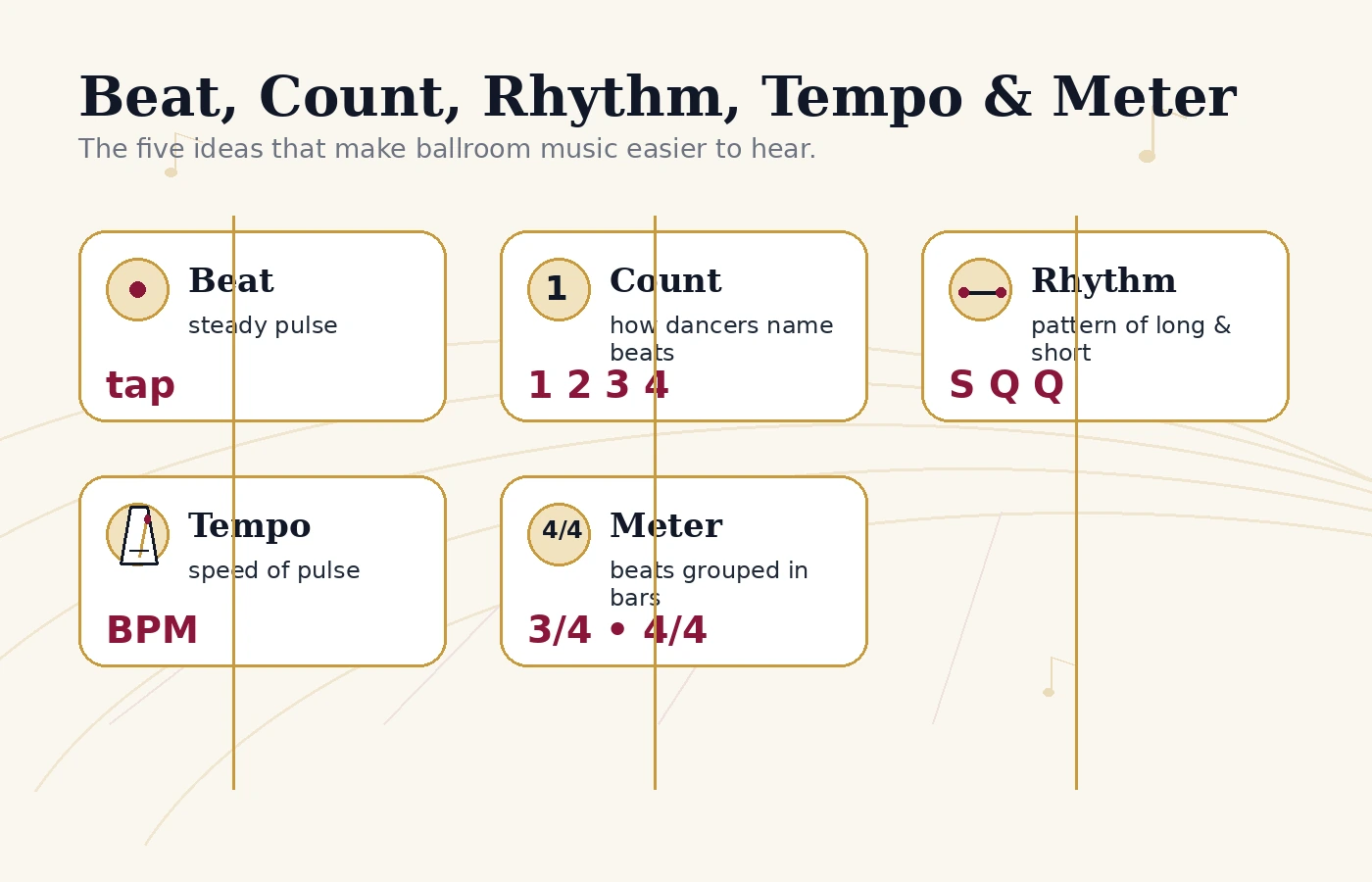
The beat is the steady pulse. The count is how dancers name that pulse so they can move together. The rhythm is the pattern of steps over the beat: slow, quick, quick; 1-2-3; triple-step, triple-step, rock-step. The tempo is how fast the beat is moving. The meter is how the music groups beats, often into 3s or 4s.
This is why two songs can have similar speeds but feel like different dances. A song with a rolling 3-count may invite Waltz. A song in 4/4 with a soft romantic pulse may invite Rumba or Nightclub Two Step. A song with a bright swing feel may invite Foxtrot or Swing.
| Term | Plain-English meaning | Why it matters | Example |
|---|---|---|---|
| Beat | The steady pulse you tap | First thing dancers must hear | Tap your foot evenly |
| Count | How dancers name the beats | Helps partners move together | 1-2-3 or slow-quick-quick |
| Rhythm | Pattern of long/short/accented movement | Makes each dance feel different | Cha Cha has split-beat action |
| Tempo | Speed of the beat | Helps decide if a dance is comfortable | Measured in BPM |
| Meter | How beats group in measures | Helps distinguish 3-feel vs 4-feel | 3/4 vs 4/4 |
| Time signature | Music notation for beat grouping | Useful for identifying Waltz vs many 4/4 dances | 3/4, 4/4 |
| BPM | Beats per minute | Common tempo measurement | 120 BPM |
| MPM | Measures per minute | Common ballroom tempo reference | 30 MPM in 4/4 equals 120 BPM |
| Slow | A dance count usually held longer | Helps understand Foxtrot, Rumba, Swing | “Slow” often spans two beats |
| Quick | A shorter dance count | Helps contrast rhythm values | Quick-quick |
| Phrase | A musical unit that feels like a sentence | Helps dancers start and finish cleanly | Sets of 8 or longer phrases |
| Accent | Emphasis on a beat or note | Helps identify the “1” and dance character | Tango accents |
For full definitions, browse the Ballroom Pages glossary.
Why do different ballroom dances use different counts?

Different ballroom dances were built around different movement qualities. Waltz rotates and flows through a 3-count. Foxtrot glides through slows and quicks. Cha Cha compresses extra foot actions into the music with a “cha-cha-cha” or “4&1” feeling. Swing often uses single or triple rhythm. Salsa and Bachata usually feel organized in 8-count phrases even though the underlying meter is commonly 4/4.
The important point: dance count is practical. It helps you move, not just analyze the song. Teachers may use numbers, slows and quicks, syllables, or sounds depending on the dance, level, and syllabus. That is normal.
Ballroom music by dance style
Use these cards as a starting point, not a final rulebook. Dance music varies by syllabus, teacher, social context, region, and whether you are dancing for practice, performance, competition, or a wedding.
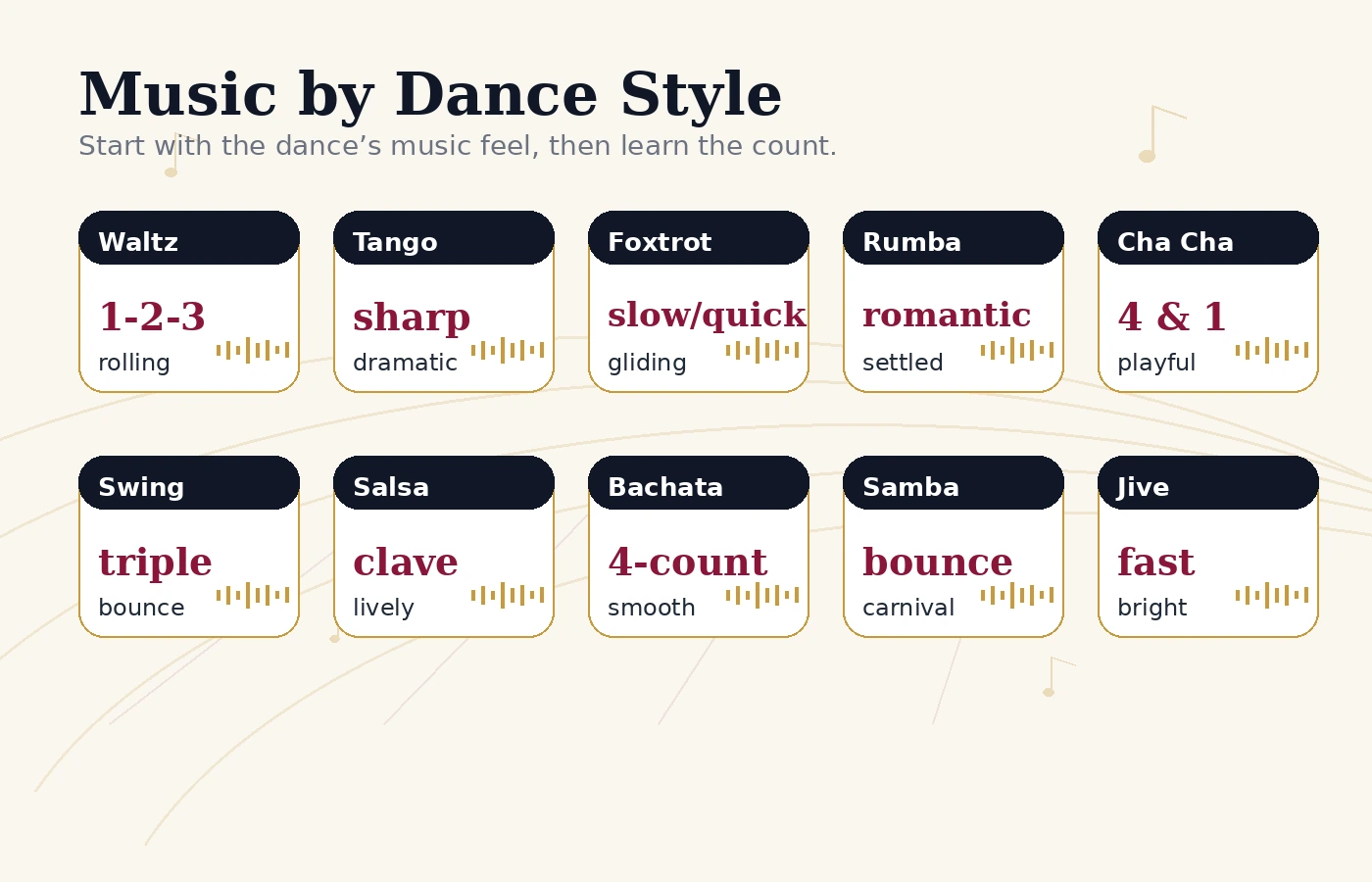
Waltz
Rolling 3-count music with a smooth, floating feeling. Start by hearing “1-2-3.”
Tango
Dramatic, sharp, accented music. Listen for contrast: stillness, attack, and phrase changes.
Foxtrot
Smooth 4/4 with a walking or gliding quality. Beginners often hear “slow, slow, quick, quick.”
Viennese Waltz
Faster rotating waltz music. Still a 3-count feel, but the tempo can feel much more demanding.
Quickstep
Fast, bright, energetic music. Start by hearing the pulse before trying to step quickly.
Rumba
Slow, romantic 4/4 music. The dance count depends on American or International context.
Cha Cha
Playful, syncopated 4/4. Listen for the extra split-beat action in “cha-cha-cha” or “4&1.”
Samba
Bouncy Latin music with a distinctive pulse. The feeling matters as much as the number count.
Paso Doble
March-like, dramatic music. Often associated with strong accents and competition contexts.
Jive
Bright, fast swing-family music. Start with the bounce before adding speed.
East Coast Swing
Swing music with single or triple rhythm. Good for social dancing and many upbeat wedding songs.
Bolero
Slow, expressive rhythm dance music. Often feels more dramatic and stretched than Rumba.
Mambo
Driving Latin rhythm, often faster and sharper than beginner Rumba or Cha Cha.
Salsa
Latin social dance music commonly organized in phrases of 8. Beginners often count “1-2-3, 5-6-7.”
Bachata
Romantic 4-count social music. Beginners often hear “1-2-3-tap.”
Merengue
Clear marching pulse; one of the easiest social rhythms to begin hearing.
Hustle
Disco/pop-friendly social dance music. Counts vary by teacher and style.
West Coast Swing
Flexible, slotted swing music that can fit many contemporary songs.
Nightclub Two Step
Gentle slow-dance-friendly music, often useful for wedding first dances.
Argentine Tango
A separate social tango tradition; do not assume it uses the same musical approach as ballroom Tango.
Want a deeper dive on one style’s music? Start with the Cha Cha music guide, the Foxtrot music guide, the Tango music guide, the Samba music guide, the Quickstep music guide, the Viennese Waltz music guide, or the Paso Doble music guide — count, tempo, songs, and practice playlists.
Tempo and time signature: useful, but not the whole answer

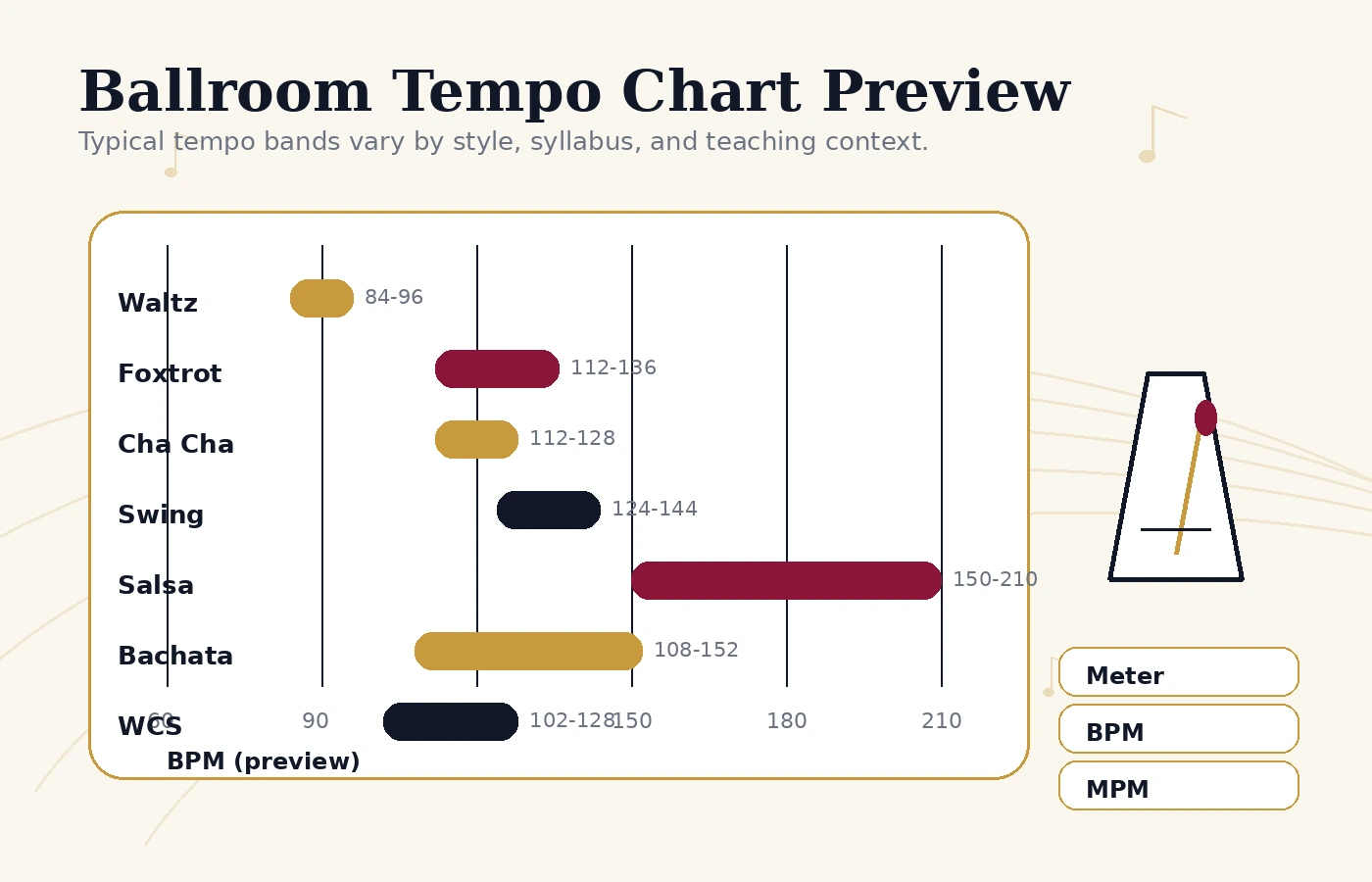
Tempo is usually measured in BPM, or beats per minute. Some ballroom references also use MPM, or measures per minute. Time signature tells you how beats are grouped in the music. For example, many Waltzes use a 3-count feel, while many Foxtrots, Rumbas, Cha Chas, Swings, Salsas, and Bachatas are commonly felt in 4.
Tempo helps you narrow the dance, but it is not enough by itself. A song’s rhythm pattern, accents, phrasing, instrumentation, and mood all matter.
Common count patterns by style
These are common beginner-facing counts, not the only valid counts. Your teacher may count differently depending on American, International, social, wedding, or competitive context.
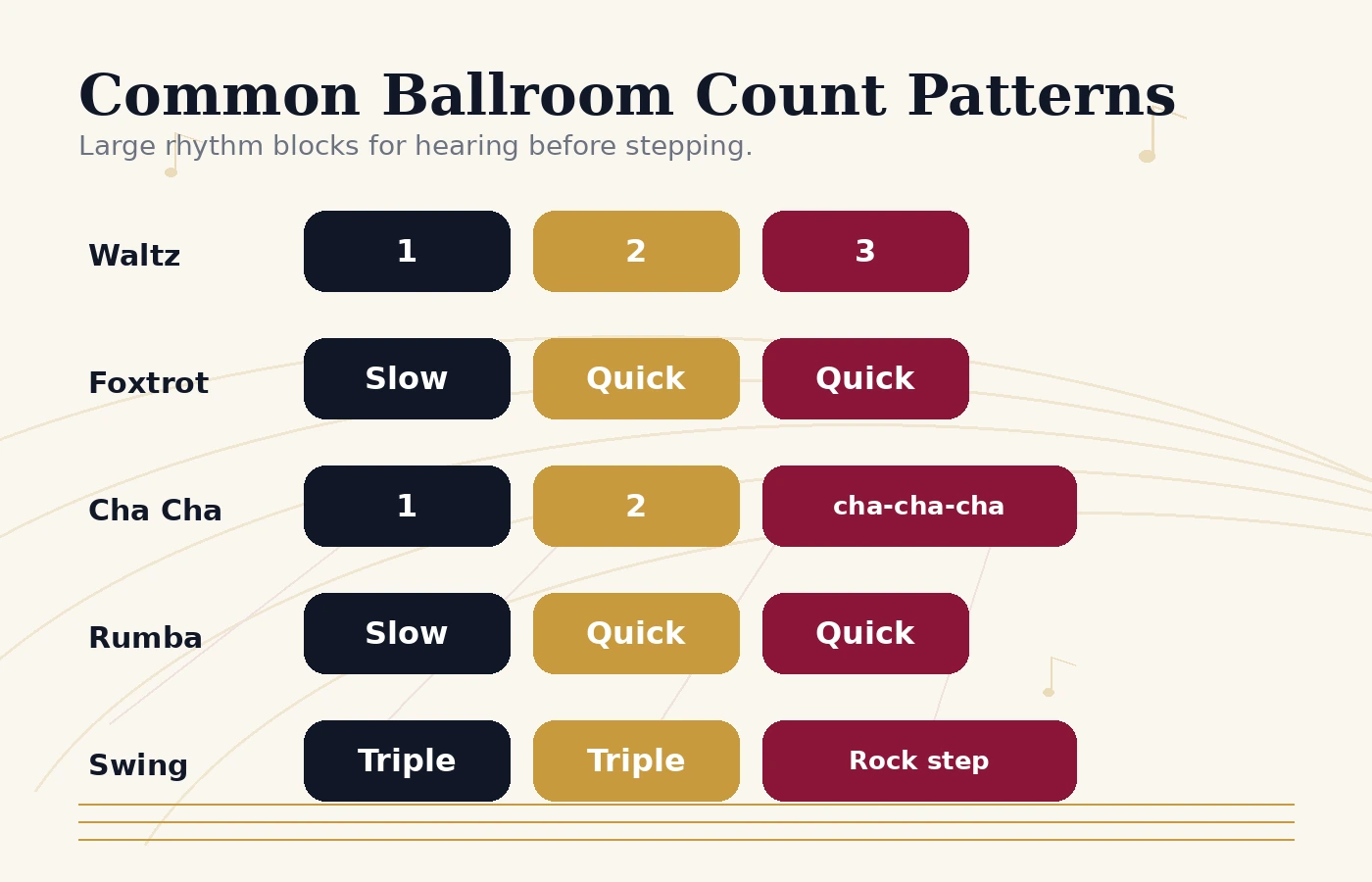
| Dance | Common count | Meter / time feel | Typical music feel | Beginner timing tip |
|---|---|---|---|---|
| Waltz | 1-2-3 | 3-feel | Flowing, rolling, romantic | Count “1” as the strongest beat |
| Tango | Slow-slow-quick-quick-slow or 1-2 phrasing | Often felt in strong 2/4 or 4/4 groupings | Sharp, dramatic, accented | Listen for attack and stillness |
| Foxtrot | Slow-slow-quick-quick or slow-quick-quick | 4-feel | Smooth, walking, gliding | Do not rush the slows |
| Viennese Waltz | 1-2-3 | Fast 3-feel | Sweeping, rotating | Hear the 3 before trying speed |
| Quickstep | Slow-quick-quick and related patterns | Fast 4-feel | Bright, lively | Keep steps small when tempo is fast |
| Rumba | Slow-quick-quick or 4-1, 2, 3 depending context | 4-feel | Slow, romantic, grounded | Know whether your teacher uses American or International timing |
| Cha Cha | 2-3-4&1 or 1-2-cha-cha-cha | 4-feel with split beat | Playful, syncopated | Hear the “cha-cha-cha” before stepping |
| Samba | 1-a-2 or related bounce rhythms | 2-feel / 4-feel depending context | Bouncy, festive | Feel bounce, not just speed |
| Jive | 1-2, 3&4, 5&6 | Fast swing feel | Bright, energetic | Find bounce before foot speed |
| East Coast Swing | Triple-step, triple-step, rock-step; or single rhythm | 4-feel swing | Bouncy, social | Triple rhythm works well for slower swing |
| Salsa | 1-2-3, 5-6-7 | 4/4 in 8-count phrases | Lively, Latin, percussive | Notice the silent 4 and 8 |
| Bachata | 1-2-3-tap, 5-6-7-tap | 4-feel / 8-count phrases | Romantic, steady | Keep the tap relaxed |
| Merengue | 1-2 marching pulse | 2-feel / 4-feel | Festive, simple pulse | March evenly first |
| Hustle | &1-2-3 or 1-2-3 depending style | 4-feel | Disco/pop, driving | Ask which count system your teacher uses |
| West Coast Swing | 1-2, 3&4, 5&6 | Flexible 4-feel | Smooth, elastic, contemporary | Listen for phrase and connection |
| Nightclub Two Step | Quick-quick-slow or slow-quick-quick depending teacher | Slow 4-feel | Gentle, romantic | Great for many slow wedding songs |
| Argentine Tango | Not fixed like ballroom syllabus counts | Tango phrasing | Improvisational, expressive | Treat it separately from ballroom Tango |
How to match a song to a dance style
Start with listening, not guessing. Lyrics and mood can help, but they should not be the only clue.
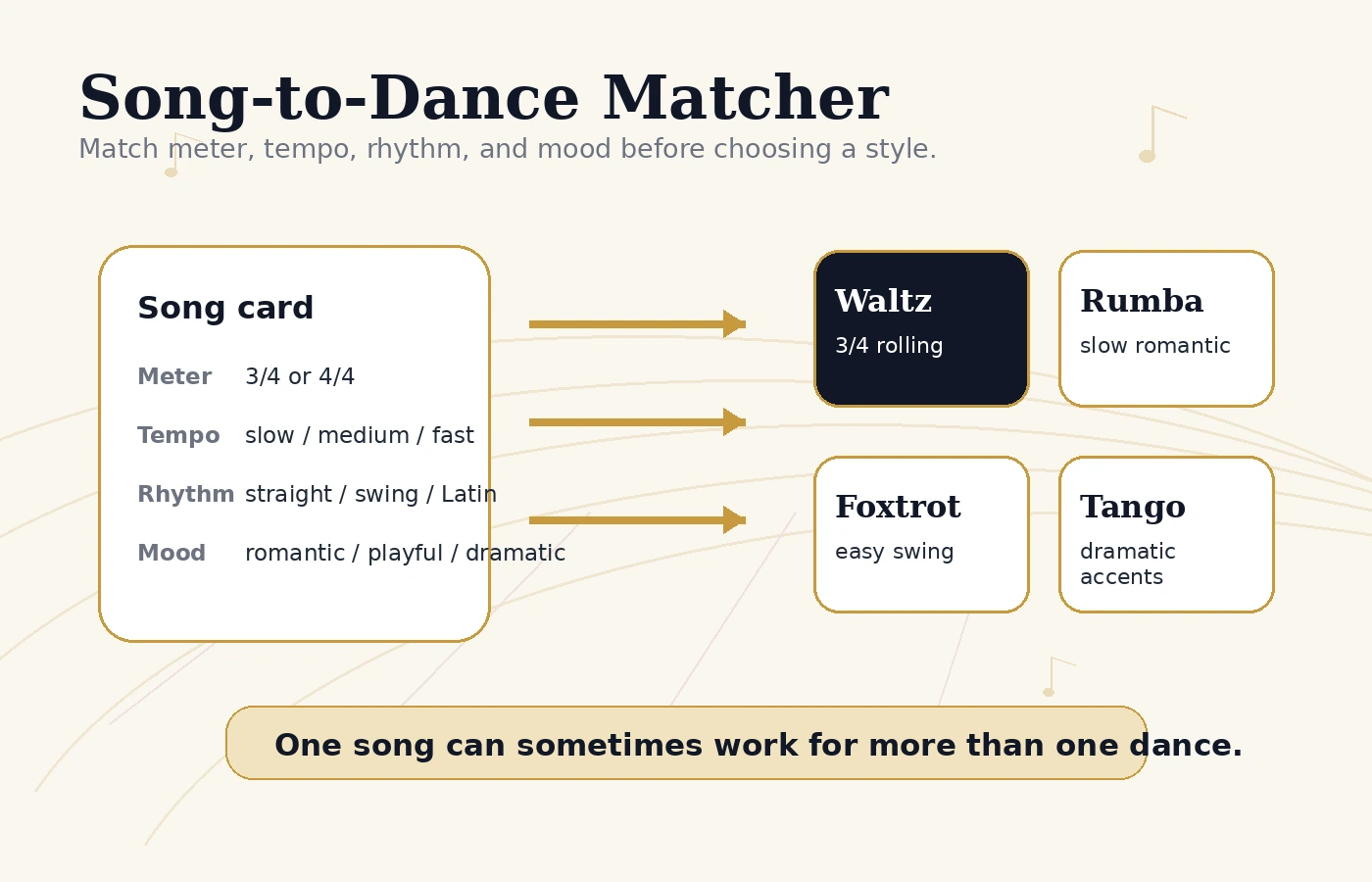
- Listen for meter. Does the song feel like it groups naturally in 3 or 4?
- Feel the tempo. Is the beat slow, medium, fast, or too fast for comfortable beginner dancing?
- Notice the rhythm pattern. Is it smooth, swingy, Latin, sharp, bouncy, or march-like?
- Match the mood. Romantic, classic, playful, dramatic, energetic, or relaxed?
- Check the goal. Wedding first dance, lesson practice, social dancing, or performance?
- Use the matcher. If you are planning a first dance, use the wedding song-to-dance guide.
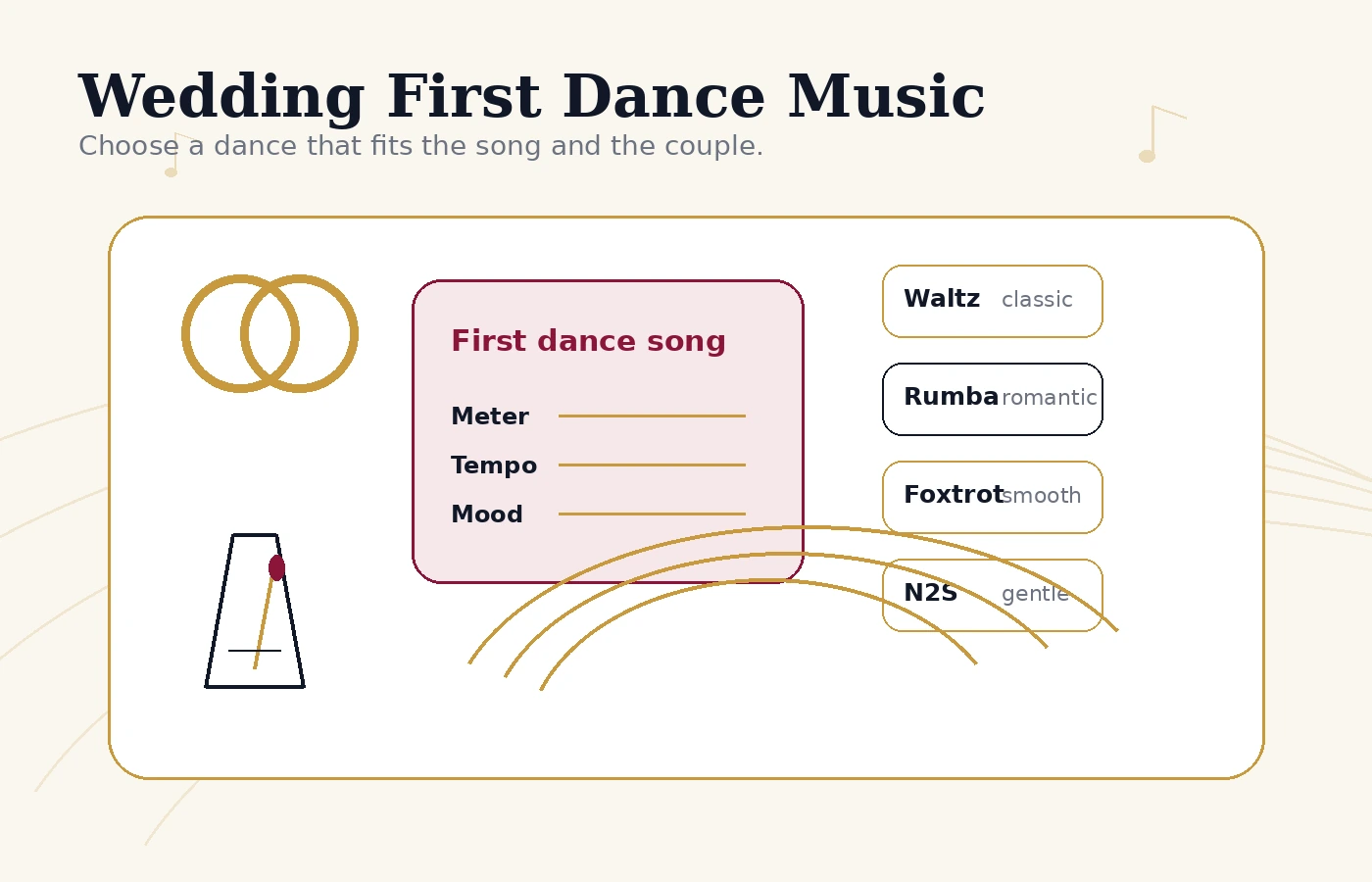
Wedding first dance music
Wedding songs are often chosen for lyrics first, but dancing works better when the music also fits a clear movement pattern.
For many couples, the best options are not always traditional Waltz. Rumba, Foxtrot, East Coast Swing, Nightclub Two Step, and simple social dance structures can all work beautifully depending on the song.
Ballroom playlists and music resources
A good ballroom playlist is not just a list of songs. It should tell you what dance the music fits, why it fits, whether it is beginner-friendly, and what to practice while listening.
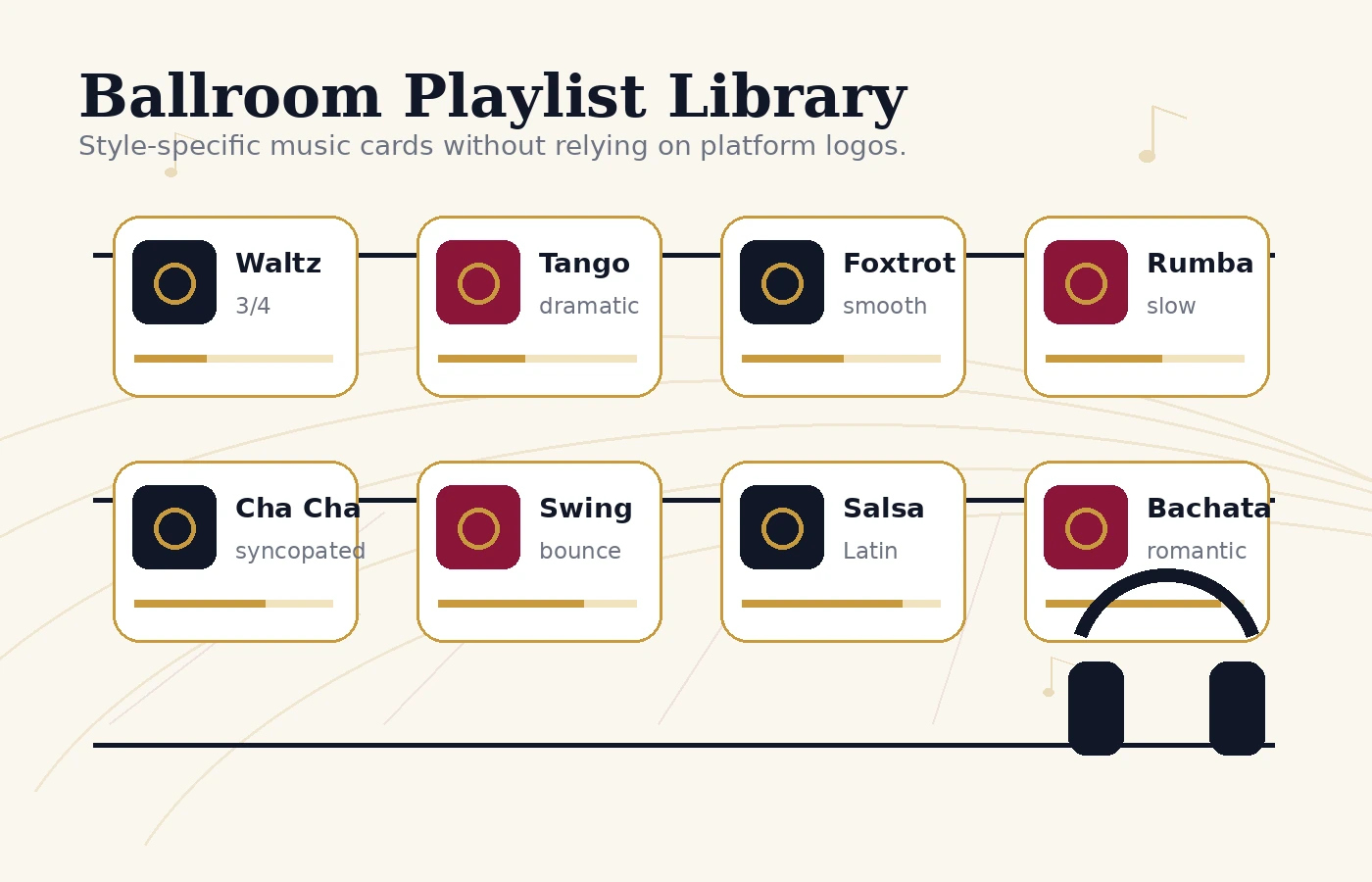
Use playlists for three different jobs:
- Listening practice: hear beat, phrase, and count.
- Dance practice: repeat one style until the timing feels natural.
- Song discovery: find music for social dancing, lessons, or a wedding first dance.
Practice drills for hearing the beat

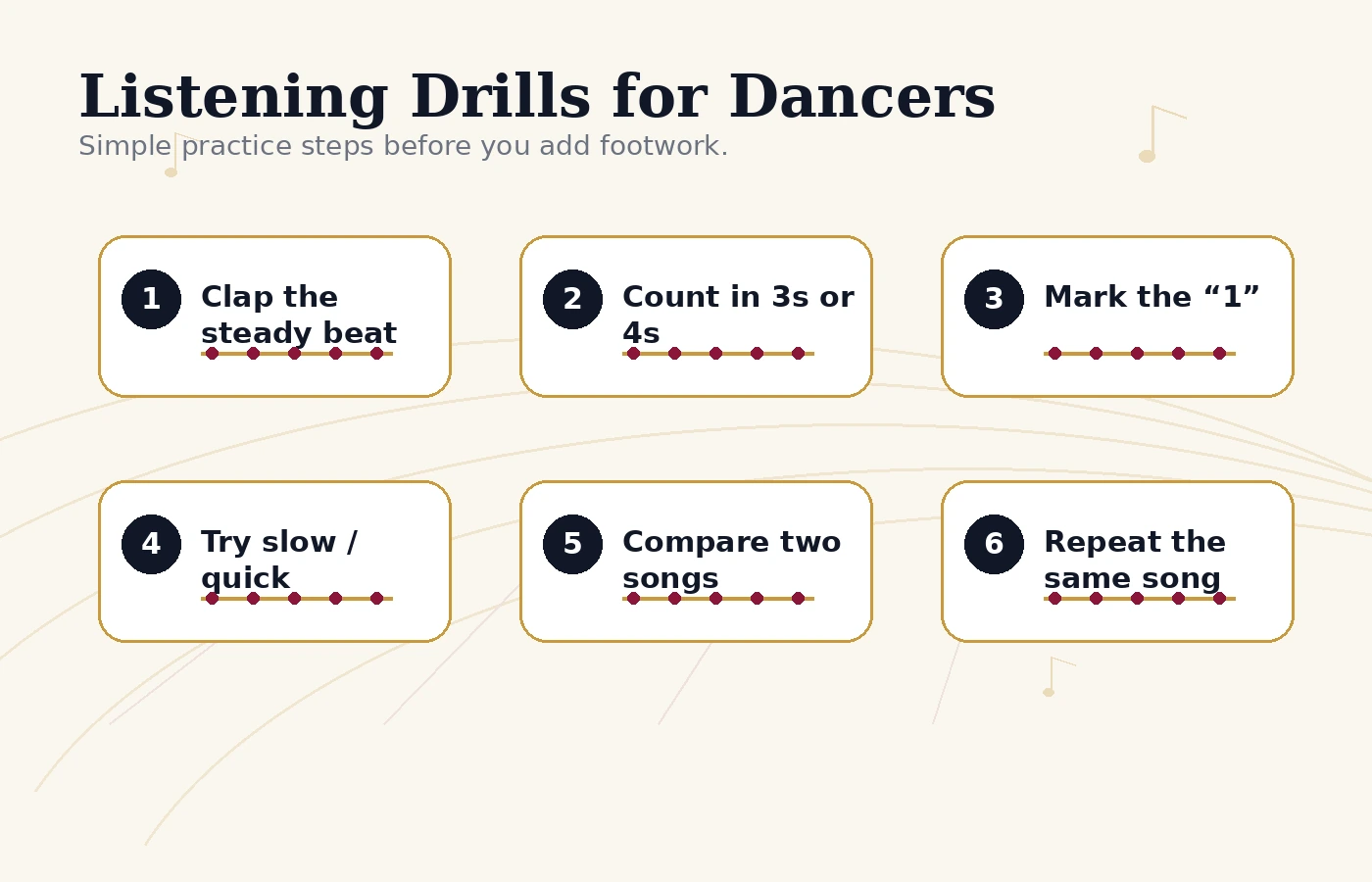
Clap the steady beat
Ignore lyrics for a moment and find the pulse.
Count in sets of 3 or 4
Try both; notice which one feels natural.
Mark the “1”
Listen for the beat that feels like the beginning of the phrase.
Try slow/quick patterns
Say “slow, quick, quick” while clapping.
Compare two songs
Ask what feels different: speed, accent, rhythm, or mood?
Practice with the same song several times
Repetition trains your ear.
Record what dance style it feels like
Use a practice log so you can compare later.
Common timing mistakes
Counting too many things at once.
Start with beat only.
Confusing beat with count.
Beat is pulse; count is how dancers organize pulse.
Ignoring phrasing.
Listen for beginnings and endings in the music.
Choosing a dance by lyrics only.
Check meter, tempo, rhythm, and mood.
Assuming every slow song is Waltz.
Many slow songs are 4/4 and may fit Rumba, Foxtrot, or Nightclub Two Step.
Treating BPM as the only factor.
BPM narrows options; rhythm confirms them.
Not listening before practicing steps.
Clap and count before moving.
Switching dance styles before finding the beat.
Stay with one song long enough to hear its structure.
Tools for learning ballroom timing
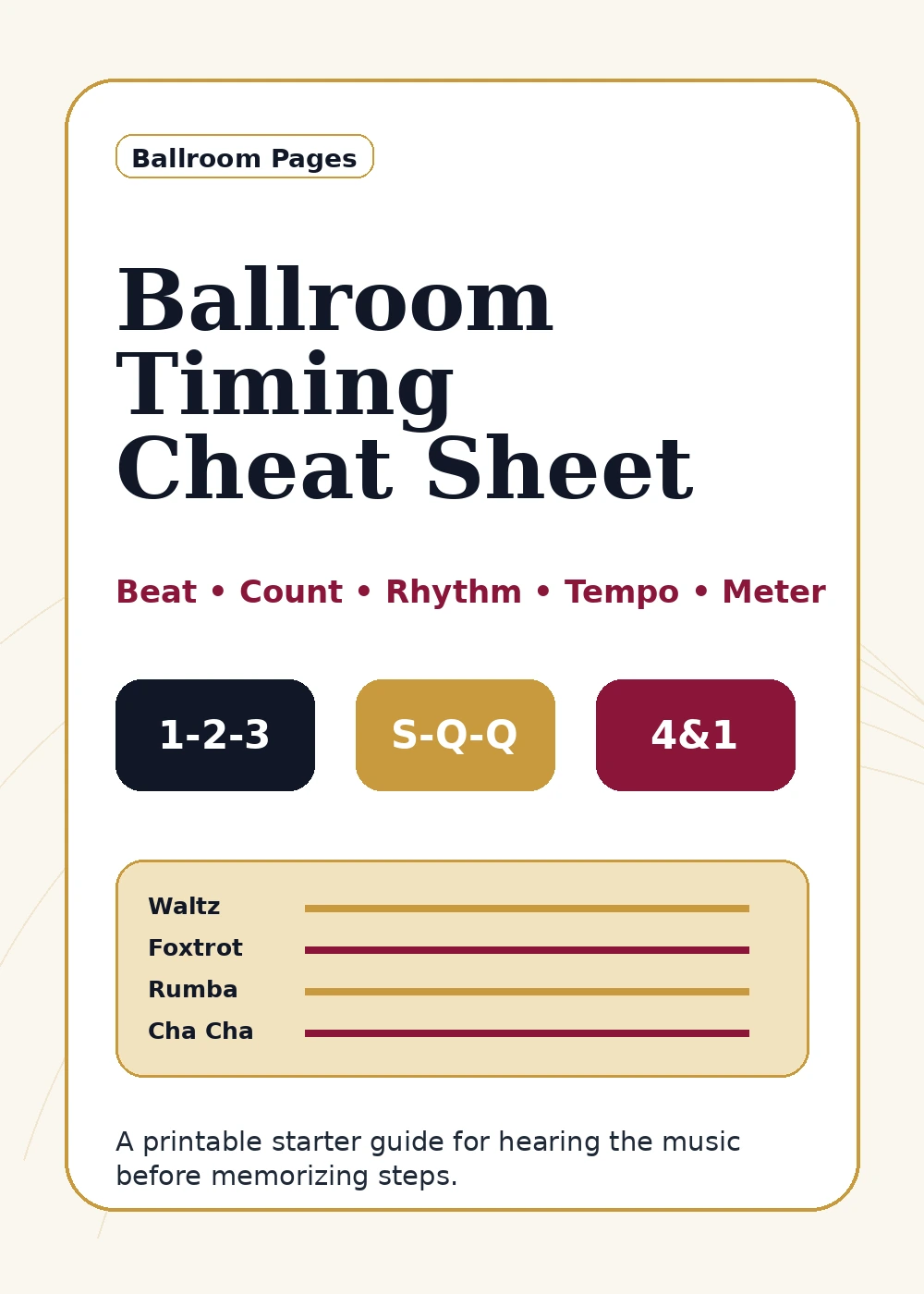
- Ballroom Timing Cheat Sheet: A printable starter guide for beat, count, rhythm, tempo, and common dance counts.
- Tempo Chart: A deeper reference for typical tempo ranges by dance. Open chart.
- Song-to-Dance Matcher: A future tool for narrowing dance options from a song. Preview.
- Practice Log: Track songs, counts, dances, and timing notes. Open practice log.
 Free timing cheat sheet