What does Viennese Waltz music sound like?
Viennese Waltz music feels fast, sweeping, and continuous. It has a clear triple-meter pulse you can count 1-2-3, with a noticeably stronger “1” that the rotation turns around. Where slow Waltz can float and stretch, Viennese Waltz keeps moving — the music seems to carry you forward without pausing.
Classic Viennese Waltz is associated with the great Strauss-era waltzes and orchestral writing, but the same feel shows up in film scores, some folk waltzes, and a few modern 3/4 songs. The shared thread is a steady, danceable pulse rather than a particular genre.
This page goes deep on the music. For movement, rotation, and safety, see the Viennese Waltz dance guide; for the broader family, see ballroom dance styles.
How to count Viennese Waltz music
Viennese Waltz is counted 1-2-3, just like slow Waltz, but faster and more continuous. The most important listening skill is hearing the strong “1” at the start of each measure. Once you can find the “1,” the rest of the rotation falls into place.
- 1Strong
- 2Beat
- 3Beat
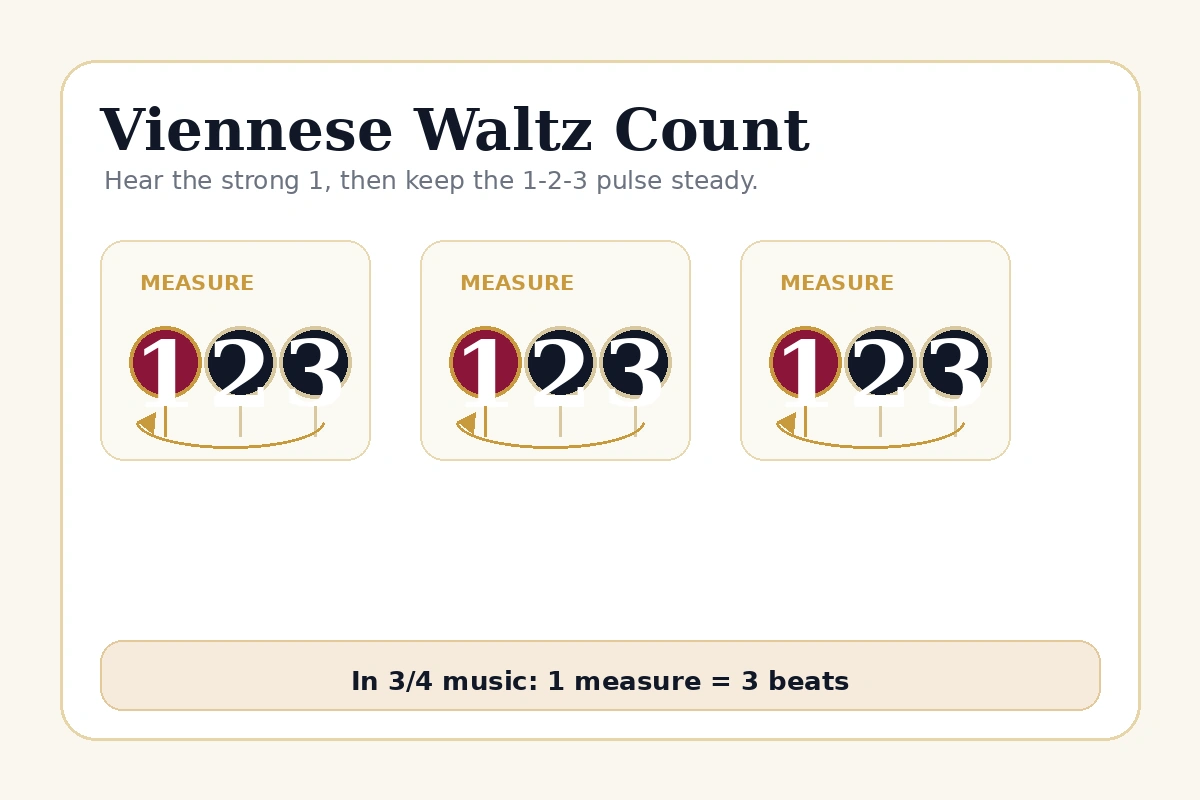
Try this: play a Viennese Waltz track and clap only on the “1.” If you can clap a steady, even “1” without rushing, the song has a usable pulse. Then add “2, 3” quietly between claps.
For counting across every ballroom style, see how to count ballroom dance music. This page stays focused on the Viennese Waltz feel specifically.
Viennese Waltz tempo: how fast should the music be?
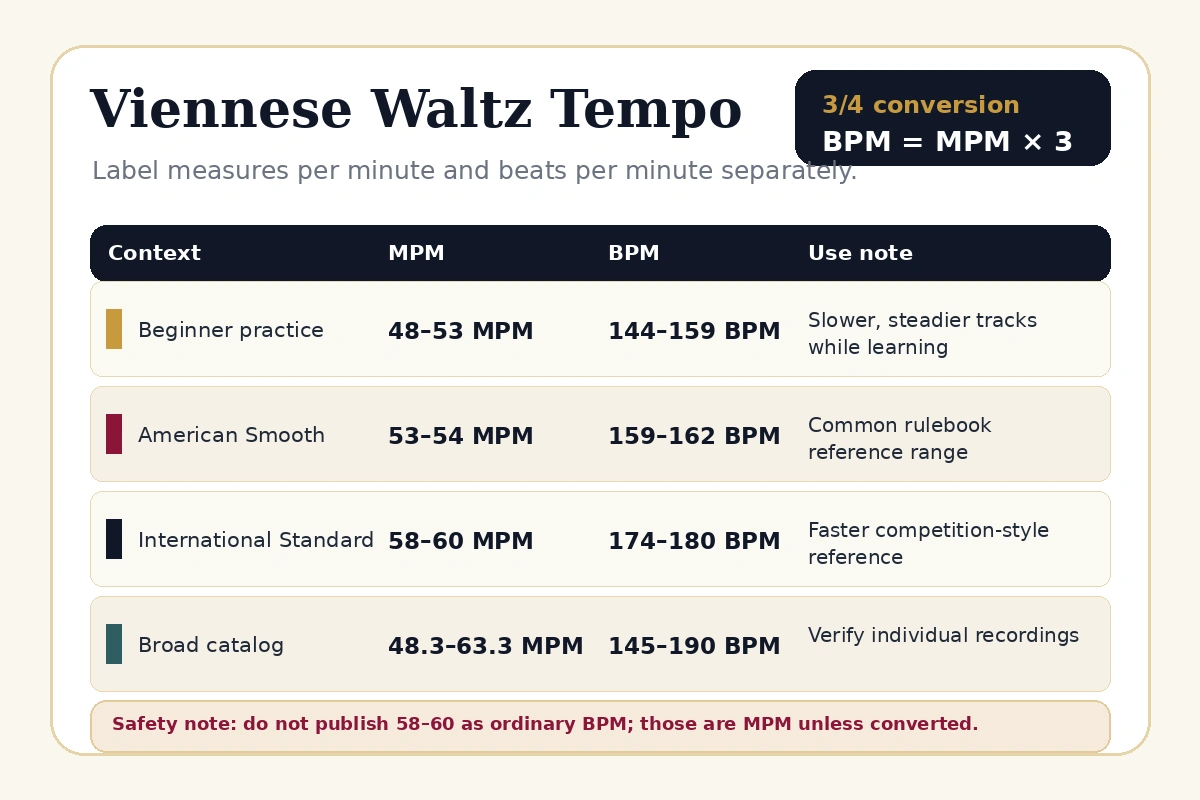
Tempo is where most confusion happens, because Viennese Waltz is in 3/4 and different sources count it differently. The key fact: in 3/4 music, one measure has three beats, so beats per minute equals measures per minute times three.
BPM = MPM × 3Examples:
53 MPM = 159 BPM · 58 MPM = 174 BPM · 60 MPM = 180 BPM
| Context | Commonly referenced tempo (measures per minute) | Beat-per-minute equivalent | Notes |
|---|---|---|---|
| Beginner listening/practice | About 48–53 MPM | About 144–159 BPM | Editorial practice range; use slower, steadier tracks while learning. |
| American Smooth Viennese Waltz | 53–54 MPM | 159–162 BPM | USA Dance gives 53–54 MPM; NDCA lists 53 MPM. |
| International Standard Viennese Waltz | 58–60 MPM | 174–180 BPM | USA Dance gives 58–60 MPM; NDCA lists 58 MPM / 174 BPM. |
| Broad catalog/listening range | About 48.3–63.3 MPM | About 145–190 BPM | Music4Dance catalog-style range; verify individual songs. |
For tempos across every dance, see the ballroom dance tempo chart. This section focuses only on Viennese Waltz.
How to tell if a song works for Viennese Waltz
A good Viennese Waltz song is one you can count, enter cleanly, and keep steady. Use this quick checklist before you commit a track to practice or a performance.
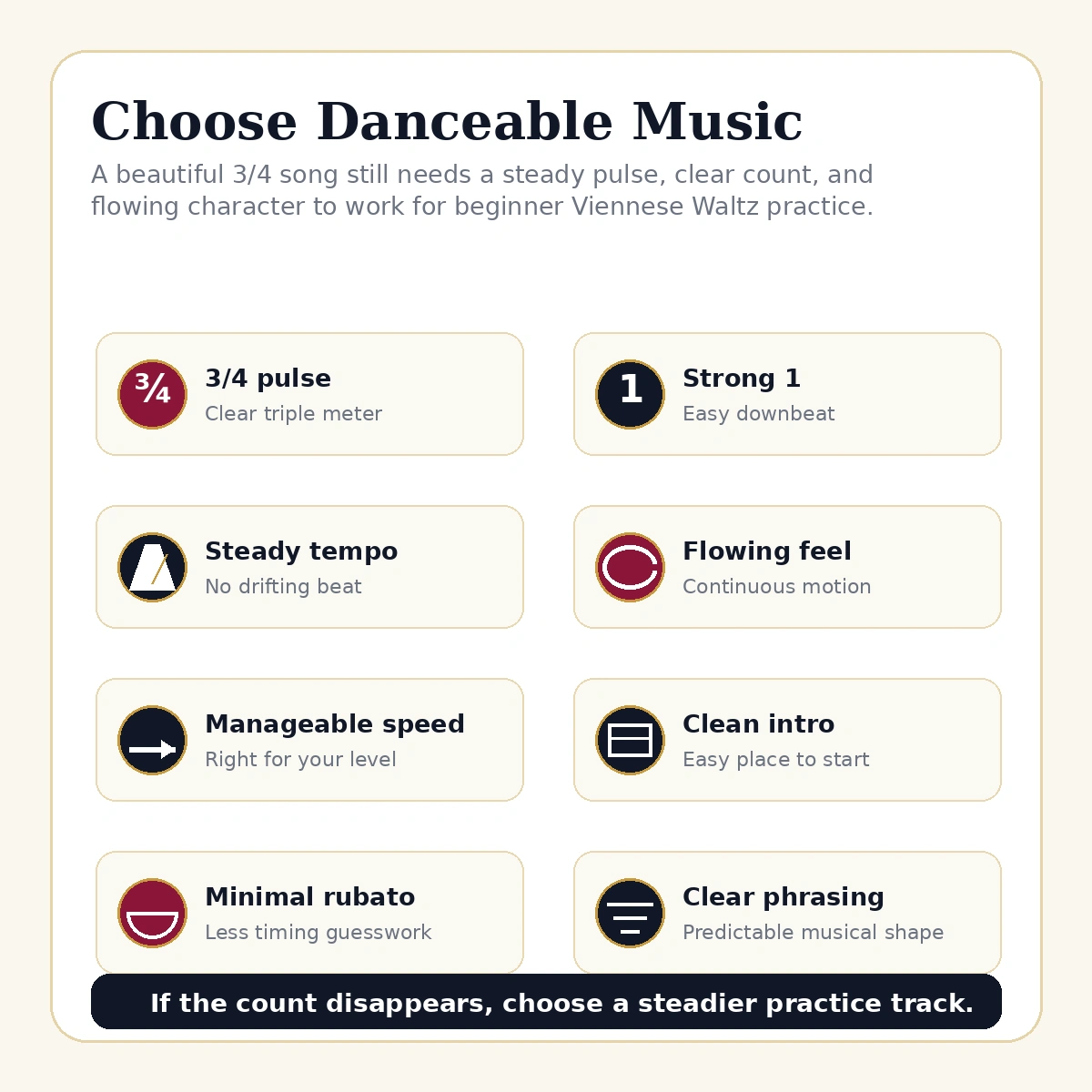
- It is genuinely in 3/4 (you can count 1-2-3, not 1-2-3-4).
- The “1” is clear and easy to hear.
- The tempo is steady and does not drift faster or slower.
- The speed matches your level — not so fast that rotation collapses.
- The intro gives you a clear place to start.
- The character flows and sweeps rather than stopping and starting.
- There is not so much rubato that the pulse disappears.
- It fits your goal: listening, lesson, social practice, wedding, or showcase.
Build your Viennese Waltz timing faster
Download the Viennese Waltz Timing & Practice Playlist Cheat Sheet for a simple count guide, tempo reminder, song-fit checklist, and practice-plan prompts.
Download the cheat sheetBest Viennese Waltz songs and examples
Use this as a curated, verification-aware starting point, not a definitive ranking. Different recordings of the same piece can have very different tempos, arrangements, and danceability, so always confirm the exact version before relying on it.
| Song | Artist/composer | Why it can work | Beginner difficulty | Best use | Verification note |
|---|---|---|---|---|---|
| The Blue Danube | Johann Strauss II | Classic Viennese Waltz reference with sweeping 3/4 character | Medium | Listening, classical reference, showcase | Verify exact arrangement and tempo. |
| The Skater’s Waltz | Émile Waldteufel | Classic waltz feel and recognizable phrasing | Medium | Listening, lesson context | Verify exact arrangement and tempo. |
| Waltz No. 2 | Dmitri Shostakovich | Dramatic orchestral waltz feel | Medium to hard | Showcase or listening | Verify arrangement; may not suit beginners. |
| Waltz of the Flowers | Pyotr Ilyich Tchaikovsky | Flowing orchestral waltz character | Harder | Performance inspiration | Verify section and tempo. |
| Potter Waltz | Patrick Doyle | Film-score waltz energy; common in dance-music references | Medium | Showcase, themed practice | Verify recording and BPM before publishing. |
| You Are the Reason | Calum Scott | Pop-style 3/4 option listed in dance-music references | Medium | Wedding/showcase exploration | Verify exact version and danceability. |
| Midnight Waltz | David Garrett / Royal Philharmonic / Franck van der Heijden | Strong contemporary orchestral energy | Medium to hard | Showcase or advanced practice | Verify tempo and arrangement. |
| My Favourite Things — Viennese Waltz version | Various dance-orchestra recordings | Often arranged for ballroom timing | Easier if a ballroom arrangement is used | Class/practice | Verify source, version, and platform availability. |
Tempos and danceability vary by recording and arrangement; this is a list of examples to test, not a claim that every version is danceable.
Practice Viennese Waltz with Ballroom Pages playlists
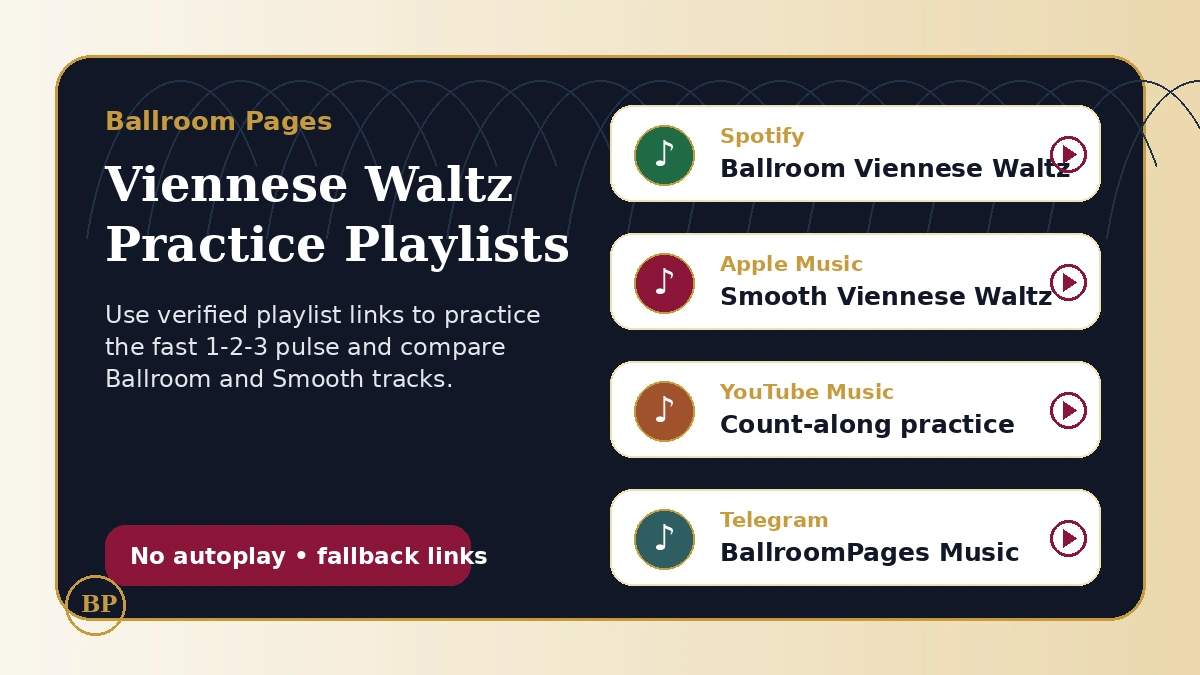
Use verified Ballroom Pages playlists to hear the fast 1-2-3 pulse, compare Ballroom and Smooth Viennese Waltz tracks, and build a simple listening-to-practice routine. Start by listening without dancing, clap the “1,” then add a small basic rotation.
Spotify
Apple Music
Viennese Waltz
Viennese Waltz 2
Smooth Viennese Waltz
Smooth Viennese Waltz 2
YouTube / YouTube Music
Ballroom Viennese Waltz (YouTube)
Find the Ballroom Pages Viennese Waltz selection in the full playlist hub.
Smooth Viennese Waltz (YouTube)
Find the Ballroom Pages Viennese Waltz selection in the full playlist hub.
More resources
BallroomPages Music on Telegram
All Ballroom Pages playlists
Viennese Waltz music by use case
The right Viennese Waltz track depends on what you are doing with it.
| Use case | What to choose | What to avoid |
|---|---|---|
| Beginner listening | Steady, clearly phrased tracks at a slower tempo with an obvious “1” | Very fast or rubato-heavy recordings |
| Lesson practice | A track your teacher approves with a predictable tempo | Songs that speed up, slow down, or change feel |
| Social dancing | Recognizable, danceable waltzes with a continuous flow | Tracks that stall the rotation |
| Wedding first dance | A meaningful 3/4 song with a steady, danceable pulse | Beautiful ballads with no clear beat or in 4/4 |
| Showcase/competition practice | Music matched to the relevant style tempo and character | Random playlist picks without tempo checking |
Planning a wedding? Use match a song to a dance style, browse first dance songs by dance style, and start with the wedding dance guide.
Viennese Waltz vs slow Waltz music
Slow Waltz and Viennese Waltz are both usually in 3/4, which is why beginners mix them up. The difference is speed and character.
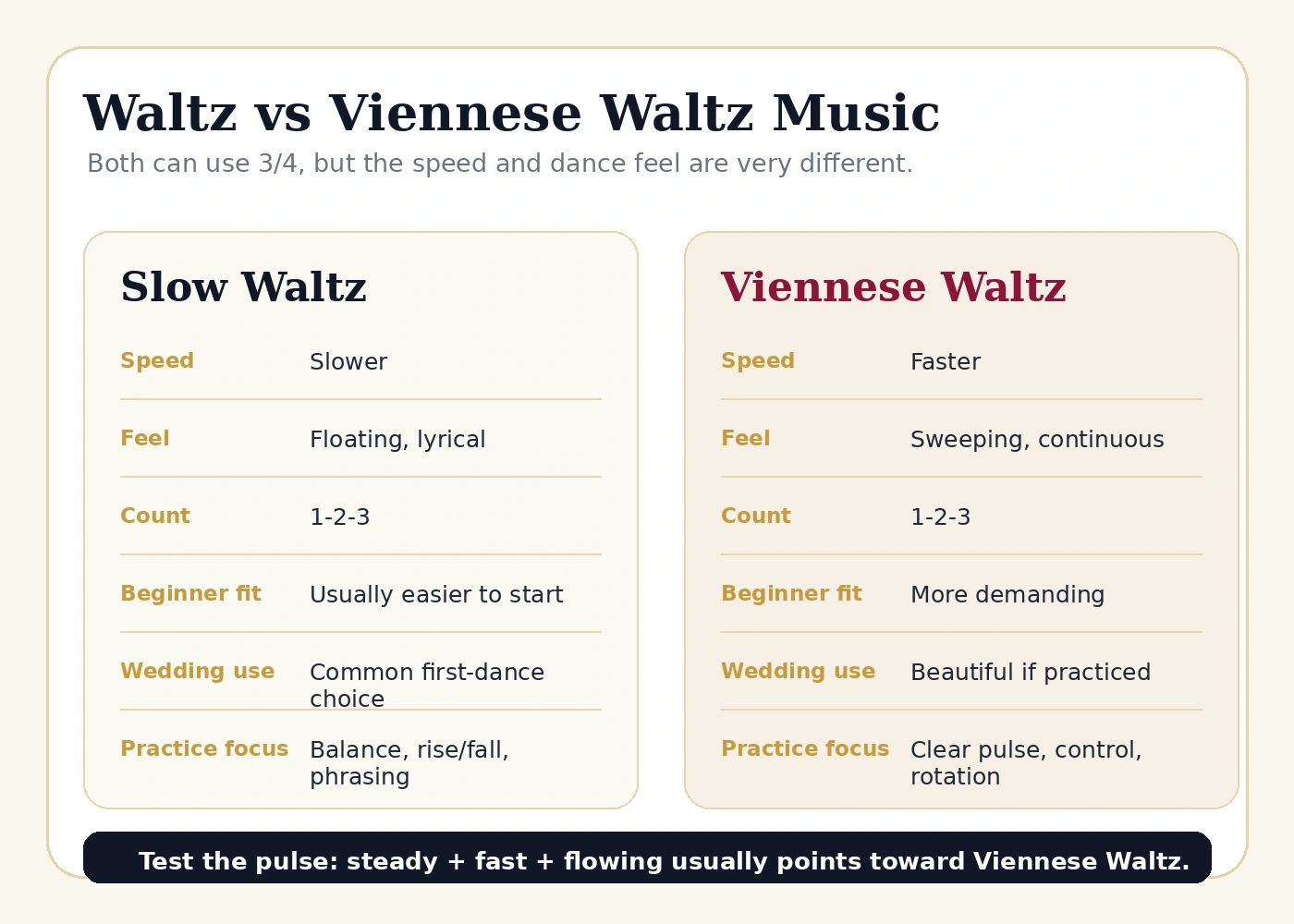
| Topic | Slow Waltz music | Viennese Waltz music |
|---|---|---|
| Meter | Usually 3/4 | Usually 3/4 |
| Tempo feel | Slower; commonly around 28–30 MPM in references | Faster; commonly around 53–60 MPM in references |
| Character | Floating, with rise and fall you can stretch | Sweeping and continuous, built for rotation |
| Beginner cue | Does it let you rise, fall, and breathe? | Does it keep moving and pull you around the turn? |
| Page role | Covered by the Waltz dance guide and a planned Waltz music guide | Covered here |
For the dances themselves, see the Waltz dance guide and the Viennese Waltz dance guide. A dedicated Waltz music guide is planned; until it is published, use how to count ballroom dance music and the ballroom dance tempo chart for slow Waltz tempo. The smooth, gliding Foxtrot dance guide is another useful comparison.
Common Viennese Waltz music mistakes
Confusing MPM with BPM
58–60 are measures per minute, not ordinary beats per minute. Multiply by three for BPM.
Choosing music that is too fast
If rotation collapses, drop to a slower, steadier track while learning.
Picking a 4/4 song by mistake
Count it: Viennese Waltz needs a true 1-2-3, not 1-2-3-4.
Using a rubato-heavy recording
Free-time arrangements hide the pulse. Pick a steady recording for practice.
Ignoring the intro
Find the “1” and a clear entry point before you start moving.
Practicing only one song
Rotate tracks so you are hearing the rhythm, not memorizing a recording.
Beginner practice drills
Clap the “1”
Play a track and clap only on count 1. If you can hold a steady “1,” the song has a usable pulse.
Whisper 1-2-3
Clap the “1” and quietly say “2, 3” between claps to feel the full measure.
Count the intro
Listen for where the phrase starts so you enter on a clear “1” instead of guessing.
Walk a small rotation
Without a partner, mark a gentle turn to the pulse. Keep it small and on time.
Compare slow vs Viennese
Play a slow Waltz and a Viennese Waltz back to back. Feel how the Viennese keeps moving.
Rotate your tracks
Try the same simple timing across several playlist songs so timing becomes flexible.
Connect timing to movement with frame and posture and lead and follow, and stay safe on a busy floor with floorcraft for traveling dances. New to ballroom? Start with ballroom dance for beginners.