What makes Tango music sound like Tango
Ballroom Tango music has a personality you can hear before you ever learn a step. It feels dramatic, confident, and a little mysterious. The beat is strong and steady, the accents are sharp rather than smooth, and the phrasing often arrives in clear blocks that build tension and then release it. Where Waltz flows and Foxtrot glides, ballroom Tango snaps and pauses.
For dancing, the most useful quality is a clear, tappable pulse. Tango dance music tends to keep the beat obvious so dancers can place sharp, deliberate steps and crisp stops. That is why it pairs naturally with slow and quick rhythms and with the staccato character of the dance.
This page focuses on the music. For the dance itself—steps, frame, posture, character, and beginner instruction—use the full Tango dance guide.
Ballroom Tango vs Argentine Tango music
Searchers often mix these up because both are called “Tango,” but they come from different traditions and use music differently.
| Topic | Ballroom Tango (American & International) | Argentine Tango |
|---|---|---|
| Music feel | Sharp, march-like accents; strong, steady pulse | Often more rubato, expressive, and varied in phrasing |
| Typical setting | Syllabus, social ballroom, competition (Smooth/Standard) | Social milongas and its own performance tradition |
| Frame | Generally a closed ballroom frame for syllabus/competition | A different embrace and movement vocabulary |
| Beginner count | Commonly slow-slow-quick-quick-slow | Often felt through walking and the music’s phrasing rather than a fixed syllabus count |
| Playlist note | Use ballroom Tango playlists for this page’s drills | Do not assume the same playlist works for both styles |
This page is about ballroom Tango music. For the Argentine tradition, see the Argentine Tango guide. For the ballroom dance itself, see the Tango dance guide.
Tango time signature, tempo, and BPM
Ballroom Tango music is usually written in 2/4 and is sometimes counted in 4/4. Tempo can be described in two ways. BPM means beats per minute—the pulse you tap. MPM means measures per minute—how many full measures pass in a minute. These are not the same number, and the conversion depends on how many beats are in each measure.
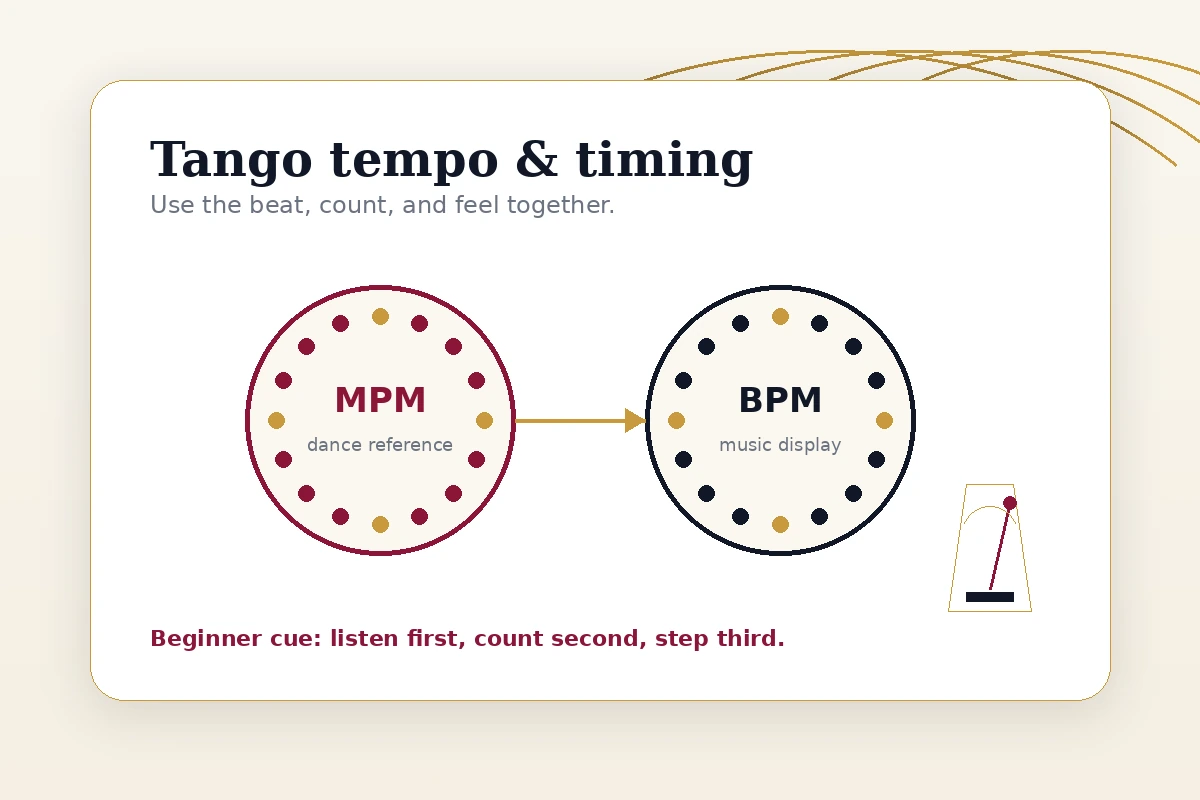
Because Tango is usually in 2/4, the BPM numbers you see online do not all convert cleanly from the same MPM reference, and different sources count the pulse differently. That is why this guide treats competition MPM references as a guide and treats BPM ranges as general, not universal. The reliable habit is to tap the beat and confirm tempo with your teacher or your event’s rules.
| Context | Guidance | Note |
|---|---|---|
| Beginner/social practice | Start with a steady song with an obvious, tappable beat. Use your teacher’s practice track first when available. | Practical advice; not an official range. |
| American Tango (Smooth) | Competition rulebooks describe Tango in measures per minute (MPM) for 2/4 music; confirm the current figure in the rulebook. | Use the rulebook value; do not assume a fixed BPM. |
| International Tango (Standard) | Likewise described in MPM for 2/4 music; verify against the current rulebook for your competition. | Organizations and editions can differ. |
| Broader online BPM references | General references often cite Tango music in the rough range of roughly 120–132 BPM, but reported numbers vary by how the pulse is counted. | General guidance, not a universal standard. |
| Wedding Tango | Choose a steady, clearly accented beat and an intro you can count; match the drama to the couple. | Song fit depends on arrangement and choreography. |
Compare tempos across every dance on the ballroom dance tempo chart, and learn the underlying skill in how to count ballroom dance music.
How to count Tango music
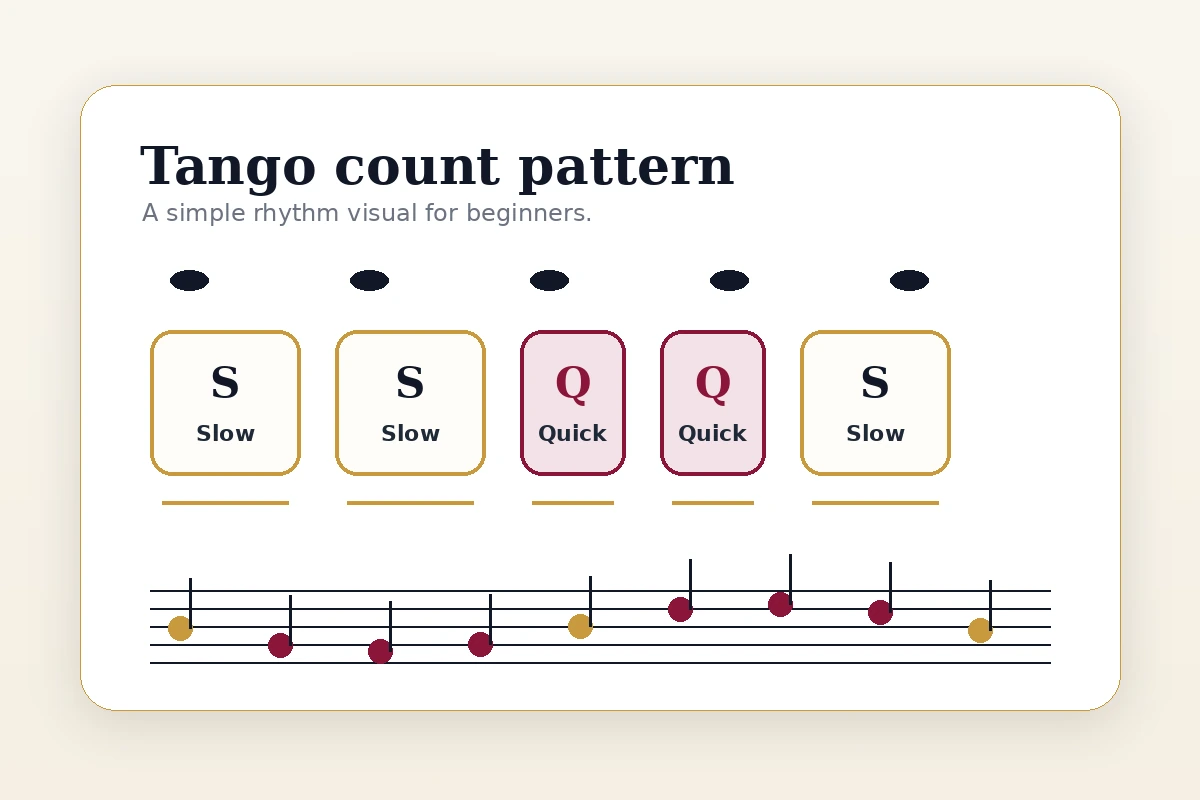
Tango counting is easiest when you separate the beat from the step words. A beat is the pulse you tap. A count is how dancers organize that pulse. In many beginner ballroom Tango patterns a slow takes one strong beat and a quick takes half a beat, which is why teachers often say “slow, slow, quick, quick, slow” instead of only counting numbers.
- SSlow
- SSlow
- QQuick
- QQuick
- SSlow
| Pattern | Feel | How to practice |
|---|---|---|
| Tap the beat | The steady pulse | Before any steps, tap the strong beat and keep it even. |
| Slow-slow-quick-quick-slow | A common beginner ballroom Tango rhythm | Say the words out loud over the beat before adding movement. |
| Quick-quick (the QQ) | Two faster steps inside the pattern | Clap the two quicks so they fit evenly, not rushed. |
| Hear the phrase | Music arriving in clear blocks | Notice where a musical phrase starts so you can begin cleanly. |
For the full topic across every dance, read how to count ballroom dance music. For steps that use this count, see the Tango dance guide.
Count Tango without guessing
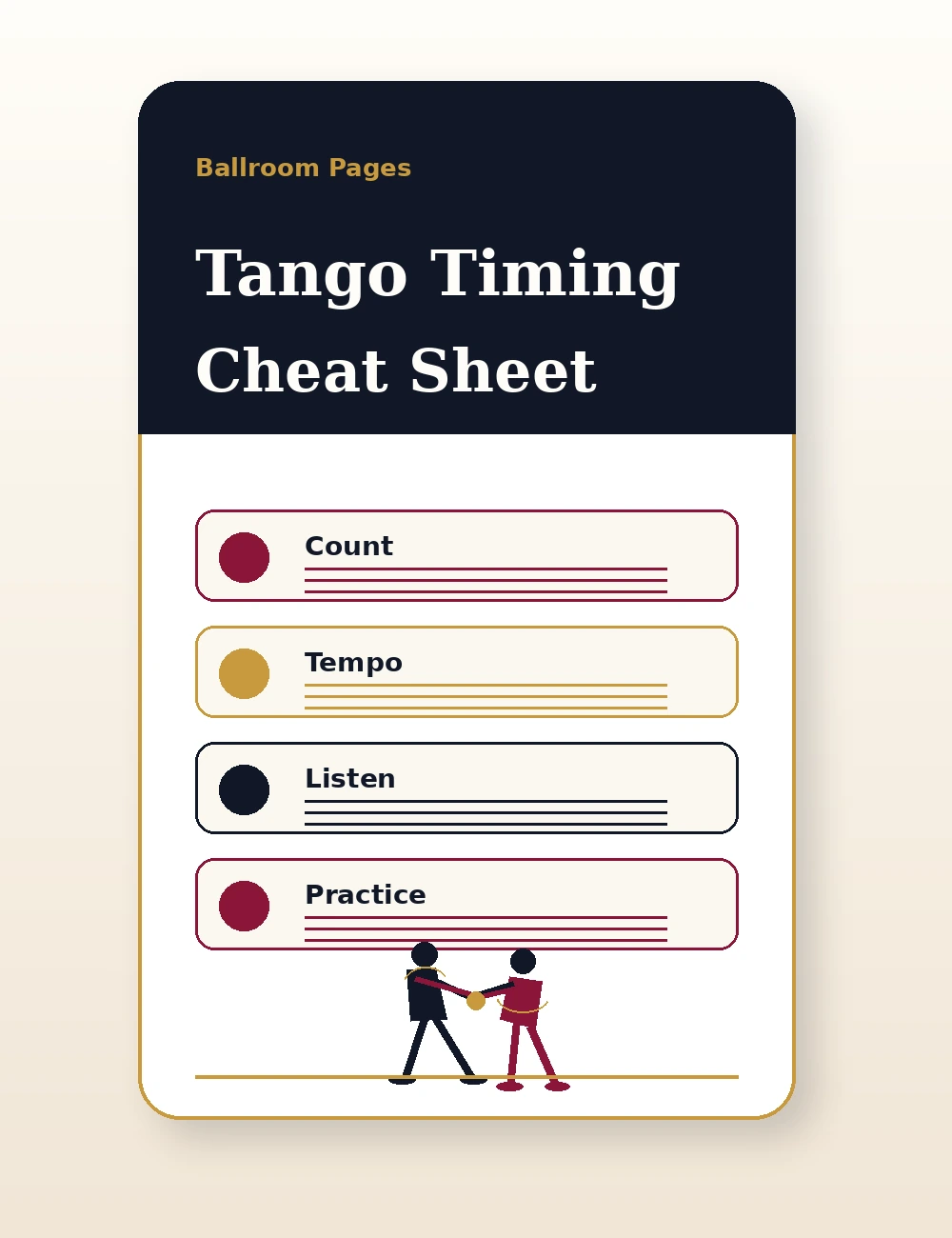
Get a one-page Tango Timing Cheat Sheet with beginner counts, tempo notes, and listening drills.
Download the cheat sheetHow to hear the beat, accents, and phrasing
Once you can tap a steady beat, the next skill is hearing how Tango music is organized. Three things help most: the underlying pulse, the accents (the beats that feel stronger or sharper), and the phrasing (how the music groups into blocks that begin and end).
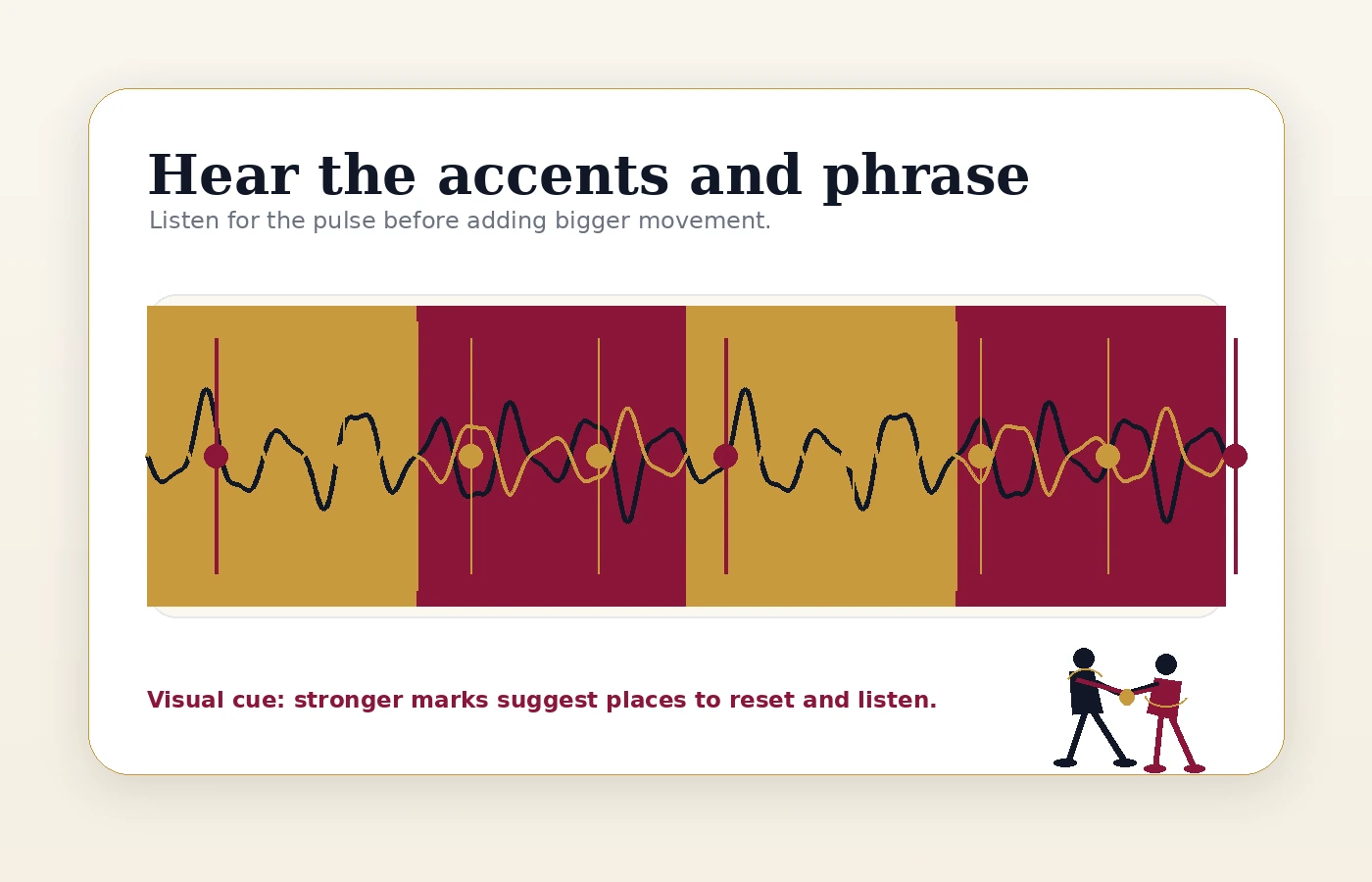
- Find the pulse: tap along until the beat feels automatic.
- Feel the accent: notice which beats sound stronger or sharper—Tango accents are crisp, not smooth.
- Hear the phrase: listen for the music arriving in clear blocks so you know where to start and stop.
- Notice pauses: Tango music often leaves space; those gaps are part of the character, not mistakes.
American Tango vs International Tango music notes
You will see both “American Tango” and “International Tango” because Tango appears in more than one ballroom style family. Both use dramatic, accented Tango music, but they sit in different systems.
| Topic | American Tango (Smooth) | International Tango (Standard) |
|---|---|---|
| Style family | American Smooth | International Standard |
| Music feel | Dramatic, accented; can feel slightly more flexible in social settings | Sharp, driving, and competition-oriented in many contexts |
| Hold/context | American Smooth may allow more open work at higher levels | Standard dances are generally danced in closed position |
| Music overlap | Both can use overlapping Tango recordings, so always check the actual track and your teacher’s guidance. | |
| Page role | This article explains music and timing differences; it does not replace the dance guides or create a separate style page. | |
For the style families, see American Smooth vs International Standard and the broader American vs International ballroom overview.
Choosing Tango songs for practice, socials, competitions, and weddings
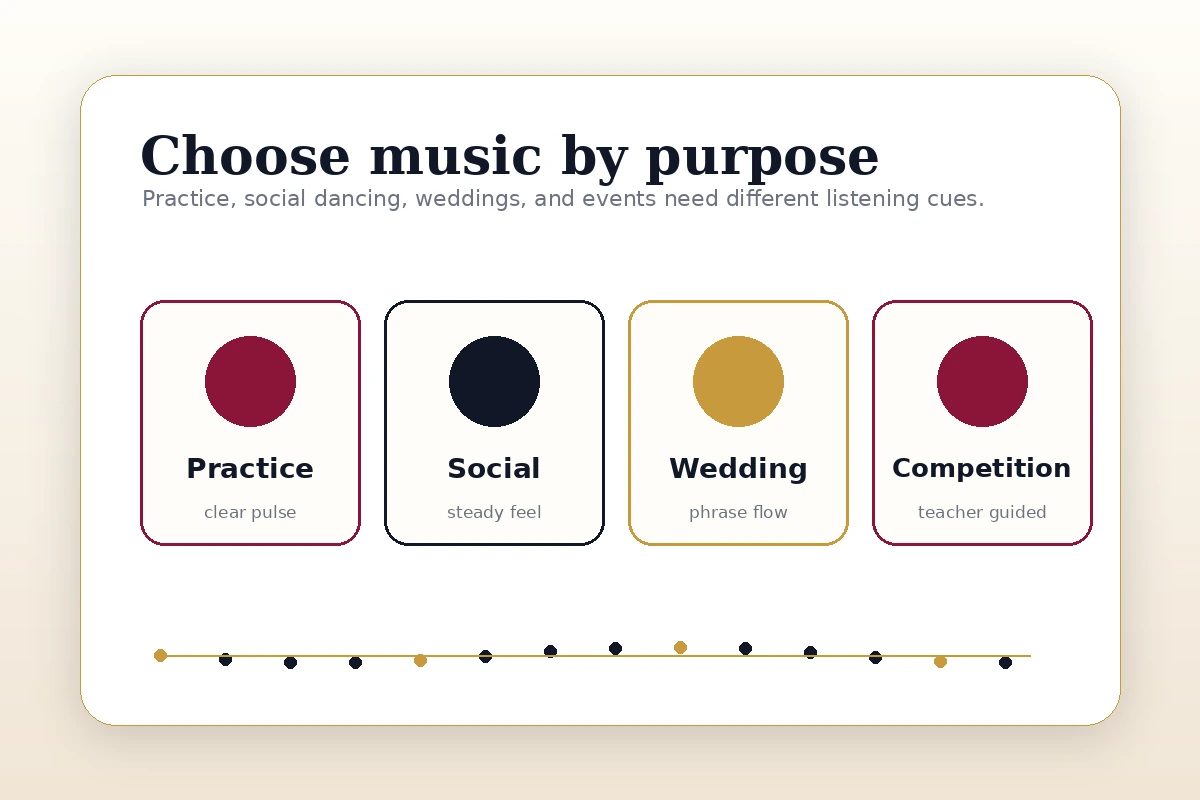
A good Tango song is not just a song with “tango” in a playlist title. Test the actual recording before you rely on it.
- The beat is strong and steady, and you can tap it without guessing.
- The accents are clear, so slow and quick steps feel natural.
- The tempo is comfortable for your level—not rushed, not stalled.
- The intro gives dancers enough time to start cleanly.
- The phrasing is clear enough to know where to begin and end.
- The song fits your goal: lesson practice, social dancing, wedding first dance, showcase, or competition practice.
- Your teacher or choreographer can confirm it works for your intended pattern.
| Goal | Choose | Avoid |
|---|---|---|
| Beginner practice | Clear beat, obvious accents, moderate tempo | Free-time intros or songs with a vague pulse |
| Social dancing | Recognizable, steady, dramatic feel | Songs that drift in and out of tempo |
| Competition practice | Teacher-approved or syllabus/competition-appropriate track | Random playlist picks without tempo checking |
| Wedding first dance | Meaningful song with a steady, danceable Tango pulse | Beautiful songs with no clear, steady beat |
| Showcase | Strong character and a clear performance arc | Songs that only work after heavy editing |
Different recordings of the same song can have different tempos, intros, and arrangements. Always count and test before relying on a track. Planning a wedding? Try what dance fits your song and first dance songs by dance style.
Not sure if your song is a Tango?
Match your song to the right ballroom dance before you choose choreography.
Find what dance fits your songBeginner practice drills for Tango timing
Tap the pulse
Play a ballroom Tango song. Tap the steady beat until it feels automatic before adding any words.
Say slow/quick
Over the beat, say slow-slow-quick-quick-slow out loud. Keep the two quicks even, not rushed.
Count the intro
Start the music and count how many beats or measures pass before the main groove begins.
Find the accents
Listen for the sharp, stronger beats. Clap only on the accents to train your ear.
Walk the rhythm
Without a partner, walk small, deliberate steps to the slow/quick rhythm. Aim for timing, not styling.
Build the underlying skill with how to count ballroom dance music, and connect timing to partnership with lead and follow and frame and posture.
Ballroom Pages Tango playlists
Use these playlists to practice hearing the Tango pulse before you add larger movement. Start with one clear track, clap or count the beat, say the rhythm, then try a small pattern. Playlist links are practice support; they do not replace teacher feedback.
- Listen first: tap the beat before moving.
- Count second: say slow-slow-quick-quick-slow over the beat.
- Move third: walk or mark the rhythm before adding full patterns.
- Review last: ask whether the intro, tempo, or quicks caused problems.
Spotify
Ballroom / Standard Tango
Ballroom / Standard Tango 2
American Smooth Tango
American Smooth Tango 2
Apple Music
Ballroom / Standard Tango
Ballroom / Standard Tango 2
American Smooth Tango
American Smooth Tango 2
YouTube / YouTube Music
Ballroom / Standard Tango (YouTube)
Pending verified URL
American Smooth Tango (YouTube)
Pending verified URL
More resources
All Ballroom Pages playlists
BallroomPages Music on Telegram
More: Ballroom Music & Timing, the tempo chart, and how to count ballroom dance music.
Common Tango music mistakes
Choosing a dramatic song with no steady beat
Mood is not enough. Pick a song with a clearly tappable pulse.
Confusing ballroom Tango with Argentine Tango music
They are related but different. Use ballroom Tango tracks for these drills.
Assuming one universal BPM
Tempo varies by organization and setting; count the song instead of trusting a number.
Rushing the quicks
Keep the two quick steps even so the rhythm stays clean.
Ignoring the intro
Count the intro so you know exactly when to start.
Practicing only to one song
Try several Tango songs so your timing becomes flexible.
Trusting a playlist title without testing
Count and walk the rhythm before using a track in lessons or performance.
Picking a wedding song with no clear pulse
Choose meaning and danceability, not just the lyrics.
Quick Tango timing cheat sheet
| Item | Quick reference |
|---|---|
| Time signature | Usually 2/4 (sometimes counted in 4/4). |
| Common beginner count | Slow-slow-quick-quick-slow. |
| Feel | Dramatic, sharp accents, strong steady pulse, clear phrasing and pauses. |
| Tempo | Varies by organization/syllabus/setting; competition rulebooks use MPM. Confirm the current figure. |
| Test before you trust | Tap the beat → count it → say slow/quick → try a small pattern. |
| For the dance itself | See the Tango dance guide. |
This is a quick reference, not a substitute for instruction. The downloadable cheat sheet below covers the same essentials in a printable one-page format.