
What does Cha Cha music sound like?
Cha Cha music feels lively, playful, crisp, and rhythm-forward. It often has a clear pulse, strong percussion or groove, and enough rhythmic brightness to support the “cha-cha-cha” action.
Traditional Cha Cha songs may use Latin percussion and Cuban-influenced rhythmic textures. Modern social and studio Cha Cha songs can also come from pop, funk, rock, dance, country, or Latin-pop playlists. The genre label matters less than the danceable structure: a steady 4/4 beat, clear timing, and a rhythm that invites compact, syncopated movement.
How to count Cha Cha music
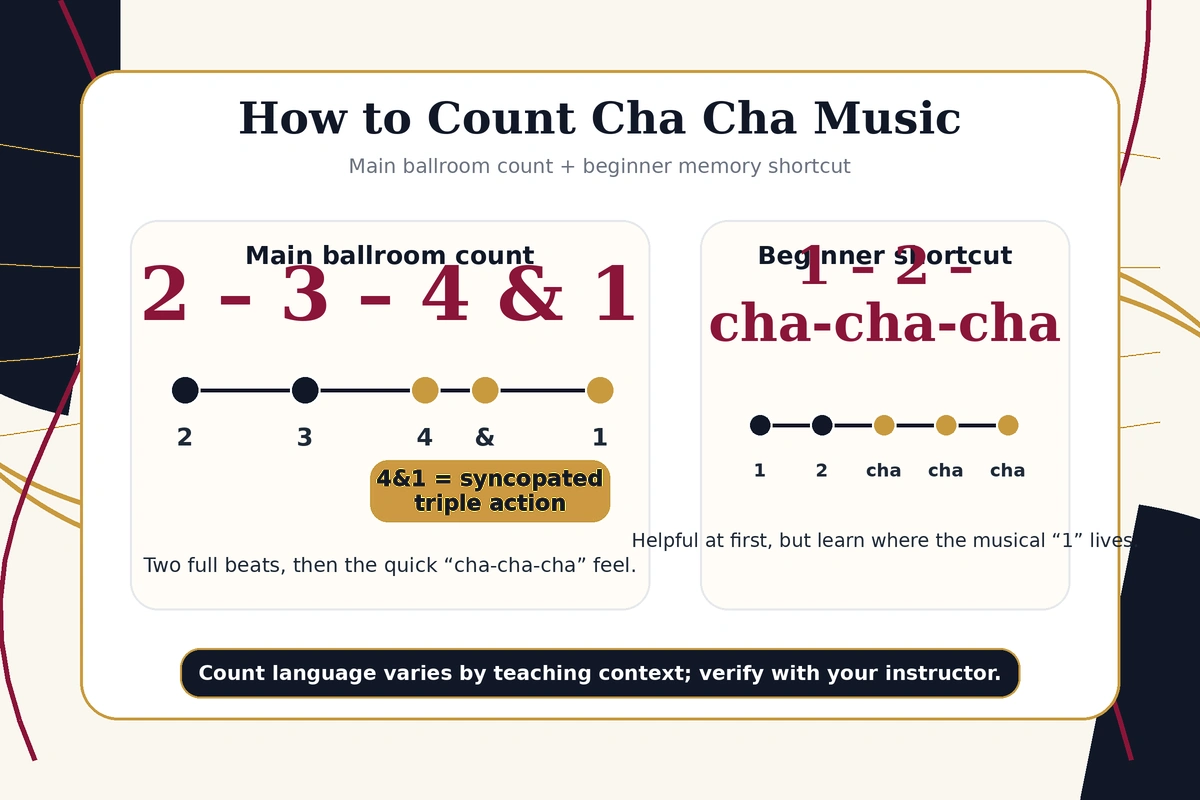
Most ballroom Cha Cha teaching uses the rhythmic idea: 2 – 3 – 4 & 1.
- 2
- 3
- 4
- &
- 1
That gives you two full-beat steps on 2 and 3, then a syncopated triple action across 4 & 1. The 1 is the first beat of the next measure, which is why experienced dancers often care about finding the real musical downbeat.
Beginners may also hear: 1 – 2 – cha-cha-cha. This can be helpful at the very beginning because it is easy to say and easy to remember. The tradeoff is that the words do not always tell you where the musical bar line is. As dancers improve, they should learn to hear the 4&1 relationship so they do not lose the phrase.
| Count language | What it helps with | What to watch |
|---|---|---|
| 2-3-4&1 | More precise ballroom timing | Harder for complete beginners at first |
| 1-2-cha-cha-cha | Easy beginner memory cue | Can hide the musical downbeat |
| 4&1, 2, 3 | Highlights the chassé/triple action | May feel backward until the phrase is clear |
| 1-2-3&4 | More common in some social/nightclub contexts | Not the usual competitive ballroom phrasing |
For the broader topic across all dances, read how to count ballroom dance music.
Cha Cha tempo: how fast should the music be?
| Context | Suggested framing | Tempo guidance | Verification note |
|---|---|---|---|
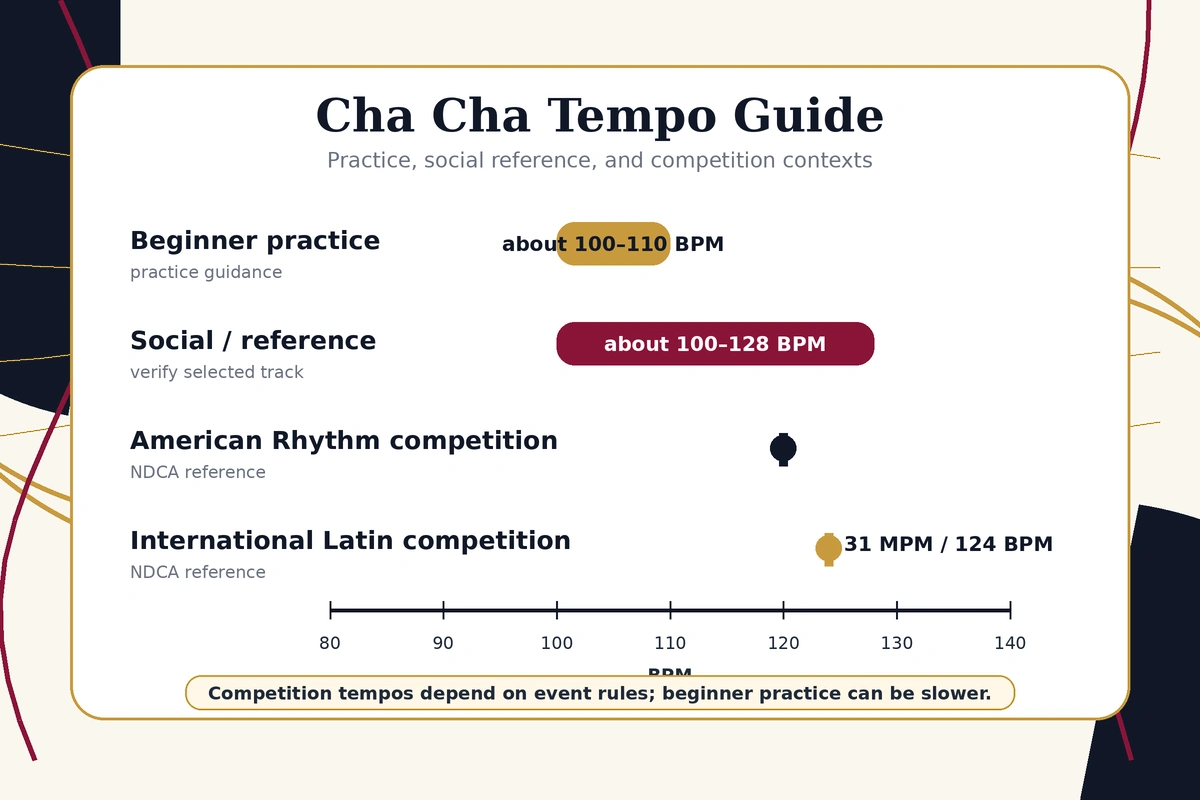
| International Latin competition | Official NDCA reference | 31 MPM / 124 BPM | NDCA 2026 approved tempi |
| American Rhythm competition | Official NDCA reference | 30 MPM / 120 BPM | NDCA 2026 approved tempi |
| General social/reference range | Broader reference range | about 100–128 BPM | Verify selected track |
| Beginner practice | Slower learning range | about 100–110 BPM | Practice guidance, not competition standard |
| Common studio/social songs | Moderate dance range | about 110–130 BPM | Useful for song screening |
For competition, use the tempo required by the event or syllabus context. For beginner practice, choose music slow enough that you can hear the beat, transfer weight clearly, and say the count without rushing. Compare across dances on the ballroom dance tempo chart.
How to tell if a song works for Cha Cha
| Question | Good sign | Harder for beginners |
|---|---|---|
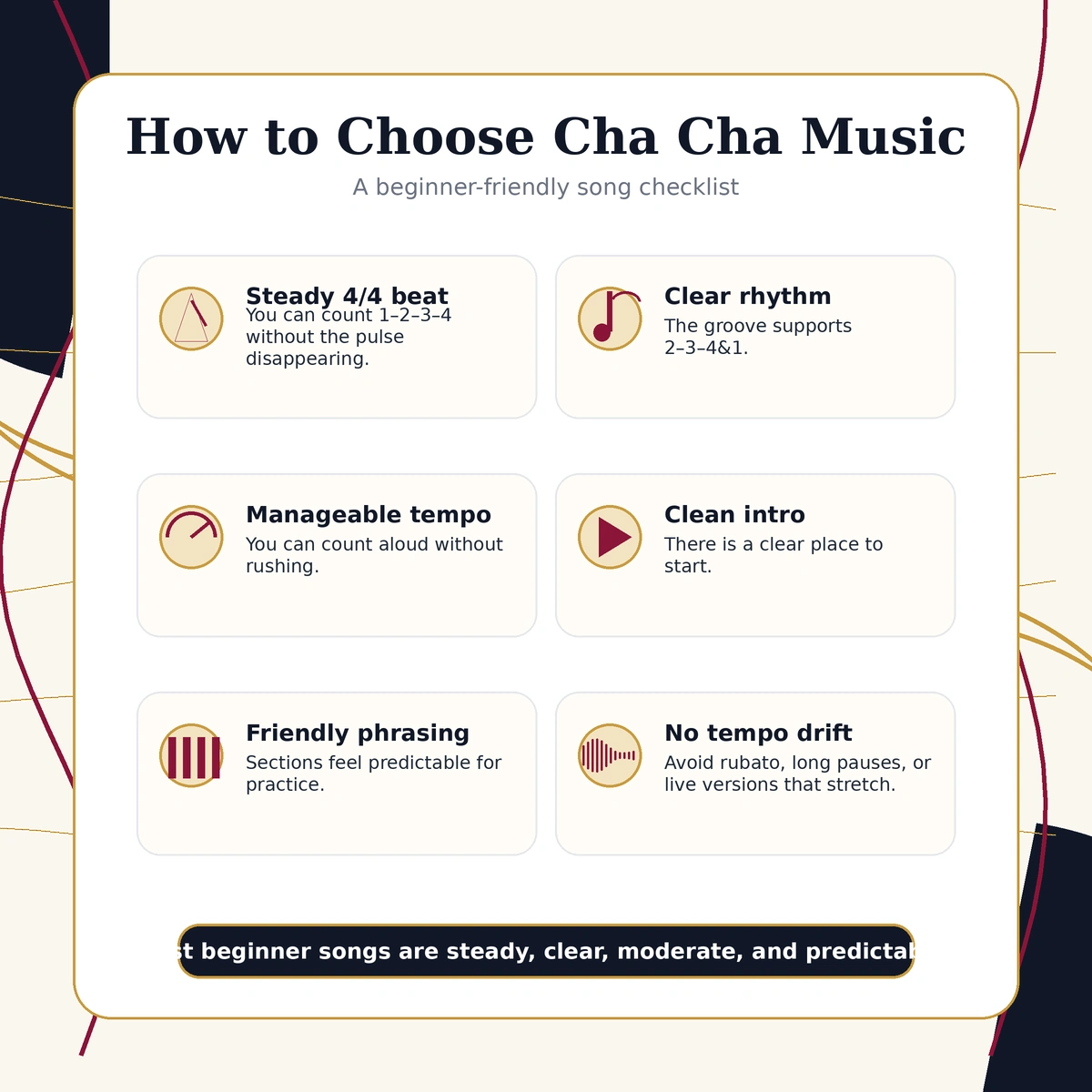
| Is the pulse steady? | You can clap evenly through verse and chorus | Tempo drifts, pauses, or stretches |
| Is it in 4/4? | You can count 1-2-3-4 repeatedly | Meter feels uneven or unclear |
| Can you hear the rhythm? | Groove supports 2-3-4&1 | Vocals hide the beat |
| Is the speed manageable? | You can count aloud without rushing | You skip weight changes |
| Is the intro usable? | Clear intro gives time to start | Rubato/no-beat intro |
| Does it phrase cleanly? | Sections feel predictable | Odd breaks interrupt practice |
Best Cha Cha songs and examples
Use this as a starting list of examples, not a definitive “best ever” ranking. Song availability and tempo can vary by platform, country, remix, and recording version, so always verify the exact version before relying on it.
| Song | Artist | Why it works | Beginner difficulty | Best use | Verification note |
|---|---|---|---|---|---|
| A Night Like This | Caro Emerald | Clear stylish groove; listed as Cha-Cha-Cha at 123 BPM by Ballroom-music.net | Medium | Social/showcase | Verify exact version |
| September | Earth, Wind & Fire | Strong familiar pulse; listed at 126 BPM | Medium-fast | Social/party | Verify exact version |
| Sway | Michael Bublé | Smooth recognizable danceable feel; listed at 126 BPM | Medium | Social/wedding reception | Verify exact version |
| Corazon Espinado | Santana, Maná | Latin-rock feel; listed at 120 BPM | Medium | Practice/social | Verify exact version and spelling |
| Oye Como Va | Tito Puente | Classic Latin groove; listed at 124 BPM | Medium | Timing practice | Verify arrangement/version |
| I Wanna Be Your Lover | Prince | Listed at 115 BPM; moderate groove | Easier-medium | Beginner/social practice | Verify clean count |
| It’s So Nice To Have a Man Around the House | Della Reese | Listed at 100 BPM; slower tempo can help beginners | Easier | Slow practice | Verify musical fit |
| Smooth | Santana feat. Rob Thomas | Commonly cited as Cha Cha-danceable and recognizable | Medium | Social/showcase | Verify tempo and arrangement |
Practice Cha Cha with Ballroom Pages playlists
Music is one of Ballroom Pages’ strongest legacy assets, already organized by platform and dance family—Spotify, Apple Music, YouTube/YouTube Music, Telegram, plus Rhythm Cha-Cha and Latin Cha Cha collections. This guide preserves that and makes it easier for beginners to use.
Use the playlists like a practice ladder:
- Start with a slower, clearer Cha Cha.
- Count aloud without moving.
- Clap the beat.
- Mark the “cha-cha-cha” rhythm.
- Add the basic step from the Cha Cha dance guide.
- Move to a normal social or competition-speed playlist once the count feels stable.
Spotify
Rhythm Cha-Cha 1
Rhythm Cha-Cha 2
Latin Cha Cha 1
Latin Cha Cha 2
Apple Music
Rhythm Cha-Cha 1
Rhythm Cha-Cha 2
Latin Cha Cha 1
Latin Cha Cha 2
YouTube / YouTube Music
Latin Cha Cha 1
Latin Cha Cha 2
Rhythm Cha Cha (YouTube)
Pending verified URL from legacy page
Rhythm Cha Cha 2 (YouTube)
Pending verified URL from legacy page
Telegram
BallroomPages Music channel
For every dance and platform, visit the full Ballroom Pages playlists page.
Cha Cha music by use case
| Use case | What to choose | What to avoid |
|---|---|---|
| Beginner practice | Slower, steady, clear-count songs | Fast remixes or unclear beat |
| Group class | Moderate tempo, familiar structure | Long intros or dramatic pauses |
| Social dancing | Recognizable songs with good groove | Songs that only dancers understand |
| Wedding reception | Fun, familiar, upbeat songs | Songs too fast for guests or attire |
| Showcase/performance | Strong character and phrasing | Too many unpredictable breaks |
| Competition practice | Tracks close to required tempo/context | Unverified random playlist songs |
Cha Cha vs Rumba, Salsa, Bachata, and Mambo music
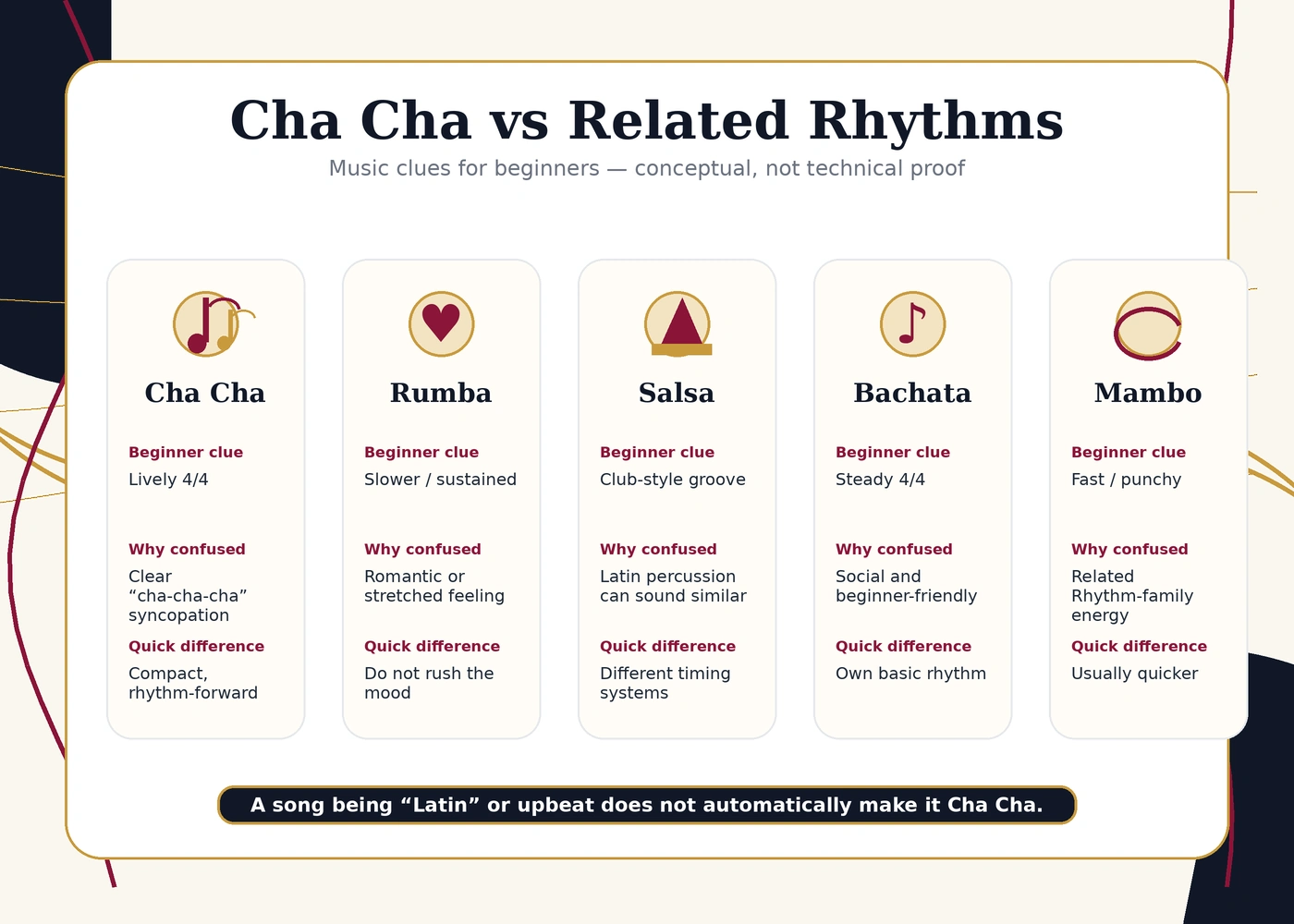
| Style | Beginner music clue | Why it gets confused with Cha Cha | Quick difference |
|---|---|---|---|
| Cha Cha | 4/4, lively, clear syncopated “cha-cha-cha” feel | Appears in both American Rhythm and International Latin | More compact and syncopated than many beginners expect |
| Rumba | Slower or more sustained depending on style | Shares Latin/Rhythm family context | Usually more romantic and stretched |
| Salsa | Often faster, social-club feel | Latin percussion and strong groove | Different timing systems and social structure |
| Bachata | Usually steady 4/4 with bachata-specific feel | Also Latin/social and beginner-friendly | Its own basic rhythm and partner style |
| Mambo | Fast, punchy, Rhythm-family energy | Related Latin/social roots | Usually much faster in ballroom competition context |
| Latin pop | Genre label, not a dance guarantee | Many Latin-pop songs are danceable | Check meter, tempo, beat clarity, and phrase structure |
Common Cha Cha music mistakes
| Mistake | Why it causes problems | Better choice |
|---|---|---|
| Choosing a song that is too fast | Beginners rush weight changes and lose the count | Start slower, then build tempo |
| Counting only the vocals | Vocals can sit ahead of or behind the beat | Clap the underlying pulse |
| Missing the 4&1 | Dance loses its Cha Cha character | Practice saying 2-3-4&1 |
| Assuming Salsa or Bachata equals Cha Cha | Related social/Latin context does not mean same timing | Check count and rhythm first |
| Using a song with tempo drift | Basic step never settles | Use a steady studio/practice track |
| Starting on the wrong phrase | Dance feels disconnected from music | Wait for a clear phrase or intro |
| Switching count systems without context | Student thinks teachers contradicted each other | Learn what each count explains |
Practice drills
- Clap the four-count. Play a steady Cha Cha and clap 1-2-3-4 evenly through a full phrase.
- Add the Cha Cha rhythm. Keep the pulse, then layer the “cha-cha-cha” on 4 & 1.
- Use the beginner shortcut carefully. Say “1-2-cha-cha-cha,” then check it against 2-3-4&1 so you keep the real downbeat.
- Step only after the count is stable. Add the basic from the dance guide once you can count without rushing.
- Build a playlist progression. Move from a slower practice track to a social/competition-speed track.