What is Argentine Tango?
Argentine Tango is a social partner dance and music tradition connected to the Río de la Plata region, especially Buenos Aires and Montevideo. In plain English, it is a dance where two partners move together through walking, embrace, weight changes, pauses, turns, and musical choices.
Unlike many beginner ballroom dances, Argentine Tango is not mainly about memorizing a fixed basic pattern and repeating it around the room. It is often improvised: the leader proposes movement, the follower responds, and both dancers adjust to the music, the space, and each other.
Ballroom Pages includes Argentine Tango as a social partner dance style because many ballroom students encounter it in studios, social dance communities, and wedding-dance conversations. It should not be merged with the ballroom Tango page. If you want the American Smooth or International Standard version, read the ballroom Tango guide.
Argentine Tango, ballroom Tango, American Tango, and International Tango
The word “Tango” can be confusing because several dances share the name.
Argentine Tango is the focus of this page. It is the social/cultural Tango tradition associated with milongas, embrace, musicality, walking, and improvisation.
Ballroom Tango is the broader ballroom-studio term many beginners use for syllabus Tango. On Ballroom Pages, the canonical ballroom Tango page is the ballroom Tango guide.
American Tango is the American Smooth ballroom version. It is often taught in social ballroom studios and appears in American Smooth syllabus and competition contexts.
International Tango is the International Standard ballroom version. It is typically danced in a more formal ballroom frame and appears in International Standard syllabus and DanceSport contexts.
Where Argentine Tango comes from
Tango is tied to the cultural history of Argentina and Uruguay. It is commonly connected to Buenos Aires, Montevideo, and the Río de la Plata region, and it is recognized by UNESCO as intangible cultural heritage.
For beginners, the important point is this: Argentine Tango is not just a set of dramatic shapes. It is a living social dance, music culture, and community practice. Stage Tango can be beautiful, but it is not the same as what most beginners should expect on a crowded social floor.
What Argentine Tango feels like
Argentine Tango often feels more like a musical conversation than a preset routine. A beginner class may begin with standing comfortably, finding balance, walking, changing weight, and learning how to listen through the embrace.
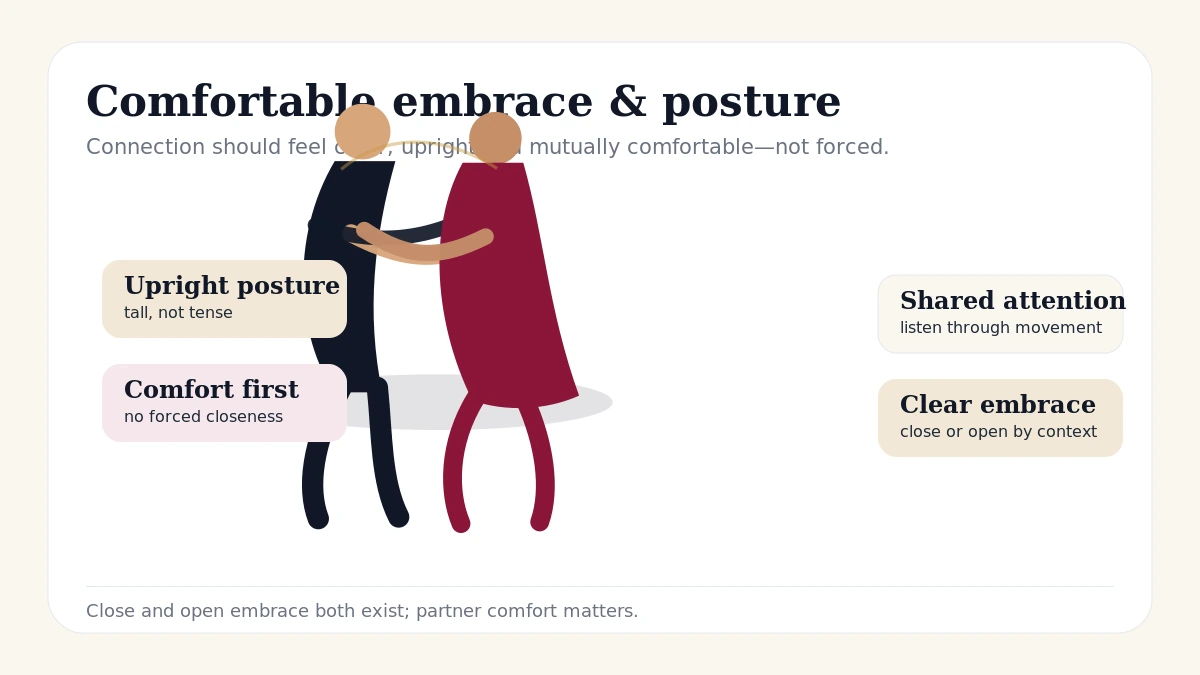
The dance can be close, but it should not feel forced. Some dancers use close embrace, some use open embrace, and many communities or teachers use both. The best beginner rule is simple: connection should be clear, comfortable, and mutually respectful.
The movement is often compact. At a milonga, dancers share the floor with many other couples, so social Tango usually avoids large show moves. A good beginner Tango may look quiet from the outside, but it can feel rich because of the timing, pause, direction, and shared musical choices.
Argentine Tango music and timing
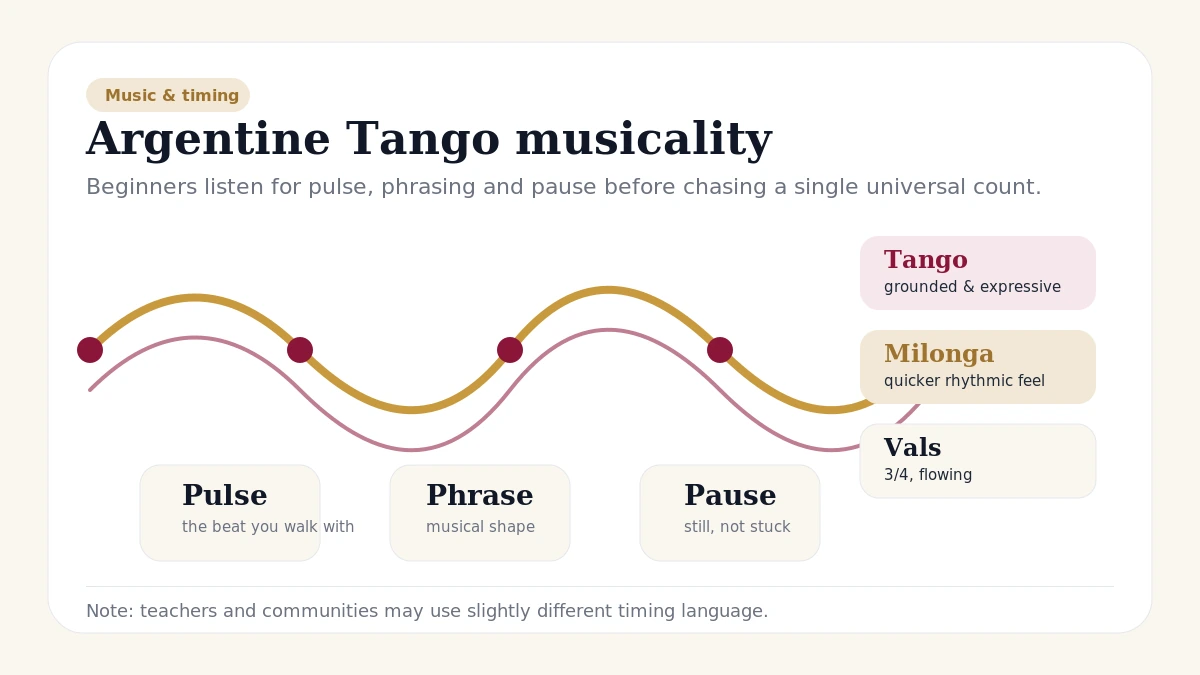
Argentine Tango timing can be tricky because different teachers and sources use different language. Some describe tango music in 2/4; others describe it in 4/4 or related notation. Vals is commonly explained in 3/4, while milonga is often described with a quicker 2/4 rhythmic feel.
For beginners, the safest approach is not to memorize one universal count. Start by hearing the pulse, walking clearly, pausing without freezing, and noticing how the music phrases.
| Form | What to listen for | Feel |
|---|---|---|
| Tango | Listen for pulse, phrasing, pauses, and changes in energy | Grounded, expressive, sometimes dramatic, often subtle |
| Milonga | Quicker rhythmic feel; keep steps compact | Playful, rhythmic, lively |
| Vals | 3/4 waltz-related flow interpreted through Tango style | Flowing, circular, lilting |
| Ballroom Tango | Often taught with standardized timing such as slow/quick patterns depending on style | Sharper, more structured, more syllabus-based |
A Ballroom Pages Argentine Tango playlist is coming soon.
For more help with timing, see how to count ballroom dance music and the ballroom dance tempo chart, or visit the Ballroom Music & Timing hub.
Basic Argentine Tango concepts for beginners
Before learning complicated figures, beginners should understand a few core ideas.
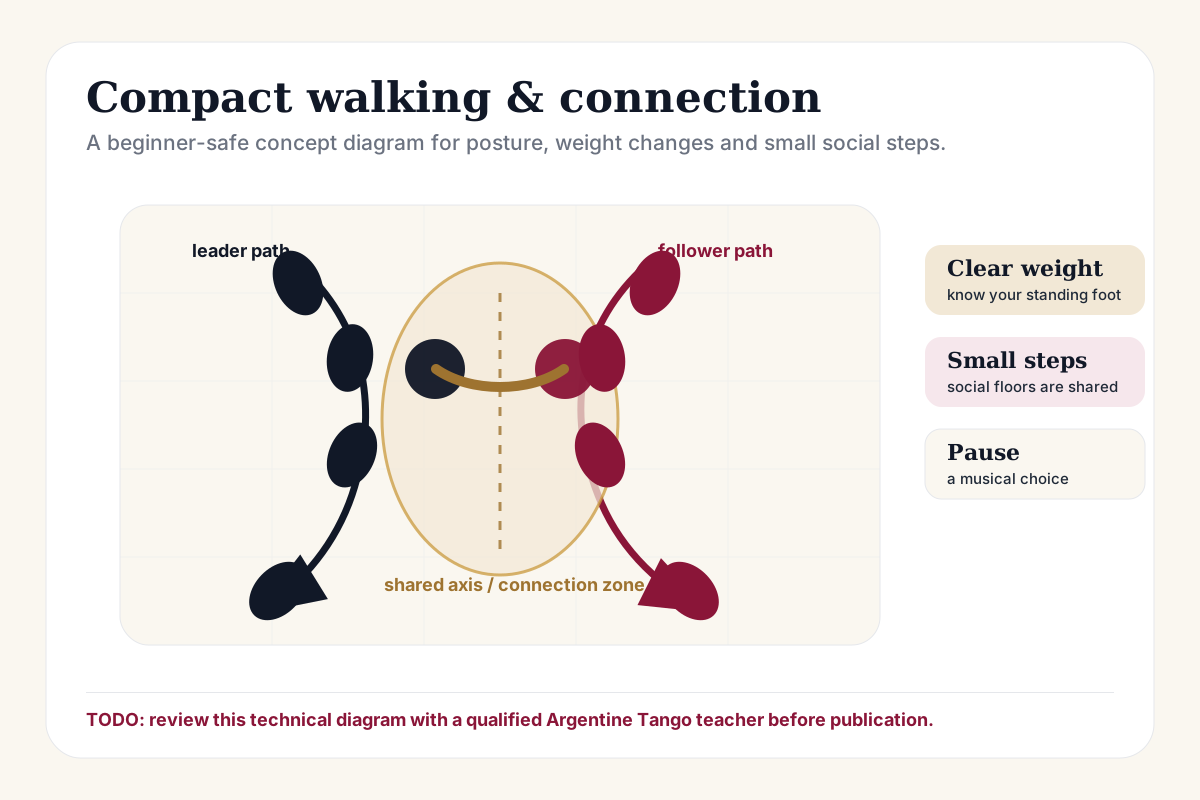
Posture: Stand comfortably tall, with your weight clear over one foot or the other. Avoid leaning heavily, collapsing through the chest, or pulling with the arms.
Embrace: The embrace is the partner connection. It may be close or open depending on teacher, community, music, comfort, and floor conditions. It should feel supportive and communicative, not restrictive.
Walking: Walking is central. Argentine Tango walking is not casual strolling; it is attentive, balanced movement with clear weight transfer. A beginner can spend a long time learning to walk well.
Weight changes: A weight change means moving your balance from one foot to the other. Clear weight changes help both partners know which foot is free and what movement is possible next.
Axis and balance: Your axis is your sense of balance over your standing foot. Beginners do not need advanced vocabulary immediately, but they do need to avoid hanging on a partner for balance.
Connection: Connection is not just the arms. It includes posture, timing, shared attention, body tone, the embrace, and how clearly each dancer listens and responds.
Musical pauses: A pause is not “doing nothing.” In Tango, a pause can be a musical choice. Beginners should practice stopping without losing balance or connection.
Ochos: Ochos are a common Argentine Tango concept involving crossing and pivoting or figure-eight-like movement. They are useful, but they should come after basic walking, weight changes, balance, and partner connection are understood.
See also frame and posture guide, lead and follow in partner dancing, and the ballroom dance glossary.
Argentine Tango social dance etiquette
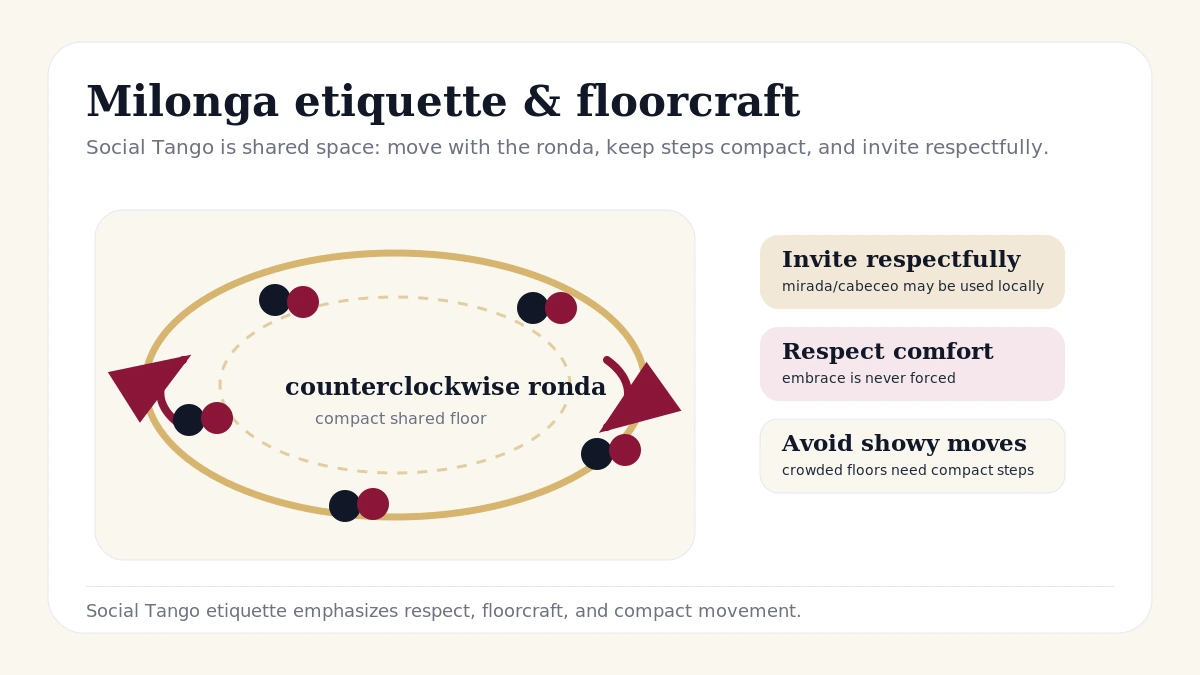
A social Tango event is often called a milonga. Etiquette varies by city and community, but beginners should learn the spirit of the códigos: respect, clarity, floor awareness, and partner comfort.
- Invite respectfully. In many Tango communities, dancers use mirada and cabeceo: eye contact and a small nod or gesture to invite a dance. Not every local scene uses them the same way.
- Respect a “no.” If someone does not respond or declines, do not pressure them.
- Respect embrace preference. No one should be forced into close embrace.
- Enter the floor carefully. Look for space and join the flow.
- Follow the ronda. Social Tango generally moves counterclockwise around the room.
- Keep steps compact. Crowded floors are not the place for big show moves.
- Avoid stage vocabulary on social floors. High boleos, ganchos, and dramatic figures can be unsafe or unwelcome in a milonga.
- Thank your partner. Courtesy matters as much as steps.
For more, read dance etiquette for social dancing, the broader social dancing guide, and lead and follow in partner dancing.
Argentine Tango vs Ballroom Tango
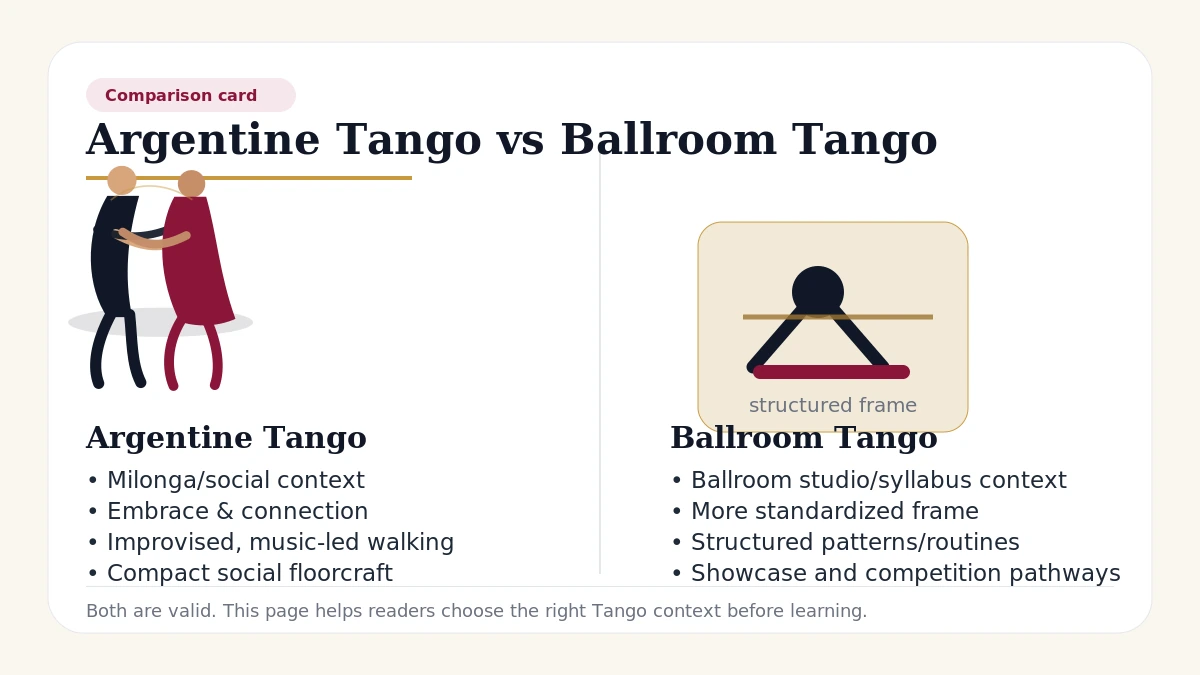
Argentine Tango and ballroom Tango are both valuable. The goal is not to decide which one is “better.” The goal is to know which one you are learning.
| Aspect | Argentine Tango | Ballroom Tango |
|---|---|---|
| Primary context | Social Tango culture, milongas, practicas, Tango communities, performance/competition in specific Tango contexts | Ballroom studios, social ballroom, American Smooth, International Standard, DanceSport |
| Frame / embrace | Close and open embrace both exist; connection and comfort are central | More standardized ballroom frame or hold, depending on American or International style |
| Movement feel | Walking-based, grounded, compact, improvised, music-led | Sharper, more structured, often more progressive around the room |
| Choreography vs improvisation | Social Argentine Tango is strongly improvisational | May be taught through syllabus figures, patterns, routines, or choreography |
| Music / rhythm | Often taught through pulse, phrasing, pauses, and musical interpretation | Often taught with style-specific timing systems such as slow/quick patterns |
| Social setting | Milongas and practicas, where floorcraft and ronda matter | Ballroom socials, lessons, showcases, competitions |
| Competition / studio context | Tango de Pista and Stage Tango exist; Pista emphasizes social-dance values | American Smooth and International Standard Tango appear in ballroom syllabus and competition systems |
| Beginner path | Posture, embrace, walking, weight changes, connection, musicality, floorcraft | Basic patterns, frame, timing, promenade, walks, turns, syllabus figures |
| Wedding suitability | Works with the right song and enough coaching; can be subtle and dramatic | May be easier to structure for a short choreographed first dance |
| Best next page | Social dance etiquette, lead/follow, music | Ballroom Tango guide |
Argentine Tango vs Milonga, Vals, Rumba, Foxtrot, Waltz, and Nightclub Two Step
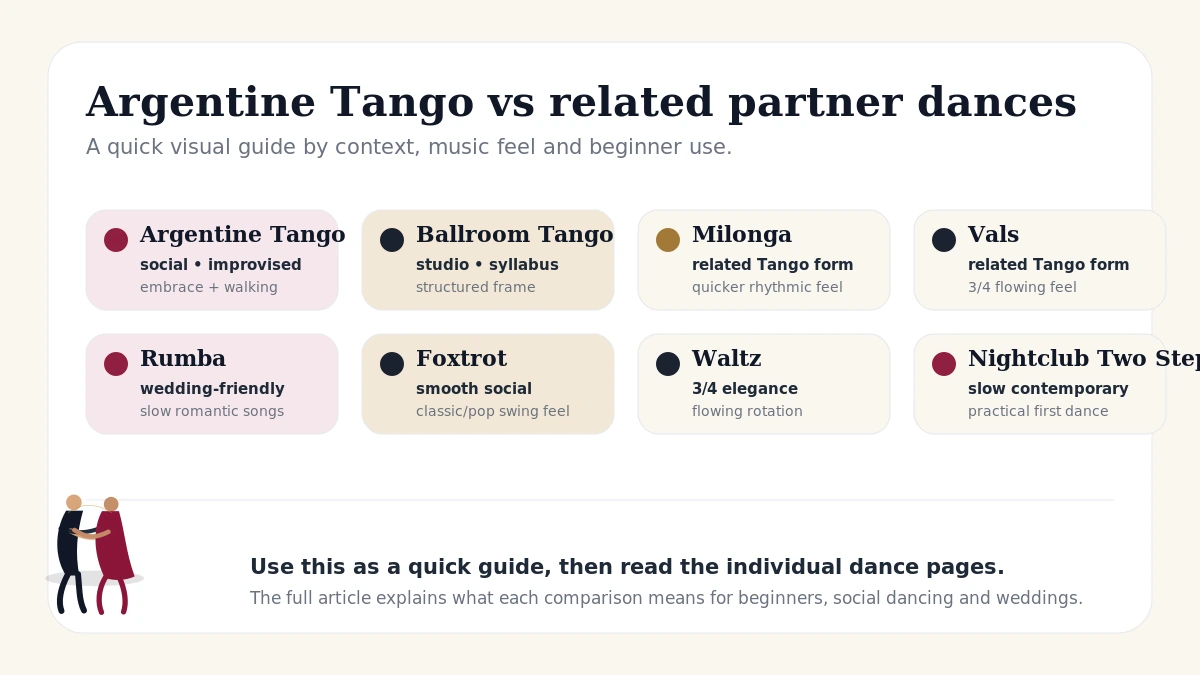
| Dance | Relationship | Beginner note |
|---|---|---|
| Milonga | Related Tango social/music form with quicker rhythmic feel | Great later; first understand Tango walking and floorcraft |
| Vals | Related Tango waltz form, commonly felt in 3/4 | Compare with Waltz if you like flowing rotation |
| Ballroom Tango | More standardized ballroom/studio/syllabus context | Read the ballroom Tango guide |
| Rumba | Slower, often easier for romantic wedding songs; Latin/Rhythm body action differs | Often more wedding-friendly for beginners |
| Foxtrot | Smooth, social, adaptable to many classic songs | Often easier for couples who want a relaxed first dance |
| Waltz | 3/4, flowing, elegant, more structured for many beginners | Good if the song is clearly in 3/4 |
| Nightclub Two Step | Popular for slow contemporary songs | Often easier than Argentine Tango for many wedding couples |
| Salsa | Different social Latin dance with different music, timing, and body rhythm | Useful social comparison only; do not confuse it with Tango |
Common beginner mistakes
| Mistake | Fix |
|---|---|
| Expecting Argentine Tango to look like stage Tango | Start with walking, pausing, balance, and partner comfort |
| Taking steps too large | Practice compact steps |
| Pulling with the arms | Use comfortable connection through posture, body tone, and shared timing |
| Ignoring weight changes | Know which foot has your weight |
| Trying dramatic moves too early | Learn to walk and pause musically first |
| Not listening to the music | Practice hearing pulse, phrasing, and pauses |
| Confusing Argentine Tango with ballroom Tango | Argentine Tango is social, improvised, embrace- and music-led; ballroom Tango is more standardized within ballroom systems |
| Forgetting floorcraft | Stay aware of the ronda, avoid collisions, and keep movement respectful |
Beginner practice tips
- Walk slowly by yourself. Attentive, balanced walking is the foundation of the dance.
- Pause on purpose. Practice stopping without losing balance or connection.
- Listen before dancing. Hear the pulse, phrasing, and pauses first.
- Practice posture. Stand comfortably tall with clear balance over your standing foot.
- Use small steps. Compact movement is easier to control and better for social floors.
- Try connection drills with a teacher. Connection is best learned with guidance and a partner.
- Watch social Tango, not only stage clips. Stage Tango is choreographed; social Tango is what you will dance at a milonga.
- Learn etiquette early. Invitations, the ronda, and partner comfort are part of the dance.
Is Argentine Tango good for weddings?
Argentine Tango can be beautiful for a wedding first dance when the couple loves the music, has enough lesson time, and wants a connected, stylized dance rather than a simple sway. It works best when the choreography is simplified and adapted to the couple’s comfort.
It is not the easiest choice for every couple. If your song is a slow romantic ballad, Rumba for beginners, Nightclub Two Step for slow songs, Foxtrot, or simple slow dancing may fit more naturally. If your song is in 3/4, Waltz may be a better match. If you want a sharper ballroom look, ballroom Tango may be easier to structure for performance.
Read the wedding dance guide if your main goal is choosing a first dance.
Is Argentine Tango useful for social dancing?
Yes. Argentine Tango is especially useful if you want a deep social dance community, musical partner connection, and a dance that can grow with you for years.
Beginners should expect a learning curve. Social Tango requires more than steps: you learn how to enter the floor, use the ronda, respect invitations, adjust embrace, keep movements compact, and listen to a partner. The reward is that even a simple walk can feel expressive when it is musical and connected.
Is Argentine Tango a ballroom dance?
Argentine Tango is ballroom-adjacent in many studios, but it is not the same thing as ballroom Tango.
A practical way to say it: Argentine Tango is a social and cultural partner dance often taught in dance studios and included on Ballroom Pages as a social dance style. It should not be represented as identical to American Smooth Tango, International Standard Tango, or the general ballroom Tango page.
This is why Ballroom Pages keeps two separate pages:
- /dance-styles/argentine-tango/ for Argentine Tango.
- /dance-styles/tango/ for ballroom Tango.