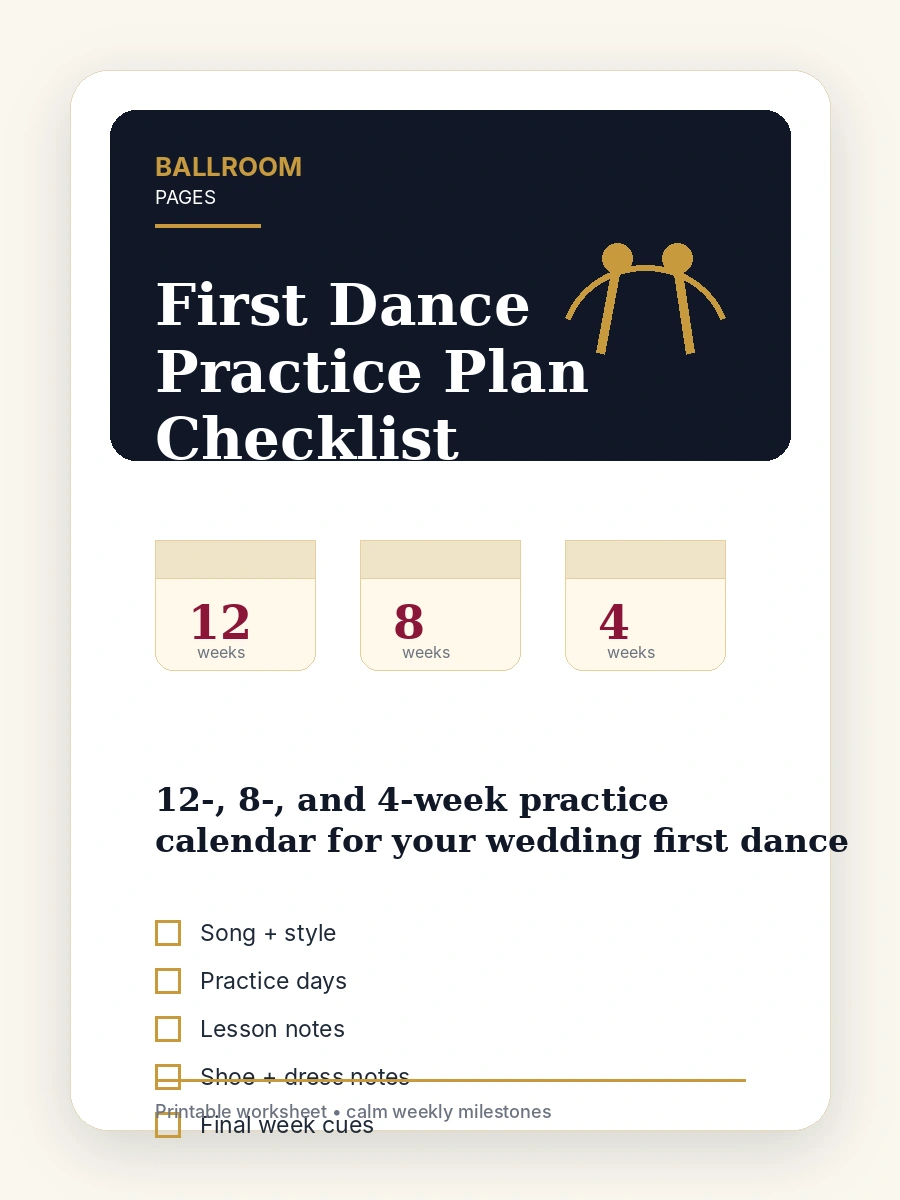
How to choose your first dance practice timeline
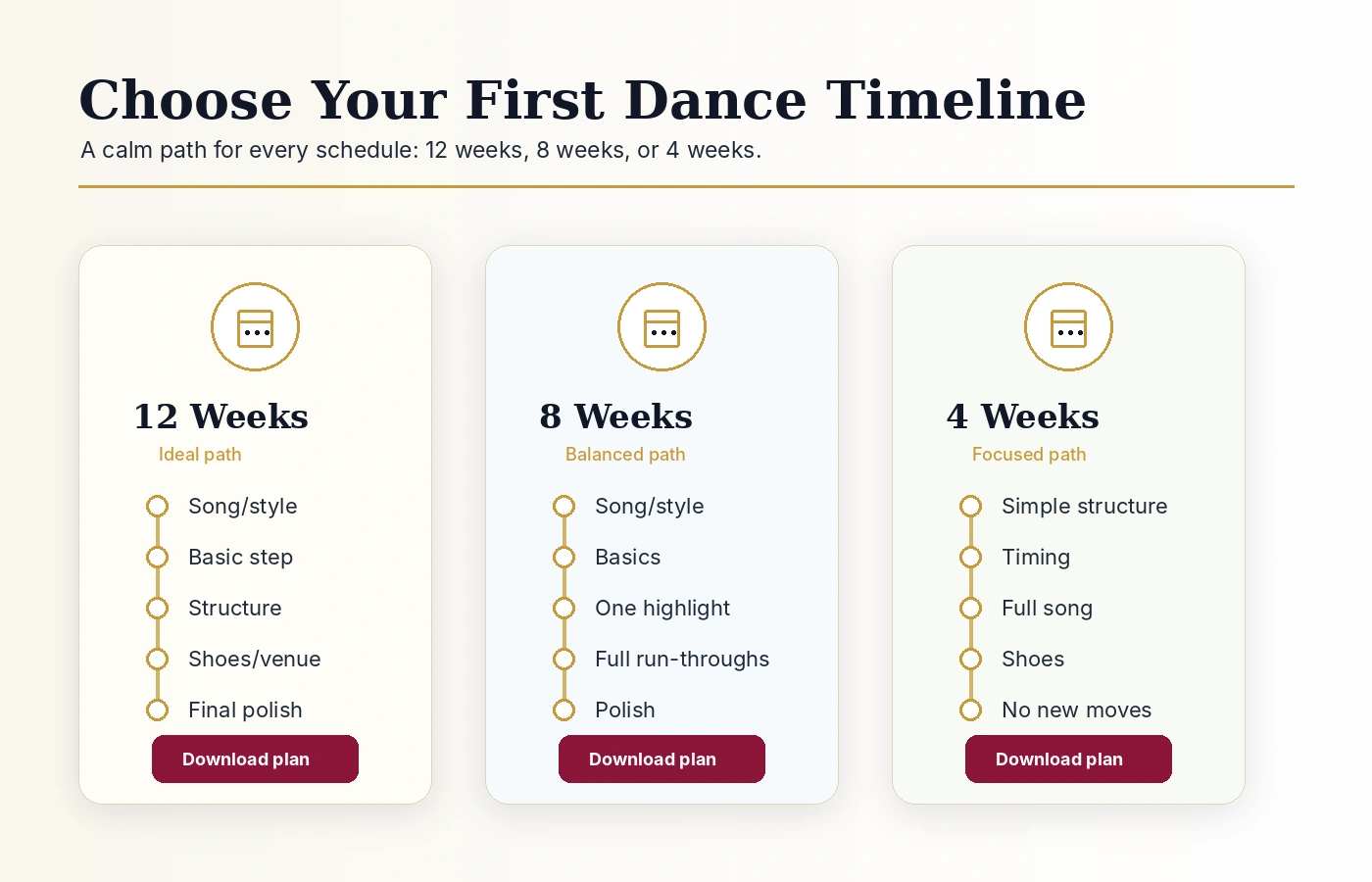
Choose your plan based on how much time you have, how comfortable you feel dancing together, and how complex you want the final dance to be.
12 weeks
Choose this if you want time to build comfort, learn basic movement, practice with your song, polish transitions, and test shoes, dress constraints, floor size, and entrance direction.
See the 12-week plan →8 weeks
Choose this if you want a simple but polished first dance. You have enough time to learn a basic pattern, add one or two turns, practice the song structure, and feel steady without trying to become dancers overnight.
See the 8-week plan →4 weeks
Choose this if you are starting late and want something calm, elegant, and realistic. Keep the structure simple: entrance, basic step or sway, one turn or highlight, and ending.
See the 4-week plan →Less than 4 weeks
Simplify heavily. Use a short song edit, avoid risky elements, choose one comfortable movement pattern, and rehearse the entrance and ending until they feel natural.
Use the simple structure →Quick decision summary
If you want choreography and polish, choose 12 weeks. If you want simple and confident, choose 8 weeks. If you want calm and low-risk, choose 4 weeks. If you are under 4 weeks, choose structure over choreography.
Before you start practicing
Before you learn steps, make these decisions. They will save time and prevent frustration.
1. Choose or confirm your song
Pick a song you both like and can hear clearly. If the full song feels long, ask your DJ, band, or editor about a shorter version.
2. Match the song to a dance style
Some songs feel like Waltz, some feel like Rumba, Foxtrot, Swing, Cha Cha, Salsa, Bachata, or Nightclub Two Step. Start with the song’s meter, tempo, and feeling. Our guide to what dance fits your wedding song walks through it step by step.
3. Decide what you actually want
You do not need full choreography. Many couples do best with a simple structure: entrance, base step, turn, small travel or rotation, and ending.
4. Edit the song length if needed
A shorter edit is often easier to practice and less stressful on the wedding day. Make sure the final edit has a clear beginning, ending, and cue for your final pose.
5. Think about dress, shoes, floor, and venue
Long dresses, tight skirts, slick floors, outdoor surfaces, small dance floors, and high heels can all change what feels safe. Plan for the real conditions, not just the living room version. See wedding dance shoes and our wedding dance shoes gear guide planned.
6. Choose your learning approach
You can take private lessons, use online guidance, or practice DIY. If you want dips, lifts, advanced turns, or dramatic choreography, work with a qualified instructor.
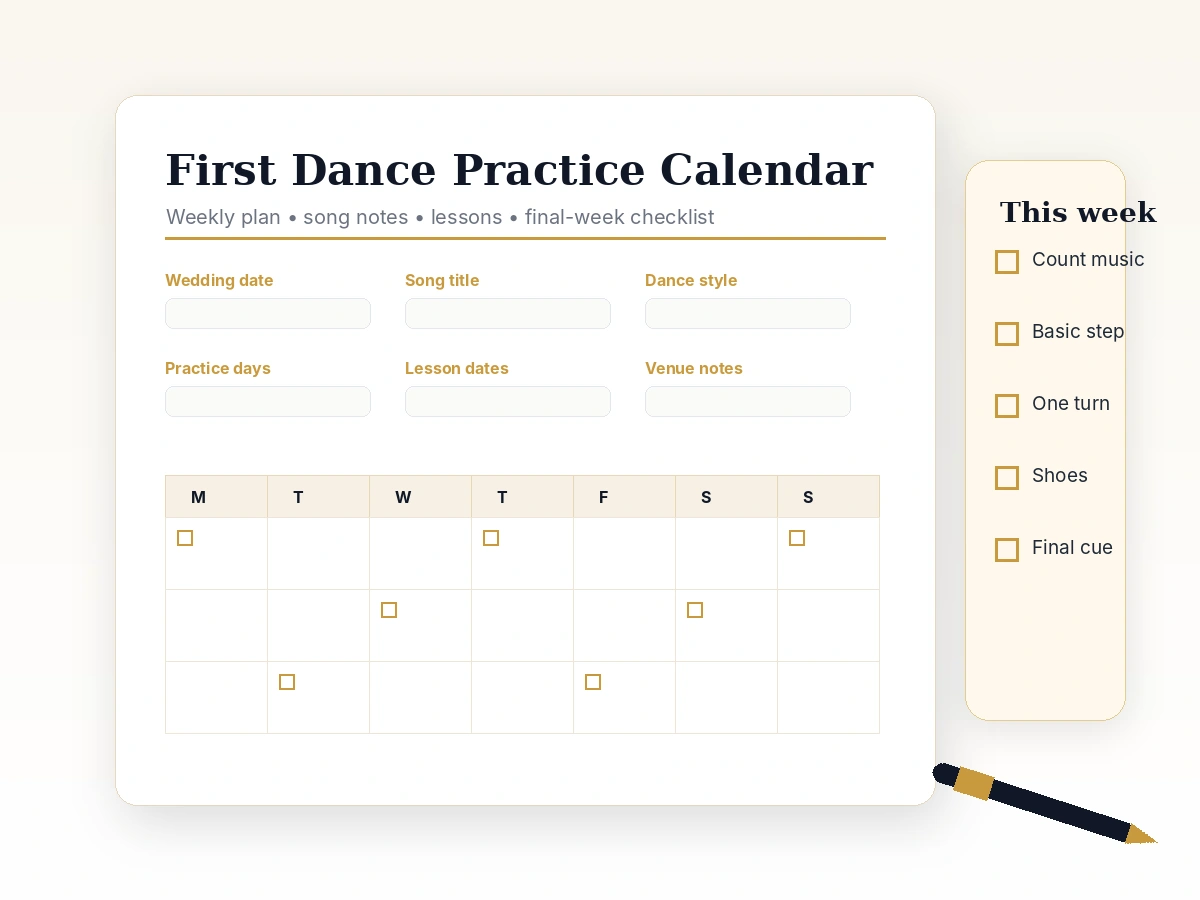
12-week first dance practice plan
Use this plan if you want the most comfortable path. You will build the dance slowly, practice musical timing, and leave space for shoes, dress, floor, and final-week calm.
Choose the song, style, and structure
Goals: Song confirmed, dance style chosen, practice days scheduled.
- Choose your song and confirm the final edit.
- Match the song to a likely dance style.
- Decide if you want full choreography, simple structure, or a mix.
- Sketch the dance shape: entrance, base step, one highlight, ending.
- Take a first lesson or choose your DIY learning path.
- Start listening to the song several times per week.
Practice focus: Counting, walking in together, basic hold, and hearing the beat.
Build the basic movement
Goals: Basic step, timing, frame, and first transition.
- Learn the base movement for your style.
- Practice the first 30–45 seconds slowly.
- Add one transition or turn.
- Work on frame, posture, and partner connection.
- Practice with style-appropriate music, not only the final song.
Practice focus: Clean timing before extra moves.
Build the full song structure
Goals: Dance mapped from beginning to ending.
- Divide your song into sections: intro, first phrase, middle, final phrase, ending.
- Add a clean entrance.
- Choose one highlight moment.
- Decide how much you will travel or rotate.
- Practice the final pose or ending cue.
- Begin full-song run-throughs at least once per practice session.
Practice focus: Transitions and musical cues.
Polish and test real-world details
Goals: Shoes, dress constraints, floor size, and final song edit tested.
- Practice in wedding shoes or similar shoes.
- Test dress constraints if possible.
- Practice in a space similar to your dance floor size.
- Confirm the song edit with your DJ or band.
- Record one practice video and watch for only the most important fixes.
- Keep the dance simple if anything feels unstable.
Practice focus: Comfort, not perfection.
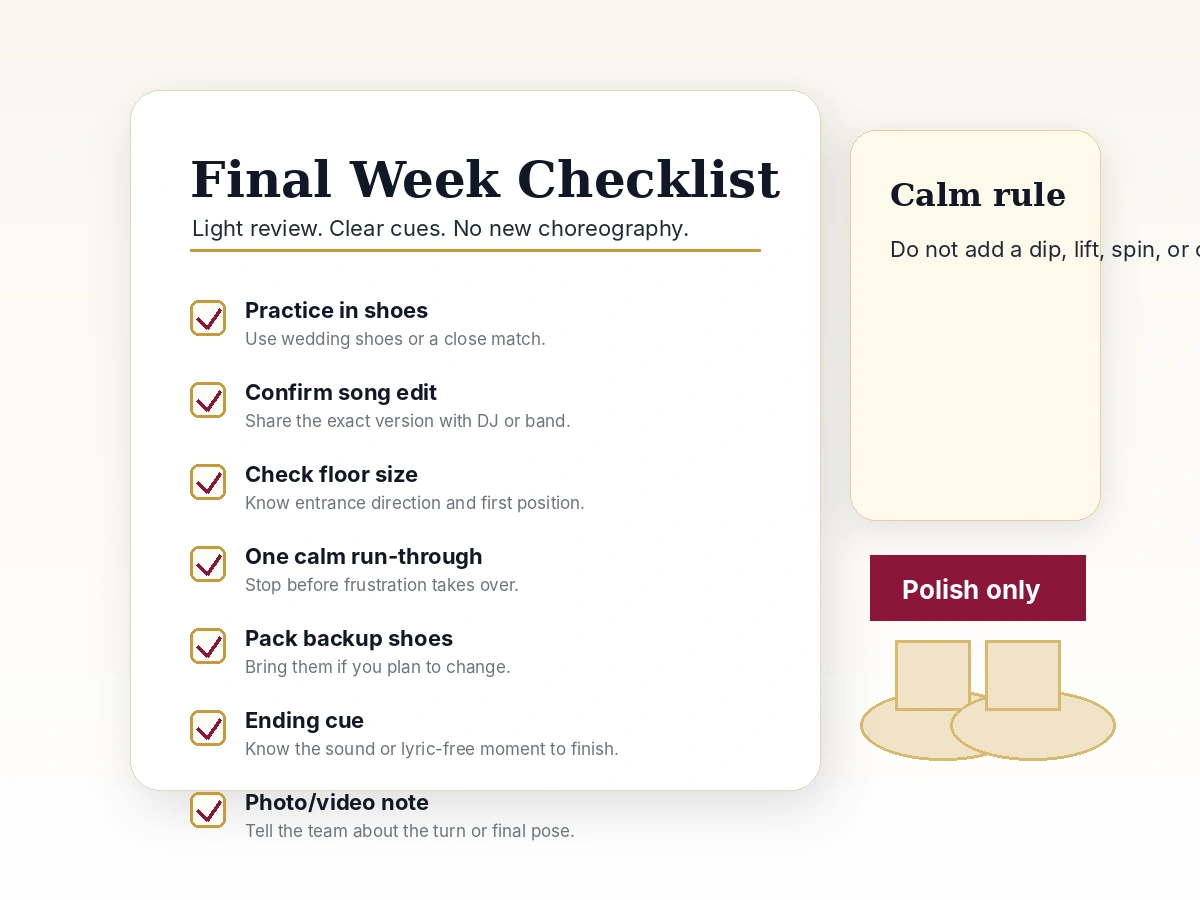
Light review only
Goals: Calm confidence.
- Do not add new choreography.
- Do one calm run-through, not ten stressful ones.
- Practice the entrance direction and ending cue.
- Confirm the song edit, dance floor, and photographer/videographer positioning.
- Pack dance shoes if changing shoes.
- End practice while you still feel good.
Practice focus: Familiarity and calm.
8-week first dance practice plan
The 8-week plan works well when you want a simple, polished first dance without overcomplicating it.
Choose song, style, and scope
Pick the song, confirm the dance style, and choose a realistic level. Decide now that fewer moves done well will look better than too many moves rushed.
Learn the basic pattern
Focus on the base step, hold, timing, and how you start together.
Add one turn or highlight
Choose one move that looks good and feels safe. Practice it slowly before adding it to the music.
Build the song structure
Map your entrance, first section, middle, final section, and ending.
Practice transitions
The dance will feel better when transitions are smooth. Practice the moments between steps, not just the steps themselves.
Add shoes and venue details
Practice in wedding shoes or similar shoes. Think about floor size, dress shape, and where guests will be standing.
Full-song run-throughs
Run the whole dance, but do not panic if you make mistakes. The goal is recovery, not perfection.
Polish only
Keep practice light. Confirm your song edit and ending cue. No new choreography.
What to cut if you fall behind
Cut extra arm styling, second spins, complicated dips, long traveling sections, dramatic lifts, and any move that only works half the time.
4-week first dance practice plan
The 4-week plan is for couples who need a calm, simple result quickly. You can still create a beautiful first dance. The key is to stop adding and start repeating.
Choose a simple structure
Choose the song edit, decide the style, and pick one base movement. Add only one or two moves: usually a turn and an ending.
Practice timing and transitions
Listen, count, and move slowly. Practice the entrance into the base step, the base step into the turn, and the turn into the ending.
Run the full song
Use your final song edit. Practice the whole dance in the order it will happen. If a move feels unreliable, simplify it now.
Polish only
Do light review. Practice in shoes. Confirm the music. Do not add a new dip, lift, spin, or complicated ending.
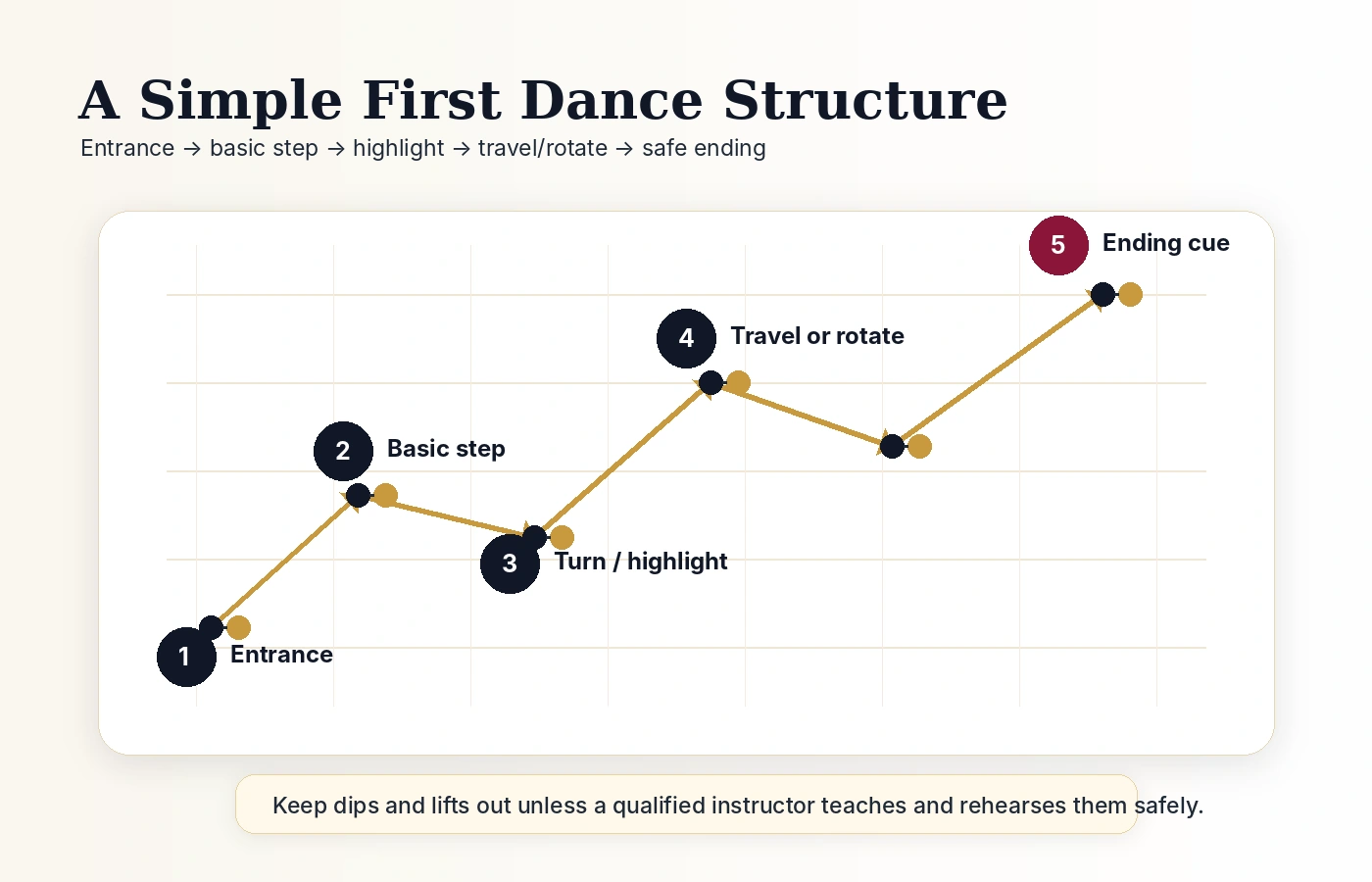
A simple first dance structure
A first dance does not need many moves. It needs a beginning, a comfortable middle, and an ending you both understand.
Entrance
Walk in together, pause, breathe, and take hold.
Base movement
Use a sway, side step, box step, Rumba box, Foxtrot basic, Swing basic, or another simple pattern that fits your song.
Highlight moment
Add one turn, small rotation, or gentle change of direction.
Travel or rotate slightly
Move just enough to avoid looking stuck, but not so much that you feel lost.
Ending
Choose a clear final pose, small turn into hold, or simple close.
Safety: Skip risky dips or lifts unless you learn them with professional instruction and practice them safely in the shoes and clothing you will actually use.
Weekly practice session template
20–30 minute practice
- 3–5 minutes: Warm up, walk together, loosen shoulders and hands.
- 5 minutes: Listen, clap, or count the music.
- 10 minutes: Practice the basic pattern or one choreography section.
- 5–10 minutes: Run the section with music.
- 2 minutes: Write down the next action.
45 minute practice
- 5 minutes: Warm up and reconnect.
- 10 minutes: Count the song and review cues.
- 15 minutes: Work on steps, turns, or transitions.
- 10 minutes: Run the dance with music.
- 5 minutes: Make notes and stop before frustration takes over.
For general practice routines, see our ballroom dance practice routine planned.
Practice with music
Use music before you feel ready. Couples often wait too long to practice with actual songs, then the dance feels different when the music starts.
Week 1: Choose song and identify style
Use the song-matching guide and Ballroom Pages playlists to compare Waltz, Rumba, Foxtrot, Swing, Cha Cha, Latin/social, and Nightclub Two Step possibilities.
Weeks 2–4: Count and practice the basic pattern
Use slower or style-appropriate playlists to hear the rhythm without the pressure of your final wedding song. If counting feels hard, read how to count ballroom dance music.
Weeks 5–8: Practice structure and transitions
Use both the final song and style playlists. This helps you stop memorizing only one recording and start understanding the timing.
Final weeks: Use your actual edited song
Practice with the final version your DJ or band will play. Confirm the intro, ending, and final cue.
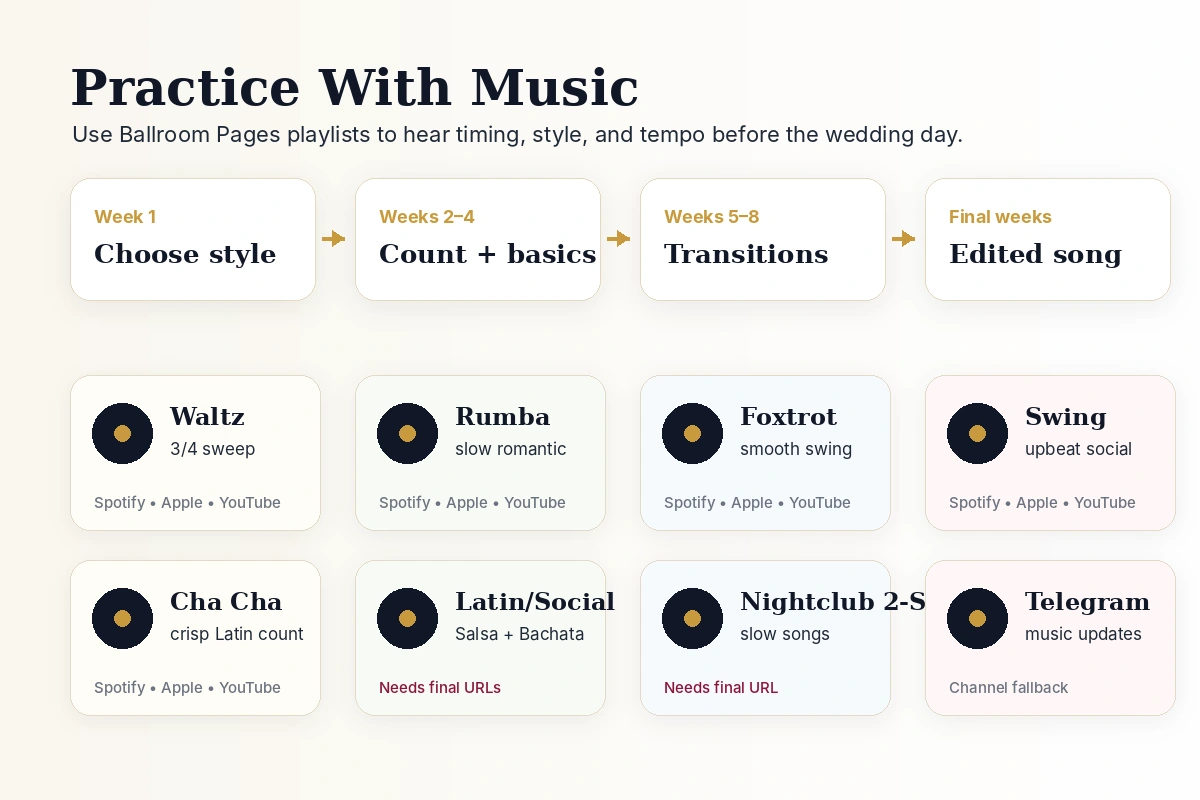
Ballroom Pages practice playlists
Each card lists what the playlist is best for and when to use it during your plan. Links open on external platforms, so no players load on this page and it stays fast.
-
Waltz / Slow Waltz
- Best for
- Songs that count 1-2-3.
- Use during
- Weeks 1–4 counting practice.
-
Rumba
- Best for
- Slow, romantic 4/4 songs.
- Use during
- Basic-pattern and structure weeks.
-
Foxtrot
- Best for
- Smooth, jazzy, classic standards.
- Use during
- Structure and transition weeks.
-
Swing
- Best for
- Upbeat, bouncy, joyful songs.
- Use during
- Basic-rhythm and energy practice.
-
Cha Cha
- Best for
- Bright, crisp, rhythmic pop.
- Use during
- Counting and timing practice.
-
Nightclub Two Step
- Best for
- Slow contemporary ballads.
- Use during
- Gentle base-step practice.
Playlist URL needed
-
Salsa
- Best for
- Energetic Latin first dances.
- Use during
- Style-feel and rhythm practice.
Playlist URL needed
-
Bachata
- Best for
- Warm, close, romantic songs.
- Use during
- Connection and base-step practice.
Playlist URL needed
More on every platform via the Music & Timing hub, including Apple Music and YouTube Music libraries and the Telegram channel, BallroomPages Music.
Common first dance practice mistakes
Mistake: Practicing without counting
Fix: Spend five minutes clapping or counting before you dance. If you cannot hear the beat, the steps will feel random.
Mistake: Choosing too many moves
Fix: Pick one base movement, one highlight, and one ending. Add only if the basics are steady.
Mistake: Waiting too long to practice in wedding shoes
Fix: Start testing shoes once the structure is set. Do not wait until the wedding week.
Mistake: Ignoring the song intro and outro
Fix: Decide exactly when you walk on, when you take hold, and what sound cue tells you the dance is ending.
Mistake: Not deciding on entrance and ending
Fix: Rehearse the first and last 10 seconds until they feel automatic.
Mistake: Practicing only once per week
Fix: Short sessions several times per week are more useful than one long session.
Mistake: Adding dips or lifts too late
Fix: Use a safe pose or simple turn unless you have professional help and enough time to rehearse.
Mistake: Practicing when tired or frustrated
Fix: Stop early. You want the dance associated with calm repetition, not arguments.
Final week and day-of checklist
- Practice in wedding shoes or similar shoes.
- Confirm the final song edit with the DJ or band.
- Confirm dance floor size and surface.
- Practice the entrance direction.
- Do one calm run-through, not ten stressful ones.
- Pack dance shoes if changing shoes.
- Decide the exact ending cue.
- Tell the photographer or videographer if you have a planned turn, pose, or ending moment.
- Do not add new choreography.