
What is Viennese Waltz?
Viennese Waltz is a fast, rotational ballroom dance in 3/4 time. It is known for continuous turning, sweeping travel, and a strong sense of musical flow.
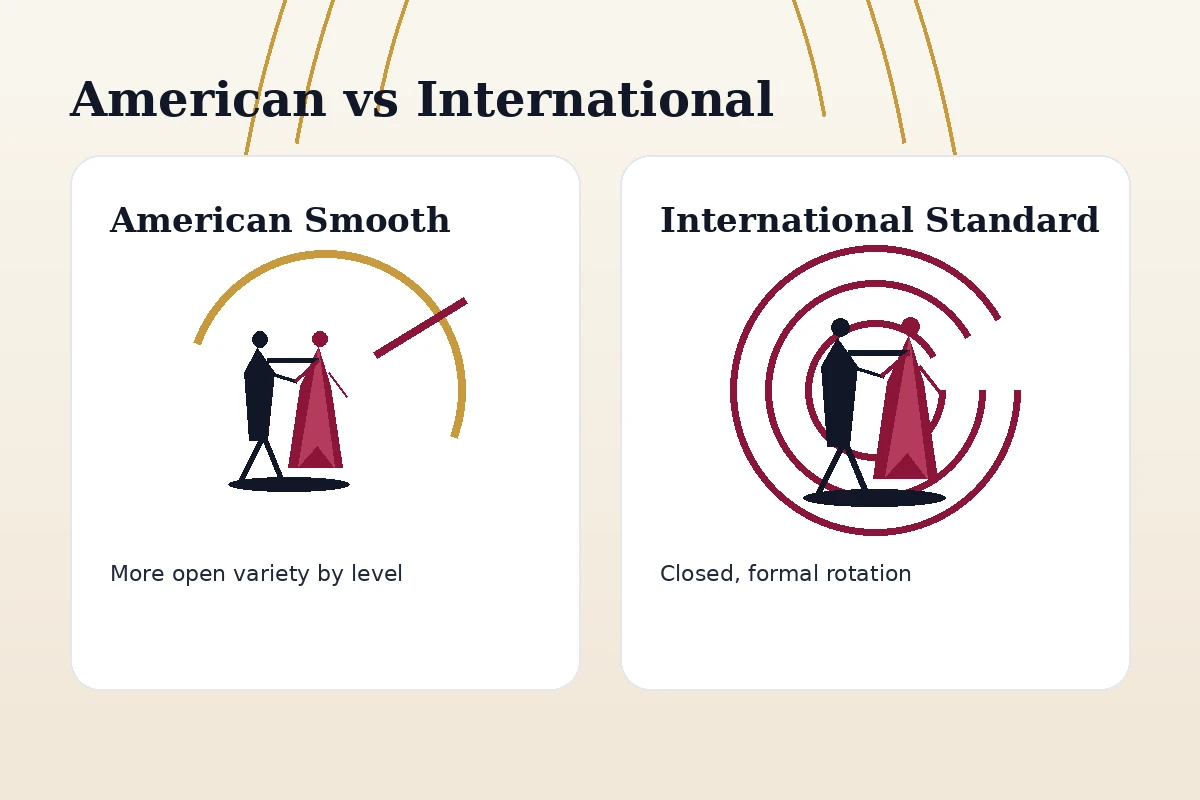
In ballroom settings, Viennese Waltz appears in both International Standard and American Smooth contexts. International Standard Viennese Waltz is more closed-position and formal in structure, while American Smooth Viennese Waltz may allow more open shapes and variety depending on level and rules.
Viennese Waltz is related to Waltz, but it should have its own page and learning path. Regular Waltz is typically slower and more beginner-friendly, while Viennese Waltz asks dancers to manage speed, rotation, balance, and floorcraft much earlier.
If you are brand new to ballroom, start by understanding the dance before trying to spin quickly. The right first goal is not “go fast.” It is “stay balanced, connected, and aware while moving through 3/4 timing.”
What Viennese Waltz feels like
Viennese Waltz feels sweeping, continuous, and circular. Where regular Waltz may give beginners time to feel rise, fall, and shaping, Viennese Waltz moves more quickly and asks the couple to keep the rotation organized.
The dance should not feel like uncontrolled spinning. A good Viennese Waltz feels centered, musical, and directed around the room.
The leader’s job is to create clear timing, direction, and rotation. The follower’s job is to stay balanced, responsive, and connected without anticipating or pulling out of the turn. Both partners need posture, calm frame, and shared control.
Viennese Waltz timing and count
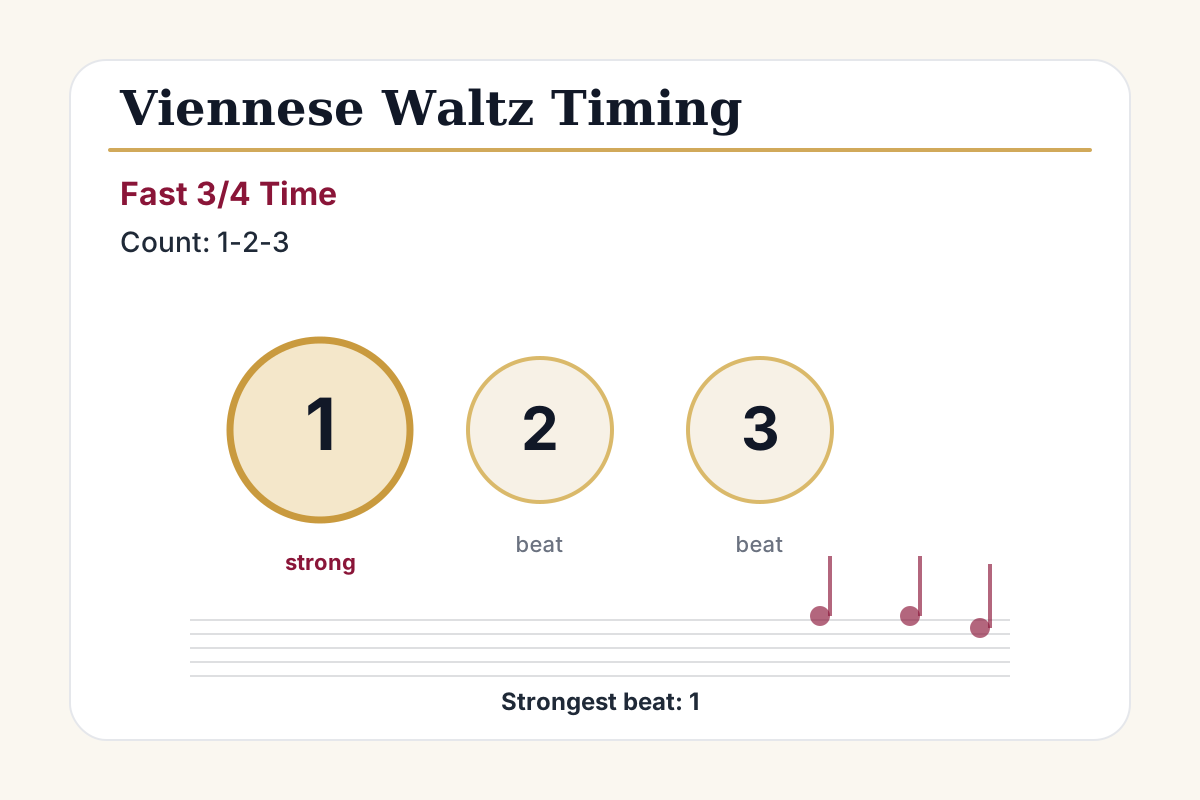
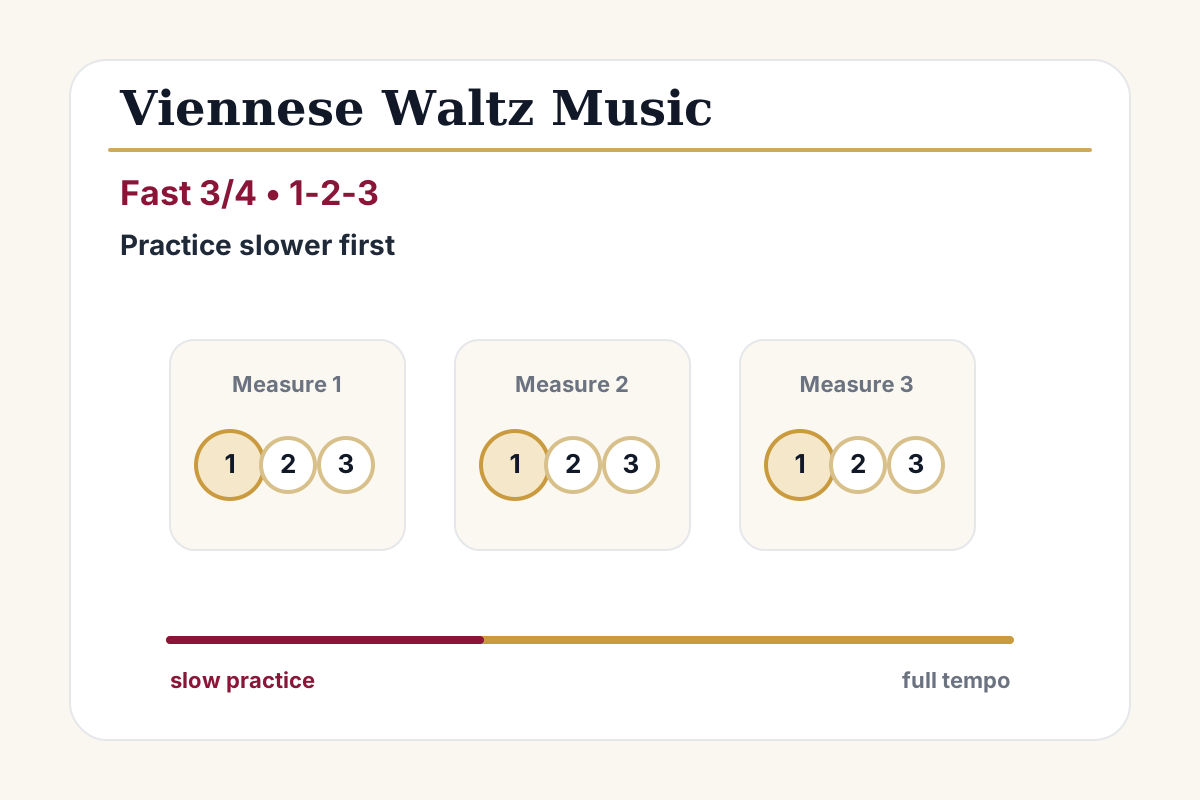
Viennese Waltz is usually counted 1-2-3, 1-2-3. Like Waltz, it has three beats per measure, but the tempo is much faster.
| Timing idea | Beginner explanation |
|---|---|
| Time signature | Usually 3/4 |
| Basic count | 1-2-3 |
| Count phrase | 1-2-3, 1-2-3 |
| Strongest beat | Usually beat 1 |
| Tempo note | Faster than regular Waltz |
| Beginner challenge | Staying calm while the music moves quickly |
| Practice fix | Count slowly first, then increase tempo gradually |
| Safety note | Do not jump straight into fast continuous rotation |
The count is simple, but the speed changes everything. Beginners often understand the numbers before they can control the movement.
Start by clapping or stepping the count without turning. Then practice a single change step or controlled turn concept slowly with a teacher before trying full-speed rotation.
How to Count Ballroom Dance Music
Why rotation matters
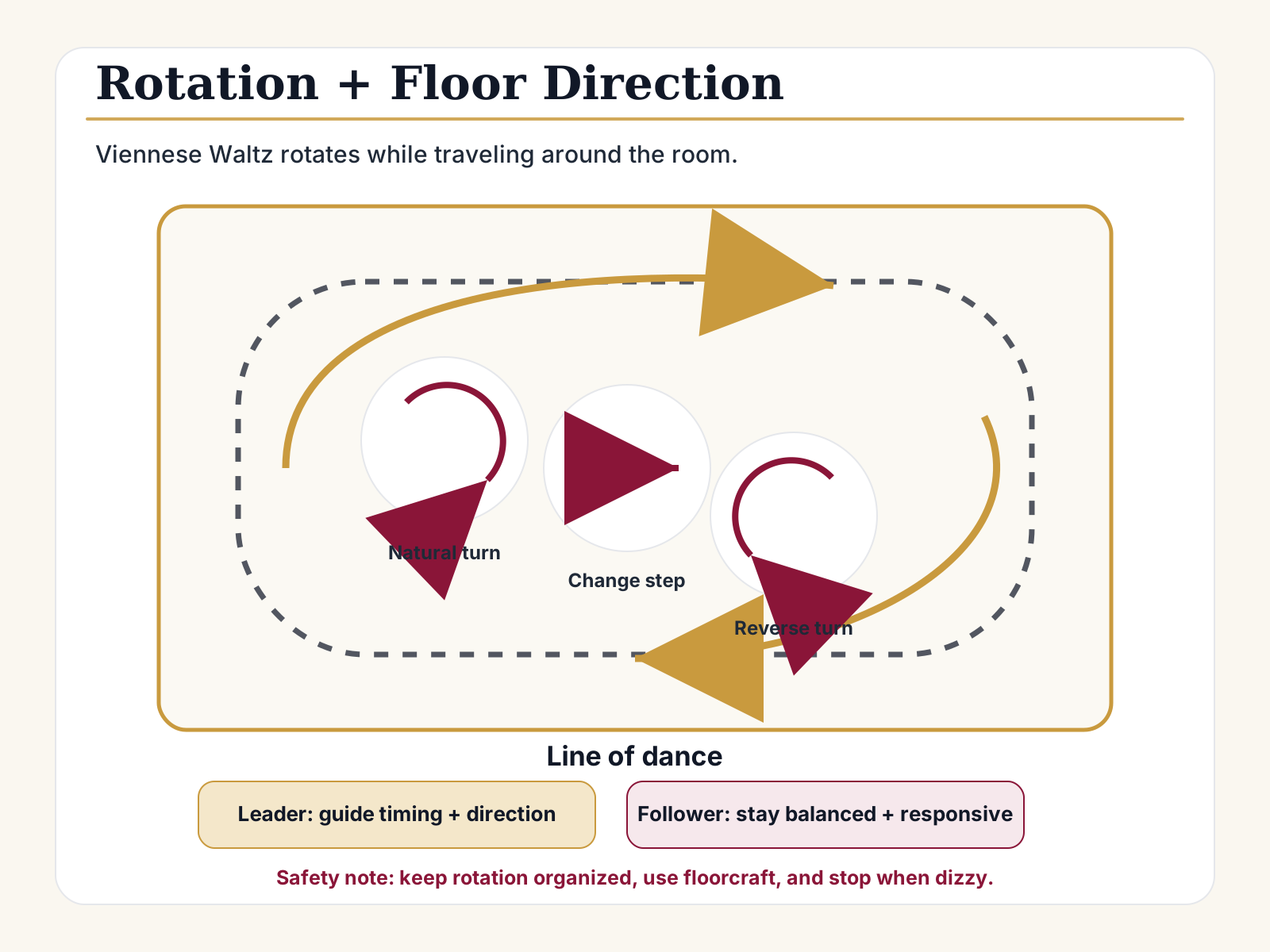
Rotation is the heart of Viennese Waltz. The dance is built around turns that travel around the room, not around a beginner box step.
Many sources describe the dance as rotary, with natural turns rotating one direction, reverse turns rotating the other, and change steps helping dancers switch direction. That is why Viennese Waltz can feel thrilling, but also why it can feel disorienting at first.
Rotation requires more than turning your feet. Dancers need a stable frame, shared center, steady timing, awareness of direction, and good floorcraft.
If you feel dizzy, rushed, or pulled off balance, slow down. The answer is usually not “try harder.” It is to reduce speed, simplify the figure, improve posture, and practice with guidance.
Learn floorcraft basics before trying faster traveling dances
Basic Viennese Waltz movements
Beginner Viennese Waltz is usually introduced through a small set of core ideas rather than a long list of patterns. The most important concepts are timing, rotation direction, change steps, and balance.
| Beginner concept | What it teaches |
|---|---|
| Natural turn | Clockwise / right-turning rotation |
| Reverse turn | Counterclockwise / left-turning rotation |
| Change step | A non-rotating or less-rotating step pattern that helps change direction |
| Balance step / hesitation | Control, timing, and preparation |
| Closed position | Stable partner frame and body relationship |
| Floorcraft | Moving safely with other couples |
American Smooth syllabi may include more variety earlier than International Standard contexts, such as hesitations, balance steps, and certain open or underarm actions depending on level and rules. International Standard is generally more closed-position and focused on a smaller vocabulary of turning actions.
Do not try to learn every figure from a syllabus list by reading. Use this page as orientation, then work with a qualified teacher for technique.
Glossary support: Natural Turn, Reverse Turn, Closed Position, Promenade Position.
Natural turn, reverse turn, and change step overview
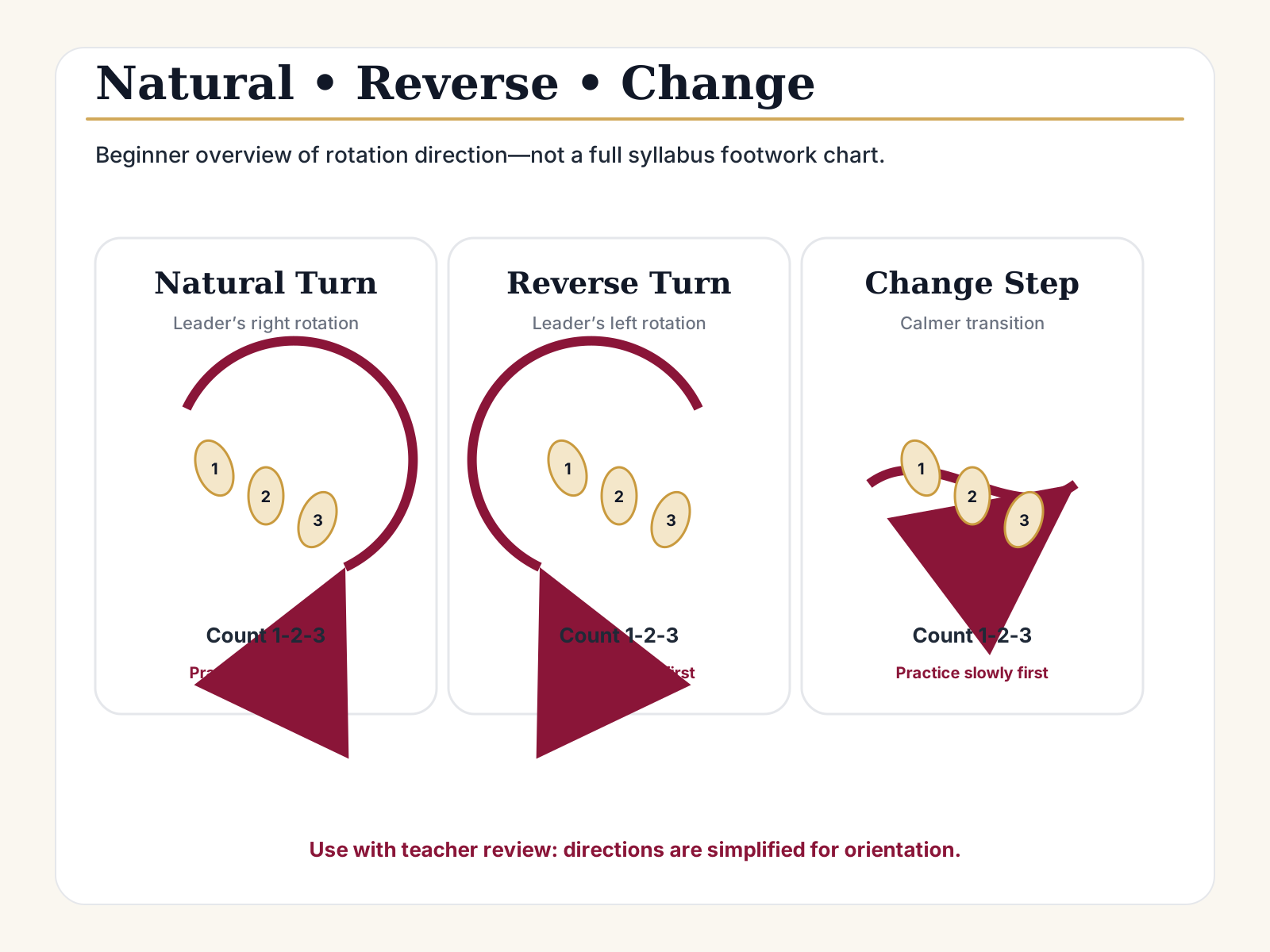
The natural turn rotates to the leader’s right. The reverse turn rotates to the leader’s left. A change step helps dancers move out of one turning direction and prepare for another.
For a beginner, those three ideas explain the basic architecture of Viennese Waltz:
| Movement | Plain-English idea | Beginner caution |
|---|---|---|
| Natural turn | Rotates one direction while traveling | Do not force the partner around |
| Reverse turn | Rotates the other direction while traveling | Often feels harder at first |
| Change step | Helps change or reset direction | Keep it calm and balanced |
| Hesitation / balance action | Slows or stabilizes the movement | Useful before full-speed practice |
This is not a full technical breakdown. Footwork, timing, body position, and shaping vary by syllabus and level.
Viennese Waltz music
Viennese Waltz music usually has a fast 3/4 feeling. It is often associated with classical and traditional waltz music, especially the Viennese ballroom tradition, but teachers may also use other suitable 3/4 music for practice.
| Music question | Beginner answer |
|---|---|
| What meter does it use? | Usually 3/4 |
| What should I listen for? | Fast repeating 1-2-3 measures |
| Is it the same as slow Waltz music? | No. Viennese Waltz is faster and more rotational |
| Can modern songs work? | Sometimes, if the rhythm and tempo fit |
| Wedding caution | A fast 3/4 song may be beautiful but hard to dance safely |
| Practice tip | Start slower than performance tempo when learning |
A song can be in 3/4 and still not be a comfortable Viennese Waltz for beginners. Tempo, floor space, dress, shoes, and experience all matter.
Viennese Waltz vs Waltz
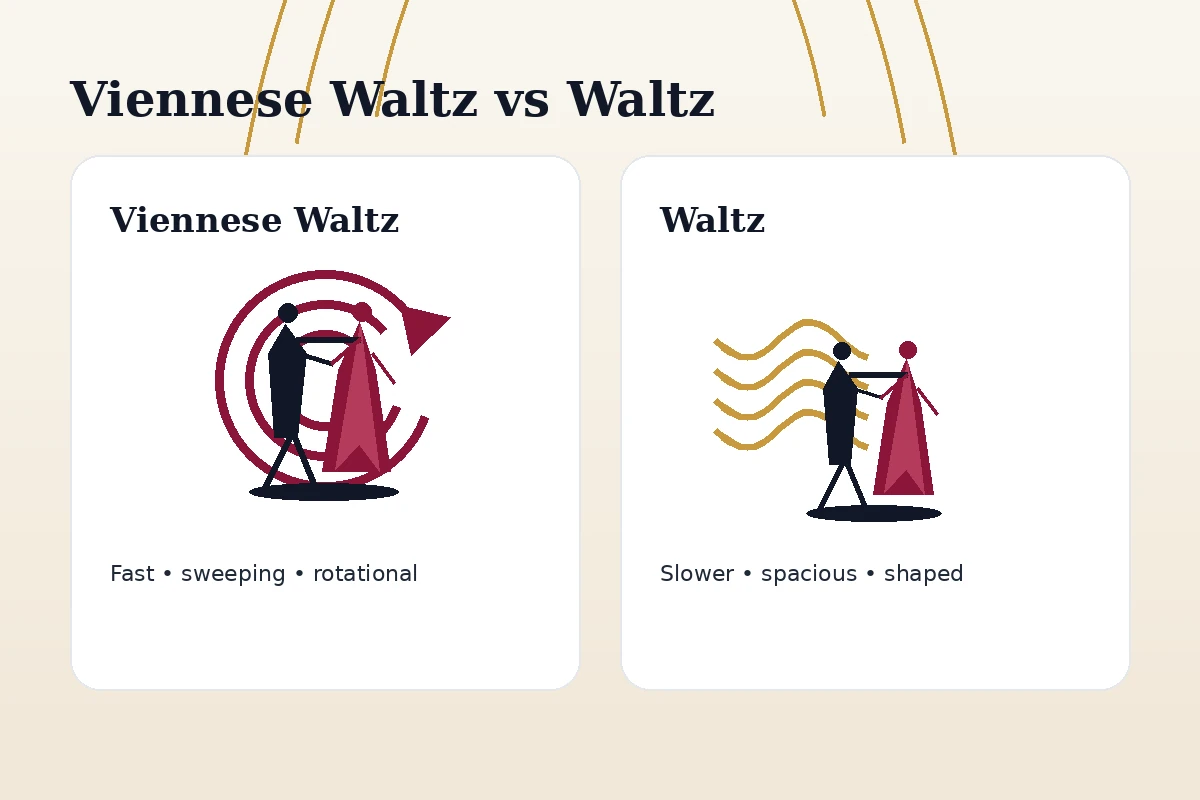
Viennese Waltz and Waltz are related, but they should not be merged into one beginner page.
| Feature | Viennese Waltz | Waltz |
|---|---|---|
| Common meter | 3/4 | 3/4 |
| Basic count | 1-2-3 | 1-2-3 |
| Speed | Fast | Slower |
| Movement feel | Sweeping, continuous, rotational | Flowing, spacious, more shaped |
| Beginner suitability | More demanding | More beginner-friendly |
| First dance fit | Beautiful but challenging | Often easier for wedding couples |
| Main skill demand | Rotation, balance, frame, floorcraft | Timing, posture, rise/fall, basic steps |
| Canonical page | /dance-styles/viennese-waltz/ | /dance-styles/waltz/ |
The shared 3/4 count is the reason people confuse them. The speed and rotation are the reason they feel so different.
If you are completely new to ballroom, regular Waltz is usually the better first place to start. Viennese Waltz can come later, once timing, posture, partner frame, and floorcraft are more comfortable.
American Viennese Waltz vs International Viennese Waltz
American Smooth Viennese Waltz and International Standard Viennese Waltz are both ballroom contexts, but they do not always use the same movement vocabulary or presentation.
| Feature | American Smooth Viennese Waltz | International Standard Viennese Waltz |
|---|---|---|
| Dance family | American Smooth | International Standard |
| Hold / style | May include more open work and variety depending on level and rules | Generally closed-position and more formal in Standard context |
| Beginner concepts | Natural / reverse turns, closed changes, hesitations, balance steps, limited open work by level | Natural / reverse turns, closed changes / change steps, tightly controlled rotation |
| Competition context | American Smooth events | International Standard events |
| Beginner focus | Timing, balance, frame, safe rotation, simple transitions | Closed hold, rotation, timing, control, floorcraft |
| What not to assume | Open work does not mean “anything goes” | Standard does not mean beginners should attempt full competitive technique immediately |
If you are learning socially, your teacher may introduce practical Smooth-style ideas to make the dance usable and safe. If you are training for competition, follow your teacher, syllabus, and event rules.
American Smooth vs International Standard
Viennese Waltz for weddings
Viennese Waltz can be spectacular for a wedding first dance, but it is not the safest or easiest default choice. It works best for couples who have a suitable fast 3/4 song, enough floor space, appropriate clothing, and time to practice with instruction.
Is Viennese Waltz right for your wedding first dance?
Viennese Waltz may be right if…
- Your song is clearly in 3/4 and has a fast, sweeping feel.
- You want an elegant, dramatic, ballroom-style first dance.
- You have enough floor space for travel and turning.
- You have time for lessons and practice.
- Your dress and shoes allow safe movement.
- You are comfortable learning rotation and floorcraft.
Check the song and the floor first
Viennese Waltz may not be right if…
- Your song is slow and romantic rather than fast and sweeping.
- You want the easiest possible first dance.
- You have a small or crowded dance floor.
- Your dress restricts steps or turning.
- You are prone to dizziness and have little time to train.
- You do not have access to instruction.
A wedding Viennese Waltz does not need to be full competition speed or complexity. A teacher may adapt the choreography, simplify transitions, or recommend regular Waltz instead.
Viennese Waltz in social dancing
Viennese Waltz appears at ballroom socials, formal dances, and ball settings. It is beautiful when the floor has enough space and dancers understand the line of dance.
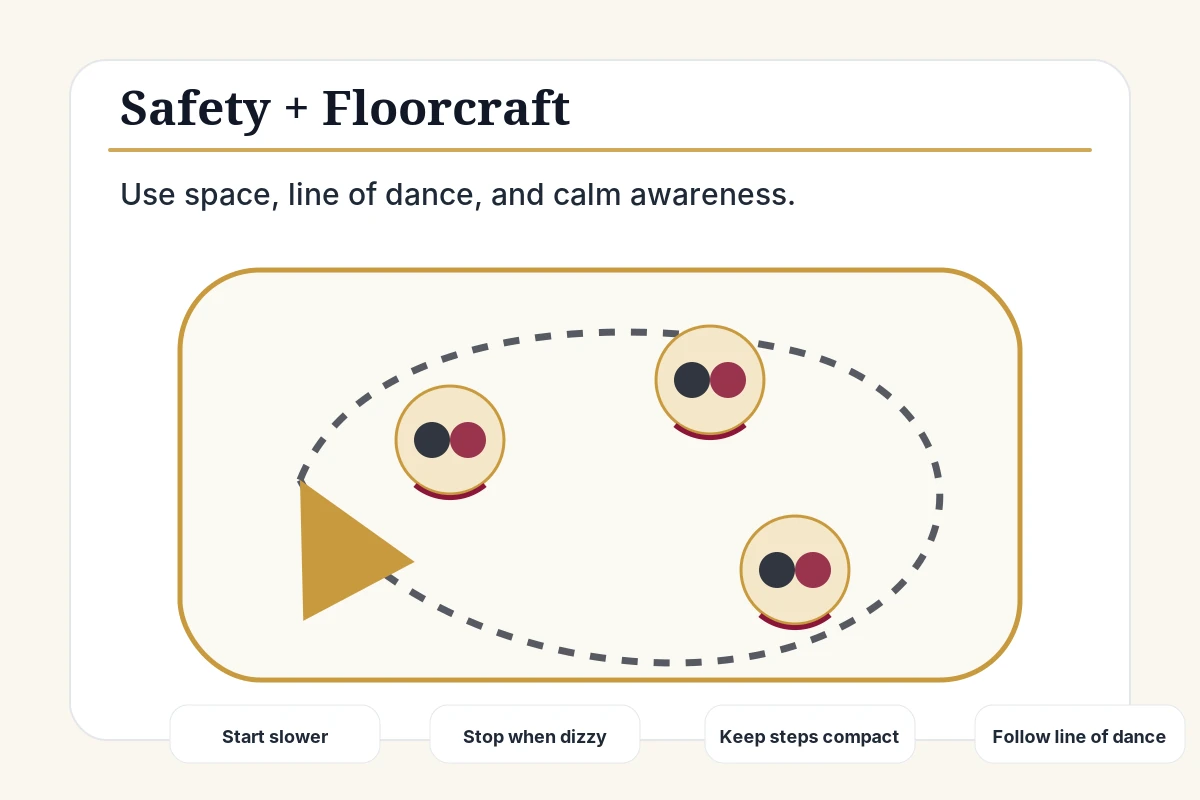
Social Viennese Waltz requires courtesy. Because the dance travels and rotates, dancers need to watch the room, keep steps controlled, and avoid sudden changes that surprise other couples.
If the floor is crowded, simplify. Use smaller actions, avoid forcing rotation, and step off the floor if you feel dizzy or unsafe.
Viennese Waltz in competition
Viennese Waltz appears in International Standard and American Smooth competition contexts. The expectations differ by style system, level, syllabus, and organization.
This guide is not a syllabus replacement. It gives beginners a clear overview before formal instruction.
For competition training, work with a qualified instructor and follow the appropriate syllabus and event rules. Competition technique can involve detailed expectations for hold, footwork, body rotation, rise, swing, shaping, allowed figures, and restrictions.
Common beginner mistakes
| Mistake | Why it happens | Better fix |
|---|---|---|
| Treating it like regular Waltz | Both dances count 1-2-3 | Remember Viennese Waltz is faster and more rotational |
| Trying to spin too soon | The dance looks like constant turning | Learn timing and change steps before full-speed rotation |
| Forcing the partner around | Rotation feels urgent | Use frame, direction, and timing instead of pulling |
| Taking steps too large | Dancers try to travel before control is ready | Start smaller and increase only with balance |
| Looking down | Fear of losing place | Keep posture lifted and use peripheral awareness |
| Ignoring dizziness | Repeated rotation can be disorienting | Pause, breathe, and restart slowly |
| Practicing fast alone | Speed feels exciting | Use instruction and safe space for rotation drills |
| Forgetting floorcraft | The dance travels quickly | Watch line of dance and nearby couples |
| Over-romanticizing the dance | Movies and balls make it look effortless | Respect the technique behind the elegance |
Safety and floorcraft tips
Viennese Waltz can be safe and enjoyable when approached carefully. The concern is not that the dance is dangerous by itself; the concern is trying fast rotation before balance, frame, and space are ready.
| Safety / floorcraft check | Why it matters |
|---|---|
| Start below performance tempo | Helps the body learn control before speed |
| Practice with a teacher or experienced partner | Reduces pulling, guessing, and unsafe turns |
| Keep the frame calm | Prevents collapsing or yanking during rotation |
| Use a clear floor path | Avoids collisions on crowded floors |
| Stop when dizzy | Dizziness is a signal to reset |
| Wear appropriate shoes | Helps with turning and floor contact |
| Avoid dramatic dips or lifts | They are not needed for beginner Viennese Waltz |
| Learn line of dance | Keeps movement predictable for other couples |
| Keep steps compact at first | Reduces speed and balance problems |
Beginner Viennese Waltz practice plan
| Practice session | Focus | What to do |
|---|---|---|
| Session 1 | Hear fast 3/4 | Count 1-2-3 with Viennese Waltz music without dancing |
| Session 2 | Step the count | Practice small weight changes on 1-2-3 |
| Session 3 | Frame and posture | Build a calm closed position without stiffness |
| Session 4 | Change step idea | Practice simple non-rotating changes slowly |
| Session 5 | Rotation awareness | Learn natural vs reverse direction conceptually |
| Session 6 | One turn at a time | Practice a controlled turn slowly with instruction |
| Session 7 | Dizziness check | Learn when to pause and reset |
| Session 8 | Floorcraft | Practice moving with a clear path and awareness |
| Session 9 | Music variation | Compare slower practice tracks and faster examples |
| Session 10 | Review | Record a short clip and check posture, timing, and control |
Do not judge Viennese Waltz by how fast you can turn on day one. Judge it by whether the movement stays calm, balanced, and connected as the tempo increases.