
Ballroom Glossary
Promenade Position in Ballroom Dance
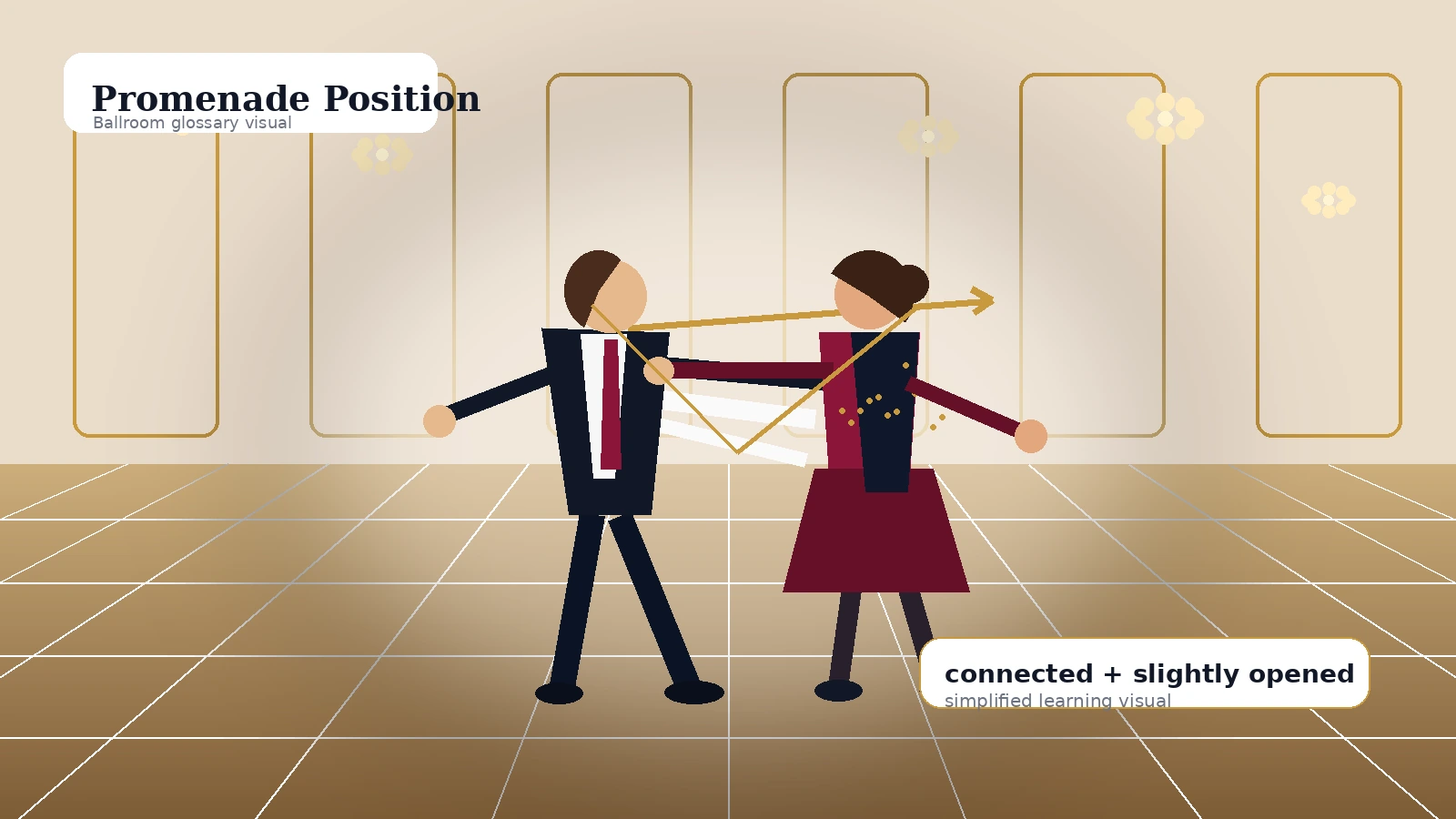
Promenade position is a ballroom partner position where the couple stays connected but opens slightly so both dancers can move in the same general direction. You may see it written as PP in dance notes, syllabus materials, or step descriptions.
If you are new to ballroom, the word can sound more complicated than the idea. Think of promenade position as a connected “opened” shape—not two people walking casually side by side, and not a completely open hand-hold position.
Quick definition of promenade position
Promenade Position PP
- Skill category
- Partner position / Connection
- Used in
- Tango, Waltz, Foxtrot, Quickstep, and related ballroom, smooth, and standard figures
- Related terms
- closed position, open position, frame, connection, line of dance, outside partner, lead and follow
Promenade position is a ballroom dance position where partners remain connected but open slightly into a V-shaped relationship so they can move in the same general direction.
Beginner translation: both partners keep a connection while opening slightly so they can travel together.
What promenade position means
Promenade position is one of the most useful ballroom position terms to know because it shows up in step names, teacher explanations, and dance diagrams. In many beginner explanations, the couple starts from a more closed partner relationship and then opens slightly so both partners can travel in the same general direction.
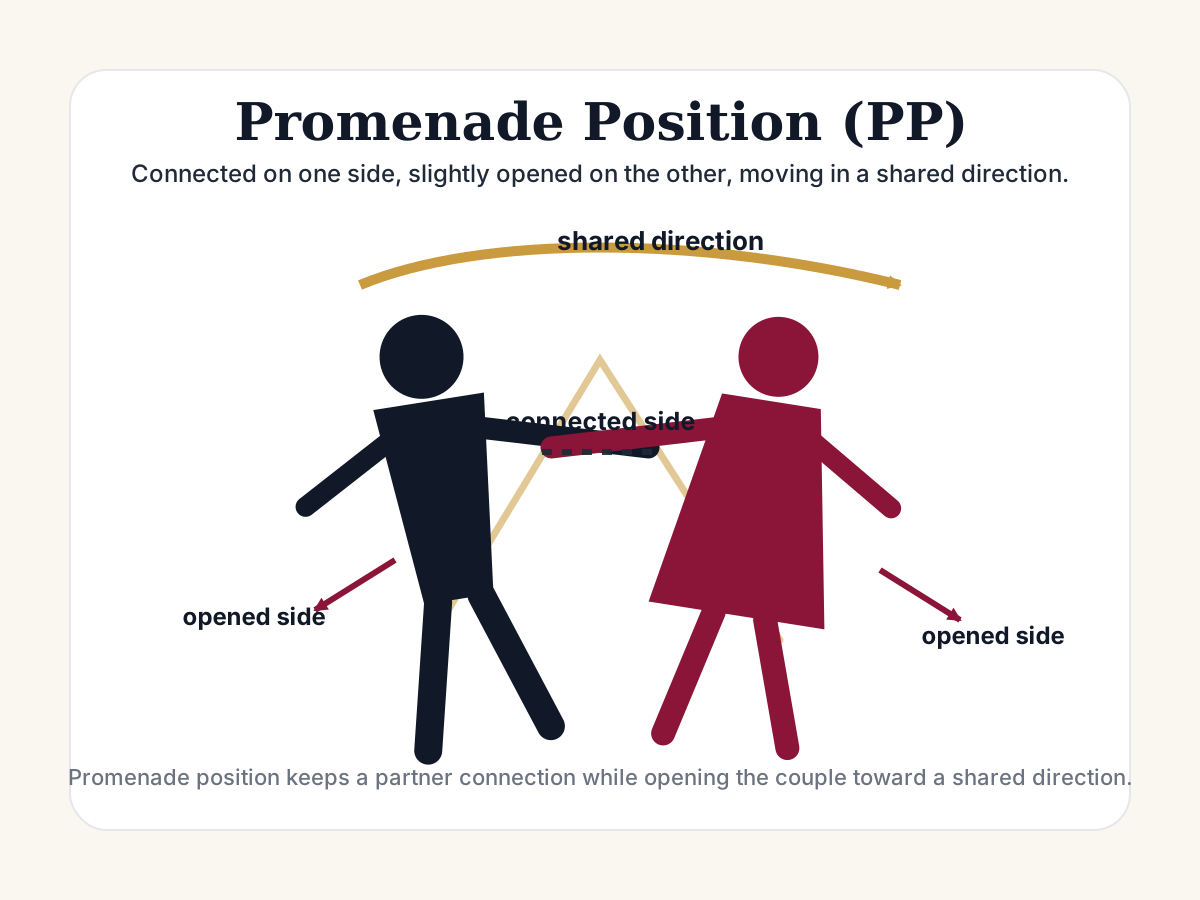
The key word is connected. Promenade position is not simply two dancers walking next to each other. The partners are still organized as a couple. Their frame, body relationship, and timing still matter.
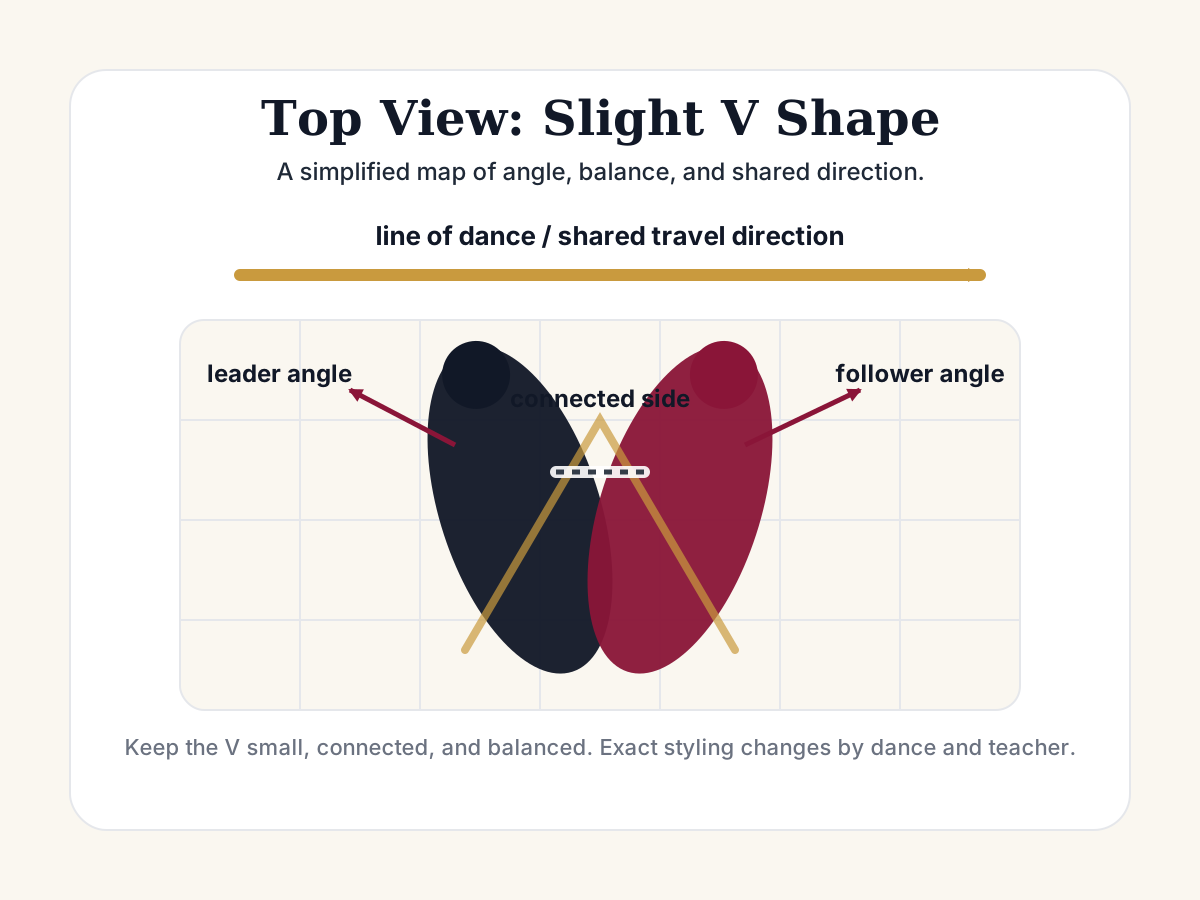
A common visual description is a V shape. One side of the partnership stays more connected, while the other side opens. This gives the couple a shared direction while preserving the feeling of partner dancing.
Exact details can vary by dance, syllabus, teacher, level, and style family. A beginner does not need to memorize every technical variation at first. It is enough to understand that promenade position is a connected, slightly opened partner shape.
Editorial note: Exact details vary by dance style, syllabus, teacher, level, and context. Use this page as a beginner-friendly definition, then refine the technique with your instructor.
Promenade position vs closed position vs open position
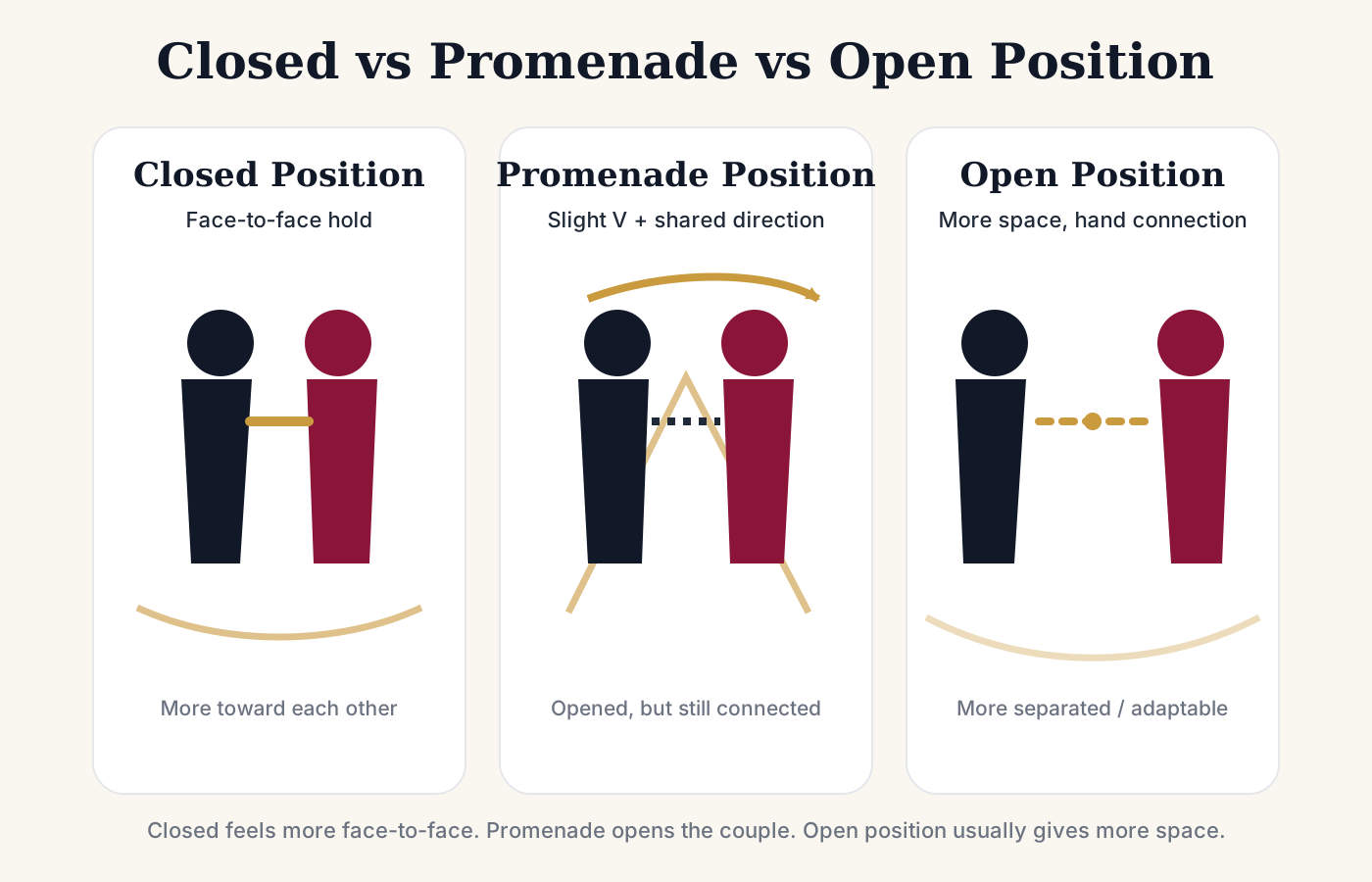
Promenade position becomes much easier to understand when you compare it with closed and open position.
| Position | Partner relationship | Body direction | Connection | Common uses | Beginner mistake |
|---|---|---|---|---|---|
| Closed position | Partners face each other closely in a ballroom hold | More toward each other | Continuous frame/body relationship | Waltz, Foxtrot, Tango, Quickstep, many basic figures | Collapsing posture or leaning on partner |
| Promenade position | Partners stay connected but open slightly into a V shape | Same general direction of travel | Connected frame with an opened side | Tango, promenade figures, smooth traveling actions | Pulling partner open or opening too wide |
| Open position | Partners are more separated, often connected by one or both hands | Often facing each other or arranged for turns/patterns | Primarily hand/arm/frame connection | Social patterns, turns, underarm actions, some Smooth/Rhythm/Latin work | Treating hand grip as the whole connection |
How promenade position feels
Promenade position should feel organized, connected, and directional. It should not feel like one partner is twisting the other partner open.
For the leader, the goal is to create a clear invitation through timing, frame, and body organization. Leading mainly with the hand usually makes promenade position feel late, tense, or uncomfortable.
For the follower, the goal is to stay balanced and responsive without guessing or over-opening. The follower should not have to collapse the frame or twist to “find” the position.
Both dancers are responsible for their own balance. If one person leans, hangs, grips, or turns too far, the position becomes harder for both partners.
The communication behind this is covered in lead and follow, and the body organization in frame and posture. See also the glossary terms frame and connection.
Where you see promenade position
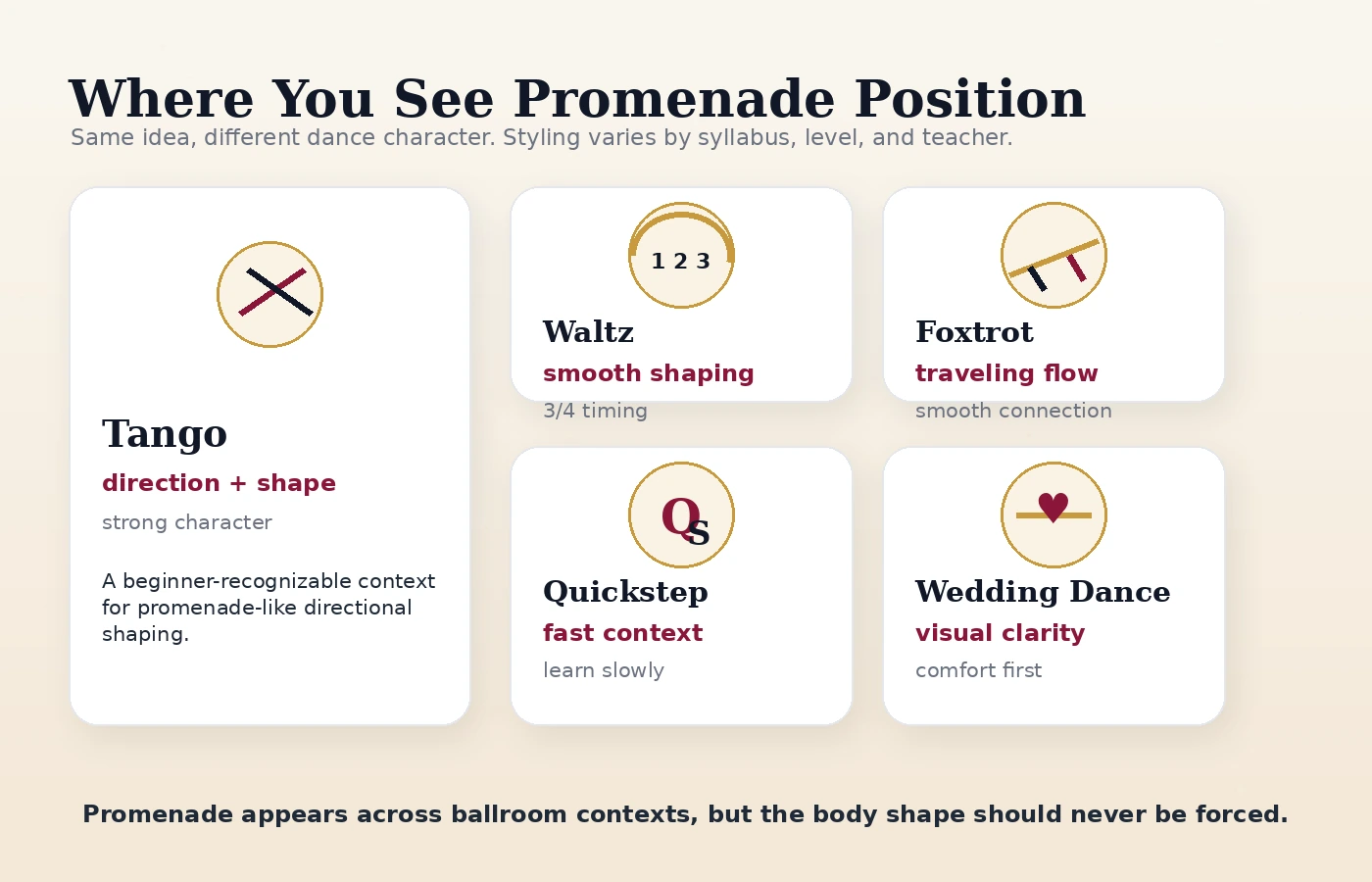
Tango
Tango is one of the most beginner-recognizable contexts for promenade position. The sharp, directional character of ballroom Tango makes the opened partner shape easier to notice. You may hear a teacher say “promenade” when describing a Tango figure or a movement that changes from closed position into a shared travel direction. See the Tango guide.
Waltz
In Waltz, promenade position may appear in figures involving promenade shaping or traveling actions. Beginners should focus first on timing, frame, and balance before trying to create a large shape. See the Waltz guide.
Foxtrot
Foxtrot often connects promenade position with smooth traveling movement. Because Foxtrot can feel subtle, the position may be less obvious to beginners than in Tango, but the same idea applies: a connected couple shape opens toward a shared direction. See the Foxtrot guide.
Quickstep
Quickstep can include promenade-position figures in Standard/ballroom contexts, but the tempo is often fast for beginners. Learn the concept slowly before trying to use it in a quick dance. See the Quickstep guide.
Wedding dance context
Promenade position can help wedding couples understand what a teacher means by “opening out” or “traveling together,” but it should not be forced into a first dance without instruction. A simple, comfortable hold and clear timing usually matter more than adding technical positions too early. See the Wedding Dance Guide.
Common promenade position mistakes
| Mistake | What it looks/feels like | Why it happens | Beginner fix |
|---|---|---|---|
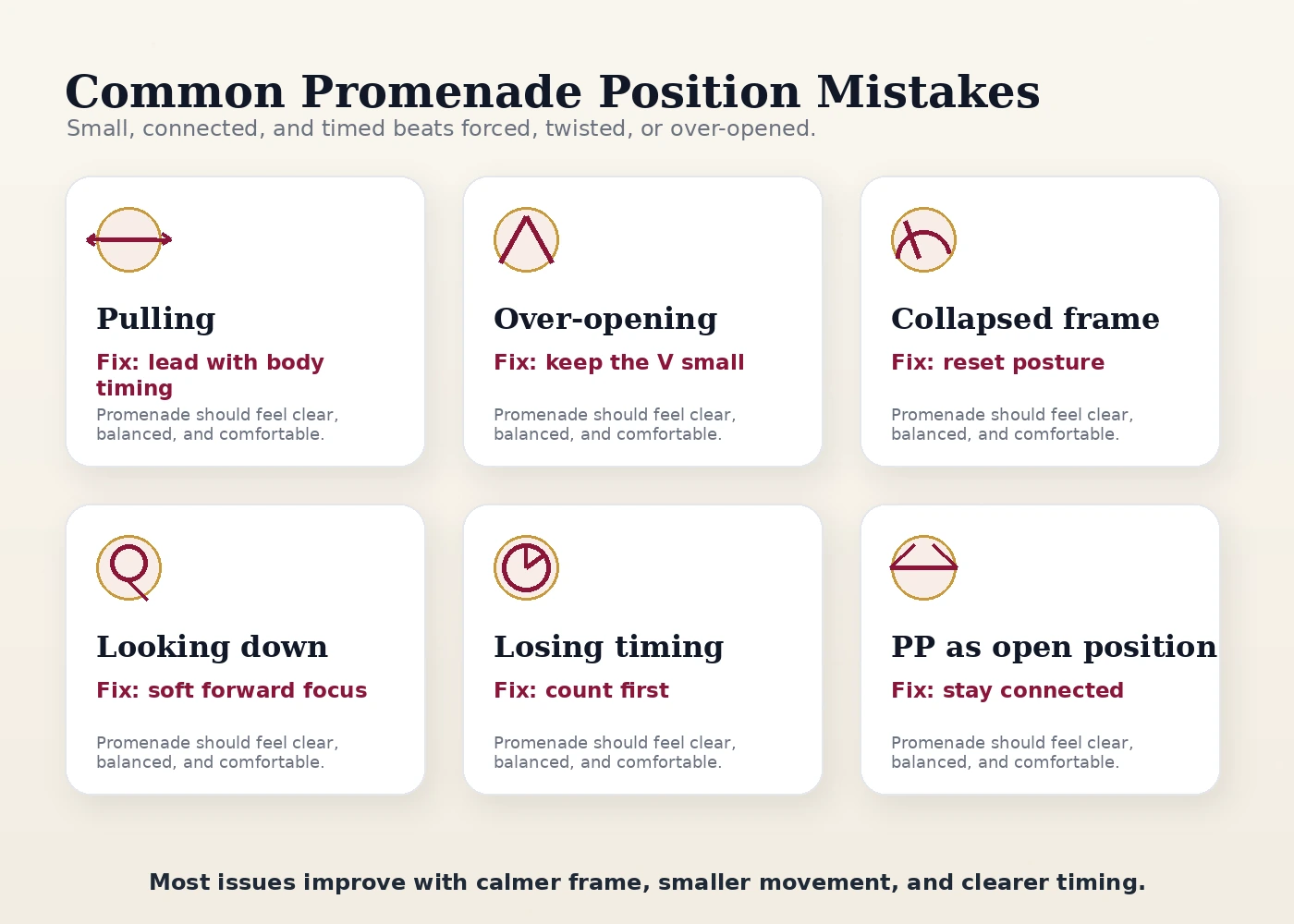
| Leading the partner open with the hand | Follower feels yanked or twisted. | Leader tries to create PP with the arm instead of body timing and frame. | Make the movement smaller; lead with body organization, not force. Lead and follow |
| Turning shoulders without moving the body | Top line twists, feet feel stuck. | Dancers think PP is only an upper-body shape. | Keep body and feet organized; ask a teacher for exact correction. Frame and posture |
| Collapsing the frame | The couple loses shape and feels heavy. | Low tone, poor posture, uncertainty. | Reset posture and keep a living frame. Frame |
| Looking down | Balance drops and direction becomes unclear. | Fear of stepping wrong. | Use soft forward focus and practice slowly. Beginner guide |
| Opening too wide | Couple separates or loses connection. | Trying to exaggerate the V shape. | Keep the opening small and connected. Connection |
| Losing timing | PP feels late or rushed. | Dancers move before agreeing with the music. | Count first; move after both partners feel the beat. Count music |
| Treating PP as open position | Partners disconnect too much. | Confusing “opened” with “open position.” | Compare closed, promenade, and open visually. Open position |
| Forgetting individual balance | One dancer hangs on the other. | Over-reliance on partner contact. | Each dancer stands over their own feet. Frame and posture |
Beginner practice notes
Note: Promenade position is a concept you can learn from a glossary page, but the exact technique is best refined with a teacher or reliable demonstration. This page is not a full step tutorial.
- Start by understanding the shape before trying to travel.
- Practice slowly and keep the movement small.
- Work on frame and lead/follow first.
- Listen to music and count before moving.
- Avoid yanking, twisting, gripping, or forcing a partner into position.
- Stop if the movement feels painful, unsafe, or confusing.
- Use slow music while learning.
Practice with music
Music helps promenade position make more sense because the position is usually connected to direction, timing, and travel. Use playlists as context, not as a substitute for instruction. If you need help finding the beat first, read How to Count Ballroom Dance Music.
Tango
Best for hearing a stronger promenade-style context and directional character.
Waltz
Useful for smooth timing and shaping.
Foxtrot / Smooth Foxtrot
Useful for traveling movement and flow.
Quickstep
Useful as context, but usually too fast for early physical practice.
SpotifyApple & YouTube to verify
Music & Timing
Best next step for learning how to count before moving.
FAQ
Promenade position FAQ
What is promenade position in ballroom dance?
Promenade position is a partner position where the couple stays connected but opens slightly into a V-shaped relationship so both partners can move in the same general direction.
What does PP mean in ballroom dance?
PP means Promenade Position. You may see the abbreviation in dance notes, step descriptions, syllabus materials, or teacher handouts.
Is promenade position the same as open position?
No. In promenade position, the couple remains connected in a slightly opened shape. In open position, partners are usually more separated and connected mainly by one or both hands.
Which dances use promenade position?
Promenade position is especially common to hear about in Tango, and it also appears in Waltz, Foxtrot, Quickstep, and other ballroom, smooth, or standard-style figures.
Is promenade position common in Tango?
Yes. Tango is one of the most beginner-recognizable places where promenade position appears because the dance often uses strong direction, shaping, and position changes.
How do you get into promenade position?
Usually, dancers move from a connected partner position into a slightly opened shape. The exact method depends on the dance, figure, syllabus, and teacher, so beginners should learn it slowly with qualified instruction rather than forcing it.
Why does promenade position feel twisted or uncomfortable?
It often feels twisted when one partner pulls with the hand, opens too wide, collapses frame, turns only the shoulders, or loses balance. The fix is usually smaller movement, clearer timing, and better frame—not more force.
Can beginners learn promenade position?
Yes, beginners can understand the concept early, but the physical technique should be practiced slowly. Start with the idea of connected direction before attempting fast or complicated figures.
Do both partners look the same direction in promenade position?
Often the couple is oriented toward a shared direction of travel, but exact head position and styling vary by dance, syllabus, and teacher. A diagram can help with the basic idea, but in-person correction is best for details.
Editorial
Sources and editorial note
This glossary guide should be reviewed periodically by a qualified ballroom instructor, experienced competitor, adjudicator, or equivalent ballroom professional. For technical diagrams, use instructor-reviewed assets before final publication.
Suggested sources
- University of Georgia ballroom terminology reference
- NDCA Vocabulary of Dance Positions, Holds and Proximities
- WDSF DanceSport discipline descriptions
- Dance Central position and partnering reference
- Ballroom Pages legacy playlist pages for music-practice links
This is dance terminology, not medical advice. Ballroom Pages follows an editorial policy of education-first guidance. Questions? Contact us. Updated May 22, 2026.