
Glossary
CBM (Contra Body Movement)
CBM sounds technical, but it is just the natural twist your body makes when you walk—right foot forward, left side following. In ballroom, that same counter-rotation is what starts nearly every turn. Here is what contra body movement really is, how it differs from CBMP, the dances that rely on it, and how to feel it in your own body.
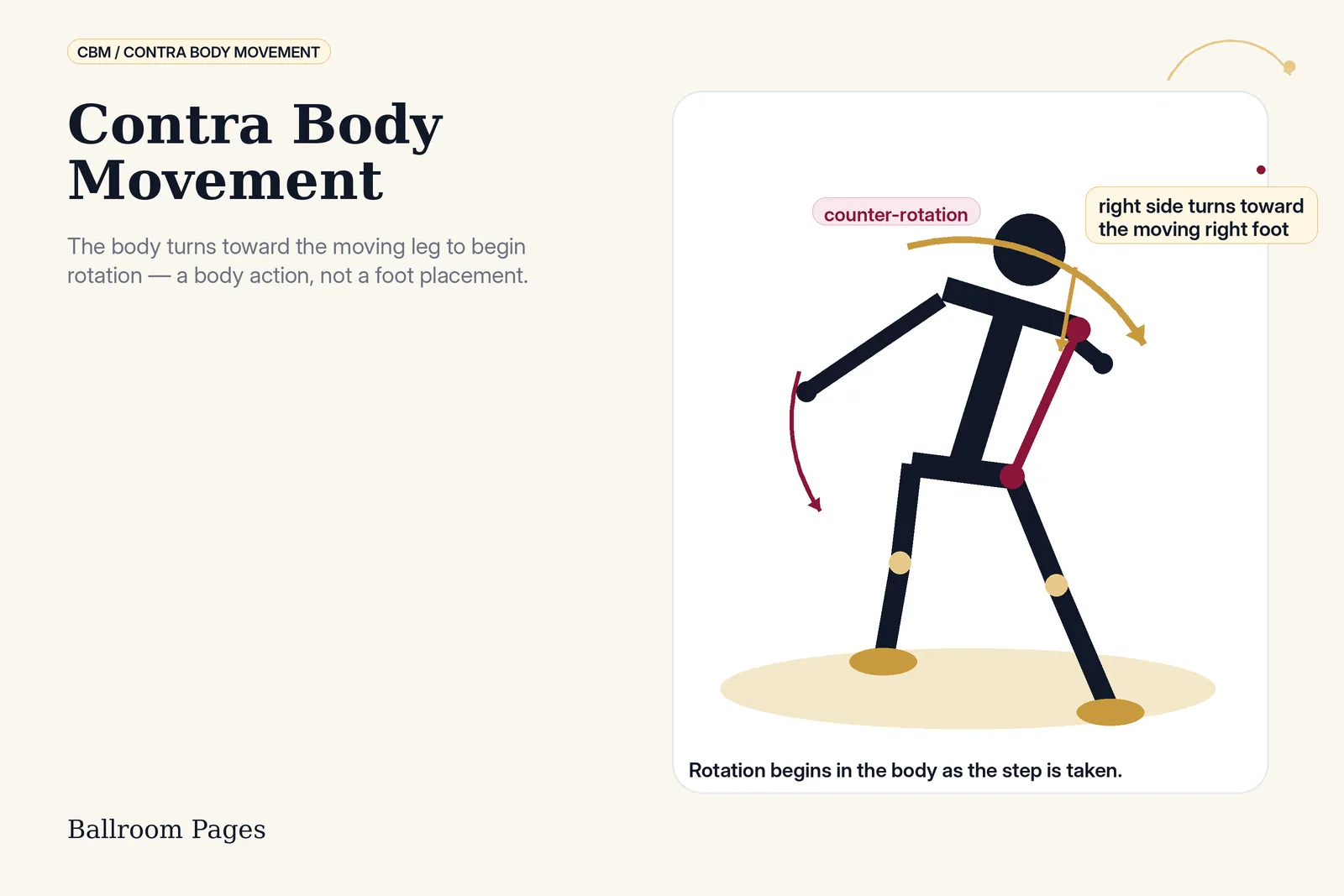
Definition of CBM
Contra body movement (CBM)
- Pronunciation
- C-B-M
- Skill category
- Technique & turns
- Companion term
- Pivot (a figure that relies on CBM)
- Related terms
- contra body movement position (CBMP), pivot, natural turn, reverse turn, alignment, sway
In ballroom dance, contra body movement (CBM) is turning the body—hips and shoulders together—toward the moving leg on a forward or backward step. It initiates rotation, helps the dance progress, and is the natural counter-rotation you already do when you walk.
CBM is a movement. CBMP is a foot position. They sound alike and are constantly confused.
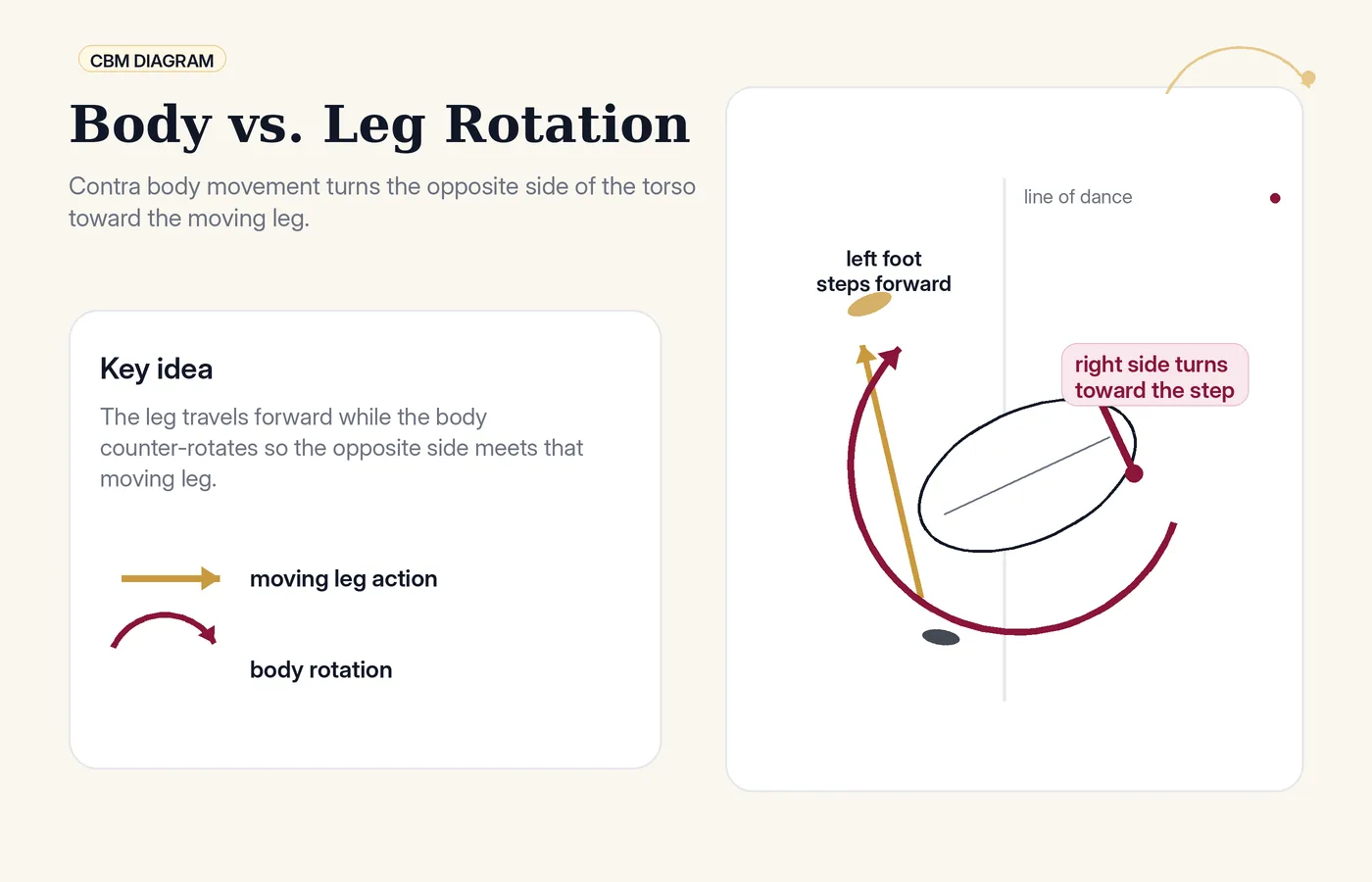
What contra body movement means in ballroom dance
Contra body movement is a rotation of the torso against the legs. When you step forward with your right foot, your left hip and left shoulder come forward to meet it—the body turns one way while the leg swings the other. That opposition is CBM.
It is not an exotic ballroom invention. It is exactly what your body does when you walk naturally: opposite arm and leg swing together. Ballroom simply takes that instinct and uses it deliberately—to begin a turn, to keep movement flowing down the floor, and to give figures a finished, connected look.
CBM is used across the Standard and Smooth dances—Waltz, Foxtrot, Tango, and Quickstep—wherever a figure needs to rotate.
CBM vs CBMP
The single most common confusion in this topic. They share three letters and nothing else:
| CBM (movement) | CBMP (position) |
|---|---|
| An action: the body turns toward the moving leg | A position: the foot is placed on or across the line of the other foot |
| Happens on forward or backward steps | Can occur without any body rotation at all |
| Used to start a turn | Used for shape, line, and certain figures (e.g. in Tango) |
| You feel it in the torso | You see it in the feet |
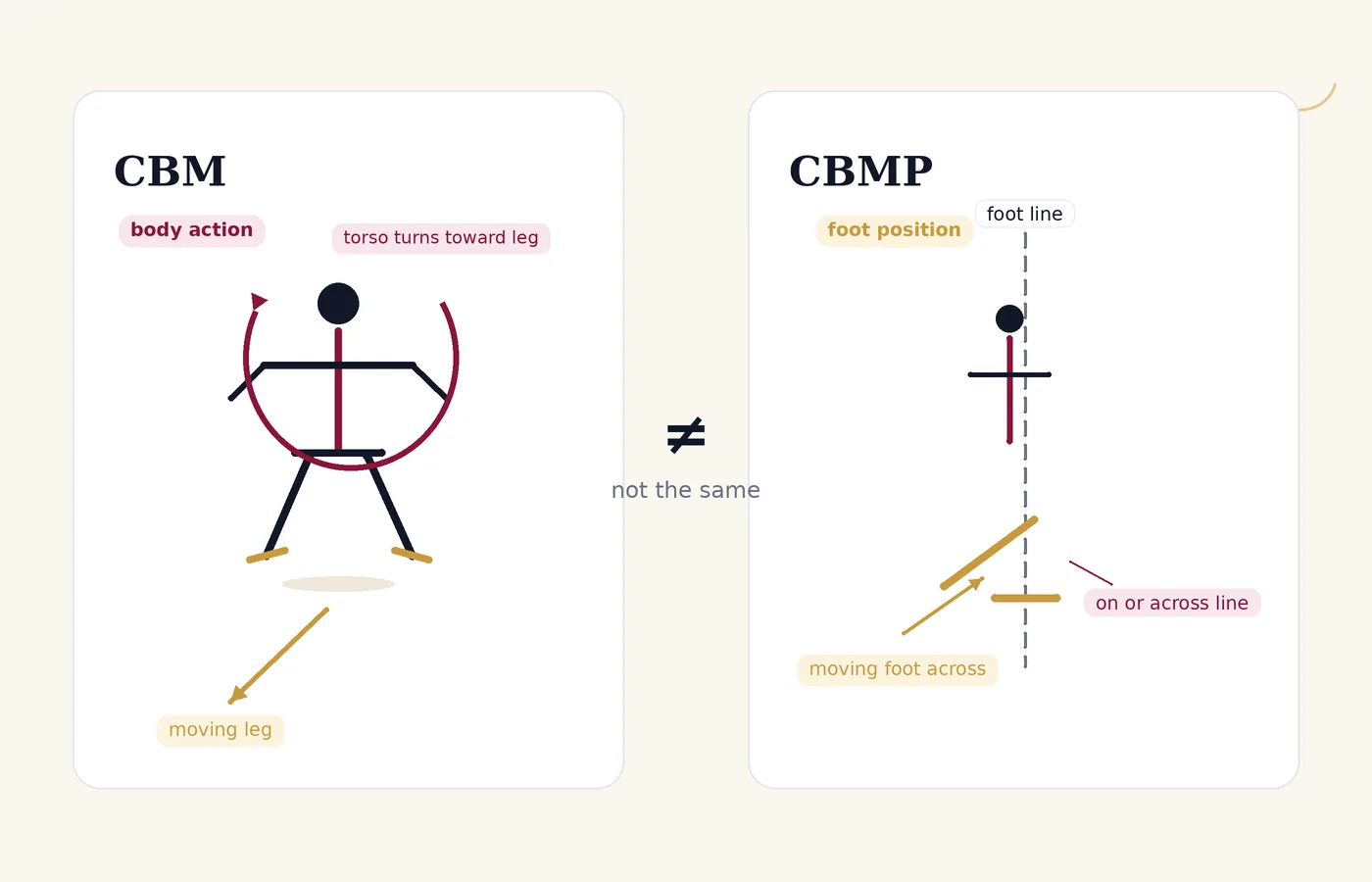
Short version: CBM is something the body does; CBMP is somewhere the foot is. A step can have one, both, or neither.
How CBM works
Three rules make CBM correct rather than a random twist:
The three rules of CBM
- Turn toward the moving leg. Right side toward a stepping right leg, left side toward a stepping left leg.
- Body and leg move together. The rotation and the step happen at the same time, not one after the other.
- Forward or backward only. CBM belongs on progressive steps. There is no CBM on a pure side step.
Because the rotation is set up as the step is taken, CBM gives a turn its momentum before the turn even begins. That is why teachers treat it as the engine of Standard turning figures.
Where CBM is used
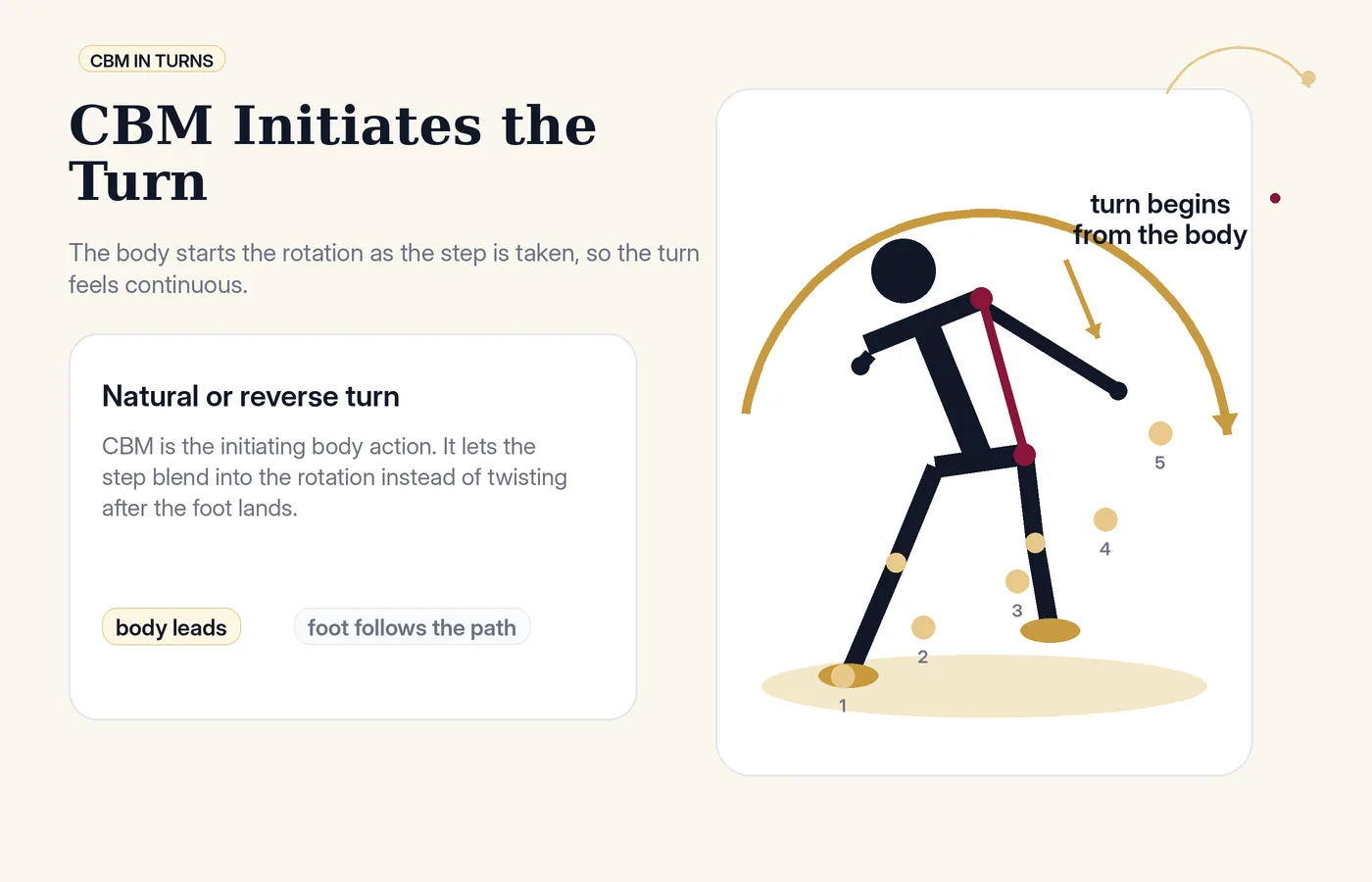
CBM shows up wherever a Standard or Smooth figure rotates:
- Natural turn and reverse turn. CBM starts the rotation into both.
- Pivots. The forward step into a pivot uses CBM to establish the turn.
- Progression. A touch of CBM helps figures travel cleanly down the line of dance.
- Styling. Even where no turn follows, a little CBM gives movement a connected, intentional look.
Note: this site also has a contra body movement entry. CBM and contra body movement are the same thing—this page is the fuller guide.
Common CBM mistakes
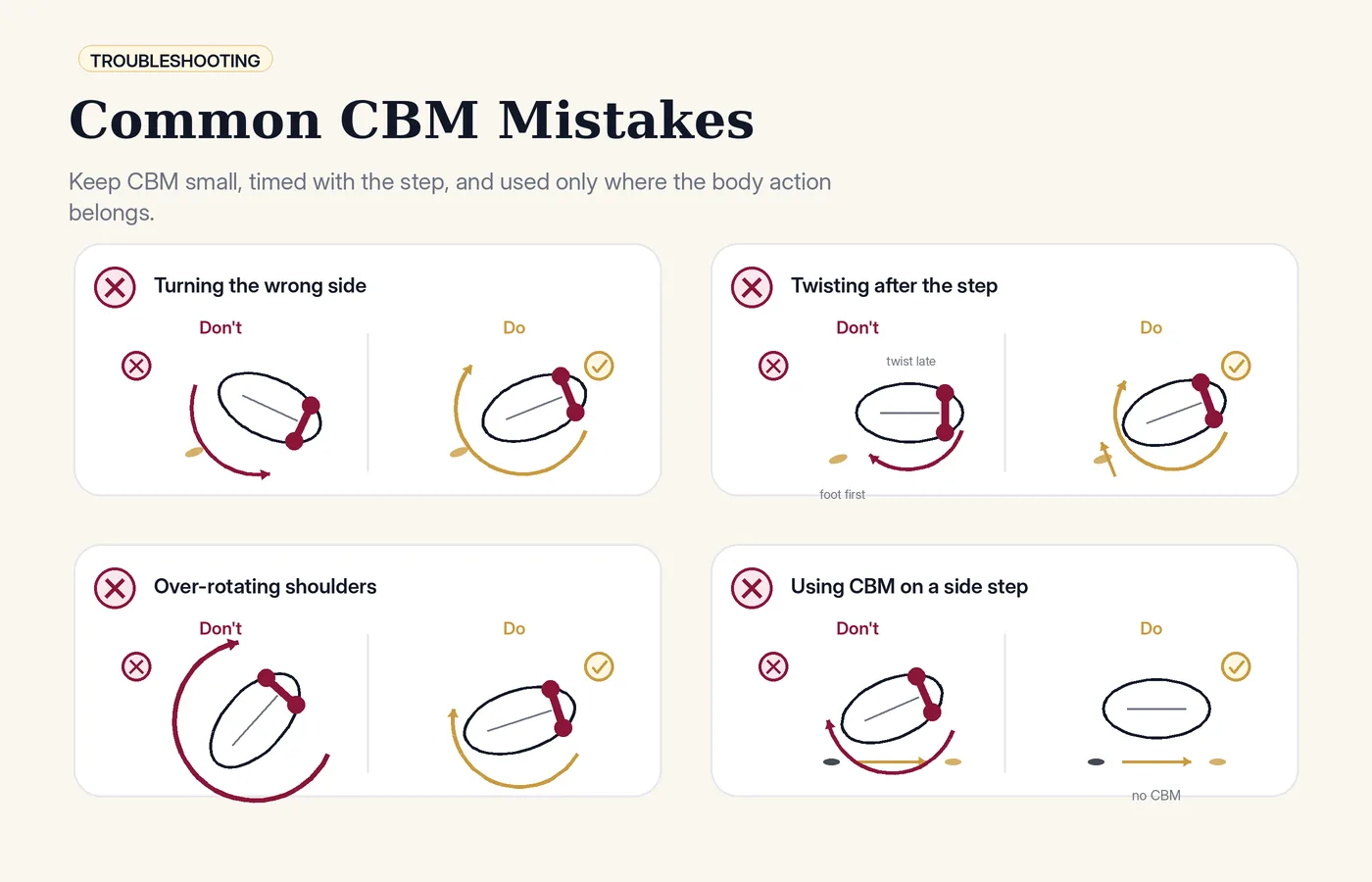
Turning the wrong side
Fix: The side that turns is the side of the moving leg. Right leg forward, right side forward.
Twisting after the step
Fix: Body and leg move together. Late rotation kills the turn’s momentum.
Over-rotating
Fix: CBM is a subtle initiation, not a big shoulder swing. A small, timed turn is enough.
Using CBM on side steps
Fix: CBM belongs on forward and backward steps only. Side steps do not take it.
Confusing it with CBMP
Fix: CBM is a body action; CBMP is a foot position. Know which one the figure calls for.
Practice CBM
CBM is easiest to feel slowly, on your own, before adding a partner:
- Exaggerated walks. Walk forward and deliberately bring the same-side hip and shoulder forward with each step. Feel the natural twist.
- Step and turn. Take a forward step with CBM and let a small turn happen from it. Notice the body leading the rotation.
- Slow Waltz box. Add a touch of CBM to the forward step of a box and feel how the turn begins more easily.
-
Waltz (CBM into turns)
3/4 Standard. Practice CBM on the forward step of natural and reverse turns.
-
Foxtrot (smooth CBM)
Long, gliding steps. Feel CBM aid progression down line of dance.
-
Tango (marked CBM)
Sharper body action. Practice clear, timed rotation into figures.
-
BallroomPages Music (Telegram)
Mixed-style practice tracks. Turn and CBM drills coming soon.
FAQ
CBM FAQ
What is contra body movement in dance?
Contra body movement (CBM) is turning the body—hips and shoulders together—toward the moving leg on a forward or backward step. It is the natural counter-rotation of walking, used in ballroom to start turns and aid progression.
What is the difference between CBM and CBMP?
CBM is a movement: the body rotates toward the moving leg. CBMP (contra body movement position) is a position: the moving foot is placed on or across the line of the standing foot. CBM is felt in the torso; CBMP is seen in the feet.
Which dances use CBM?
CBM is used throughout the Standard and Smooth dances—Waltz, Foxtrot, Tango, and Quickstep—wherever a figure needs to rotate, such as natural turns, reverse turns, and pivots.
Does CBM happen on side steps?
No. CBM occurs only on forward and backward steps (including diagonal steps that still travel forward or back). A pure side step does not use CBM.
Is CBM the same as leading a turn?
CBM is what initiates the rotation of a turn in your own body; the lead communicates that turn to your partner through the frame. CBM starts the turn; the frame shares it.
Editorial
Sources and review notes
This glossary entry should be reviewed by a qualified ballroom instructor before launch. CBM technique follows widely accepted conventions from ISTD, NDCA, and standard Ballroom and Standard syllabus materials. The CBM versus CBMP distinction is a common exam point—confirm the specifics with your coach or syllabus provider.
This is dance terminology, not medical advice. Ballroom Pages follows an editorial policy of education-first guidance. Questions? Contact us. Updated July 9, 2026.