Ballroom Glossary · Turns

Natural Turn

A Natural Turn is a ballroom dance term for a right-turning figure or action. In simple beginner language: natural usually means the couple turns to the right, while reverse usually means the couple turns to the left.

You may hear “Natural Turn” in Waltz, Viennese Waltz, Quickstep, Foxtrot, and related ballroom figures. The exact steps, timing, alignment, and amount of turn can change by dance, syllabus, level, and teacher, so this page explains the meaning first—not a full step pattern.

In ballroom dance, a Natural Turn generally rotates the couple to the right, or clockwise when viewed from above.

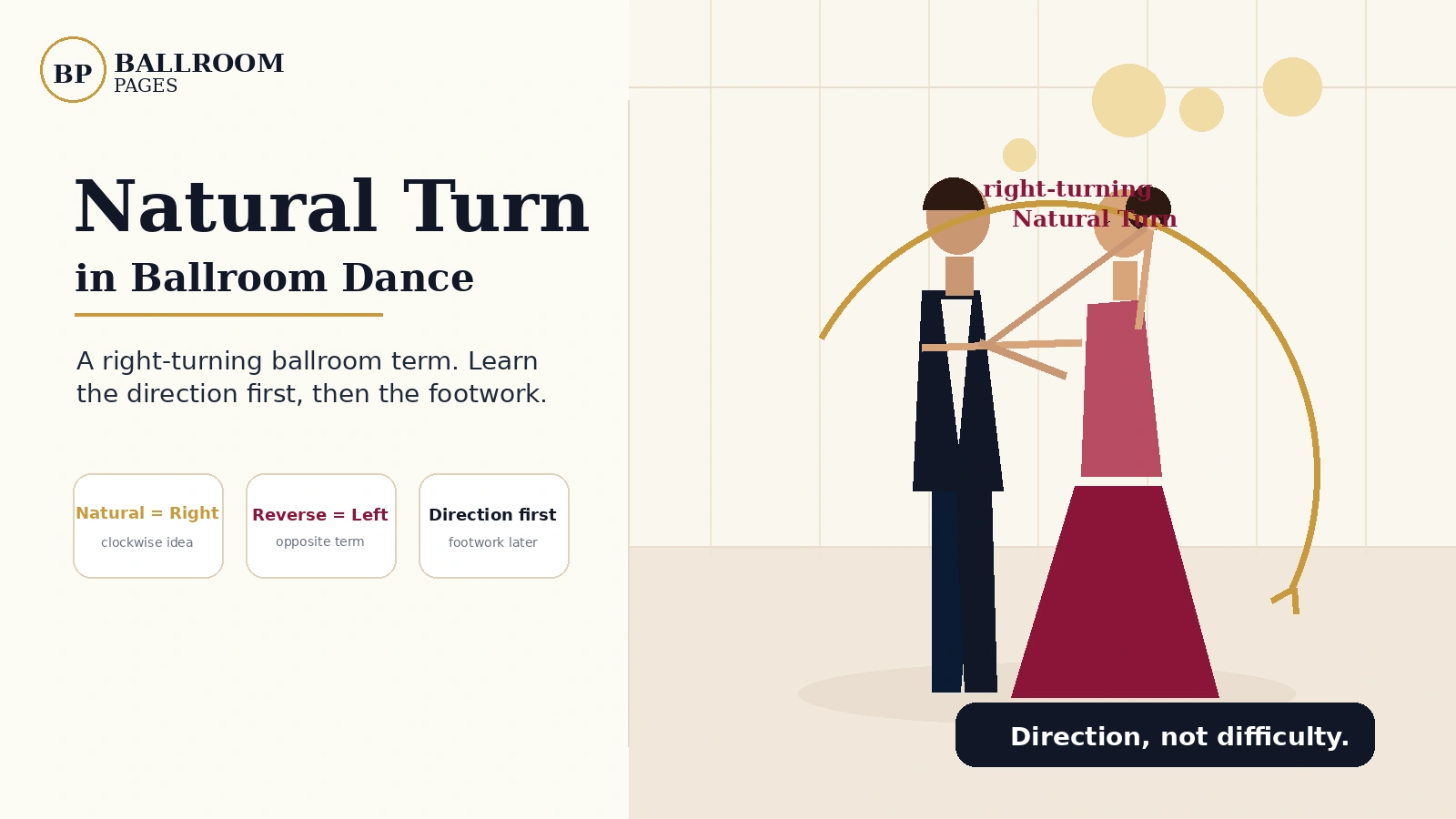
Ballroom couple in a connected frame with subtle curved arrows showing the idea of a right-turning Natural Turn.

Quick definition of Natural Turn

Natural Turn

Used for
Ballroom turning figures and right-turning actions
Basic meaning
A natural turn generally rotates to the right, or clockwise for the couple when viewed from above.
Opposite term
Reverse Turn
Commonly connected with
Waltz, Viennese Waltz, Quickstep, Foxtrot, Natural Spin Turn, Natural Weave, Natural Pivot Turn
Beginner translation
“Natural” usually tells you the direction of turn, not the difficulty level.

What Natural Turn means

A Natural Turn is a turning action or named figure used in ballroom dance. The word natural is not about whether the step feels easy. It is mainly a direction word.

In most beginner explanations:

  • Natural Turn = turn to the right.
  • Reverse Turn = turn to the left.

That definition sounds simple, but it becomes important because many ballroom figures use the same naming logic. Once you understand natural and reverse, names like Natural Spin Turn, Natural Weave, Natural Pivot Turn, and Reverse Turn start to make more sense.

A teacher may say “natural turn” in two different ways. Sometimes they mean a specific syllabus figure in a dance such as Waltz. Other times they may be helping you understand the direction of a right-turning action. The context matters.

Teacher note: Natural means direction. It does not mean the step will feel natural on your first try.

Natural Turn vs Reverse Turn

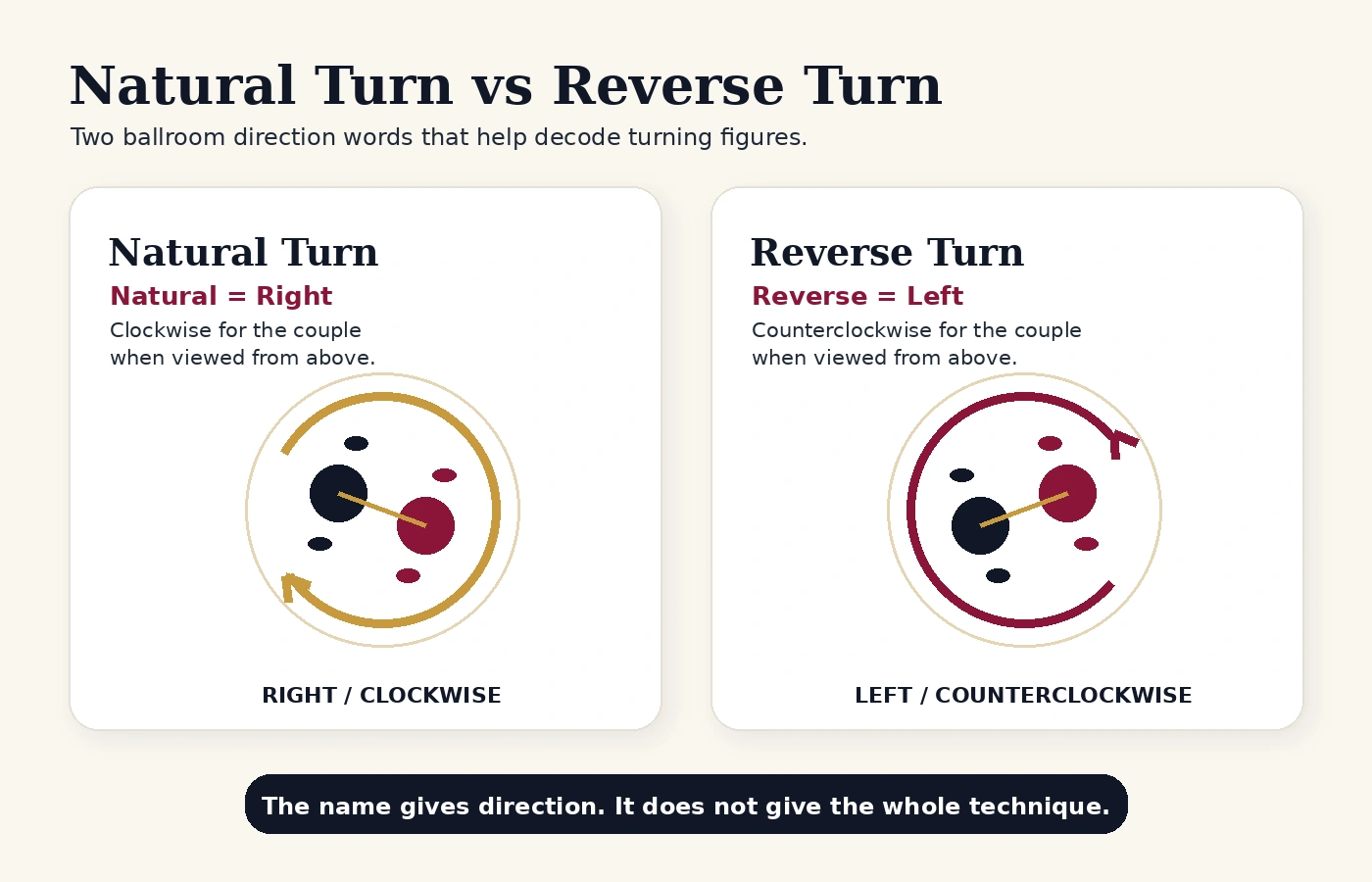
Diagram comparing Natural Turn as right-turning clockwise rotation and Reverse Turn as left-turning counterclockwise rotation.
Natural and reverse describe opposite turning directions. Diagram review: pending qualified ballroom instructor review.
Natural and Reverse are directional companion terms
TermBasic directionBeginner translationCommon confusion
Natural TurnRight-turning / clockwise for the couple“Turn right”Thinking natural means easy
Reverse TurnLeft-turning / counterclockwise for the couple“Turn left”Confusing reverse with going backward
Both termsUsed in rotating ballroom dances and figuresDirection labelsApplying one dance’s exact footwork to every dance

Natural and reverse turns both require timing, balance, frame, and awareness of line of dance. The name tells you the basic direction, but it does not give you the whole technique. For the left-turning side, see Reverse Turn.

Where you’ll see Natural Turns

Waltz

Waltz is one of the strongest beginner examples. A teacher may say “Natural Turn” to describe a right-turning Waltz figure. Before worrying about exact footwork, notice the big idea: the couple rotates to the right while staying connected through the frame.
Waltz Dance Guide

Viennese Waltz

Viennese Waltz is built around continuous rotation, so natural and reverse turning ideas are especially useful. Treat it as listening/context first if you are new; the tempo can be demanding.

Viennese Waltz Guide

Quickstep

Quickstep includes natural-turning figures, but the tempo is faster and the exact figure names and timing can vary by syllabus and level. Beginners should understand the right-turning idea first, then learn the actual figure with an instructor.

Quickstep Guide

Foxtrot / Slow Foxtrot

Foxtrot can include Natural Turn and related natural-turning figures, but Foxtrot movement quality and footwork are not the same as Waltz. Natural points to a right-turning family of movement, while the dance-specific technique belongs in a proper Foxtrot guide or lesson.

Foxtrot Dance Guide

Related natural-turning figures

You may also see “natural” in figure names such as Natural Spin Turn, Natural Pivot Turn, Natural Weave, Natural Twist Turn, and Natural Telemark. Do not try to learn all of those from this page. Use the word natural as a clue: the figure probably has a right-turning relationship.

Beginner example

In Waltz, a teacher may say “natural turn” to describe a right-turning figure. Before worrying about heel leads, rise and fall, exact alignments, or the full six-step pattern, notice this:

The couple is rotating to the right while staying connected through the frame and moving with the music.

That is enough for a beginner glossary understanding. Full footwork belongs in a separate lesson or step tutorial.

Why Natural Turn matters

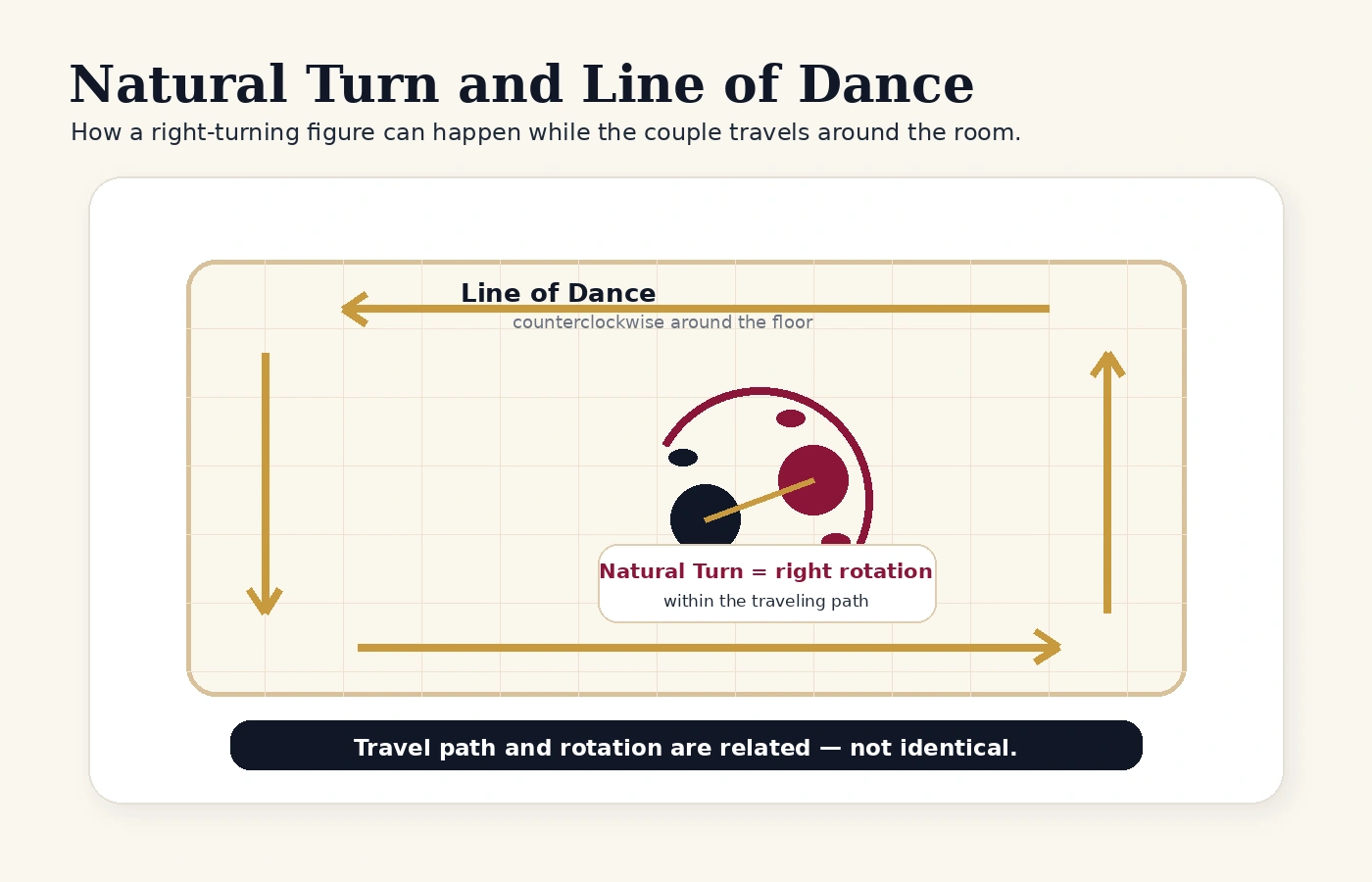
Diagram showing a Natural Turn rotating to the right while the couple travels along the counterclockwise line of dance.
Natural Turn helps beginners connect turning direction with floor travel. Diagram review pending.

Natural Turn matters because it helps you decode ballroom language. Instead of memorizing step names as random labels, you can start reading the words. It helps you understand:

  • Direction: natural usually means right-turning.
  • Opposite terms: reverse usually means left-turning.
  • Floorcraft: turning direction relates to how couples travel around the room.
  • Line of dance: ballroom couples usually move counterclockwise around the floor — see line of dance.
  • Figure names: Natural Spin Turn, Natural Pivot Turn, and Natural Weave become less mysterious.
  • Partner connection: turning is not just spinning your shoulders; the whole partnership has to stay organized.

A useful beginner goal is not “perfect Natural Turn.” A better goal is: can I recognize the direction and stay balanced while counting the music? Build the underlying skills with lead and follow, frame and posture, and how to count ballroom dance music.

Common mistakes

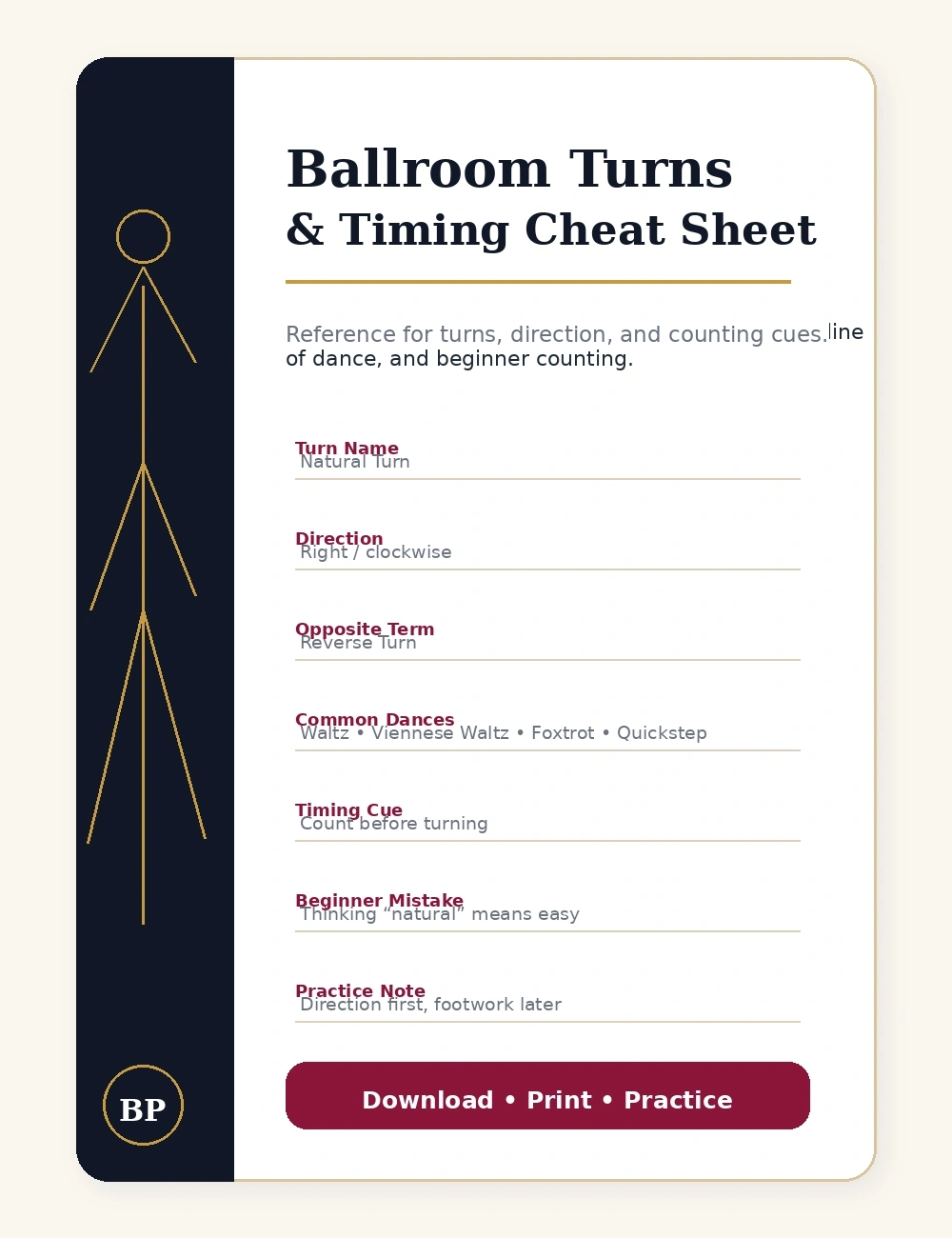
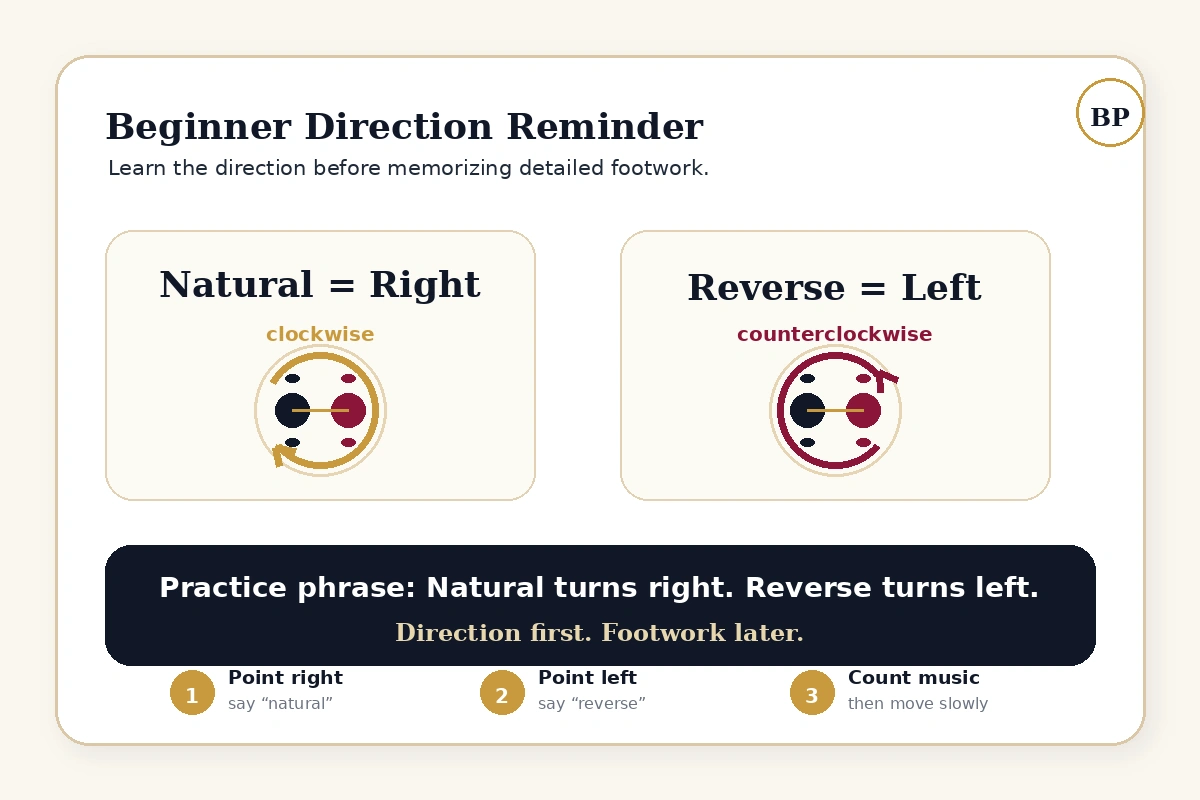
Beginner practice card showing natural equals right, reverse equals left, with arrows for clockwise and counterclockwise rotation.
Direction first, footwork later.
  • 1. Thinking “natural” means easy

    You feel frustrated because the movement does not feel natural yet.

    Fix: Treat natural as a direction word: natural = right.

  • 2. Confusing natural and reverse

    You turn the wrong way or lose the pattern.

    Fix: Say it out loud: “natural right, reverse left.”

  • 3. Turning only the shoulders

    The upper body twists, but the feet and partnership do not travel clearly.

    Fix: Learn direction first, then practice with a teacher who can correct body, feet, and frame.

  • 4. Leading with the arms alone

    The follower feels dragged or twisted.

    Fix: Keep the movement small and work on frame, timing, and body organization.

  • 5. Losing frame

    The couple collapses or separates during the turn.

    Fix: Reset posture, reduce step size, and return to lead-and-follow basics.

  • 6. Looking down

    Balance drops and the turn becomes late.

    Fix: Use a soft forward focus and practice slowly.

  • 7. Ignoring line of dance

    The turn points the couple into traffic or into the middle of the room unexpectedly.

    Fix: Learn line of dance before trying traveling turns in social space.

  • 8. Applying Waltz footwork to every dance

    Quickstep or Foxtrot feels wrong even though the name sounds familiar.

    Fix: Remember: same directional idea, different dance technique.

Practice tips

Note: These notes are for understanding the term, not mastering the full figure. Use an instructor or reliable demonstration when learning actual footwork.

  1. Face a wall and point to your right. Say, “natural.”
  2. Point to your left. Say, “reverse.”
  3. Draw a small clockwise arrow with your finger. Say, “Natural Turn.”
  4. Draw a small counterclockwise arrow. Say, “Reverse Turn.”
  5. Walk a very small right-turning pathway by yourself without a partner.
  6. Clap or count Waltz music before attempting any turning figure.
  7. Practice in safe spacing; do not try traveling turns in a crowded room.
  8. With a partner, keep the movement small and avoid pulling, twisting, or forcing.
Practice phrase: Natural turns right. Reverse turns left. Direction first, footwork later.

Hear the Natural Turn in Waltz and ballroom music

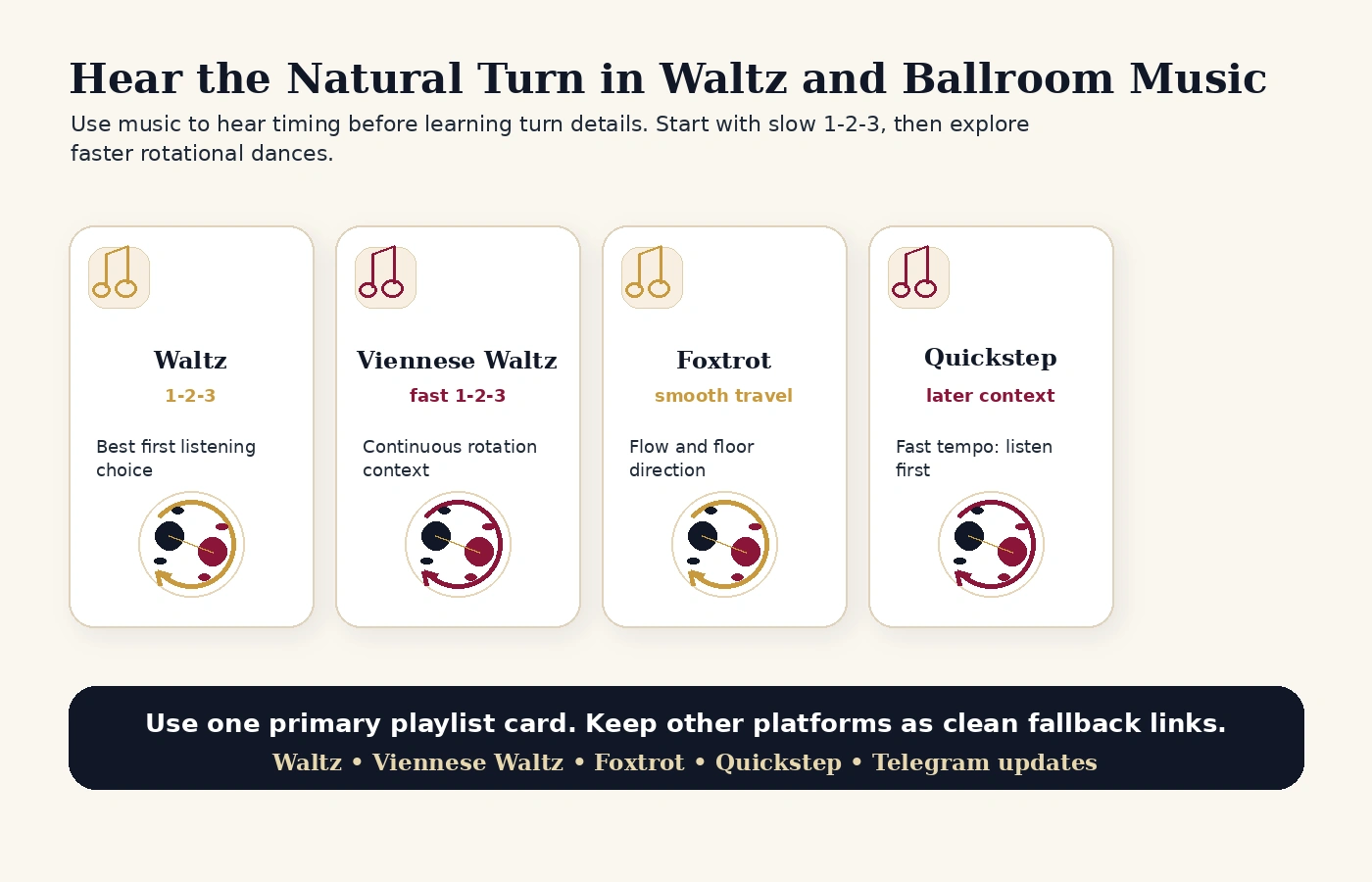
Ballroom Pages playlist cards for Waltz, Viennese Waltz, Foxtrot, Quickstep, and Music & Timing.
Use music to hear timing before learning turn details.

Music helps the term feel less abstract. A Natural Turn is not just a shape; it happens in time. Start by listening to the rhythm and counting before trying to dance the full figure.

Waltz Playlist

Best first listening choice for slow 1-2-3 timing. Listen, then count before adding any turn.

FAQ

Natural Turn FAQ

  • What is a Natural Turn in ballroom dance?

    A Natural Turn is a ballroom term for a right-turning figure or action. In many contexts, the couple rotates clockwise when viewed from above.

  • Why is it called a Natural Turn?

    For beginners, the most important point is that natural means right-turning, not easy. Some references connect the name to right-turning movement in closed ballroom position and line-of-dance travel, but you should treat it first as a directional term.

  • Is a Natural Turn clockwise or counterclockwise?

    A Natural Turn is generally clockwise for the couple when viewed from above. A Reverse Turn is generally counterclockwise.

  • What is the difference between a Natural Turn and a Reverse Turn?

    Natural Turn means right-turning. Reverse Turn means left-turning. Both can appear in rotating ballroom dances, and both require timing, balance, frame, and floor awareness.

  • What dances use a Natural Turn?

    Natural Turn is strongly associated with Waltz and Viennese Waltz and also appears in Quickstep, Foxtrot, and related ballroom figures. Exact steps and timing vary by dance and syllabus.

  • Is a Natural Turn the same in Waltz and Quickstep?

    No. The directional idea is related, but the timing, character, footwork, and amount of turn can differ. Do not apply Waltz footwork to Quickstep without instruction.

  • Is Natural Turn hard for beginners?

    The concept is simple: natural means right. The physical figure can take practice because it involves timing, balance, frame, and coordinated partner movement.

  • Do I need a partner to practice the idea of a Natural Turn?

    No. You can practice recognizing right vs left rotation, drawing clockwise and counterclockwise arrows, and counting Waltz music alone. You need a partner or instructor to practice true partner connection and full figure technique.

Editorial

Editorial note

This glossary entry explains the beginner-friendly meaning of Natural Turn. Reverse Turn details, exact footwork, timing, and amount of turn vary by dance style, syllabus, teacher, level, and context. Use this page as a plain-English reference and confirm dance-specific technique with a qualified instructor. Final technical diagrams should be reviewed by a qualified ballroom instructor before launch.

This is dance terminology, not medical advice. Ballroom Pages follows an editorial policy of education-first guidance. Questions? Contact us. Updated May 22, 2026.