
Glossary
Natural Spin Turn in Ballroom Dance
The natural spin turn is usually the first figure that makes a beginner feel like they are really dancing—half a natural turn, then a controlled spin that carries the couple down the floor. It is a staple of Waltz and Quickstep, and its underturned version is the classic way to turn a corner. Here is what it is, how the steps fit together, and how to keep the spin from turning into a stumble.
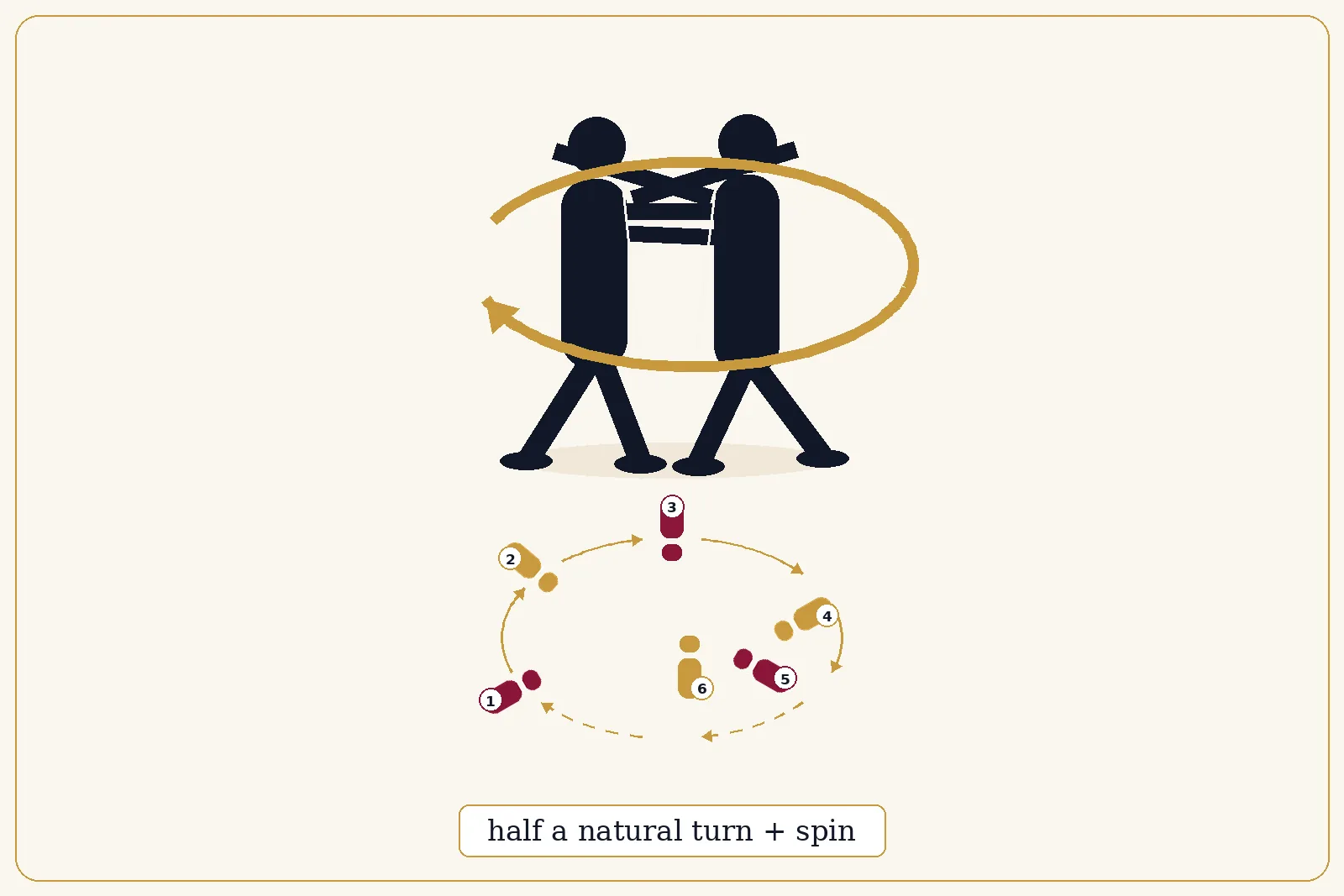
Definition of natural spin turn
Natural Spin Turn
- Also called
- Spin turn
- Skill category
- Figures & turns
- Companion term
- Natural turn (its first half)
- Related terms
- pivot, reverse turn, alignment, CBM, frame
The natural spin turn is a ballroom figure danced in Waltz and Quickstep: the first three steps of a natural turn followed by a pivoting spin, advancing the couple about five-quarters of a turn down the line of dance. Danced underturned, it is the classic way to turn a corner.
Think of it as a natural turn that trades its second half for a spin.
What the natural spin turn is
Ballroom figures come in families, and the natural spin turn belongs to the turning family that rotates to the right—the “natural” direction. It is built from two pieces you may already know: the first half of a natural turn, and a pivot-based spin. Danced at full amount, it rotates the couple roughly five-quarters of a full turn while traveling down the line of dance.
It appears very early in the syllabus—most dancers meet it as a Newcomer or Pre-Bronze Waltz figure—because it solves a practical problem: it lets a couple keep traveling and rotating without endlessly repeating the same box-like turns. It is also most beginners’ first taste of pivoting action, which is why it gets drilled so much: the spin either feels effortless or chaotic, and the difference is technique, not talent.
The steps, in plain English
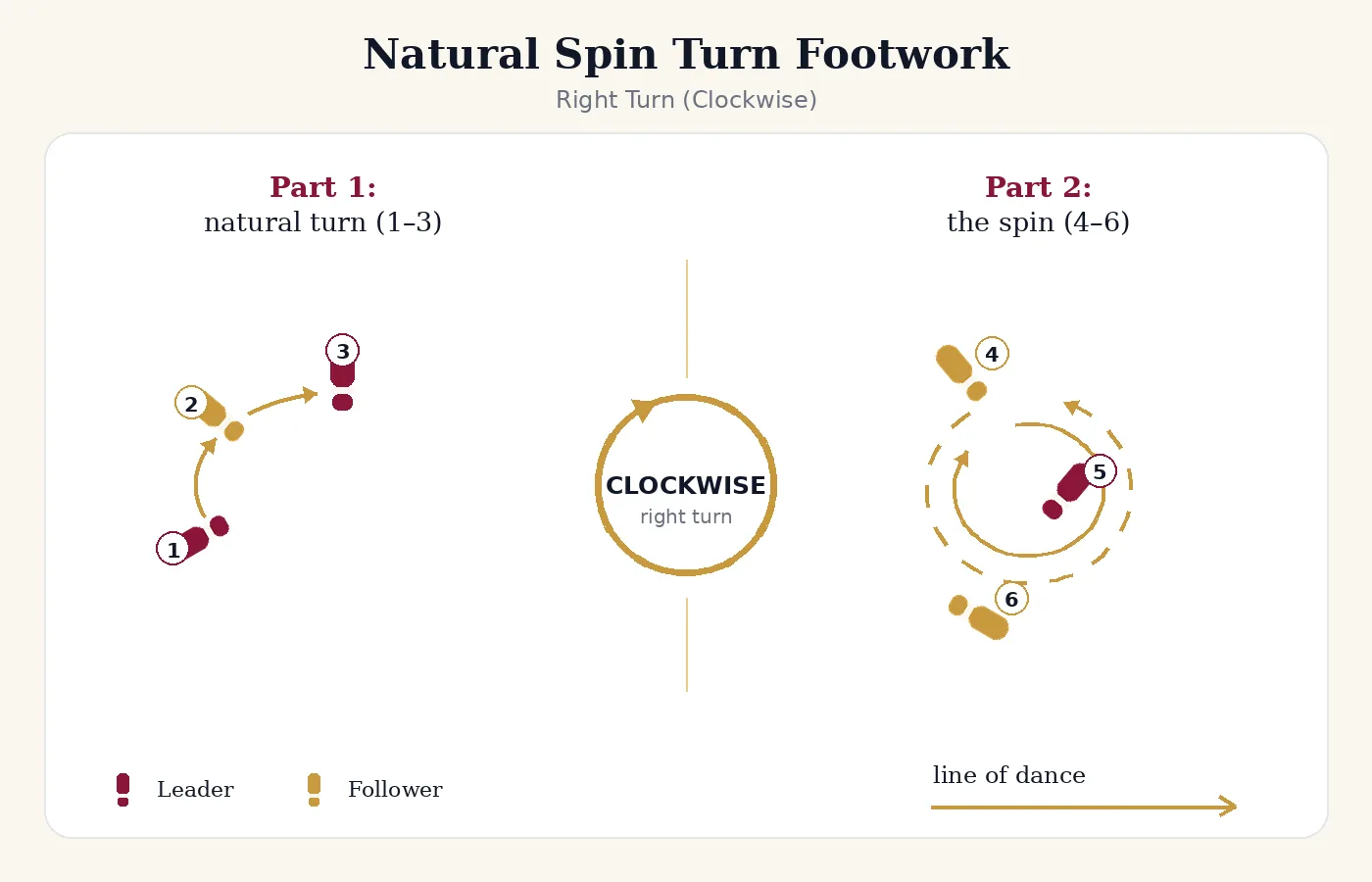
Six steps, two halves. Here is the leader’s pattern in Waltz (the follower dances the mirrored counterpart):
Part one — half a natural turn (steps 1–3)
- Step 1: Right foot forward, starting to turn right, facing diagonal to the wall.
- Step 2: Left foot to the side, still turning across the line of dance.
- Step 3: Right foot closes to the left foot—the leader is now backing the line of dance.
Part two — the spin (steps 4–6)
- Step 4: Left foot back down the line of dance, turning strongly to the right—this is the pivot.
- Step 5: Right foot forward down the line of dance, still turning right.
- Step 6: Left foot to the side, finishing backing diagonal to center, down the line of dance.
The exact alignments matter more as you progress—that is what alignment is for—but the beginner version is simple: turn half a natural turn, then let a grounded pivot carry you through the spin.
Natural spin turn vs natural turn
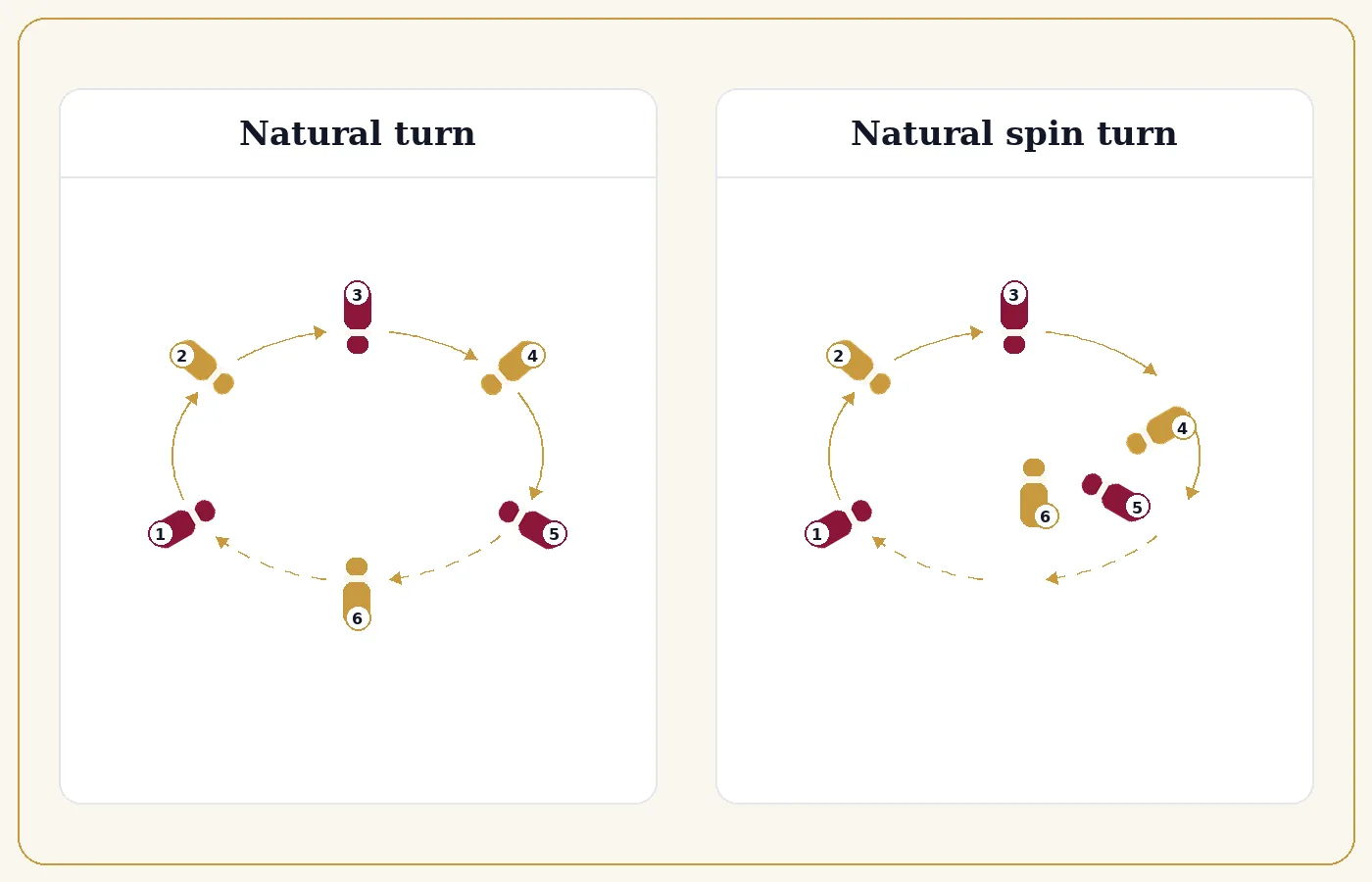
The two share their first three steps; the difference is what happens next.
| Natural turn | Natural spin turn |
|---|---|
| Second half is three more walking-and-closing steps | Second half is a pivoting spin |
| Rotation spread evenly across six steps | Rotation concentrated in the spin |
| Roughly three-quarters of a turn | Roughly five-quarters of a turn (full amount) |
| The default first turning figure | The default way to keep rotating and travel |
Waltz vs Quickstep timing
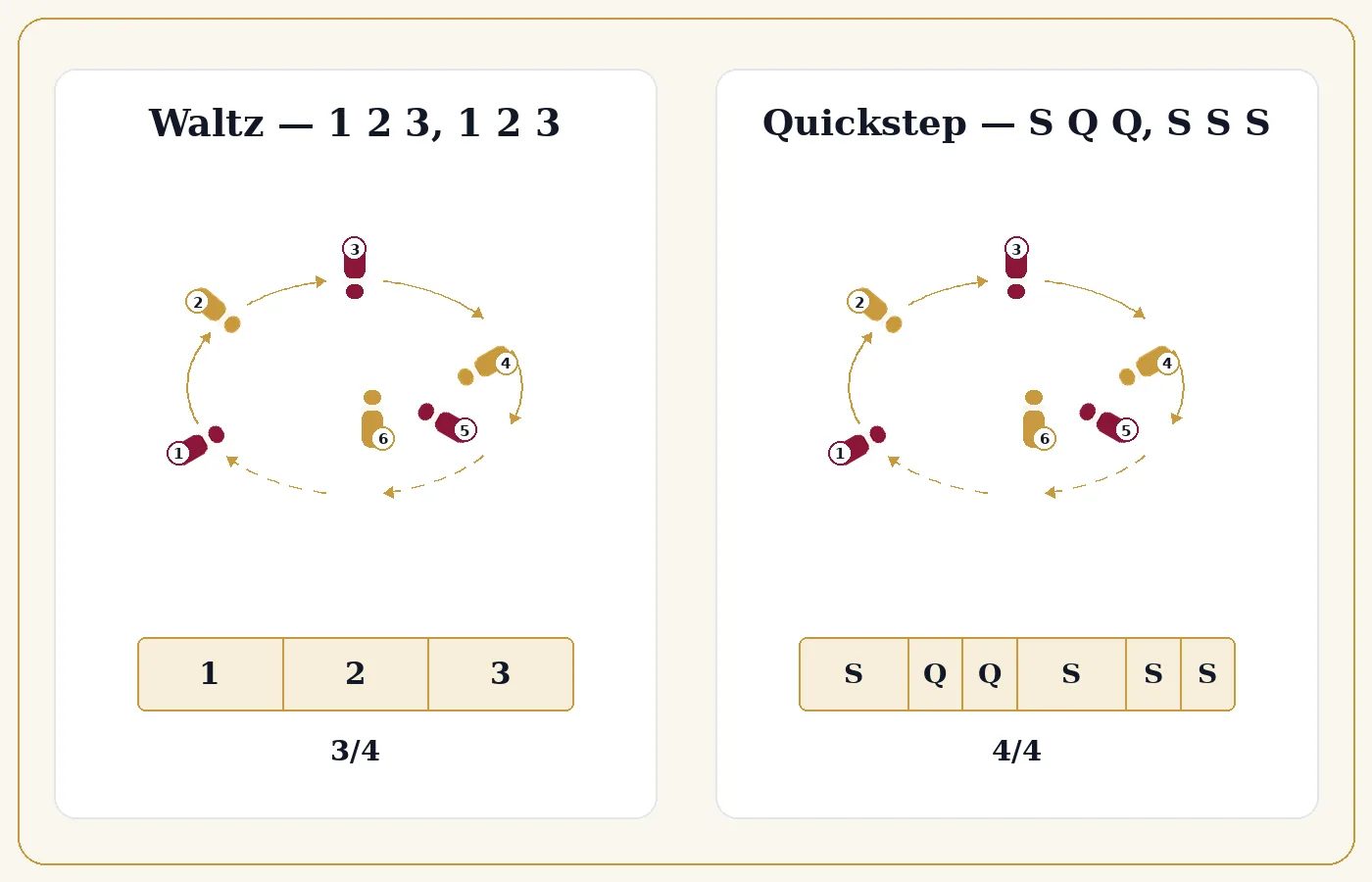
The footwork is essentially the same in both dances; the music changes the character.
| Dance | Time signature | Timing of the six steps |
|---|---|---|
| Waltz | 3/4 | 1-2-3, 1-2-3 (one step per beat) |
| Quickstep | 4/4 | Slow-quick-quick, slow-slow-slow (SQQ SSS) |
In Waltz the spin breathes with the rise and fall of the music; in Quickstep the slows give you time to control the pivot at a faster tempo. If slow-quick-quick timing is new to you, read that entry first—it unlocks the Quickstep version.
The underturned spin turn: how corners get turned
A ballroom floor is a rectangle, and every traveling dance has to turn four corners per lap. The underturned natural spin turn—the same figure danced with less rotation—is the classic answer. Instead of spinning the full amount and continuing down the same wall, the couple underturns the spin so they finish facing the new line of dance.
This is worth practicing deliberately: social dancers use the underturned version constantly, because floors are crowded and corners come up fast. If you learn only one amount of turn, learn the underturned one—then add rotation as your pivot gets stronger.
Common natural spin turn mistakes
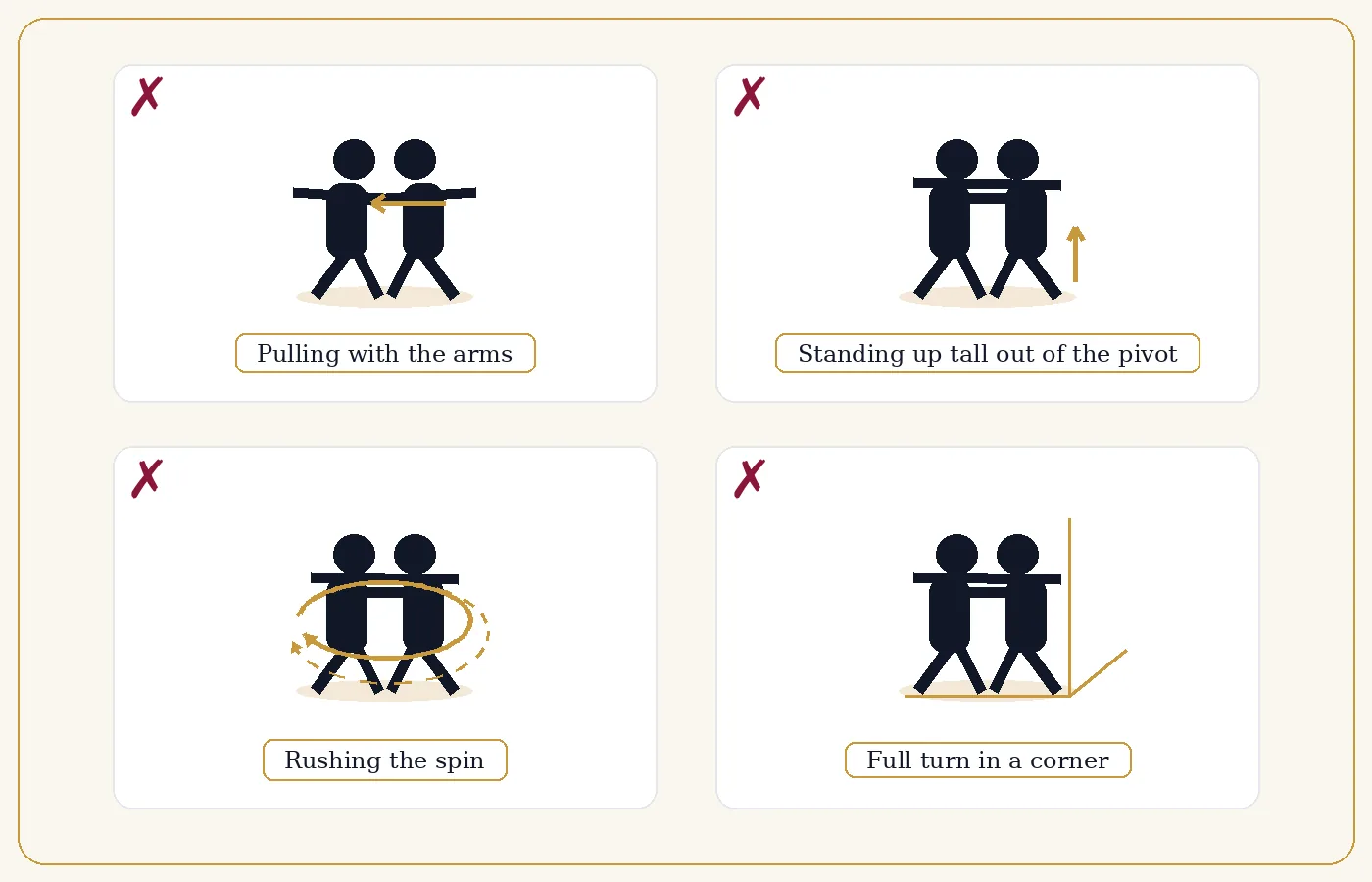
Pulling the spin around with the arms
Fix: The rotation comes from the body and the pivoting foot, prepared by CBM. Keep the frame quiet and let the legs do the turning.
Standing up out of the pivot
Fix: Stay grounded with softly flexed knees through step 4. A pivot on a stiff, tall leg wobbles; a pivot into the floor spins cleanly.
Rushing the spin ahead of the music
Fix: The spin has three full steps. Give each one its beat—especially the slows in Quickstep—instead of collapsing them into one panicked rotation.
Turning the full amount on every floor
Fix: Match the rotation to the room. Underturn at corners and in traffic; save the full spin for open floor.
Practice the natural spin turn
Build it from the ground up—first the pieces, then the music:
- Own the natural turn first. The spin turn borrows its first half; if the natural turn is shaky, the spin has nothing to stand on.
- Drill the pivot solo. Step back on the left foot and pivot a half turn, staying low and balanced, before adding a partner.
- Corner practice. Dance natural turn into underturned spin turn around the four corners of your practice space.
-
Waltz (home of the figure)
3/4 time with a clear “1”—practice the spin turn where it was born.
-
Quickstep (the fast version)
Same footwork at speed—the slows are your control points.
-
Technique library
Frame, posture, and lead-and-follow guides that make turning figures work.
-
BallroomPages Music (Telegram)
Mixed-style practice tracks. Figure drills coming soon.
FAQ
Natural Spin Turn FAQ
What is a natural spin turn?
The natural spin turn is a Waltz and Quickstep figure made of the first three steps of a natural turn followed by a three-step pivoting spin. It turns to the right and advances the couple about five-quarters of a turn down the line of dance.
Is the natural spin turn a beginner figure?
Yes—it appears at Newcomer or Pre-Bronze level in most syllabi, usually shortly after the natural and reverse turns. It is often a beginner’s first figure with a true pivoting action, which is why it gets so much practice time.
What is an underturned spin turn?
The same figure danced with less rotation. Instead of spinning the full amount, the couple underturns so they finish facing the new line of dance—which makes it the standard way to turn a corner of the ballroom.
What is the difference between a natural turn and a natural spin turn?
They share their first three steps. The natural turn finishes with three more walking-and-closing steps; the spin turn replaces that second half with a pivoting spin, which concentrates the rotation and travels further down the floor.
Is the natural spin turn the same in Waltz and Quickstep?
The footwork is essentially the same; the timing changes. Waltz dances it as two bars of 1-2-3. Quickstep uses slow-quick-quick, slow-slow-slow (SQQ SSS), where the slows give you time to control the pivot at the faster tempo.
Editorial
Sources and review notes
This glossary entry should be reviewed by a qualified ballroom instructor before launch. Step descriptions, amounts of turn, and timing follow widely used syllabus conventions (ISTD-style International Standard); individual studios and syllabi vary in alignments and figure levels.
This is beginner orientation, not a substitute for instruction. Ballroom Pages follows an editorial policy of education-first guidance. Questions? Contact us. Updated July 9, 2026.