
Glossary
Alignment in Ballroom Dance
Every step in a traveling ballroom dance points somewhere. Alignment is the language dancers use to say where—which way your feet and body face relative to the room and the flow of traffic. Get it right and you glide around the floor without collisions; get it wrong and you cut across the middle into oncoming couples. Here is the room compass, the diagonals, and how to read the alignment of any step.
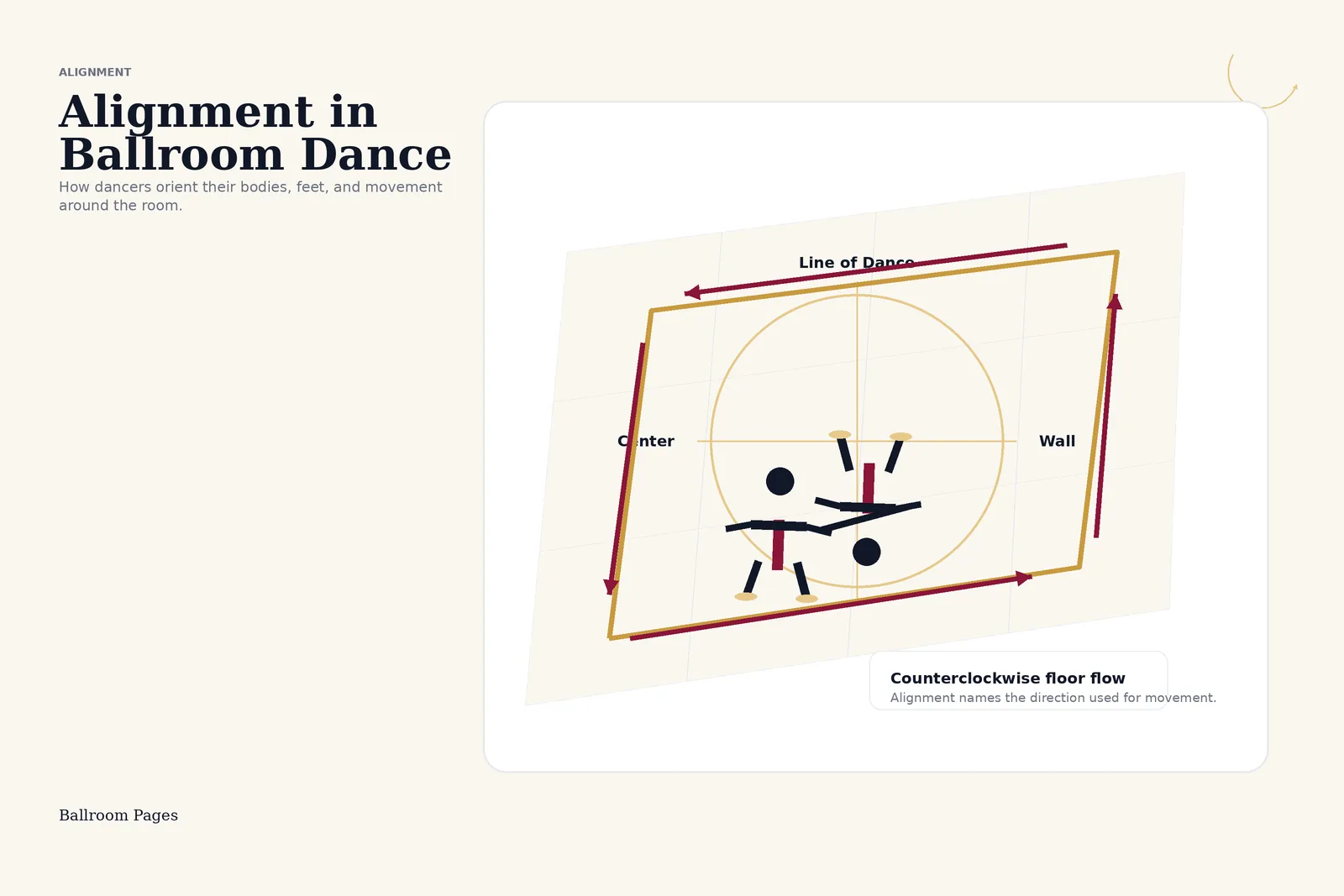
Definition of alignment
Alignment
- Pronunciation
- uh-LINE-ment
- Skill category
- Technique & floorcraft
- Companion term
- Line of dance (the main reference direction)
- Related terms
- line of dance, diagonal wall, diagonal center, facing, backing, pointing, floorcraft
In ballroom dance, alignment is the direction the feet and body face or move in relation to the room and the line of dance. It uses a fixed set of reference directions—line of dance, wall, center, and the diagonals—plus the words facing, backing, and pointing to describe exactly where a step starts, travels, and ends.
Alignment is your compass on the floor. It tells you which way to point, not which step to take.
What alignment means in ballroom dance
Alignment answers one question: which direction? In the traveling ballroom dances—Waltz, Foxtrot, Tango, Quickstep, and Viennese Waltz—you move around the room, and every step is described by the direction it faces or travels relative to the walls and the flow of traffic.
Alignment does two jobs. First, it keeps traffic flowing: if everyone travels the same way and knows their direction, couples do not collide. Second, it tells you how far to turn: a step described as ending “backing line of dance” tells you precisely where your body should be pointing when you finish the figure.
Alignment is not the same as the step itself. Two different figures can share the same alignment, and the same figure can be danced from different alignments. Alignment is the map reference; the figure is the route you take.
The room compass: the eight alignments
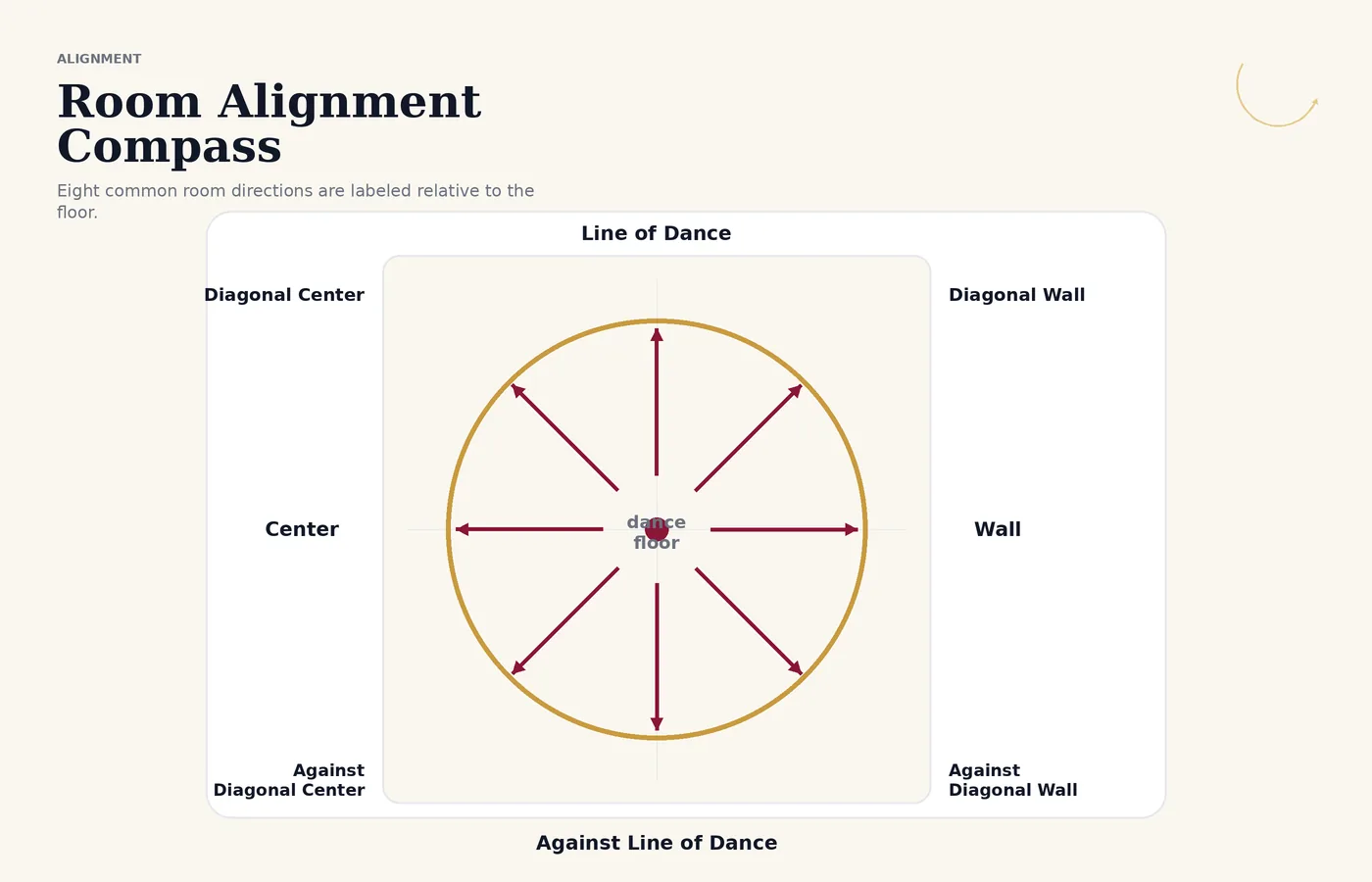
Ballroom borrows the idea of a compass. Instead of north and south, the reference points are the walls, the center, and the flow of traffic. The compass diagram above lays out all eight directions:
- Line of Dance (LOD) — the main direction of travel, counterclockwise around the room. Think of it as north.
- Against Line of Dance — directly opposite LOD, back against the flow of traffic.
- Wall — toward the nearest outer wall of the room.
- Center — toward the middle of the floor, opposite the wall.
- Diagonal Wall (DW) — halfway between line of dance and wall.
- Diagonal Center (DC) — halfway between line of dance and center.
- Against Diagonal Wall and Against Diagonal Center — the two backward diagonals, used mostly on backing steps.
Most figures begin and end on line of dance or one of the two forward diagonals—those three (LOD, DW, DC) come up far more often than the rest.
Line of dance explained
The line of dance is the single most important alignment. It is the counterclockwise path traffic takes around the perimeter of the floor. When a teacher says “move down line of dance,” they mean travel that direction, following the couples ahead of you.
Everything else is defined relative to it. Wall is to your outside as you travel LOD; center is to your inside; the diagonals sit between LOD and each of those. Because the whole room agrees on this one direction, a floor full of couples can travel together without a traffic jam. Straying against the line of dance is the classic beginner error—it puts you head-on with everyone else.
Diagonal wall and diagonal center
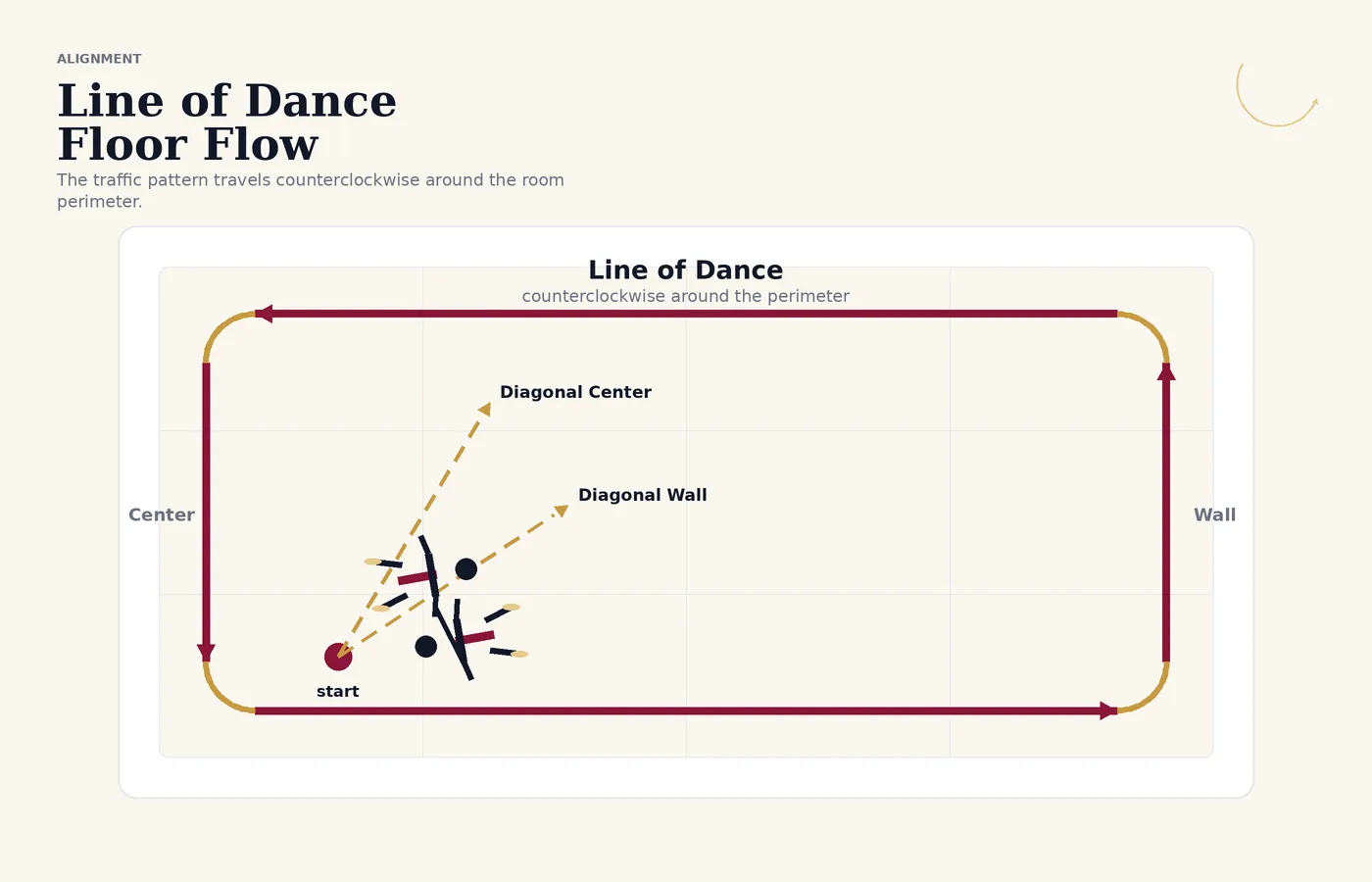
The two forward diagonals are where most traveling figures actually point. Diagonal wall (DW) aims halfway between line of dance and the wall; diagonal center (DC) aims halfway between line of dance and the center of the room.
They matter because they let couples progress along the floor while gently curving in and out, rather than marching in a rigid straight line. A natural (right) turn often starts facing diagonal wall; a reverse (left) turn often starts facing diagonal center. Learn to feel these two diagonals and most Standard choreography suddenly makes spatial sense.
Facing, backing, and pointing
A direction on its own is not enough—you also need to know how your body relates to it. Three qualifying words do that:
| Term | Meaning | Example |
|---|---|---|
| Facing | The front of your body points in the direction | “Facing diagonal wall” — chest toward DW |
| Backing | Your back is toward the direction (you step backward into it) | “Backing line of dance” — back toward LOD |
| Pointing | A foot is aimed in a direction while the body faces elsewhere | “Pointing diagonal center” — foot to DC, body turned |
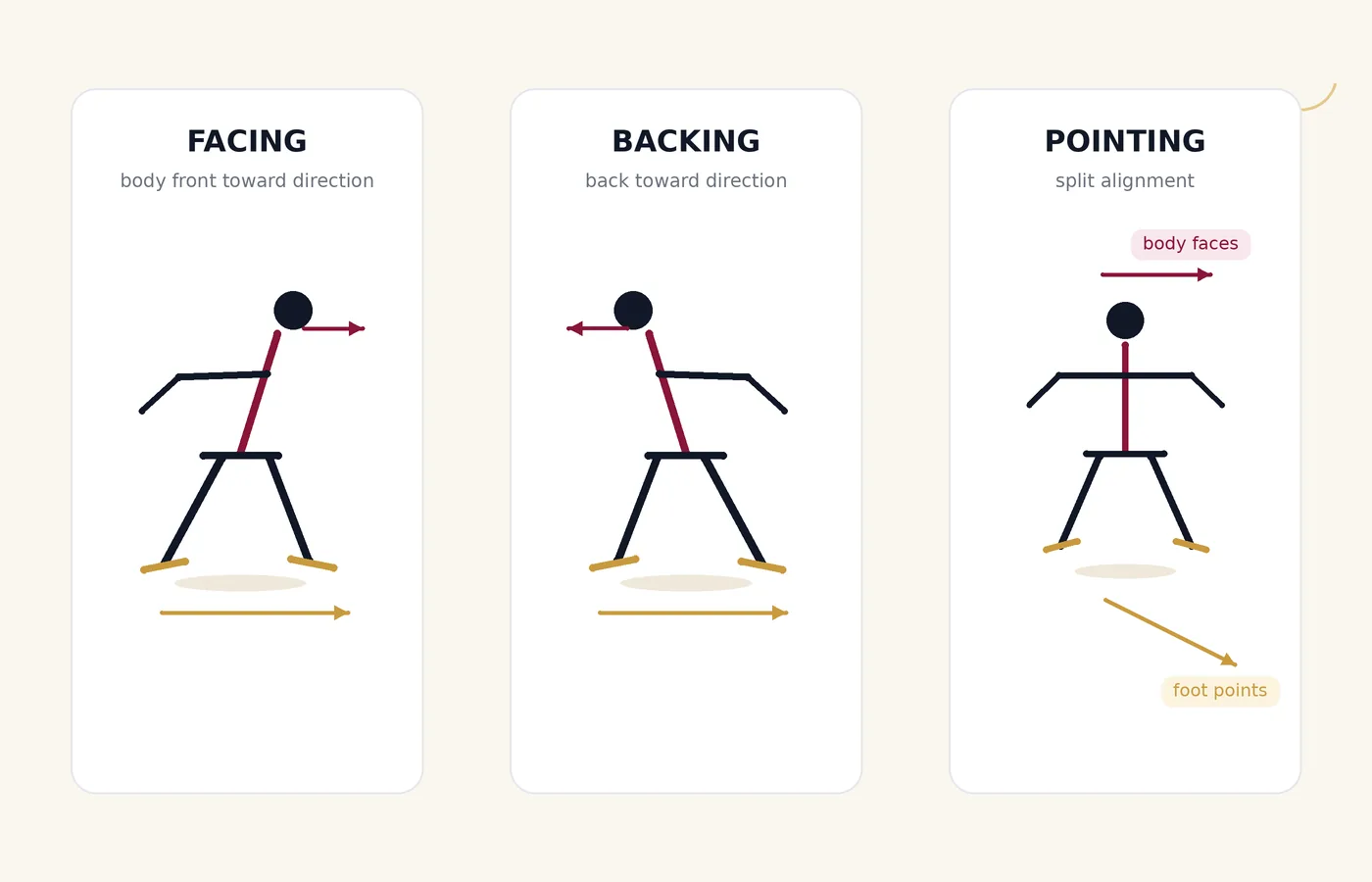
You will also hear “moving toward” (the direction a step travels, which can differ from where you face) and “end alignment” (where you are oriented once a figure finishes). Together these words turn a vague “turn a bit” into an exact instruction.
How to read a step: start, rotate, arrive
Any figure can be decoded with three questions. This is the mental checklist experienced dancers run automatically:
The alignment checklist
- Start: what alignment am I facing or backing before the figure?
- Rotate: how much turn does the figure add, and in which direction?
- Arrive: what is my end alignment once the figure finishes?
For example: start facing diagonal wall, make a 3/8 turn to the right, and you end backing line of dance. That single sentence tells you where to begin, how far to turn, and where to point when you are done. A useful pattern to remember: right-turning figures often start facing wall or diagonal wall, while left-turning figures often start facing center or diagonal center.
Room alignment vs body alignment
“Alignment” is used two different ways in dance, and mixing them up causes confusion:
- Room alignment (this page): the direction you face or travel relative to the floor and line of dance. A floorcraft and choreography concept, most used in the traveling Standard dances.
- Body alignment: how your body parts stack vertically—head over ribs over hips over feet. That is really posture, and it is a technique concept about balance, not direction.
If you searched “alignment in dance” wanting the second meaning—keeping the body correctly stacked—head to the posture and frame guides instead. This page is about direction on the floor.
Common alignment mistakes
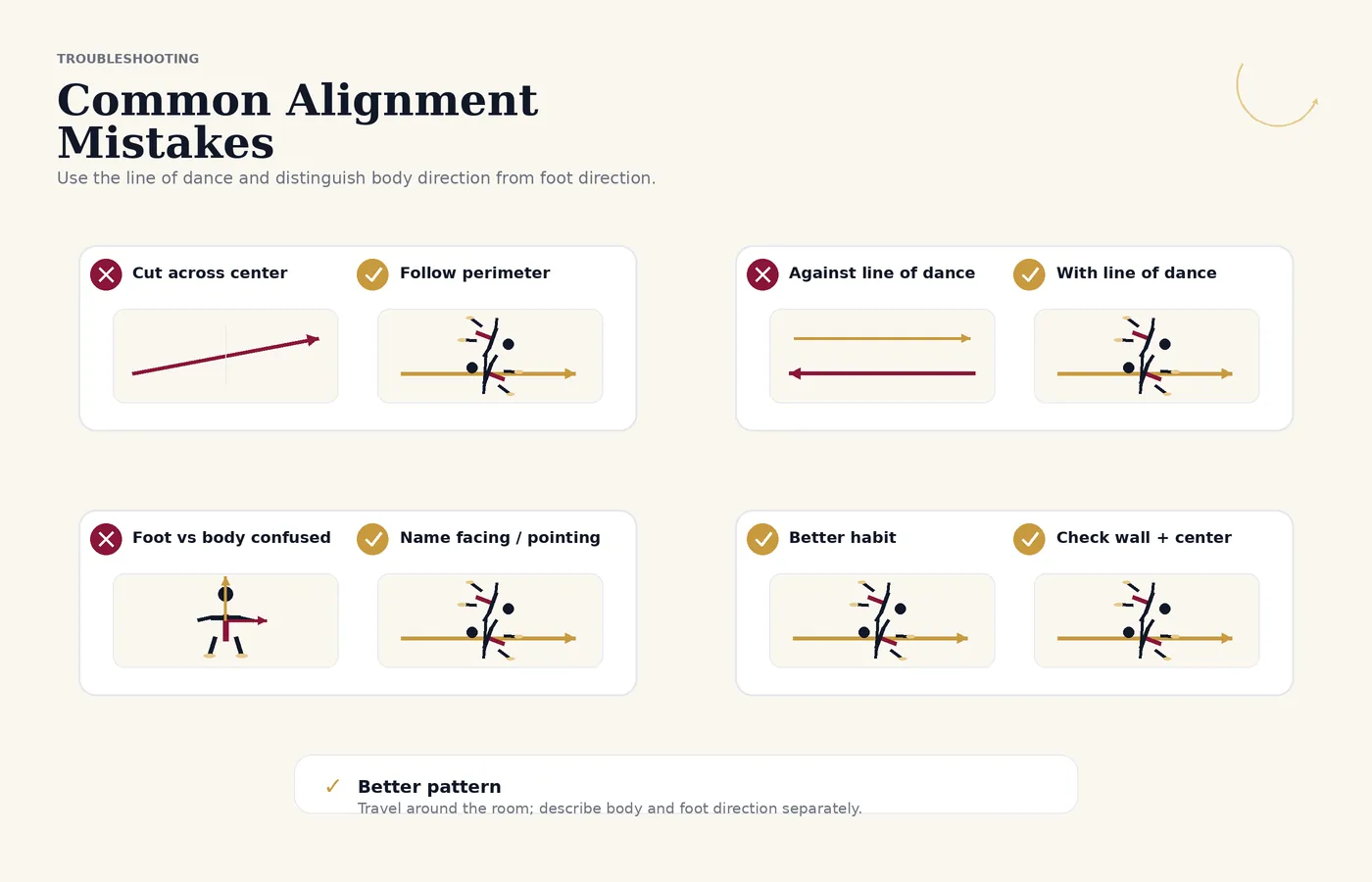
Traveling against the line of dance
Fix: Keep the counterclockwise flow. Moving against it puts you head-on with the whole floor. When in doubt, follow the couples ahead.
Cutting across the center
Fix: Stay in your lane near the outside unless a figure sends you inward. Diving through the middle crosses everyone else’s path.
Confusing foot direction with body direction
Fix: Pointing is about the foot; facing is about the body. They are not always the same—read which one the instruction means.
Ignoring the end alignment
Fix: Know where a figure should leave you pointing. If your end alignment is off, the next figure starts wrong too.
Turning too much or too little
Fix: Use start and end alignments to measure the turn. “Facing DW to backing LOD” is a specific amount, not a guess.
Practice your alignment
Alignment clicks once you use the real room as your reference. Try these:
- Name the walls. Stand on the floor and point: line of dance, wall, center, diagonal wall, diagonal center. Say each out loud until it is instant.
- Walk the perimeter. Travel line of dance around the whole room, staying near the wall. Feel the counterclockwise flow become automatic.
- Call your figures. As you practice a routine, say the end alignment of each figure out loud: “backing line of dance,” “facing diagonal wall.” It builds the map fast.
-
Waltz (traveling practice)
3/4 Standard. Practice line of dance and the two forward diagonals as you travel.
-
Foxtrot (smooth travel)
Long, gliding steps down line of dance—great for feeling alignment change.
-
Tango (marked direction)
Sharp changes of alignment. Practice clear start and end directions.
-
BallroomPages Music (Telegram)
Mixed-style practice tracks. Floorcraft drills coming soon.
Alignment is inseparable from floorcraft—reading the floor and steering around other couples. Once you can name your direction at any moment, navigating a crowded floor gets far easier.
FAQ
Alignment FAQ
What does alignment mean in dance?
In ballroom dance, alignment is the direction your feet and body face or travel relative to the room and the line of dance. It is described with reference directions (line of dance, wall, center, diagonals) and the words facing, backing, and pointing.
What is the line of dance?
The line of dance is the main direction of travel around the floor, counterclockwise around the perimeter. It is the reference every other alignment is measured against, and following it keeps couples from colliding.
What is diagonal wall?
Diagonal wall (DW) is the direction halfway between line of dance and the wall. Many traveling figures, especially right turns, begin facing diagonal wall. Its partner direction is diagonal center (DC), halfway between line of dance and the center of the room.
What is the difference between facing and backing?
Facing means the front of your body points toward a direction; backing means your back is toward it and you step backward into it. So “facing line of dance” and “backing line of dance” point your body opposite ways along the same line.
Why is alignment important in ballroom dancing?
Alignment keeps traffic flowing so couples do not collide, and it tells you exactly how far to turn in a figure. It is the foundation of floorcraft—navigating a shared floor smoothly and safely.
Is alignment the same as posture?
No. Room alignment (this page) is about the direction you face on the floor. Body alignment—stacking head over ribs over hips over feet—is really posture, a balance and technique concept. Both use the word “alignment,” but they are different ideas.
Editorial
Sources and review notes
This glossary entry should be reviewed by a qualified ballroom instructor before launch. Alignment terminology follows widely accepted conventions from ISTD, NDCA, and standard Smooth and Standard syllabus materials. Exact start and end alignments for specific figures vary by syllabus and organization—check with your coach or syllabus provider.
This is dance terminology, not medical advice. Ballroom Pages follows an editorial policy of education-first guidance. Questions? Contact us. Updated July 9, 2026.