
Glossary
Pivot in Ballroom Dance
A pivot looks deceptively simple—two dancers turning together, gliding down the floor—but it is one of the milestones that separates confident ballroom dancers from beginners. It asks for exact foot position, committed weight, and shared balance between partners. Here is what a pivot actually is, how it differs from a pivoting action, the step-by-step mechanics, and the mistakes that trip most people up.
Definition of pivot
Pivot
- Pronunciation
- PIV-uht
- Skill category
- Technique & turns
- Companion term
- Natural turn (a common lead-in to pivots)
- Related terms
- contra body movement (CBM), natural turn, reverse turn, sway, line of dance, spin
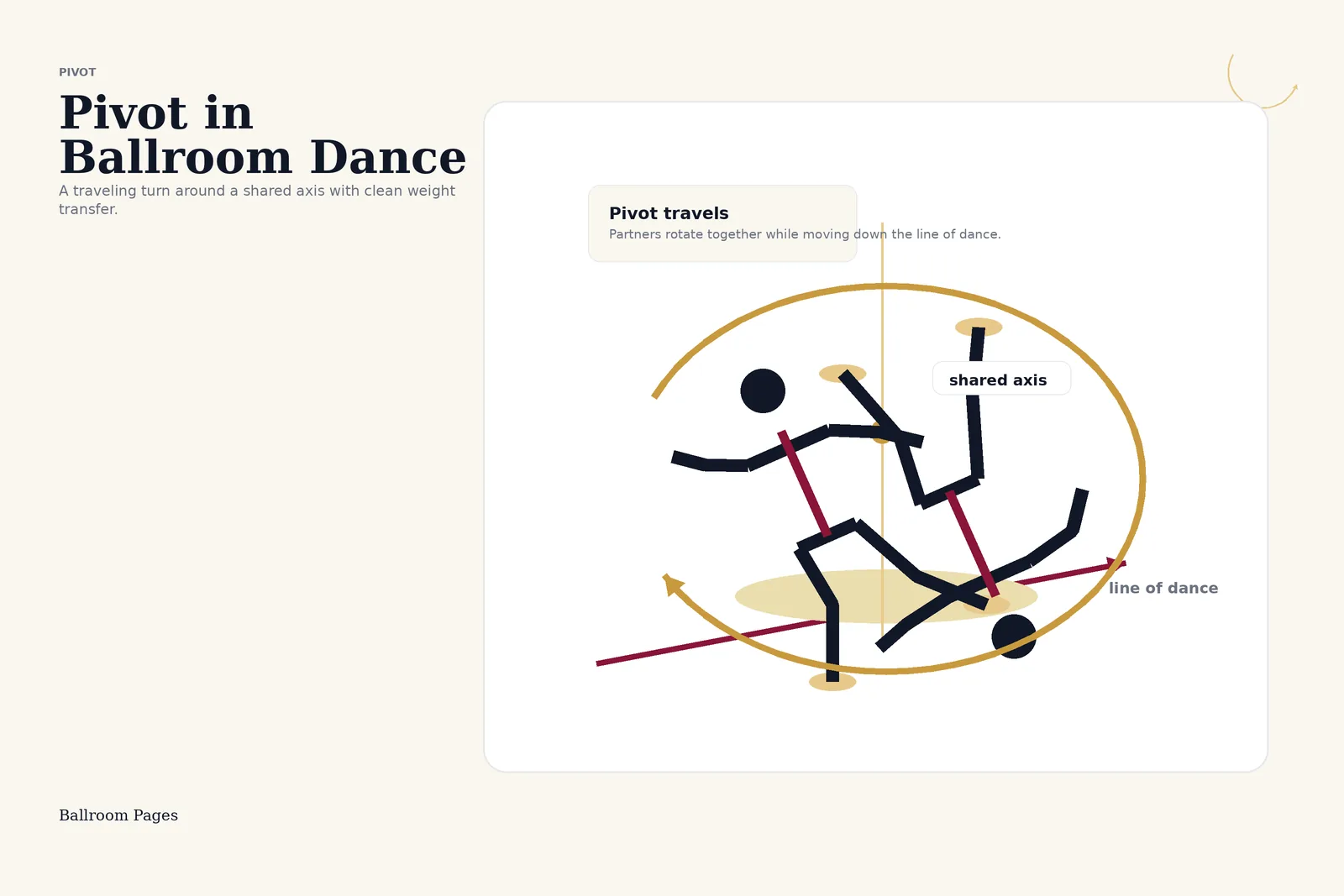
In ballroom dance, a pivot is a turn of up to 180° on one foot, in which the free leg is held in front of or behind the turning foot and the body rotates around a shared axis with the partner. The ball of the standing foot swivels in place while the couple travels down the line of dance and the partners exchange positions.
A pivot turns on the ball of one foot and travels while it turns—that is what makes it a pivot.
What a pivot means in ballroom dance
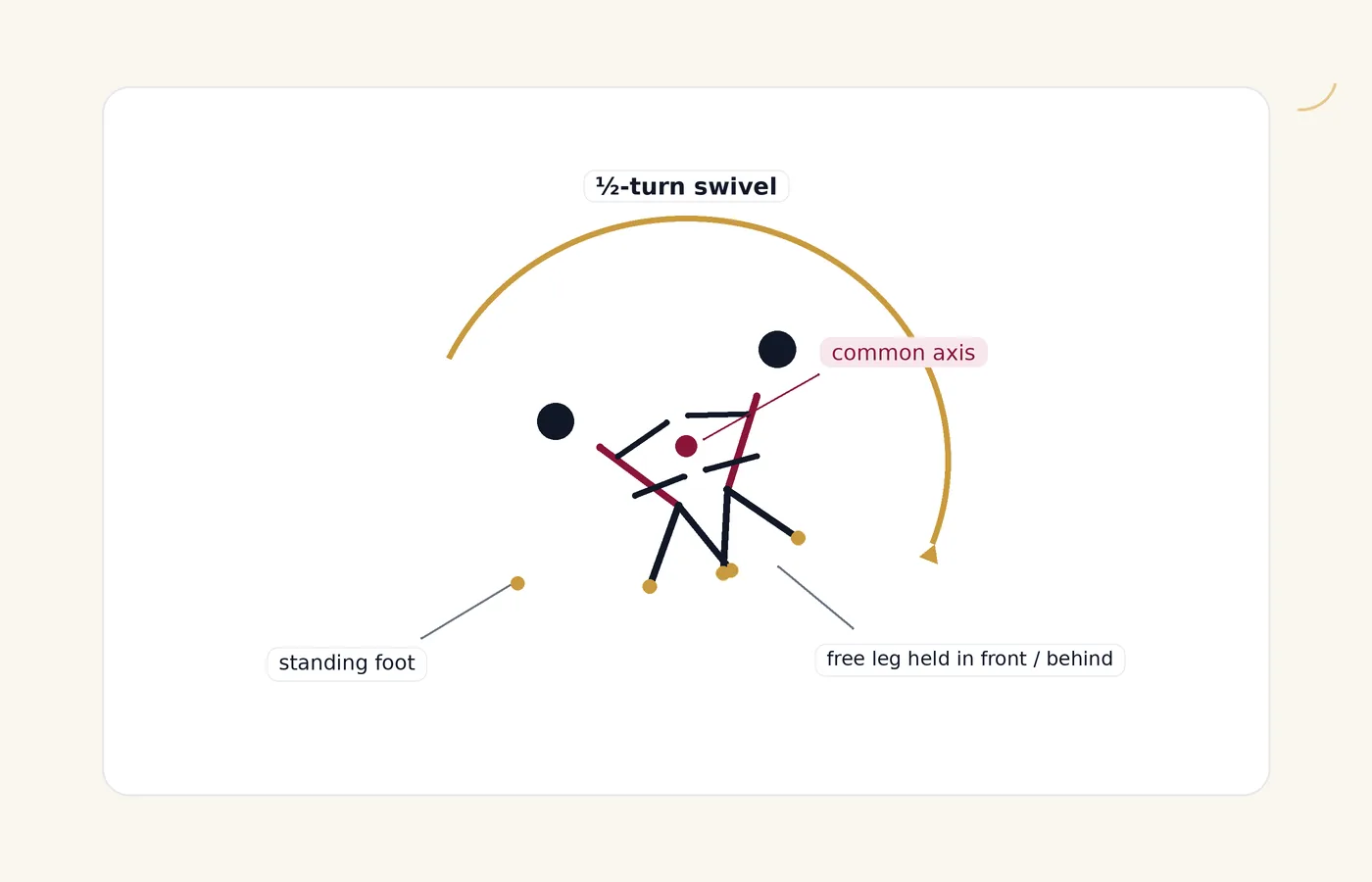
A pivot is a rotation on one foot. You place your weight fully onto a single foot and turn on the ball of it, up to half a turn (180°), while the free leg stays extended in front of or behind you. In partnered ballroom, both dancers pivot together around one shared point between them—a common axis—and the couple travels down the floor as they turn.
What makes ballroom pivots distinctive is that they are done as a couple, in motion, often several in a row. A strong forward step by one partner establishes the axis and the momentum; the couple rotates a half turn, the partners swap front-and-back positions, and the next pivot begins. Done well, a run of pivots down the line of dance looks effortless and continuous.
Because it demands committed weight, precise feet, and shared balance, the pivot is usually taught as an intermediate figure—a milestone rather than a first step.
Pivot vs pivoting action
Dancers often blur two different things. A true pivot and a “pivoting action” are not the same:
| Pivot | Pivoting action |
|---|---|
| A defined figure: up to 180° on one foot | A general turning action, often less than a full pivot |
| Partners rotate around a shared common axis | Rotation may be more individual or on the spot |
| Travels down the line of dance | May stay in place or travel little |
| Uses clear contra body movement and a side lead | Uses a lighter turning momentum |
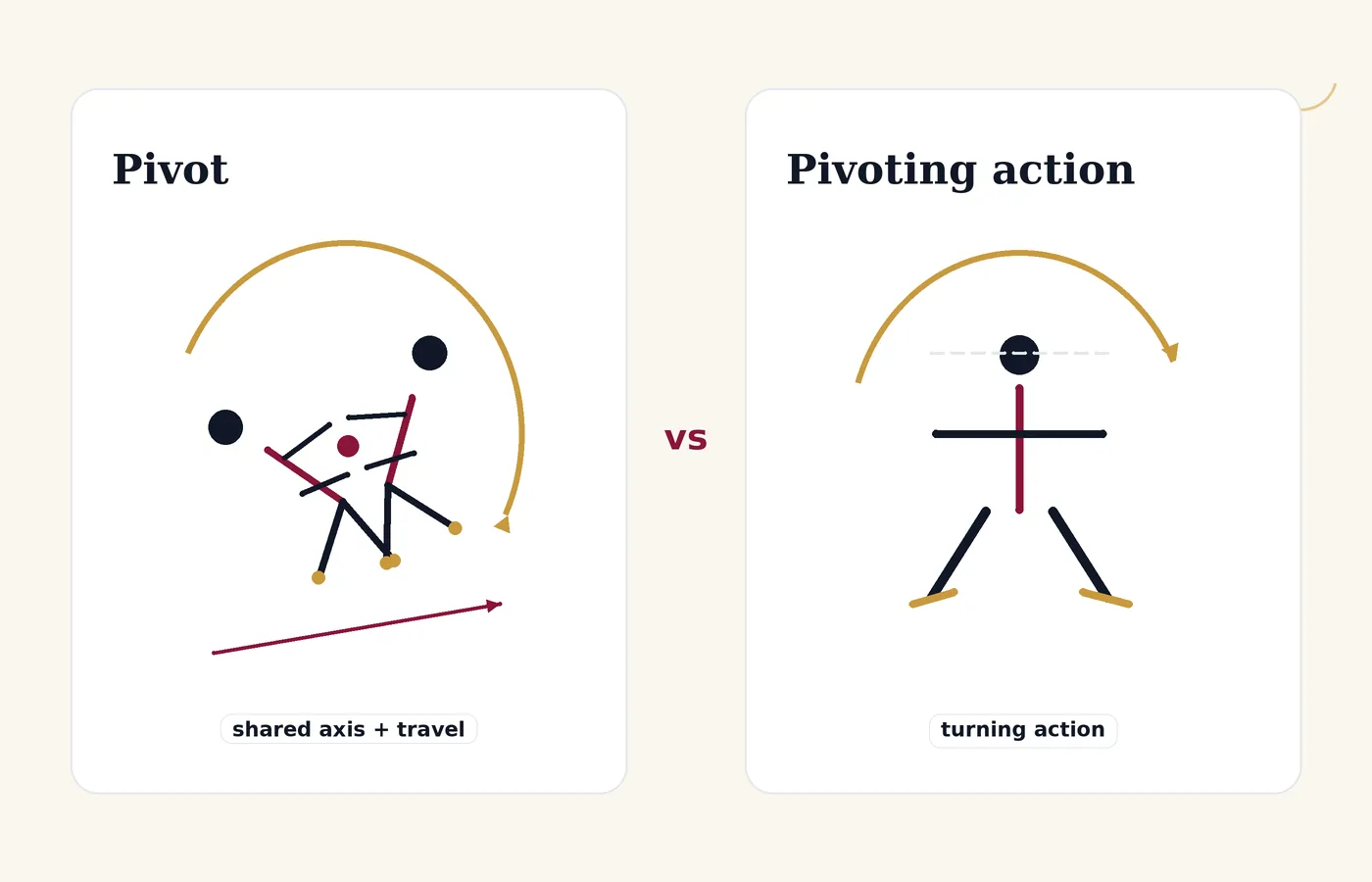
The distinction matters because they feel different to lead and to follow. When a teacher says “pivot,” they usually mean the full figure around a shared axis—not just any turning motion.
How a ballroom pivot works, step by step
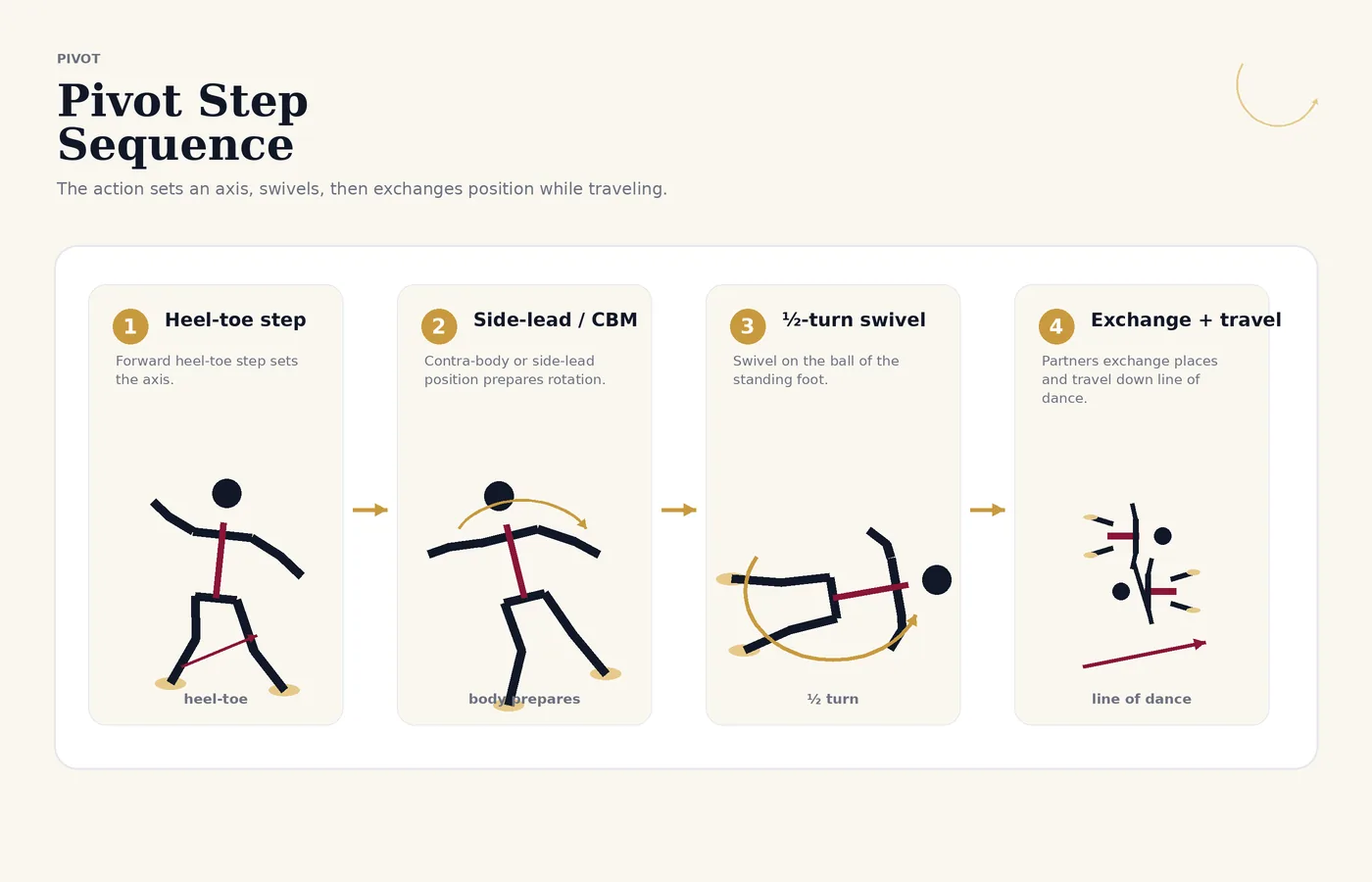
A single pivot breaks down into four clear actions:
- Step forward, heel to toe. The forward-moving partner takes a strong, clear step down line of dance. This establishes the location of the shared axis and the momentum for the turn.
- Find contra body movement. The stepping foot travels along the line of the other foot, creating a contra body movement position that supports a clear right side lead.
- Swivel a half turn on the ball of the foot. With weight fully committed to the standing foot, both partners rotate up to 180° on the ball of that foot, exchanging front-and-back positions.
- Pass the momentum and repeat. The partner who set the axis now receives the position and momentum from the other, ready to drive the next half turn—so pivots chain smoothly down the floor.
Turn from the base, not the top. Drive the rotation from the feet and legs with a calm, connected upper body. Trying to spin from the shoulders throws both partners off balance—the single most common reason pivots fall apart.
Where pivots show up
Pivots and pivoting figures appear across the traveling dances:
- Natural pivot / spin. A right-turning pivot that follows a natural turn, common in Waltz and Quickstep.
- Tango. Pivoting actions feed the sharp rotations and changes of direction that define the dance.
- Quickstep. Running pivots down the line of dance are a signature of the dance’s speed and swing.
- Viennese Waltz. The continuous rotation of the dance relies on clean, repeated pivoting.
Previous experience in other dance forms may not transfer directly. Pivots in salsa or jazz are usually simpler and rarely use the shared-axis partnering that ballroom pivots demand.
Common pivot mistakes
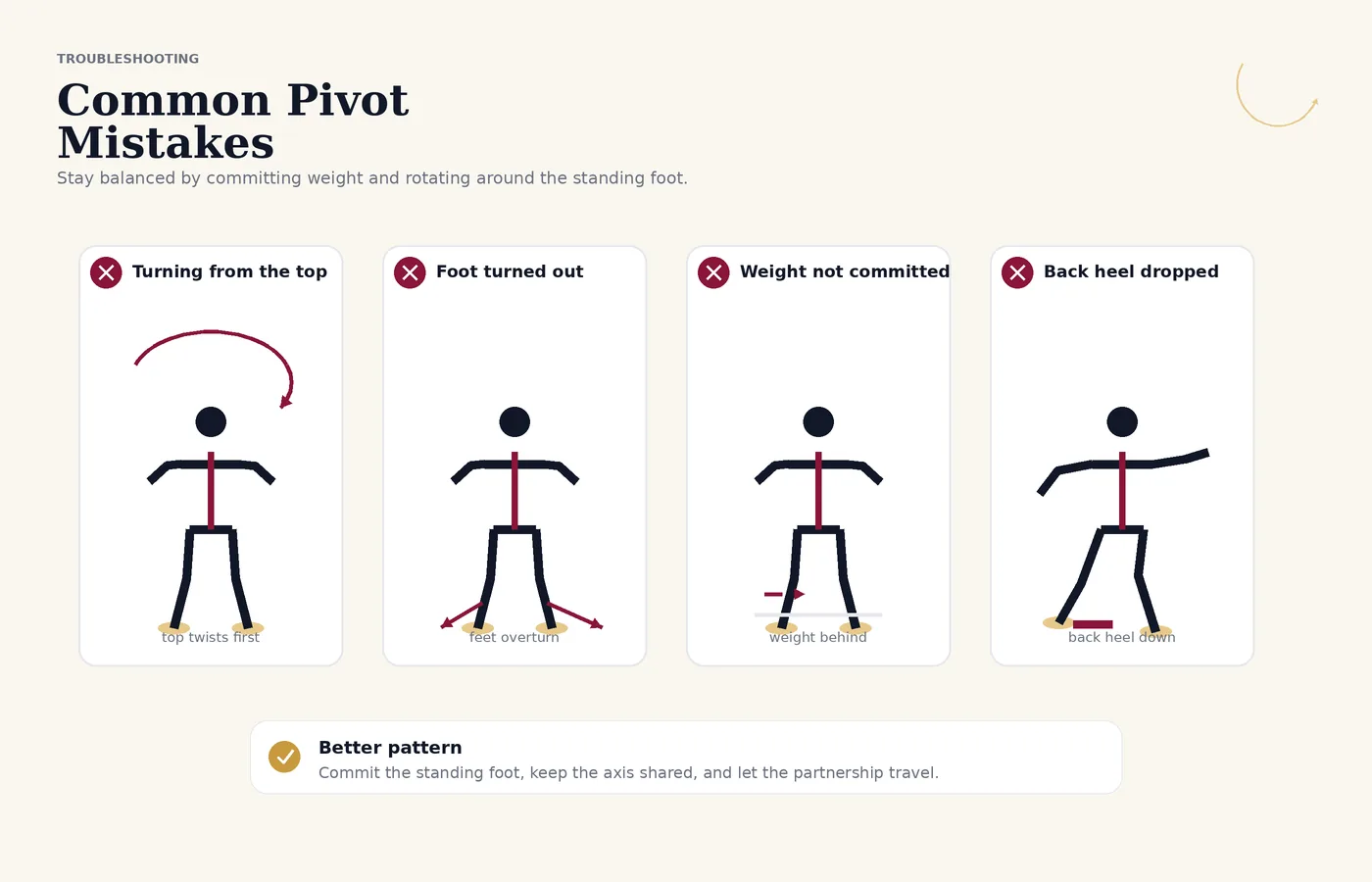
Turning from the top
Fix: Drive the turn from the base with a light, steady connection above. Propelling from the shoulders pulls you off the axis.
Foot turned out
Fix: Keep the stepping foot straight, with knee and thigh facing forward. A turned-out foot overturns the pivot and unbalances the couple.
Weight not fully committed
Fix: Get all your weight onto the standing foot before you turn. Half-committed weight makes a clean 180° impossible.
Dropping the back heel
Fix: Keep the heel of the back foot off the floor throughout, so the movement does not stall between pivots.
Blaming the partner
Fix: Pivots are shared 50/50. If it is not working, check your own detail first, then solve it together—errors are simply harder to hide with a partner.
Practice the pivot
Build the pivot in stages, starting on your own before adding a partner:
- Solo swivels. Weight on one foot, free leg held behind, swivel a half turn on the ball of the standing foot. Repeat both directions until balance is reliable.
- Forward-step commitment. Practice a strong heel-to-toe forward step and fully transfer weight before any turn. No turn until the weight is there.
- Chain of two. Once single pivots feel stable, link two in a row, passing momentum from one to the next. Add music only when the mechanics hold.
-
Tango (pivoting actions)
Sharp rotations. Practice clear axis and committed weight at a marked tempo.
-
Quickstep (running pivots)
Fast travel down line of dance. Build single pivots before chaining.
-
Viennese Waltz (continuous turn)
Rotation that never stops. Feel the shared axis carry the couple around.
-
BallroomPages Music (Telegram)
Mixed-style practice tracks. Turn and pivot drills coming soon.
If a pivot feels effortful, something is fighting you—usually tension or weight in the wrong place. A correct pivot should feel light and almost automatic once the axis and momentum are set.
FAQ
Pivot FAQ
What is a pivot in dance?
A pivot is a turn of up to 180 degrees on one foot, with the free leg held in front or behind. In ballroom, both partners pivot together around a shared axis and travel down the floor as they turn, swiveling on the ball of the standing foot.
How do you do a pivot turn?
Take a strong forward step to set the axis and momentum, step across the line of your standing foot into contra body movement position (CBMP), commit your full weight, then swivel up to a half turn on the ball of that foot. Pass the momentum to your partner to chain into the next pivot.
What is the difference between a pivot and a spin?
A pivot is up to a half turn on one foot with the free leg extended, usually danced as a couple around a shared axis and traveling down the floor. A spin is generally a fuller rotation and can be more on the spot. Many figures link a pivot and a spin together.
Are pivots hard for beginners?
They are usually an intermediate skill. Pivots demand precise foot position, fully committed weight, and shared balance between partners, so most teachers introduce them after the basic figures are secure. They look simple but reward careful practice.
Which ballroom dances use pivots?
Pivots and pivoting actions appear in Tango, Quickstep, and Viennese Waltz, and in natural pivot figures within Waltz. They are a feature of the traveling Standard dances rather than the Latin dances.
Editorial
Sources and review notes
This glossary entry should be reviewed by a qualified ballroom instructor before launch. Pivot technique follows widely accepted conventions from ISTD, NDCA, and standard Ballroom and Standard syllabus materials. Exact foot positions and amounts of turn vary by figure and syllabus—work with a qualified coach when learning pivots.
This is dance terminology, not medical advice. Ballroom Pages follows an editorial policy of education-first guidance. Questions? Contact us. Updated July 9, 2026.