Quickstep music at a glance
| Detail | Summary |
|---|---|
| Dance family/context | International Standard / Ballroom |
| Common meter | 4/4 |
| Beginner count idea | Slow and quick values; slow usually takes two beats, quick usually takes one |
| Competition tempo reference | NDCA 2026: 50 MPM / 200 BPM. WDSF legacy: 50–52 bars per minute. |
| General dance-music range | Dance Central lists Pro/Am 48–52 MPM / 192–208 BPM; Music4Dance lists 200–208 BPM / 50–52 MPM. |
| Music feel | Bright, upbeat, buoyant, often jazz/swing/big-band influenced |
| Beginner difficulty | Challenging at first because of speed and energy, but easier with listening practice |
| Best first practice goal | Hear the pulse before trying to move at full speed |
Tempo references are cited in the tempo section and sources below; general dance-music ranges are not official competition standards.
What does Quickstep music sound like?
Quickstep music should feel light, energetic, and traveling. It often has a bright swing or jazz character, with a pulse that makes the dance feel lifted rather than heavy.
The mistake many beginners make is thinking “fast song = Quickstep.” A song can be fast and still be hard to dance if the beat is muddy, the intro is confusing, the arrangement changes too much, or the energy feels more like Swing, Jive, Charleston, or pop-rock than ballroom Quickstep.
Quickstep has historical and musical overlap with Foxtrot, Charleston, ragtime, jazz, and swing traditions. That shared musical family is why some Quickstep songs may sound related to Foxtrot or Swing, while still needing a faster, more progressive ballroom feel.
Quickstep timing and count
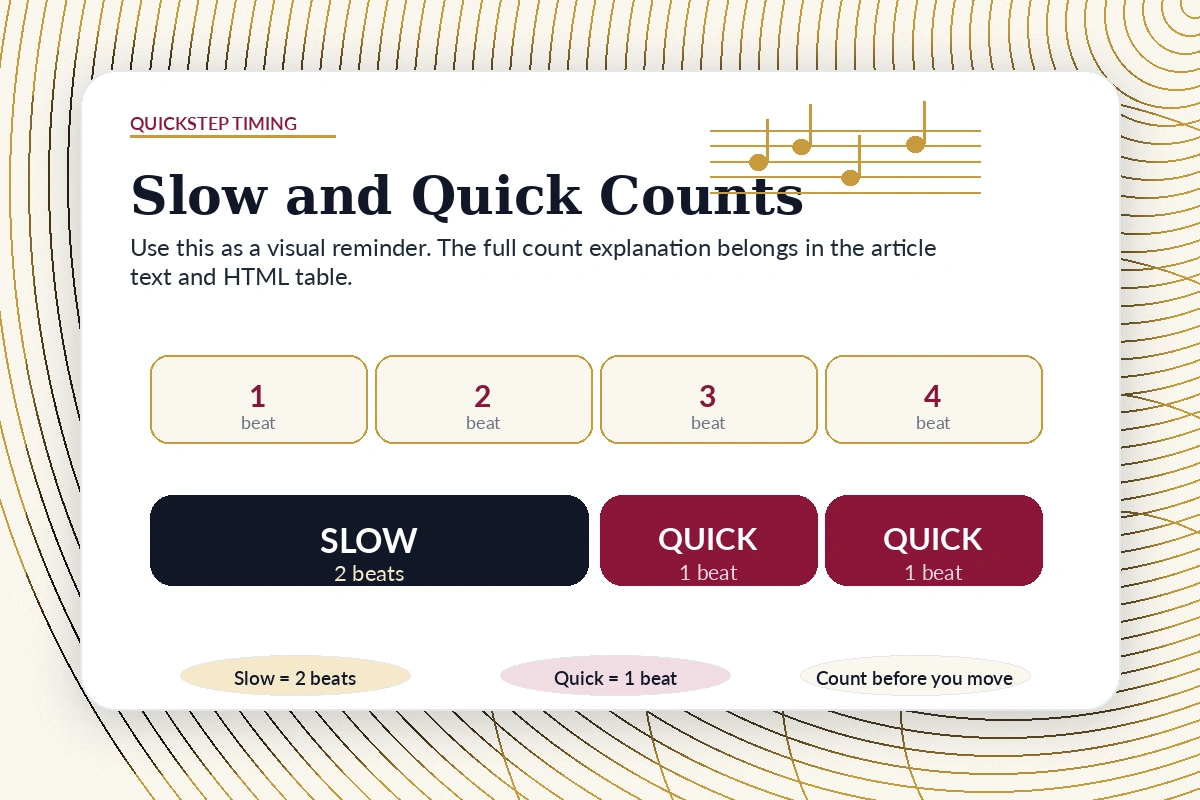
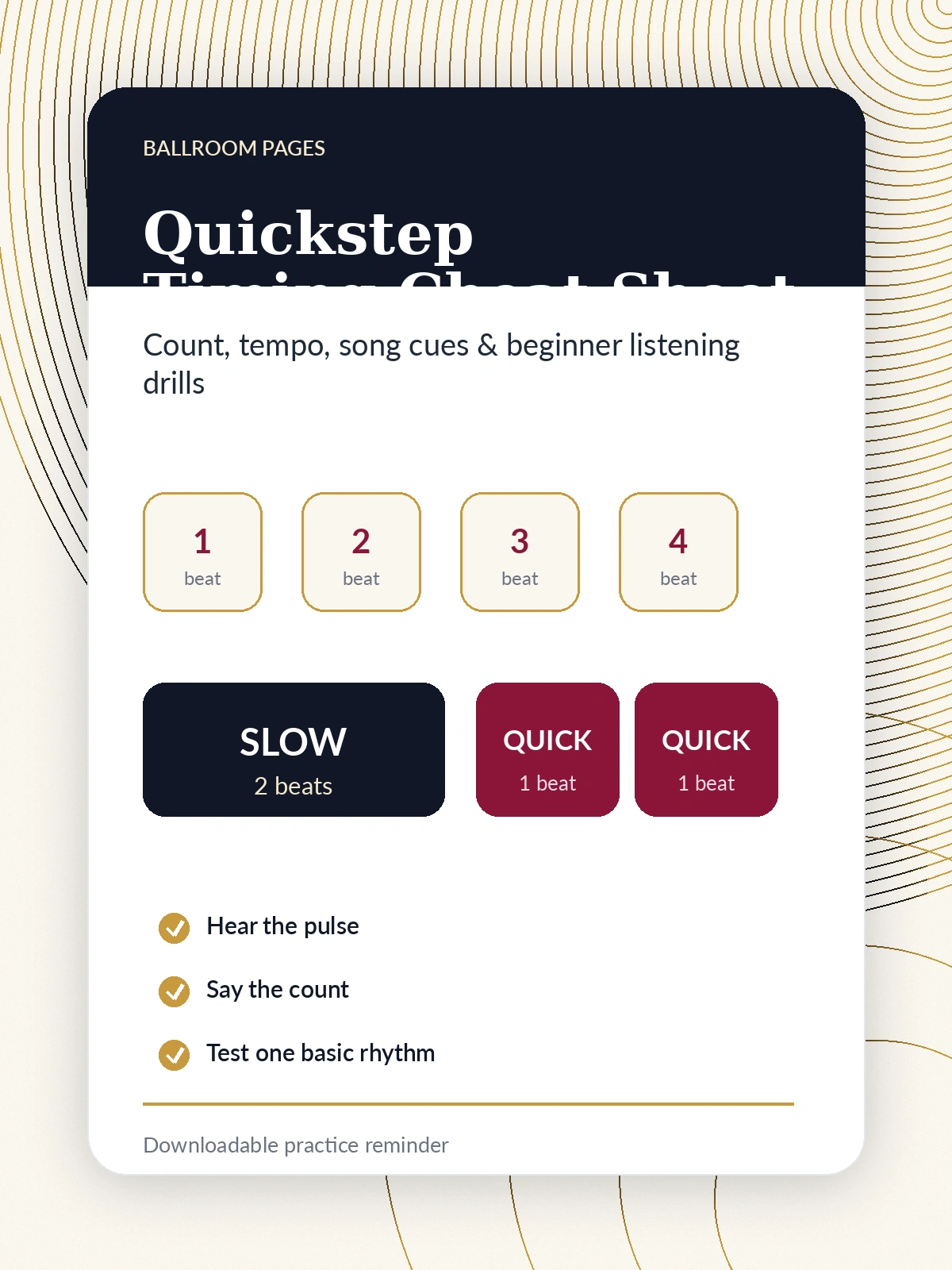
Quickstep uses slow/quick timing language. In plain English:
- A slow usually takes two beats.
- A quick usually takes one beat.
- A common beginner feel is slow, quick, quick or combinations such as slow, slow, quick, quick, depending on the figure.
- Advanced Quickstep can include syncopations and split beats, so the basic pattern is a starting point, not the whole dance.
- SSlow · 2
- QQuick · 1
- QQuick · 1
| Count idea | Beat value | Beginner explanation | Use on page |
|---|---|---|---|
| Slow | 2 beats | Step and allow time; do not rush it | Teach first |
| Quick | 1 beat | A shorter step value | Teach first |
| Slow, Quick, Quick | 4 beats total | One slow plus two quicks fits a four-beat measure | Useful listening drill |
| Slow, Slow, Quick, Quick | 6 beats total | Common in some basic teaching patterns; may cross bar lines | Explain carefully |
| Syncopated counts | Varies | Advanced figures may add “and” counts | Mention, do not overload beginners |
For the broader topic across every dance, read how to count ballroom dance music.
Quickstep tempo: how fast should the music be?
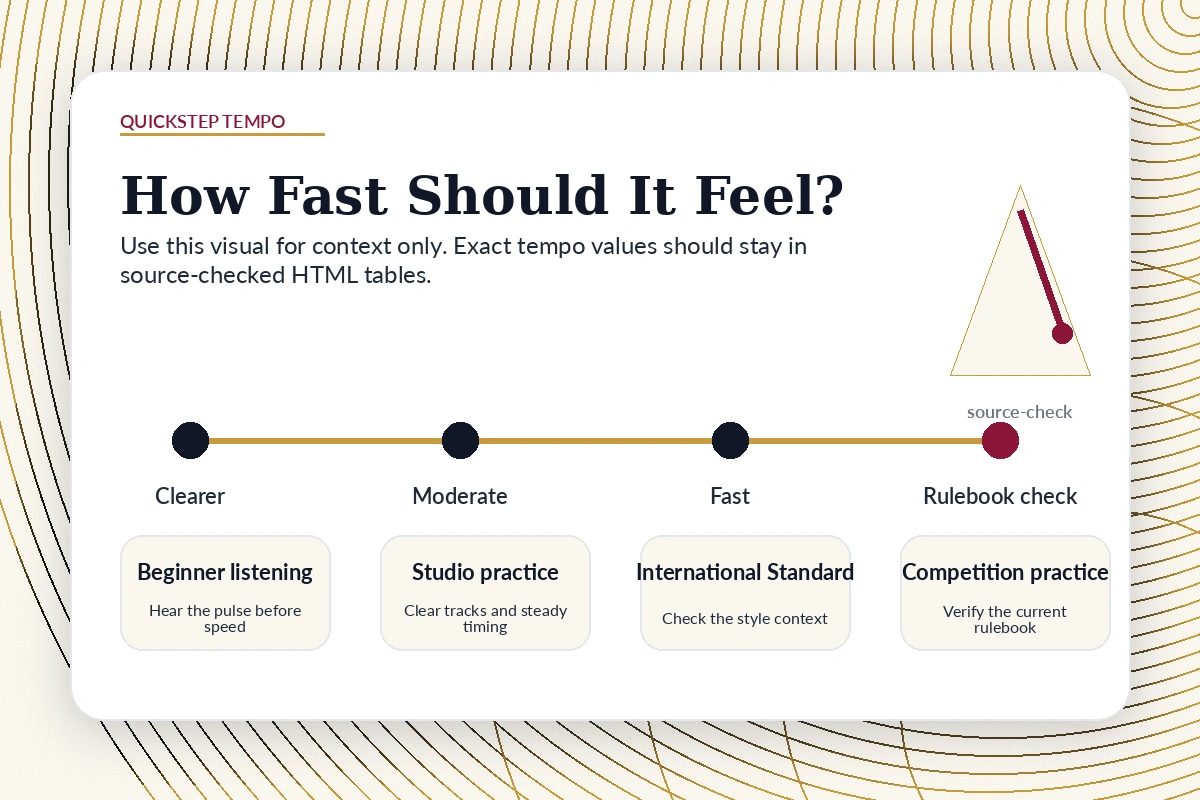
Quickstep tempo is often described in measures per minute or bars per minute, abbreviated MPM, and sometimes in beats per minute, abbreviated BPM. In 4/4 music, one measure contains four beats, so 50 MPM equals 200 BPM.
| Context | Practical guidance | Source-backed notes |
|---|---|---|
| Beginner listening practice | Start with slower or clearer Quickstep-labeled tracks, or slow playback when practicing the count. Do not force full competition speed immediately. | Teaching recommendation, not official tempo. |
| Studio or social practice | Many dance-music references cluster around 48–52 MPM / 192–208 BPM. | Dance Central lists Quickstep Pro/Am at 48–52 MPM / 192–208 BPM. |
| International Standard reference | Quickstep is part of the Standard dance family. | WDSF lists Quickstep among the five Standard dances. |
| NDCA competition context | 50 MPM / 200 BPM for International Style Quickstep in the 2026 rulebook. | NDCA 2026 Rules & Regulations. |
| WDSF competition context | 50–52 bars/min in legacy WDSF competition rules. | WDSF legacy rules. |
The safe wording is: Quickstep is usually fast, commonly around 50 MPM / 200 BPM in competition references, but dancers should check the rulebook or studio standard for their specific context. Compare across dances on the ballroom dance tempo chart.
Quickstep vs Foxtrot vs Swing music
Quickstep, Foxtrot, and Swing can sound related because all three can draw from jazz, swing, or big-band music. The difference is how the dancer uses that music.
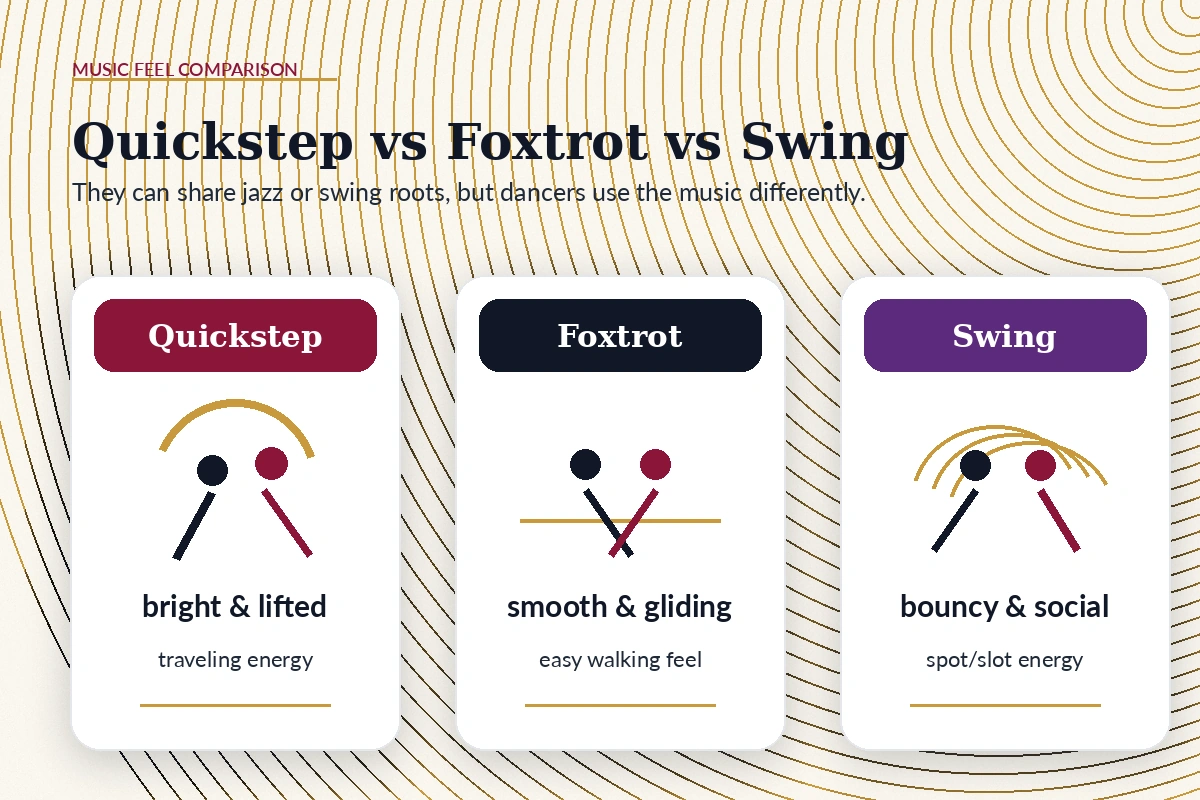
| Dance | Typical feel | Timing/count concept | Tempo impression | Best beginner listening cue |
|---|---|---|---|---|
| Quickstep | Bright, fast, buoyant, traveling | Slow/quick values; many figures vary | Fast | Can you hear a light, steady pulse and say “slow, quick, quick”? |
| Foxtrot | Smooth, gliding, jazzy | Often slow/quick timing language | Usually less frantic than Quickstep | Does it feel like smooth walking and gliding? |
| Swing | Bouncy, social, often spot/slot-based | Often triple or single rhythm depending on style | Can be fast, but energy is different | Does it make you want to bounce or triple step in place? |
For technique and style context, see the Quickstep dance guide and the Foxtrot guide.
How to choose a Quickstep song
A good Quickstep song is not just upbeat. It should make the dance easier to hear and safer to practice.
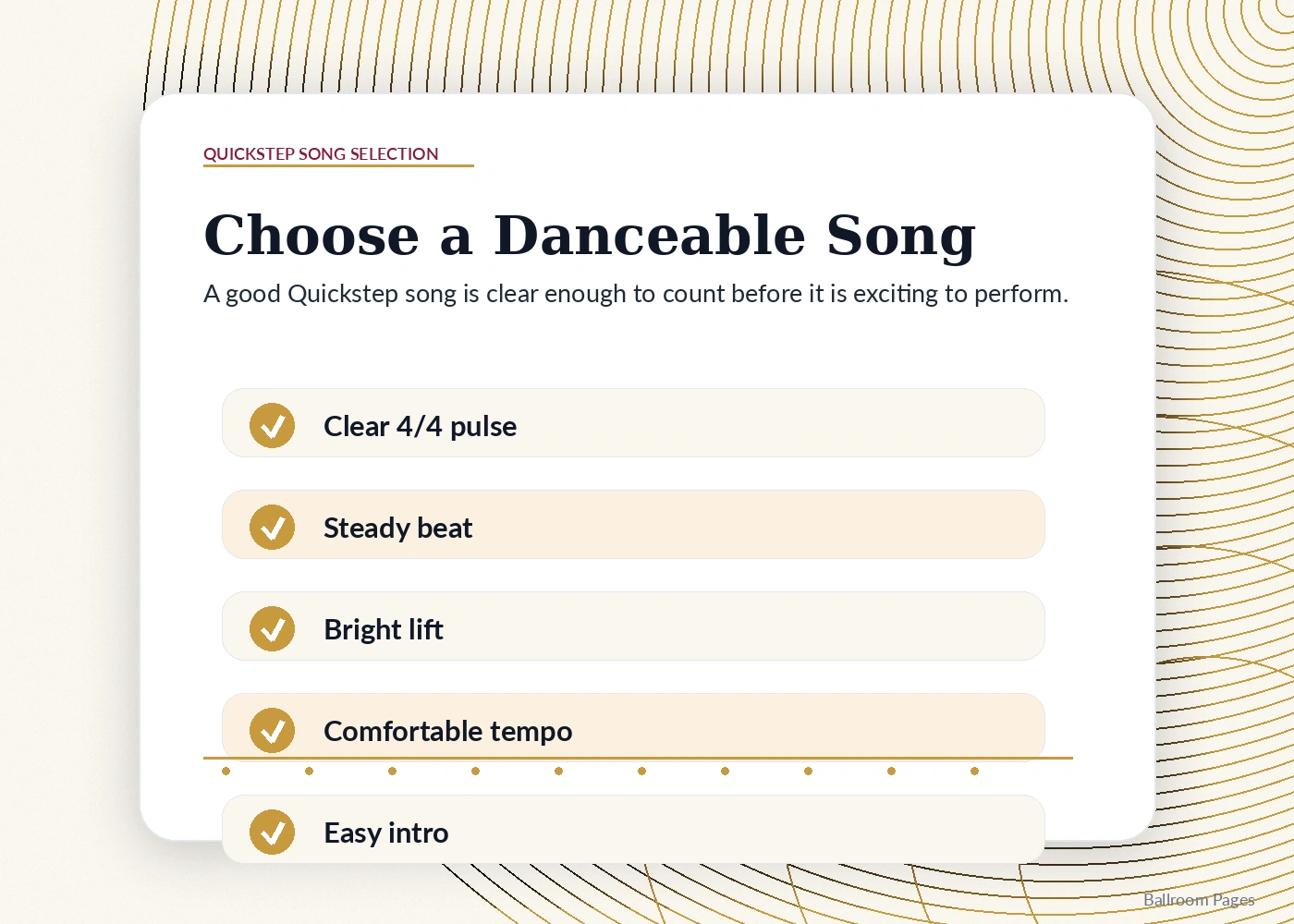
- A clear 4/4 feel.
- A steady beat you can clap.
- Bright, lifted energy.
- A tempo that matches your current level.
- A clear intro or count-in.
- A rhythm that is not too busy for beginners.
- Enough consistency for repeating a basic rhythm.
- A feel that suits your goal: listening, lesson, social practice, showcase, or competition preparation.
| Goal | Best song choice | Avoid |
|---|---|---|
| Beginner listening | Clear beat, moderate-feeling Quickstep track, easy intro | Very fast tracks with complicated syncopation |
| Lesson practice | Track your teacher approves; predictable arrangement | Songs that constantly change energy or tempo |
| Social/studio event | Danceable, bright, familiar enough to follow | Tracks that feel more like Jive/Swing than Quickstep |
| Showcase | Musical personality that supports choreography | Choosing drama over danceability |
| Competition practice | Organization-appropriate tempo and character | Relying on unsourced BPMs or random playlists |
Get the Quickstep count in one printable page
The Quickstep Timing Cheat Sheet gives you the basic slow/quick idea, a simple 4/4 beat grid, beginner listening drills, and a checklist for choosing danceable Quickstep songs.
Download the Quickstep Timing Cheat SheetPractical, beginner-friendly, and unsubscribe anytime.
Best Quickstep songs and examples
Use this section as a curated, verification-aware guide. Do not publish a giant generic song dump. Every public song example should be checked for danceability, arrangement, platform availability, and rights/embedding policy.
| Song example candidate | Artist/version noted in sources | Why it may work | Best for | Publication note |
|---|---|---|---|---|
| “Suddenly I See” | KT Tunstall | Listed as a Quickstep example by Music4Dance | Listening/practice | Verify exact arrangement and danceability before final public list. |
| “Putting On the Ritz” | Tony Evans / Robbie Williams versions appear in dance-music sources | Classic bright Quickstep feel in some arrangements | Practice/showcase | Do not assume all versions are the same tempo. Verify version. |
| “I Get a Kick Out of You” | Rosemary Clooney version appears in Delta Dance list | Classic vocal swing feel | Listening/practice | Verify arrangement and platform availability. |
| “Get Happy” | Candye Kane version appears in Delta Dance list | Upbeat swing/jazz character | Listening/practice | Verify arrangement and tempo. |
| “Sing Sing Sing” quickstep arrangement | Ballroom Orchestra and Singers listed on ballroom-music.net | Strong big-band energy | Advanced listening/showcase idea | Very version-dependent; verify before recommending to beginners. |
| “Pencil Full of Lead / Oh Marie” | Listed in Dance Vision Quickstep playlist snippet | Bright modern swing-pop energy | Listening/practice | Use only if playlist ownership/permissions and track availability are verified. |
Editorial note: if a verified Ballroom Pages Quickstep playlist feed is available, use playlist tracks from that source first. Until then, this is a “song examples to test” list, not an authoritative “best songs” ranking. We do not fabricate BPMs.
Practice Quickstep timing with Ballroom Pages playlists
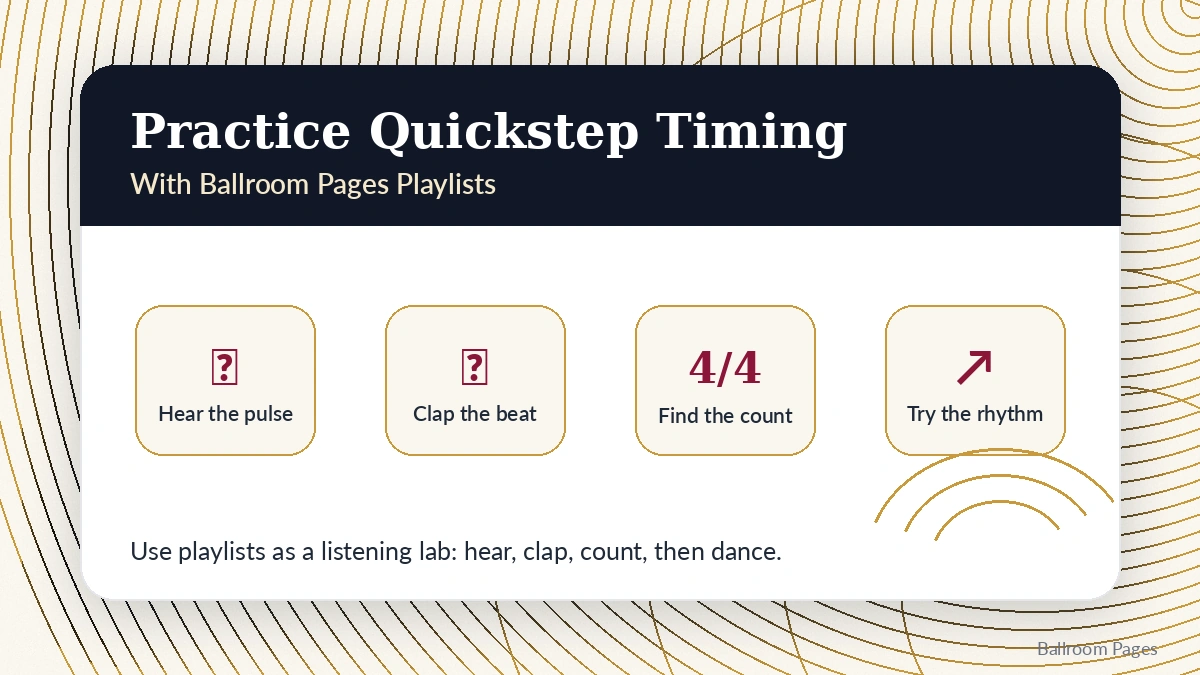
Use the playlists to hear the difference between:
- Bright Quickstep energy.
- Standard ballroom practice music.
- Songs that are fast but too rhythmically busy.
- Songs that feel more like Swing, Jive, or Foxtrot than Quickstep.
Start by listening without dancing. Clap the pulse. Then say “slow, quick, quick.” Only then try a small basic rhythm.
Spotify
Quickstep by Ballroom Pages
Quickstep 2 by Ballroom Pages
Apple Music & YouTube Music
Quickstep on Apple Music
Find the Ballroom Pages Quickstep selection in the full playlist hub.
Quickstep on YouTube Music
Find the Ballroom Pages Quickstep selection in the full playlist hub.
More resources
BallroomPages Music on Telegram
All Ballroom Pages playlists
More: Ballroom Music & Timing, the tempo chart, and how to count ballroom dance music.
Quickstep music for competition, showcases, and social practice
Quickstep music choice changes depending on the setting.
For listening practice, choose clear tracks that help you hear the beat. You are training your ear, not proving speed.
For lesson practice, use music your instructor approves, especially when connecting counts to specific figures.
For showcases, musical personality matters, but danceability still comes first. A clever song that is hard to count can make rehearsal harder than it needs to be.
For competition practice, check the relevant organization and event rules. NDCA and WDSF references do not use identical public wording, and rulebooks can change by year, organization, and event context.
For social or studio practice, keep the goal simple: stay on time, travel safely, and avoid letting the speed make your frame collapse.
Steady your shape with frame and posture, build partnership timing with lead and follow connection, and prepare for events with the ballroom dance competitions guide.
Beginner listening and timing drills
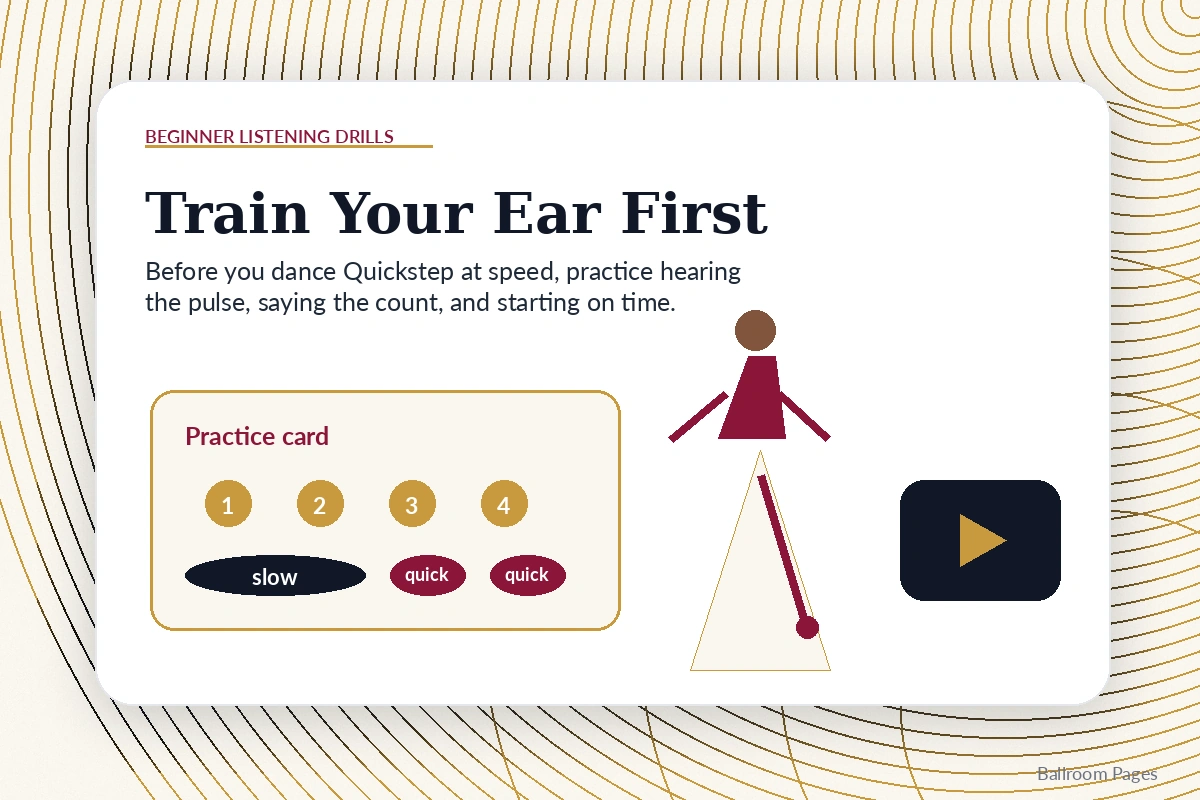
Clap the pulse first
Play a Quickstep track and clap the steady beat before you try steps. If you cannot clap it, do not dance it yet.
Say the rhythm out loud
Say “slow, quick, quick” over the music. Keep the slow relaxed. Most beginners rush the slow and then feel late.
Walk without a partner
Walk the rhythm in a small space. This removes partner pressure and helps you hear whether your feet are arriving too early.
Count the intro before moving
Do not start just because the song started. Listen for the phrase, find the pulse, then move.
Compare Quickstep to Foxtrot
Play one Quickstep track and one Foxtrot track. Notice how Quickstep feels brighter and faster, while Foxtrot usually feels smoother and more gliding.
Try the same rhythm to multiple tracks
Do not practice only one song. If timing works on only one track, you may be memorizing the song instead of hearing Quickstep music.
Build the skill with how to count ballroom dance music and structure your sessions with a ballroom dance practice routine.
Common Quickstep music mistakes
| Mistake | Why it causes problems | Better choice |
|---|---|---|
| Choosing music that is too fast | You rush, lose frame, and stop hearing the slows | Start with clearer tracks and slow playback if needed |
| Assuming every swing/jazz song is Quickstep | Swing feel does not automatically make a danceable Quickstep | Test the beat and slow/quick count |
| Ignoring the intro | You start off-time and spend the phrase catching up | Count before moving |
| Practicing only one song | You memorize one arrangement instead of hearing rhythm | Rotate through several verified tracks |
| Treating BPM as the only test | BPM does not tell you if the arrangement is clear or danceable | Count, clap, and try a simple pattern |
| Using unsourced “competition tempo” claims | Rulebooks vary and change | Cite the relevant organization and year |
| Jumping into advanced figures | Syncopation feels overwhelming before basics are secure | Learn the basic pulse first |