
Ballroom Competitions
Ballroom Competitions Made Clear
Pro-Am, DanceSport, levels, categories, attire, etiquette, and first-competition preparation explained in plain English—so you can understand the pathway before you enter.
Educational guide. Source-aware. Not an official rulebook, event organizer, or registration portal.
Start here
Start here if you’re competition-curious
Use these five checkpoints before you think about registration.
-
1. Ask what pathway fits you
Are you entering Pro-Am with your teacher, amateur with another student, or a different category? The answer changes what rules and expectations apply.
-
2. Learn your style family
Common competition families include International Standard, International Latin, American Smooth, and American Rhythm. Some events also include social or club-style categories.
-
3. Know your level before you choose entries
Newcomer, Bronze, Silver, Gold, and Open do not mean the same thing everywhere. Your teacher or coach should help you choose appropriate entries.
-
4. Verify the rules before you plan choreography
Syllabus and open events may allow different figures. Do not assume a step is legal because you learned it in class.
-
5. Prepare for the whole day, not just the dance
Packing, check-in, heat times, shoes, hair, food, rest, and nerves all matter. Use the first ballroom competition checklist.
Pathway
The ballroom competition pathway
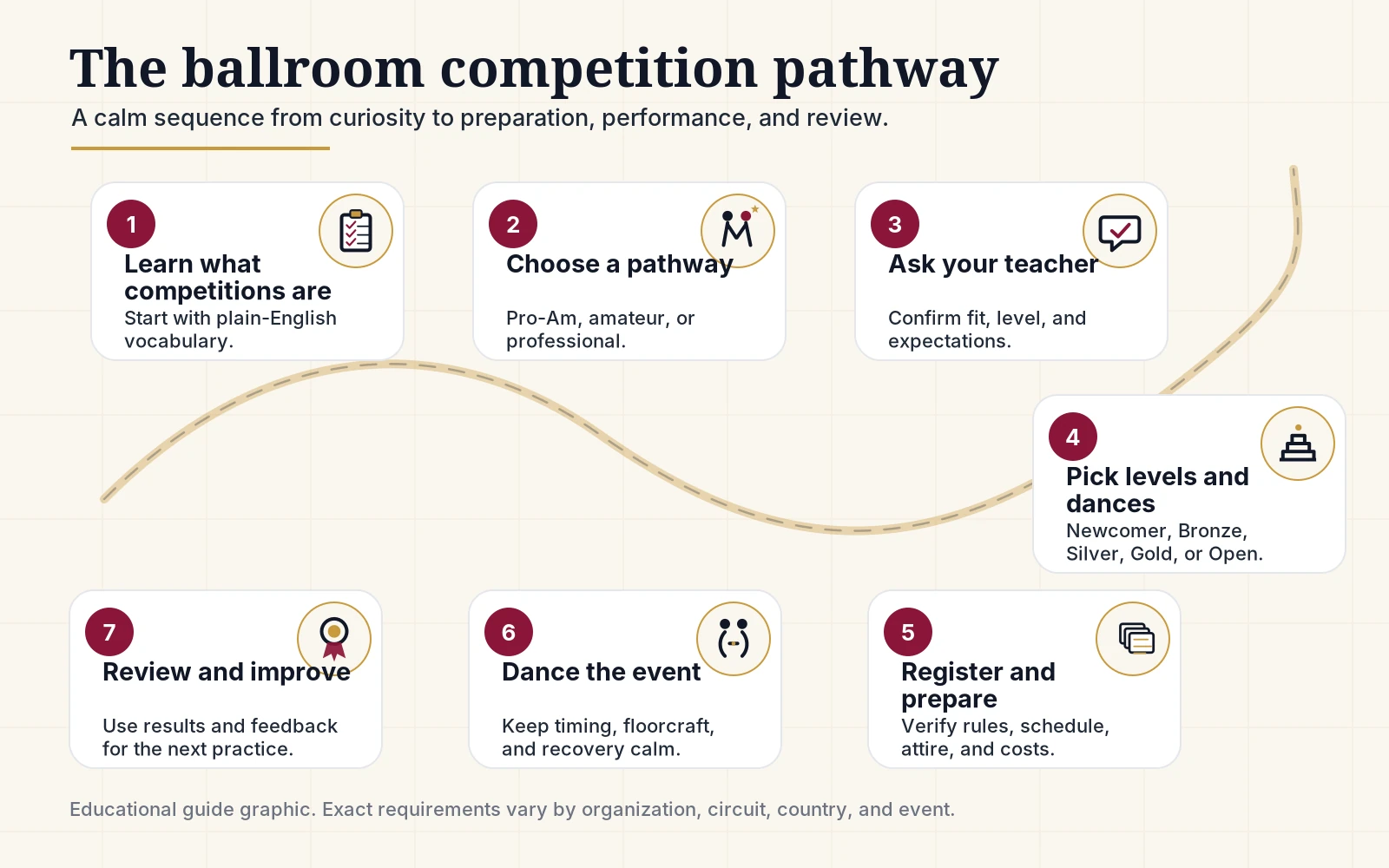
A first competition becomes less mysterious when you see it as a sequence of decisions.
-
Curious
You have seen a competition or heard your teacher mention one. Your job is to learn the vocabulary.
-
Considering
You ask what kind of event fits your goals, schedule, budget, and current level.
-
Planning
You choose styles, levels, heats, attire, and a practice timeline with your teacher or coach.
-
Entering
You confirm registration details, rules, payment deadlines, schedule expectations, and required documents.
-
Dancing
You focus on timing, posture, partnership, floorcraft, and calm recovery when something goes differently than planned.
-
Reviewing
After the event, you look at results, notes, video, and teacher feedback to decide what to practice next.
Pathways
Pro-Am vs amateur vs professional
Competition pathways describe who dances together and what type of event you enter. They are not a ranking of who matters more.
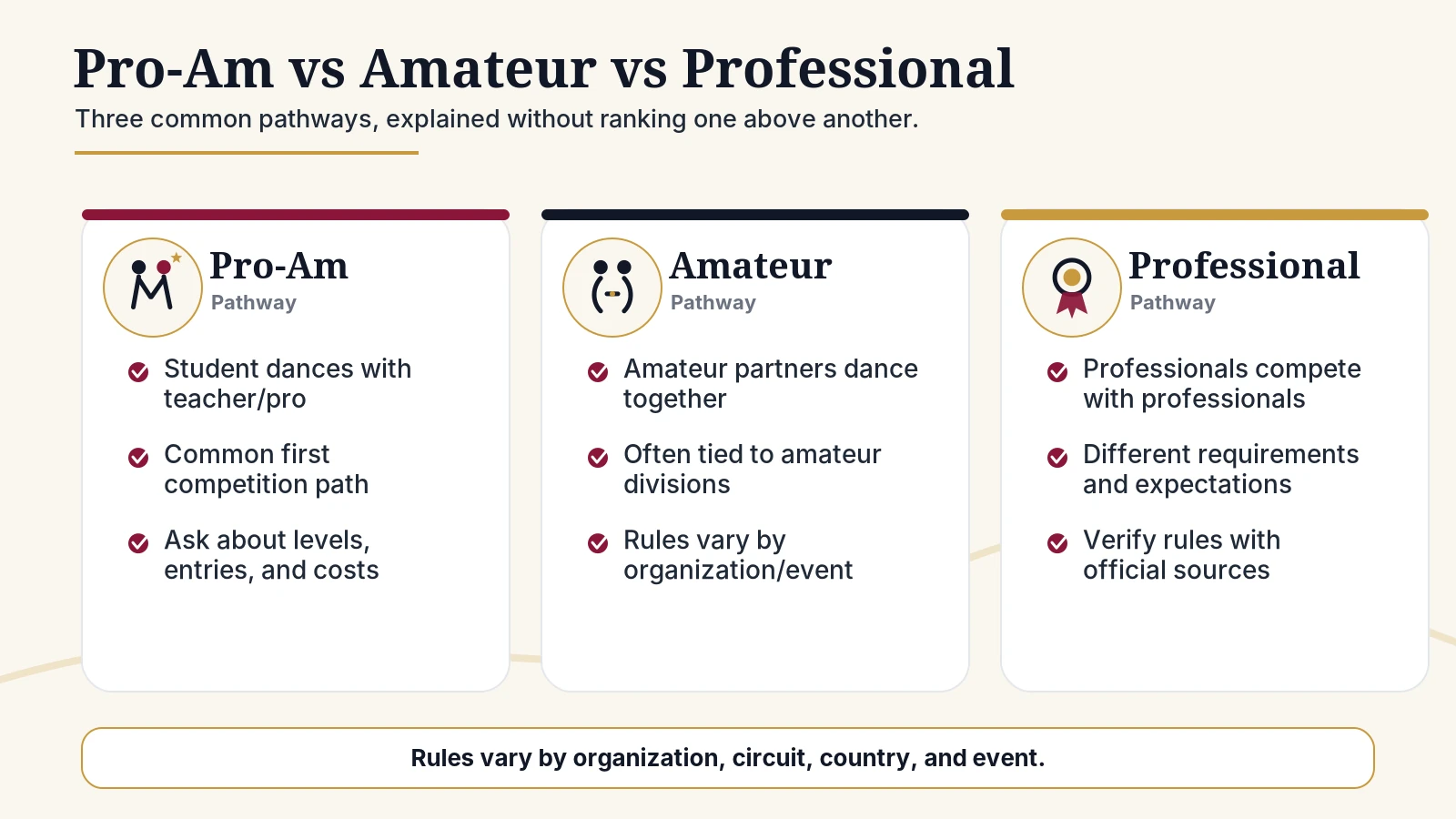
| Pathway | Plain-English meaning | Common fit | What to verify |
|---|---|---|---|
| Pro-Am | A student dances with a professional teacher or instructor. | Studio students, adult learners, dancers without an amateur partner. | Registration status, student eligibility, allowed levels, entry limits, costs, scholarship rules. |
| Amateur | Two amateur dancers compete together. | Student couples, collegiate dancers, partners training together. | Age category, proficiency level, syllabus/open rules, partner eligibility. |
| Professional | Professional dancers compete with professional partners. | Teachers, coaches, performers, career competitors. | Professional registration, event eligibility, circuit-specific rules. |
| Student/Student or mixed formats | Two students or mixed-status dancers may enter specific categories where offered. | Some Pro-Am or studio event settings. | Whether the event offers the format and what eligibility rules apply. |
No pathway is automatically better. The best choice depends on your goals, partner situation, teacher, budget, and the competition system you are entering.
New to competing? The most common starting point for adult students is Pro-Am. Read the full Pro-Am ballroom dance guide — how it works, levels and heats, costs, what to ask before signing up, and how to prepare for your first event.
Levels
Levels, syllabus, and open choreography
Level names help organize competition entries, but they are not universal. Always verify the specific rulebook and event rules.
-
Level
Newcomer
A beginner-friendly category offered by some events for dancers who are new to competition. The exact definition and time limit can vary.
-
Level
Bronze
An early syllabus level focused on foundational figures and technique. Bronze is where many new competitors begin, but rules still vary.
-
Level
Silver
A syllabus level after Bronze that usually adds more figures, shaping, movement, and technical expectations.
-
Level
Gold
A higher syllabus level with more advanced material than Bronze or Silver.
-
Level
Open
A level or event type where choreography is generally not restricted to a closed syllabus in the same way. Open does not mean “anything goes”; event rules still apply.
-
Concept
Syllabus
A structured list of allowed figures or elements for a level. Syllabus rules are especially important because an otherwise beautiful step may be disallowed if it is above the level or outside the event’s rules.
Want the full picture? Read Bronze, Silver, and Gold ballroom levels explained — what each level means, what changes as you progress, Pro-Am context, a practice roadmap, and practice music.
Categories
Styles and dance categories
Most ballroom competitions organize entries by style family, dance, level, and sometimes age or other divisions. For the full decoder — how style, partnership, level, age division, and format combine — read ballroom dance competition categories.
-
International Standard
Waltz, Tango, Viennese Waltz, Slow Foxtrot, and Quickstep. Standard is known for closed hold, travel, and a formal frame.
-
International Latin
Cha Cha, Samba, Rumba, Paso Doble, and Jive. Latin often emphasizes rhythm, body action, leg action, and expressive style.
-
American Smooth
Waltz, Tango, Foxtrot, and Viennese Waltz. Smooth allows more open work and separation than International Standard in many systems.
-
American Rhythm
Cha Cha, Rumba, East Coast Swing, Bolero, and Mambo. Rhythm is related to, but not identical with, International Latin.
-
Social or club-style crossover categories
Some events include dances such as Salsa, Bachata, Hustle, West Coast Swing, Merengue, or Nightclub Two Step. Do not assume these categories are available at every competition.
Vocabulary
Heats, rounds, finals, and results
Competition schedules use their own vocabulary. These terms help you follow the day.
-
Schedule
Heat
A scheduled entry or group on the floor. Your heat may be one dance, one level, one category, or part of a larger event structure.
-
Format
Single-dance event
You are judged on one dance, such as Bronze Rumba or Silver Waltz.
-
Format
Multi-dance event
You dance several dances as one event, such as a three-dance Rhythm event or a five-dance Latin event.
-
Stage
Round
A stage of competition. A large event may have earlier rounds before a final.
-
Stage
Final
The last round where placements are determined.
-
Results
Placement
Your result within the event. Placements are useful feedback, but they are not the whole story of your progress.
-
Officials
Judges or adjudicators
The officials who evaluate the dancing. The exact judging system and panel requirements vary by organization and event.
-
Officials
Scrutineering
The process of processing judges’ marks and calculating results. Competitors usually do not need to understand the full math on their first event, but they should know that results are handled by officials, not by the dancers themselves.
Preparation
First competition preparation checklist
Use this as a planning aid, then verify the details with your teacher and organizer.
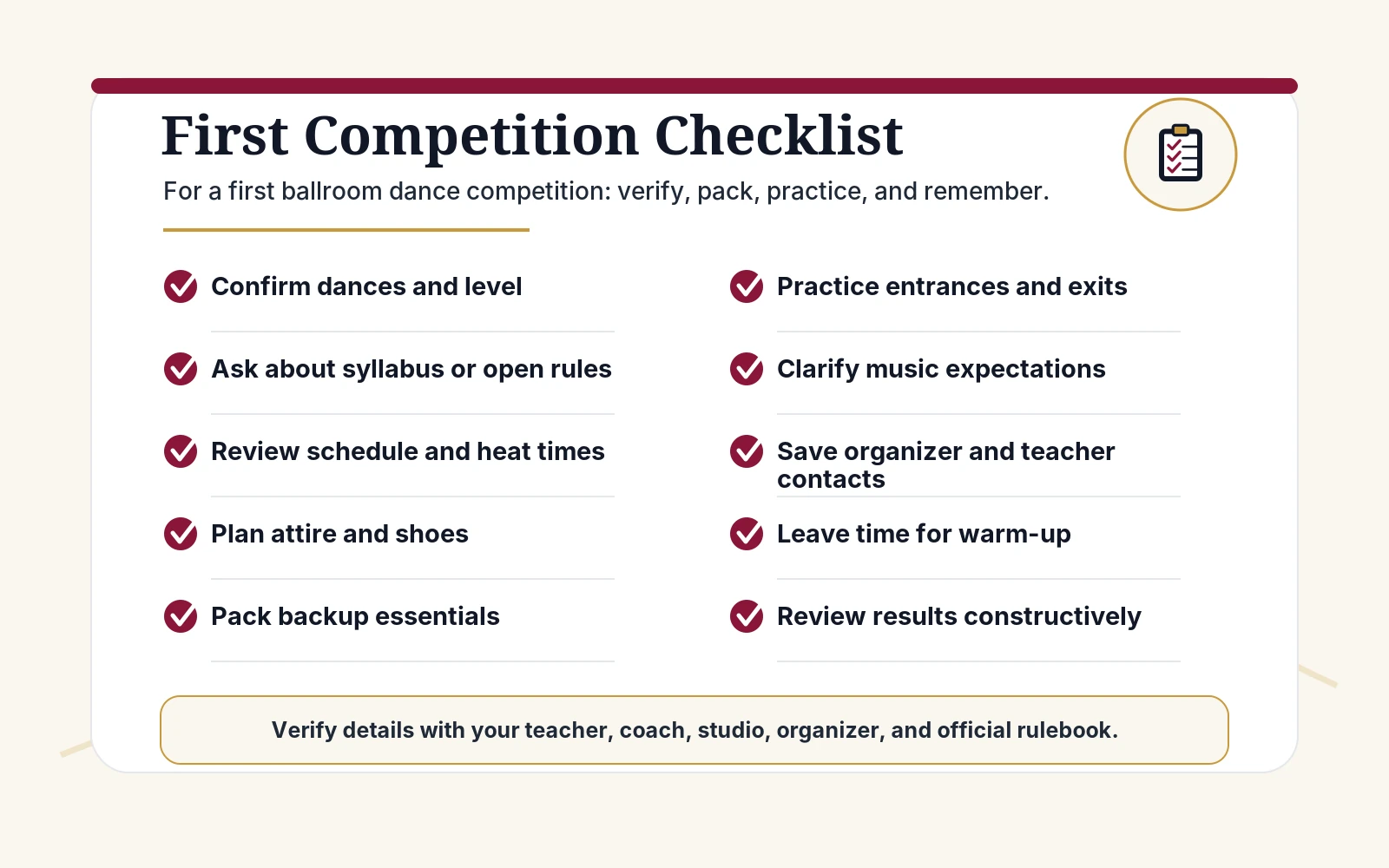
Before you register
- Ask your teacher what pathway fits you.
- Confirm your style, level, and entries.
- Read the event’s rules or ask where to find them.
- Ask what costs are included and what costs are separate.
- Check deadlines for entries, packages, hotel, tickets, and cancellations.
Before competition week
- Practice your entries in the order you may dance them.
- Try on shoes, attire, accessories, and hair/grooming choices.
- Pack backups for small failures: extra tights, pins, tape, shoe brush, water, snacks.
- Confirm transportation, hotel, arrival time, and check-in process.
- Ask when heat sheets or schedules are expected.
On competition day
- Arrive early.
- Check in.
- Keep your number visible and secure.
- Stay near the ballroom before your heats.
- Warm up gently.
- Keep patterns smaller if the floor is crowded.
- Thank your partner, teacher, officials, and fellow dancers.
After the event
- Review results calmly.
- Ask your teacher what improved and what needs practice.
- Watch video if you have it.
- Write down three takeaways.
- Choose one technique focus for the next month.
Questions
What to ask your teacher
Bring these questions to a lesson or coaching conversation before you commit to an event.
- Which competition pathway fits me: Pro-Am, amateur, student/student, or something else?
- Which style family should I enter first?
- Which dances are realistic for my current level?
- Which level should I enter, and why?
- Are my routines syllabus-safe for this event?
- What should I practice before registration?
- What will the total cost likely include?
- What attire and shoes do I need?
- How early should I arrive before each heat?
- What should I do if I make a mistake on the floor?
- How will we review results afterward?
Questions
What to ask the organizer
If your teacher cannot answer something definitively, bring it to the event organizer in writing.
- Which rulebook applies to this event?
- Are there event-specific rules that differ from the general rulebook?
- What are the registration deadlines?
- Are there entry limits or package requirements?
- When will the schedule or heat list be available?
- How early should competitors report before a heat?
- What are the photography and video rules?
- What dress code applies to my age, level, and event?
- Are there rules about props, lifts, tricks, drops, or open choreography?
- Who should competitors contact for rule or schedule questions?
Attire & packing
Attire, shoes, grooming, and packing
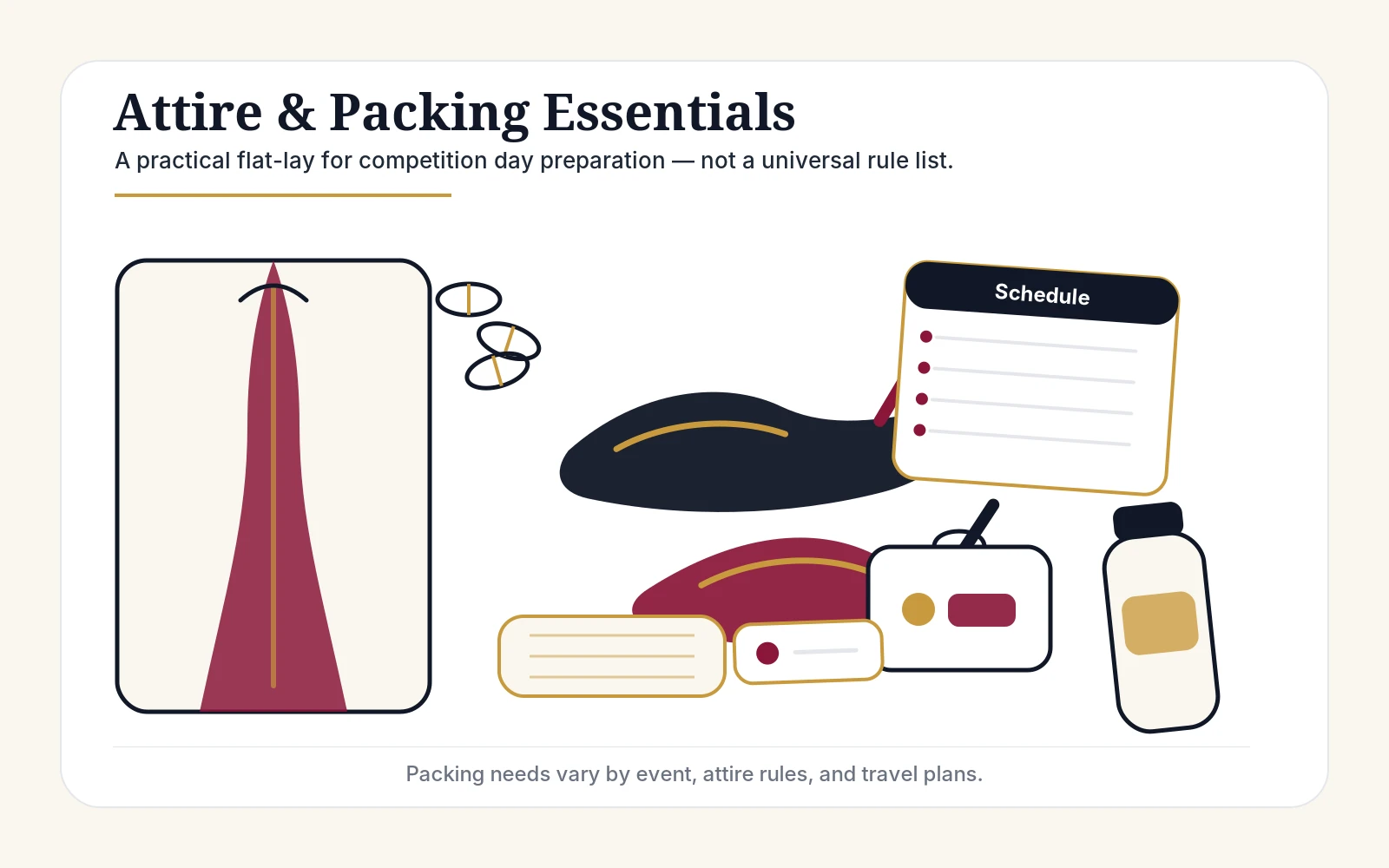
Competition attire should support the dance, the rules, and your confidence. Some events are formal; some beginner or collegiate events are simpler; some age groups and levels have specific dress restrictions. Always check the rules before buying or altering attire.
-
Attire basics
Choose clothing that fits securely and allows movement. Make sure hems, sleeves, straps, and accessories do not distract you. Test your outfit while dancing, not just while standing still. Bring a backup option if possible.
-
Shoes
Use shoes appropriate for your dance style and floor. Brush suede soles if you use them and the venue allows it. Do not wear brand-new shoes for the first time on competition day.
-
Grooming
Hair should stay secure through movement. Makeup and grooming expectations vary by event, level, age group, and personal preference. Keep fragrance moderate because shared ballroom spaces can be crowded.
-
Packing
Bring competition number supplies if required, dance shoes, attire, accessories, safety pins, hair pins, tape, sewing kit, stain remover, lint roller, water, snacks, mints, towel, comfortable layers, phone charger, schedule, ID, payment card, and rule/contact notes.
Etiquette
Etiquette and floorcraft
Competition etiquette overlaps with social dance etiquette, but the floor and schedule pressure raise the stakes.
-
Respect the schedule
Competition days move quickly. Be near the ballroom before your heat and listen for announcements.
-
Protect your partner and the floor
Use floorcraft. Avoid running into other couples, cutting through traffic, or forcing large patterns when space is tight.
-
Do not surprise anyone with risky movement
Dips, lifts, tricks, drops, aerials, and dramatic lines need consent, training, space, and rule permission. On a crowded floor, simpler is usually safer.
-
Treat officials respectfully
Questions about rules, marks, or scheduling should go through the proper channel. Do not approach judges casually to challenge results.
-
Be gracious with other competitors
Everyone is managing nerves, schedules, and goals. A calm “good luck” and “thank you” goes far.
-
Review results constructively
A placement is one piece of information. Use it with teacher feedback, video, and your own goals.
Costs
Costs and expectations
Competition costs can vary widely. Do not rely on a generic online number. Ask for a line-item estimate before committing.
- Entry fees
- Teacher/professional fees
- Studio fees or coaching fees
- Admission or package costs
- Hotel and travel
- Attire, shoes, grooming, and alterations
- Hair/makeup vendors
- Photography or video
- Meals, parking, tips, and incidentals
A good first competition plan includes both a practice plan and a budget conversation.
Source-checking
Official rules and source-checking
Before competition day, verify the following with the official source:
- Which organization or circuit sanctions or governs the event.
- Which rulebook applies.
- Whether the event has its own supplemental rules.
- Which category, age, level, and style you are entering.
- Whether your choreography is legal for your event.
- What attire rules apply.
- What check-in, deck, schedule, and photography rules apply.
Editorial standards
Expert review note
Related guides
Related guides
Companion hubs across Ballroom Pages for foundation, style, music, technique, and floor behavior.
FAQ
Ballroom competition FAQ
The questions readers ask most often before a first ballroom competition.
-
What is a ballroom dance competition?
A ballroom dance competition is an event where dancers perform ballroom or partner-dance styles for adjudicators. Events may include Pro-Am, amateur, professional, syllabus, open, single-dance, multi-dance, youth, senior, collegiate, or social-dance categories depending on the organizer.
-
What does DanceSport mean?
DanceSport is a term often used for organized competitive dance, especially in official or international contexts. It can include Standard, Latin, Smooth, Rhythm, and other disciplines depending on the organization.
-
What is Pro-Am ballroom?
Pro-Am usually means a student dances with a professional teacher or instructor. It is common in U.S. ballroom competitions, but eligibility, divisions, and registration requirements vary by organization and event.
-
Do I need to be advanced to compete?
No. Many competitions offer beginner or newcomer-friendly entries, but the names and requirements vary. Ask your teacher what level and event format fit your current dancing.
-
What are Bronze, Silver, Gold, and Open?
Bronze, Silver, and Gold are commonly used syllabus levels. Open generally means choreography is not limited to the same closed syllabus restrictions, but Open still has rules. Always verify with the event’s official rulebook.
-
What is a heat?
A heat is a scheduled entry or group on the competition floor. Your heat number helps you know when to be ready to dance.
-
What should I wear to a ballroom competition?
Wear attire that fits the event rules, your dance style, your age/level category, and your comfort. Do not buy expensive competition attire before confirming what is allowed for your event.
-
How much does a ballroom competition cost?
Costs vary widely by event, location, teacher arrangement, entries, travel, attire, and services. Ask your teacher or studio for a line-item estimate before registering.
-
Are lifts and tricks allowed?
Do not assume so. Lifts, drops, tricks, aerials, and dramatic dips may be restricted or unsafe in many contexts. Verify the rules and never surprise a partner with risky movement.
-
Which rulebook should I follow?
Follow the rulebook and event-specific rules for the competition you are entering. If there is a conflict, ask the organizer or your teacher which source is authoritative for that event.