
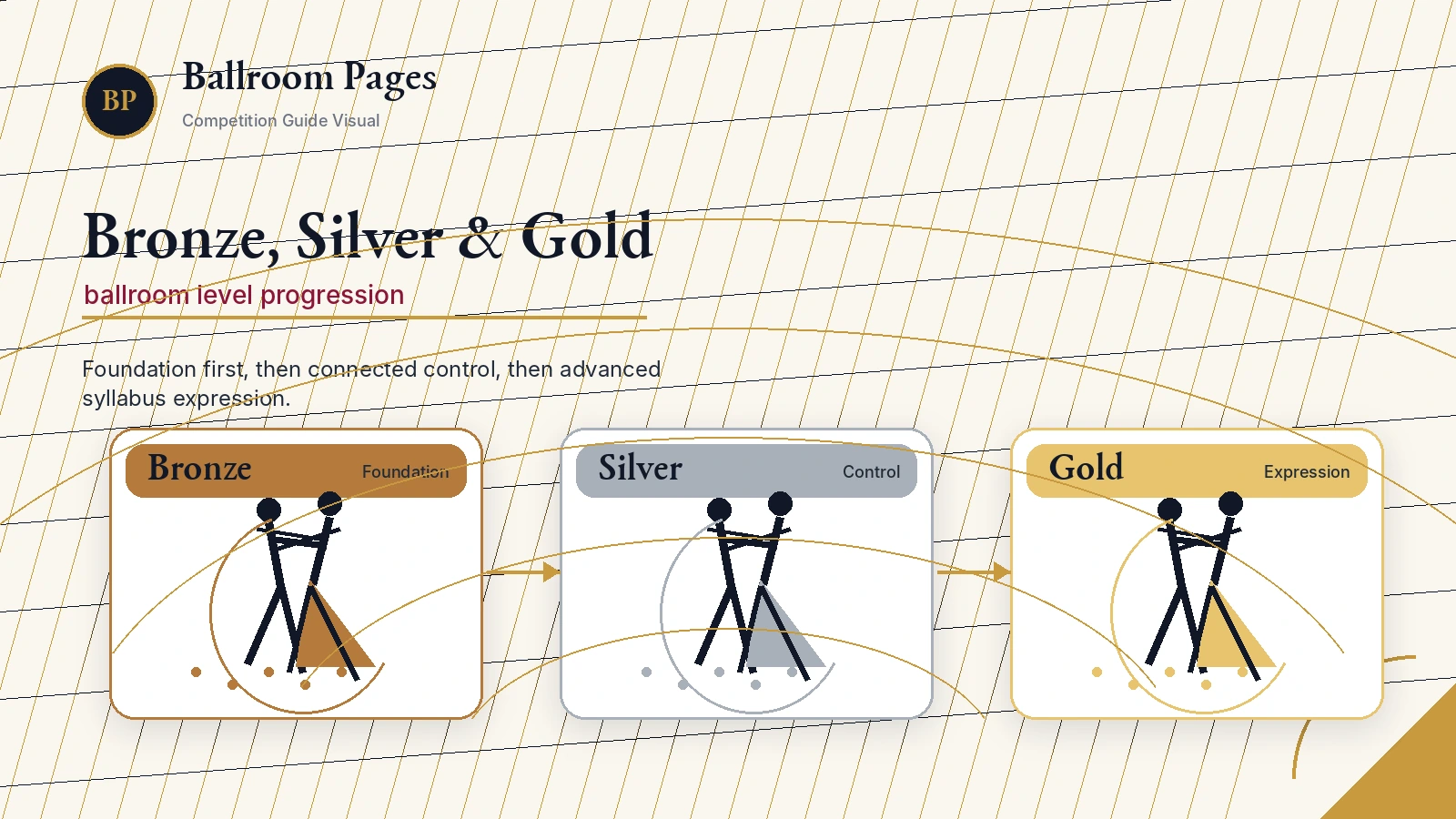
Bronze vs Silver vs Gold at a glance
This overview is a general guide. The exact figures and boundaries for each level depend on your organization and syllabus.
| Bronze | Silver | Gold | |
|---|---|---|---|
| Stage | Foundational | Intermediate | Advanced syllabus |
| Focus | Core figures, timing, basic technique | More figures, better quality, more shaping | Refined technique, harder figures, performance |
| Typical figures | Smaller set of fundamental patterns | Expanded patterns and combinations | Advanced syllabus patterns and more demanding actions |
| Technique emphasis | Posture, balance, weight transfer, timing | Continuity, shaping, footwork detail | Polish, musicality, control under pressure |
| Used for | Social, medals, competition | Social, medals, competition | Social, medals, competition |
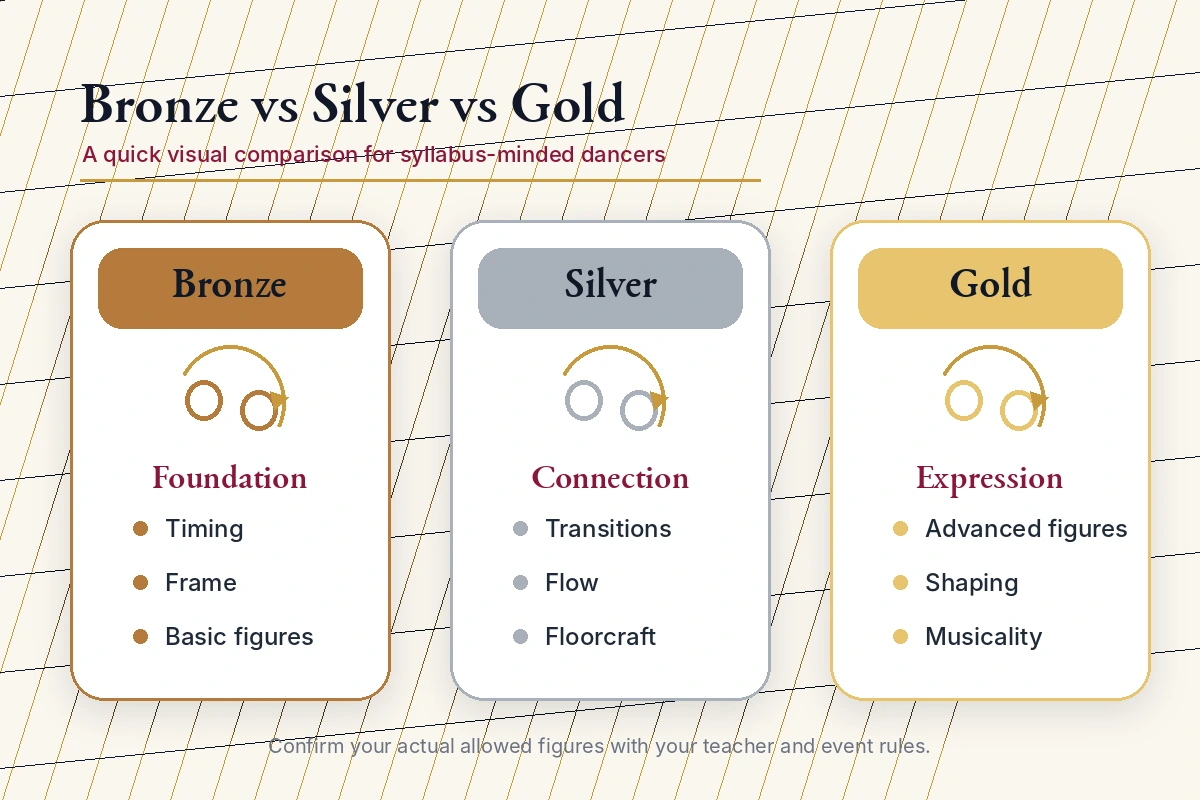
What a ballroom syllabus level means
A “syllabus” is a defined list of figures (steps and patterns) organized by level. When a dance is danced at a syllabus level, the figures generally come from that level’s approved list. Bronze, Silver, and Gold are the three most common syllabus tiers, with Bronze at the foundation and Gold as the most advanced syllabus material.
Two important points keep this realistic. First, syllabus content is defined by organizations and dance registries, and different systems organize figures differently—so a figure that sits in one level for one organization may sit elsewhere for another. Second, “syllabus” levels are usually distinguished from “open” levels, where choreography is freer. For the terms themselves, see the ballroom dance glossary .
Bronze ballroom level
Bronze is the foundational level. It is where most newer competitive and medal-exam dancers begin, and it emphasizes the building blocks: posture, balance, timing, weight transfer, and a core set of fundamental figures. The goal at Bronze is not to collect many patterns—it is to make the fundamentals clear, comfortable, and musical.
Some programs add sub-levels around Bronze (such as Newcomer or Pre-Bronze), and the exact figure list varies by organization. Build the underlying skills with frame and posture and lead and follow, and lock in timing with how to count ballroom dance music.
Silver ballroom level
Silver is the intermediate level. Dancers usually keep their Bronze foundation while adding more figures, more shaping, and more continuity between patterns. Quality expectations rise: footwork detail, smoother transitions, and clearer musicality matter more than simply knowing additional steps.
A common Silver pitfall is rushing into new figures before the Bronze fundamentals are reliable. Strong Silver dancing usually looks like clean Bronze technique applied to a wider vocabulary.
Gold ballroom level
Gold is the advanced syllabus level. It typically involves more demanding figures, greater control, refined technique, and stronger performance quality. Gold dancing is usually judged not just on what figures you can perform, but on how well you perform them—balance, timing, shaping, and musicality under pressure.
Beyond Gold, many organizations offer open and championship categories with freer choreography. Exact level names and what is permitted vary by organization and event.
What changes as you progress
Moving up is less about memorizing more steps and more about raising quality. As dancers progress, the same fundamentals are expected to look better and hold up at higher speed and under performance pressure.
| Element | Earlier (Bronze) | Later (Silver / Gold) |
|---|---|---|
| Figures | Core fundamentals | Expanded and more demanding |
| Quality | Clear and on time | Refined, controlled, expressive |
| Continuity | Pattern to pattern | Smooth, connected sequences |
| Musicality | On the beat | Phrasing and interpretation |
| Partnership | Basic connection | Responsive leading and following |
Partnership quality is practiced with a partner and a teacher; solo work supports timing, posture, and weight transfer but does not replace real leading and following.
Social dancing vs medal exams vs competition
Bronze, Silver, and Gold appear in three different contexts, and it helps to know which one you are in.
| Setting | What the level means here | Goal |
|---|---|---|
| Social dancing | A guide to the material you are learning in class | Confidence and enjoyment on a social floor |
| Medal exams (medal tests) | A structured assessment of level-appropriate figures and technique | Feedback and recognized progress |
| Competition | A category you enter against others at a similar level | Performance and placement |
You do not have to compete to use these levels. Many social dancers progress through Bronze, Silver, and Gold material without entering an event. For the broader picture, see ballroom competition categories and the Ballroom Competitions hub.
Pro-Am and amateur context
Bronze, Silver, and Gold categories appear in both Pro-Am and amateur entries. In Pro-Am, an amateur student typically dances with a professional partner—often their own teacher—within a level category. In amateur events, two amateurs partner each other. The level still describes the syllabus material being danced.
Exact Pro-Am and amateur rules, eligibility, and category structures vary by organization and event, so confirm the details before you enter. A dedicated Pro-Am guide is planned in the Competitions section.
American Smooth/Rhythm vs International Standard/Latin
The level names Bronze, Silver, and Gold are used across all four main competitive families, but the syllabus figures, technique, and conventions differ:
- American Smooth — Waltz, Tango, Foxtrot, Viennese Waltz, with open work allowed at higher levels.
- American Rhythm — Cha Cha, Rumba, Swing, Bolero, Mambo.
- International Standard — Waltz, Tango, Viennese Waltz, Slow Foxtrot, Quickstep, danced in a closed frame.
- International Latin — Cha Cha, Samba, Rumba, Paso Doble, Jive.
So “Silver” in International Latin and “Silver” in American Smooth describe a similar stage but very different material. Compare the families in ballroom dance styles.
Practice roadmap for Bronze, Silver, and Gold
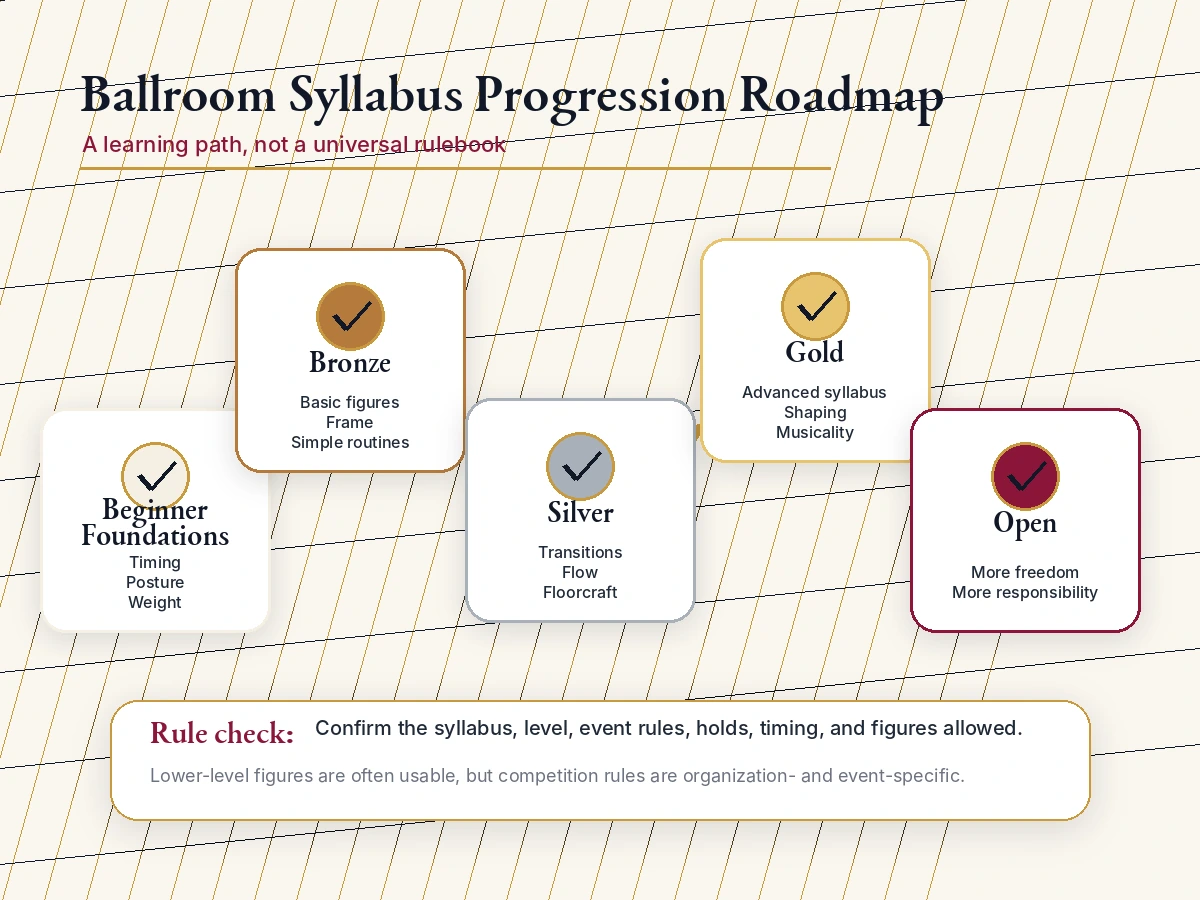
- BronzeLock in posture, timing, balance, and weight transfer on a core set of figures. Make the basics clear and musical before adding patterns.
- Bronze → SilverOnce Bronze feels reliable, add figures gradually and raise quality: continuity, footwork detail, and smoother transitions.
- SilverApply clean Bronze technique to a wider vocabulary. Prioritize shaping and musicality over collecting steps.
- Silver → GoldRefine control and performance quality. Practice holding technique under speed and pressure.
- GoldPolish advanced figures, phrasing, and interpretation. Seek regular coaching feedback.
Build a weekly plan with the ballroom dance practice routine and sharpen the fundamentals with ballroom technique guides.
Know exactly what to practice at your level
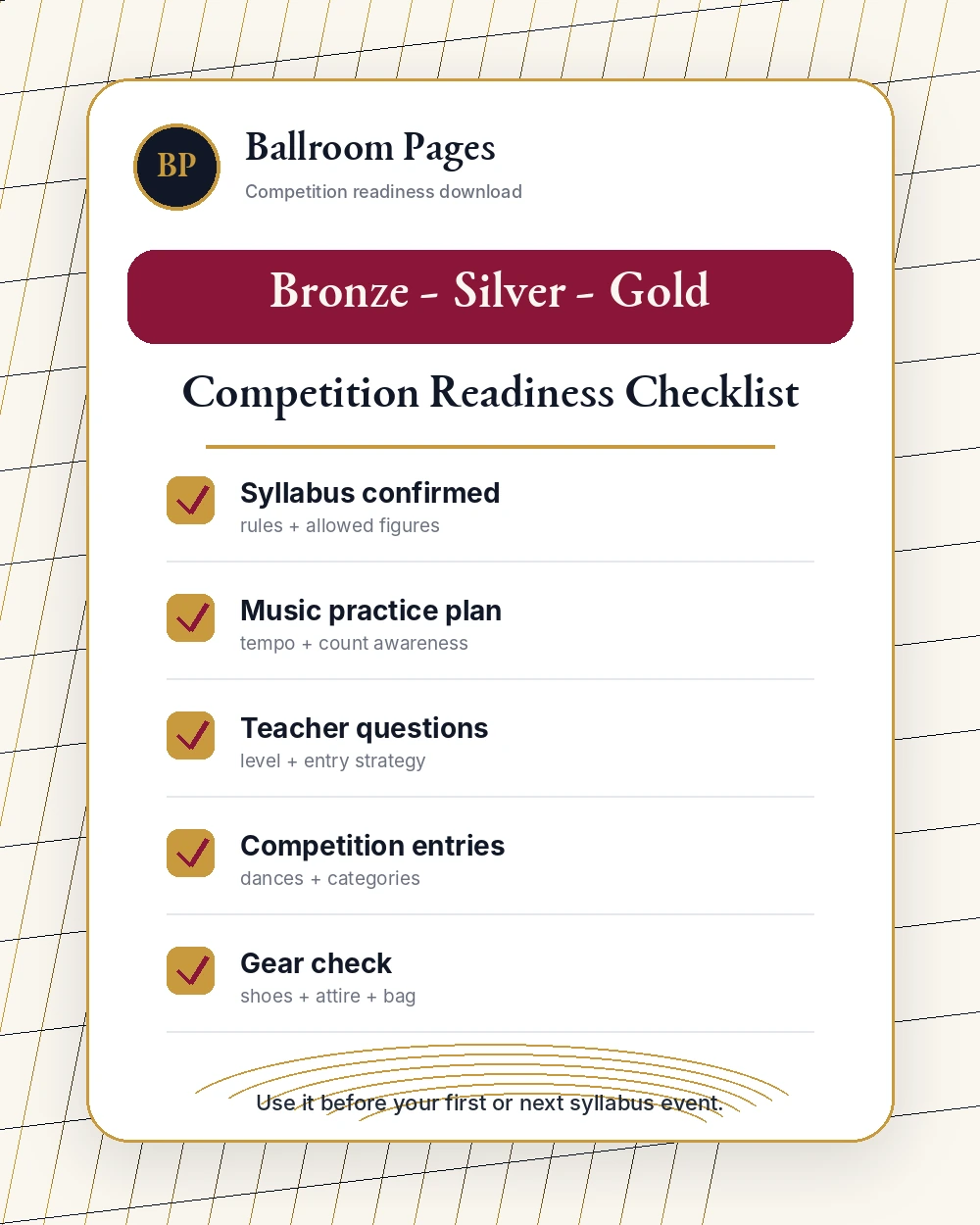
Download the Bronze–Silver–Gold Checklist—a simple printable to track figures, technique focus, and questions for your teacher.
Download the Bronze–Silver–Gold ChecklistPractice music for Bronze, Silver, and Gold
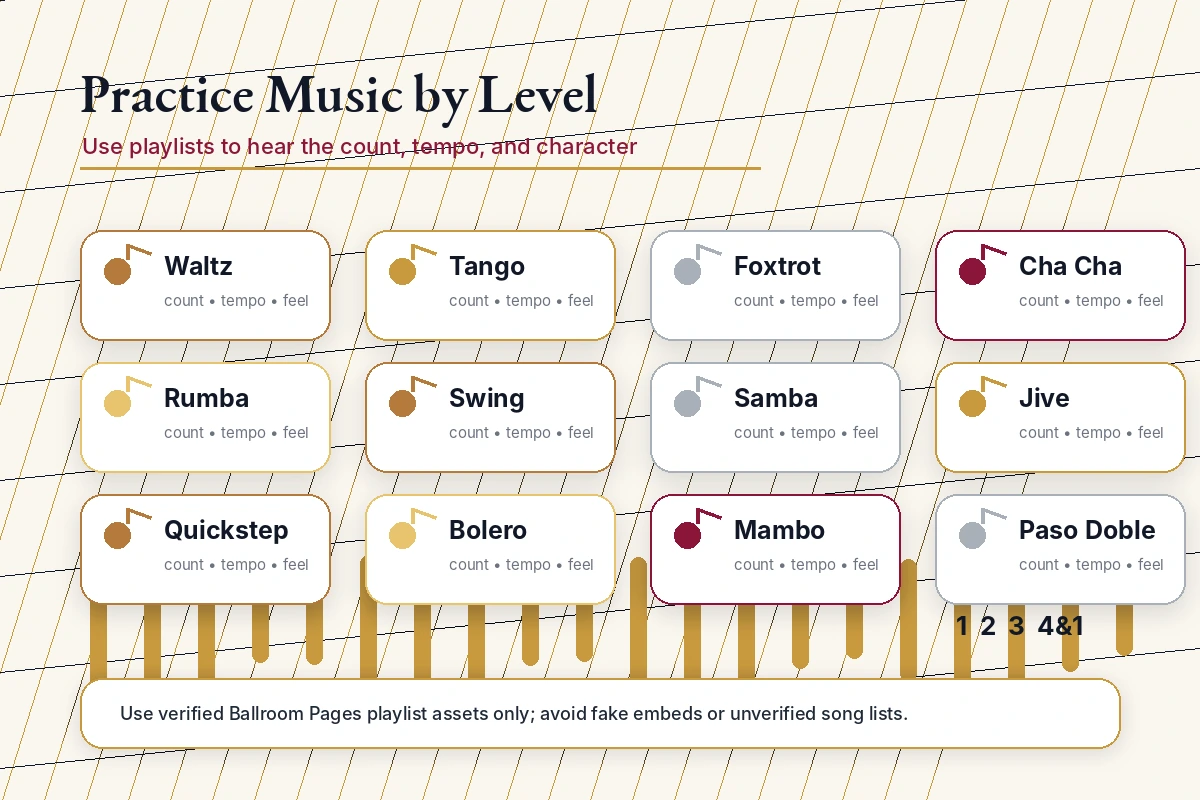
Practice music helps at every level—but use it once a figure is clear enough that music does not hide the problem. These Ballroom Pages music guides cover count, tempo, and verified playlist links by dance. (Browse everything in the Ballroom Pages playlists hub, and check speeds on the tempo chart.)
Standard / Smooth
Foxtrot music
Count, tempo & playlists.
Tango music
Count, tempo & playlists.
Viennese Waltz music
Count, tempo & playlists.
Quickstep music
Count, tempo & playlists.
Rhythm / Latin
Cha Cha music
Count, tempo & playlists.
Samba music
Count, tempo & playlists.
Paso Doble music
Count, tempo & playlists.
More dances & playlists
Waltz, Rumba, Swing, Bolero, Mambo, Jive & Salsa.
More resources
BallroomPages Music on Telegram
Ballroom Music & Timing
Common mistakes
| Mistake | Why it causes problems | Better choice |
|---|---|---|
| Rushing to the next level | Weak fundamentals show up under pressure | Make your current level reliable first |
| Collecting figures over quality | More steps, less control and musicality | Prioritize timing, balance, and shaping |
| Assuming levels are identical everywhere | Rules differ by organization and syllabus | Confirm your system’s figures with your teacher |
| Mixing levels without guidance | Can be ineligible for a syllabus category | Check what your category allows before competing |
| Skipping timing work | Patterns fall apart with music | Count first, then add music |
| Comparing your timeline to others | Progress varies by person and practice | Track your own quality and consistency |
What to ask your teacher or coach
Because details vary by organization, your teacher is the most reliable source for your situation. Useful questions include:
- Which syllabus and organization are we following?
- What figures are in my level for each dance?
- What technique should I prioritize before adding new patterns?
- Am I working toward social dancing, medal exams, or competition?
- If I compete, what does my level category allow?
- What does a realistic progress plan look like for me?
Expert review and source note
This guide describes Bronze, Silver, and Gold in general terms. Syllabus figures, level boundaries, and competition eligibility are set by individual organizations and registries and can change, so this page does not state any single organization’s official rules. For authoritative, current details, consult your teacher and the relevant rulebooks and syllabi, which may include:
- NDCA — National Dance Council of America rulebook and registered syllabi.
- WDSF — World DanceSport Federation competition structure and discipline lists.
- DVIDA and ISTD — widely used American and International syllabus systems.
- USA Dance — amateur DanceSport rules and syllabus context.
- Your studio, teacher, or competition organizer for the specific system you are learning.
Organization names are provided as places to verify current rules; this page does not reproduce or claim to represent their official requirements.