What does Paso Doble music sound like?
Paso Doble music tends to feel theatrical, march-like, and ceremonial. It usually has a strong, even pulse you can step to like a confident walk, with bold accents and a sense of building toward dramatic moments. Where many social Latin dances feel playful or flowing, Paso Doble music feels structured and grand, often arriving in clear sections that rise and resolve.
Because the music is dramatic, beginners sometimes assume any intense Spanish-style track will work. It will not. For dancing, the most useful qualities are a clear pulse, steady tempo, strong accents, and phrasing you can predict—not just mood.
This page focuses on the music. For steps, shaping, character, and choreography, use the Paso Doble dance guide. Paso Doble sits in the International Latin family alongside Cha Cha, Samba, Rumba, and Jive.
Is it “Paso Doble” or “pasodoble”?
You will see both. Dictionaries often list pasodoble as a single word, reflecting its Spanish origins, while ballroom and DanceSport materials commonly write Paso Doble as two words. Neither is wrong. Ballroom Pages uses “Paso Doble” as the editorial title style and treats “pasodoble” as an equivalent search spelling, so you land in the right place whichever you type.
How to count Paso Doble music
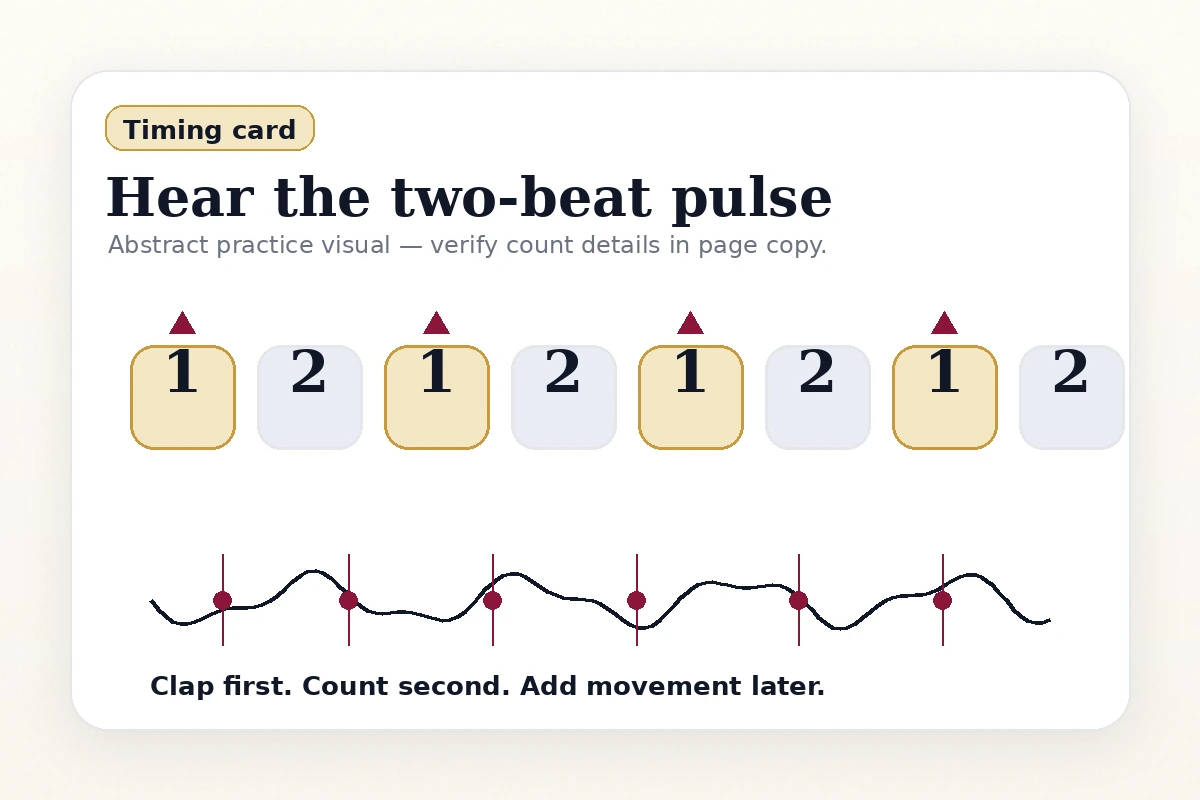
For beginners, counting Paso Doble starts with hearing the pulse, not memorizing figure counts. Tap the steady, march-like beat first. Once that feels secure, count larger phrases—often in groups of eight—so you can find where each phrase begins and where the music builds to a highlight.
- 1Strong
- 2Beat
The exact figure counts for specific steps belong with your teacher and the Paso Doble dance guide, not a playlist. For counting fundamentals across every dance, see how to count ballroom dance music.
Paso Doble tempo: how fast should the music be?
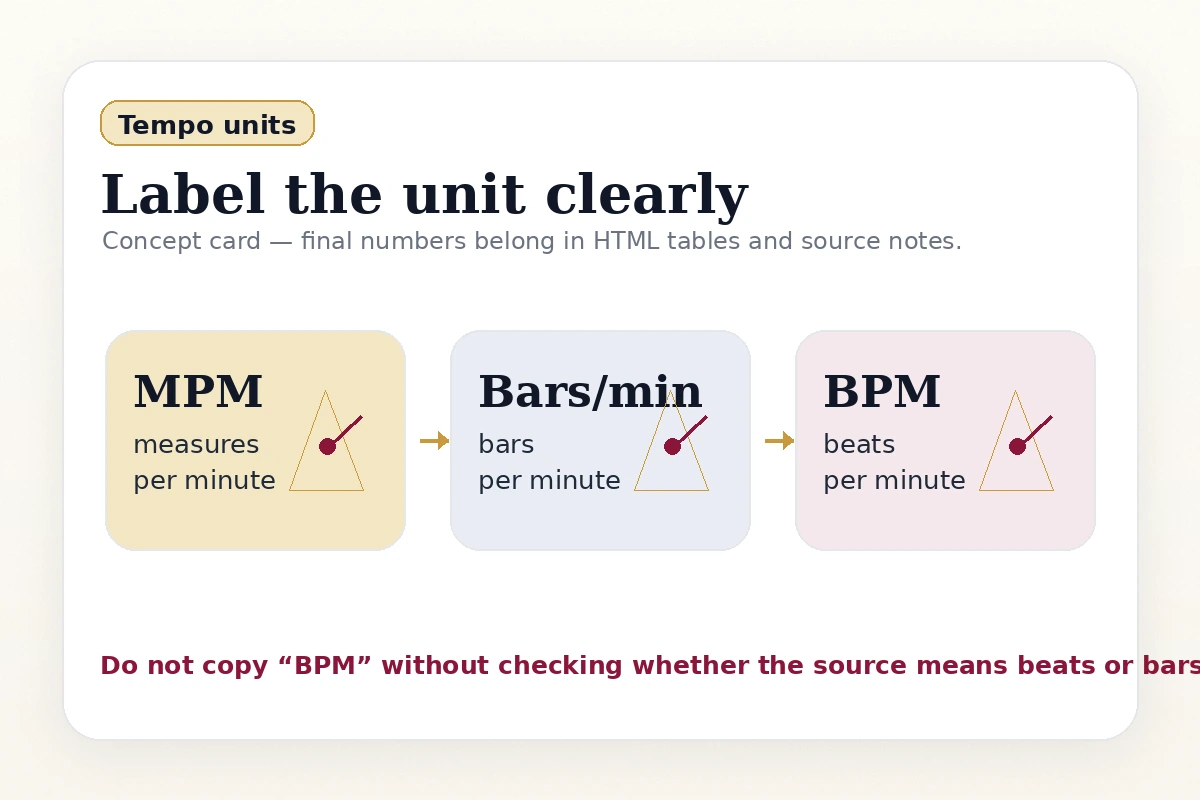
Paso Doble tempo is where confusion happens, because different organizations use different numbers and different units. Some count measures per minute (MPM), some count bars per minute, and some music apps show beats per minute (BPM). These are not the same, so always check the unit before comparing numbers.
| Source | Referenced tempo | Unit / note |
|---|---|---|
| NDCA (2026) | 55 MPM / 110 BPM | 2 beats per measure (so 55 measures = 110 beats). |
| Dance Central | 56 MPM / 112 BPM | Measures per minute with beat-per-minute equivalent. |
| DanceSport Australia | 56–62 | Bars per minute. |
| WDO | 56–60 | WDO defines “BPM” as bars per minute, not beats. |
| DanceVision | 116–124 BPM | One teaching/source convention, described in 4/4 timing. |
Understanding Paso Doble phrasing and accents
Paso Doble is unusual among beginner-accessible dances because phrasing matters so much. Many recordings build toward specific dramatic moments—often called highlights—where the music swells or lands on a strong accent. Dancers and choreographers frequently shape choreography around those moments.
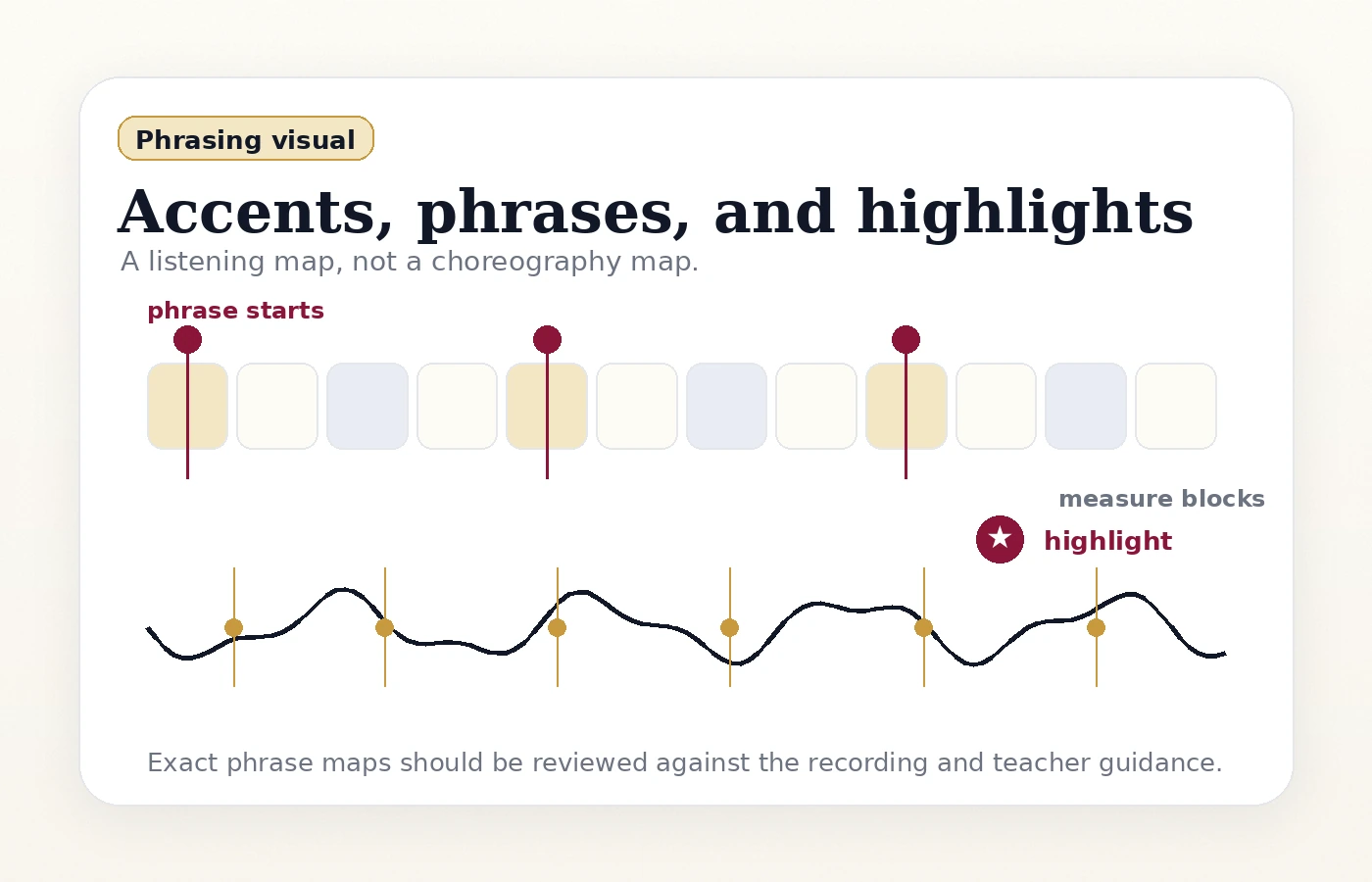
For practice, you do not need to map every highlight perfectly. Start by noticing where a phrase begins and where the music feels like it “arrives.” That awareness alone will make your timing feel more deliberate. Detailed phrase maps—especially for well-known competition arrangements—should come from a qualified instructor who knows the recording you are using.
Count Paso Doble without guessing
Get a one-page Paso Doble Timing & Practice Playlist Cheat Sheet with beginner listening cues, unit labels, tempo notes, and playlist progression ideas.
Download the cheat sheetNo pressure, no performance drama—just clearer timing.
How to tell if a song works for Paso Doble
Choose songs by pulse, tempo, phrasing, and clarity—not just mood. Use this checklist before you rely on a track for practice.
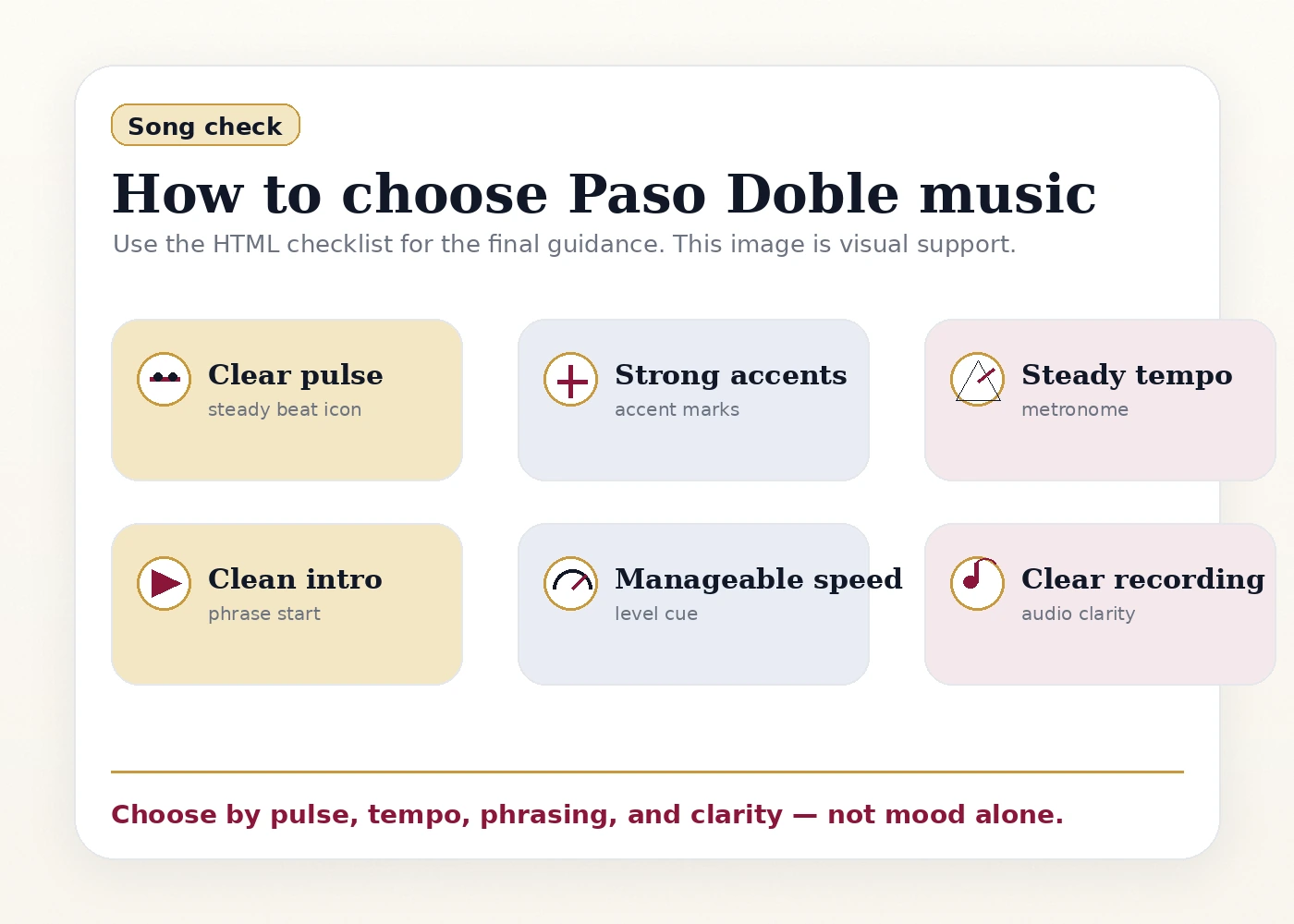
- A clear, march-like pulse you can tap.
- Strong, predictable accents.
- A steady tempo that does not drift.
- A clean intro or obvious phrase start.
- A manageable speed for your level.
- Clear recording quality (not a noisy live capture).
- Teacher-approved or playlist-vetted for danceability.
Best Paso Doble songs and examples
Use this as a verification-aware starting point, not a definitive ranking. Arrangements differ widely, and availability depends on platform and region, so confirm the exact recording, tempo, and danceability before you rely on any track. We do not quote lyrics.
| Song / source | Why it can help | Best use | Verification note |
|---|---|---|---|
| España Cañà / Spanish Gypsy Dance | Classic Paso Doble reference with recognizable phrase structure and highlights | Phrase/highlight study, listening | Verify the exact arrangement and tempo; versions differ. |
| Ballroom Pages Paso Doble playlist tracks | Curated for ballroom practice on the verified Spotify playlists below | Beginner–intermediate practice | Track difficulty varies; pick clear, steady recordings first. |
| El Gato Montes | Traditional Spanish piece often referenced for Paso Doble | Listening / advanced practice | Verify arrangement and tempo before recommending to beginners. |
| La Virgen de la Macarena | Ceremonial, march-like character | Listening / showcase reference | Verify arrangement and tempo before recommending to beginners. |
| Amparito Roca | Well-known Spanish march often cited for Paso Doble | Listening / phrasing reference | Verify danceability and tempo before recommending to beginners. |
Availability depends on platform and region; this is a list of examples to test, not a claim that every version is danceable.
Practice Paso Doble with Ballroom Pages playlists
Use these playlists as practice support. Start by listening without moving, tap the march-like pulse, count a phrase, then add movement only once the timing feels secure. Playlist links are a tool, not a substitute for teacher feedback.
Spotify
Paso Doble (Ballroom Pages)
Paso Doble 2 (Ballroom Pages)
Apple Music
Paso Doble on Apple Music
Find the Ballroom Pages Paso Doble selection in the full playlist hub while the direct link is audited.
YouTube / YouTube Music
Paso Doble on YouTube Music
Find the Ballroom Pages Paso Doble selection in the full playlist hub while titles and tracks are verified.
More resources
BallroomPages Music on Telegram
All Ballroom Pages playlists
More: Ballroom Music & Timing, the tempo chart, and how to count ballroom dance music.
Paso Doble music by use case
How you use Paso Doble music depends on your goal.
| Use case | What to choose | Note |
|---|---|---|
| Beginner practice | Clear, steady, well-recorded ballroom tracks at a manageable speed | Build pulse and phrasing awareness first. |
| Technique class | Tracks your teacher approves with predictable phrasing | Connect counts to figures with instructor guidance. |
| Showcase / performance | Music with strong character and clear highlights | Danceability and clarity still come before drama. |
| Competition preparation | Recordings matched to your organization’s tempo and character expectations | Confirm units and event standards; see the competitions guide. |
| Dramatic reception / show moment | Only with a caveat: a short, choreographed feature, not a typical first dance | Paso Doble is rarely a beginner-friendly wedding first dance. |
Paso Doble is more commonly useful for International Latin awareness, competition preparation, and showcases than for everyday social dancing or a typical wedding first dance. If you are choosing a wedding song, start with what dance fits your song and the wedding dance guide.
Paso Doble vs Tango, Flamenco, Cha Cha, Samba, Rumba, and Jive music
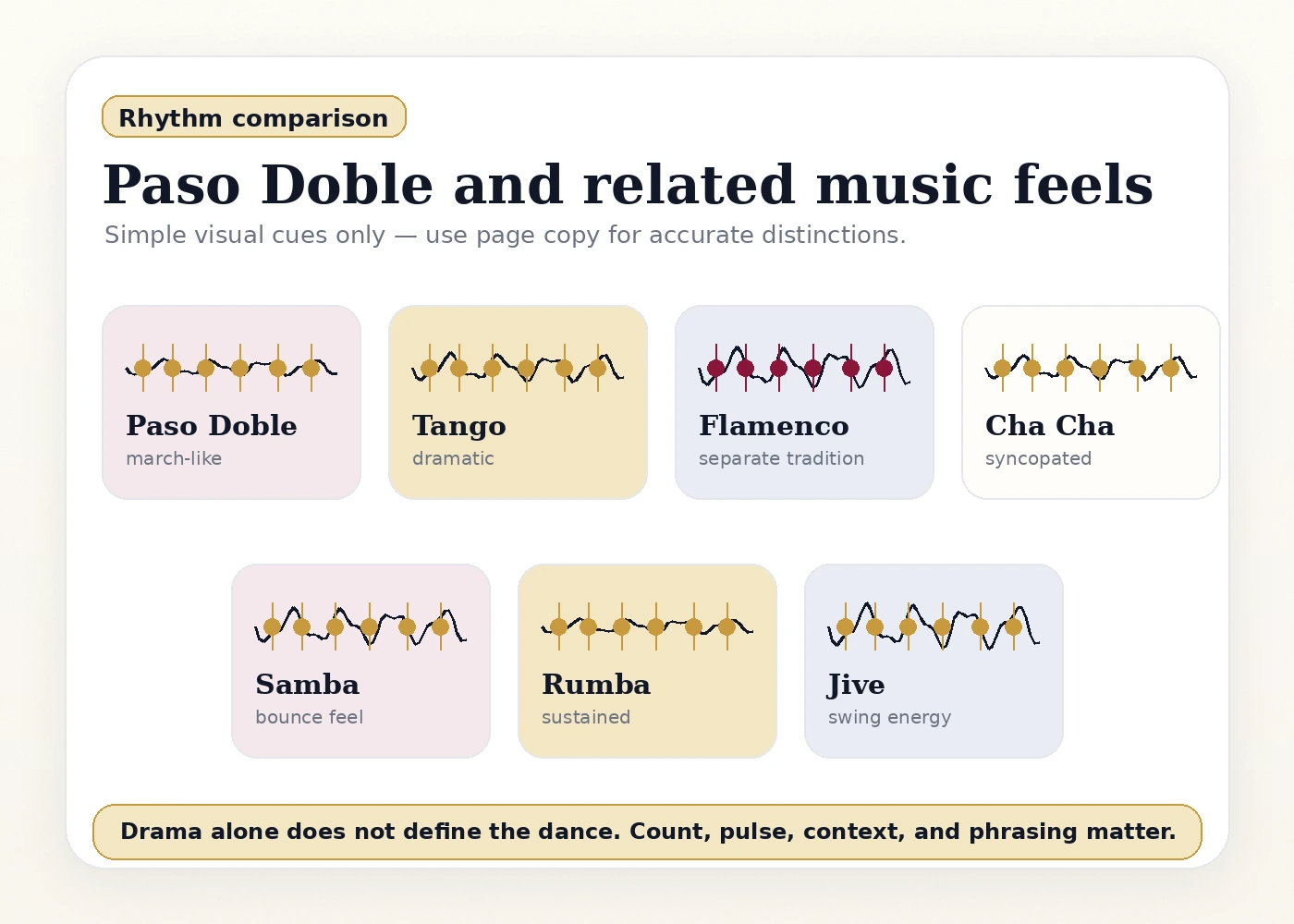
Paso Doble can feel dramatic, but drama alone does not define the dance. Here is how its music compares with related styles. Note that flamenco is its own rich art form—related in cultural roots and mood, but not the same as ballroom Paso Doble.
| Style | Music feel | Key difference from Paso Doble |
|---|---|---|
| Paso Doble | March-like, ceremonial, dramatic, built around phrase highlights | — |
| Tango | Sharp, staccato, intense | Both feel dramatic, but Tango has its own timing and accent character; the two are not interchangeable. |
| Flamenco | A distinct Spanish art form with its own rhythms (compás) and tradition | Culturally related in mood, but flamenco is not ballroom Paso Doble. |
| Cha Cha | Playful, syncopated, “cha-cha-cha” rhythm | Lighter and more rhythmic; not march-like. |
| Samba | Bouncy, syncopated, “1 a 2” lift | Buoyant rather than ceremonial. |
| Rumba | Slow, romantic, flowing | Smooth and lyrical rather than march-like. |
| Jive | Fast, bright, bouncy swing feel | Energetic and light rather than grand. |
Common Paso Doble music mistakes
| Mistake | Why it causes problems | Better choice |
|---|---|---|
| Choosing a song that is too fast | Timing and accents blur, and movement gets rushed | Start slower and build to full tempo |
| Confusing dramatic Tango music with Paso Doble | Different timing and accent character lead to off-time practice | Confirm the march-like pulse before assuming it is Paso Doble |
| Assuming every Spanish-style song is Paso Doble | Mood is not danceability; many tracks lack a usable pulse | Test pulse, tempo, and phrasing first |
| Counting vocals instead of pulse | Vocals drift off the beat and mislead your timing | Tap the instrumental pulse, not the singing |
| Ignoring phrase structure | Highlights arrive unexpectedly and choreography feels random | Count phrases and notice where the music arrives |
| Using concert/live recordings with big tempo changes | Rubato and tempo swings make beginner practice unstable | Use steady studio recordings for practice |
| Mixing BPM and MPM | Numbers look comparable but measure different things | Always check whether a source means beats, bars, or measures |
Beginner practice drills for Paso Doble music
Clap the main pulse
Play a steady Paso Doble track and clap the march-like pulse until it feels automatic. If you cannot clap it, do not dance it yet.
Count small, then larger
Count the simple pulse first, then count phrases (often eights) so you can find where each phrase begins.
Find the accents
Listen for the strong accents and the moments the music “arrives.” Clap only on those to train your ear.
Slow before full tempo
Practice the timing at a comfortable speed before using full competition-style tempo.
Playlist progression
Move from clear, steady tracks to more dramatic ones as your timing improves.
Mark the highlights
Note where a recording builds to a highlight, so you can connect those moments to choreography later.
These drills build listening and timing. Actual step learning—figures, shaping, and character—belongs on the Paso Doble dance guide. New to ballroom? Start with ballroom dance for beginners, and connect timing to partnership with frame and posture and lead and follow.