What makes Samba music sound like Samba
Samba music feels buoyant, percussive, syncopated, and alive. For dancers, the most important features are a strong underlying pulse, a rhythmic lift that makes you want to move, accents that help you feel count 1, enough steadiness to practice without guessing, and a groove that supports the “1 a 2” rhythm.
A beginner does not need to identify every instrument. Start by listening for the downbeat, then say the count out loud: 1 a 2, 3 a 4, 5 a 6, 7 a 8.
Ballroom Samba vs Brazilian Samba music
“Samba” covers several related but distinct traditions. Knowing which one you mean keeps your music choices and expectations realistic.
| Form | Best understood as | Music relationship | Dancer takeaway |
|---|---|---|---|
| International Latin Samba | Competitive ballroom Latin dance | Uses Samba-inspired rhythm in a dancesport setting | Learn count, tempo, rhythm, and syllabus expectations. |
| Social ballroom Samba | Partnered social/ballroom form | Often uses ballroom-friendly Samba tracks | Prioritize clear rhythm and lead/follow comfort. |
| Brazilian Samba no pé | Solo Brazilian Samba tradition | Often associated with carnival and Brazilian social/music culture | Related culturally, but not the same as ballroom Samba. |
| Samba de Gafieira | Brazilian partnered Samba | A Brazilian partner dance tradition with its own movement vocabulary | Do not assume ballroom Samba steps or counts automatically apply. |
| Wedding/performance Samba | Choreographed choice for a couple or showcase | Song choice may be more flexible | Choose music for energy, clarity, and comfort. |
For steps, bounce action, body movement, and beginner dance instruction, read the Samba dance guide.
Samba time signature, tempo, and BPM
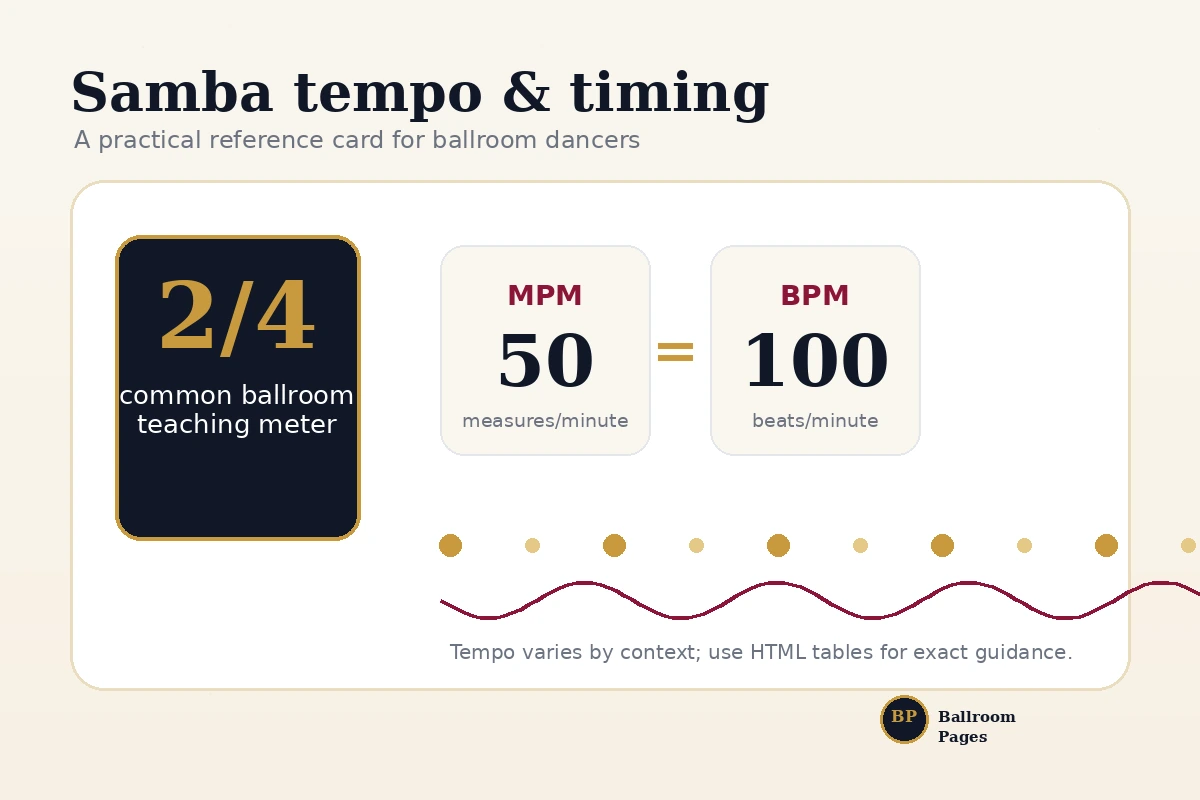
For ballroom dancers, Samba is commonly taught in 2/4, meaning two beats per measure. The tempo is often discussed in both MPM (measures per minute) and BPM (beats per minute). Because Samba has two beats per measure in many ballroom references, 50 MPM = 100 BPM.
| Context | Practical guidance | Notes |
|---|---|---|
| Beginner practice | ~96–100 BPM | Easier to hear and count. |
| Common ballroom reference range | ~96–104 BPM | Good range for playlist filtering. |
| NDCA 2026 International Latin Samba | 50 MPM / 100 BPM | Official competition reference. |
| Dance Central Latin Samba reference | 48–50 MPM / 96–100 BPM | Shows commonly used published variation. |
| Wedding or showcase Samba | Flexible | Choose clarity and comfort before strict competition tempo. |
Do not present one single tempo as universal. Competition, syllabus, country, event, and teaching context can affect what is considered appropriate. Compare across dances on the ballroom dance tempo chart.
How to count Samba music
The beginner-friendly ballroom Samba count is: 1 a 2, 3 a 4, 5 a 6, 7 a 8. Say it like this:
- 1 = strong beat
- a = quick in-between sound
- 2 = next main beat
- 1Strong
- aQuick
- 2Beat
The “a” is not the same as “&.” A common beginner mistake is turning Samba into 1 & 2, which can make the rhythm feel too even or skippy.
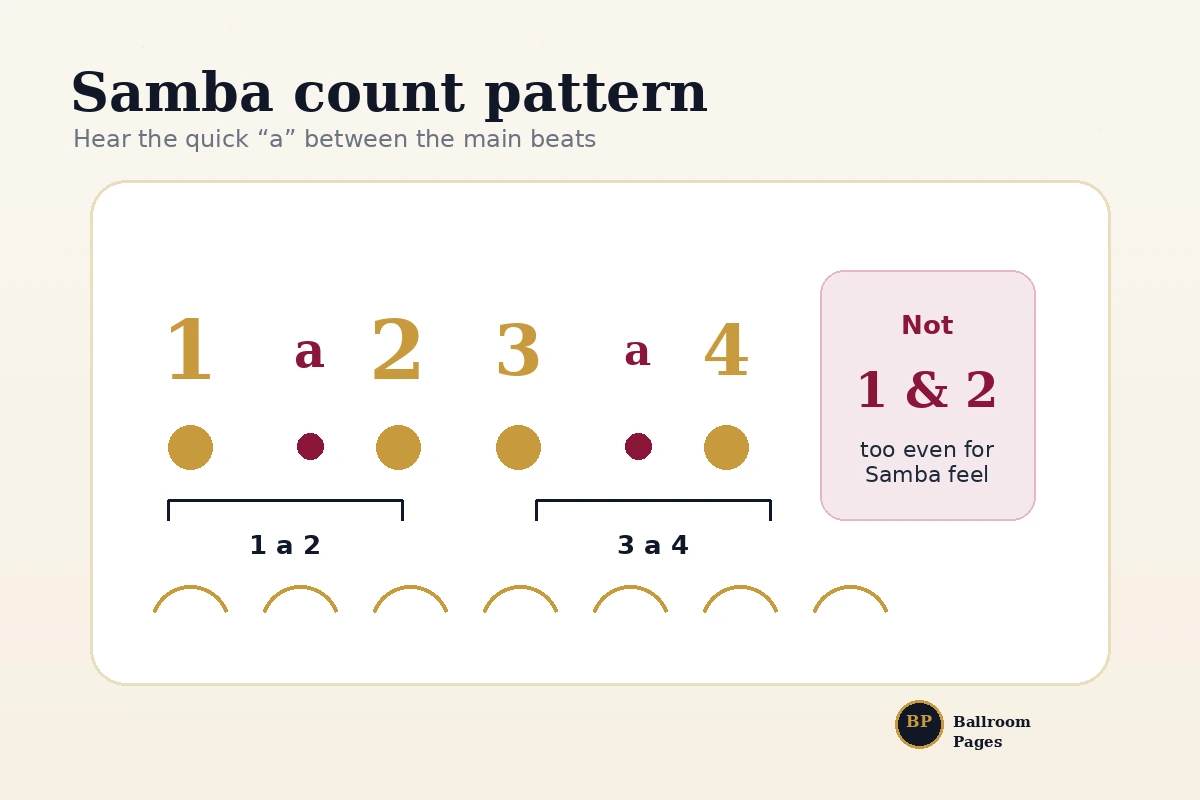
Beginner counting drill
- Play a clear Samba track.
- Tap only the main beats: 1, 2, 3, 4.
- Add the voice count: 1 a 2, 3 a 4.
- Clap only on 1 for one minute.
- Then count a full phrase: 1 a 2, 3 a 4, 5 a 6, 7 a 8.
For the full topic across every dance, read how to count ballroom dance music.
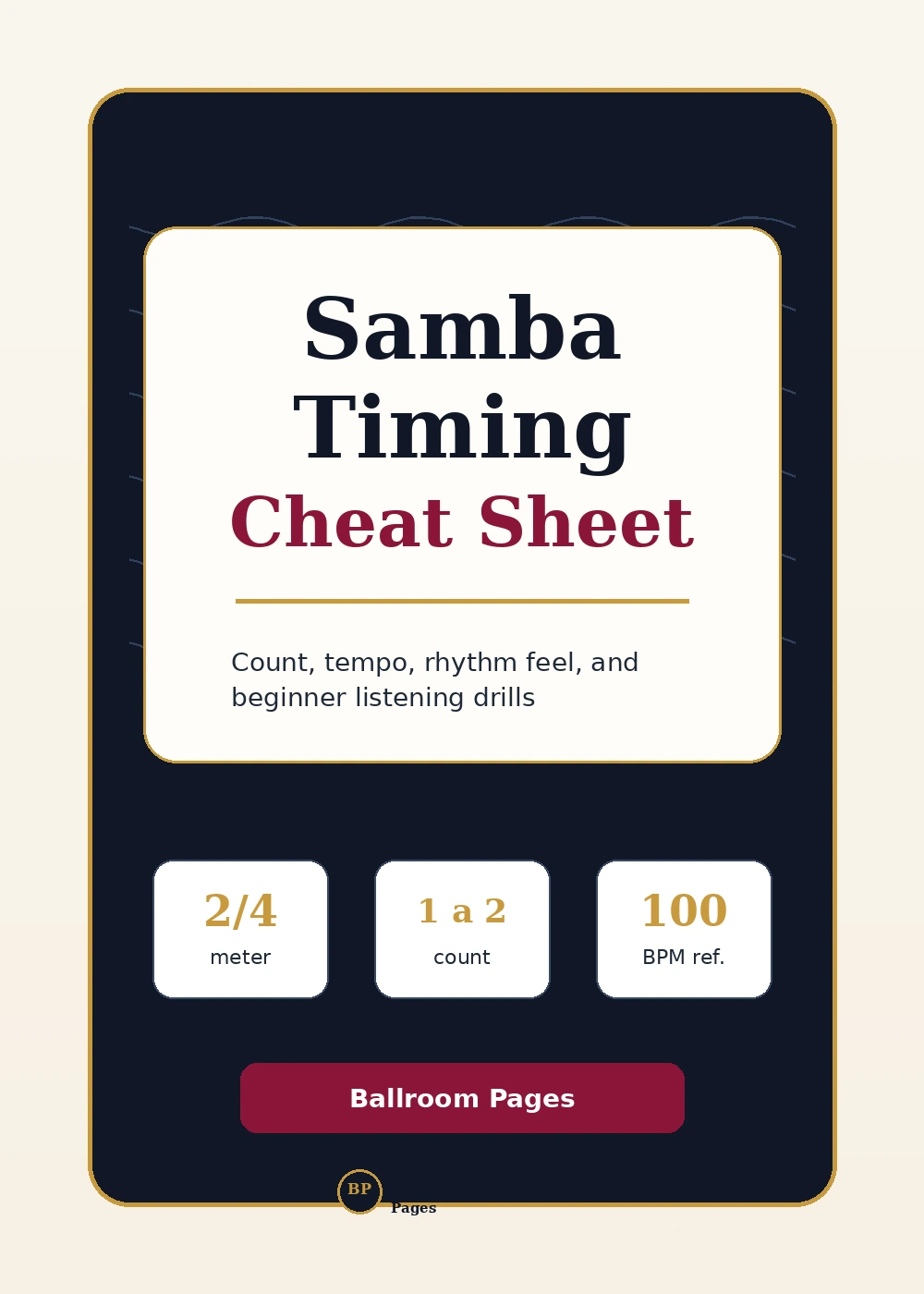
Download the Samba Timing Cheat Sheet
Keep the count, tempo range, beginner drills, and song-selection checklist beside you while you practice.
Get the cheat sheetNo spam — just practical ballroom music, timing, and beginner-friendly guides. Unsubscribe anytime.
How to hear Samba rhythm, accents, and bounce
Once you can tap a steady beat, learn to hear how Samba music is organized. These five ideas help most:
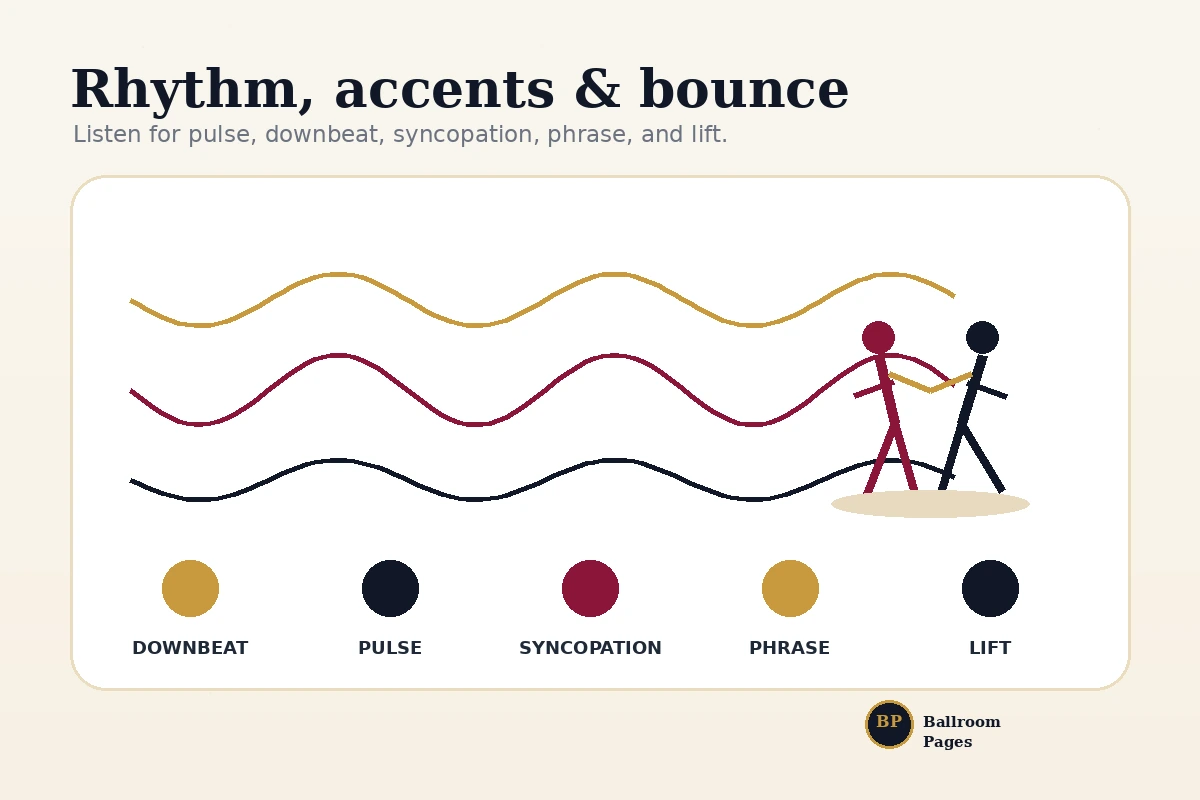
- Downbeat: the strong beat that tells you where count 1 is.
- Pulse: the steady underlying beat you can tap.
- Syncopation: the quick “a” and off-beats that give Samba its energy.
- Phrase: how the music groups into blocks (often eights) so you know where to start.
- Lift: the buoyant, bouncy quality that makes Samba feel like it rises and falls.
Quick listening test
- Can you tap a steady beat?
- Can you say 1 a 2 without rushing?
- Does the song keep a consistent tempo?
- Does the groove feel lively rather than smooth or romantic?
- Can a beginner hear count 1 without help?
International Latin Samba music notes
International Latin includes Samba, Cha-Cha-Cha, Rumba, Paso Doble, and Jive. For this page, use International Latin Samba when talking about competitive ballroom Latin, social ballroom Samba when talking about casual partner dancing, and Brazilian Samba, Samba no pé, or Samba de Gafieira only when clearly distinguishing related traditions.
Explore the other International Latin dances: Cha Cha, Rumba, Paso Doble, and Jive.
Choosing Samba songs for practice, socials, competitions, and weddings
A good Samba song depends on your setting. Test the actual recording before you rely on it.
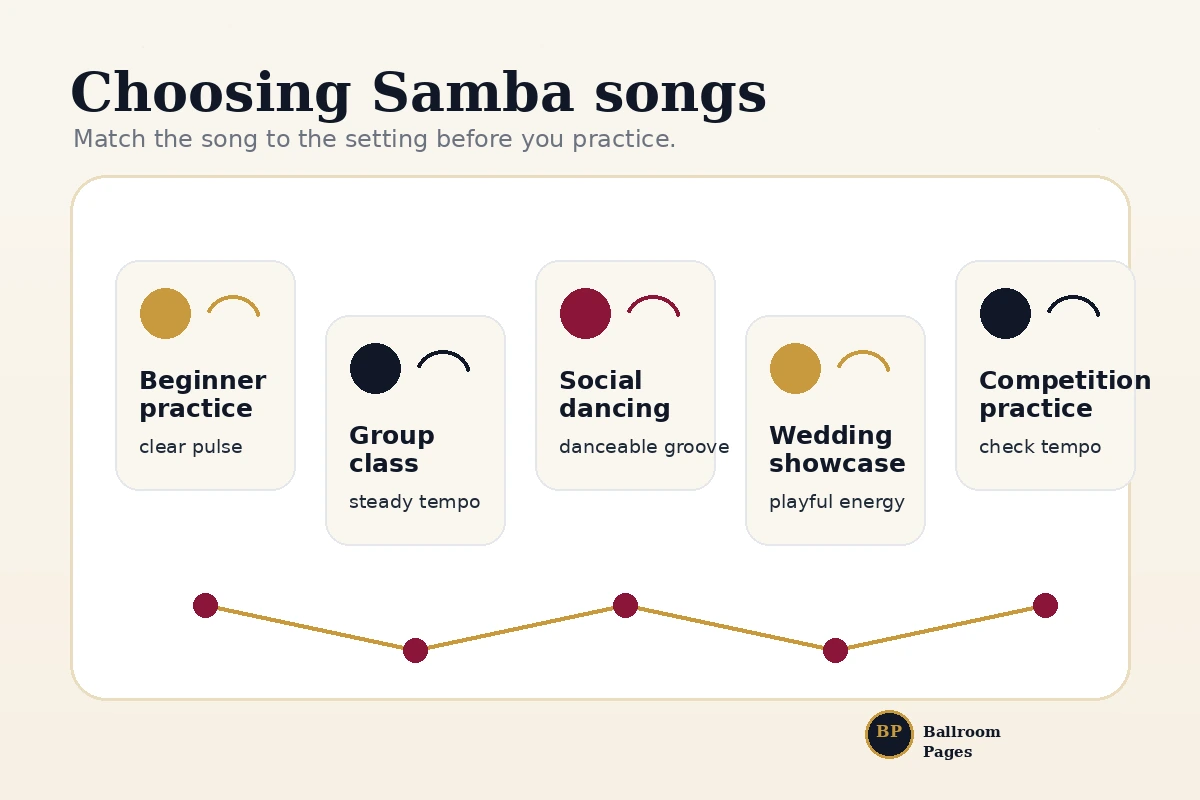
| Use case | What to choose | What to avoid | Best CTA |
|---|---|---|---|
| Beginner practice | Clear pulse, moderate tempo, simple arrangement | Very fast percussion-heavy tracks | Download the Samba Timing Cheat Sheet |
| Group class | Consistent tempo and obvious downbeat | Songs with long rubato intros or tempo changes | Listen to Samba Playlists |
| Social dancing | Fun, recognizable, danceable groove | Songs that confuse beginners or feel too performance-specific | Explore Ballroom Pages playlists |
| Competition practice | Music close to your governing body or studio’s tempo expectations | Random pop songs with unstable BPM | Ask your coach and check tempo |
| Wedding dance | Lively, playful, performance-friendly song | Songs too fast for formalwear or limited dance space | Check the wedding song matcher |
| Showcase/performance | High-energy music with a strong arrangement | Songs that overwhelm the choreography | Work with your instructor |
Wedding note: Samba can be a memorable wedding performance choice, but it is usually not the easiest first dance for nervous beginners. If the song is lively and the couple wants a party-style routine, Samba may work. If the couple wants romantic, simple, and traditional, Waltz, Rumba, Foxtrot, or Nightclub Two Step may be better. Start with the wedding dance guide and what dance fits your wedding song.
Beginner listening drills for Samba timing
Find count 1
Play a Samba track and clap only on count 1. Train your ear to feel where each phrase begins.
Speak the rhythm
Say “1 a 2” out loud over the music. Keep the “a” quick—do not turn it into an even “&.”
Count in eights
Count a full phrase: 1 a 2, 3 a 4, 5 a 6, 7 a 8, and notice how the music resets.
Compare two songs
Play two Samba tracks back to back. Notice which one makes count 1 easiest to hear.
Mark your playlist
As you listen, flag the songs with the clearest pulse so practice sessions start faster.
Build the underlying skill with how to count ballroom dance music, and connect timing to partnership with lead and follow and frame and posture.
Ballroom Pages Samba playlists
Use these playlists to practice hearing the Samba pulse before you add larger movement. Start with one clear track, find count 1, say the rhythm, then try a small pattern. Playlist links are practice support; they do not replace teacher feedback.
- Listen first: find count 1 before moving.
- Count second: say 1 a 2, 3 a 4 over the beat.
- Move third: mark the rhythm before adding full patterns.
- Review last: ask whether the tempo or syncopation caused problems.
Apple Music
Apple Music: Samba
Apple Music: Samba 2
Spotify
Spotify Samba
Spotify Samba link pending verification.
YouTube / YouTube Music
YouTube / YouTube Music Samba
YouTube Samba link pending verification.
More resources
BallroomPages Music on Telegram
All Ballroom Pages playlists
More: Ballroom Music & Timing, the tempo chart, and how to count ballroom dance music.
Common Samba music mistakes
Counting “1 & 2” instead of “1 a 2”
The “a” is quicker than an even “&.” Counting it evenly makes Samba feel skippy and loses the lift.
Choosing songs that are too fast
High-energy tracks can be hard to count. Start nearer 96–100 BPM so you can hear the pulse.
Treating every Brazilian Samba track as ballroom practice music
Many Brazilian recordings are wonderful but not ideal for ballroom timing practice.
Ignoring the downbeat
If you cannot hear count 1, you cannot start cleanly. Find count 1 first.
Practicing steps before hearing the rhythm
Listen and count before you add movement, or timing problems get baked in.
Using competition tempo as the only standard
Event tempi are useful references, not a universal rule for every practice or social setting.
Quick Samba timing cheat sheet
| Item | Quick reference |
|---|---|
| Common ballroom teaching meter | 2/4 |
| Main count | 1 a 2 |
| Full practice count | 1 a 2, 3 a 4, 5 a 6, 7 a 8 |
| Beginner practice range | Around 96–100 BPM |
| Useful broader range | Around 96–104 BPM |
| NDCA 2026 International Latin reference | 50 MPM / 100 BPM |
| Best first listening skill | Find count 1 |
| Biggest beginner trap | Counting “1 & 2” too evenly |
| Next guide | Samba dance guide for steps and movement |