
Drill 1: Clap the steady beat
Play a song and clap only the main pulse—1, 2, 3, 4—until it feels automatic.
Glossary · Music & Timing
Syncopation is a rhythm that accents or steps around the expected beat. In dance, it helps explain & counts, off-beat accents, quick rhythmic changes, and why some patterns feel lively, surprising, or “between the beats.”
When you understand syncopation, counts like 1 & 2, 1 a 2, or 2-3-4&1 stop feeling like random extra steps and start feeling connected to the music.
Syncopation
In music, syncopation happens when a rhythm emphasizes a beat or part of a beat that normally would not be emphasized. Instead of always feeling the strongest accents on the expected counts, the music may stress a weaker beat, an off-beat, a held note, or a subdivision between the beats.
A simple way to hear it:
That is why syncopation can feel lively, bouncy, playful, jazzy, or surprising. It creates energy by playing with your expectation of where the beat should land.
In ballroom, Latin, Rhythm, and social dance, syncopation can show up in several ways. A dancer might step on an & count, change weight faster than expected, hold through a beat, accent an off-beat, or use a figure that divides a beat into smaller parts.
This does not mean the dancer ignores the beat. Good syncopation still belongs to the music.
A beginner might experience syncopation as:
Editorial note: Teachers may use the word differently. Some use syncopation in the strict musical sense: an unexpected accent. Others use it in a dancer-friendly way to mean a split beat, added step, rhythm variation, or more nuanced timing. This page uses both meanings carefully.
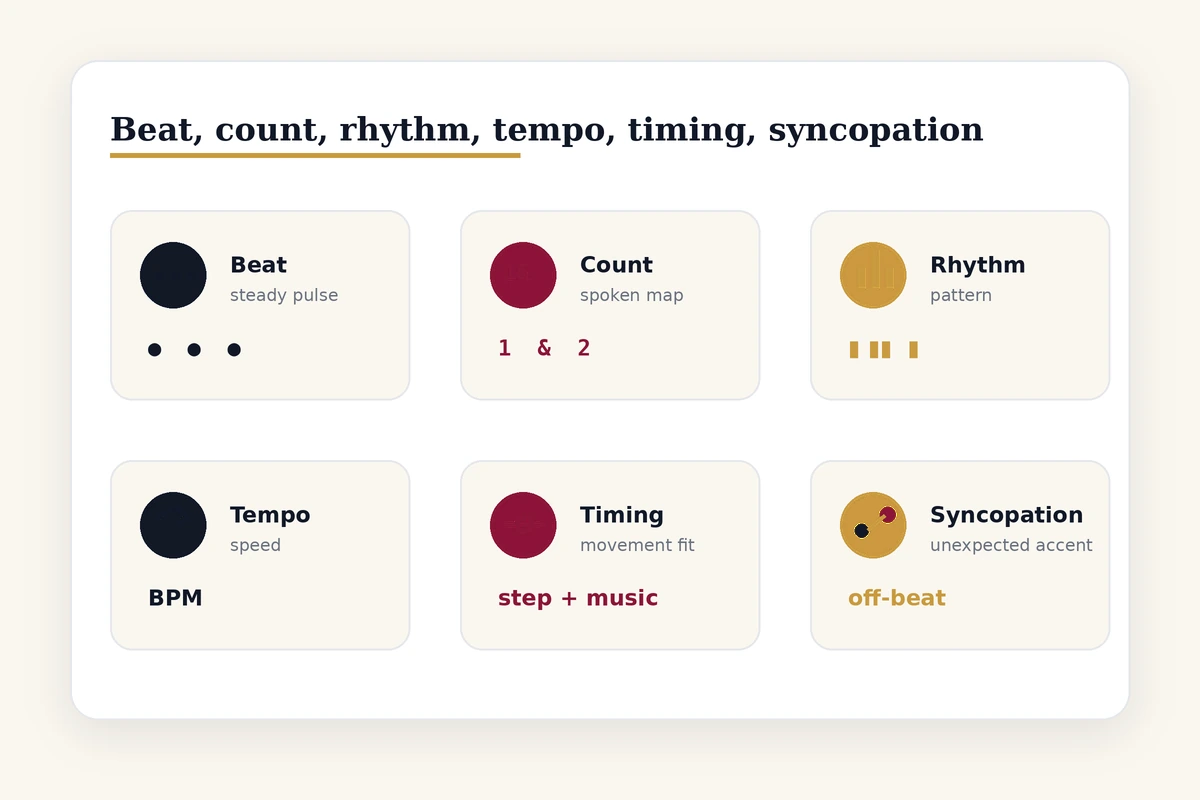
| Term | Meaning | Example | Read more |
|---|---|---|---|
| Beat | The steady pulse of the music. | The thing you tap your foot to. | Beat |
| Count | Numbers or words dancers use to organize movement. | 1-2-3, slow-quick-quick, 2-3-4&1. | How to count |
| Rhythm | The pattern of sounds or steps over time. | Cha Cha’s quick triple feeling. | Rhythm |
| Tempo | The speed of the music. | Faster or slower BPM/MPM. | Tempo chart |
| Accent | A beat, note, or movement that feels emphasized. | Count 1 in many 4/4 songs. | Accent |
| Off-beat | A place between or away from the main beat. | The & in 1 & 2. | Off-beat |
| Timing | How your steps fit the music. | Stepping on time instead of early or late. | Timing |
| Syncopation | Emphasis or movement around an unexpected beat/subdivision. | 1 & 2, a split beat, or an accented off-beat. | This page |
Dancers often count syncopation by adding smaller pieces between the main beats.
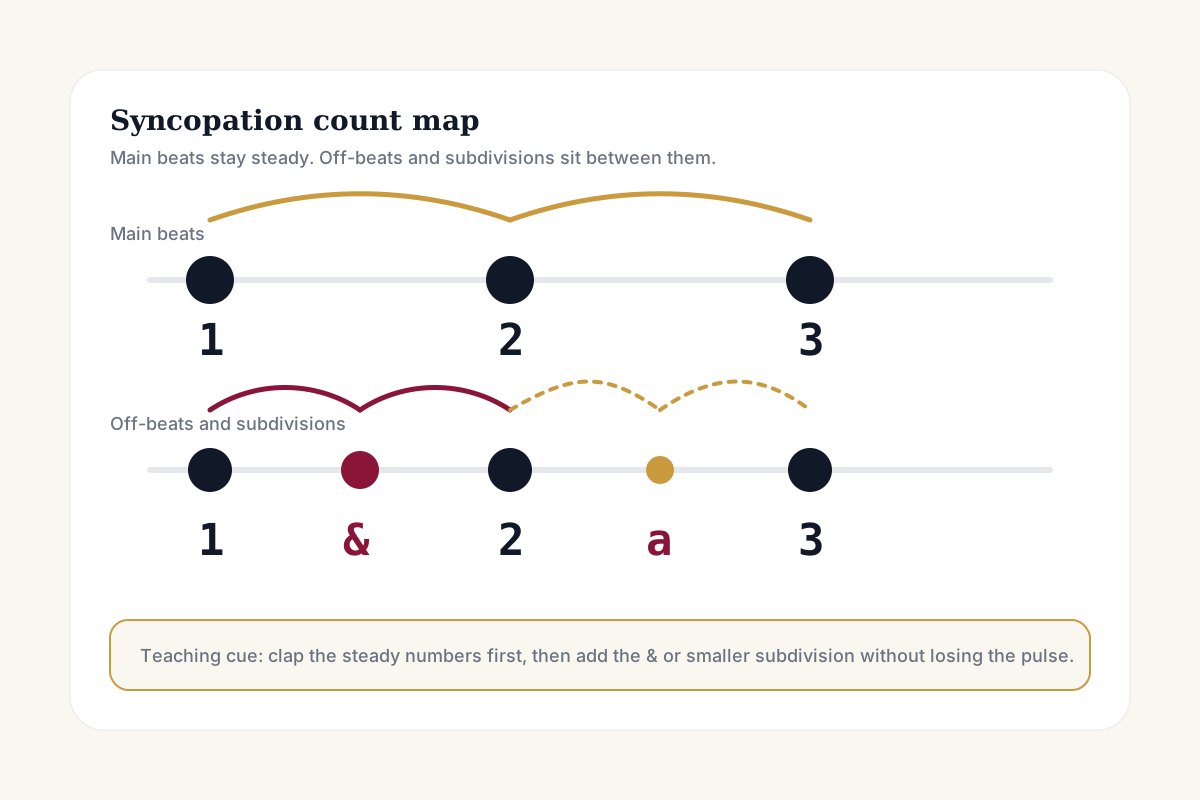
The & is the halfway point between two main beats. A beginner can practice by saying: one-and-two. Then clap on 1, clap lightly on &, and clap again on 2. This does not mean every 1 & 2 pattern is automatically syncopation in the strictest music-theory sense. But in dance lessons, & counts are often where beginners first meet syncopated timing.
Some dances and teachers use smaller subdivisions than &. A common spoken pattern is one-a-two. This can help describe faster or more detailed timing, especially when a rhythm has more than one subdivision inside a beat.
Ballroom teachers often use slow and quick instead of numbers. A slow usually takes more time. A quick usually takes less time. Several quicks in a row can make a rhythm feel more active, but quick steps alone are not automatically syncopation.
Cha Cha is a helpful example because the 4&1 part gives dancers a clear split-beat feeling. Many ballroom/Latin teachers count International-style Cha Cha as 2, 3, 4 & 1. This is why beginners often hear Cha Cha described as syncopated. The rhythm is not random; the & is part of the musical and step pattern.
| Dance | Where syncopation appears | What to listen for |
|---|---|---|
| Cha Cha | 4&1, chassé timing, quick triple rhythm. | Listen for the split feeling between 4 and 1. |
| East Coast Swing | Triple steps such as 1&2, 3&4. | Listen for the bounce/pulse inside the triple rhythm. |
| Jive | Fast Latin swing-family rhythms and sharp timing changes. | Listen for quick energetic rhythm that still sits inside the beat. |
| Quickstep | Lock steps, runs, chassés, advanced split-beat figures. | Listen for light, jazzy movement with crisp rhythm. |
| Foxtrot | Basic slow/quick timing plus rhythm variations and chassé-like figures. | Hear walking rhythm first; add variation later. |
| Tango | Sharp accents, pauses, and rhythmic contrast. | Listen for timing changes, not just speed. |
| Mambo | On-2 feeling, Latin rhythm layers, quick weight changes. | Hear where the break step lands. |
| Salsa | Holds, quicks, clave-influenced accents, social timing patterns. | Hear the difference between stepping and holding. |
| Samba | Pulse, subdivisions, Latin rhythmic layering. | Listen for pulse and accents inside the measure. |
Not just dancing faster.
Not random extra steps.
Not the same as tempo.
Not every quick count.
Not something that should fight the music.
Not a replacement for hearing the beat.
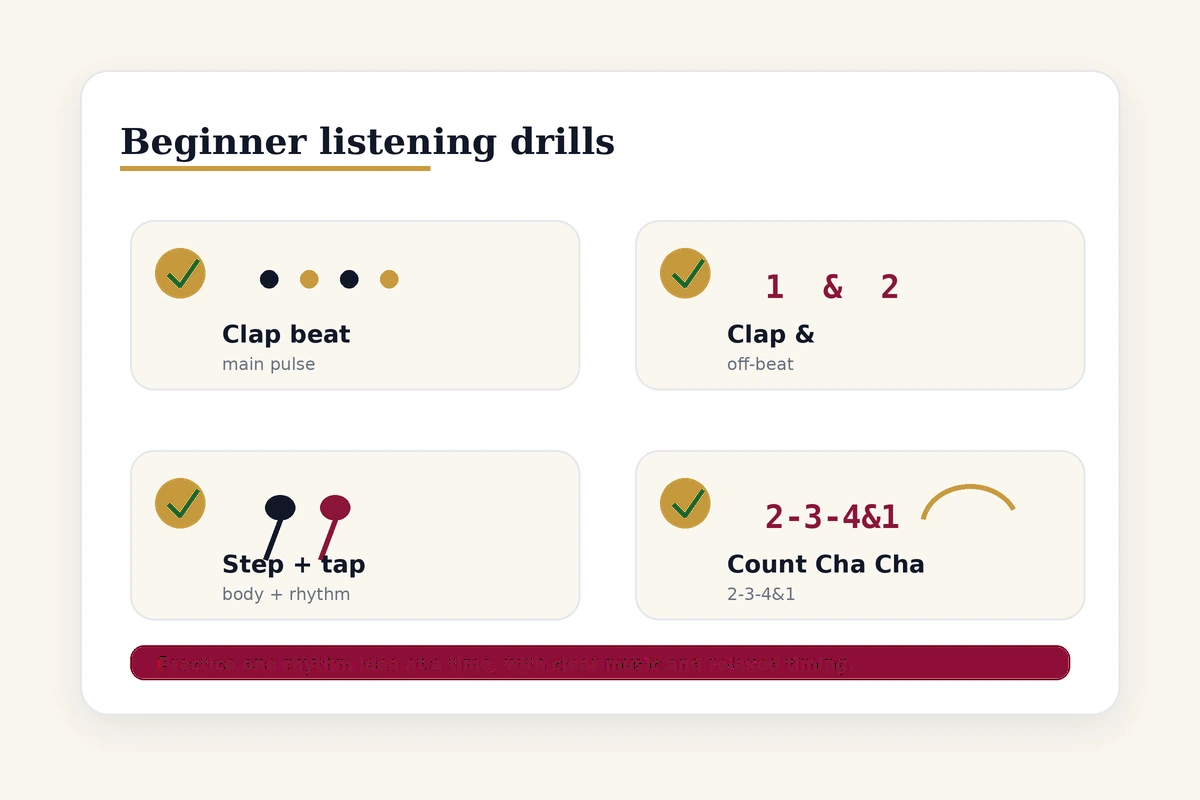
Play a song and clap only the main pulse—1, 2, 3, 4—until it feels automatic.
Keep the same song and clap only the halfway points: the & between each number.
Step on the numbers with your feet while tapping the & with a hand, so both lines of rhythm coexist.
Say 2, 3, 4 & 1 out loud at a slow tempo and feel the split-beat on 4 & 1.
Pick a single clear track, count out loud, and work on just one rhythm idea before moving on.
Teacher note: A qualified instructor can help connect the count to real step patterns, especially when different syllabi, studios, or styles count the same dance differently.
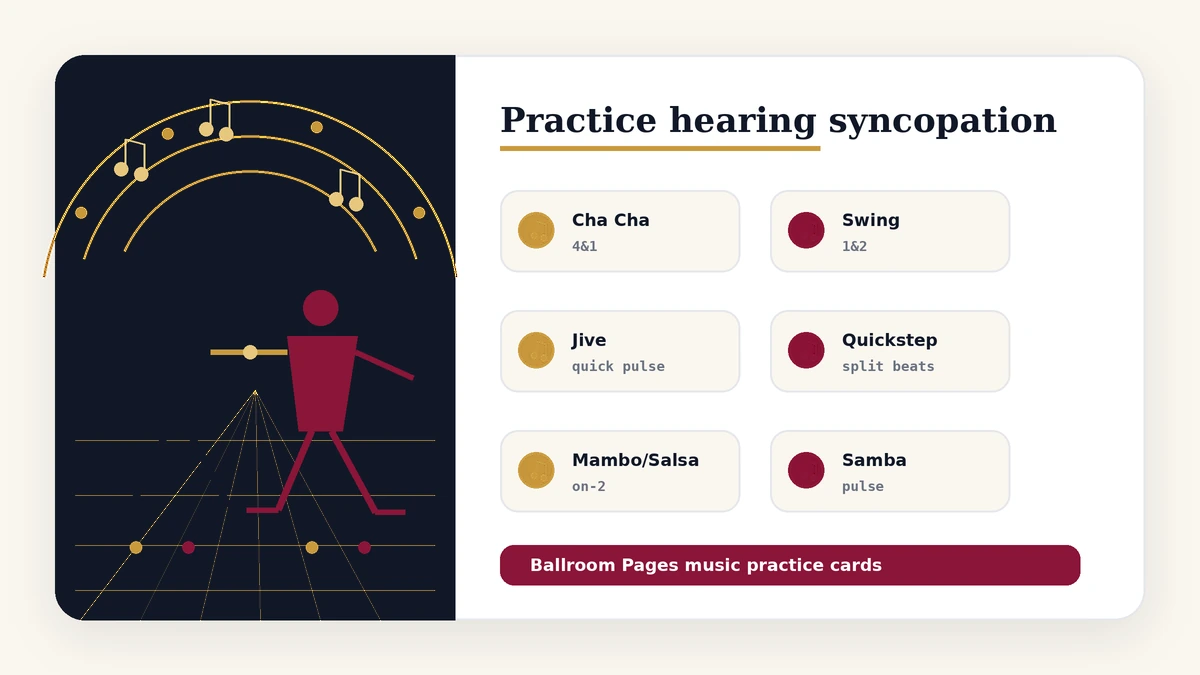
Use music practice as ear training, not as a race. Start with one clear track, count out loud, and practice only one rhythm idea at a time.
Listen for 4&1, the clearest beginner split-beat feeling.
Listen for triple rhythm: 1&2, 3&4.
Listen for fast, energetic swing-family rhythm.
Playlist URL coming soonJive guide
Listen for light, jazzy timing and split-beat figures.
Playlist URL coming soonQuickstep guide
Hear the walking rhythm first, then notice variations.
Playlist link under auditFoxtrot guide
Listen for sharp accents and pauses.
Hear the break step and the held counts (on-2 feeling).
Listen for pulse, subdivision, and Latin rhythmic layering.
Browse every playlist across platforms, plus the Music & Timing hub.
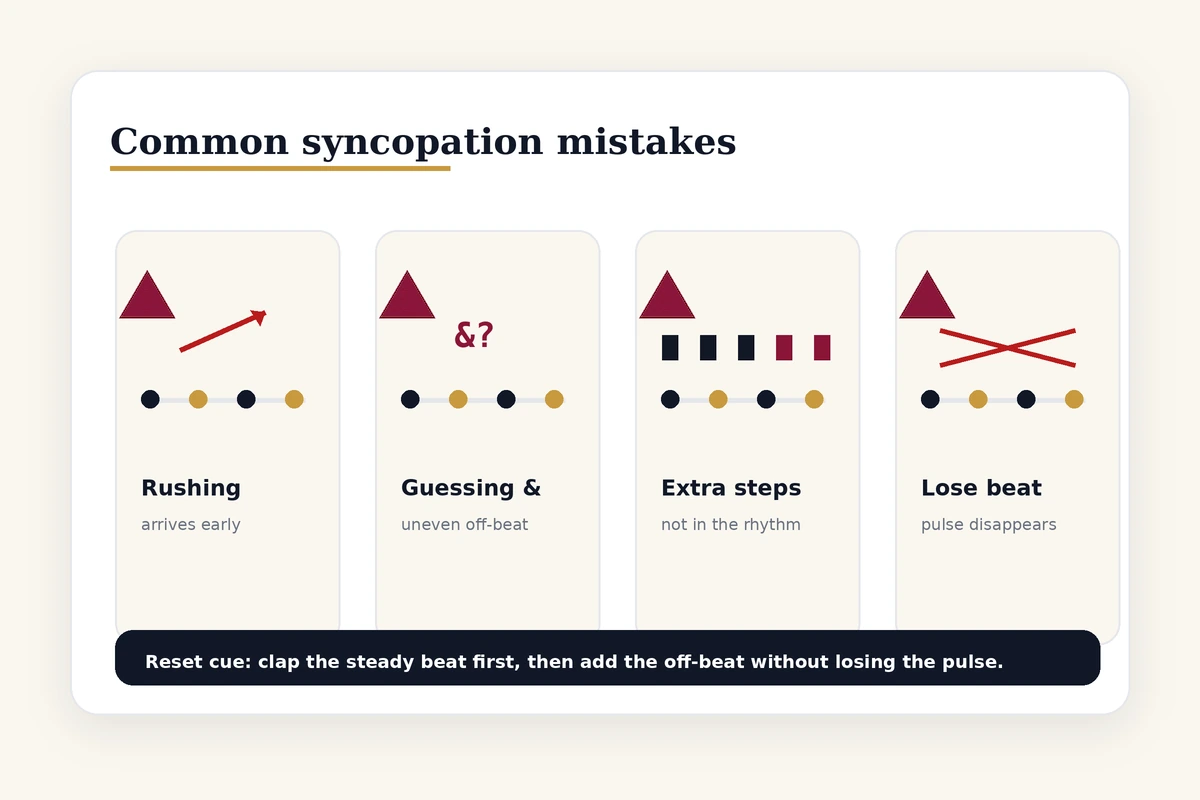
| Mistake | What it sounds or feels like | Fix |
|---|---|---|
| Thinking syncopation means “go faster” | The dancer rushes and arrives early. | Count the main beat first, then add the &. |
| Treating & as a guess | The rhythm feels uneven or random. | Say the full count out loud: 1 & 2. |
| Ignoring the main beat | The dancer loses the phrase or partner timing. | Clap the numbers before clapping the &. |
| Calling every quick step syncopation | The term becomes confusing. | Ask whether the step changes the expected accent or subdivision. |
| Adding extra steps that do not fit | The pattern fights the music. | Simplify until the rhythm matches the track. |
| Over-practicing with fast music | The count becomes tense and unclear. | Use slower, clearer tracks first. |
| Copying a teacher’s syncopation without context | The figure works in one dance but not another. | Ask what count, style, and figure the teacher means. |
| Forgetting partner timing | One dancer hears the rhythm but the partnership falls apart. | Count together before adding styling or speed. |
FAQ
Syncopation in dance is rhythm that emphasizes or moves around an unexpected beat, off-beat, or subdivision. For beginners, it often shows up as an & count, split beat, held accent, or quick timing change that still fits the music.
In ballroom dance, syncopation can mean stepping, holding, accenting, or changing weight in a way that plays with the expected beat. Some teachers also use the word to describe added or split steps within a set number of beats.
No. Rhythm is the pattern of sounds or movements over time. Syncopation is one kind of rhythmic effect where emphasis happens in an unexpected place.
Start with the steady beat, then add subdivisions. For example, count 1 & 2 to feel the halfway point between beats, or use a dance-specific count like Cha Cha’s 2-3-4&1.
Syncopation is commonly discussed in Cha Cha, Swing, Jive, Quickstep, Mambo, Salsa, Samba, and some Foxtrot or Tango contexts. It appears differently by dance, syllabus, teacher, and figure.
Cha Cha is often described as syncopated because of the 4&1 part of the rhythm. Many teachers count International-style Cha Cha as 2, 3, 4&1.
It can feel confusing at first because beginners often try to hear the & before they can feel the main beat. Start by clapping the steady beat, then add the off-beat slowly.
Use clear music, count out loud, clap the main beat, then clap the & counts. Cha Cha and Swing playlists are useful starting points because their split-beat rhythms are easier to hear.
Editorial
This glossary guide is written for beginner clarity and should be reviewed periodically by experienced ballroom dancers, music/timing educators, or qualified instructors. Dance teachers and syllabi may use timing language differently, so use this page as a plain-English reference and confirm dance-specific details with your instructor.
This is dance and music terminology, not a music-theory textbook. Ballroom Pages follows an editorial policy of education-first guidance. Questions? Contact us. Updated May 22, 2026.