
Glossary
Line of Dance in Ballroom
Put thirty traveling couples on one floor without rules and you get bumper cars. Ballroom’s answer is the line of dance—an invisible counterclockwise highway around the room that every traveling dance follows. Learn it once and every crowded floor becomes navigable. Here is which way to go, who has right of way, how the lanes work, and what happens at the corners.
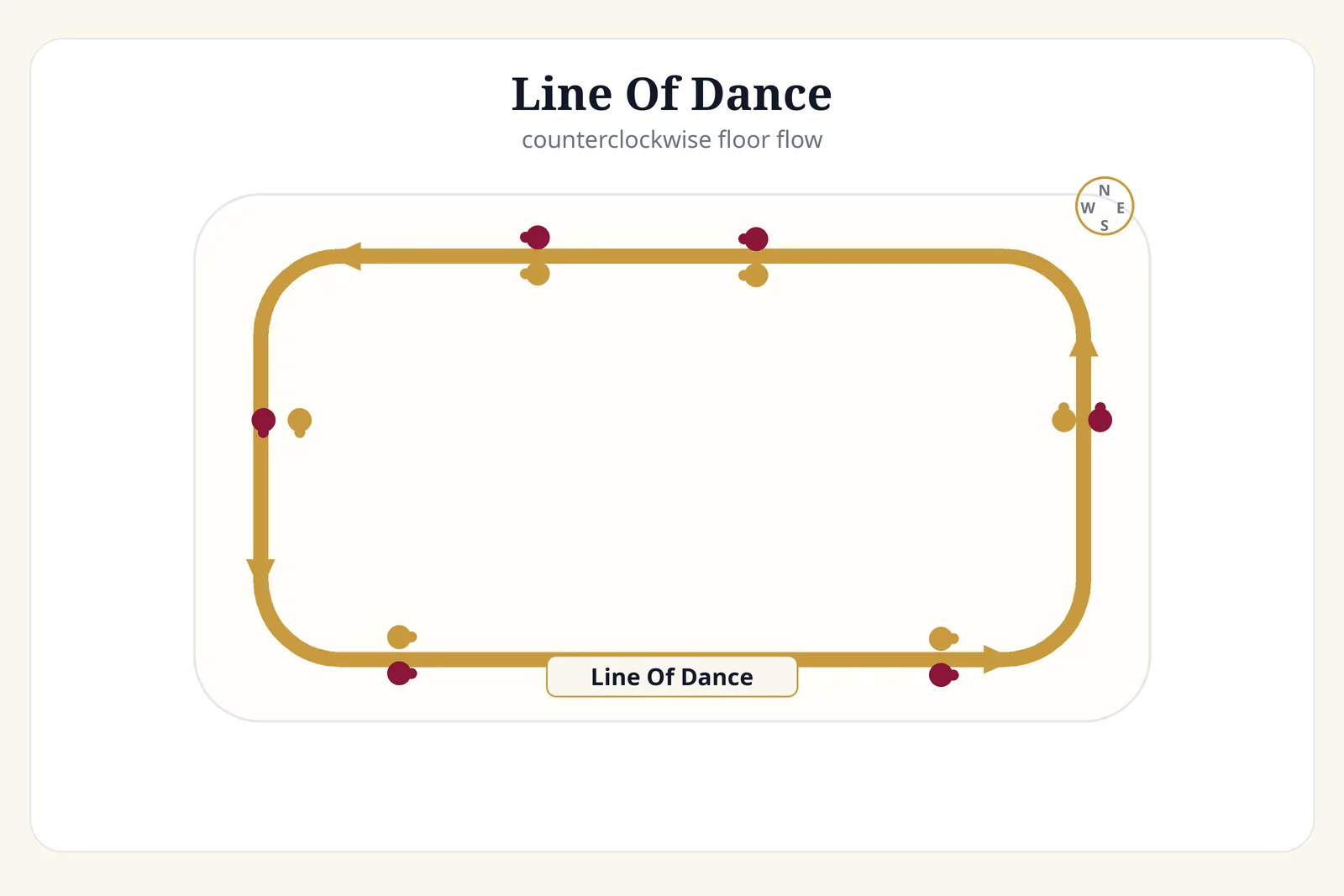
Definition of line of dance
Line of Dance
- Also written
- LOD
- Skill category
- Floorcraft & navigation
- Companion term
- Alignment (directions measured from it)
- Related terms
- floorcraft, alignment, natural turn, reverse turn
The line of dance (LOD) is the counterclockwise traffic flow around the ballroom floor that all traveling dances follow. Couples progress counterclockwise around the room, faster-moving couples keep to the outside, and every figure’s alignment is described relative to it.
Think of it as a one-way ring road: everyone drives the same direction, and the fast lane is on the outside.
What the line of dance is
Traveling dances—Waltz, Foxtrot, Tango, Quickstep, Viennese Waltz, Samba—are built to move. Their figures carry couples across the floor, and a crowded floor of moving couples needs traffic law. The line of dance is that law: an imaginary line running counterclockwise around the perimeter of the room, which all traveling couples follow like cars on a one-way ring road.
It is one of the first things taught in any Standard or Smooth class, because it is what makes social dancing on a shared floor possible at all. Every figure in the syllabus is designed with the LOD in mind—naturals and reverses alternate so couples can keep progressing, and alignments like “facing diagonal to wall” only mean anything measured against the line of dance.
Which direction? Counterclockwise, always
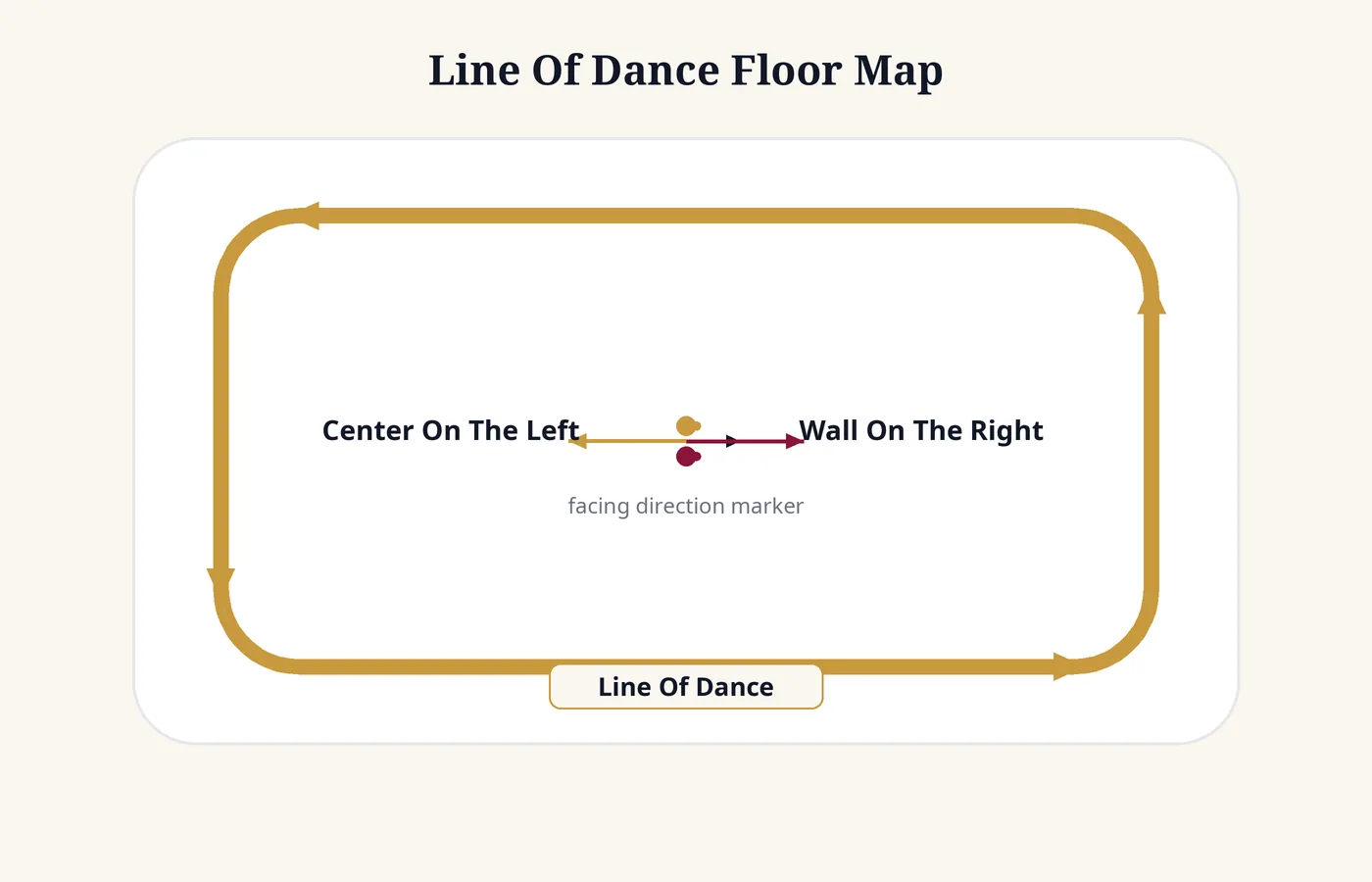
Stand anywhere on the floor and face so the nearest wall is on your right and the center of the room is on your left—you are now facing down the line of dance. Travel that way and you are with the traffic. The convention is universal: every ballroom, every country, every competition floor runs counterclockwise (the same direction as ice-skating rinks and athletics tracks).
Quick orientation check: wall on your right, center on your left, and you’re facing the LOD. If the wall is on your left, you are dancing against traffic.
Lanes and right of way
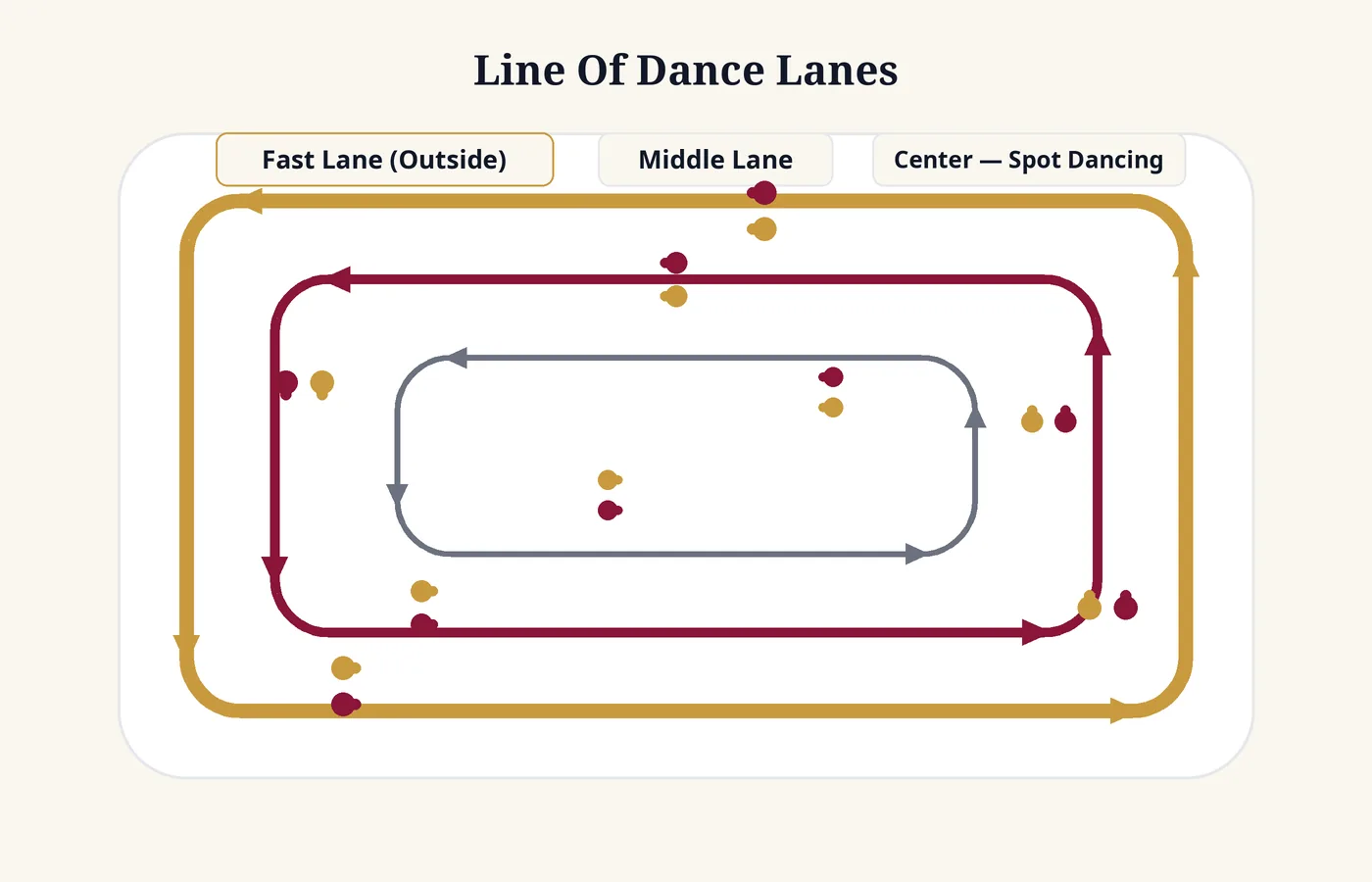
A busy floor organizes itself into rough lanes, exactly like a highway:
Floor traffic rules
- Outside lane = fast lane. Couples covering the most ground (big Quickstep, Viennese Waltz) keep to the perimeter.
- Middle lane = cruising. Moderate travelers and anyone working through figures.
- Center = spot dancing. Couples doing non-traveling figures, beginners taking it slow, and (on social floors) Rumba or swing dancers sharing the room.
- Overtake toward the center, passing on the slower couple’s inside—never squeeze past on the outside lane.
- The couple in front has right of way. Following couples are responsible for avoiding them; if traffic stops, dance in place until it clears.
- Never travel against the LOD for more than a step or two—figures that move briefly against it are designed to rejoin the flow immediately.
This is the heart of floorcraft—the leader’s skill of navigating traffic—and of basic floor etiquette.
What happens at corners
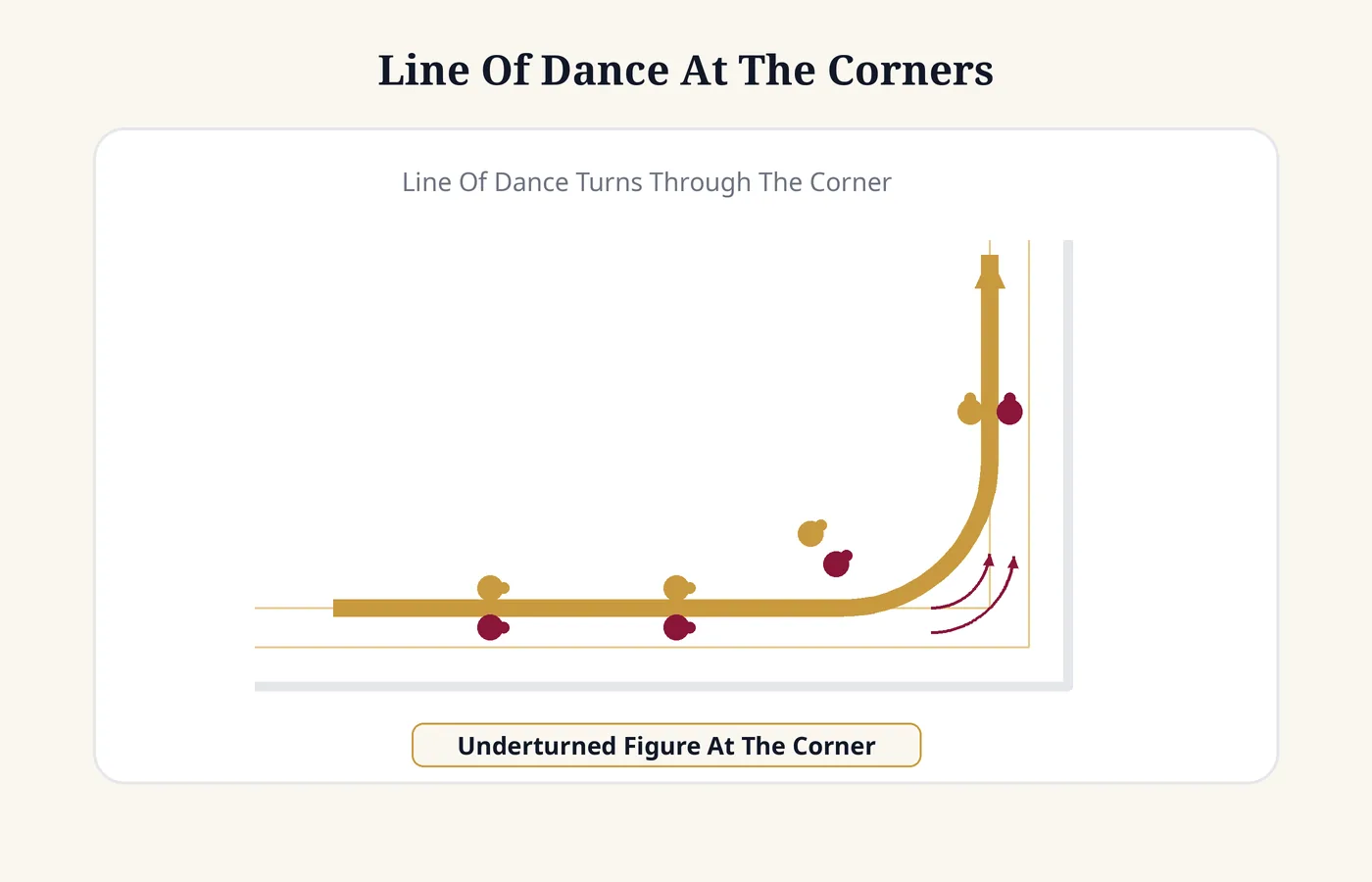
Floors are rectangles, so the line of dance turns four corners per lap. Each corner bends the LOD ninety degrees, and there is a new “line of dance” along each wall. Syllabus figures handle this elegantly: corner-friendly figures rotate the couple just enough to face the new LOD—the classic example is the underturned natural spin turn, and natural turns and reverse turns can both be shaped to a corner.
Social shortcut while you learn: dance simpler figures along the walls, and save your turning figure for the corners. The room will teach you the timing.
The LOD is the compass for alignment
Open any syllabus and you meet phrases like “facing diagonal to wall” or “backing line of dance.” All of those directions are measured from the line of dance—it is the north on ballroom’s compass. Eight standard directions radiate from it (LOD, diagonal to wall, wall, diagonal to wall against LOD, against LOD, and their center-side mirrors). That system is covered in full in the alignment entry; the thing to grasp here is that without the LOD, alignments would have nothing to refer to.
Common line of dance mistakes
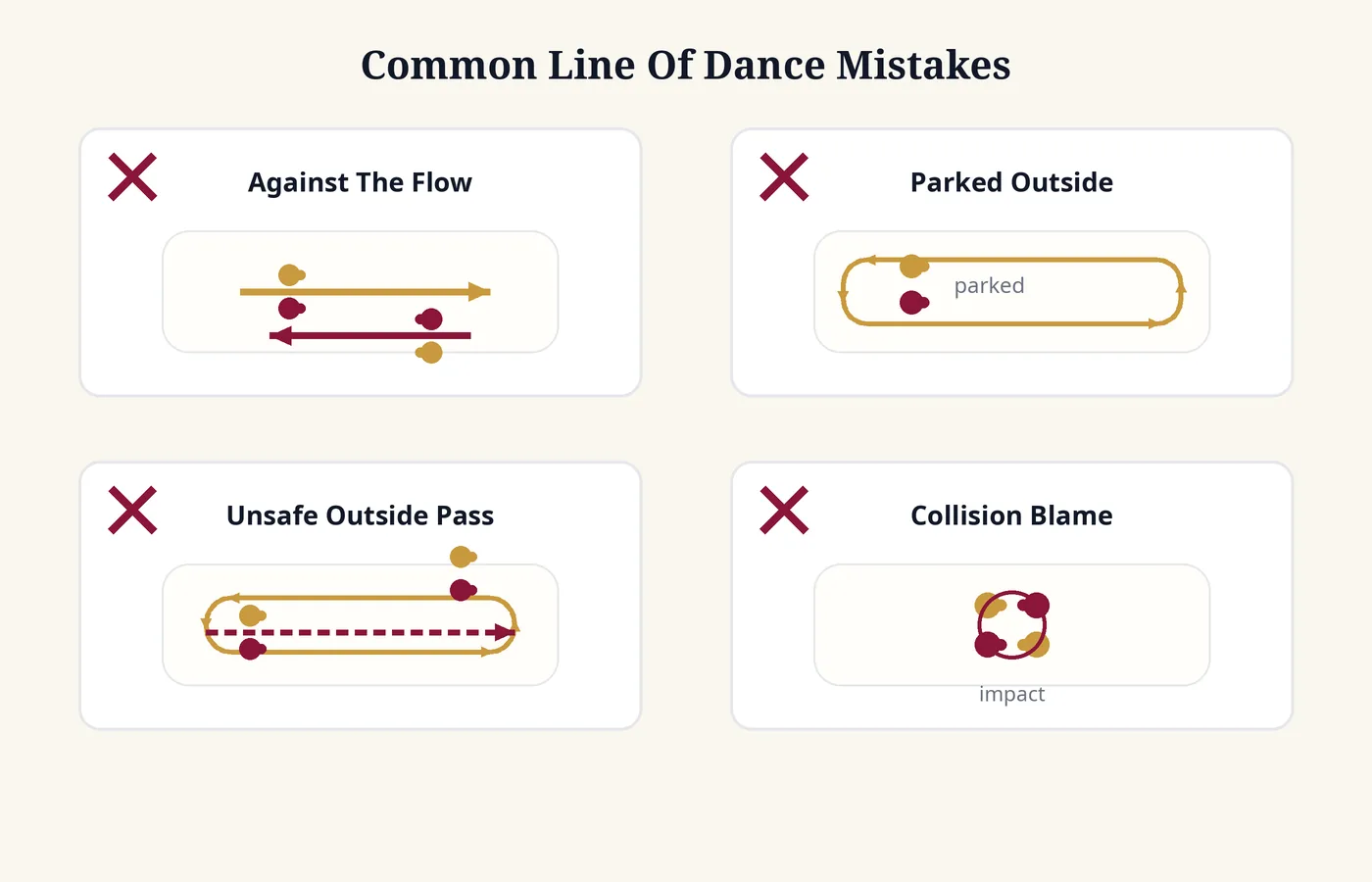
Dancing against the flow
Fix: Orient before you start: wall on the right, center on the left. If you get turned around mid-dance, dance in place until you can rejoin the flow.
Parking in the fast lane
Fix: If you need to work on something or chat, drift to the center. The outside lane is for moving traffic.
Overtaking on the outside
Fix: Pass on the inside (toward the center), with room to spare, and rejoin the lane ahead.
Blaming the couple ahead for a collision
Fix: The couple in front has right of way. Leaders own the navigation—leave space, plan an exit, and treat every stop ahead as your problem to solve.
Practice navigating the LOD
Navigation is a skill you can drill even in a small space:
- Walk the ring. Walk your living room’s perimeter counterclockwise to music, calling the walls: “long wall… corner… short wall…”
- Corner drill. Dance basics along a wall and place a turning figure at each corner, four corners per lap.
- Traffic game. On a social floor, pick a slower couple and practice following at a safe distance for a full lap—spacing is the skill.
-
Waltz (learn the flow)
Unhurried traveling music—perfect for your first laps around the LOD.
-
Quickstep (the fast lane)
Once the flow is second nature, this is what the outside lane feels like.
-
Floorcraft guide
The full navigation skill: reading traffic, planning exits, protecting your partner.
-
BallroomPages Music (Telegram)
Mixed-style practice tracks. Navigation drills coming soon.
FAQ
Line of Dance FAQ
What is the line of dance in ballroom?
The line of dance (LOD) is the counterclockwise traffic flow around the ballroom floor that all traveling dances follow. Couples progress counterclockwise around the room, and figure directions (alignments) are described relative to it.
Which direction does the line of dance go?
Counterclockwise—universally. Face so the nearest wall is on your right and the center of the room is on your left, and you are facing down the line of dance.
Who has right of way on the dance floor?
The couple in front. Following couples are responsible for avoiding them, and overtaking happens toward the center (the inside), never on the outside lane. If traffic stops ahead, dance in place until it clears.
Do all dances follow the line of dance?
Only the traveling dances: Waltz, Foxtrot, Tango, Quickstep, Viennese Waltz, and Samba. Spot dances like Rumba, Cha Cha, and the swing dances don’t progress around the room—on a shared social floor those couples keep to the center.
How do dancers turn the corners of the floor?
The line of dance bends ninety degrees at each corner, and couples use corner-friendly figures—classically an underturned natural spin turn—to rotate just enough to face the new line of dance and keep traveling.
Editorial
Sources and review notes
This glossary entry should be reviewed by a qualified ballroom instructor before launch. Line-of-dance conventions and floor etiquette follow widely accepted social and competitive practice; individual venues and competitions may publish their own floor rules.
This is beginner orientation, not a substitute for instruction. Ballroom Pages follows an editorial policy of education-first guidance. Questions? Contact us. Updated July 9, 2026.