
Ballroom dance, in plain English
At its simplest, ballroom dance is two people moving together to music. One person leads. The other follows. Both share a frame, listen for the same beat, and travel across a floor in patterns that match the song’s feel—smooth and gliding for some dances, sharp and rhythmic for others.
The word “ballroom” describes both a family of recognized dances and the broader world of partner dancing. You will hear it in social studios, on wedding dance floors, in dance schools, on cruise ships, and in serious competitions known as DanceSport.
Ballroom dance in simple terms
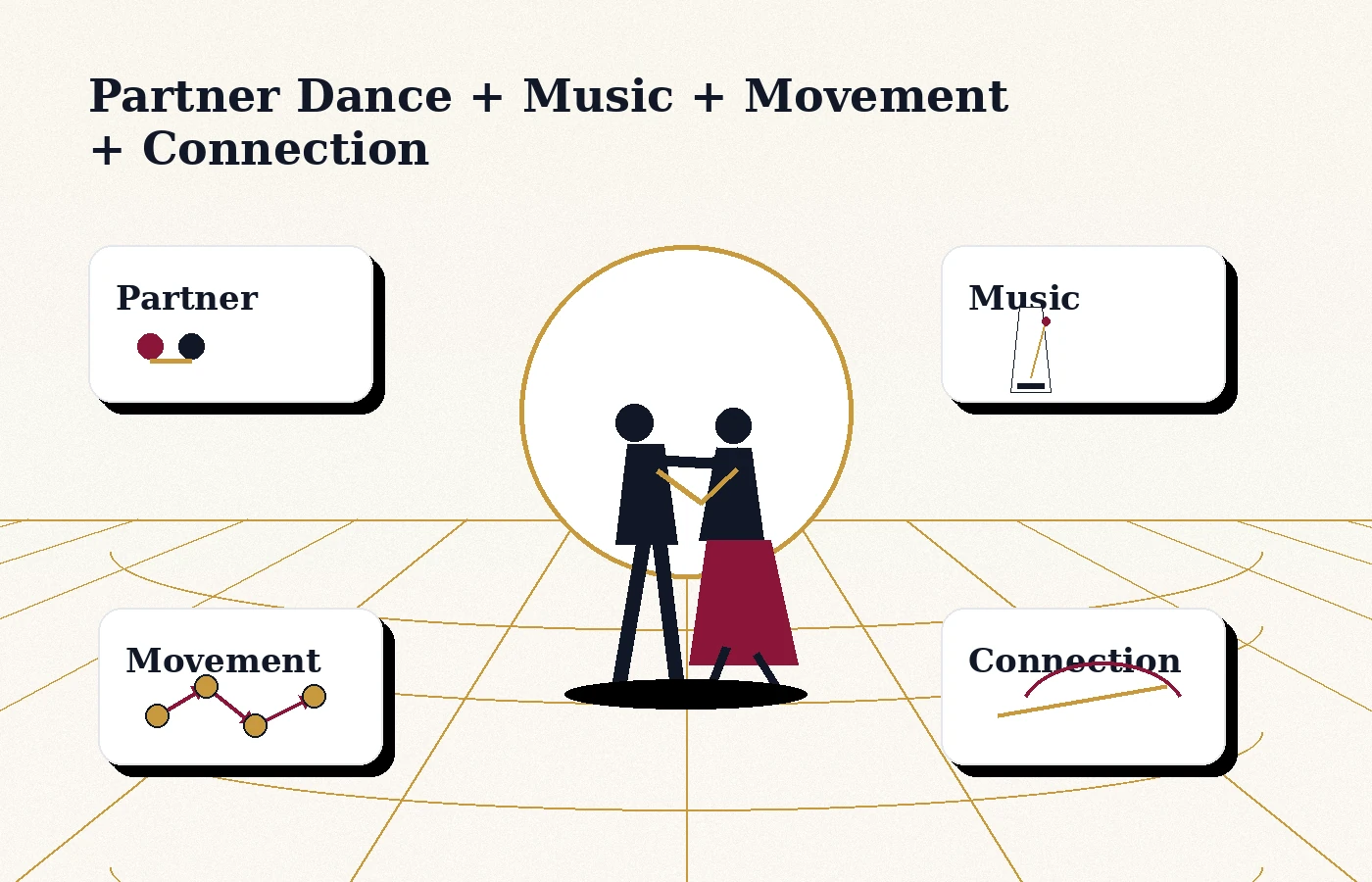
Think of ballroom dance as a shared language. The music sets the rhythm, the leader proposes the next move, and the follower responds. Neither is performing alone; they are reading each other through posture, weight, and frame.
That conversation can be slow and graceful, as in Waltz, or quick and percussive, as in Cha Cha. The vocabulary—steps, figures, holds, and timing patterns—differs from dance to dance, but the core idea is the same: two dancers moving as one to music.
Ballroom vs social dance vs Latin dance vs DanceSport
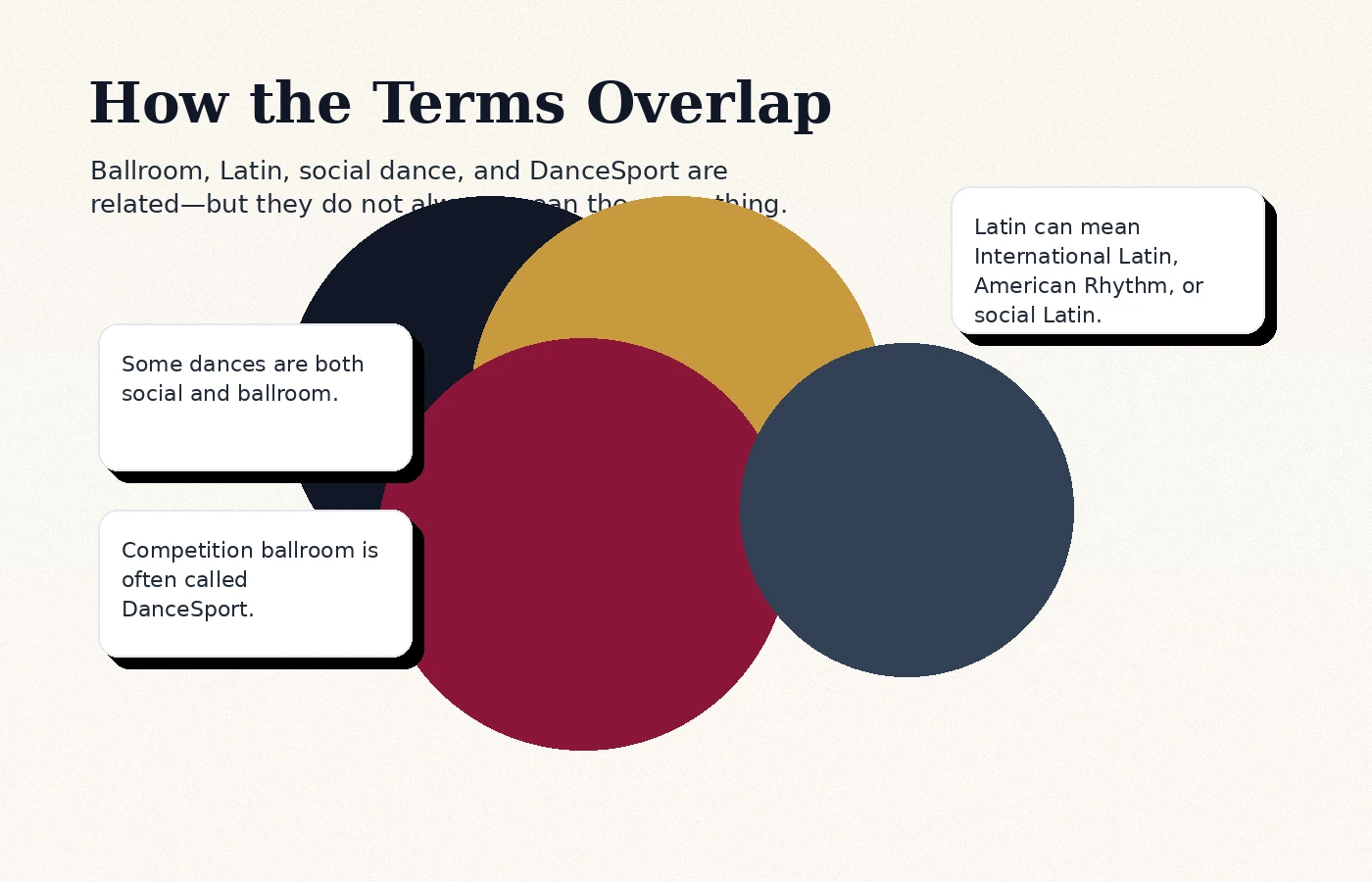
People often use these terms interchangeably, but they describe overlapping—not identical—ideas. Here is how they relate.
| Term | What it means | Typical setting | Examples |
|---|---|---|---|
| Ballroom dance | Partner dances usually associated with formal syllabi and recognized families. | Studios, weddings, ballroom competitions. | Waltz, Tango, Foxtrot, Rumba, Cha Cha, Swing. |
| Social dance | Partner dancing in a social setting where people lead and follow without competition rules. | Socials, clubs, weddings, casual studio nights. | Salsa, Bachata, Hustle, West Coast Swing. |
| Latin dance | Dances rooted in Latin American music and culture; some are inside formal ballroom syllabi. | Studios, social events, festivals, competitions. | Rumba, Cha Cha, Salsa, Bachata, Samba, Merengue. |
| DanceSport | The competitive form of ballroom dance with structured levels, costumes, and judging. | Sanctioned competitions and championships. | International Standard and International Latin events. |
The short version: ballroom is the umbrella, social is the casual setting, Latin is a regional and rhythmic flavor, and DanceSport is competition.
The main contexts for ballroom dance
The same dance can look very different depending on where it lives. A Foxtrot at a wedding is not the same Foxtrot you would see at a competition. Most ballroom dancers move through several of these contexts over time.
- Social ballroom
- Casual dances at studios, socials, cruises, and parties. The goal is enjoyment and partner connection rather than competition.
- Wedding ballroom
- First-dance choreography or simple social steps that match a couple’s chosen song. See our wedding dance hub.
- Studio learning
- Group classes and private lessons that build technique, repertoire, and confidence over time.
- Competitive ballroom (DanceSport)
- Sanctioned events with levels, syllabi, costumes, and judging criteria. Athletic and rehearsed.
- Performance
- Showcases, demonstrations, and stage shows where ballroom dance is choreographed for an audience.
The main ballroom dance families
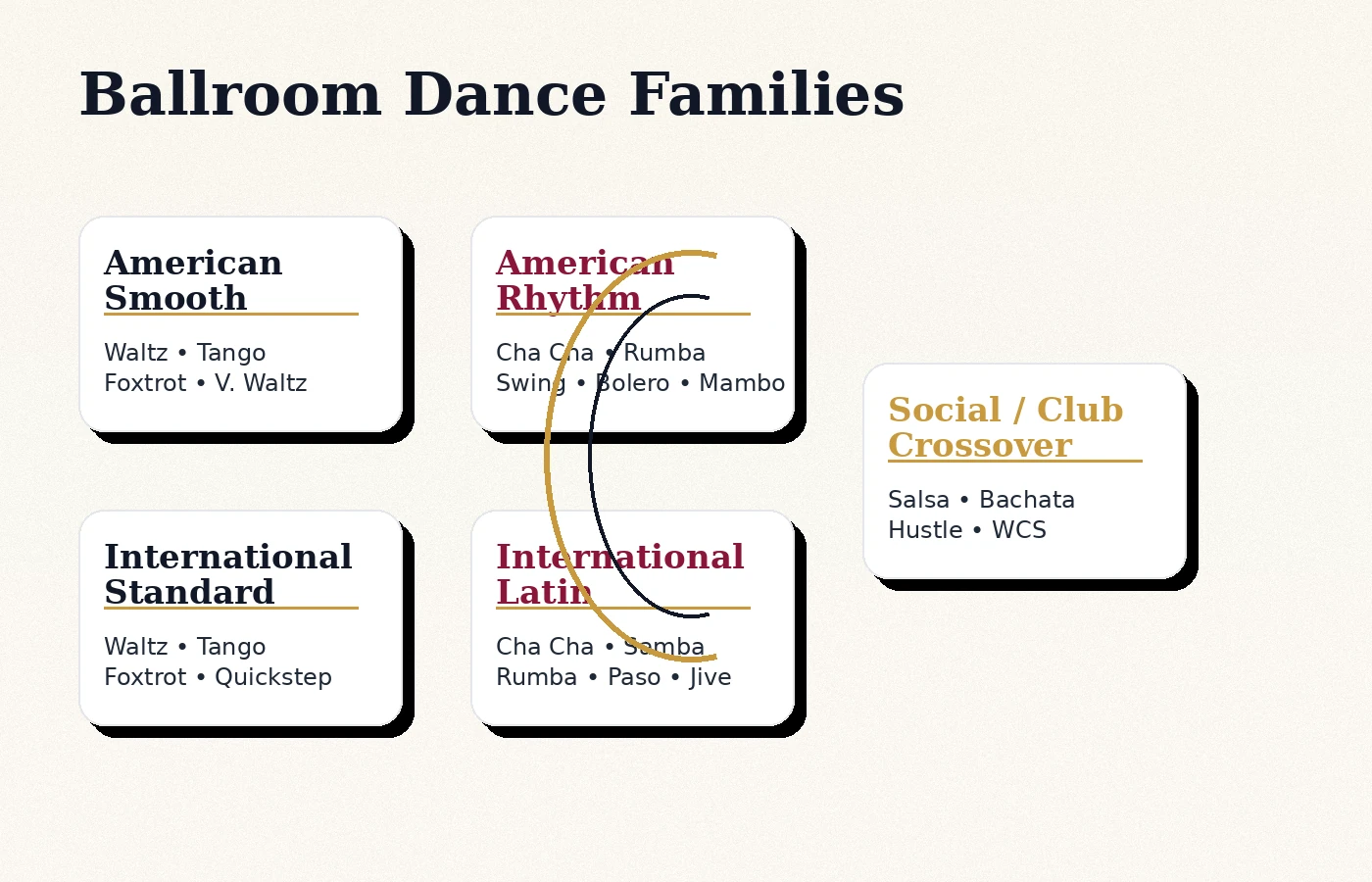
Formal ballroom dance organizes its repertoire into four recognized families. American styles emphasize social usability and breakaway movement; International styles emphasize closed-hold technique and global competition standards.
| Family | Feel | Hold | Common dances |
|---|---|---|---|
| American Smooth | Elegant, traveling, with both closed and open positions. | Closed and open holds. | Waltz, Tango, Foxtrot, Viennese Waltz. |
| American Rhythm | Hip motion, grounded steps, expressive partner work. | Mostly open and Latin holds. | Rumba, Cha Cha, East Coast Swing, Bolero, Mambo. |
| International Standard | Strict closed hold, rise and fall, gliding across the floor. | Closed hold throughout. | Waltz, Tango, Viennese Waltz, Foxtrot, Quickstep. |
| International Latin | Sharp, rhythmic, hip-driven; expressive open work. | Latin hold and breakaways. | Cha Cha, Samba, Rumba, Paso Doble, Jive. |
Want to compare these dances side-by-side? Visit the Dance Styles hub.
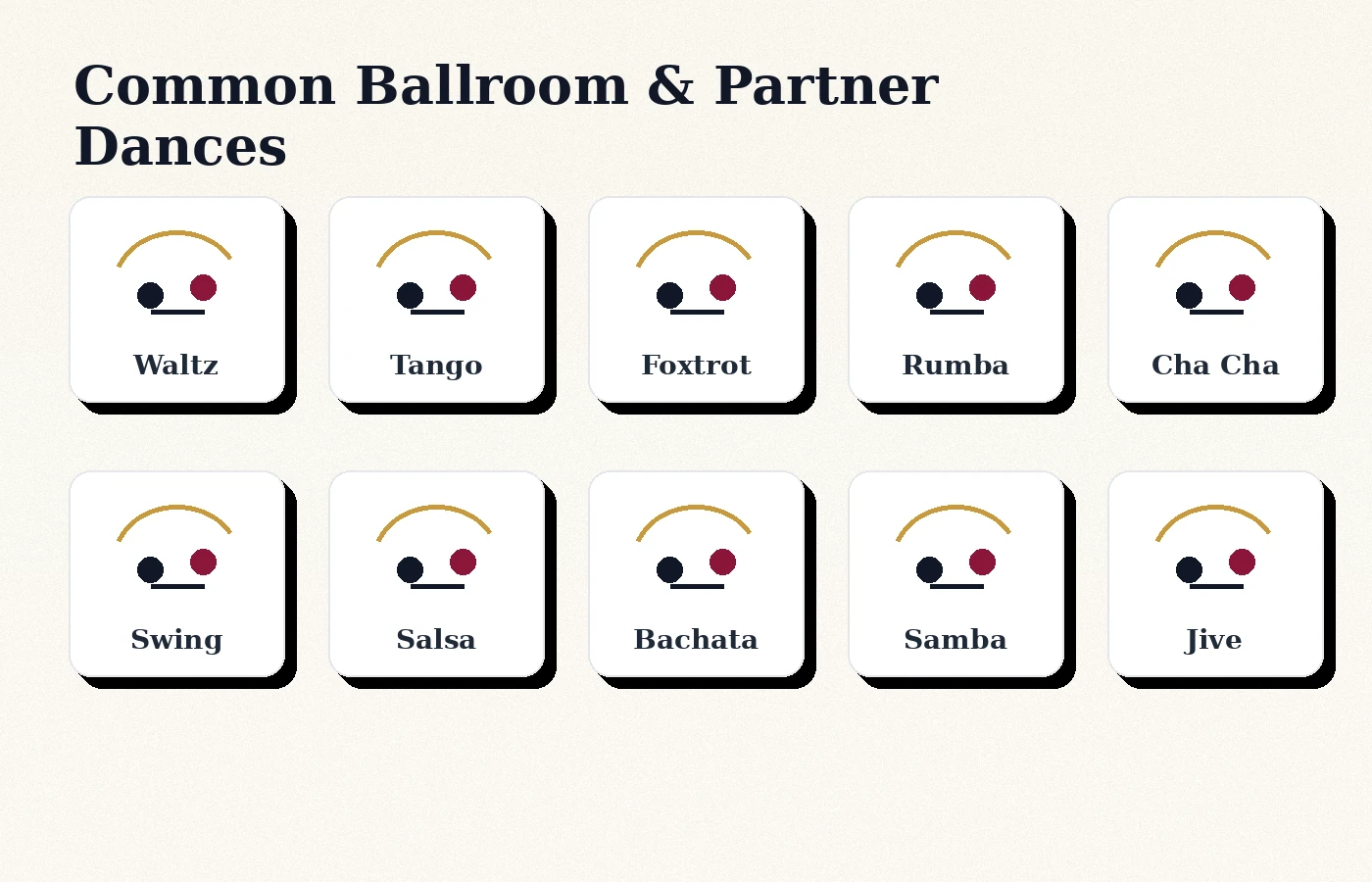
Common ballroom and partner dances
These are the dances most beginners encounter first. Each is a deep topic with its own music, history, timing, and beginner pitfalls.
-
Waltz
Smooth, gliding, and built on rise and fall. Often the first dance new students learn.
-
Tango
Dramatic, precise, and full of contrast, shape, and musical accents.
-
Foxtrot
Classic, social, and versatile for swing-influenced music and weddings.
-
Rumba
Romantic and grounded; useful for slow songs and many wedding first dances.
-
Cha Cha
Bright and rhythmic; great for learning sharp timing and Latin energy.
-
East Coast Swing
Fun, upbeat, and beginner-friendly for social dance floors.
-
Salsa
Energetic Latin social dance; popular at clubs and Latin nights.
-
Bachata
Approachable, musical, and one of the most popular social Latin dances.
How ballroom music works
Every ballroom dance is built on a specific musical feel. Waltz lives in 3/4 time. Foxtrot, Cha Cha, and Swing live in 4/4. Tempos—measured in beats per minute—tell you which dance fits a given song.
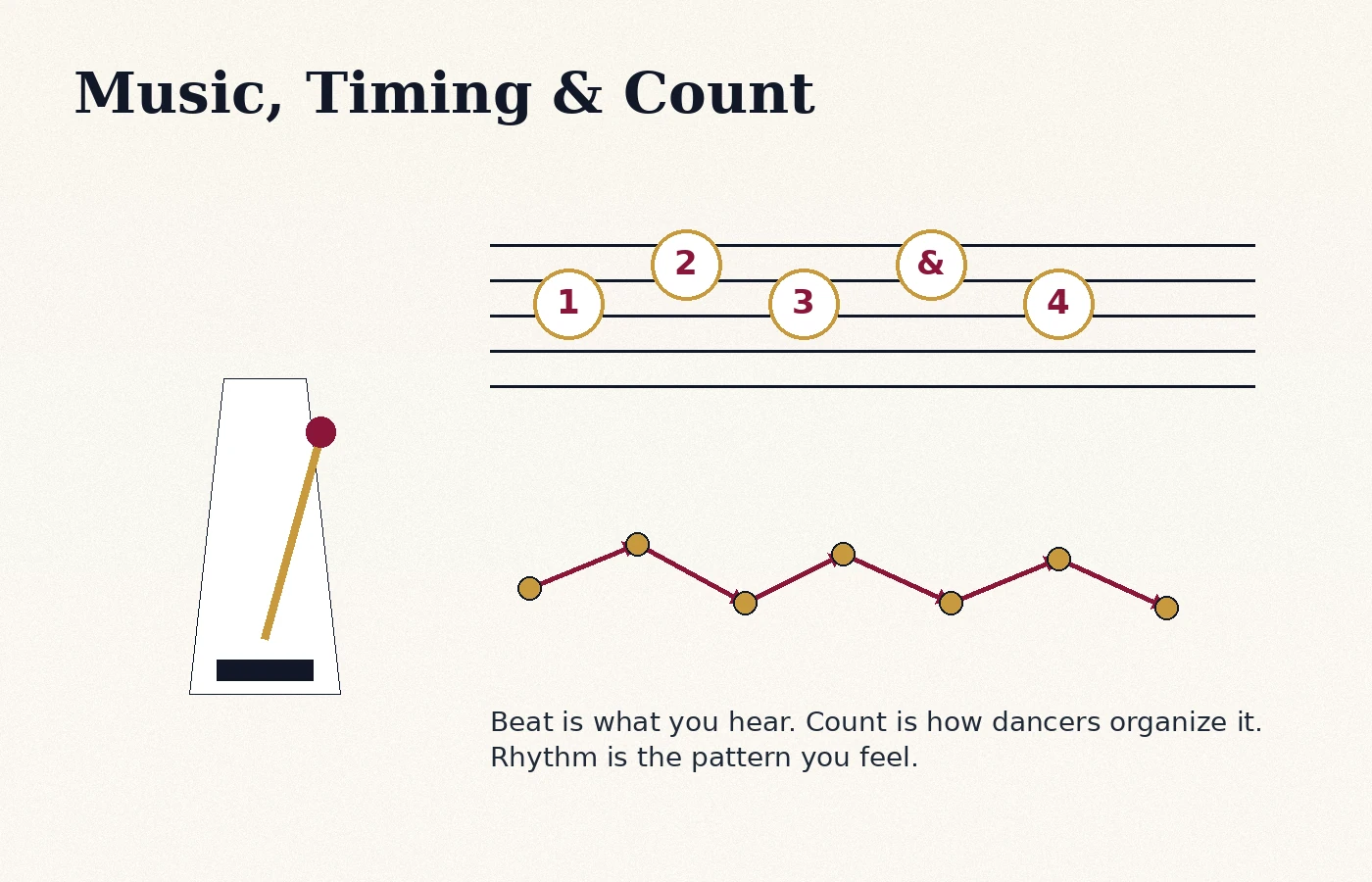
Beginners often start by learning to hear the down-beat, count it consistently, and match a basic step to it. From there, they learn rhythm patterns—the "slow-quick-quick" of Rumba, the "1-2-cha-cha-cha" of Cha Cha, or the steady rise and fall of Waltz.
For a deeper introduction, read our guide on how to count ballroom dance music and our tempo chart by dance style. The broader music & timing hub covers playlists and song-fit ideas.
What ballroom dancing looks like for beginners
A first lesson is usually less intimidating than people expect. You will not jump into competition routines. You will work on standing well, holding a frame with a partner, hearing the music, and dancing a few simple patterns in time.
Most beginners start with one or two dances and add more as they get comfortable. Posture and timing are usually the first things to improve. Step variety comes later.
Beginner first steps
- Learn how to stand and hold a frame.
- Practice counting music slowly and consistently.
- Pick one or two beginner dances—often Waltz, Rumba, Cha Cha, Foxtrot, or East Coast Swing.
- Take a few group classes or private lessons to learn the basics.
- Practice short sessions often, rather than long sessions rarely.
For a structured starting point, see our ballroom dance for beginners guide and the best ballroom dances for beginners.
Is ballroom dancing hard to learn?
The basics are friendlier than many newcomers fear. Within a few lessons, most beginners can dance simple patterns to music with a partner. Mastery, however, takes time—timing, technique, partner connection, and musicality all develop over years.
The hardest parts for beginners are usually not the steps. They are hearing the beat reliably, keeping a steady frame, and trusting the lead-follow conversation instead of memorizing patterns.
The good news: those skills compound. Drilling posture, counting music, and dancing with many partners pays off across every dance you learn next.
Do you need a partner to start ballroom dance?
No. Many beginners learn solo. Group classes rotate partners on purpose, which actually helps you develop your lead or follow faster than always dancing with the same person. Private lessons are taught with an instructor, so you do not need a partner to schedule one.
Social dance events—ballroom socials, salsa nights, swing dances—are generally welcoming to solo dancers. A friendly “Would you like to dance?” is enough.
Ballroom dance terms beginners should know
You do not need to memorize a dictionary, but a few terms come up early and often.
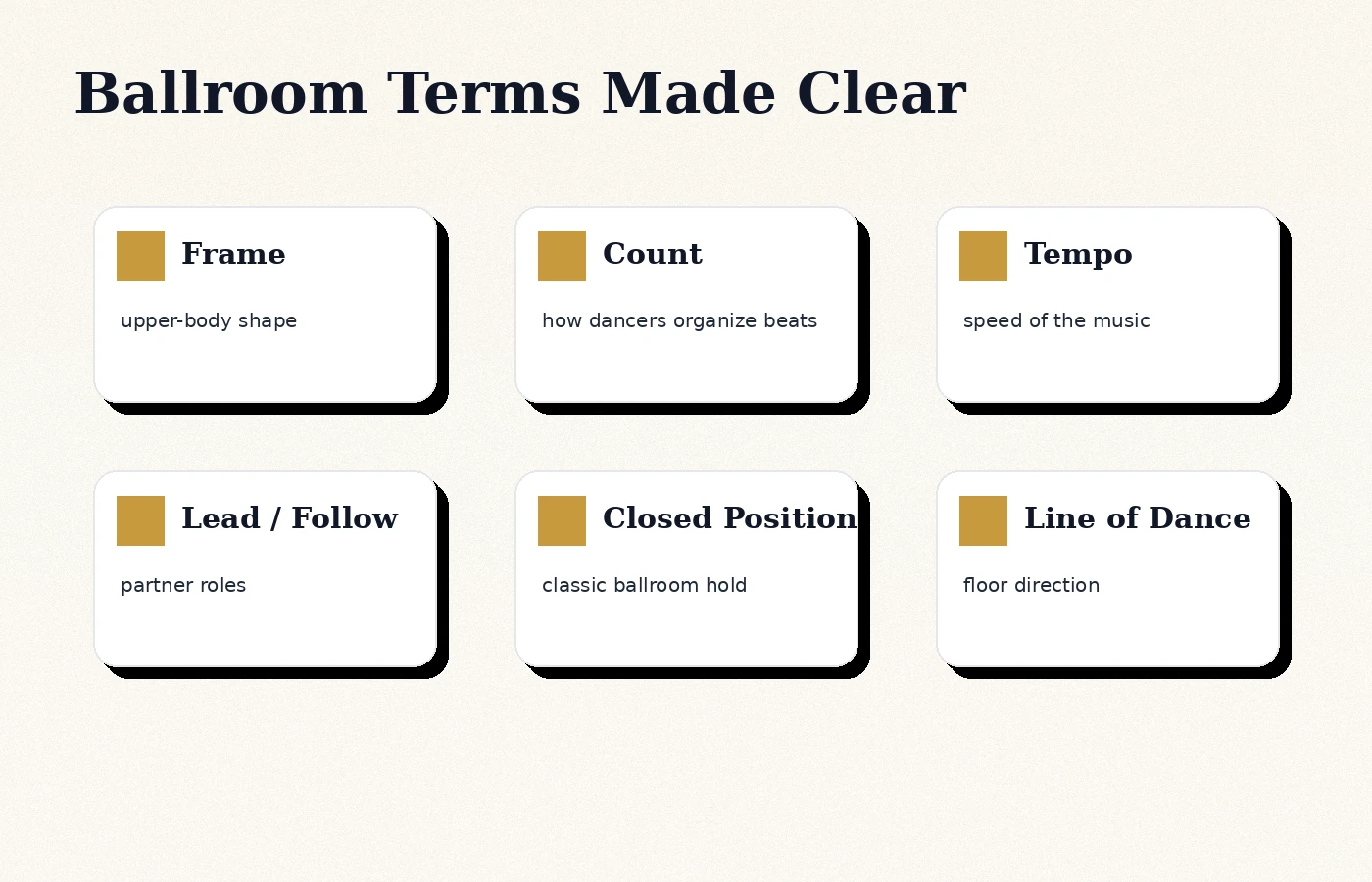
- Frame
- The connected shape two partners hold together—arms, shoulders, and posture working as one structure.
- Lead and follow
- The way one partner proposes the next move and the other responds. Both are active; neither is passive. See lead and follow.
- Posture
- Standing tall through the spine with weight balanced. The foundation for every dance. See frame and posture.
- Count
- Saying the rhythm aloud—“1, 2, 3” for Waltz, “1, 2, 3, 4” for Foxtrot, “slow-quick-quick” for Rumba.
- Tempo
- How fast or slow the music is, measured in beats per minute (BPM).
- Closed hold
- A connected partner position used in many Smooth and Standard dances.
- Open hold / breakaway
- Partners separate while staying connected through one or both hands. Common in Rhythm, Latin, and Swing.
For more, browse the Ballroom Pages glossary.
Common myths and beginner mistakes
-
Myth: You need rhythm or experience to start.
Truth: Counting music is a skill, and it improves with practice. Many beginners cannot hear the beat clearly in their first weeks—and most do, within a few months.
-
Myth: Ballroom is only for older couples.
Truth: Ballroom and partner dance communities span all ages. University clubs, wedding couples, social dancers, and competitors all share the floor.
-
Myth: You have to learn every dance.
Truth: Pick one or two dances that match the music you love or the goals you have. Add more later if you want.
-
Mistake: Memorizing patterns instead of listening to music.
Better: Drill timing first. The patterns make sense once the music does.
-
Mistake: Looking down at your feet.
Better: Lift your head, lengthen the spine, and trust the lead-follow conversation.
How to start learning ballroom dance
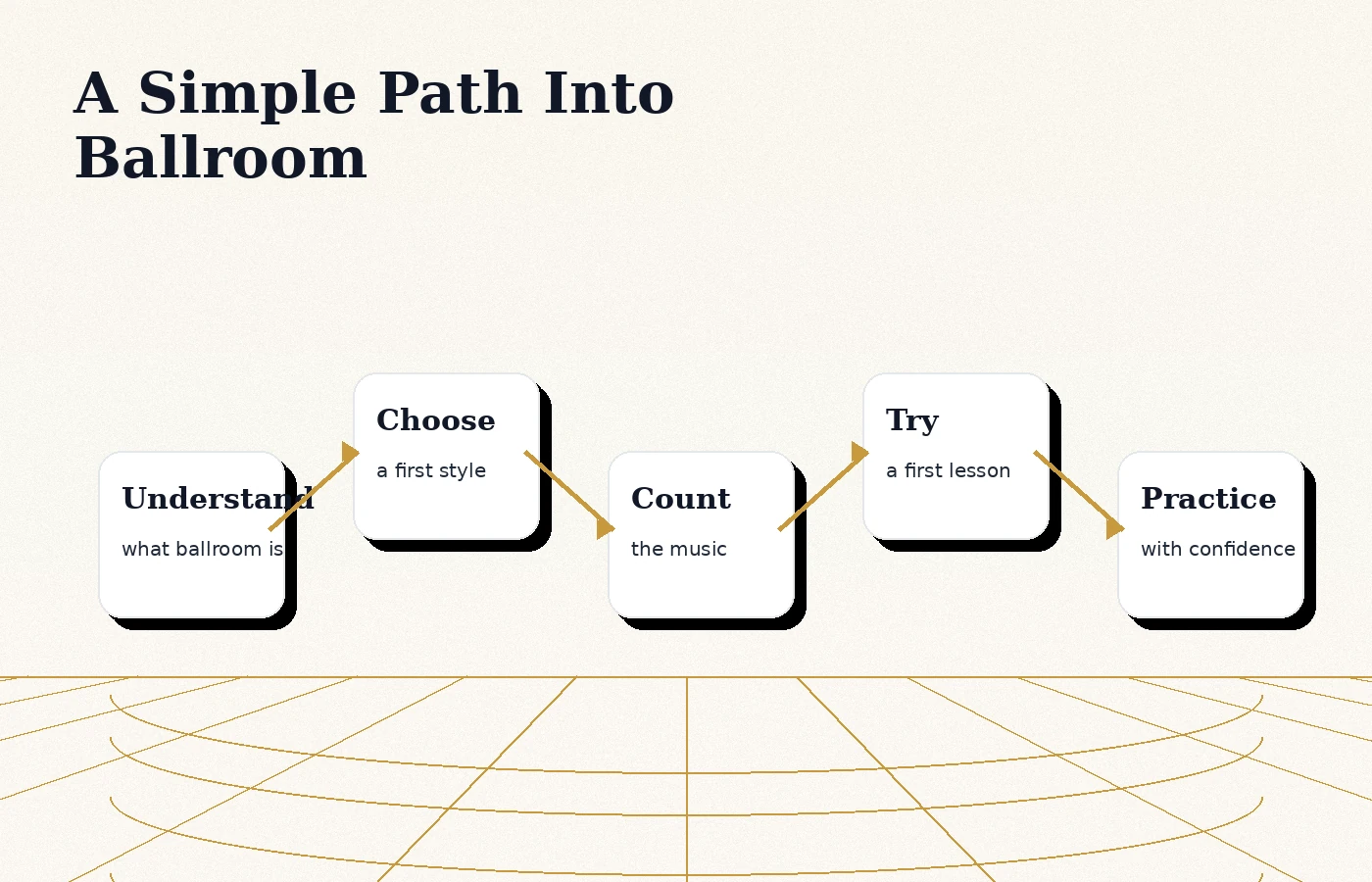
You do not need to figure this out alone. A simple path works for almost everyone.
-
Understand the basics
Read what ballroom dance is, how partner roles work, and what to expect in a first lesson. Open beginner guides.
-
Hear the beat
Practice simple counts so Waltz, Rumba, Cha Cha, Foxtrot, and Swing start to make sense. Learn to count music.
-
Pick your first dances
Start with one or two beginner-friendly dances that match your goals. Compare beginner dances.
-
Take a class or a few private lessons
Group classes are friendly and rotate partners. Private lessons accelerate technique.
-
Practice in short sessions
Frame, timing, footwork, and partner connection improve faster with frequent short drills than rare long ones.
-
Get the right shoes when you are ready
Suede-soled ballroom shoes change how you move. See ballroom dance shoes for beginners.