Meter
Meter is the count structure of the song. Waltz-style music usually feels like 1-2-3, while most social, Latin, Swing, Foxtrot, Rumba, Hustle, and slow dance options live in a 4-count world.
Resource / Music & Timing Tool
Have a song and not sure whether it fits Waltz, Rumba, Foxtrot, Swing, Cha Cha, Salsa, Bachata, Tango, Hustle, or a simple slow dance?
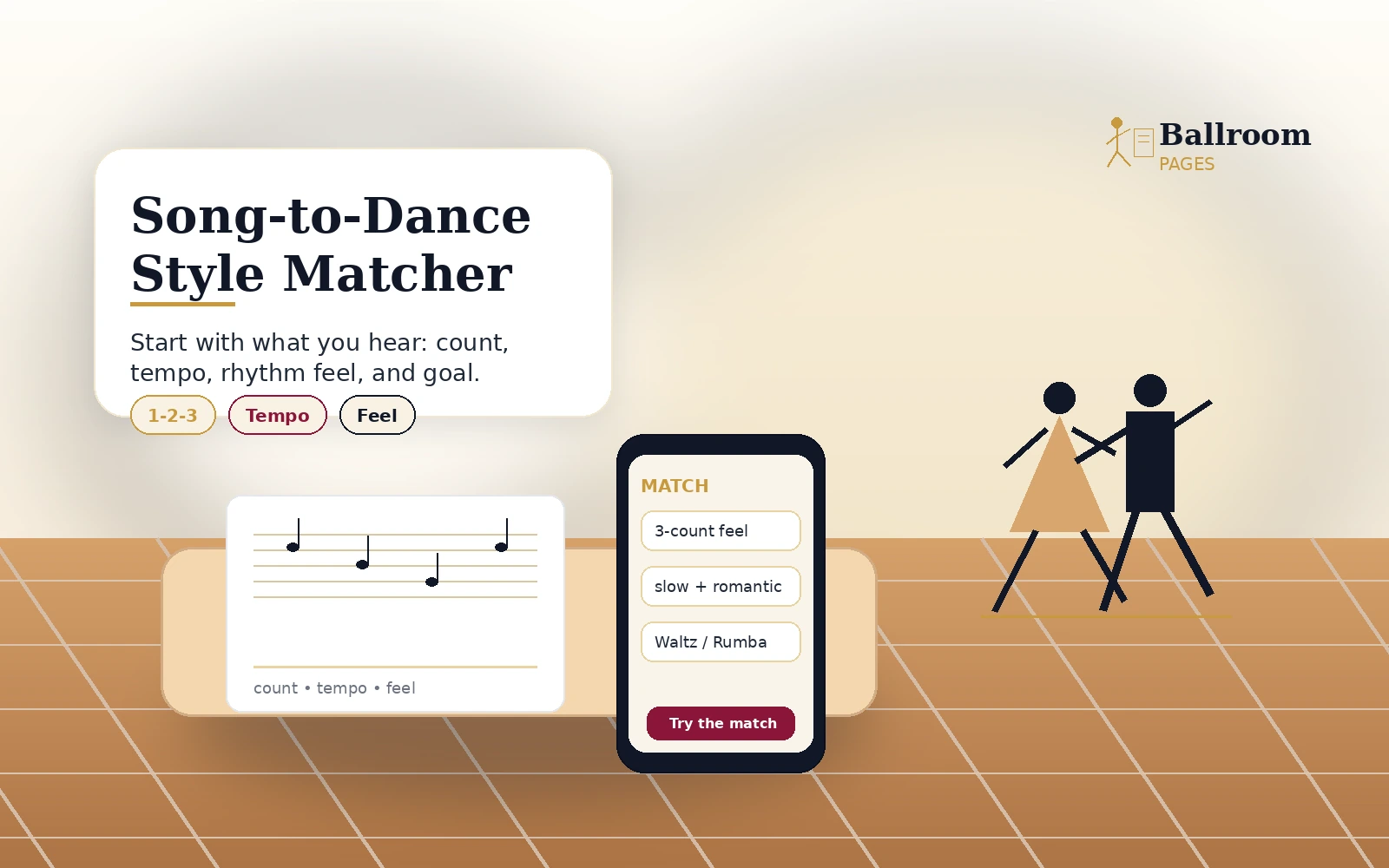
Answer a few beginner-friendly questions about the song’s count feel, speed, rhythm, mood, and purpose. The matcher will give you a practical dance recommendation, two alternate options, playlist links to test the feel, and next-step guides from Ballroom Pages. You do not need to be a musician to start.
Quick answer
A dance style usually depends on four things: meter, tempo, rhythm feel, and goal. Meter tells you whether the song feels like 3 counts or 4 counts. Tempo tells you how fast it feels. Rhythm feel tells you whether the song feels smooth, romantic, swingy, Latin, dramatic, or club-like. Your goal matters too: a wedding couple may need a simpler answer than a social dancer trying to match a rhythm closely. BPM can help, but BPM alone does not decide the dance—the rhythm pattern and how the song feels in your body matter too. Some songs can work with more than one dance, especially wedding songs.
3-count or 4-count feel
Very slow, slow, medium, upbeat, or fast
Smooth, romantic, swingy, Latin, dramatic, or club-like
Wedding, social dancing, practice, or learning
Interactive tool
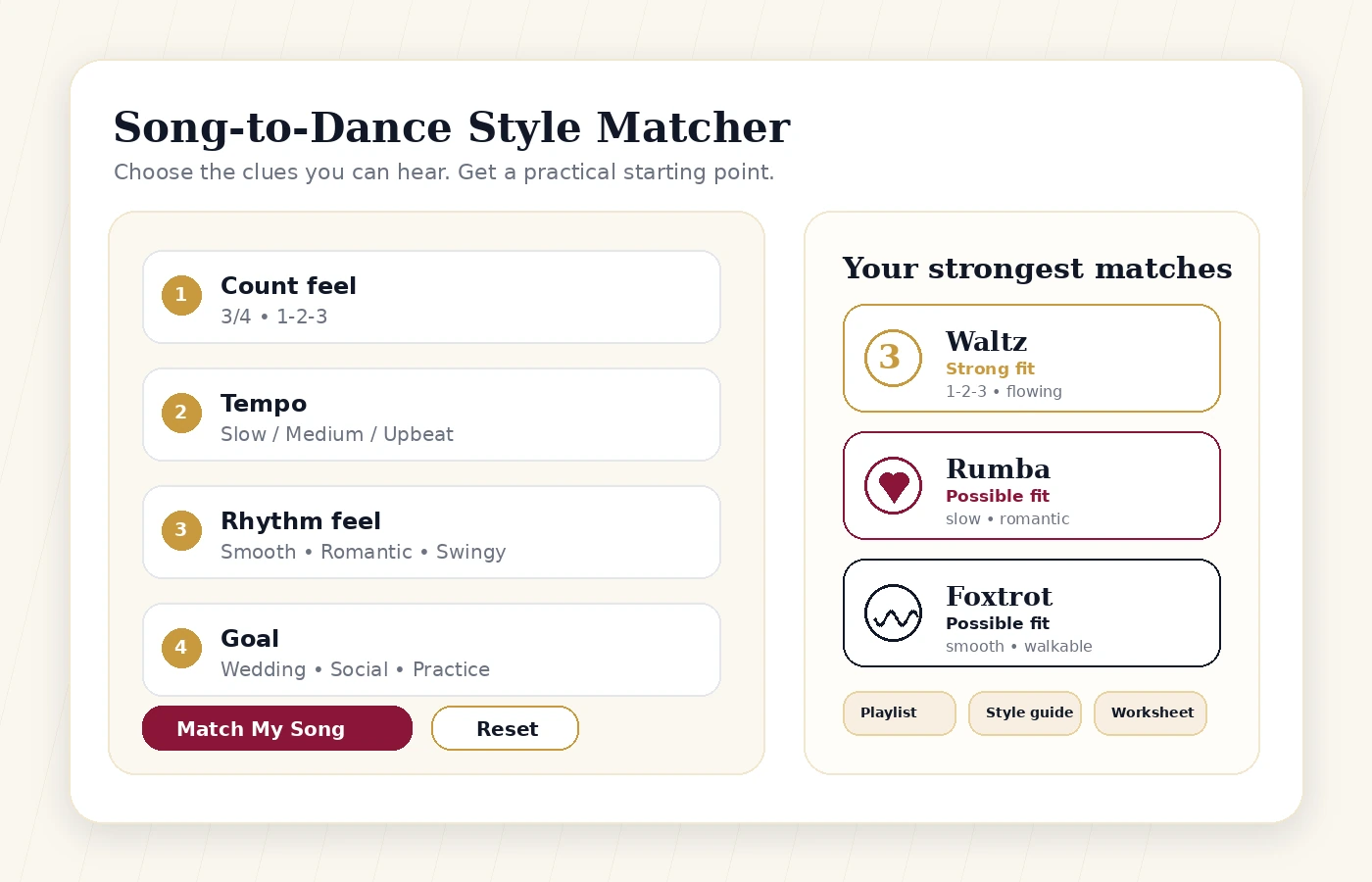
Choose the options that best describe your song. Don’t worry about getting everything perfect; the matcher will show a primary recommendation and two alternatives.
Behind the result
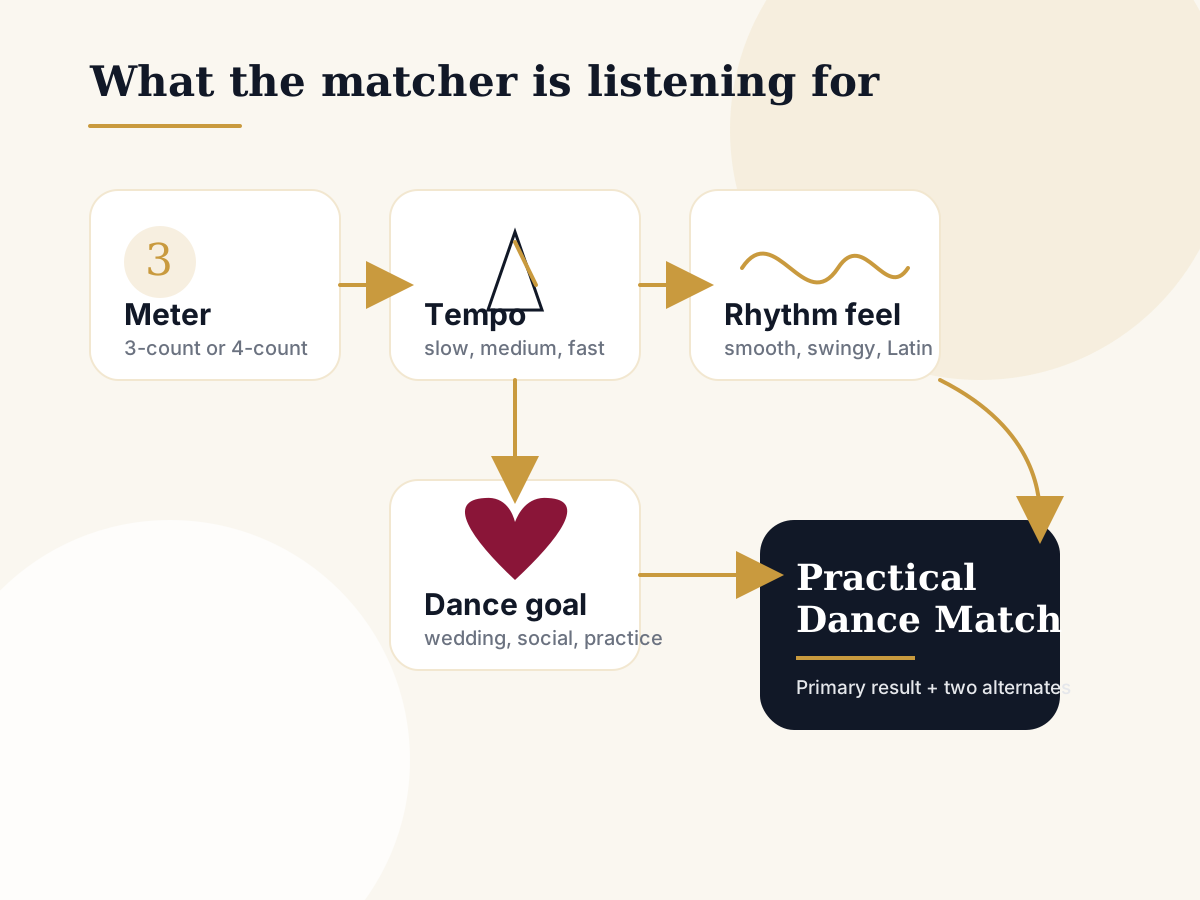
Meter is the count structure of the song. Waltz-style music usually feels like 1-2-3, while most social, Latin, Swing, Foxtrot, Rumba, Hustle, and slow dance options live in a 4-count world.
Tempo is how fast the beat feels. BPM is a useful clue, but it can be counted in different ways, especially when dancers use half-time or double-time interpretations. That is why the matcher asks for both tempo feel and rhythm feel.
Rhythm feel is the part that makes a song seem smooth, romantic, bouncy, syncopated, dramatic, or club-like. Two songs can have similar BPM but suggest different dances because the rhythm pattern is different.
A wedding first dance may need a simpler structure than a social dance. A dramatic Tango-style match may be exciting, but it may not be the easiest choice for a couple with two weeks to practice. The matcher balances song fit with practical use.
Reference
Here is how to read the result cards. A match is a practical starting point, not a final rule. Listen to a playlist, count along, and compare the alternates before choosing.
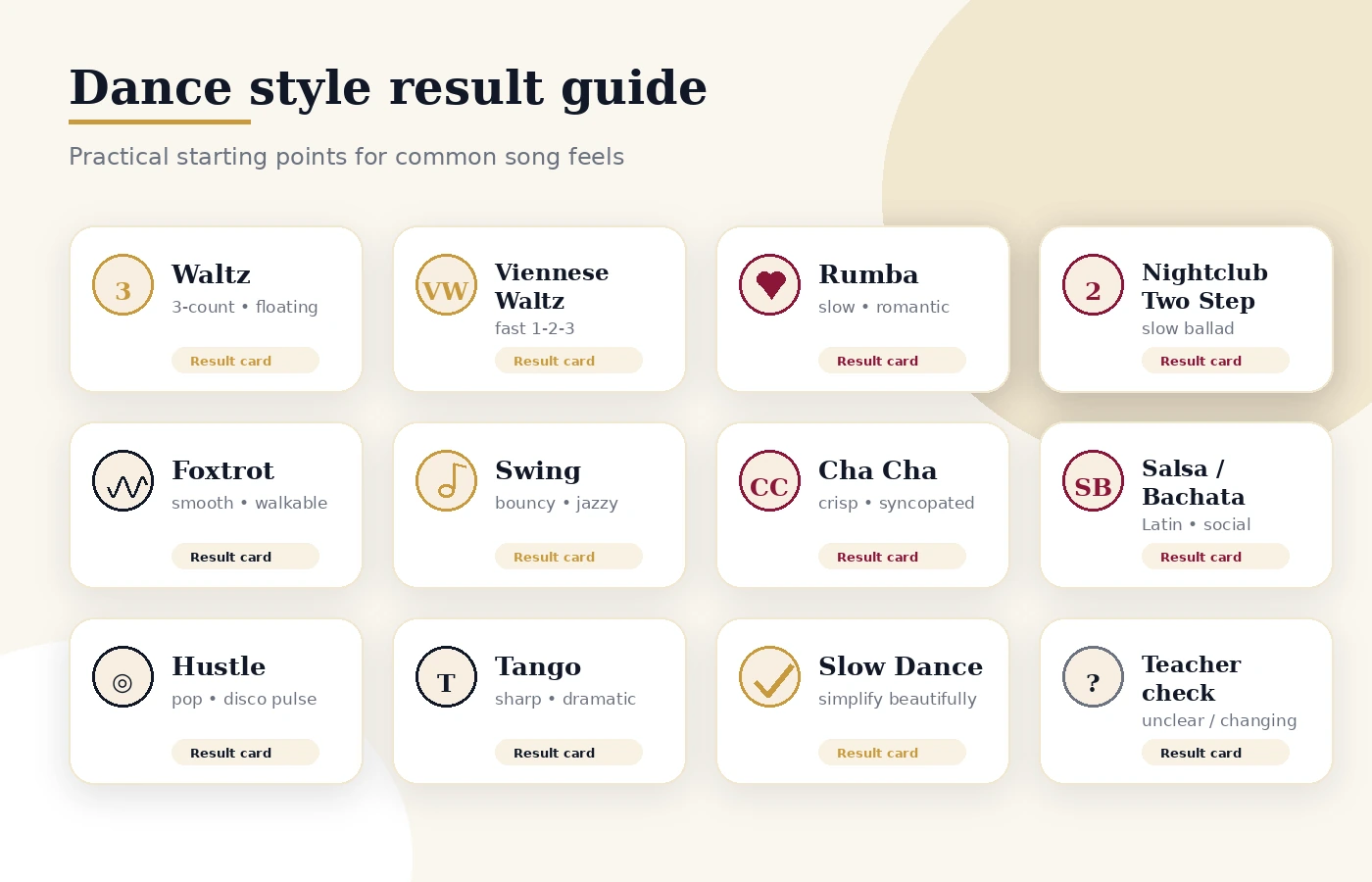
Your song seems to have a flowing 1-2-3 feel. Waltz is elegant, beginner-friendly when the tempo is moderate, and often works beautifully for first dances. Listen for a repeating three-count pulse.
Your song seems to have a fast 1-2-3 feel. Viennese Waltz can be beautiful, but it may be challenging for beginners or wedding couples without instruction.
Your song feels slow, romantic, and steady in 4/4. Rumba can be simplified for beginners and works well for many wedding songs. Listen for slow weight changes and a romantic pulse.
Your song feels like a slow romantic ballad that may not fit Waltz. Nightclub Two Step is often useful for wedding songs, but confirm the rhythm with a teacher when possible.
Your song feels smooth, steady, and walkable. Foxtrot is a practical ballroom option for beginners, social dancers, and wedding couples. Listen for a smooth walking feel.
Your song has a bouncy or swingy energy. This is a playful social option and can work for upbeat wedding moments.
Your song feels syncopated and lively, with a crisp Latin or pop pulse. Listen for a repeated cha-cha-cha feeling.
Your song has a tropical or salsa-like pulse. Salsa is social and energetic, but not every Latin pop song is Salsa.
Your song feels romantic, Latin, and grounded with a steady side-to-side pulse. This may be a good social or wedding-friendly direction.
Your song has a pop, disco, or club-like drive. Hustle can work socially and for reception energy.
Your song feels sharp or dramatic, but ballroom Tango has a specific musical character. This is a possible fit, not a default beginner fallback.
Your song may not fit one ballroom dance cleanly, or you may want the easiest wedding option. A simple structure can still look polished with posture, timing, turns, and a clear ending.
Cheat sheet
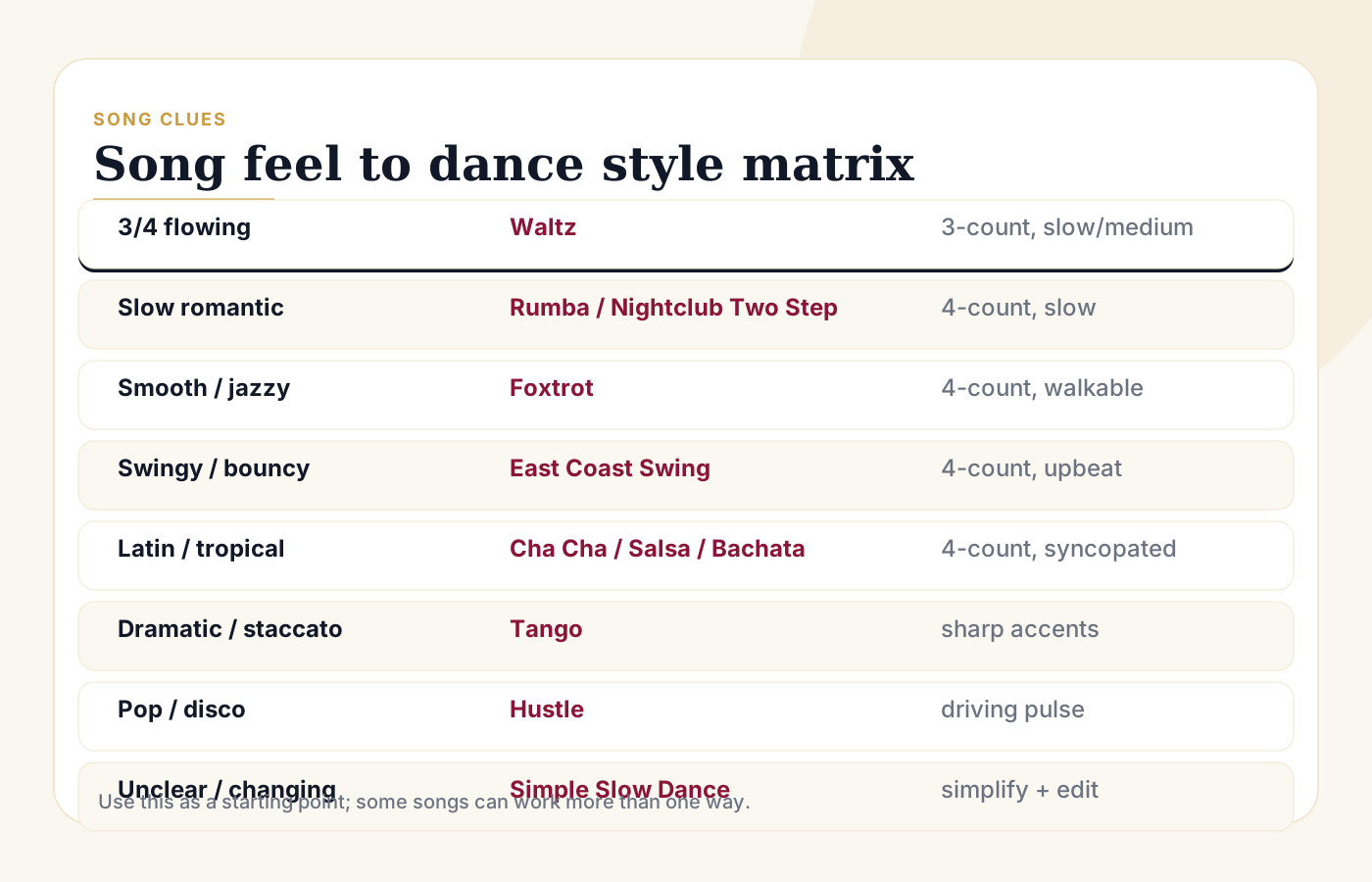
| Song clue | Possible dance | Meter/tempo feel | Beginner difficulty | Wedding fit | Social fit | Best next step |
|---|---|---|---|---|---|---|
| Smooth 1-2-3 feeling | Waltz | 3/4, slow to medium | Easy to medium | High | Medium | Try Waltz playlist and learn Waltz basics |
| Fast 1-2-3 feeling | Viennese Waltz | 3/4, very fast | Harder | Medium with adaptation | Low to medium | Ask a teacher or simplify |
| Slow romantic 4-count | Rumba | 4/4, slow | Beginner-friendly | High | Medium | Try Rumba playlist |
| Very slow romantic ballad | Nightclub Two Step or simple slow dance | 4/4, very slow to slow | Beginner-friendly | High | Medium | Use worksheet and count-along guide |
| Smooth/jazzy walking feel | Foxtrot | 4/4, medium | Beginner-friendly | High | Medium | Try Foxtrot playlist |
| Bouncy or swingy | East Coast Swing | 4/4, upbeat | Easy to medium | Medium | High | Try Swing playlist |
| Latin syncopated | Cha Cha | 4/4, medium/upbeat | Medium | Medium | High | Try Cha Cha playlist |
| Tropical/social Latin | Salsa | 4/4, upbeat | Medium | Medium | High | Compare Salsa and Bachata |
| Romantic Latin side-to-side | Bachata | 4/4, slow/medium | Easy to medium | High | High | Compare Bachata and Rumba |
| Disco/pop/club pulse | Hustle | 4/4, medium/upbeat | Medium | Medium | High | Keep patterns simple |
| Sharp and dramatic | Tango | 2/4 or 4/4 feel, dramatic | Medium to harder | Medium | Medium | Confirm with teacher |
| Unclear or changing | Simple slow dance | Flexible | Easiest | High | Low to medium | Edit song and use worksheet |
Test the feel
Before you commit to a dance style, listen to examples of that style. Play a few songs from the Ballroom Pages playlists, count along, and notice how your body wants to move. Use playlists to hear timing, not just to find songs—you can hear the difference between a floating Waltz, a romantic Rumba, a smooth Foxtrot, a bouncy Swing, and a syncopated Cha Cha.
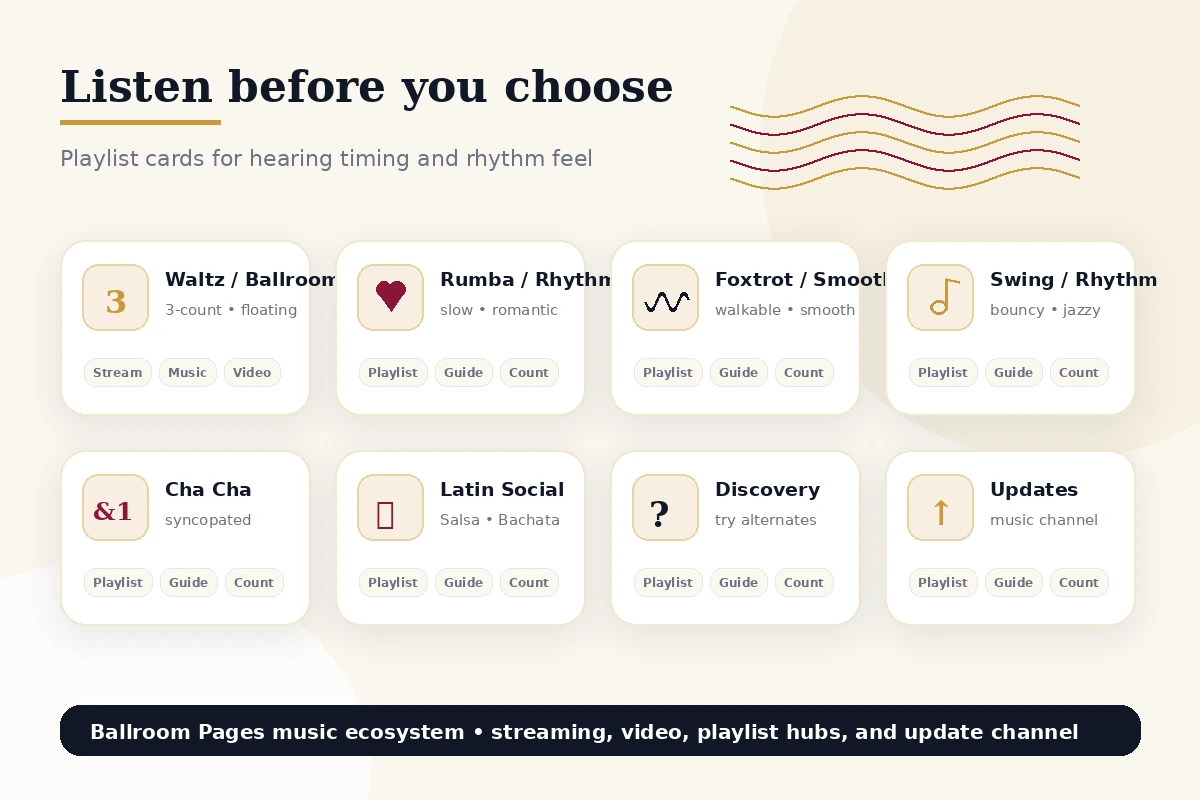
Floating 3/4. Hear the 1-2-3.
Fast, rotational 3/4.
Smooth walking feel.
Sharp, dramatic character.
Slow, romantic 4/4.
Crisp, syncopated pulse.
Bouncy, upbeat energy.
Slow, expressive rhythm dance.
Fast, driving Latin.
Slow romantic ballads.
Playlist URL neededBrowse playlists
Tropical, social pulse.
Playlist URL neededBrowse playlists
Romantic side-to-side Latin.
Playlist URL neededBrowse playlists
Pop / disco / club drive.
Playlist URL neededBrowse playlists
Soft first-dance songs.
Playlist URL neededWedding song guide
Spotify, Apple, YouTube, and the Telegram channel.
It’s okay
Many songs can work with more than one dance. That does not mean you are doing something wrong.
A song may have a long intro before the beat becomes clear, a tempo change, a chorus that feels different from the verse, a rhythm that suggests one dance but a mood that suggests another, or a BPM that works only when counted half-time or double-time.
For wedding songs, the most practical answer may be a simplified structure: entrance, basic pattern, turn, travel, final pose, and exit. A teacher can adapt ballroom ideas to a song that is meaningful but not a perfect dance-style match.
First dance
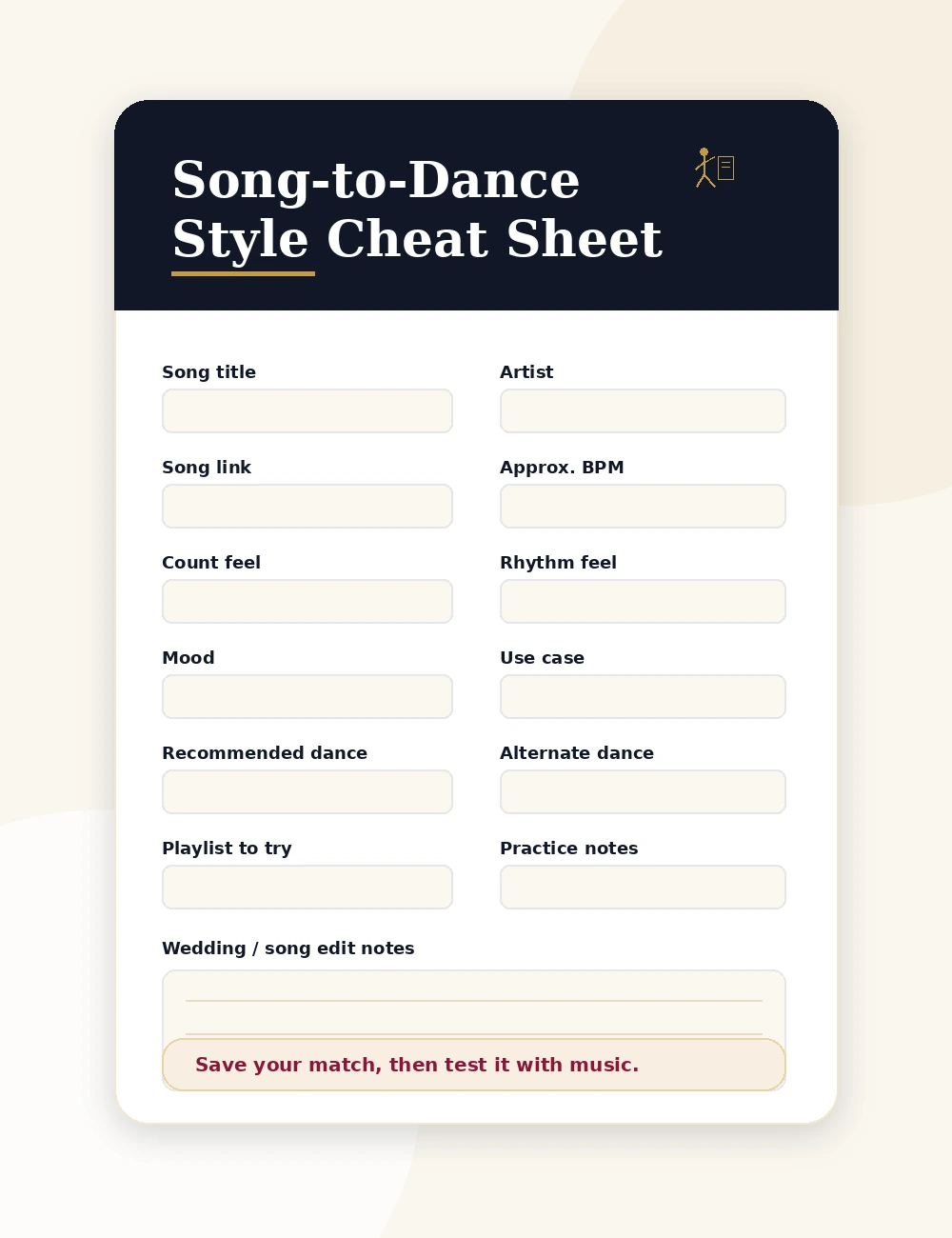
This matcher is a first step, not the whole first-dance plan. After you find a likely dance style, build a simple practice plan around your timeline, outfit, floor surface, comfort level, and song edit. Good wedding next steps:
Learn dips, lifts, and dramatic endings with a qualified instructor—don’t attempt them from a video alone.
Match your first dance song, then build your practice plan with the Wedding Dance Guide, What Dance Fits Your Wedding Song?, First Dance Songs by Dance Style, the First Dance Practice Plan, and Wedding Dance Shoes.
FAQ
Start by listening for the count feel, tempo, and rhythm. A 3-count flowing song often points toward Waltz. A slow romantic 4-count song may fit Rumba, Nightclub Two Step, or a simple slow dance. A swingy song may fit East Coast Swing, while Latin or club-like songs may point toward Cha Cha, Salsa, Bachata, Mambo, or Hustle.
Listen for meter, tempo, rhythm feel, and mood. Then consider your goal. A wedding couple may choose the simplest beautiful option, while a social dancer may choose the style that fits the rhythm most closely.
Yes. Some songs can be adapted to more than one dance, especially wedding songs and pop songs. The best answer may depend on your skill level, the part of the song you use, and whether you count it at regular time, half-time, or double-time.
No. BPM is useful, but it is not enough by itself. Time signature, rhythm pattern, accents, and musical feel matter too.
Use the “I’m not sure” option in the matcher. For a wedding first dance, start with a simple slow dance structure or a beginner-friendly option such as Rumba, Foxtrot, or Nightclub Two Step, then verify with a teacher or the worksheet.
Many slow wedding songs fit Rumba, Nightclub Two Step, Foxtrot-inspired slow dance, or a simple slow dance structure. If the song feels like a clear 1-2-3, Waltz may also be possible.
A 3/4 song usually points toward Waltz or Viennese Waltz. Slow or medium 3/4 songs are usually easier for beginners than very fast 3/4 songs.
Use the most important section of the song, usually the part you plan to dance to. For weddings, consider editing the song shorter and removing long intros, tempo changes, or sections that feel confusing.
Editorial note
This matcher offers practical, beginner-friendly recommendations to help you start—not an official dance classification. It does not analyze audio or detect BPM automatically. For dips, lifts, dramatic endings, or songs that feel unclear, confirm with a qualified instructor. Ballroom Pages follows an editorial policy of education-first guidance. Questions? Contact us.
Updated May 22, 2026.