
Glossary / Latin Figure
New Yorker
A New Yorker is a ballroom/Latin dance figure where partners usually turn or open to a side position, step or check through, replace weight, and continue back toward each other or into the next figure.
You may also hear teachers call it New York. That name is common in syllabus-style references, while “New Yorker” and “New Yorkers” are common in social and beginner teaching language.

Quick facts about the New Yorker
New Yorker
- Term
- New Yorker
- Also called
- New York, New Yorks, New Yorkers
- Plain-English definition
- A Latin/Rhythm figure in which partners open or turn to a side position, step or check through, replace weight, and return or continue into the next figure.
- Commonly used in
- Cha Cha and Rumba; sometimes adapted in broader Latin/social teaching contexts.
- Beginner takeaway
- The New Yorker is not just an arm shape. It is a controlled timing, weight-transfer, and connection pattern.
- Common mistake
- Throwing the free arm open while twisting the body off balance.
- Related terms
- Open position, side position, check, weight transfer, connection, hand-to-hand, spot turn, Cuban motion, timing.
Why it matters: the New Yorker teaches several beginner skills at once—timing, weight transfer, controlled turning, partner connection, and the difference between styling your arm and actually moving your body with balance.
Key takeaways
- New Yorker and New York usually refer to the same family of Latin ballroom figure, but syllabus-style references often use “New York.”
- Beginners most often meet the New Yorker in Cha Cha and Rumba.
- The movement is built around opening or turning, stepping/checking through, replacing weight, and staying connected enough to continue.
- It is not a lunge, dip, forced twist, or complete dance style.
- Good New Yorkers feel controlled, rhythmic, balanced, and connected—not rushed or thrown away.
What a New Yorker means in ballroom dance
A New Yorker is a figure, not a dance style.
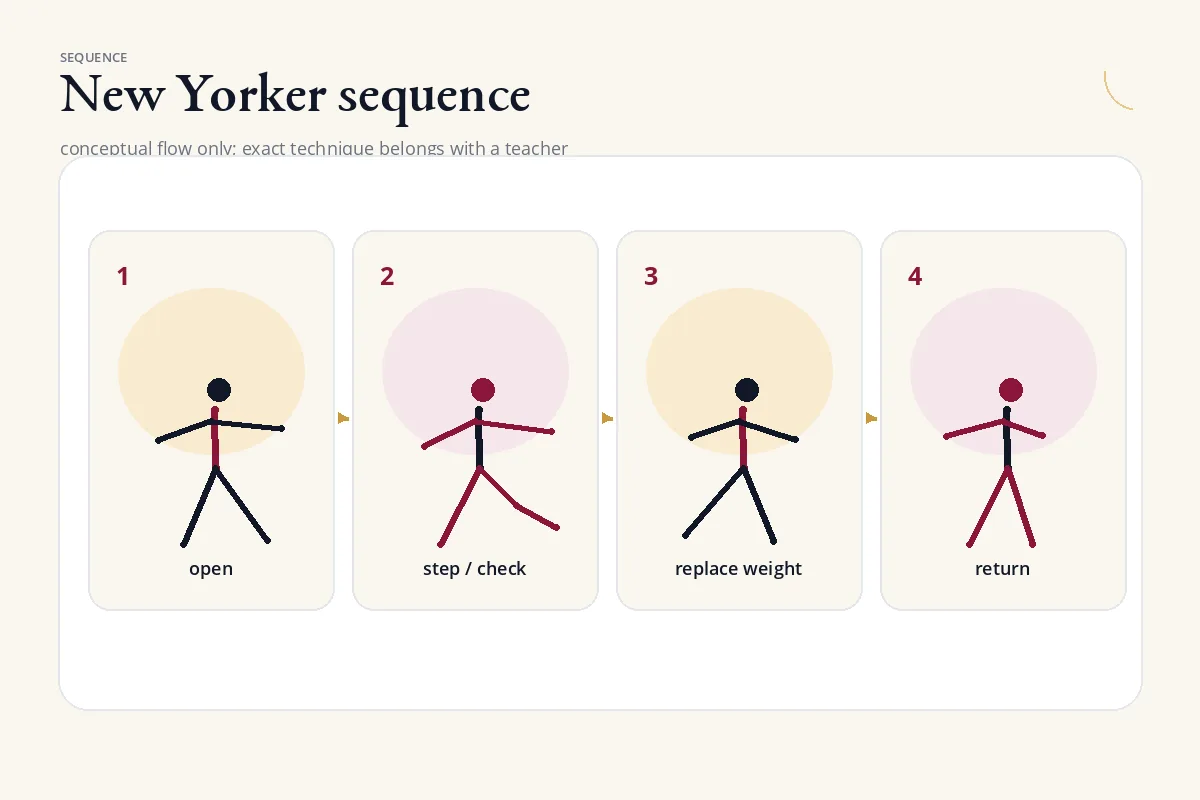
In beginner terms, it is a pattern where both partners usually open from facing each other into a side-position feeling, step or check forward/through, replace weight, and then return toward each other or continue into another figure.
The exact details depend on the dance, syllabus, teacher, and level. In Cha Cha, the New Yorker often feels crisp and rhythmical because of the chassé action. In Rumba, the same idea usually feels slower and more controlled because the music gives dancers more time to settle weight and show body action.
The free arm may style outward, but the arm is not the figure. The figure comes from timing, body direction, foot placement, weight transfer, and partner awareness.
New Yorker vs New York: which name is correct?
Both names are used, but they are not used equally in every context.
Many syllabus-style references list the figure as New York, especially in Cha Cha and Rumba. Teachers, social dancers, and studios often say New Yorker or New Yorkers, especially when they are describing repeated actions from side to side.
On Ballroom Pages, this page uses New Yorker because that is the glossary title and a common search phrase. The page also uses New York naturally so dancers can recognize the term when it appears in syllabi, class notes, videos, or competition references.
How the New Yorker works
The New Yorker is easier to understand when you separate it into ideas instead of trying to memorize every technical detail at once.
Starting relationship
Beginners often start from a facing relationship, such as an open or connected position. Depending on the dance and version, partners may have one-hand or two-hand connection before turning or opening. The important beginner idea is that the partnership still exists even when the bodies turn away from facing each other.
Opening or turning action
Both partners usually turn or open toward a side-position feeling. The bodies do not need to whip around. The turn should feel measured and organized. Think: “arrive with balance,” not “twist as far as possible.”
Step or check action
The figure commonly includes a forward or across-the-body feeling that creates a checked action. A check is not a collapse and not a lunge. It is a controlled step where the dancer manages weight, body tone, and direction so the movement can change or return.
Weight replacement
After the check, the dancer replaces weight. This is where many beginners rush. If the replace action is skipped or unclear, the next step becomes late, heavy, or disconnected.
Return or continuation
From there, the figure may return toward the partner, continue to the other side, or flow into a related figure such as a spot turn, hand-to-hand, or another Cha Cha/Rumba pattern.
Hand and arm connection
The hand connection should help partners know where they are in space. It should not drag, pull, or force the turn. The free arm can style outward, but styling should never replace balance or timing.
Posture, balance, and body tone
Keep your spine lifted, your standing leg active, and your movement compact enough to control. A smaller, cleaner New Yorker is better than a dramatic one that pulls you off your feet. See frame and posture.
Timing and musicality
The New Yorker must land inside the rhythm of the dance. In Cha Cha, listen for the sharpness of the count and the chassé. In Rumba, listen for slower weight transfer and control.
Leader and follower participation
The leader usually helps initiate direction, timing, and the next figure. The follower responds with their own balance, timing, and body action—not by being pulled through the shape. Both partners are responsible for staying on time, keeping their own balance, and maintaining a comfortable connection. Learn more in lead and follow.
New Yorker in Cha Cha and Rumba
The same figure feels different depending on the dance and the music. Here is where beginners usually meet it, and what to listen for.
| Dance | Where beginners may meet it | Count / timing note | What to listen for | Related page |
|---|---|---|---|---|
| Cha Cha | Often taught early as a New York / New Yorker action to left or right side position. | Commonly taught around 2, 3, 4&1, though teachers may count entry and exit differently. | Crisp weight changes, clear “cha-cha-cha” rhythm, and a controlled return. | Cha Cha |
| Rumba | Often taught as a beginner/newcomer figure with a slower, more controlled feeling. | International-style teaching often uses 2, 3, 4, (1); American Rhythm Rumba may use SQQ or QQS depending on method. | Slow control, clear replacement of weight, and no rushed arm throw. | Rumba |
| Related / adapted Latin contexts | Some teachers use New Yorker-like actions in broader Latin/social practice. | Counts vary by dance and teacher. | Keep the idea: open, check, replace, reconnect. Do not assume the Cha Cha version transfers exactly. | Dance styles |
Counts in plain text: Cha Cha New Yorker — commonly 2, 3, 4&1. Rumba New Yorker — International style often 2, 3, 4, (1); American Rhythm often SQQ or QQS.

Beginner note: If your class count differs from this page, follow your teacher. Counts can be taught differently depending on dance style, syllabus, entry, and whether the teacher starts counting before the figure begins.
What the New Yorker is NOT
A New Yorker is not a complete dance style. You do not “dance the New Yorker” the way you dance Cha Cha, Rumba, or Salsa. It is a figure inside a dance.
- It is not The New Yorker magazine, and it is not a person from New York.
- It is not just opening your arms. Arm styling can make the figure look expressive, but the movement is built from timing, direction, weight transfer, and connection.
- It is not a lunge or dip. A beginner New Yorker should stay balanced and controlled.
- It is not a forced twist. Turn through the whole body with control, and ask a qualified teacher to review your mechanics.
- It is not a move where one partner drags the other. The connection should guide and communicate, not pull.
- It is not something to perform without timing. If the count disappears, the figure becomes a shape instead of a dance action.
It is closely related to—but distinct from—the open position, hand-to-hand, and spot turn. Those are separate ideas that often appear near the New Yorker; see related terms below.

Beginner practice notes
Use these drills to understand the idea before trying to make the figure big or dramatic.
Solo weight-transfer drill
Stand tall and practice stepping forward with control, then replacing weight back underneath you. Keep the step small. Notice whether you can change direction without falling into the step.
Goal: feel the check and replacement without relying on a partner.
Turn-and-check awareness drill
Turn or open slightly to one side, step with control, then replace weight. Keep your shoulders and hips organized rather than twisting one part of the body sharply away from the other.
Goal: open without forcing the turn.
Slow count drill
Count slowly out loud. For Cha Cha, try “2, 3, 4&1” at a comfortable practice tempo. For Rumba, try “2, 3, 4, hold” or your teacher’s preferred count.
Goal: make the movement fit the music instead of rushing the check.
Hand connection awareness drill
With a partner, use a light one-hand connection. Practice opening and returning without pulling. Each partner should keep their own balance.
Goal: communicate timing and direction without dragging.
Cha Cha rhythm practice
Practice the New Yorker idea with a compact step and a clear chassé rhythm. Keep the “cha-cha-cha” part tidy and underneath your body.
Goal: avoid making the step too large to recover on time.
Rumba control practice
Practice the same opening/checking idea more slowly. Focus on replacing weight clearly and keeping the movement calm.
Goal: avoid rushing through the shape before the weight has settled.
Teacher-review note: New Yorkers involve turning, checking action, and partner connection. A qualified teacher should review your mechanics, especially if you feel pressure in the knees, hips, lower back, shoulders, or wrists.

Practice with music
Practice the New Yorker with music
The New Yorker becomes easier when you hear the rhythm clearly. Start with slower or moderate practice tracks, keep the movement compact, and focus on arriving on time. Verified Spotify links open in your music app; cards marked “verify before publishing” are awaiting a confirmed first-party URL.

-
Cha Cha practice
Use Cha Cha tracks when you want to feel the sharper rhythmic side of the figure.
Cha Cha on Spotify YouTube URL to verify Apple Music URL to verify
-
Rumba practice
Use Rumba tracks when you want to slow the figure down and practice control, weight replacement, and balance.
Rumba on Spotify YouTube URL to verify Apple Music URL to verify
-
American Rhythm practice
Use American Rhythm playlists when practicing New Yorker-like actions in a studio or social lesson context. (Legacy “Balero” is corrected to Bolero.)
Rhythm playlist URL to verify Mambo URL to verify Bolero URL to verify
-
Latin practice
Related rhythm listening: Cha Cha, Rumba, Samba, Jive, and broader Latin timing awareness.
Jive on Spotify Samba URL to verify
-
Full Ballroom Pages music library
Explore the full playlist library for Cha Cha, Rumba, Mambo, Salsa, Samba, Jive, and more.
-
Ballroom Pages Music on Telegram
Get playlist updates from BallroomPages Music.
More in Music & Timing, including the tempo chart and how to count ballroom dance music.
Fix it
Common mistakes and fixes
| Mistake | What it looks or feels like | Fix |
|---|---|---|
| Over-rotating the upper body | The shoulders twist farther than the feet and hips can support. | Make the turn smaller. Arrive balanced before styling the arm. |
| Forcing the knee or hip | The dancer twists into the standing leg or jams the hip to create drama. | Keep the step compact and let the body turn as a coordinated unit. Ask a teacher to review mechanics. |
| Throwing the arm open | The arm flies out while the body loses balance or timing. | Move the body first. Let the arm finish the line, not create the movement. |
| Losing hand connection | Partners disconnect, pull, or collapse the arm. | Keep a light, toned connection. Avoid gripping or dragging. |
| Stepping too far across | The step becomes too big to replace weight cleanly. | Shorten the step so you can recover on time. |
| Missing the replace action | The dancer steps through but never clearly changes weight back. | Practice step-check-replace slowly before adding styling. |
| Rushing the count | The figure arrives early and the next step feels late. | Count out loud and practice with slower music. |
| Collapsing posture | The chest drops, shoulders round, or the head falls forward. | Keep the spine lifted and the frame organized. |

FAQ
New Yorker FAQ
What is a New Yorker in ballroom dance?
A New Yorker is a Latin/Rhythm dance figure where partners usually open or turn to a side-position feeling, step or check through, replace weight, and continue into the next action. Beginners most often meet it in Cha Cha and Rumba.
Is it called New Yorker or New York?
Both names are used. Many syllabus-style references use New York, while many teachers and social dancers say New Yorker or New Yorkers. This page uses New Yorker as the title and includes New York as the alternate name.
Which dances use the New Yorker?
The strongest beginner and syllabus-style references are Cha Cha and Rumba. Some teachers also use New Yorker-like actions or terminology in broader Latin/social contexts, but the exact version and count depend on the dance and teacher.
Is the New Yorker a Cha Cha step?
It is often taught in Cha Cha, but it is not only a Cha Cha idea. It also appears in Rumba references and may be adapted in related Latin/Rhythm teaching contexts.
Is the New Yorker used in Rumba?
Yes. Rumba references often list New York to left or right side position. In Rumba, beginners should focus on slower control, clear weight replacement, and balance rather than sharp arm styling.
How do you count a New Yorker?
In Cha Cha, many teachers use a 2, 3, 4&1 rhythm. In Rumba, many International-style classes use 2, 3, 4, (1), while American Rhythm Rumba may be taught with SQQ or QQS timing. Follow your teacher’s count for the version you are learning.
Is the New Yorker hard for beginners?
The basic idea is beginner-friendly, but it can become messy if dancers over-rotate, step too far, throw the arm, or lose timing. Start small and controlled.
What is the most common mistake in a New Yorker?
The most common mistake is treating it like a dramatic arm shape instead of a controlled movement. The fix is to keep the step small, replace weight clearly, stay on count, and let the free arm style after the body is balanced.
Editorial
Source and editorial note
This glossary entry is designed as a beginner-friendly definition and practice guide, not a replacement for in-person instruction. The terminology and syllabus context should be reviewed against current ISTD, USA Dance, NDCA, and teacher guidance before final publication. Technique, turning mechanics, checked actions, and partner connection should be reviewed by qualified instructors.
Suggested references
- ISTD — Latin American syllabus outline.
- Dance Central — Cha Cha and Rumba references.
- USA Dance — Appendix B Syllabus Guidebook.
- NDCA — Approved Figures.
- BallroomDancers.com — Cha Cha New York.
- Delta Dance — beginner Cha Cha resource.
- Dance Insanity — New Yorker tutorial (teaching-language note only).
This is dance terminology, not medical advice. Ballroom Pages follows an editorial policy of education-first guidance. Questions? Contact us. Updated May 21, 2026.