
Ballroom Glossary

What Is a Chassé in Dance?

A chassé is a light step-close-step action where one foot appears to chase the other. In ballroom and social dance, you may hear the term in Cha Cha, Quickstep, Jive, Swing, Waltz, and other step names—but the exact timing depends on the dance.

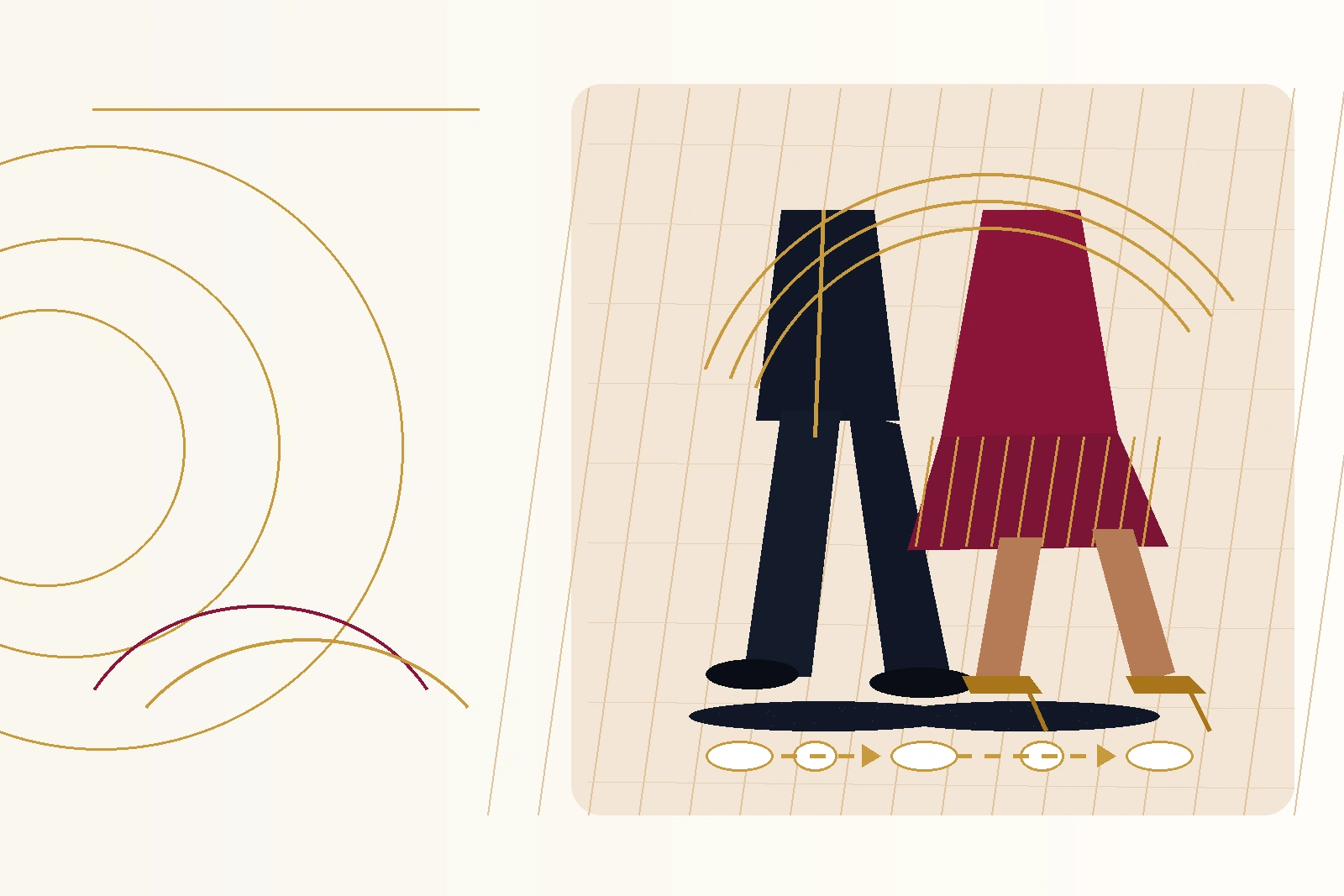
Elegant ballroom dancers illustrating a light chassé step-close-step movement.

Quick definition of chassé

Chassé

Pronunciation
shah-SAY
Also written as
chasse, chasse step
Plain-English meaning
A step-close-step action where one foot moves, the other closes toward it, and then the first foot moves again.
Literal meaning
From French, connected to “to chase.”
Movement idea
One foot “chases” the other, usually creating a small traveling or side action.
Commonly seen in
Cha Cha, Quickstep, Jive/Swing, Waltz figures, and other ballroom/social dance contexts.
Skill level
Beginner to intermediate, depending on the dance and figure.
Related terms
triple step, side step, lock step, chassé turn, closed position, frame, lead and follow.

What is a chassé?

A chassé is a dance action built around the idea of step, close, step. One foot moves, the other foot closes toward it, and then the first foot moves again.

In class, you may hear a teacher say “chassé,” “side chassé,” “progressive chassé,” or “chassé from promenade.” Those names do not all mean exactly the same thing. They share a chasing or closing action, but the count, direction, body position, and style change from dance to dance.

A chassé is a step-close-step dance action where one foot appears to chase the other. In ballroom, it appears in dances such as Cha Cha, Quickstep, Jive, Swing, and Waltz figures. The basic idea is simple, but the timing and technique vary by dance style.

Why chassé matters in ballroom dance

Chassé is useful because it shows up in many beginner and intermediate dance conversations. You may see it in step names, syllabus figures, choreography notes, timing patterns, traveling actions, technique corrections, and music-counting explanations.

Learning the word helps you understand what your teacher, partner, or video tutorial is asking for. It also helps you avoid treating every three-step rhythm as the same movement.

How a chassé works

At its simplest, a chassé feels like:

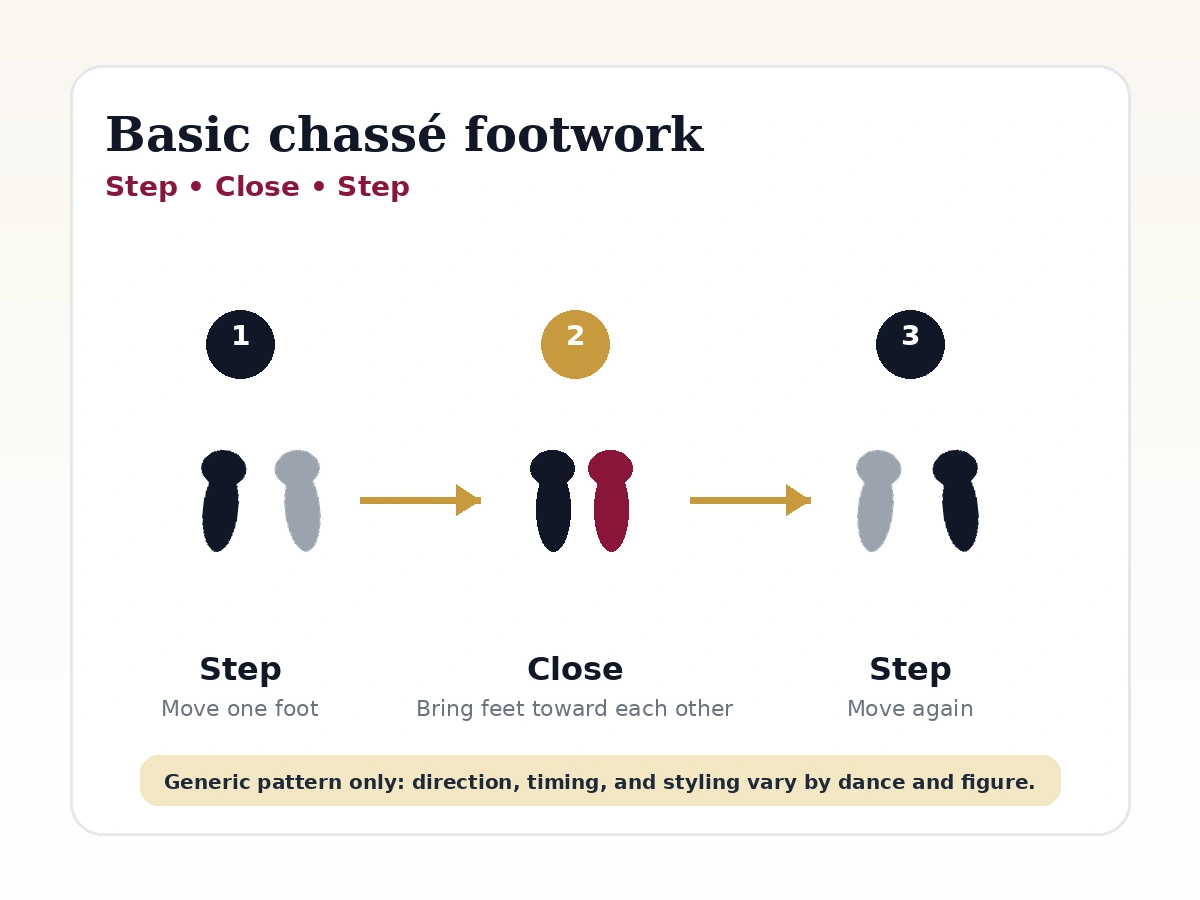
  1. Step

    Move one foot in the direction of travel.

  2. Close

    Bring the other foot toward the moving foot.

  3. Step

    Continue or complete the action with the first foot.

The action may travel sideways, forward, backward, diagonally, or turn, depending on the figure. Keep the steps small at first. A chassé is usually easier to control when the rhythm is clear and the body stays calm over the feet.

Beginner note: Do not force the close. Think of the second foot arriving neatly under you, not slamming into place.

Diagram showing a basic chassé step-close-step footwork pattern with arrows.
The step-close-step pattern at the heart of a chassé. Diagram review: pending qualified ballroom instructor review.

How to count a chassé

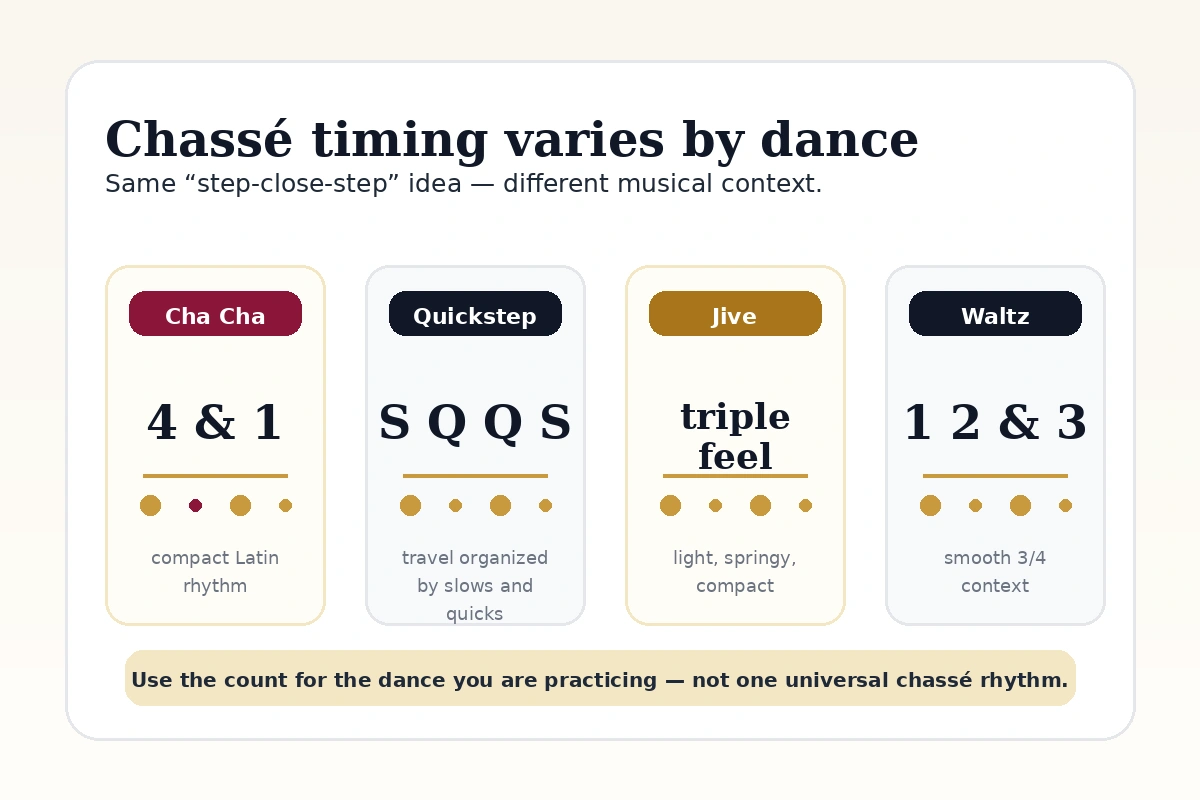
The count changes by dance. The word chassé describes a type of action, not one universal rhythm.

How a chassé is counted across different dances
Dance contextExample count languageBeginner note
Cha ChaOften taught with “4 & 1” or “cha-cha-cha” languageKeep it compact and rhythmic; avoid bouncing.
QuickstepA figure such as Progressive Chasse may use slow-quick-quick-slow timingLet the slows and quicks organize the travel.
JiveChassés often feel like compact triple actionsKeep the feet light and the steps small.
WaltzA Waltz chassé figure may use a split count such as 1, 2, &, 3Do not use Cha Cha timing in Waltz.

The safest rule: learn the chassé inside the dance you are practicing. A Cha Cha chassé, a Quickstep chassé, and a Waltz chassé are related ideas, but they do not feel identical.

Timing card showing that chassé counts vary in Cha Cha, Quickstep, Jive, and Waltz.

Dances where you may see a chassé

Cha Cha

In Cha Cha, chassé language often appears around the compact triple action that gives the dance its “cha-cha-cha” feeling. You may hear teachers talk about side chassés, forward or backward chassés, lock-style actions, or other variations.

Beginner tip: Keep the steps small enough that you can stay on time.
Quickstep

Quickstep includes named figures such as Progressive Chasse. In this context, the chassé travels and uses Quickstep timing rather than a Latin triple rhythm.

Beginner tip: Do not rush the quicks. Let the timing make the movement light.

Jive and Swing

In Jive and some Swing teaching contexts, dancers may hear chassé and triple-step language close together. The vocabulary can vary by teacher, dance style, and syllabus.

Beginner tip: Keep the action springy but controlled. Small, clear steps are better than large, messy ones.

Waltz

In Waltz, chassé appears in figures such as Chassé from Promenade Position. This feels very different from a Cha Cha chassé because the music, posture, frame, and timing are different.

Beginner tip: Keep your frame quiet and avoid turning the action into a Latin-style triple step.

Other dance contexts

The word chassé also appears outside ballroom, including ballet and other dance forms. Those meanings are related through the “chasing” idea, but the technique is not identical. On Ballroom Pages, use this page for the ballroom and social partner-dance meaning.

Practice chassé with music

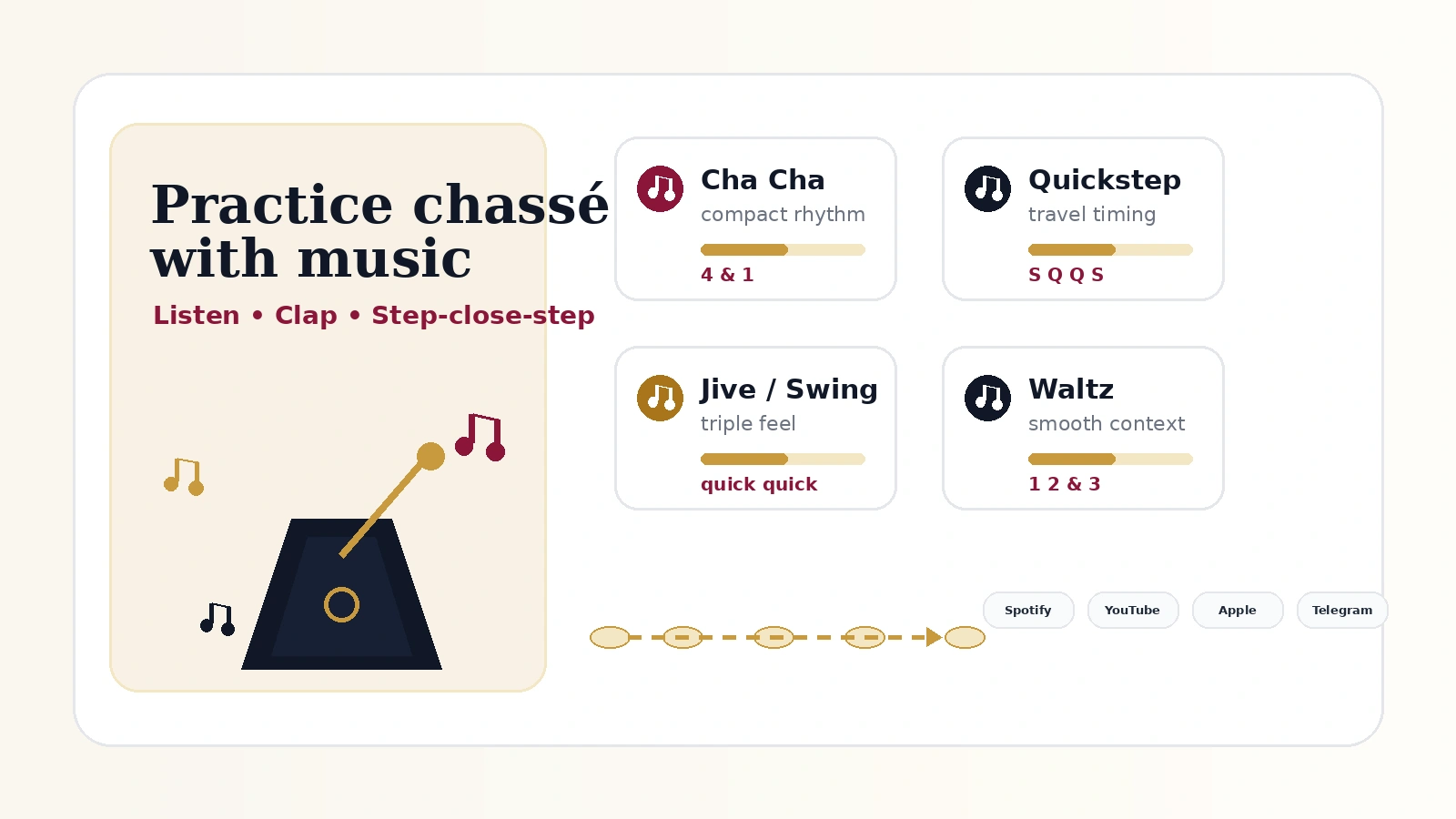
Ballroom Pages has a music playlist ecosystem for dancers. Use it to practice rhythm before you worry about traveling far.

Branded Ballroom Pages music playlist card for practicing chassé rhythm.

How to practice

  1. Start with a slower track.
  2. Listen for the repeating count before you move.
  3. Clap the rhythm first.
  4. Practice the step-close-step action without traveling too far.
  5. Add styling only after the timing feels steady.
  • Cha Cha Chassé Practice

    Practice the compact rhythm you may hear as “4 & 1” or “cha-cha-cha.” Start slowly, clap first, then keep the step-close-step action small.

  • Quickstep Chassé Practice

    Listen for how quicks and slows organize traveling movement. Keep your practice steps small before trying to travel across the floor.

  • Jive & Swing Triple Rhythm

    Use these playlists to hear a lighter triple rhythm. Focus on staying springy without making the steps too large.

  • Waltz Chassé Context

    Waltz uses a smoother 3/4 musical setting. Use this only for Waltz-context practice, not as a Cha Cha or Jive timing model.

  • BallroomPages Music

    Follow BallroomPages Music for playlist updates and dance-music ideas.

Learn the counts behind these rhythms in How to Count Ballroom Dance Music.

Common chassé mistakes

  • 1. Stepping too large

    Taking big steps makes the close rushed and unstable.

    Fix: Make the first step smaller so the closing foot can arrive on time.

  • 2. Closing the feet without keeping the rhythm

    The feet close, but the count disappears.

    Fix: Clap or say the count before dancing it.

  • 3. Losing posture or frame

    Looking down, collapsing the upper body, or pulling on a partner.

    Fix: Keep the head lifted, the ribs quiet, and the connection light.

  • 4. Forcing the movement

    Pushing the floor aggressively or making the action heavy.

    Fix: Think “neat and rhythmic” before “big and powerful.”

  • 5. Calling every triple step a chassé

    Treating all three-step rhythms as the same.

    Fix: Use the term your teacher or syllabus uses for that dance.

  • 6. Not matching the dance’s timing

    Using Cha Cha timing in Quickstep, Jive timing in Waltz, or another mismatched rhythm.

    Fix: Learn the count inside the specific dance.

  • 7. Looking down at your feet

    Checking each step visually makes the upper body tense.

    Fix: Practice slowly enough that you can feel the pattern without staring down.

Chassé vs similar dance terms

How a chassé relates to and differs from similar dance terms
TermHow it is similarHow it is different
ChasséOften a three-action step-close-step ideaUsually emphasizes one foot closing or “chasing” the other.
Triple stepAlso uses three weight changesA broader rhythm term; not every triple step is called a chassé in every dance.
Side stepMay begin a chasséA side step is one step; a chassé is usually a small sequence.
Lock stepCan also travel and use quick timingA lock step crosses or “locks” one foot behind or in front, instead of simply closing.
Chassé turnUses chassé action with rotationA turning variation; learn it after the basic action is comfortable.

Mini practice drill

Use this as a rhythm drill, not a replacement for instruction.

  1. Clap the rhythm

    Say the count out loud before moving.

  2. Step-close-step without music

    Keep the steps small and even.

  3. Add a slow track

    Practice the rhythm before traveling.

  4. Keep the upper body calm

    Let the feet move without collapsing your posture.

  5. Practice both directions if appropriate

    Some figures travel or turn, so ask your teacher which version fits your dance.

FAQ

Chassé FAQ

  • What does chassé mean in dance?

    Chassé means a step-close-step action where one foot appears to chase the other. In ballroom and social dance, it can appear in Cha Cha, Quickstep, Jive, Swing, Waltz figures, and other contexts.

  • How do you pronounce chassé?

    Chassé is pronounced shah-SAY. The accent is useful in display text, but the URL uses the non-accent spelling chasse for stability.

  • Is chassé a ballroom step?

    Yes, chassé is used in ballroom and partner-dance vocabulary, but it is also used in other dance forms. In ballroom, the timing and technique depend on the dance.

  • What dances use a chassé?

    You may see chassé actions or named chassé figures in Cha Cha, Quickstep, Jive, Swing, Waltz, and other ballroom or social dance contexts.

  • Is a chassé the same as a triple step?

    Not always. A chassé often has a three-action rhythm, so it can feel related to a triple step. But “triple step” is a broader term, and not every triple step is called a chassé in every dance.

  • How do you count a chassé?

    It depends on the dance. Cha Cha may use “4 & 1” or “cha-cha-cha” language, Quickstep may use slows and quicks, Jive may use compact triple timing, and Waltz figures may use a split count such as 1, 2, &, 3.

  • Can beginners learn a chassé?

    Yes. The basic idea is beginner-friendly, especially if you keep the steps small and practice the rhythm first. More advanced styling, rotation, and technique should be learned inside the specific dance.

  • Does the leader or follower do the chassé?

    Either role may do a chassé, depending on the figure. Ballroom Pages uses leader/follower language because the action is role-based, not gender-based.

Editorial

Sources and review notes

This page uses dictionary and dance-education references for spelling, pronunciation, etymology, and dance-specific examples. Technique details should be reviewed periodically by a qualified ballroom instructor because chassé timing and styling vary by dance, syllabus, and level.

Suggested source references

  • Merriam-Webster — spelling, pronunciation, and French origin.
  • DanceCentral — Waltz Chassé from Promenade Position, Quickstep Progressive Chasse, Jive technique, Cha Cha technique.
  • WikiDanceSport and Image Ballroom Dance — Cha Cha timing and chassé usage.
  • Ballroom instructor review — recommended for technique accuracy.

This is dance terminology, not medical advice. Ballroom Pages follows an editorial policy of education-first guidance. Questions? Contact us. Updated May 22, 2026.