Ballroom Glossary

What Is a Triple Step in Dance?

A Triple Step is a three-step rhythm or weight-change action used in many ballroom, swing, Latin, and social dances. It is often counted like 1-and-2, but the exact timing, direction, and styling depend on the dance.

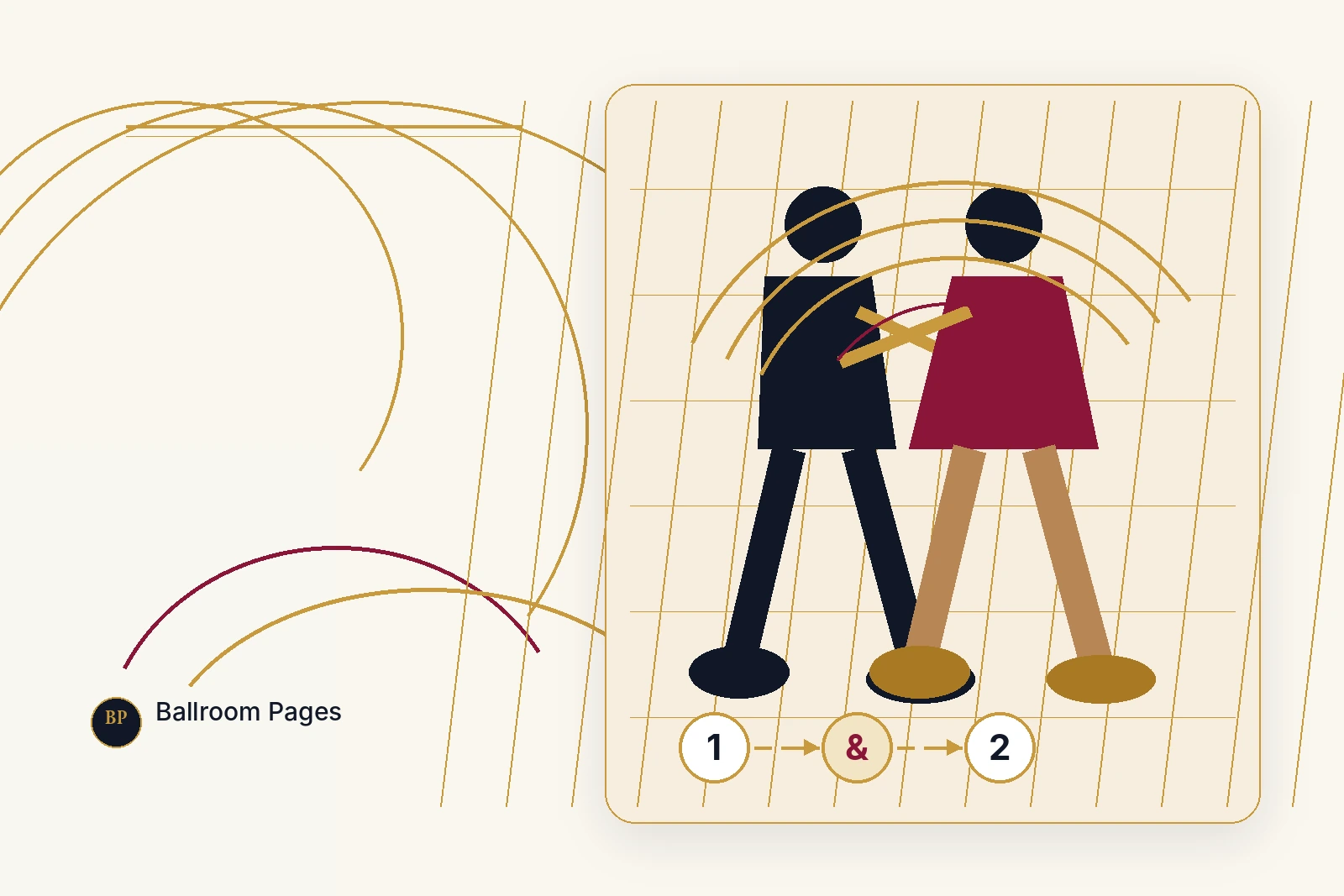
Elegant ballroom dancers illustrating a rhythmic Triple Step movement.

Quick definition of Triple Step

Triple Step

Pronunciation
TRIP-uhl step
Plain-English meaning
Three small steps or weight changes grouped into one rhythmic action.
Basic idea
A dancer changes weight three times, usually in a quick rhythm such as 1-and-2.
Common counts
1-and-2, 3-and-4, quick-a-quick, or “triple step,” depending on the dance and teacher.
Commonly seen in
East Coast Swing, Jive, West Coast Swing, Lindy Hop/social swing, Cha Cha/chassé contexts, and some country/social dance styles.
Skill level
Beginner concept; clean timing and dance-specific styling take practice.
Related terms
Chassé, Rock Step, Ball Change, Shuffle Step, Syncopation, Count, Beat, Rhythm, Lead and Follow, Frame.

A Triple Step is a dance action with three small steps or weight changes grouped into one rhythm, often counted 1-and-2. It appears in Swing, Jive, West Coast Swing, Cha Cha/chassé contexts, and other social dances, but the timing, direction, and styling vary by dance.

What is a Triple Step?

A Triple Step is a way of grouping three steps into a compact rhythm. Instead of taking one slow step or two even steps, you change weight three times in a quick pattern.

In class, you may hear a teacher say:

  • “Triple step, triple step, rock step.”
  • “Rock step, triple step, triple step.”
  • “Count it 1-and-2.”
  • “Make the triple smaller.”
  • “Don’t rush the and-count.”

Those phrases all point to the same broad idea: three clear weight changes in a rhythmic unit. The details depend on the dance.

Why the Triple Step matters

Triple Step matters because it shows up in many beginner dance patterns. It helps dancers connect footwork to rhythm, understand weight changes, and hear the difference between single steps, rock steps, chassés, and syncopated actions.

It also prevents a common beginner problem: taking three foot movements without actually changing weight clearly. A good triple step is not just “moving the feet.” It is three organized weight changes that match the music.

How a Triple Step works

At its simplest, a Triple Step feels like this:

  1. Step

    Change weight to one foot.

  2. And

    Change weight quickly to the other foot.

  3. Step

    Change weight again to the first foot.

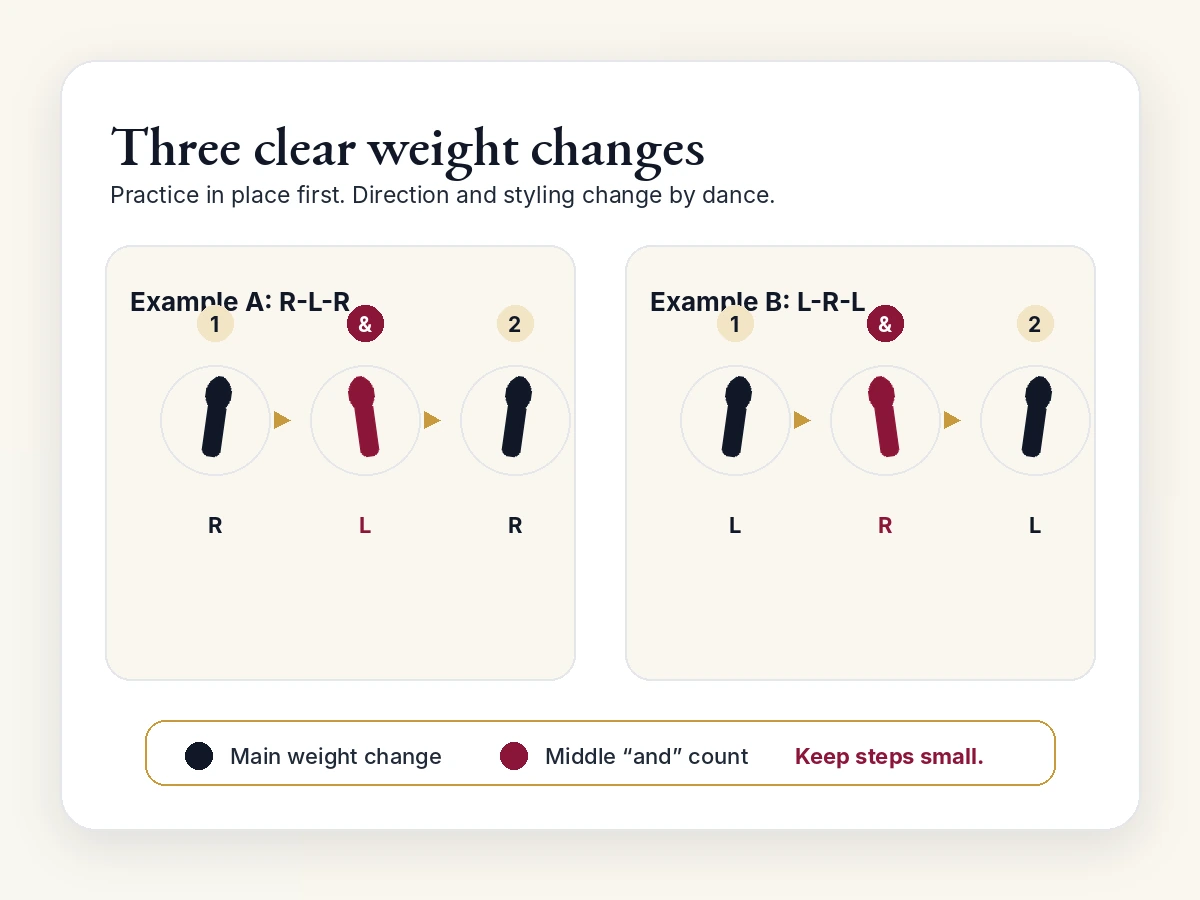
That might look like right-left-right or left-right-left. The direction can be sideways, forward, backward, nearly in place, or traveling, depending on the dance. Keep the steps small at first. A Triple Step becomes easier when the rhythm is clear, the knees stay soft, and the upper body stays calm.

Beginner note: A Triple Step is about weight changes, not just tapping the floor. If your weight does not move, it may be a tap or touch, not a true step.

Diagram showing three small weight changes used to practice a basic Triple Step.
Three clear weight changes — not just three foot taps. Diagram review: pending qualified ballroom instructor review.

How to count a Triple Step

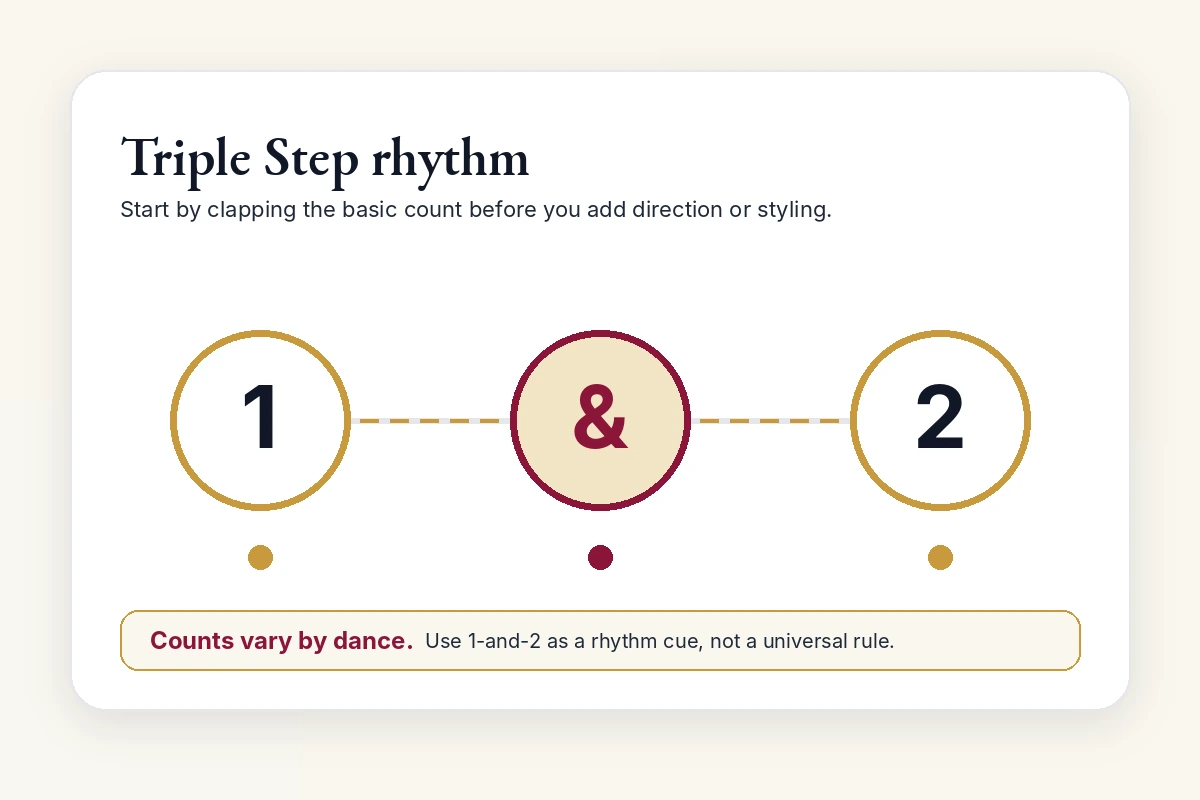
The most common beginner count is:

  • 1
  • &
  • 2

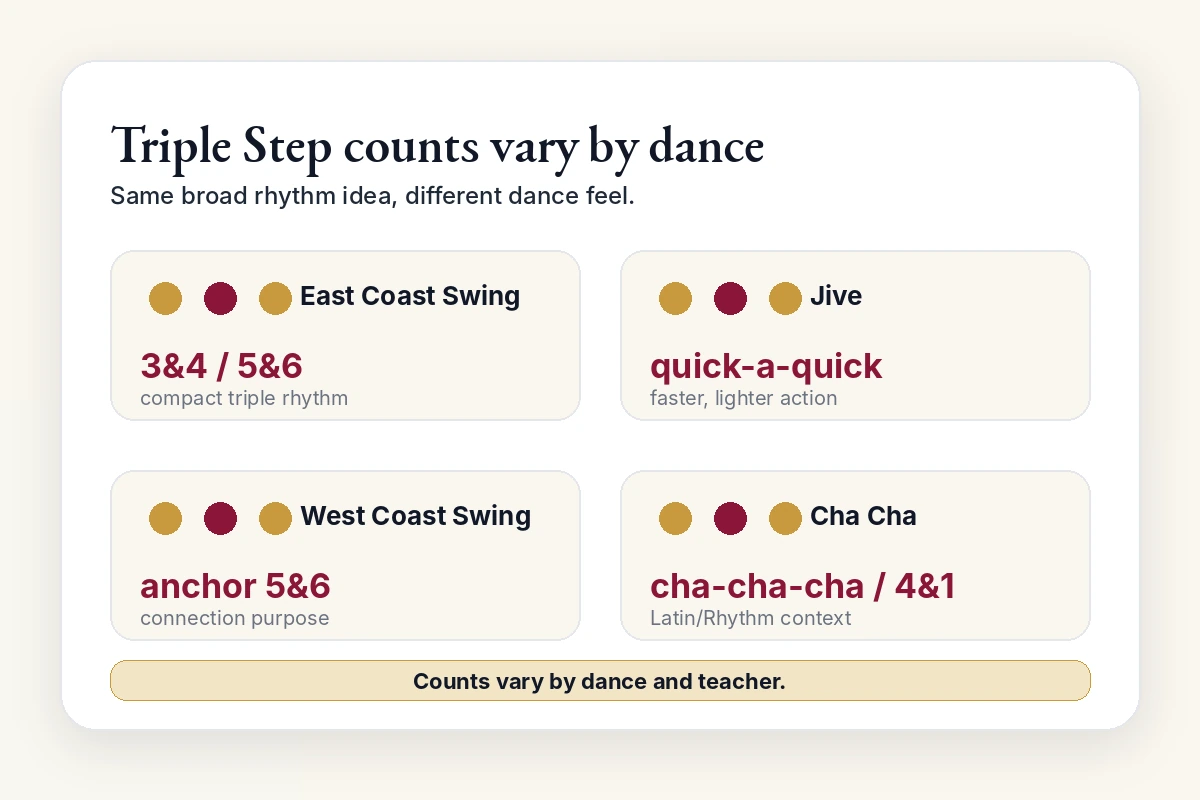
You may also hear: 3-and-4, 5-and-6, quick-a-quick, triple step, or cha-cha-cha in some Cha Cha teaching contexts.

The important rule is: do not force every dance into the same count. The Triple Step is a rhythm idea, but each dance has its own timing, body action, and musical feel.

How a Triple Step is counted across different dances
Dance contextCommon count languageBeginner note
East Coast Swing1, 2, 3-and-4, 5-and-6 — or rock step, triple step, triple stepKeep the triples compact and do not rush the “and.”
JiveOften quick-a-quick or triple-step languageJive is faster and more energetic; start slowly.
West Coast SwingTriple steps appear in anchors and other patterns, often 5-and-6 or 7-and-8The anchor has a connection purpose, not just footwork.
Cha Cha / chassé contextOften cha-cha-cha, 4-and-1, or 1-and-2 depending on teaching contextLearn the dance-specific count from your teacher.
Lindy Hop / social swingTriple steps may appear in six-count or eight-count patternsSocial dancers may mix timings depending on the song and style.
Diagram showing a basic Triple Step rhythm counted as 1-and-2.

Dances where you may hear “Triple Step”

East Coast Swing

In East Coast Swing, “triple step” is one of the first rhythm ideas many students learn. A common basic pattern uses a rock step and two triple steps.

Beginner tip: Say the rhythm before you dance it: “rock step, triple step, triple step.”
Jive

In Jive, triple-step or chassé language appears often, but the feeling is faster and sharper than many beginner swing examples.

Beginner tip: Learn the rhythm slowly before trying Jive-speed music.

West Coast Swing

In West Coast Swing, triple steps often appear in anchor steps and basic patterns. The anchor is not just “three steps”; it helps finish a pattern and prepare the next one.

Beginner tip: Keep the anchor small and connected. Do not turn it into a rushed shuffle.

Cha Cha

In Cha Cha, the term Triple Step may appear near chassé or “cha-cha-cha” explanations, but Cha Cha has its own Latin/Rhythm technique and timing.

Beginner tip: Do not treat every Cha Cha chassé exactly like Swing. The rhythm may feel related, but the dance technique differs.

Lindy Hop and social swing

Lindy Hop and social swing contexts often use triple steps, but social dancers may mix six-count and eight-count patterns depending on the song, style, class, and partner.

Beginner tip: Listen first, then step. Swing rhythm is easier when the body stays relaxed and the steps stay small.

Country and shuffle contexts

Some country/social dances use triple-step or shuffle language. For example, Triple Two Step may be taught as “triple step, triple step, walk, walk.” This is useful context, but this glossary page stays focused on ballroom, swing, and partner-dance usage.

Timing card explaining that Triple Step counts vary by dance style.

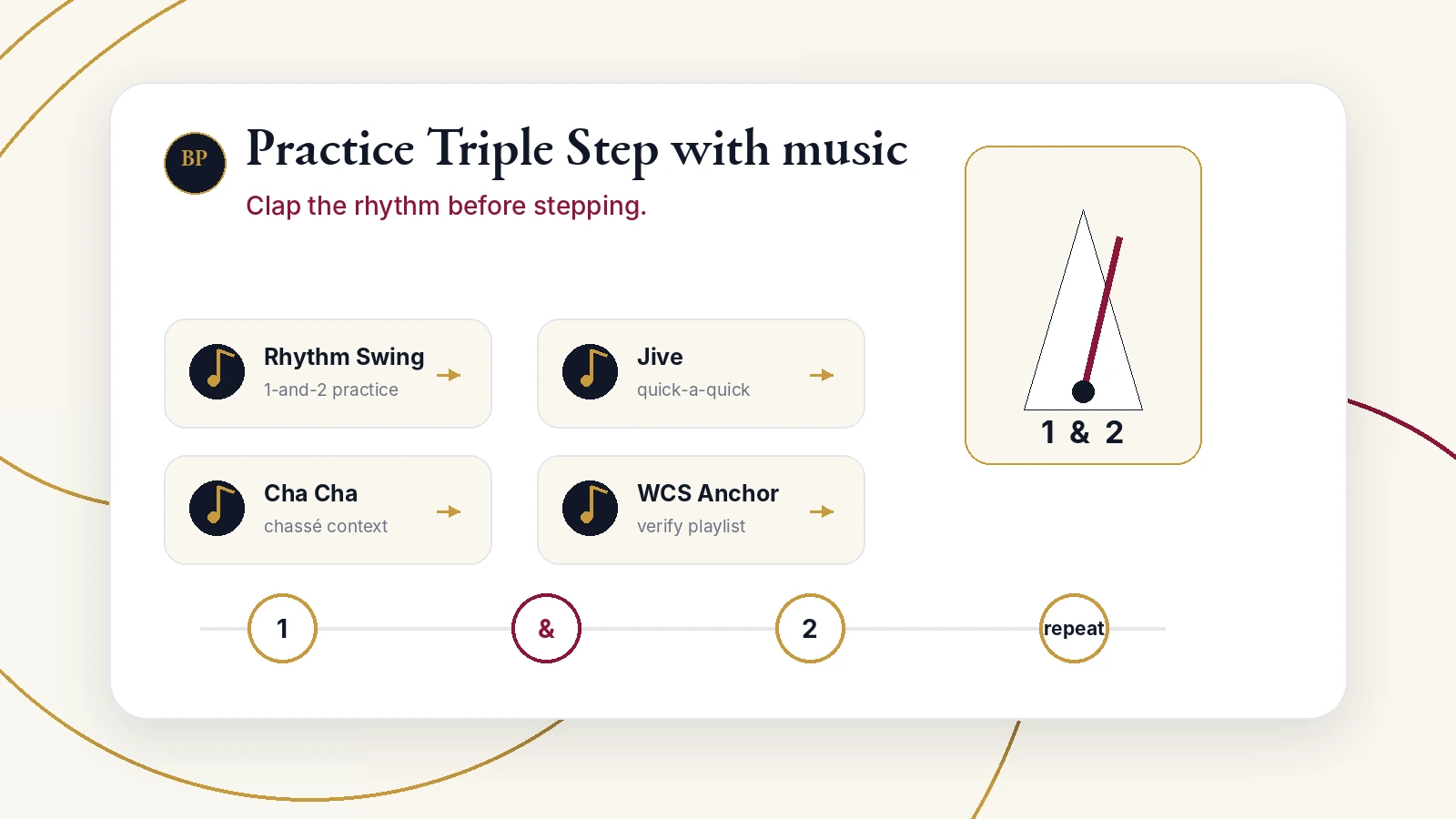
Practice Triple Step with music

Ballroom Pages has a music playlist ecosystem for dancers. Use it to practice rhythm before you worry about styling.

Ballroom Pages playlist card for practicing Triple Step timing with dance music.

How to practice

  1. Clap 1-and-2 before stepping.
  2. Say the count out loud.
  3. Keep all three weight changes small and clear.
  4. Try a slower Swing or Cha Cha track before faster Jive.
  5. Use dance-specific instruction for exact footwork and body action.
  • East Coast Swing / Rhythm Swing

    Start here for a friendly triple-step rhythm. Clap “1-and-2” first, then practice small weight changes.

  • Jive triple rhythm

    Use these after the rhythm feels comfortable. Jive is faster, so keep the steps tiny and controlled.

  • Cha Cha chassé / triple context

    Use these to hear how a triple-feeling rhythm appears in Cha Cha and chassé language. Do not copy Swing styling into Cha Cha.

  • West Coast Swing anchor practice

    The anchor is not just three steps; it helps finish the pattern and prepare the next one. A dedicated West Coast Swing playlist is on the way.

  • BallroomPages Music

    Follow BallroomPages Music for playlist updates and dance-music ideas.

Common beginner mistakes

  • 1. Making the steps too large

    The first step travels too far, so the “and” step becomes rushed.

    Fix: Keep the steps small enough that all three weight changes fit the count.

  • 2. Moving the feet without changing weight

    The foot touches the floor, but the body weight stays on the other foot.

    Fix: Practice slowly and say “weight, weight, weight.”

  • 3. Rushing the “and” count

    The middle step gets squeezed or skipped.

    Fix: Clap “1-and-2” first, then step it.

  • 4. Losing posture or frame

    The feet move, but the upper body collapses or pulls on the partner.

    Fix: Keep your head lifted, ribs quiet, and connection light.

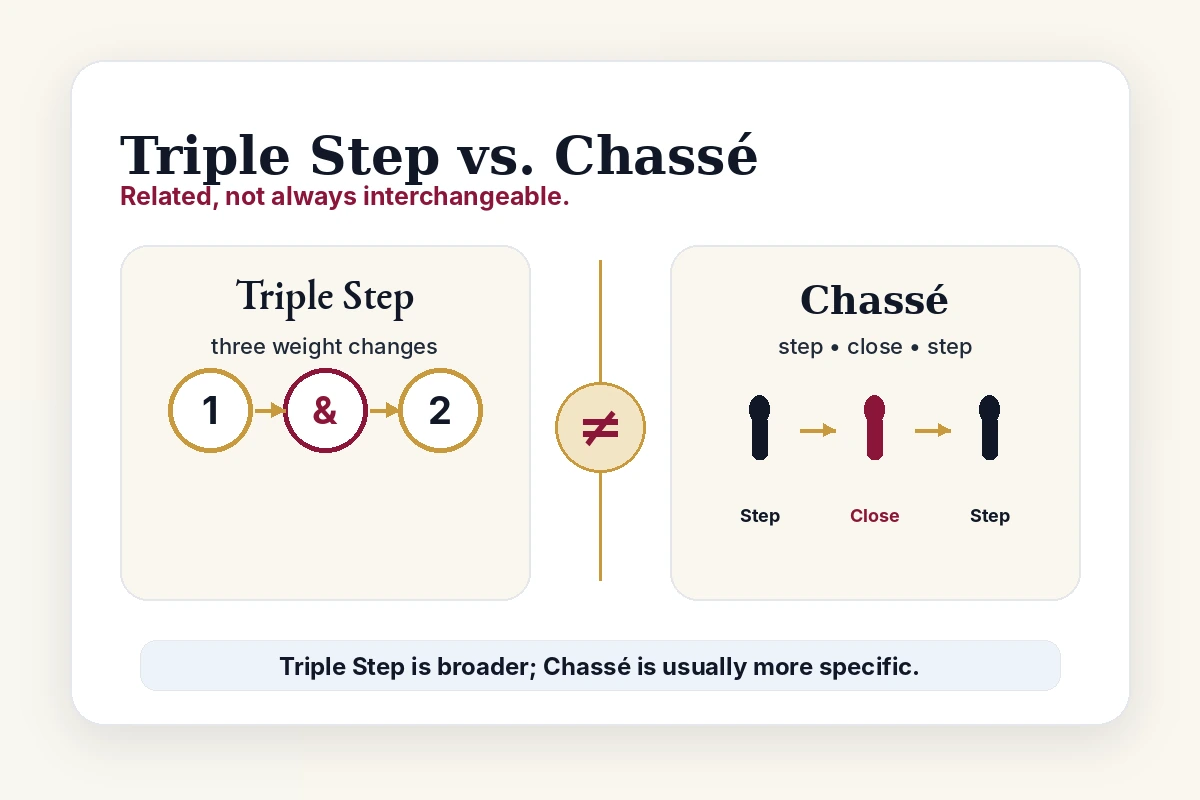
  • 5. Confusing every Triple Step with Chassé

    Assuming “Triple Step” and “Chassé” always mean the same thing.

    Fix: Treat Triple Step as the broader rhythm term; use Chassé when the step-close-step action or syllabus term applies.

  • 6. Forgetting the surrounding pattern

    Practicing triple steps without the rock step, anchor, or setup that belongs to the dance.

    Fix: Learn the Triple Step inside a real dance pattern.

  • 7. Looking down at your feet

    Watching every step makes the timing and posture worse.

    Fix: Slow down until you can feel the rhythm without staring down.

  • 8. Using the same styling in every dance

    Dancing Swing, Jive, West Coast Swing, and Cha Cha with the same body action.

    Fix: Learn the rhythm first, then add dance-specific technique.

Triple Step vs similar dance terms

Comparison diagram showing Triple Step and Chassé as related but not always identical dance terms.
How a Triple Step relates to and differs from similar dance terms
TermHow it is similarHow it is different
Triple StepThree steps or weight changes in a rhythmic unitBroad term; the direction and styling vary by dance.
ChasséCan also use a three-action rhythmUsually suggests a step-close-step or “chasing” action; not every triple step is called a chassé.
Rock StepInvolves weight transferUsually two steps: rock away and replace; not a three-step rhythm.
Ball ChangeAlso uses quick weight actionUsually a partial weight change on the ball of one foot followed by a change to the other foot.
Shuffle StepCan overlap with triple-step language in some social/country/line-dance settingsThe label varies by dance tradition; do not use it as a universal ballroom term.
SyncopationTriple steps often feel syncopatedSyncopation is a rhythm concept, not one specific foot pattern.
Lock StepCan use quick timing and travelA lock step crosses or “locks” one foot behind or in front, while a Triple Step may or may not lock.

Mini practice drill

Use this as a rhythm drill, not as a replacement for a dance lesson.

  1. Clap 1-and-2 four times.
  2. Step in place: right-left-right.
  3. Step in place: left-right-left.
  4. Keep the steps tiny and the weight changes clear.
  5. Add a slow Swing or Cha Cha track.
  6. Practice inside the dance you are learning: East Coast Swing, Jive, West Coast Swing, Cha Cha, or another style.
  7. Stop if the steps become rushed or heavy.

FAQ

Triple Step FAQ

  • What does Triple Step mean in dance?

    A Triple Step is a dance action with three small steps or weight changes grouped into one rhythm. It is often counted 1-and-2, but the exact timing and styling vary by dance.

  • How do you count a Triple Step?

    Many beginners count a Triple Step as 1-and-2. In some dances you may hear 3-and-4, 5-and-6, quick-a-quick, or “triple step.” Always match the count to the dance you are learning.

  • Is a Triple Step the same as a Chassé?

    Not always. A Chassé can be a type of triple-step action, especially when it uses a step-close-step feeling. But Triple Step is the broader rhythm term, and not every triple step is called a chassé.

  • What dances use Triple Steps?

    Triple steps appear in East Coast Swing, Jive, West Coast Swing, Lindy Hop/social swing, Cha Cha/chassé contexts, and some country or social dance styles.

  • Is Triple Step used in Swing?

    Yes. East Coast Swing and Lindy Hop/social swing often use triple-step rhythm. Some social Swing may also use single-step or other timing variations depending on the music and teaching style.

  • Is Triple Step used in Cha Cha?

    Cha Cha often uses chassé or “cha-cha-cha” rhythm language that may be explained as a kind of triple-step action. The technique is dance-specific, so do not copy Swing styling into Cha Cha.

  • Can beginners learn Triple Step?

    Yes. Beginners can learn the basic rhythm by clapping 1-and-2, then stepping three clear weight changes in place. The styling, speed, and exact footwork should be learned inside the specific dance.

  • Why do my Triple Steps feel rushed?

    They usually feel rushed because the steps are too large, the “and” count is unclear, or the dancer is trying fast music too soon. Start smaller, clap first, and practice with slower music.

Editorial

Sources and review notes

This page uses dance-education references for broad Triple Step meaning, count examples, East Coast Swing, Jive, West Coast Swing, Cha Cha/chassé context, Lindy Hop/social swing context, and ball-change comparison. Because terminology varies by syllabus, region, teacher, and dance style, the live page should be periodically reviewed by a qualified ballroom or social-dance instructor.

Suggested references

  • Dance Safari — broad Triple Step definition.
  • The Dance Store — Triple Two Step / shuffle context and three-weight-change definition.
  • Dance Vision — East Coast Swing timing and swing/Jive comparison.
  • Dance Insanity — Jive chassé and Cha Cha chassé context.
  • West Coast Swing Online — anchor step and West Coast Swing context.
  • Library of Dance — Lindy Hop / social swing context.
  • Howcast — Ball Change distinction.
  • Ballroom Pages music pages — playlist ecosystem and platform links.

This is dance terminology, not medical advice. Ballroom Pages follows an editorial policy of education-first guidance. Questions? Contact us. Updated May 22, 2026.