
Ballroom Glossary
What Is International Standard in Ballroom Dance?
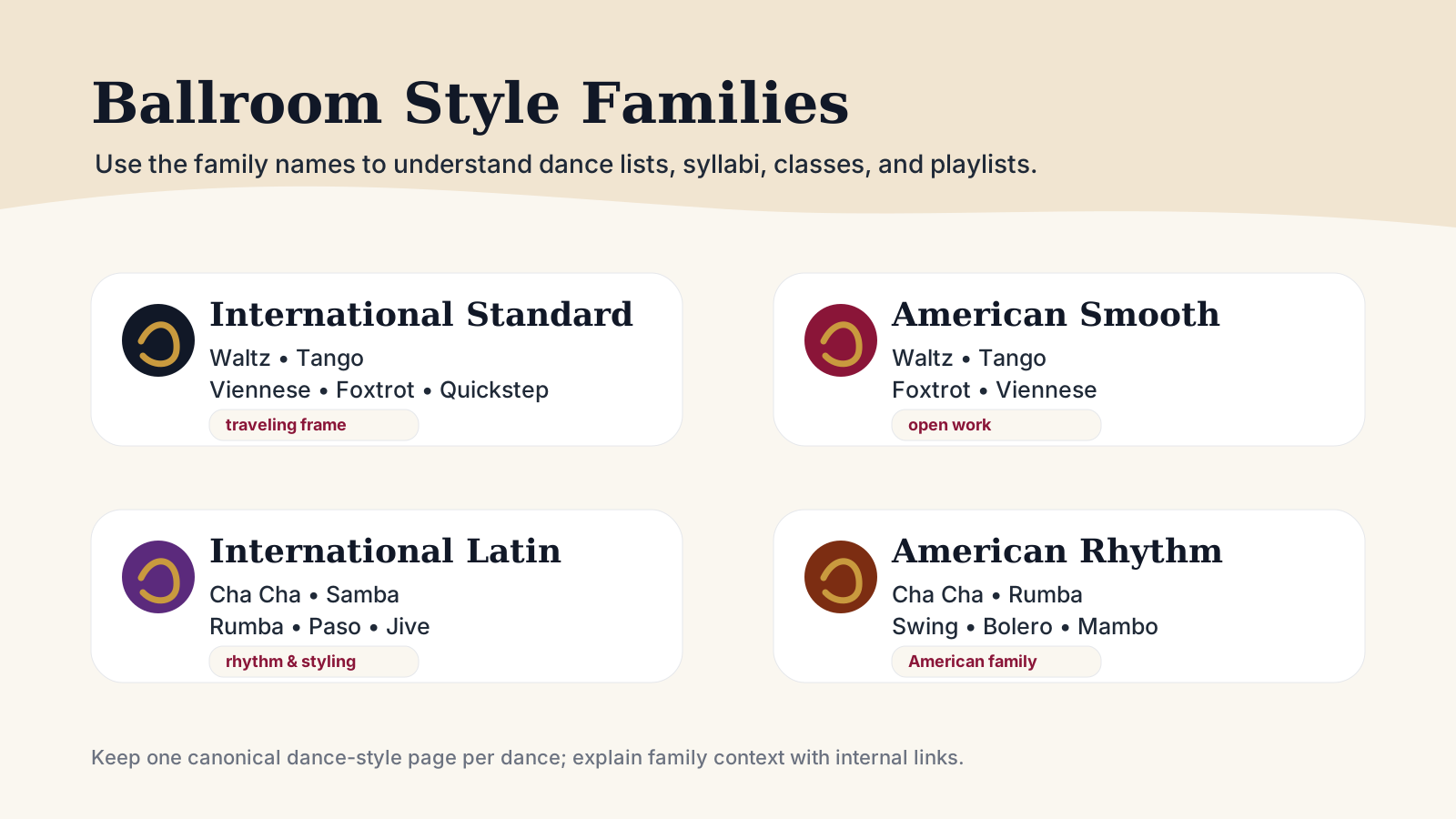
International Standard is the ballroom style family that groups Waltz, Tango, Viennese Waltz, Slow Foxtrot, and Quickstep in International Style ballroom.

Quick definition of International Standard
International Standard
- Term
- International Standard
- Also called
- Standard, Standard Ballroom, International Ballroom, and sometimes Modern Ballroom or Ballroom, depending on the organization, country, or teaching context.
- Plain-English meaning
- International Standard is a ballroom dance family, not one dance. It groups five traveling partner dances that are commonly taught and competed together in International Style ballroom.
- Category type
- Ballroom style family / DanceSport category / syllabus category
- Dances included
- Waltz, Tango, Viennese Waltz, Slow Foxtrot, Quickstep
- Common context
- Ballroom lessons, syllabi, DanceSport competitions, style-family comparisons, music playlists, and beginner dance-style lists
- Skill level
- The term is beginner-friendly. The dancing itself can range from first-lesson basics to highly advanced competitive technique.
- Related terms
- American Smooth, International Latin, American Rhythm, Closed Position, Frame, Line of Dance, Rise and Fall, Sway, Waltz, Tango, Viennese Waltz, Foxtrot, Quickstep
International Standard is a ballroom dance family in International Style ballroom. It includes five dances: Waltz, Tango, Viennese Waltz, Slow Foxtrot, and Quickstep. These dances are often grouped together because they travel around the floor, use refined partner connection, and are commonly taught or competed as the “Standard” category.
Why International Standard matters
International Standard is one of those ballroom terms that sounds more complicated than it needs to be. Once you understand it, many other ballroom categories start to make sense.
The term helps you recognize why Waltz, Tango, Viennese Waltz, Foxtrot, and Quickstep are often listed together in classes, competitions, syllabi, and playlist pages. It also helps you compare Standard with American Smooth, International Latin, and American Rhythm without assuming all ballroom dances work the same way.
For beginners, this page is not meant to replace a teacher or a dance-specific guide. It is meant to give you the map: what the category means, which dances belong to it, and where to go next.
Which dances are in International Standard?
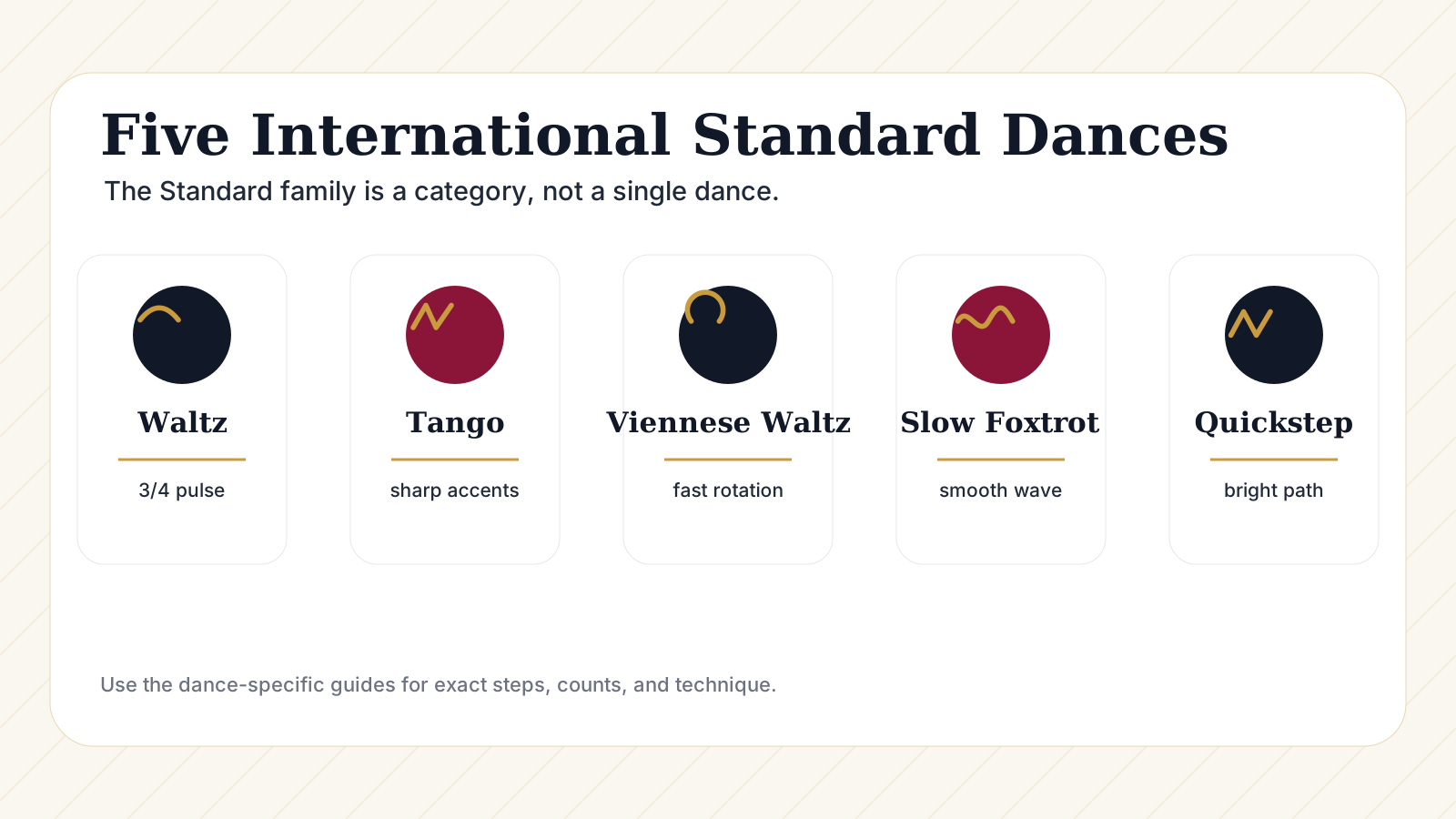
The five International Standard dances are Waltz, Tango, Viennese Waltz, Slow Foxtrot, and Quickstep. Each one has its own music, character, and timing.
Waltz
Waltz is the classic 3/4 ballroom dance many beginners recognize first. It has a graceful, traveling quality and is often a helpful entry point for understanding frame, posture, and moving around the floor.
Tango
Ballroom Tango belongs to the Standard family, but it does not feel like Waltz or Foxtrot. It is more dramatic, direct, and shaped by sharper changes of action.
Viennese Waltz
Viennese Waltz is the faster rotating waltz in the Standard family. It can feel beautiful and simple in concept, but its speed makes it a dance that should be approached carefully.
Slow Foxtrot / Foxtrot
In International Standard, this dance is often called Slow Foxtrot. Many beginners simply hear “Foxtrot,” but naming can vary by style and source.
Quickstep
Quickstep is the lively, faster Standard dance. It still belongs to the Standard family, but its energy feels brighter and more playful than Slow Foxtrot.
What International Standard feels like
International Standard is usually associated with traveling ballroom movement: dancers move around the floor rather than staying mostly in one place. In class and competition contexts, it places strong emphasis on posture, frame, partner connection, musical control, and floorcraft.
A helpful beginner image is this: Standard dances often feel like a couple moving as one unit through space. But that does not mean all five dances feel the same. Waltz, Foxtrot, Viennese Waltz, and Quickstep are often discussed with swing or traveling flow, while Tango has a more distinct character and should not be described as soft, floating, or rise-and-fall heavy in the same way.
Also remember that social dancing, studio syllabi, and competitions may use different expectations. A competition rule about hold or figures should not be treated as a universal rule for every social dance floor.
International Standard vs American Smooth
| Style family | Common dances | Beginner-friendly difference |
|---|---|---|
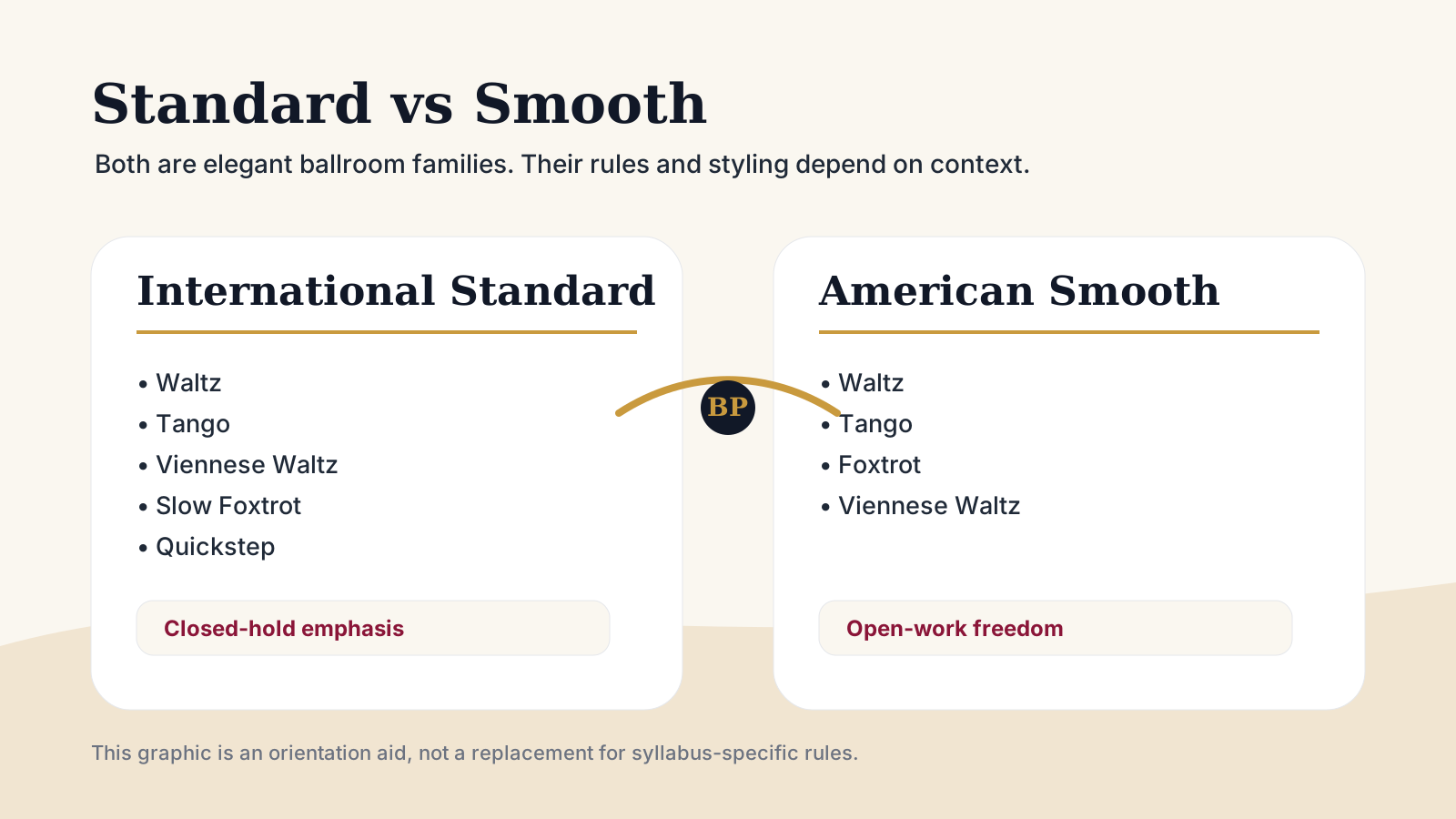
| International Standard | Waltz, Tango, Viennese Waltz, Slow Foxtrot, Quickstep | More associated with closed-hold ballroom technique in International Style contexts. |
| American Smooth | Waltz, Tango, Foxtrot, Viennese Waltz | Often allows more open work, underarm turns, separations, and choreographic freedom. |
Both can be elegant, traveling, musical, and technical. Neither is “better.” They are different style families with different teaching and competition traditions.
Want the fuller comparison? A dedicated American Smooth vs International Standard guide is planned. In the meantime, the on-page comparison above covers the beginner essentials.
International Standard vs International Latin
International Standard and International Latin are the two major International Style ballroom families.
International Standard includes Waltz, Tango, Viennese Waltz, Slow Foxtrot, and Quickstep. International Latin commonly includes Cha Cha, Samba, Rumba, Paso Doble, and Jive.
The difference is not just the dance names. The families differ in music, movement quality, hold, styling, and how partnership is expressed. Standard often emphasizes traveling movement, frame, and refined partner connection. Latin often emphasizes rhythm, body action, expressive styling, and dance-specific character.
Do not think of Latin as “less ballroom.” In DanceSport and many teaching systems, Standard and Latin are both major ballroom families.
International Standard vs American Rhythm
American Rhythm is a different American-style ballroom family. It commonly includes Cha Cha, Rumba, East Coast Swing, Bolero, and Mambo.
That means American Rhythm is not the American version of International Standard. It is closer in broad purpose to the Latin/Rhythm side of ballroom, while American Smooth is the closer comparison to International Standard.
A deeper American Rhythm vs International Latin guide and an American Rhythm glossary entry are planned. For now, see International Latin and the glossary hub.
Music and timing in International Standard
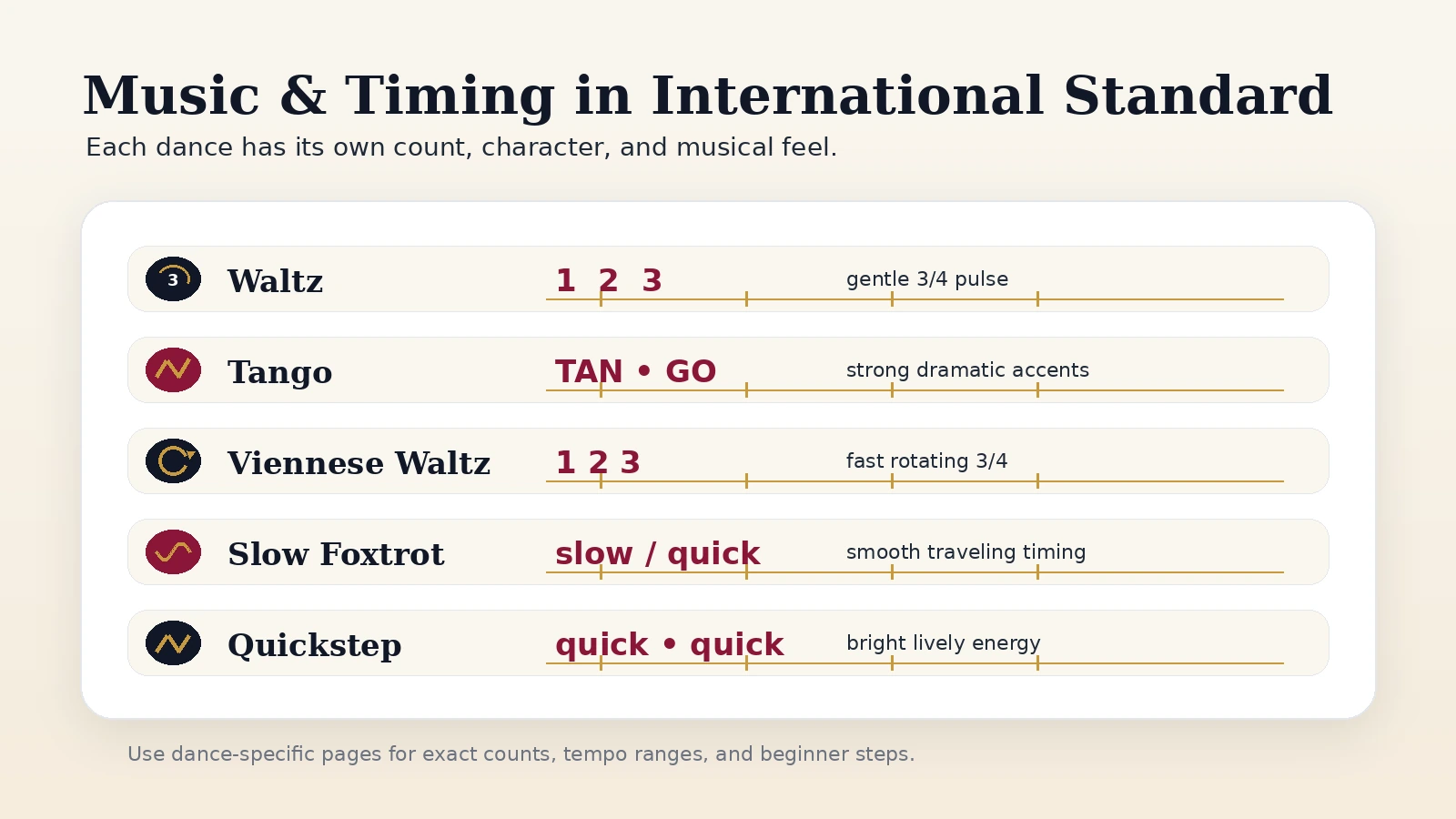
Each Standard dance has its own sound. Do not use one Standard dance’s count for every Standard dance.
| Dance | Music feel | Beginner reminder |
|---|---|---|
| Waltz | 3/4, 1-2-3 feel | Hear the three-count before stepping. |
| Tango | Stronger, more dramatic phrasing | Do not treat it like flowing Waltz. |
| Viennese Waltz | Fast 3/4 | Speed changes everything. |
| Slow Foxtrot / Foxtrot | Smooth slow/quick timing patterns | Naming and timing vary by style and syllabus. |
| Quickstep | Faster, brighter ballroom energy | Count first, then add speed. |
Use the individual dance-style pages for exact counts, tempo ranges, beginner steps, and technique notes. New here? Start with how to count ballroom dance music.
Practice with music
Practice International Standard awareness with music
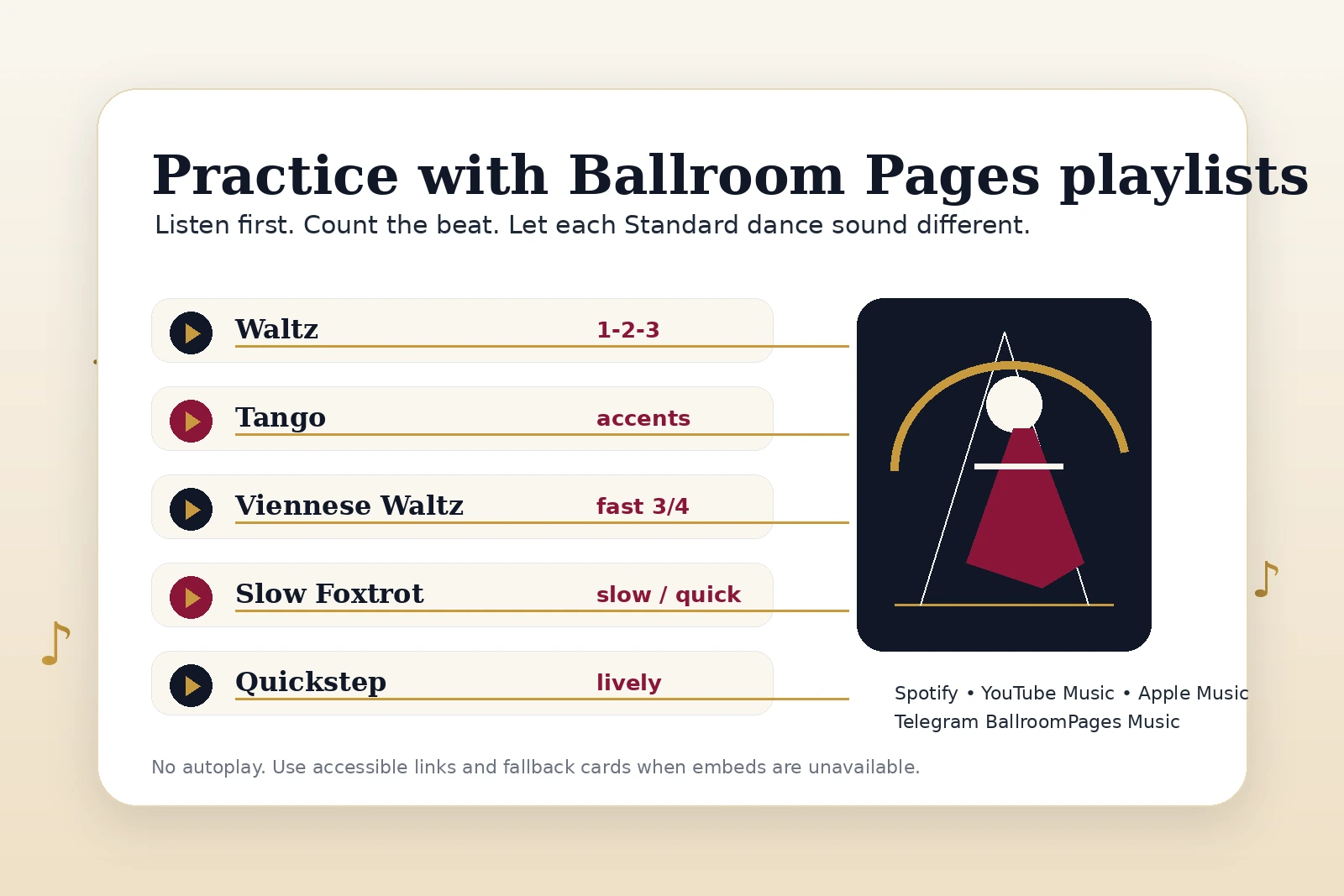
Before trying to dance all five Standard dances, listen to them. Notice how each one has a different character. Use the Ballroom Pages playlists this way:
- Listen once without moving.
- Clap or count the beat.
- Ask, “Is this Waltz, Tango, Viennese Waltz, Slow Foxtrot, or Quickstep?”
- Then read the dance-specific guide before practicing steps.
-
Waltz — hear the 3/4 Standard feel
A graceful 1-2-3 pulse.
-
Tango — hear the different Standard character
Strong, dramatic phrasing.
-
Viennese Waltz — the faster rotating 3/4
A fast 3/4 pulse.
-
Slow Foxtrot — smooth traveling music
Smooth slow/quick timing.
-
Quickstep — brighter Standard energy
Quick, buoyant ballroom music.
-
All five together
A single all-in-one International Standard playlist is being verified before publishing.
Spotify URL to verify YouTube URL to verify Apple Music URL to verify
-
Ballroom Pages Music on Telegram
Follow BallroomPages Music for ongoing ballroom music discovery.
Explore more in Music & Timing.
Common beginner misunderstandings
- International Standard is one dance.
Fix: It is a category containing five dances.
- Standard means easy or basic.
Fix: “Standard” names the style family. It does not mean beginner level.
- Standard and Smooth are identical.
Fix: They overlap, but Smooth usually allows more open work and does not usually include Quickstep.
- International Standard is the same as International Latin.
Fix: Standard and Latin are separate International Style families.
- Every Standard dance uses the same timing.
Fix: Waltz, Tango, Viennese Waltz, Foxtrot, and Quickstep each have their own music and count.
- Every Standard dance has the same rise and fall.
Fix: Tango behaves differently from dances such as Waltz and Foxtrot.
- Competition rules apply to every social floor.
Fix: Rules vary by organization, syllabus, level, and context.
- You should learn all five dances at once.
Fix: Beginners usually learn better by starting with one or two dances, listening to the music, and building frame and timing gradually.
Style families
International Standard vs similar terms
| Term | What it means |
|---|---|
| International Standard | The International Style ballroom family with Waltz, Tango, Viennese Waltz, Slow Foxtrot, and Quickstep. |
| Standard Ballroom | Often another way to refer to Standard dances, depending on context. |
| Modern Ballroom | A naming variation used by some organizations or regions for Standard/ballroom dances. |
| American Smooth | American-style ballroom family with Waltz, Tango, Foxtrot, and Viennese Waltz, often allowing more open work. |
| International Latin | International Style family with Cha Cha, Samba, Rumba, Paso Doble, and Jive. |
| American Rhythm | American-style family with Cha Cha, Rumba, East Coast Swing, Bolero, and Mambo. |
| Ballroom dance | A broad umbrella that can include Standard, Smooth, Latin, Rhythm, social partner dances, wedding dance, and more depending on context. |
Mini learning path
- Learn the five Standard dances by name.
- Listen to one playlist for each dance.
- Start with a beginner-friendly entry point such as Waltz or Foxtrot if your teacher or goal supports it.
- Learn closed position, frame, posture, line of dance, and basic timing.
- Use a teacher or a verified dance-specific guide for exact footwork.
- Compare Standard with Smooth once you understand the shared dance names.
FAQ
International Standard FAQ
What does International Standard mean in ballroom dance?
International Standard is a ballroom style family in International Style ballroom. It includes Waltz, Tango, Viennese Waltz, Slow Foxtrot, and Quickstep.
What dances are included in International Standard?
The five International Standard dances are Waltz, Tango, Viennese Waltz, Slow Foxtrot, and Quickstep. Some sources say Foxtrot instead of Slow Foxtrot, but in International Standard the dance is commonly referred to as Slow Foxtrot.
Is International Standard the same as ballroom dance?
No. International Standard is one ballroom category. Ballroom dance is a broader umbrella that can include Standard, Smooth, Latin, Rhythm, social partner dances, wedding dance, and more depending on context.
What is the difference between International Standard and American Smooth?
International Standard usually includes Waltz, Tango, Viennese Waltz, Slow Foxtrot, and Quickstep and is strongly associated with closed-hold ballroom technique. American Smooth usually includes Waltz, Tango, Foxtrot, and Viennese Waltz and often allows more open work and choreography freedom.
What is the difference between International Standard and International Latin?
International Standard includes traveling ballroom dances such as Waltz, Tango, Foxtrot, and Quickstep. International Latin includes dances such as Cha Cha, Samba, Rumba, Paso Doble, and Jive. The families differ in music, hold, styling, and movement quality.
Is Foxtrot or Slow Foxtrot part of International Standard?
Yes. In International Standard, the dance is commonly called Slow Foxtrot. Some beginner materials may shorten it to Foxtrot, but the exact naming depends on the source and style context.
Can beginners learn International Standard?
Yes, beginners can start learning Standard concepts such as posture, frame, timing, and basic movement. The full technique can become advanced, so beginners should start with simple patterns and dance-specific instruction.
Which International Standard dance should I learn first?
Many beginners start with Waltz or Foxtrot because the music and basic ideas can be easier to approach than faster dances. Your best first dance depends on your teacher, goals, music preferences, and whether you are dancing socially, for a wedding, or for competition.
Does International Standard always use closed hold?
In International Standard competition contexts, Standard is strongly associated with maintaining a closed hold. Social lessons and teaching situations can vary, so treat competition rules as context-specific rather than universal social-dance rules.
Editorial
Sources and review notes
This glossary entry was prepared from official and educational ballroom references including WDSF DanceSport discipline descriptions, USA Dance style/event materials, NDCA syllabus/position materials where relevant, Dance Vision educational explanations, and the existing Ballroom Pages playlist ecosystem. This page defines the term and orients beginners; dance-specific pages should handle detailed footwork, exact tempo ranges, syllabus figures, and technique claims.
- WDSF — DanceSport Disciplines.
- USA Dance — Competitor Guide / Spectator Guide.
- NDCA — Approved Figures, Elements & Restrictions.
- Dance Vision — ballroom style education.
- Ballroom Pages — legacy music playlist pages.
This is dance terminology, not medical advice. Ballroom Pages follows an editorial policy of education-first guidance. Questions? Contact us. Updated May 21, 2026.