What is the Foxtrot basic step?
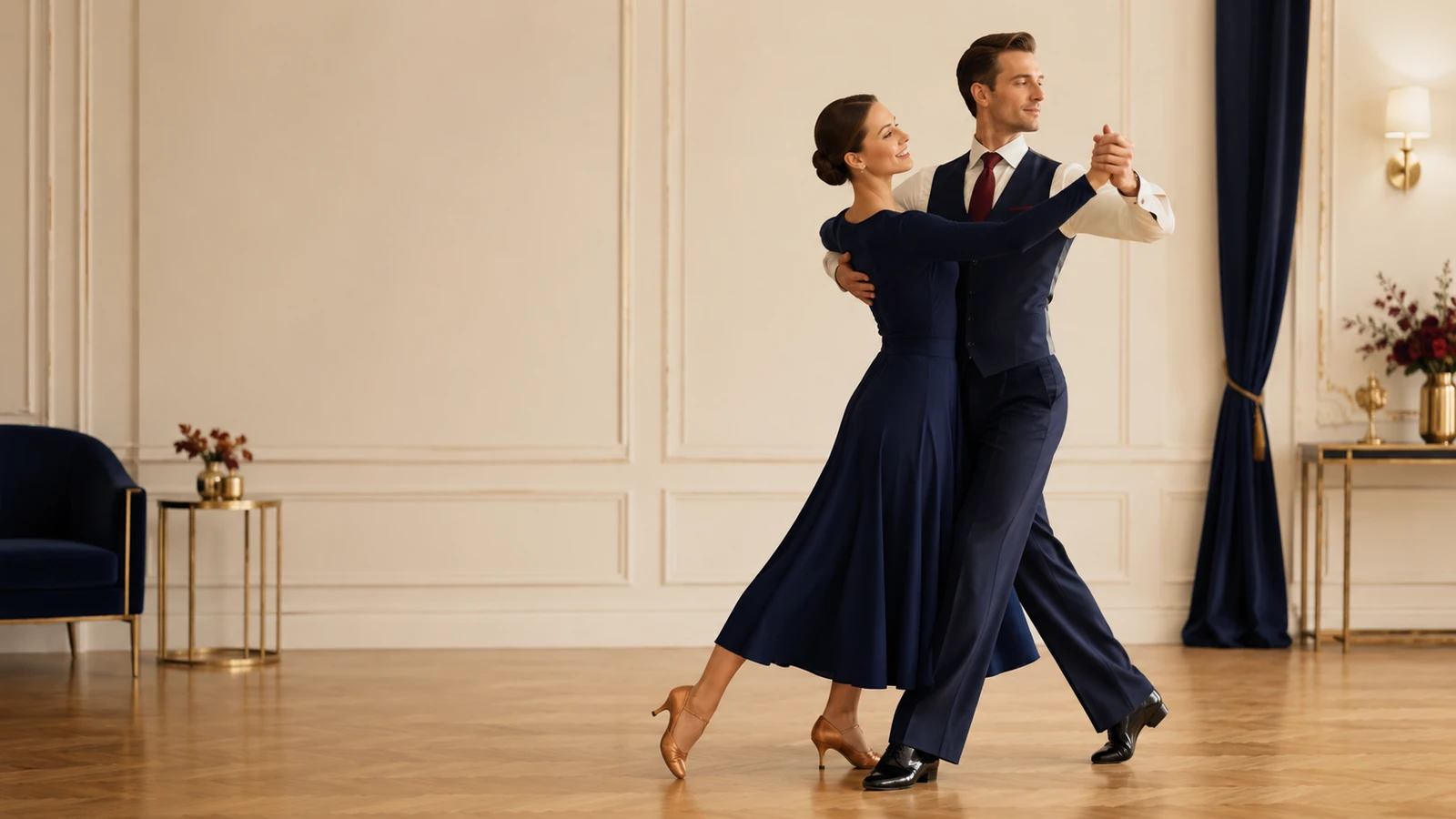
The Foxtrot basic step is one of the first patterns many dancers learn in Foxtrot. It teaches you how to travel smoothly with a partner while staying on a slow-and-quick rhythm. In beginner language, the pattern is: Walk. Walk. Side. Close.
The basic step teaches timing, posture, partner connection, direction of travel, and the difference between slow steps and quick steps. New to ballroom overall? Start with ballroom dance for beginners, then come back here.
Which Foxtrot basic are we teaching?
This page teaches the American/social Foxtrot Forward Basic using slow, slow, quick, quick timing. That is the best default for Ballroom Pages because this page is for absolute beginners, wedding couples, and social dancers who want a practical first step.
You may also hear slow, quick, quick in Foxtrot. That is not wrong. It appears in other Foxtrot figures, box-style basics, and International Slow Foxtrot contexts. If you are learning socially or for a wedding, start with slow, slow, quick, quick unless your teacher gives you a different version. If you are in a syllabus class, exam class, or competition class, follow that syllabus and your instructor’s timing.
Timing and counts
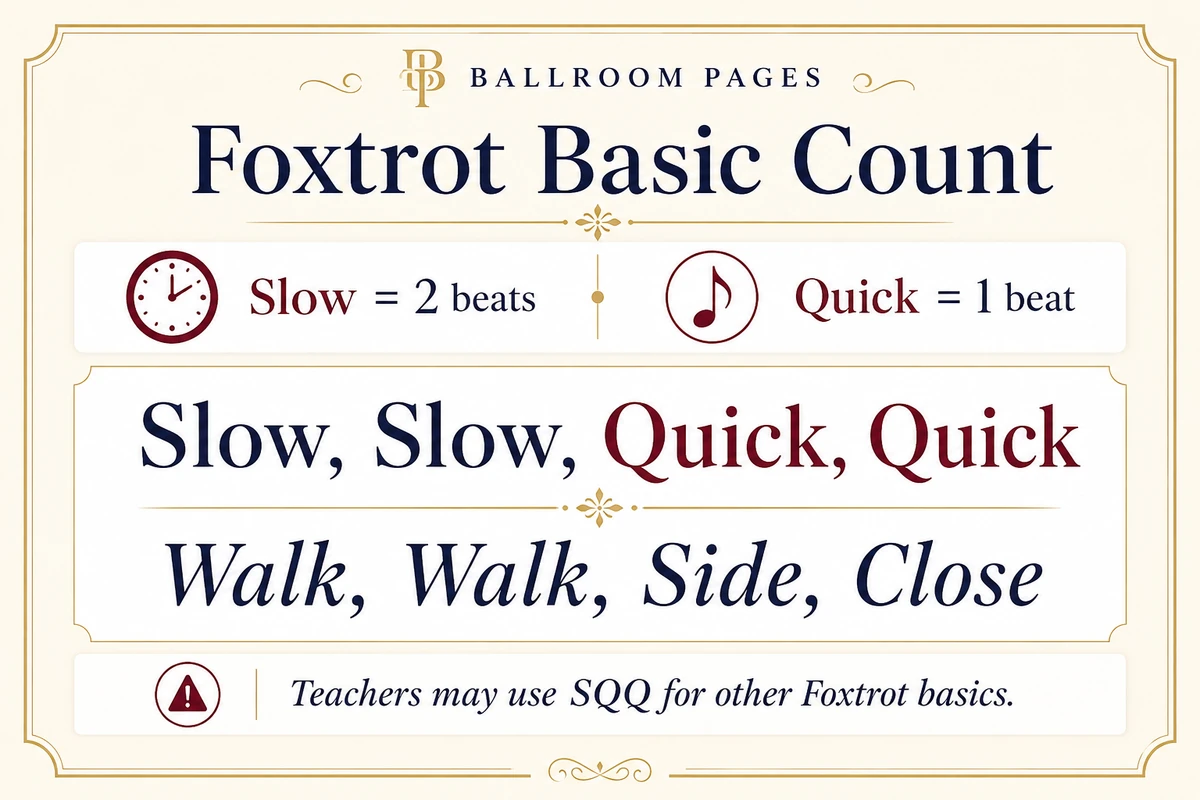
Foxtrot is usually danced to music in 4/4 time. In beginner counting, a slow usually takes two beats and a quick takes one beat.
| Count word | Beat value | What you do |
|---|---|---|
| Slow | 2 beats | Step |
| Slow | 2 beats | Step |
| Quick | 1 beat | Step side |
| Quick | 1 beat | Close and change weight |
- SSlow · 1-2
- SSlow · 3-4
- QQuick · 5
- QQuick · 6
Count it as: Slow, slow, quick, quick — or 1-2, 3-4, 5, 6.
If counting is new, read how to count ballroom dance music and check reference tempos on the ballroom tempo chart.
Leader steps
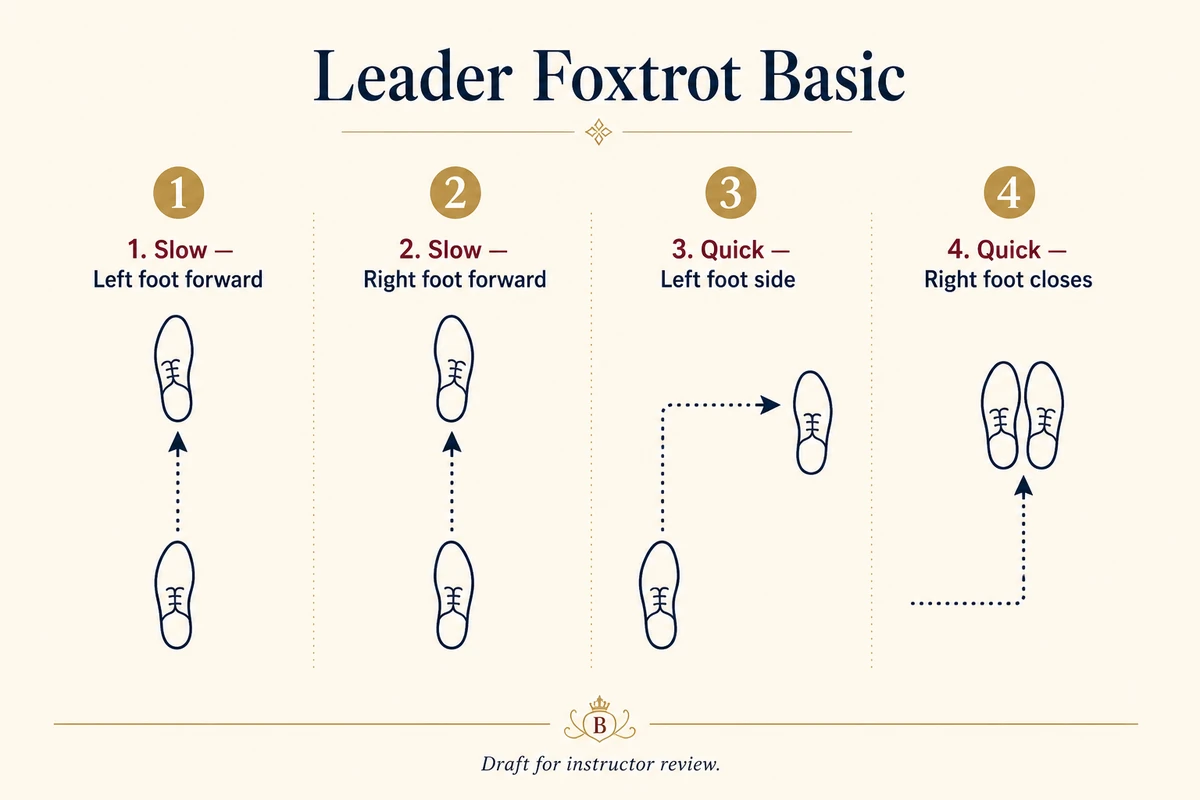
| Count | Leader step | Direction | Beginner cue |
|---|---|---|---|
| Slow | Left foot | Forward | Walk forward |
| Slow | Right foot | Forward | Walk forward |
| Quick | Left foot | Side | Step side |
| Quick | Right foot | Close to left foot | Close and change weight |
Leader notes: keep your steps small enough that your partner can move comfortably. Avoid pulling the follower through the arms. Lead timing and direction with body organization, frame, and calm movement. For more, read lead and follow in ballroom dance.
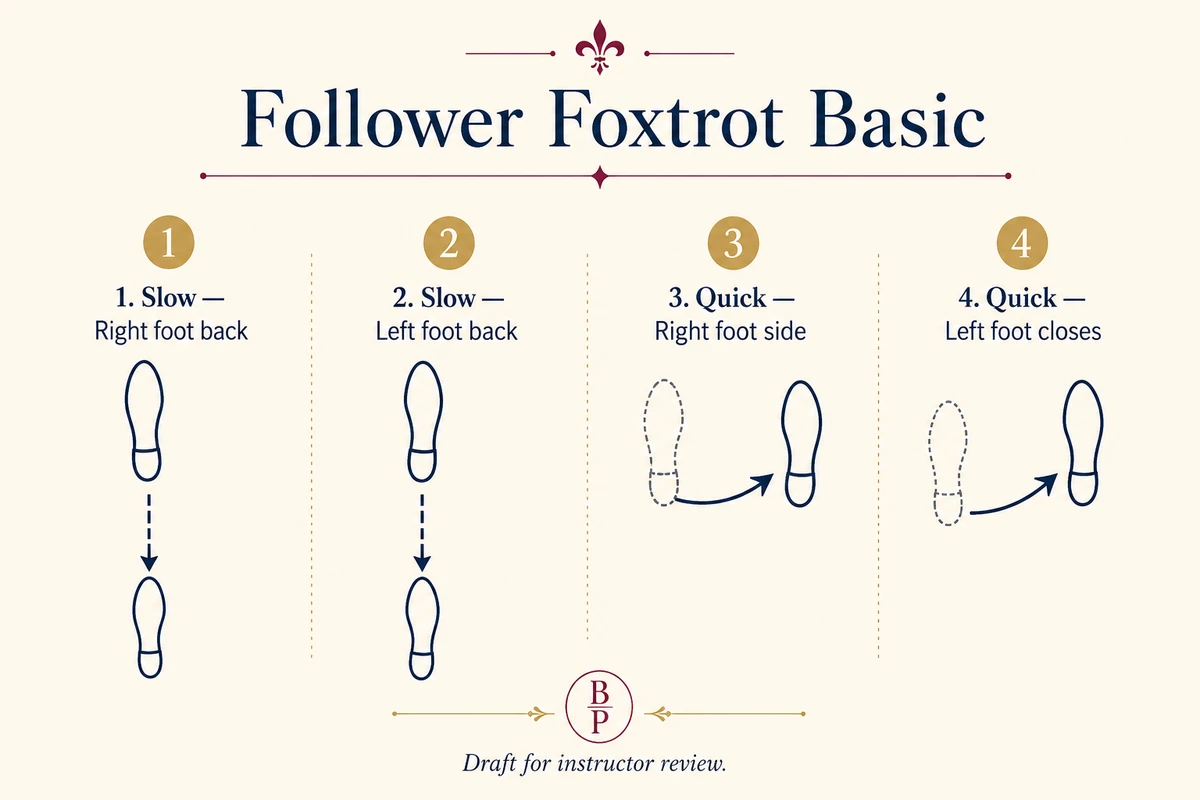
Follower steps
| Count | Follower step | Direction | Beginner cue |
|---|---|---|---|
| Slow | Right foot | Back | Walk back |
| Slow | Left foot | Back | Walk back |
| Quick | Right foot | Side | Step side |
| Quick | Left foot | Close to right foot | Close and change weight |
Follower notes: keep your steps controlled and underneath you. You are not being dragged backward. Move with your own balance while responding to the leader’s timing and direction. A steady frame and posture makes backward steps feel secure.
Leader and follower comparison
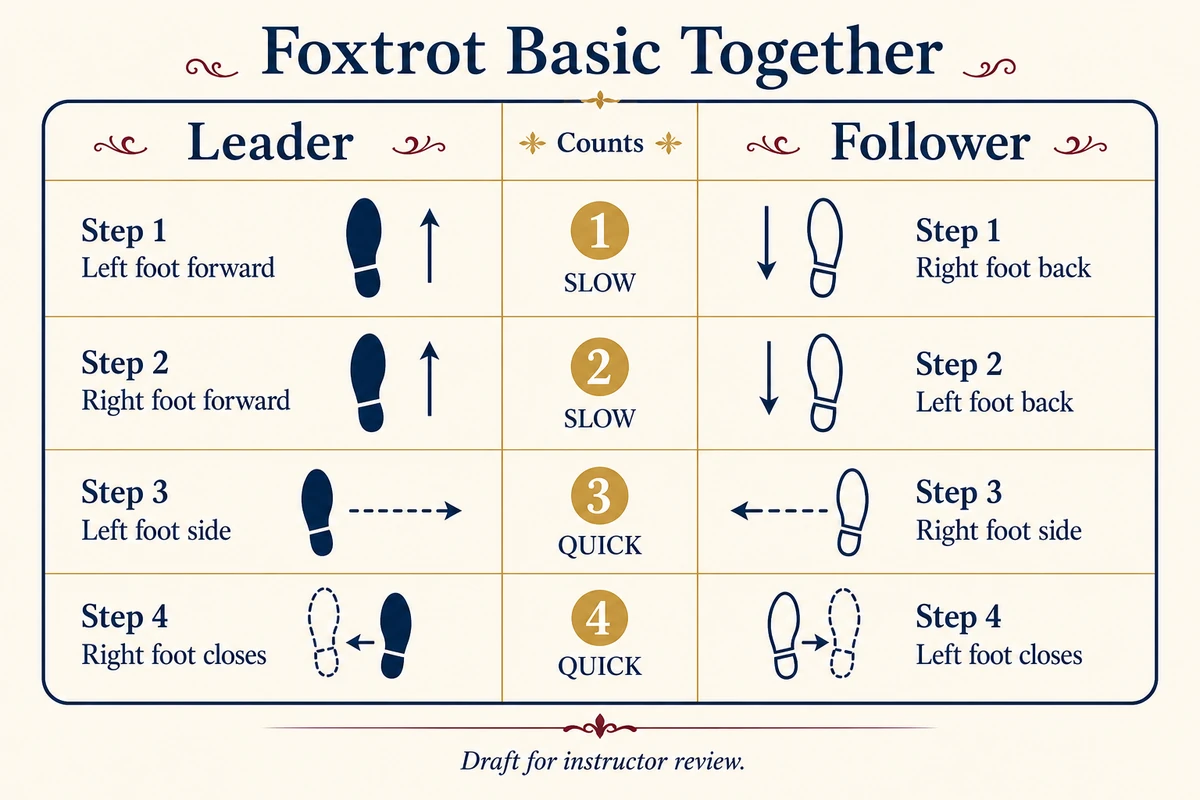
| Count | Leader | Follower | Shared feeling |
|---|---|---|---|
| Slow | Left forward | Right back | Travel smoothly |
| Slow | Right forward | Left back | Keep frame steady |
| Quick | Left side | Right side | Move sideways together |
| Quick | Right close | Left close | Close feet and change weight |
Combined footwork diagram
Seen together, the leader’s forward path and the follower’s backward path form one smooth, traveling basic.
Practice without a partner
- Say the count: slow, slow, quick, quick.
- Practice walk, walk, side, close.
- Keep steps small.
- Add posture.
- Add music.
Practice with a partner
- Start in a comfortable closed ballroom hold or beginner practice hold.
- Keep frame toned but not stiff.
- Do not squeeze, hang, pull, or push through the arms.
- Keep the first version small.
- Count out loud together.
- Stop and reset if either partner loses balance.
Instructor review is recommended before adding turns, outside partner positions, open work, dips, or performance styling.
Practice the Foxtrot basic step with music
Foxtrot timing becomes easier when you hear it. Start with a moderate track, listen for a steady 4/4 pulse, then say “slow, slow, quick, quick” before you add footwork.
-
Foxtrot on Spotify
Moderate Slow Foxtrot tracks for counting and basic-step practice.
-
Foxtrot on Apple Music
The same Slow Foxtrot feel on Apple Music.
-
Foxtrot on YouTube
YouTube and YouTube Music Foxtrot playlists are being verified before launch.
YouTube URL to verify YouTube Music URL to verify
-
More Ballroom Pages music
Follow along and browse the full library.
Get BallroomPages Music updates Browse all Ballroom Pages playlists
More in Ballroom Music & Timing.
Common mistakes and fixes
| Mistake | What it looks or feels like | Fix |
|---|---|---|
| Rushing the quick-quick | The side-close feels frantic or late. | Count out loud and make the steps smaller. |
| Taking giant slow steps | The follower feels pulled or the leader runs out of space. | Keep the walks comfortable and social-sized. |
| Looking down | The chest drops and the frame collapses. | Keep the head lifted and use diagrams before dancing. |
| Pulling with the arms | One partner feels dragged through the step. | Use a light, toned frame and move your own body. |
| Closing without weight | The final quick is tapped instead of stepped. | Change weight fully onto the closing foot. |
| Losing posture on backward steps | The follower leans away or collapses backward. | Step back underneath the body and keep the spine lifted. |
| Forgetting the side step | The basic becomes four walks instead of walk-walk-side-close. | Say “side-close” clearly on quick-quick. |
| Trying advanced styling too early | The step becomes big, theatrical, or off balance. | Learn the clean basic before adding turns or styling. |
Beginner tips
- Start with the count, not the feet.
- Practice both roles at least once.
- Use moderate music.
- Keep your feet close to the floor.
- Do not worry about advanced styling yet.
Foxtrot basic step video
A count-along demo is planned for this guide. Until it is published, use the counts, diagrams, and playlists above to practice the slow-slow-quick-quick rhythm.
 Demo video coming soon
Foxtrot variations: social, American Smooth, International Slow Foxtrot
- Social Foxtrot: often taught slow, slow, quick, quick because it feels like walking to music.
- American Smooth Foxtrot: includes SSQQ and SQQ figures; beginner Bronze basics often close the feet.
- International Slow Foxtrot: more technically demanding and often uses slow, quick, quick figure construction.
Learn the version your teacher gives you. Use this page as a beginner foundation, not as a replacement for your studio’s syllabus. For the bigger picture, read the Foxtrot dance guide or browse all ballroom dance styles.
Wedding dance relevance
Foxtrot can be a beautiful wedding first dance when the song has a medium-tempo 4/4 feel, especially if it has a smooth swing, jazz, classic standards, or elegant pop quality. It may not fit very slow, strongly Latin, 3/4, or very fast songs.