Practice shoes at a glance
| Shoe type | Best for | Main benefit | Main caution |
|---|---|---|---|
| Ballroom practice shoes | Lessons, rehearsals, long practice | Comfort, stability, repeat use | Still need proper fit and floor compatibility |
| Latin / Rhythm shoes | Latin and Rhythm technique, styling, events | Foot articulation and dance-specific line | May be less forgiving for long beginner practice |
| Smooth / Standard shoes | Waltz, Foxtrot, Tango, Standard/Smooth | Closed support and glide | Not always the most comfortable all-purpose trainer |
| Dance sneakers | Some classes, fitness-style dance, higher-cushion needs | Cushioning and support | Often bulkier; not the same ballroom floor feel |
| Character shoes | Theater, some beginner/social contexts | Stable heel, familiar feel | Not always designed for ballroom turns |
| Ballet flats | Ballet or very light indoor movement | Thin and flexible | Usually not enough support or turning control for ballroom |
| Street shoes | First lesson only if safe | Already owned | Can stick, slip, mark floors, or lack secure fit |
What are ballroom practice shoes?
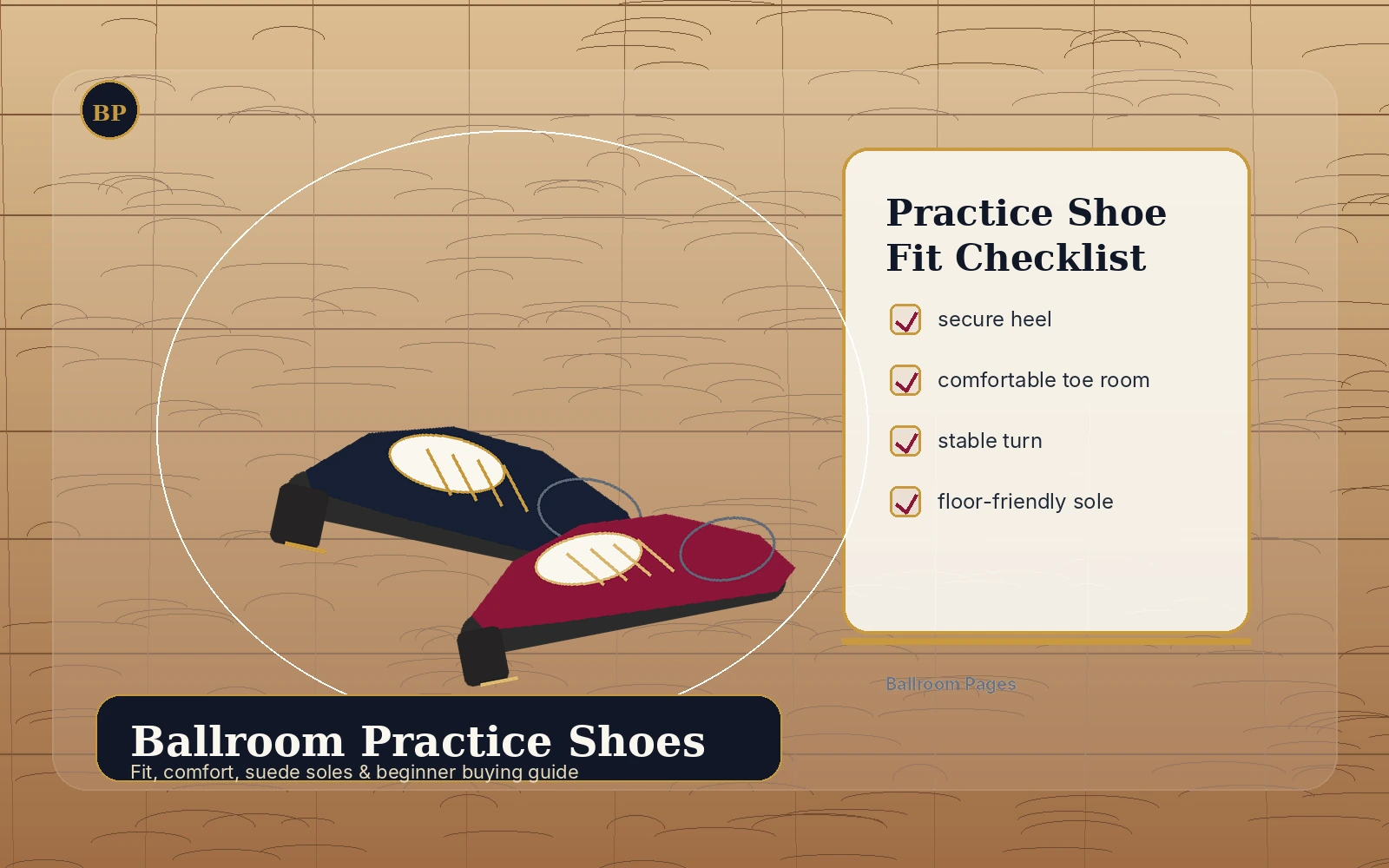
Ballroom practice shoes are dance shoes designed for training rather than performance glamour. They usually prioritize comfort, stability, flexibility, and repeated use.
Many practice shoes have suede or chrome-leather soles, a secure upper, a lower or broader heel, and materials that can handle long lessons and rehearsals. The goal is not to make the foot look dramatic. The goal is to help the dancer train clearly and consistently.
A good practice shoe should help you:
- feel the floor,
- turn without sticking,
- stop without sliding,
- keep the heel secure,
- practice longer without unnecessary discomfort,
- protect the studio floor,
- build repeatable technique.
- Ballroom practice shoes
- Dance shoes designed for repeated ballroom lessons, practice sessions, teaching, rehearsals, and social use, usually with a dance-floor-friendly sole and a more comfort-focused build than performance shoes.
Do you need practice shoes yet?
You probably do not need to buy practice shoes before your first ballroom lesson unless your studio specifically asks for them.
For a first class, many beginners can wear clean shoes that stay securely on the foot and do not leave marks. But once you begin practicing regularly, your shoes start to matter. If your footwear prevents you from turning, balancing, or feeling the floor, it becomes part of the problem your teacher has to work around.
You can probably wait if…
- you are trying one introductory lesson,
- your studio says clean non-marking shoes are fine,
- your current shoes stay securely on your feet,
- you are not practicing turns or routines yet,
- you are still deciding whether ballroom is for you.
You should consider practice shoes if…
- you take lessons weekly,
- you practice outside class,
- sneakers make you stick to the floor,
- street shoes feel slippery or unstable,
- you are preparing a wedding dance,
- you are training for a showcase, medal test, or Pro-Am,
- your feet tire quickly, or your teacher says your shoes limit your movement.
Bring a checklist to your next lesson
Not sure if you are ready to buy? Download the Practice Shoe Fit Checklist and bring it to your next lesson.
Download the Practice Shoe Fit ChecklistPractice shoes vs performance shoes
Practice shoes are usually more forgiving. Performance shoes are usually more specialized.
| Feature | Practice shoes | Performance / competition shoes |
|---|---|---|
| Main goal | Comfort, stability, repeated training | Presentation, line, style-specific performance |
| Heel | Often lower or more stable | Often selected for visual line and dance style |
| Upper | Leather, mesh, suede, synthetic, or flexible material | Satin, leather, patent, crystal, or costume-friendly materials |
| Sole | Dance-floor friendly | Dance-floor friendly but often more style-specific |
| Comfort | Built for long sessions | Depends heavily on shoe and dancer |
| Best time to buy | When lessons become regular | When routine, event, style, and teacher guidance are clear |
Performance shoes can be beautiful, but beauty is not the first requirement for practice. In practice, you need to repeat. You need to turn. You need to make mistakes. You need to stand through corrections. Your shoes should help with that.
How practice shoes differ from other dance shoes
Practice shoes vs Latin shoes
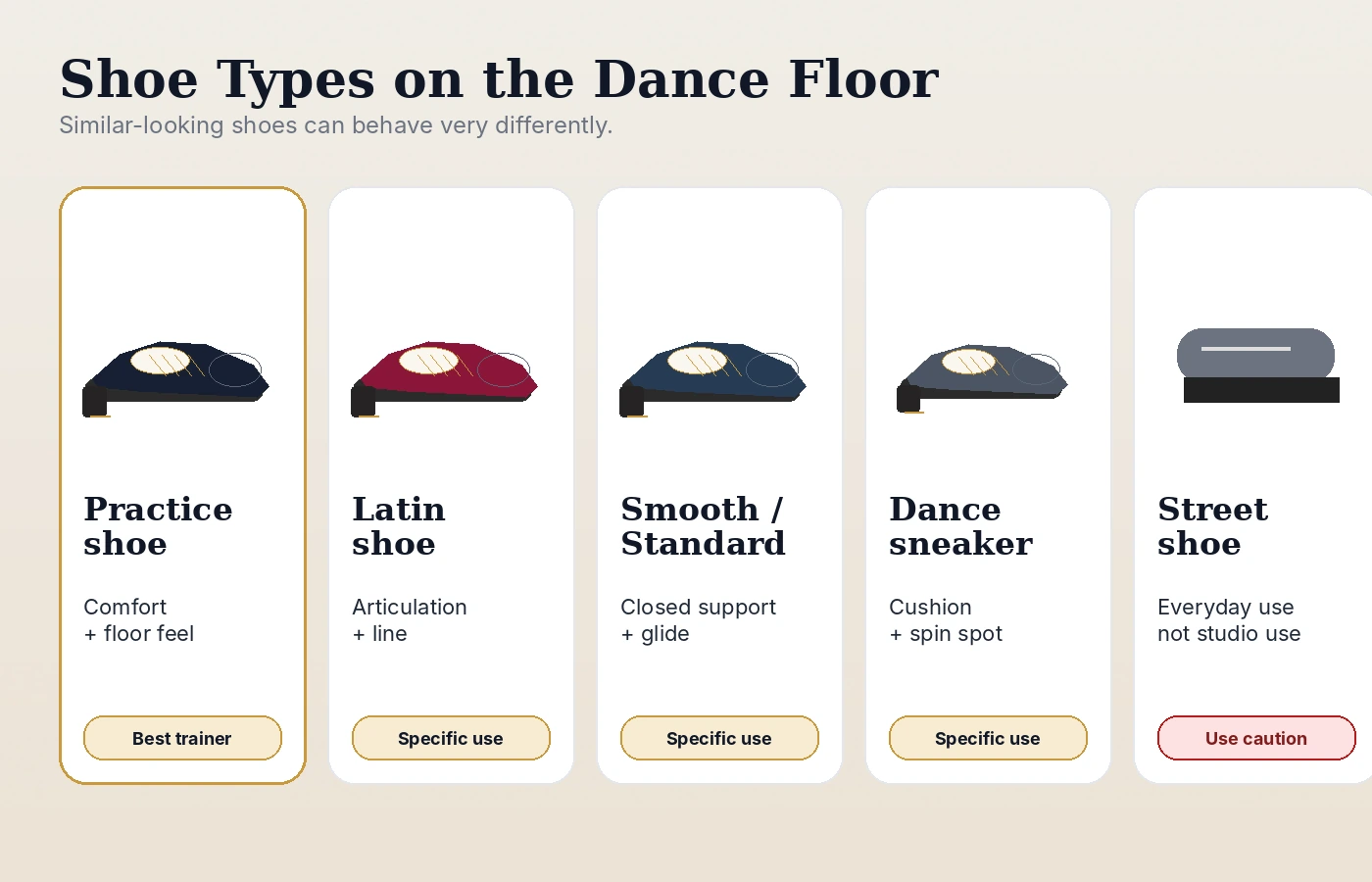
Latin or Rhythm shoes are often chosen for foot articulation, styling, and dance-specific technique. They may have higher or slimmer heels, more open designs, and straps that support dynamic movement. Practice shoes usually emphasize comfort and stability over visual line. Some dancers practice Latin or Rhythm in practice shoes, but others prefer Latin shoes when working on specific foot articulation.
Practice shoes vs Smooth or Standard shoes
Smooth and Standard shoes often provide more closed support and glide for dances like Waltz, Foxtrot, Tango, and Quickstep. Practice shoes may be more flexible or cushioned for long sessions, but they may not replace style-specific shoes for advanced work.
Practice shoes vs dance sneakers
Dance sneakers can work for some classes, especially where cushioning matters. But they often feel bulkier and may not give the same floor feedback as a suede-sole ballroom shoe.
Practice shoes vs character shoes
Character shoes can be useful in theater or some beginner contexts, but not every character shoe is built for ballroom turns, partner work, or studio-floor glide.
Practice shoes vs ballet flats
Ballet flats are flexible, but they usually do not provide the stability, heel security, or sole response ballroom dancers need for repeated partner practice.
Practice shoes vs street shoes
Street shoes are made for the street. Even when they feel comfortable, they may grip too much, slide unpredictably, mark floors, or make turns harder.
What to look for in ballroom practice shoes
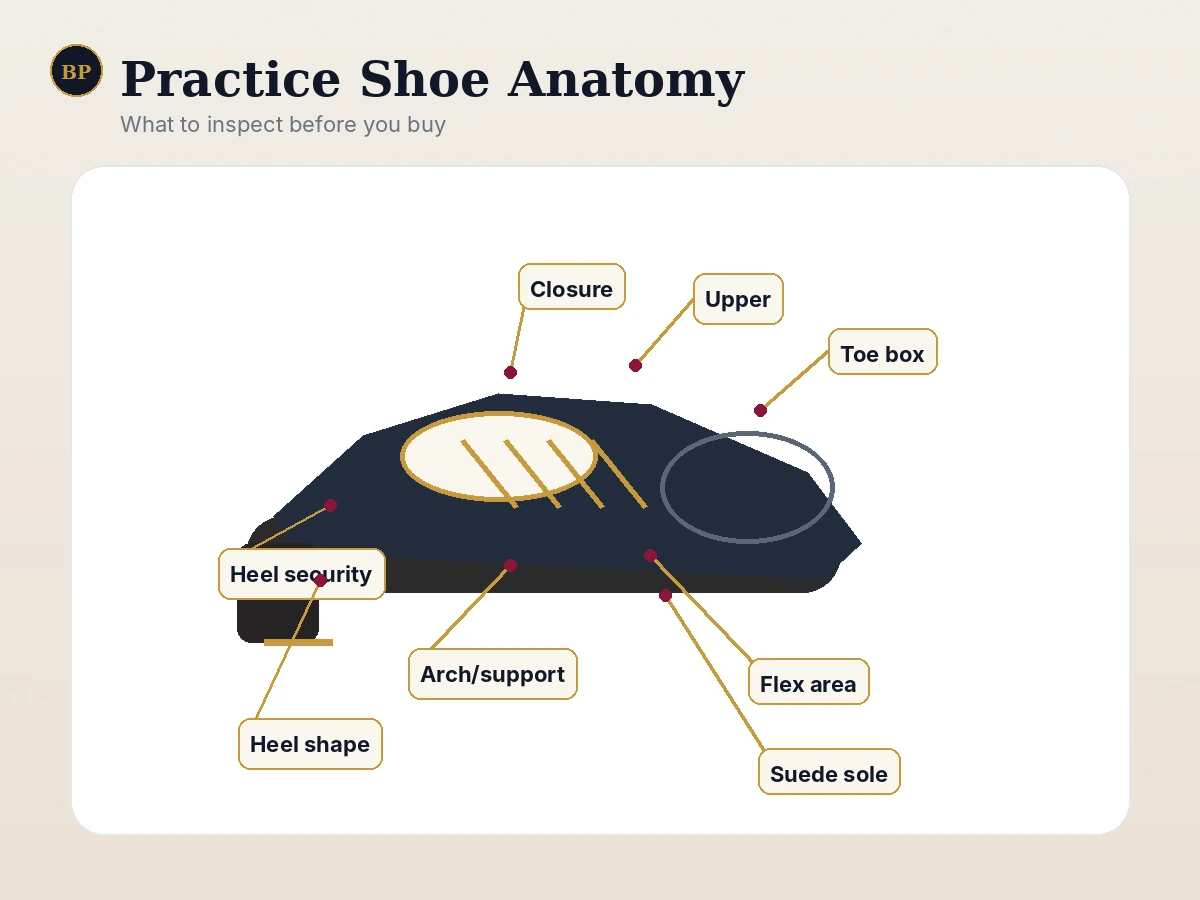
Suede or chrome-leather sole
The biggest difference from a normal shoe. You want enough glide to turn and enough grip to control your weight.
Flexibility
The shoe should let your foot articulate. A stiff shoe can block weight transfer and feel disconnected from the floor.
Heel height
Beginners usually do better with a lower, stable heel while learning; experienced dancers vary by style, role, and teacher guidance.
Heel shape
A broader heel usually feels more stable; a slim heel creates a more elegant line but can be less forgiving.
Heel security
Your heel should not pop out when you walk backward, turn, or change direction.
Toe box
Your toes should not feel crushed. For long practice, toe comfort matters more than squeezing into the smallest size.
Width
Too loose reduces control; too tight distracts from dancing. Some dancers need narrow, wide, or custom widths.
Upper material
Leather, suede, mesh, satin, patent, and synthetics all feel different. For practice, breathable and flexible often beats sparkle.
Closure
Laces, straps, T-bars, elastic, buckles, and slip-ons all change fit. Choose one that holds the foot without digging in.
Cushioning
A little helps long lessons; too much bulk reduces floor feel. The right amount depends on your feet and schedule.
Stability
It should feel steady when you stop, turn, and change weight. If it wobbles standing still, it will not improve while dancing.
Pivot and turn ability
You should rotate without forcing your knees or gripping the floor. Feeling stuck means the sole may be wrong for the floor.
Floor compatibility
Ballroom shoes are mostly for indoor dance floors—not carpet, concrete, outdoor patios, rough tile, or dirty surfaces.
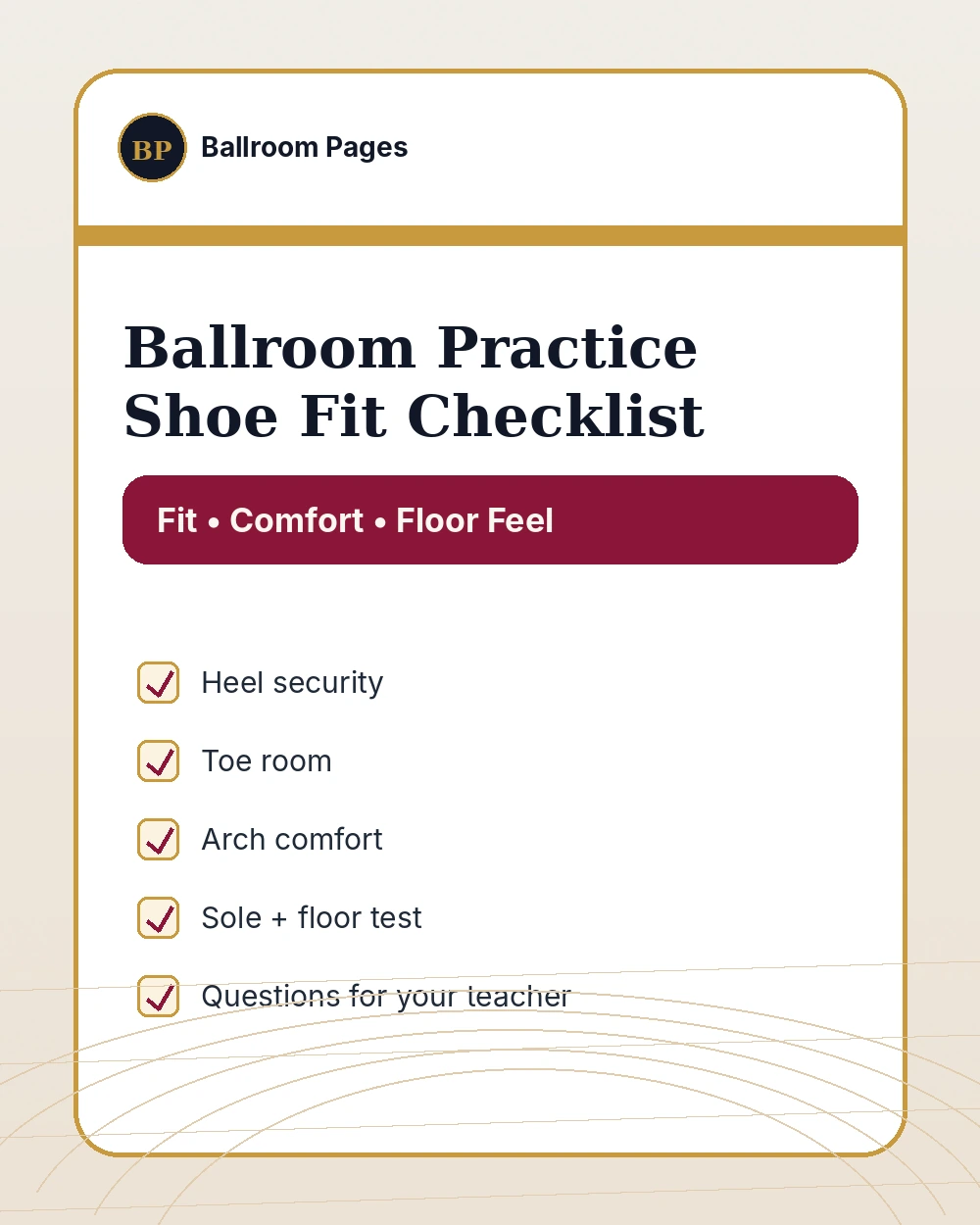
Fit and sizing checklist
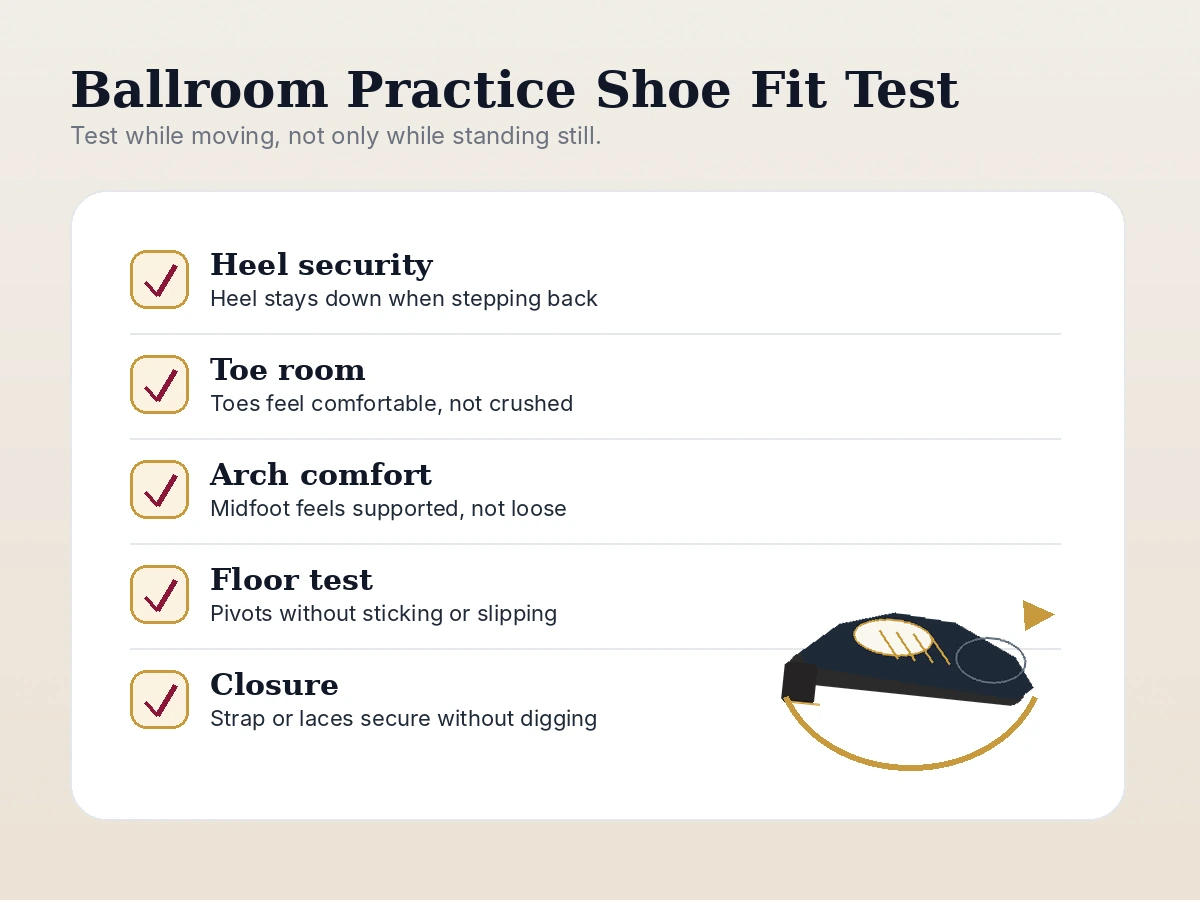
Use this checklist before keeping a new pair:
- The heel stays secure when walking backward.
- The shoe does not pinch the toes.
- The midfoot feels held, not loose.
- You can bend and point the foot naturally.
- You can pivot without sticking.
- You can stop without sliding.
- The closure does not dig into the skin.
- The shoe feels stable after 10–15 minutes, not just standing still.
- You tested both shoes, not just one.
- You checked the return policy before dancing in them.
- You asked your teacher whether the shoe matches the style you are learning.
Compare every pair the same way
Download the Ballroom Practice Shoe Fit Checklist and use it for each pair you try.
Download the Ballroom Practice Shoe Fit ChecklistWomen’s and men’s practice shoe considerations
Most dance shoe retailers still organize practice shoes into women’s and men’s categories. For Ballroom Pages, the more useful question is not gender. It is fit, role, foot shape, heel preference, dance style, and comfort.
Common follower-focused considerations
- heel height and heel shape,
- open toe vs closed toe,
- strap security,
- forefoot comfort,
- stability for turns,
- Latin/Rhythm, Smooth/Standard, or all-purpose use.
Common leader-focused considerations
- heel height,
- leather vs patent vs suede or mesh upper,
- flexibility,
- arch and midfoot support,
- glide for Smooth/Standard,
- stability for Rhythm/Latin and teaching sessions.
Unisex and teaching-style shoes
Some dancers prefer unisex or teaching-style practice shoes because they are stable, flexible, and comfortable for long rehearsals—useful for teachers, assistants, multi-style competitors, or students who want one dependable training shoe before choosing event shoes.
How to choose by use case
| Use case | Recommended direction | Why |
|---|---|---|
| First private lesson | Safe, clean shoes first; buy after instructor feedback | Avoid buying the wrong style too early |
| Weekly beginner lessons | Entry-level ballroom practice shoes | Helps with turns, floor feel, and comfort |
| Group classes | Comfortable, secure practice shoes | You may stand and repeat for long periods |
| Social dancing | Practice or social dance shoes | Comfort matters more than sparkle |
| Long rehearsals | Comfort-first practice shoes | Stability and cushioning matter over time |
| Wedding dance lessons | Stable practice shoes close to wedding-shoe height | Helps transition to event shoes later |
| Pro-Am / competition practice | Ask your coach; you may need both practice and event shoes | Training and event needs can differ |
| At-home practice | Depends on floor | Avoid suede soles on rough, dirty, or outdoor surfaces |
Planning a wedding first dance? See wedding dance shoes. New to ballroom? Start with ballroom dance for beginners and a practice routine.
What not to wear
- outdoor sneakers that grip too much,
- flip-flops or sandals without heel security,
- shoes with black marking soles,
- very loose slip-ons,
- stilettos not made for dance,
- sticky rubber soles on wood floors,
- suede-sole dance shoes outdoors,
- shoes that wobble when standing still,
- brand-new shoes tested for the first time at an event.
Care and maintenance
Practice shoes last longer when you treat them as dance equipment, not everyday shoes.
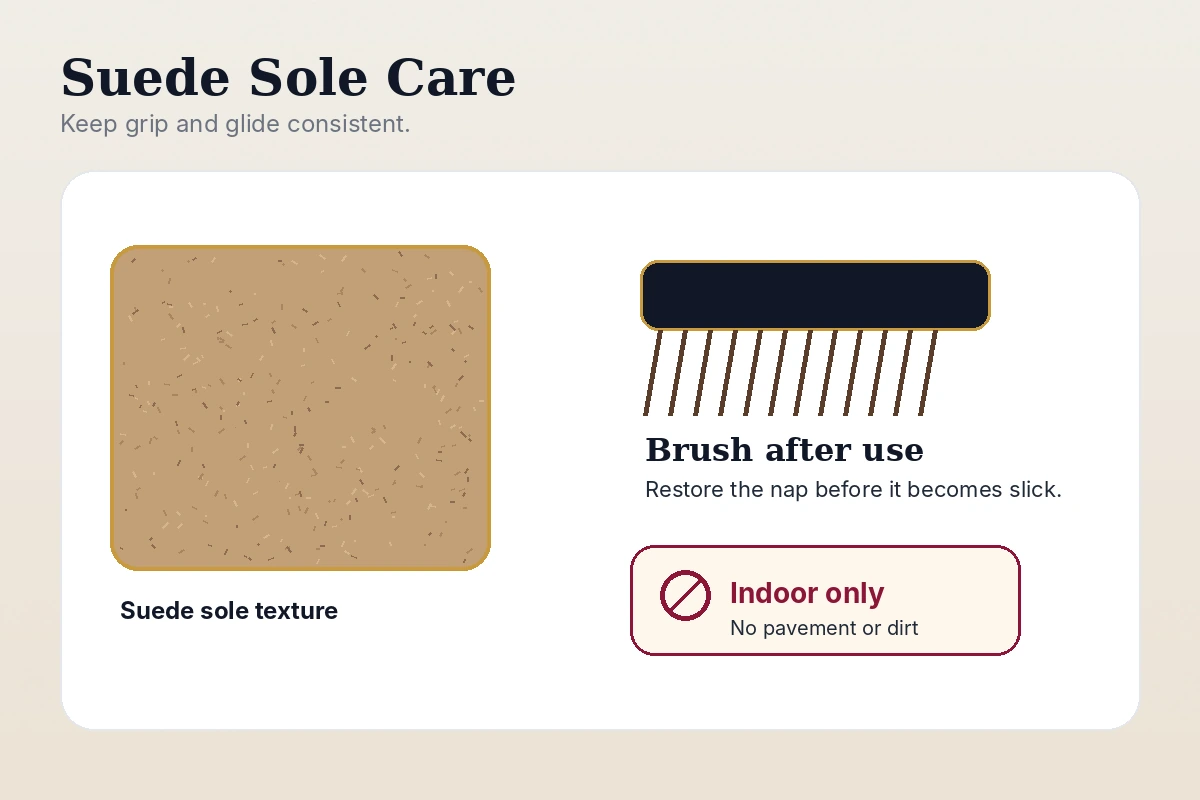
Keep them indoors
Suede soles are designed for dance floors, not sidewalks, parking lots, or outdoor patios.
Brush suede soles
A suede sole brush helps restore the nap of the sole so the shoe keeps the right balance of grip and glide.
Store them properly
Use a shoe bag. Let damp shoes air dry naturally before storing. Do not use direct heat.
Watch heel tips and uneven wear
If heel tips, soles, or stitching are worn, ask a shoe repair professional or dance shoe retailer whether they can be repaired.
Stop using unstable shoes
If a shoe has stretched out, become uneven, or no longer supports your foot, it may be time to replace it.
Practice with Ballroom Pages music after you choose your shoes
Once your shoes let you turn and move more comfortably, practice with music that helps you hear timing clearly. Start with clear, steady music before practicing faster or more dramatic songs—shoes help your body move, and music helps your timing make sense. Browse everything in the Ballroom Pages playlists hub.
Practice playlists by dance family
Ballroom / Standard
Waltz, Tango, Foxtrot, Viennese Waltz, Quickstep.
American Smooth
Waltz, Tango, Foxtrot, Viennese Waltz.
American Rhythm
Cha Cha, Rumba, Swing, Bolero, Mambo.
Latin
Cha Cha, Samba, Rumba, Paso Doble, Jive.
Social extras
Salsa, Bachata, Swing where relevant.
More resources
Per-dance count, tempo & verified playlists.
Practice with the Ballroom Pages Music & Timing playlists, and learn how to count ballroom dance music.
Common buying mistakes
- Buying the prettiest pair first.
- Choosing heel height before comfort.
- Ignoring the return policy.
- Wearing suede soles outdoors.
- Buying shoes that slip at the heel.
- Choosing by street size without checking brand sizing.
- Assuming Latin, ballroom, practice, and social shoes are interchangeable.
- Waiting until competition week or wedding week to test new shoes.
- Practicing on carpet with shoes meant for smooth studio floors.
- Buying without asking your teacher what style you are actually learning.